-
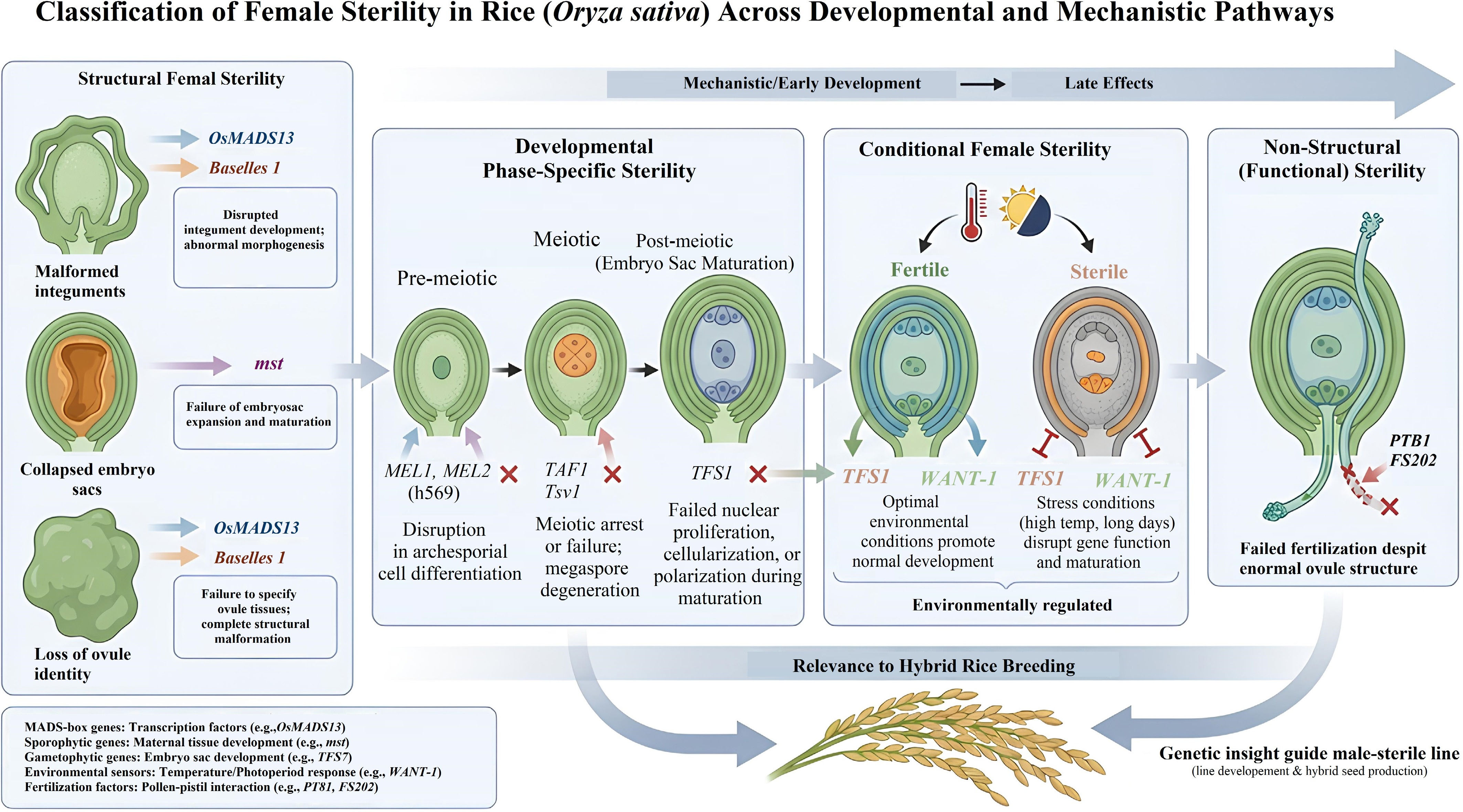
Figure 1.
Classification of female sterility based on the nature of reproductive defects. Female sterility is categorized into structural, conditional, and nonstructural types, reflecting distinct biological mechanisms affecting ovule development and fertilization.
-
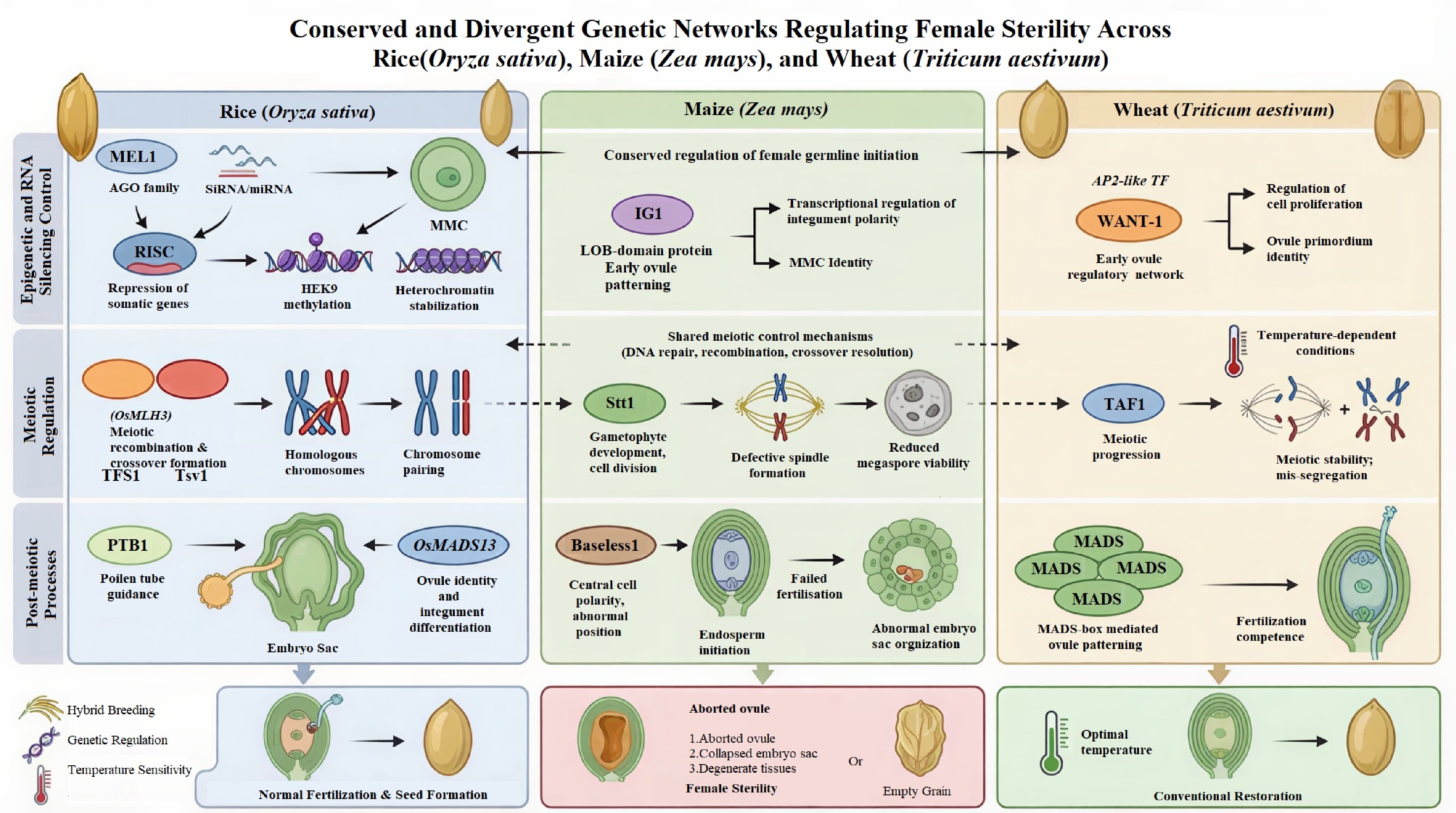
Figure 2.
Overview of the regulatory pathways governing female sterility in crop plants. The diagram integrates genetic, hormonal, and small RNA-mediated pathways that control ovule development, gametophyte formation, and fertilization processes. Disruptions in these interconnected pathways lead to diverse female-sterile phenotypes across rice, maize, and wheat.
-
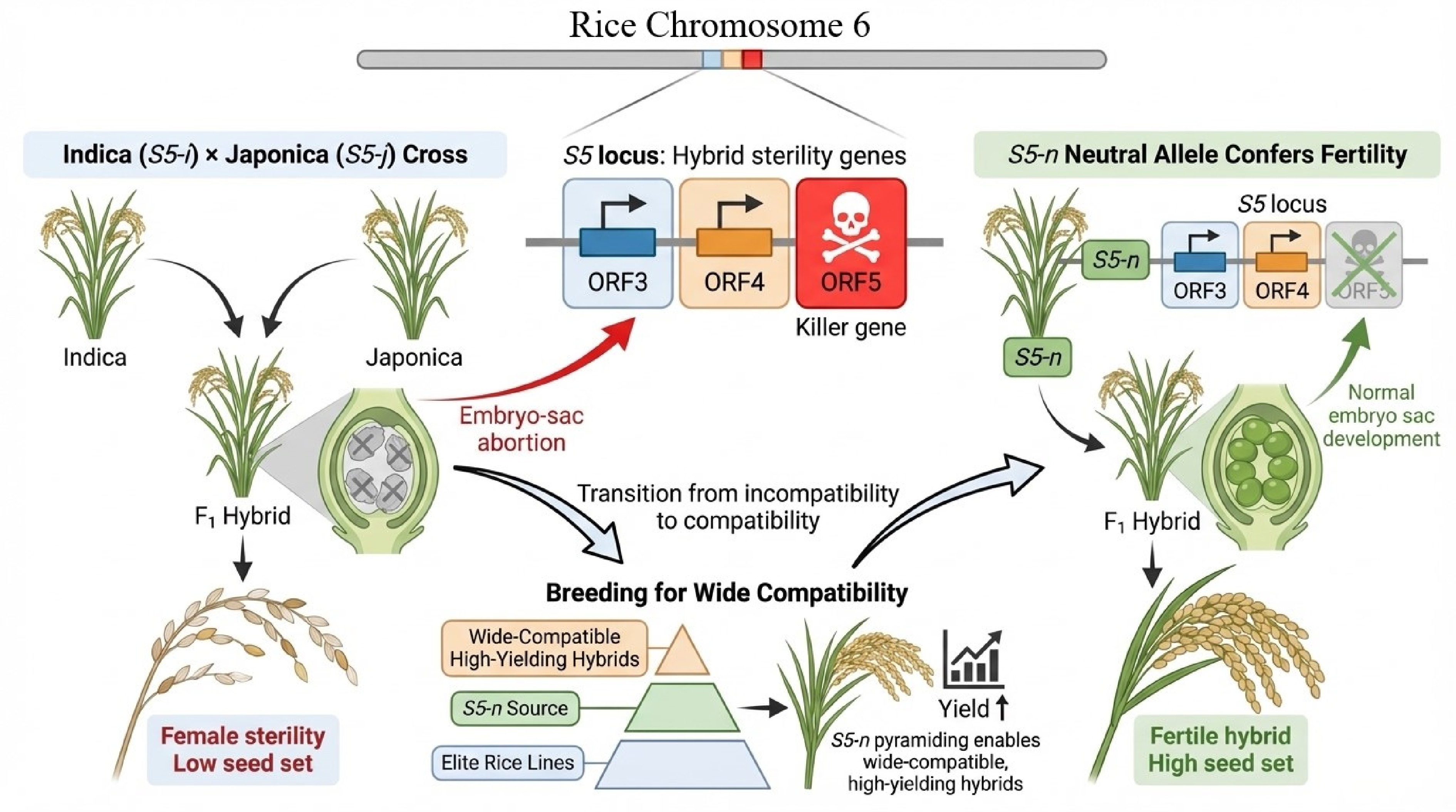
Figure 3.
Functional role of the S5 female-sterile gene in developing hybrid seed production and enhancing yield potential. The S5-n allele acts as a compatibility factor that prevents embryo sac abortion in indica–japonica hybrids, thereby restoring fertility.
-
Developmental stage A. thaliana (model dicot) Rice (O. sativa L.) Maize (Z. mays L.) Key biological insight Megaspore mother cell (MMC) specification Sporocyteless/nozzle (SPL/NZZ) regulates germline specification and restricts MMC formation[29] MEL1 regulates germline identity and small RNA-mediated silencing[30] IG1 controls female germline proliferation and embryo sac development[32] Germline specification is conserved but regulated by different gene families in dicots and monocots Meiosis during megasporogenesis DMC1 and other meiotic recombination proteins regulate chromosome pairing and recombination[33] MEL2 regulates meiotic entry and germ cell cycle progression[31] MLH3 homologs regulate crossover formation during meiosis[34] Meiotic regulation is highly conserved across species Female gametophyte development Fertilization-independent seed (FIS) complex regulates embryo sac development and fertilization competence[35] AGO7 pathway regulates tasiRNA production, affecting embryo sac development[27] STS1 influences embryo sac maturation and floral organ specification[36,37] Small RNA pathways and transcription factors regulate embryo sac development Ovule and integument development AINTEGUMENTA (ANT) controls ovule growth and integument formation[38] OsMADS13 regulates ovule identity and female fertility[39,40] SK1 regulates pistil development and prevents pistil abortion[41] Ovule morphogenesis involves conserved transcriptional regulators Fertilization and seed formation Central cell and endosperm development are controlled by epigenetic regulators[42] PTB1 regulates pollen tube guidance and seed-setting rate[43] BSL1 influences central cell polarity and endosperm development[44] Fertilization success depends on coordinated gametophyte and saprophytic interactions Table 1.
Comparative regulatory mechanisms controlling female reproductive development in model and crop plants.
-
Gene ID and Ref. Phenotype(s) in reproductive organs Spp. Applications Notes Taf1 (wheat)[55] No seed-setting on spike; female sterility Wheat Used as a pollinator/FS line in wheat hybridization Located on chr 2DS in XND126; interacts with mre11 in A. thaliana Tfs1/AGO7 (rice)[27] Female sterility at ~22 °C; blocked pollen tubes; reduced seed-setting; restored at higher temperatures Rice Conditional FS system for hybrid rice breeding Thermosensitive allele in cultivar 4266; useful as a restorer/maintainer line FS202 (rice)[19] Low seed-setting; abnormal embryo sac; failed double fertilization Rice Research/functional genetics Spontaneous mutant in the restorer line 202 H569/MEL2 (Os12g38460) (rice)[31] Female sterility, absence of embryo sacs, no seed-setting; male fertility normal Rice Hybrid rice female-sterile systems/breeding Mutation A1106G; blocks female meiosis, but male meiosis is unaffected PTB1 (LOC_Os05g05280) (rice)[43] Female sterility caused by blocked pollen tube growth; low seed-setting Rice Hybrid seed production; maintainer system (e.g. M-fs4A) Maternal control of pollen tube growth; used in transgenic systems Stt1 (Stunter1) (maize)[58] Smaller embryo sacs; abnormal antipodal/synergids; reduced seed-setting (> 50% embryo sacs fail) Maize Research/functional genetics Spontaneous inbred W23 mutation; mapping populations available Baseless1 (Bsl1) (maize)[44] Abnormal seed-setting; displaced central cell polar nuclei; sometimes in fertilization Maize Research/functional genetics Found in W22; impacts BETL and BETL factors Fsv1 (rice)[27] Ovule degeneration; aborted female gametophytes; small/degenerate ovules Rice Research/functional genetics; insights into auxin involvement Differential up-/downregulation of multiple transcription factors and auxin genes (OsTAA1, OsIAA2, OsARF6, OsPIN1a) M-fs4A (transgenic rice system)[65] Female-sterile seeds in M-fs4A lines; stable 1:1 propagation Rice Commercial hybrid seed production (maintainer system) Described as the M-fs4A/M-fs4B system Glumy (maize)[66] Glume-like ear florets; sterile organs; disturbed floral development Maize Research/inflorescence development Spontaneous mutant Table 2.
Representative female-sterile (FS) genes identified in major crop species and their roles in reproductive development and hybrid breeding.
Figures
(3)
Tables
(2)