-
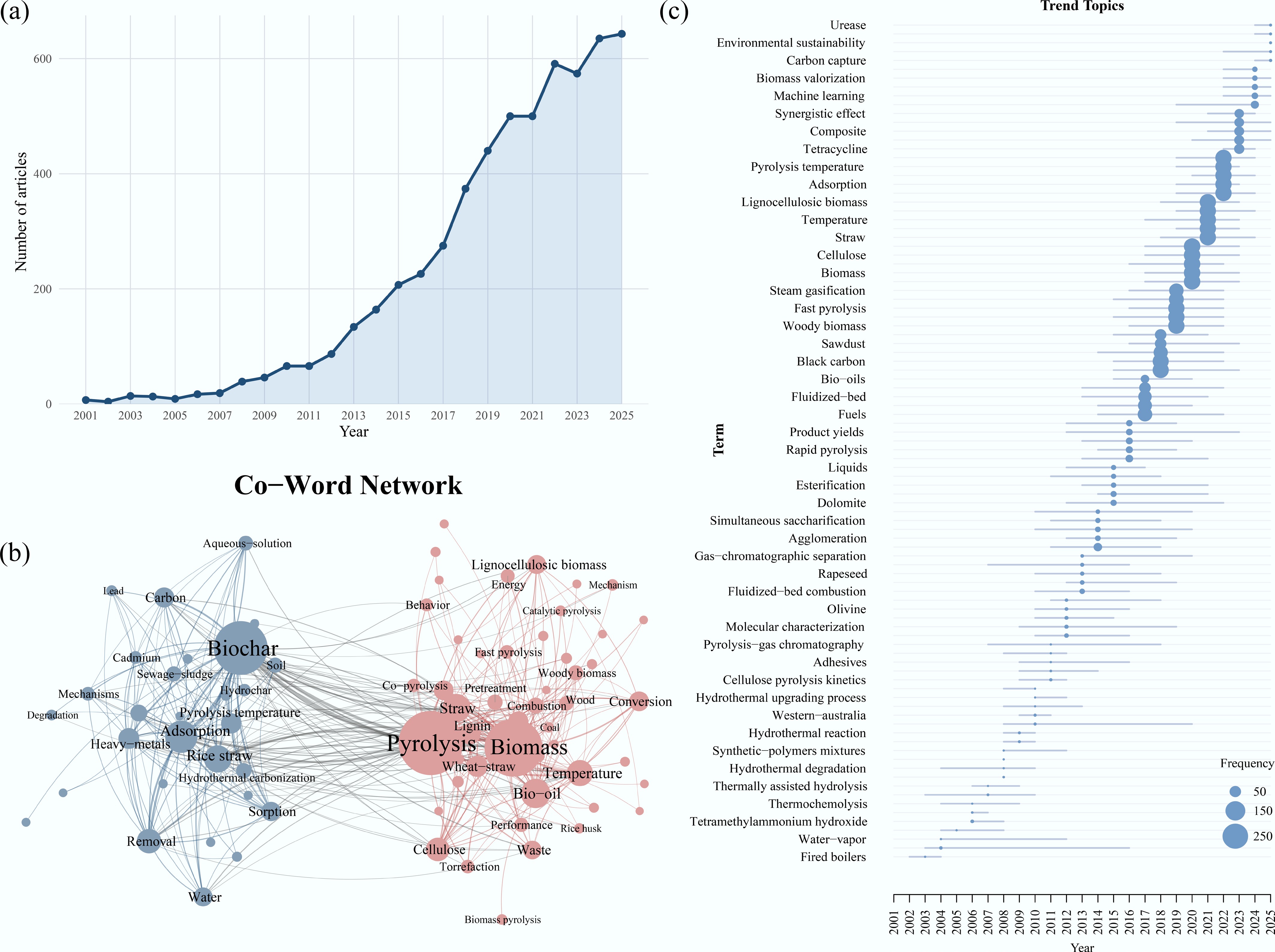
Figure 1.
Bibliometric overview of research on slow pyrolysis and product utilization of HM-contaminated biomass during 2001−2025. (a) Annual scientific production; (b) co-word network showing the main conceptual structure of the field; (c) evolutionary trend of the topic, highlighting recent and emerging themes.
-
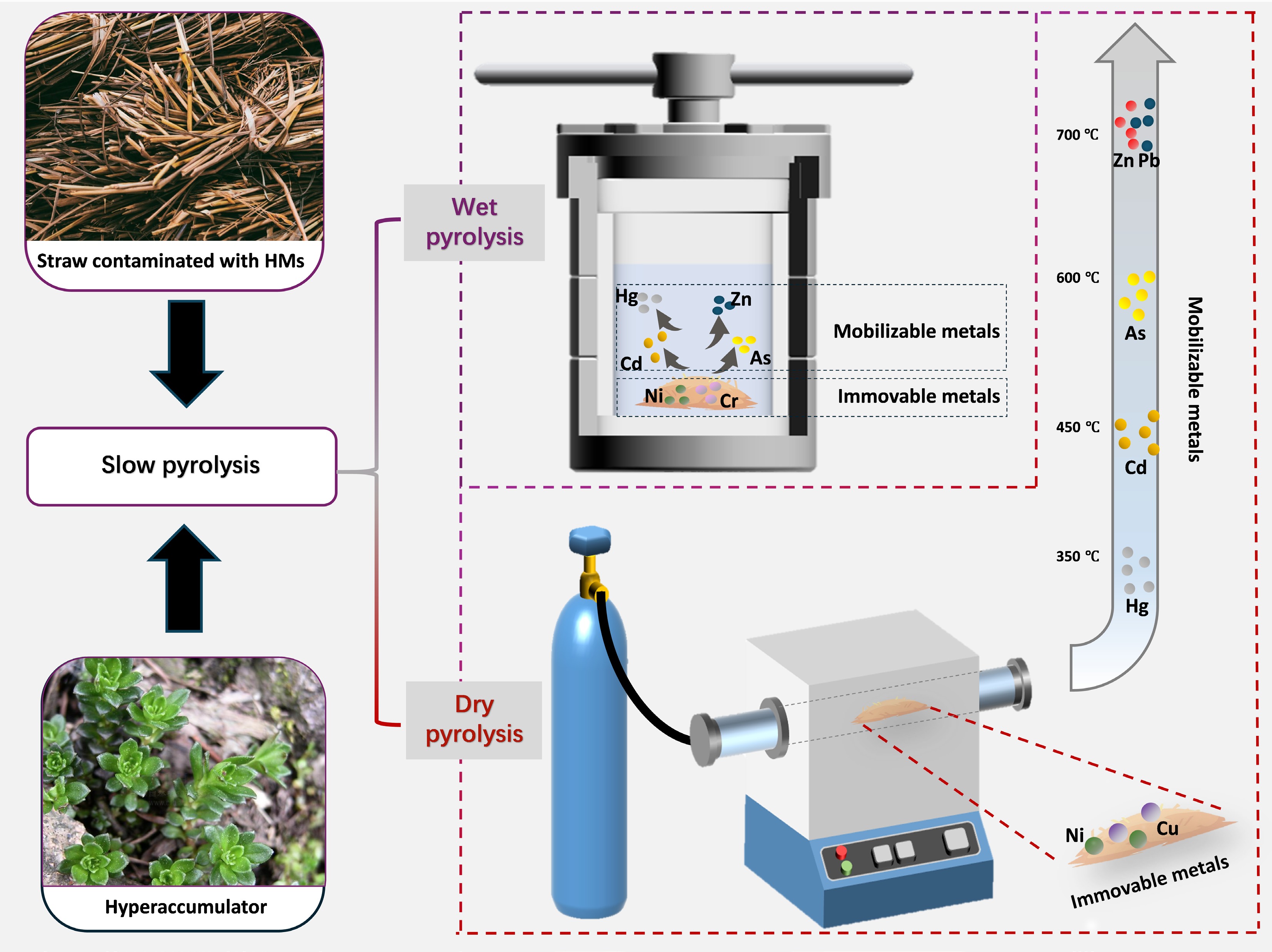
Figure 2.
The migration characteristics of HMs treated by slow pyrolysis.
-
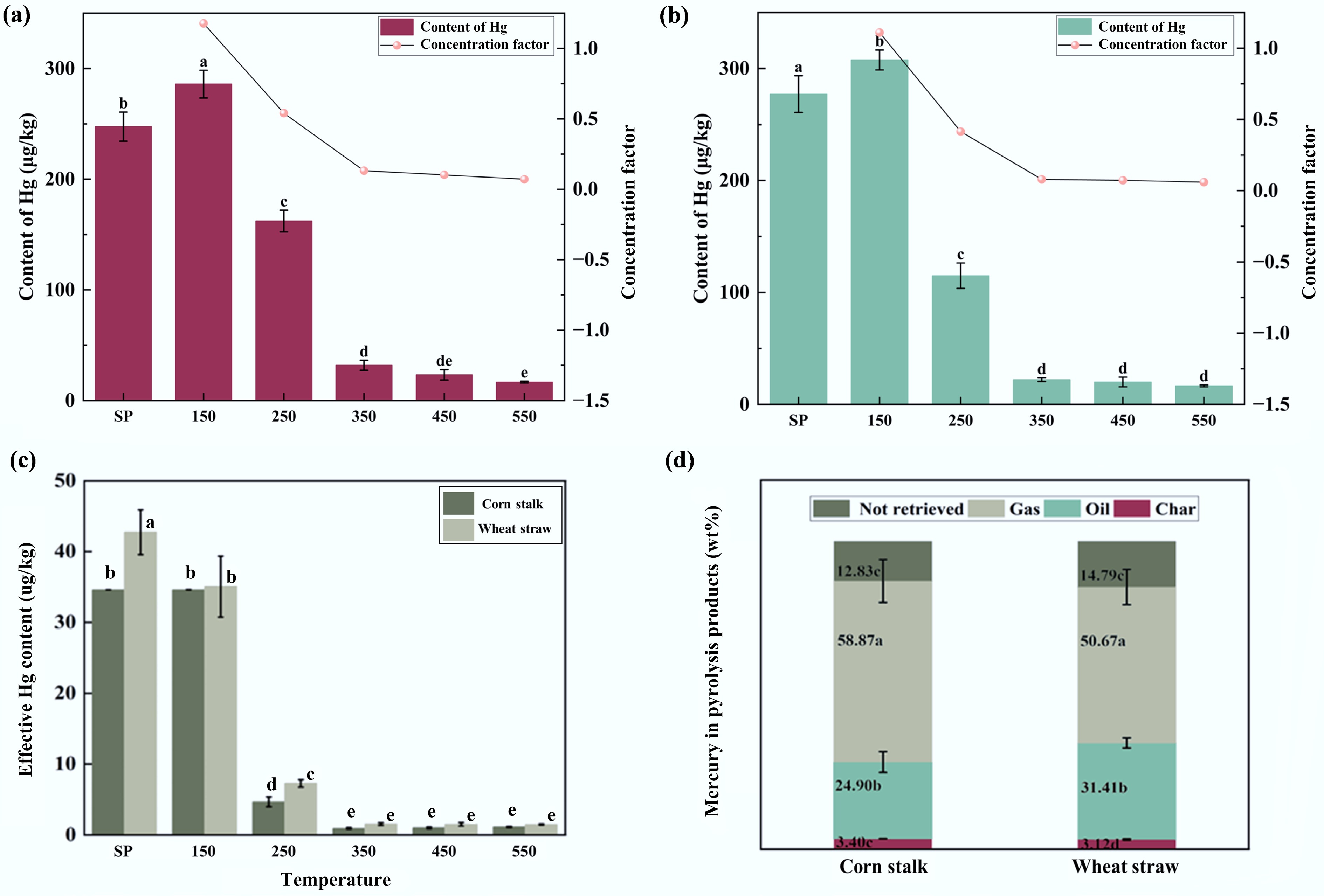
Figure 3.
The migration characteristics of Hg during slow pyrolysis. (a) The content and concentration factor of Hg in corn stalk biochar. (b) The content and concentration factor of Hg in wheat straw biochar. (c) The effective Hg content in biochar. (d) The distribution of Hg in the three phases.
-
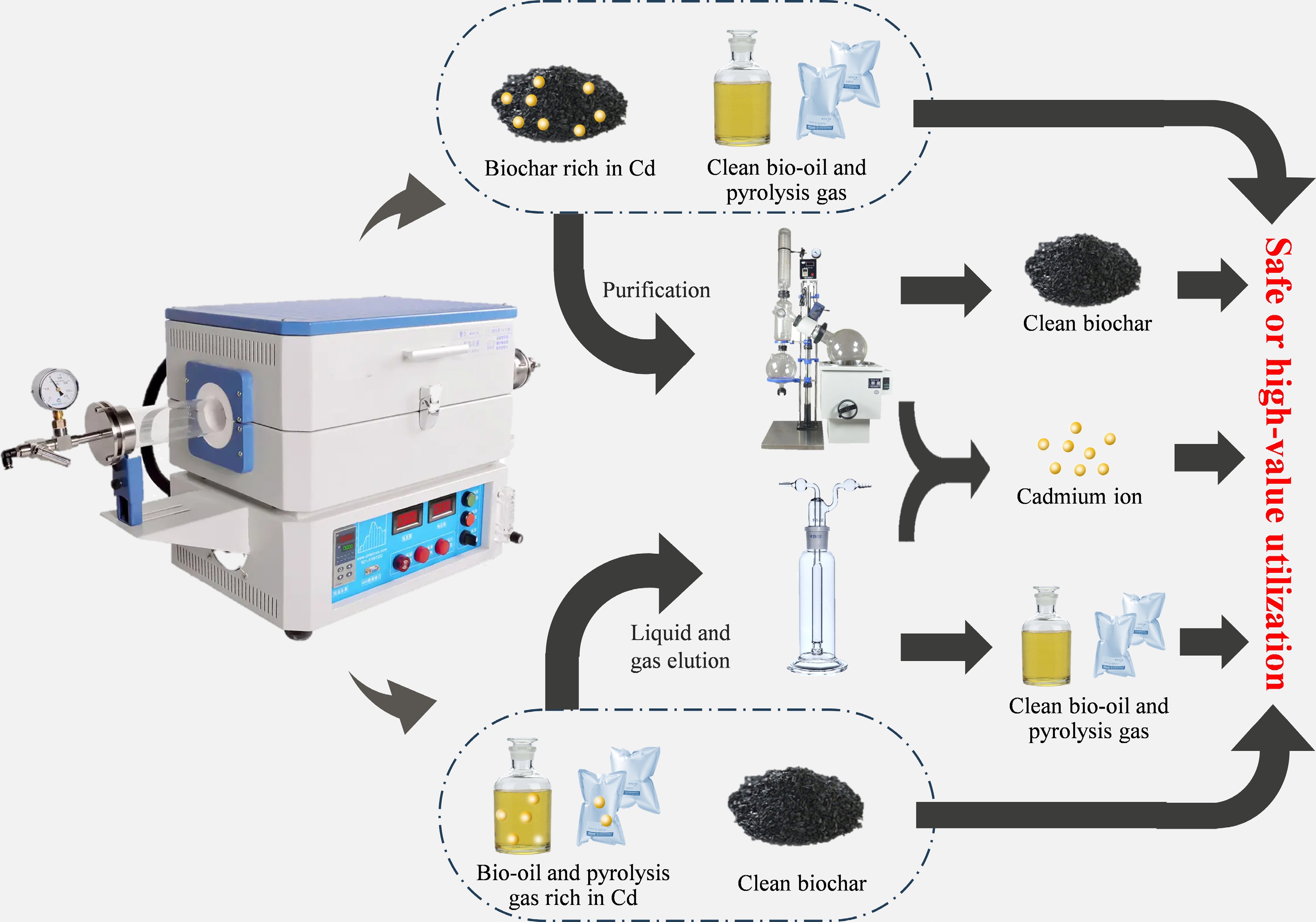
Figure 4.
Two technological routes for the slow pyrolysis of plants contaminated by Cd.
-
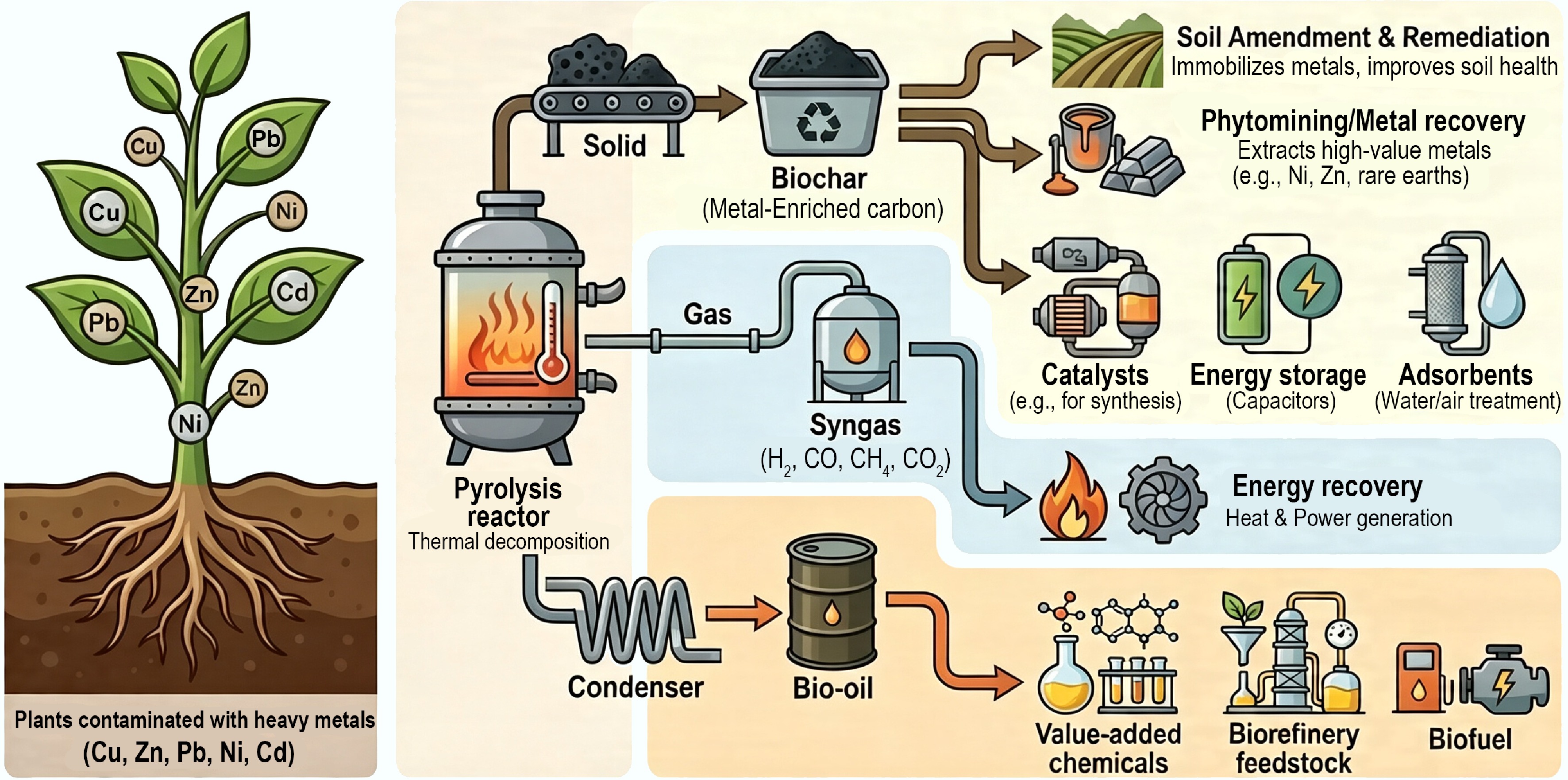
Figure 5.
Applications of slow pyrolysis products from HM-contaminated biomass.
-
Metal Before pyrolysis After pyrolysis Transformation characteristics or key influencing elements Ref. Hg Organic-bound fraction The vast majority volatilizes into the gas phase as elemental Hg, whereas in the solid phase, Hg mainly occurs in F4 form and may exist as HgS S promotes fixation → HgS [57] Cd Mainly F1 and F2 fractions In the solid products, Cd mainly occurs in the F3 and F4 fractions, and may exist as stable CdSiO3 and Cd3(PO4)2 species Cl promotes volatilization→ CdCl2S promotes fixation→ CdSP promotes fixation → Cd3(PO4)2 [58−60] Pb Mainly F1 and F2 fractions In the solid products, Pb mainly occurs in F3 (oxidizable) and F4 (residual) fractions. Pb bound to Fe/Mn oxides may be released at high temperatures through mineral phase reorganization and then transformed into F3 or F4 P promotes fixation → Pb5(PO4)3Cl/ Si promotes fixation → PbSiO3 [41,61] Ni Mainly F1 and F2 fractions, or mainly exchangeable, organic-bound, and carbonate-bound fractions Mainly occurs in the F3 and F4 fractions. Nickel tends to react with mineral components in biomass ash, such as SiO2 and CaO, forming more thermodynamically stable nickel silicates (e.g., Ni2SiO4) or perovskite-like minerals Si and Ca promote fixation → Ni2SiO4, et al. [62,63] As Mainly present as oxyanions (AsO43−, AsO33−), predominantly in organic-bound form In the solid phase, As mainly occurs in F4 form. Under the reducing atmosphere of pyrolysis, As(V) may be reduced to As(III) and form As2O3; it may even be further reduced to elemental As or As2S3 in sulfur-rich systems Fe and S promote fixation → FeAsS, As2S3, or FeAsO4 [64,65] Cr Mainly exchangeable, organic-bound, and carbonate-bound fractions At high temperatures, Cr(VI)can be effectively reduced to Cr(III) by biomass pyrolysis products such as carbon, H2S, H2, and CO. Cr(III) can further form stable mineral phases with Si, Al, Fe, and P in biomass Cr(III) is relatively harmless and less mobile, whereas Cr(VI) is highly toxic and mobile.
It can form stable mineral phases with Si, Fe, and P → Cr-Si-O complexes or spinel structures such as CrFe2O4 and CrPO4[66,67] In the BCR sequential extraction method, F1 is the acid-extractable fraction, F2 is the reducible fraction, F3 is the oxidizable fraction, and F4 is the residual fraction. In TCLP-based environmental risk assessments, the fractions include exchangeable, carbonate-bound, Fe/Mn oxide-bound, organic-bound, sulfide-bound, and residual forms. Table 1.
Comparative summary of HMs' behavior during dry pyrolysis of contaminated biomass
Figures
(5)
Tables
(1)