-
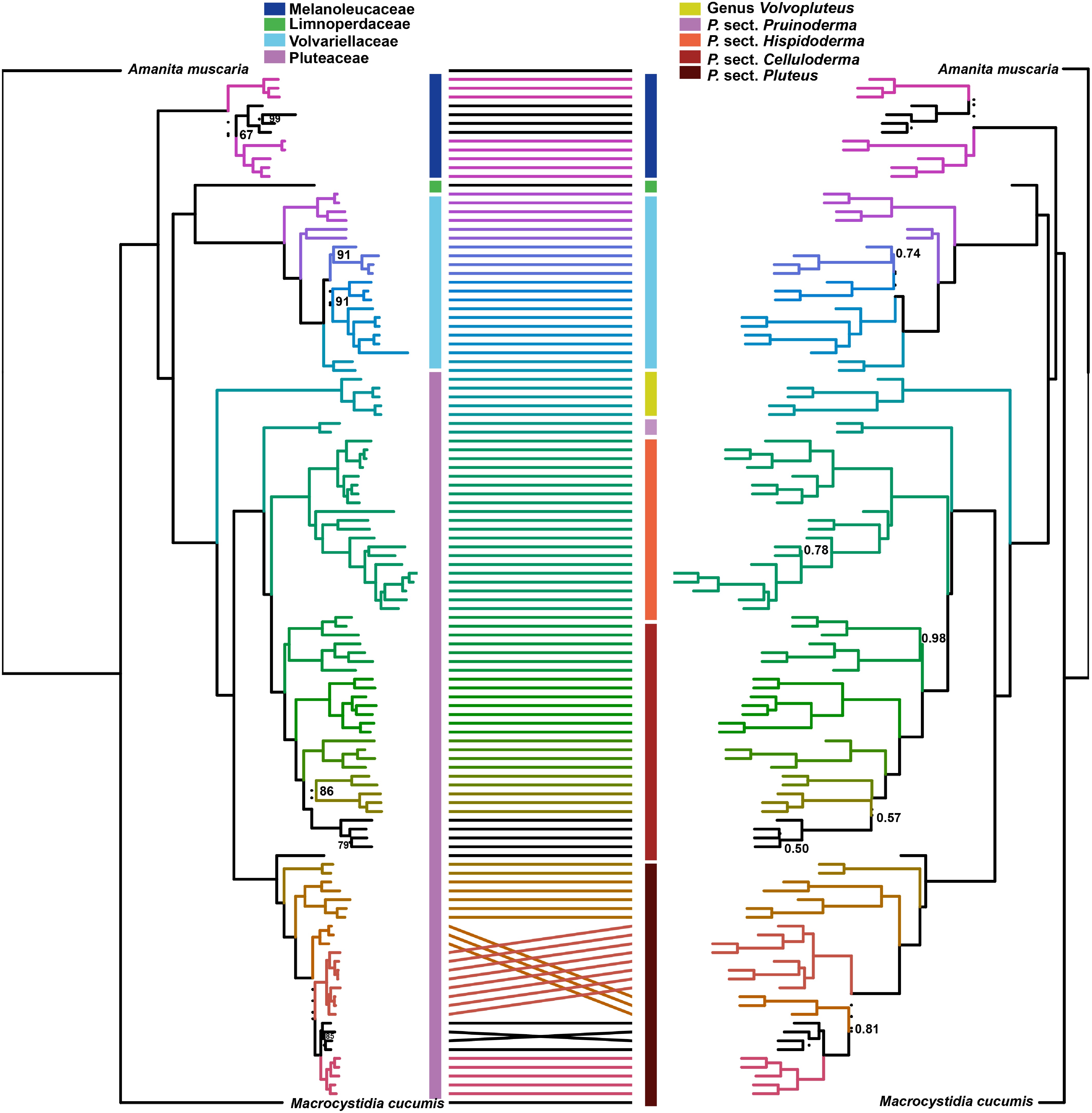
Figure 1.
Comparison of the concatenated tree (left) and the coalescent tree (right) of the Pluteineae based on the 672 single-copy orthologs. Ultrafast bootstrap (UFBS) and local posterior probability (LPP) values are presented with nodes. Nodes without values indicate 100% support (UFBS = 100, LPP = 1.00).
-
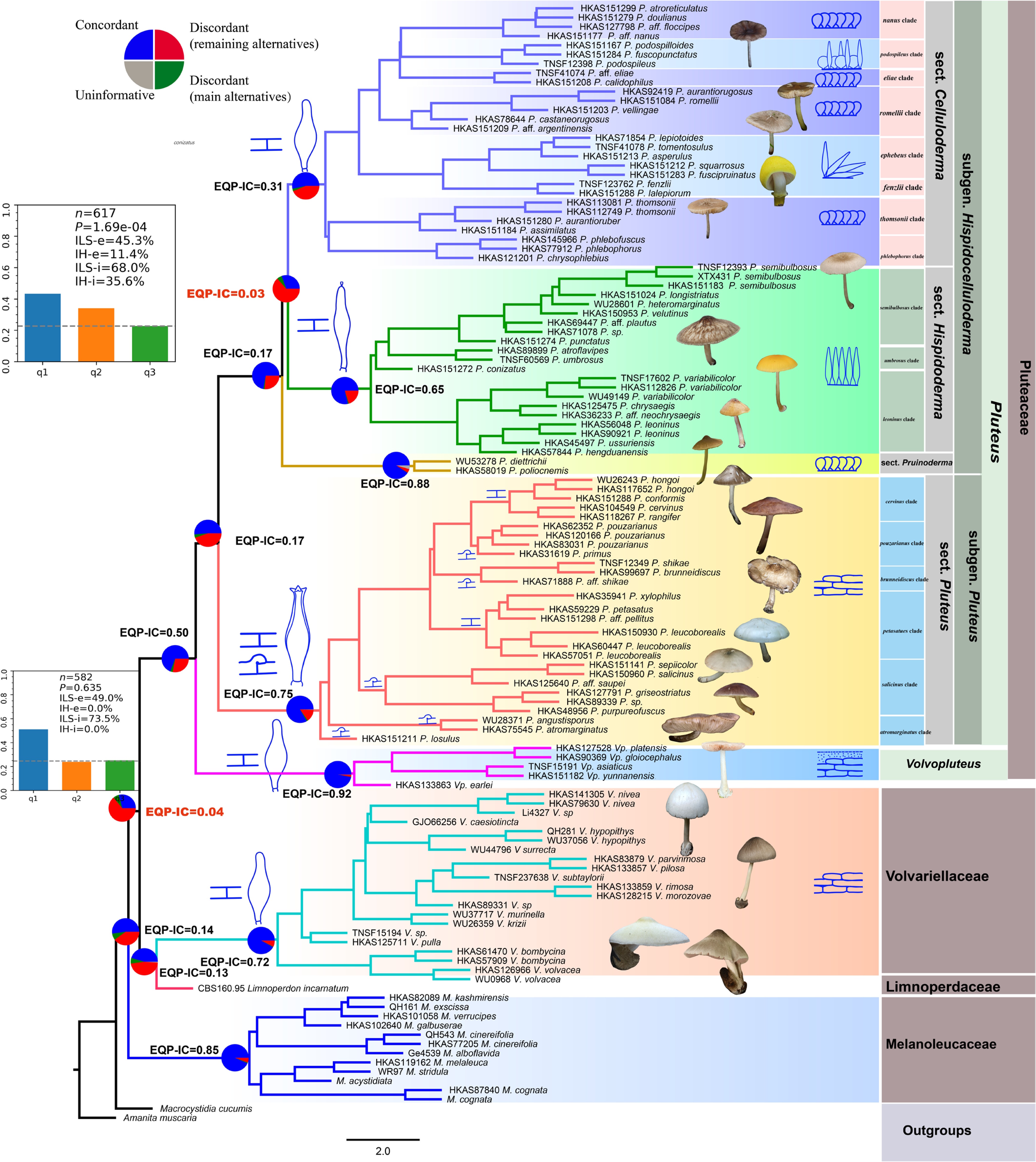
Figure 2.
Species tree topology of Pluteineae based on the 672 single-copy orthologs inferred by ASTRAL, with patterns of gene-tree concordance and conflict based on the PhyParts analysis and QuartetScores. The pie charts at the main clades show the proportion of genes that are in concordance (blue), in conflict (green for the most frequent alternative topology; red for remaining alternatives), or without enough information (gray). Macromorphology in different lineages is shown by images of basidiomes. Possible microscopic synapomorphies are illustrated with blue line drawings.
-
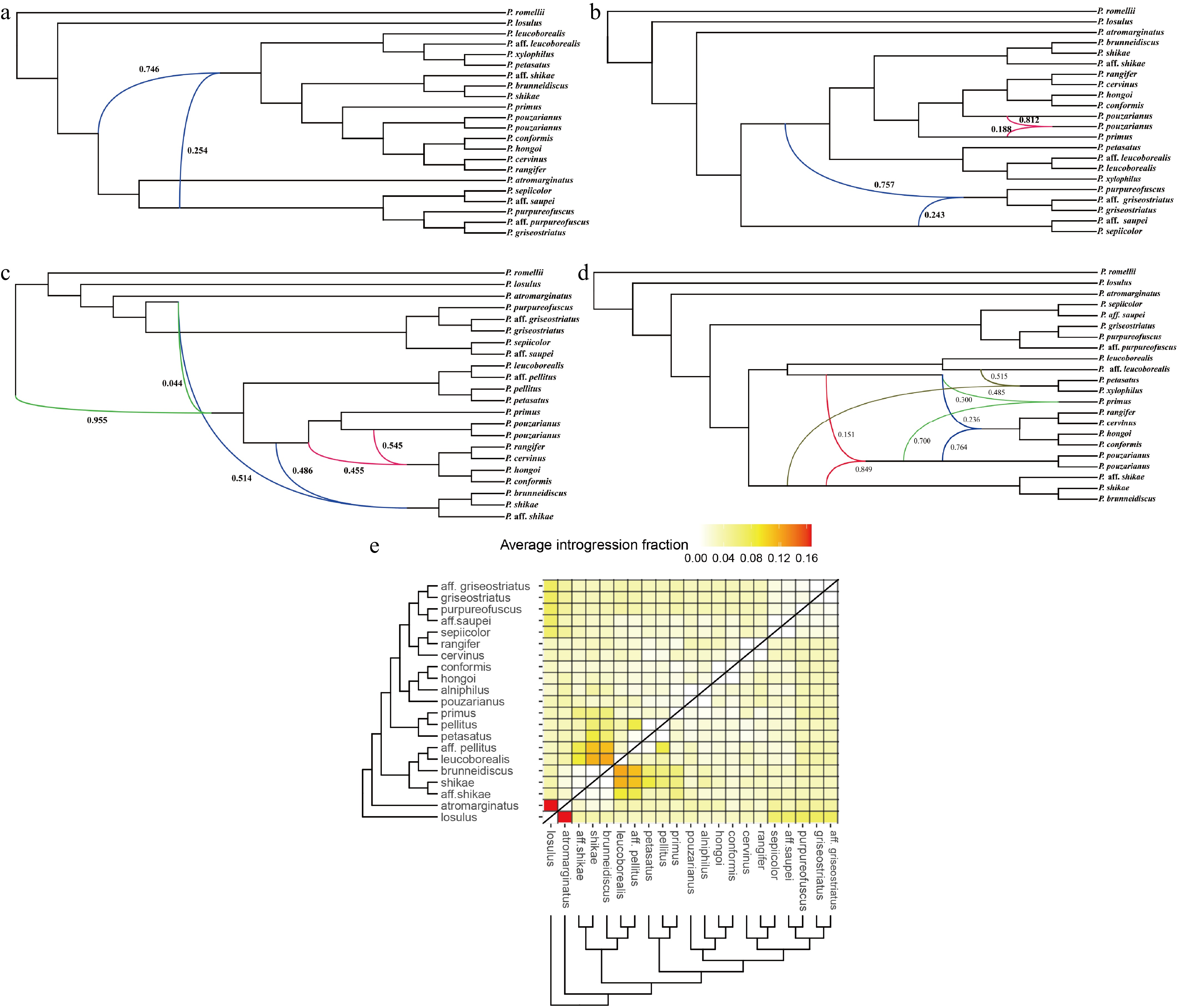
Figure 3.
The species network inference of sect. Pluteus estimated by the PhyloNet. (a) Reticulation = 1. (b) Reticulation = 2. (c) Reticulation = 3. (d) Reticulation = 4. Numerical values indicate inheritance probabilities. (e) QuIBL identified IH events based on branch lengths in 221 gene trees with single individuals from each taxon.
-
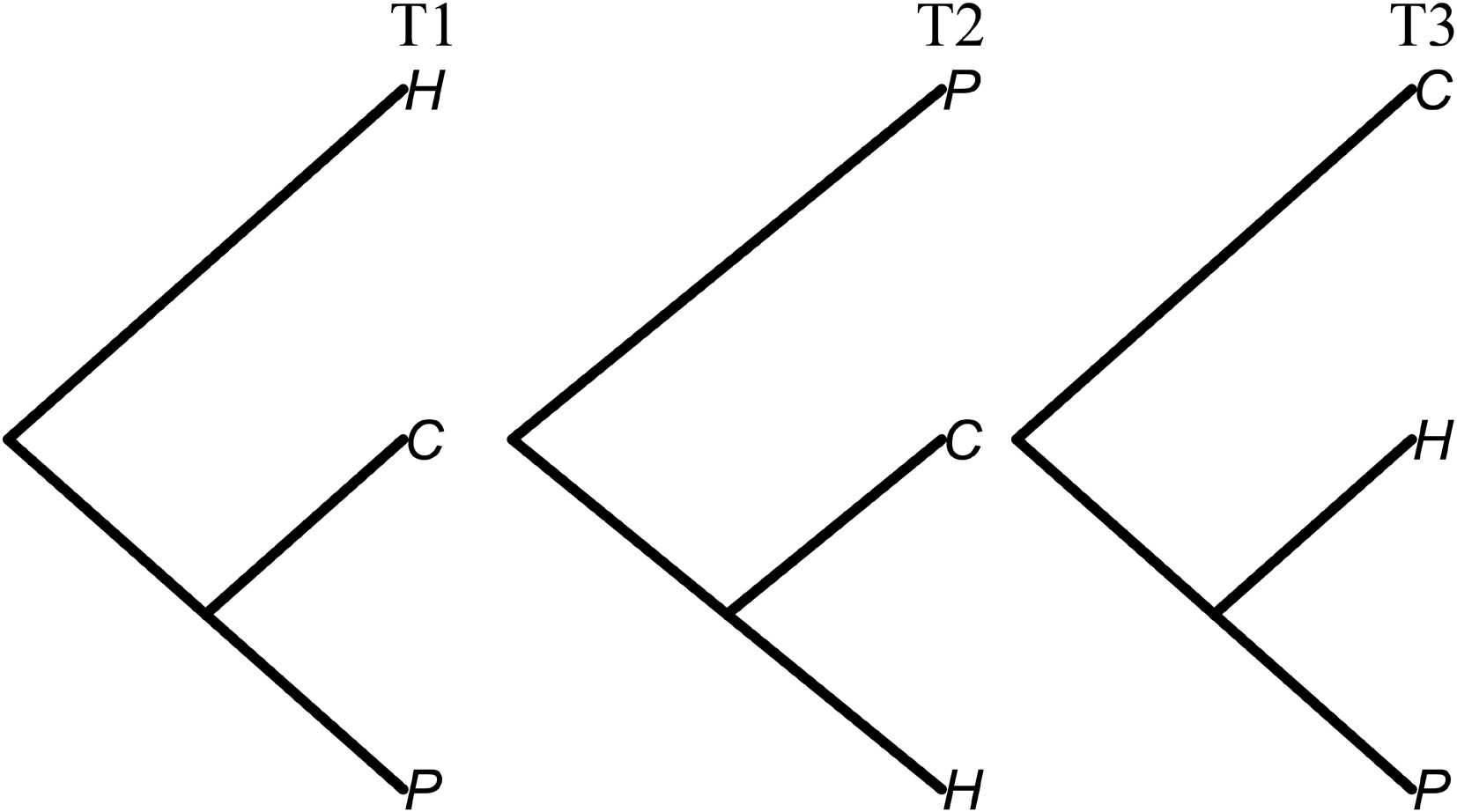
Figure 4.
Three alternative topologies of sect. Pruinoderma (P), sect. Hispidoderma (H), and sect. Celluloderma (C) within subgen. Hispidocelluloderma.
-
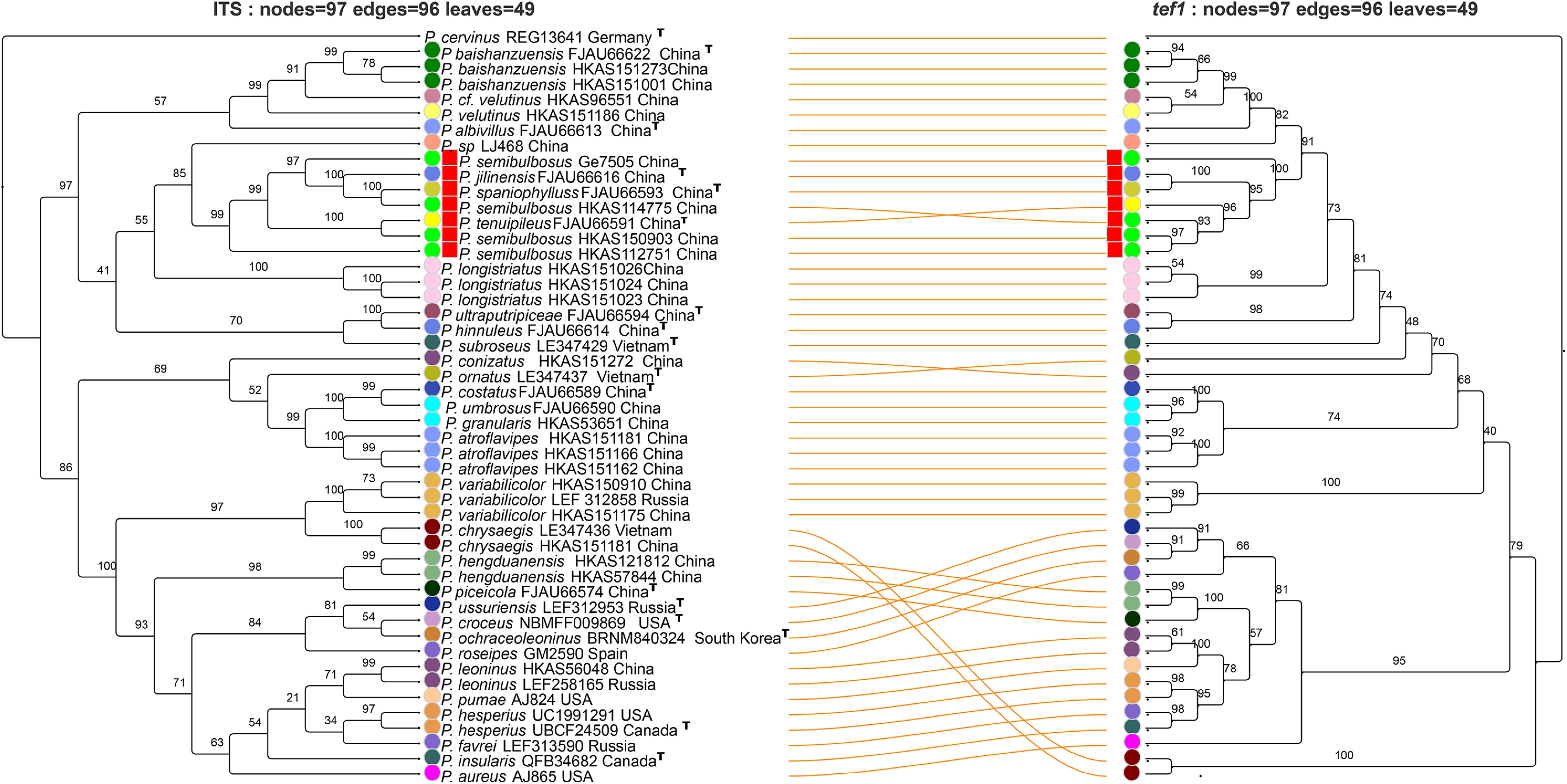
Figure 5.
Maximum likelihood tanglegram tree based on nrDNA ITS (left) and tef1 (right). Red squares indicate inconsistent sect. Hispidoderma species.
-
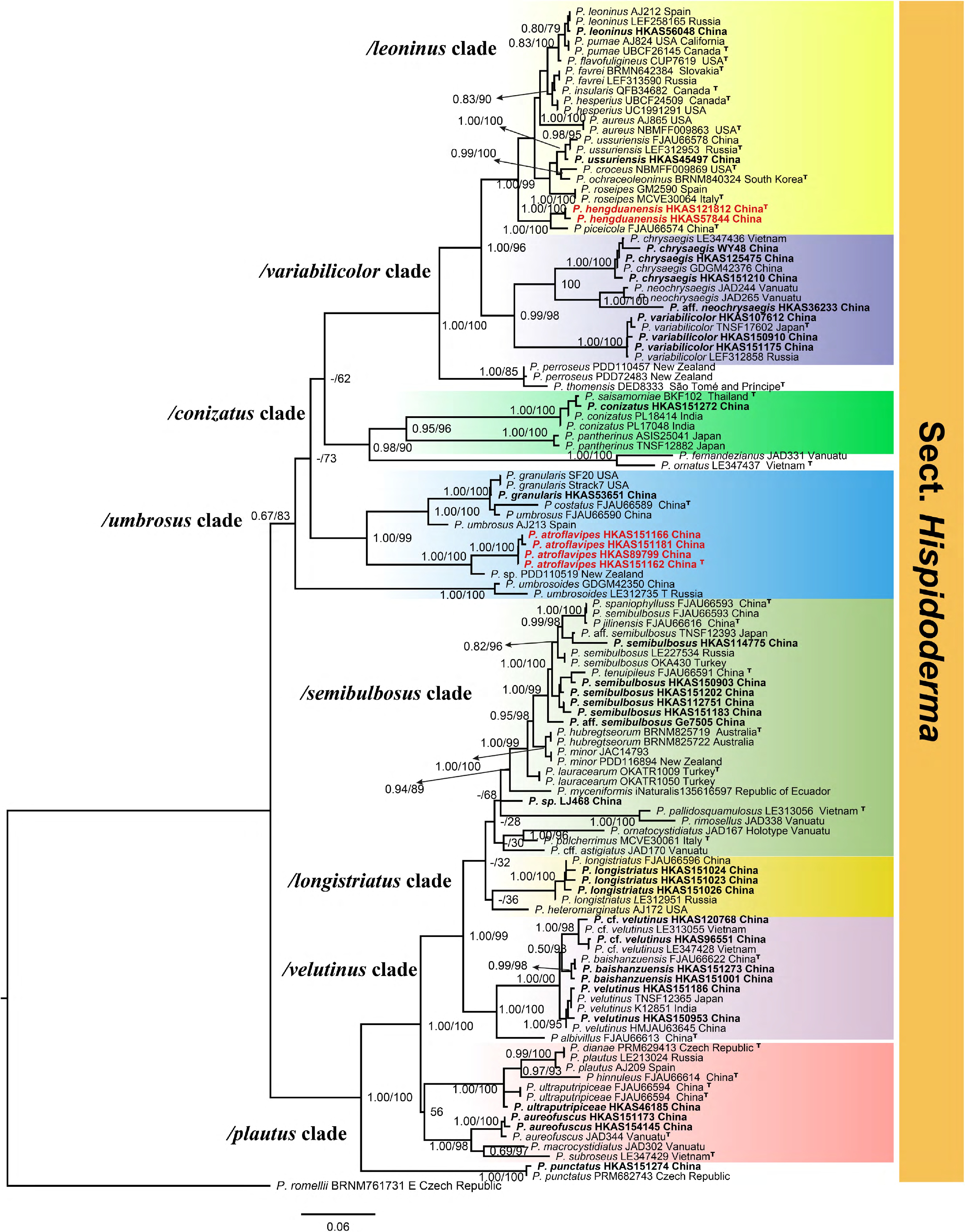
Figure 6.
The best tree from the ML analysis of Pluteus sect. Hispidoderma based on the combined data (ITS-tef1). Bayesian posterior probabilities (PP) and Bootstrap values (BS) are shown along the branches in the format PP/BS. The tree is rooted to P. romellii. Specimens examined in this study are in bold.
-
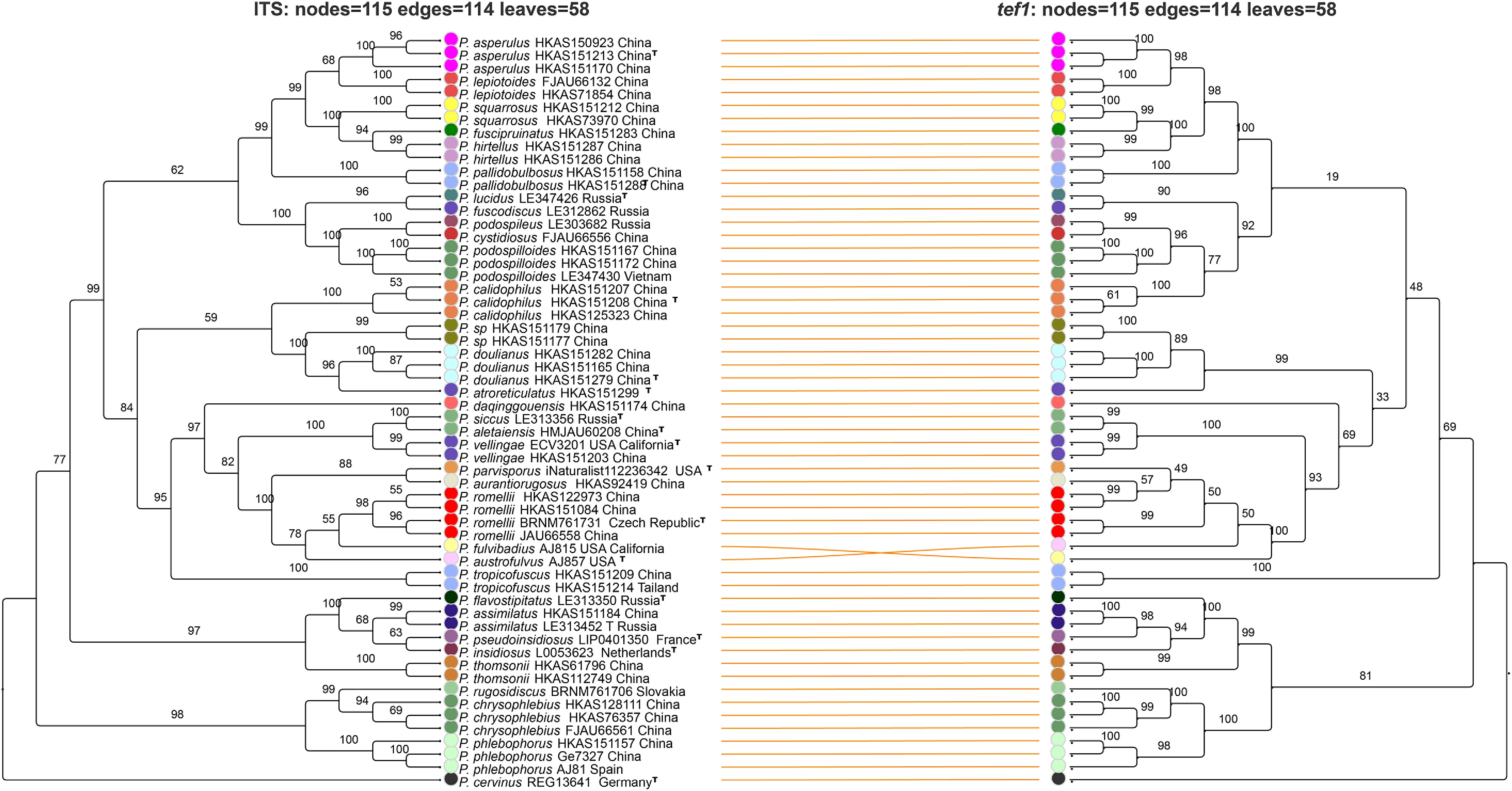
Figure 7.
Maximum likelihood tanglegram tree based on nrDNA ITS (left) and tef1 (right) of Pluteus sect. Celluloderma.
-
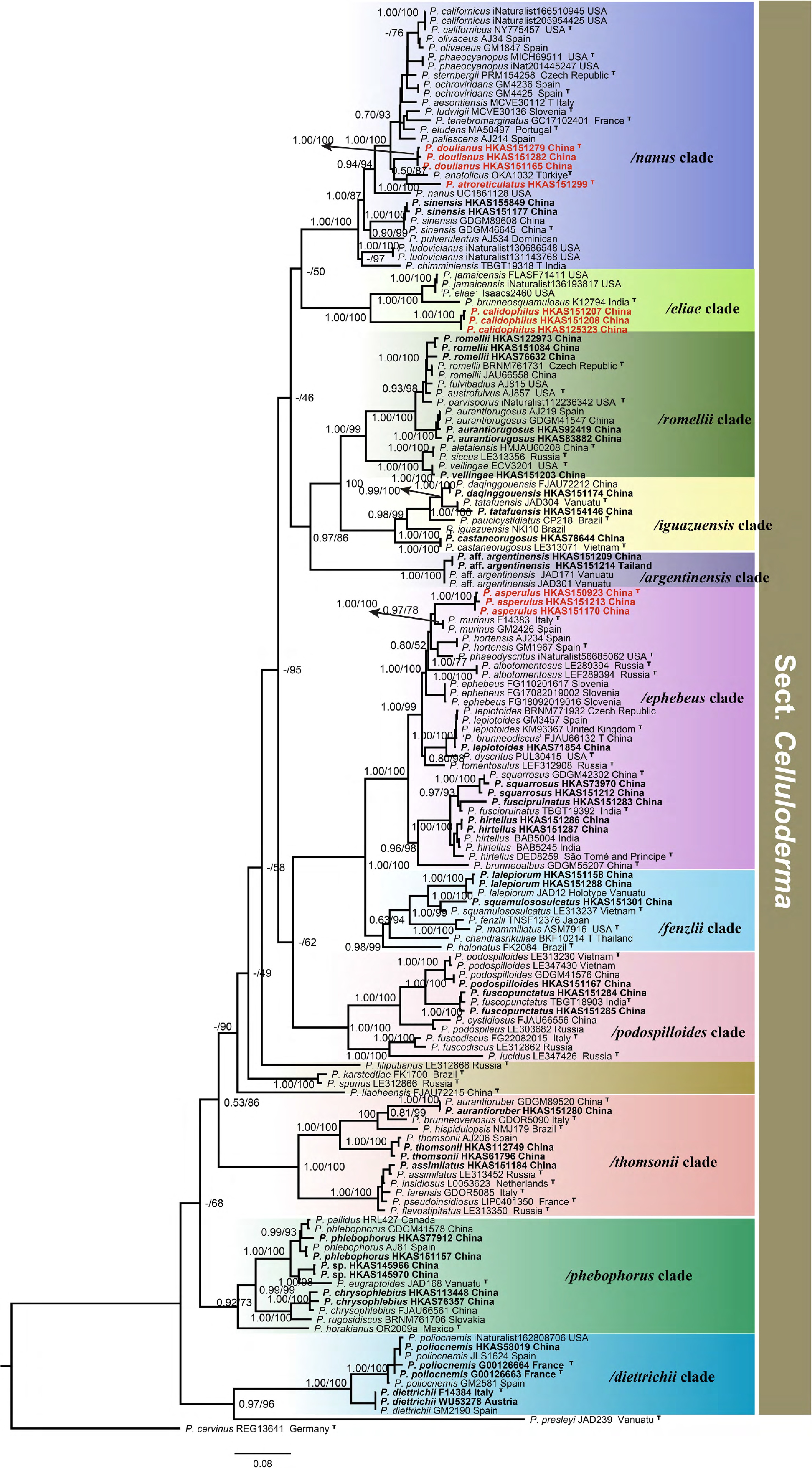
Figure 8.
The best tree from the ML analysis of Pluteus sect. Celluloderma based on the combined data (ITS-tef1). Bayesian posterior probabilities (PP) and Bootstrap values (BS) are shown along the branches in the format PP/BS. The tree is rooted to P. cervinus. Specimens examined in this study are in bold.
-
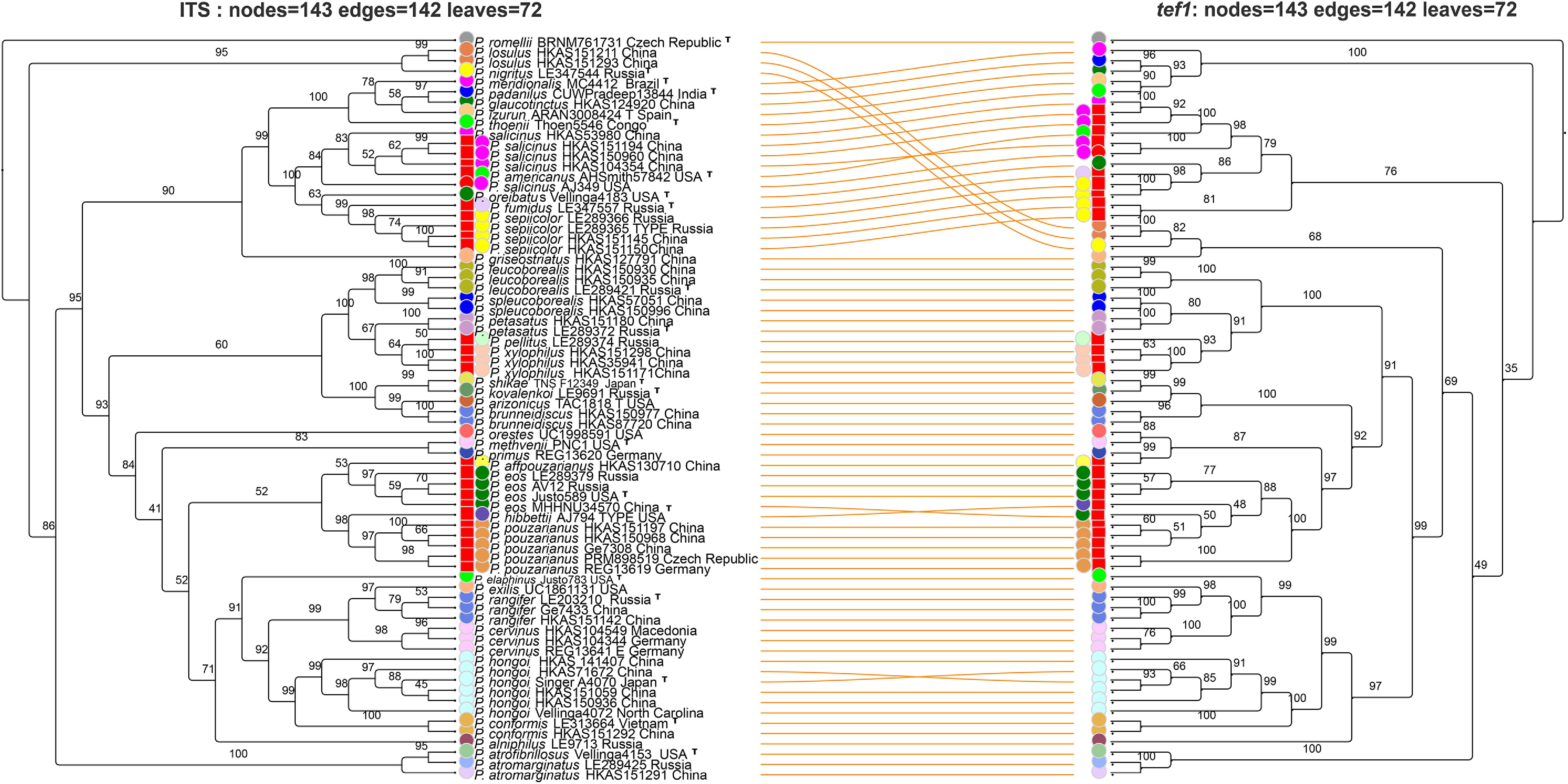
Figure 9.
Maximum likelihood tanglegram tree based on nrDNA ITS (left) and tef1 (right) of Pluteus sect. Pluteus. Red squares indicate inconsistent sect. Pluteus species.
-
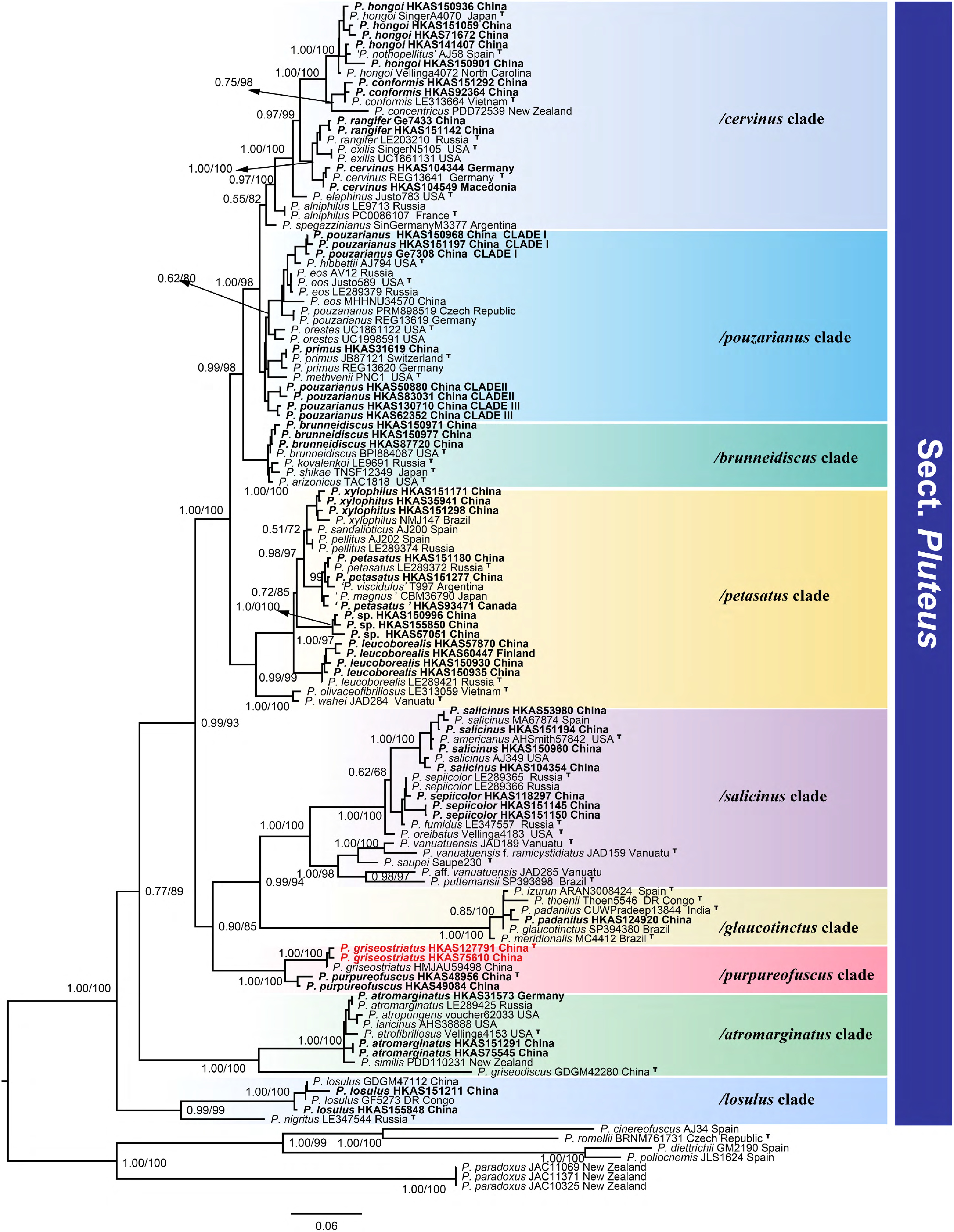
Figure 10.
The best tree from the ML analysis of Pluteus sect. Pluteus based on the combined data (ITS-tef1). Bayesian posterior probabilities (PP) and Bootstrap values (BS) are shown along the branches in the format PP/BS. Specimens examined in this study are in bold.
-
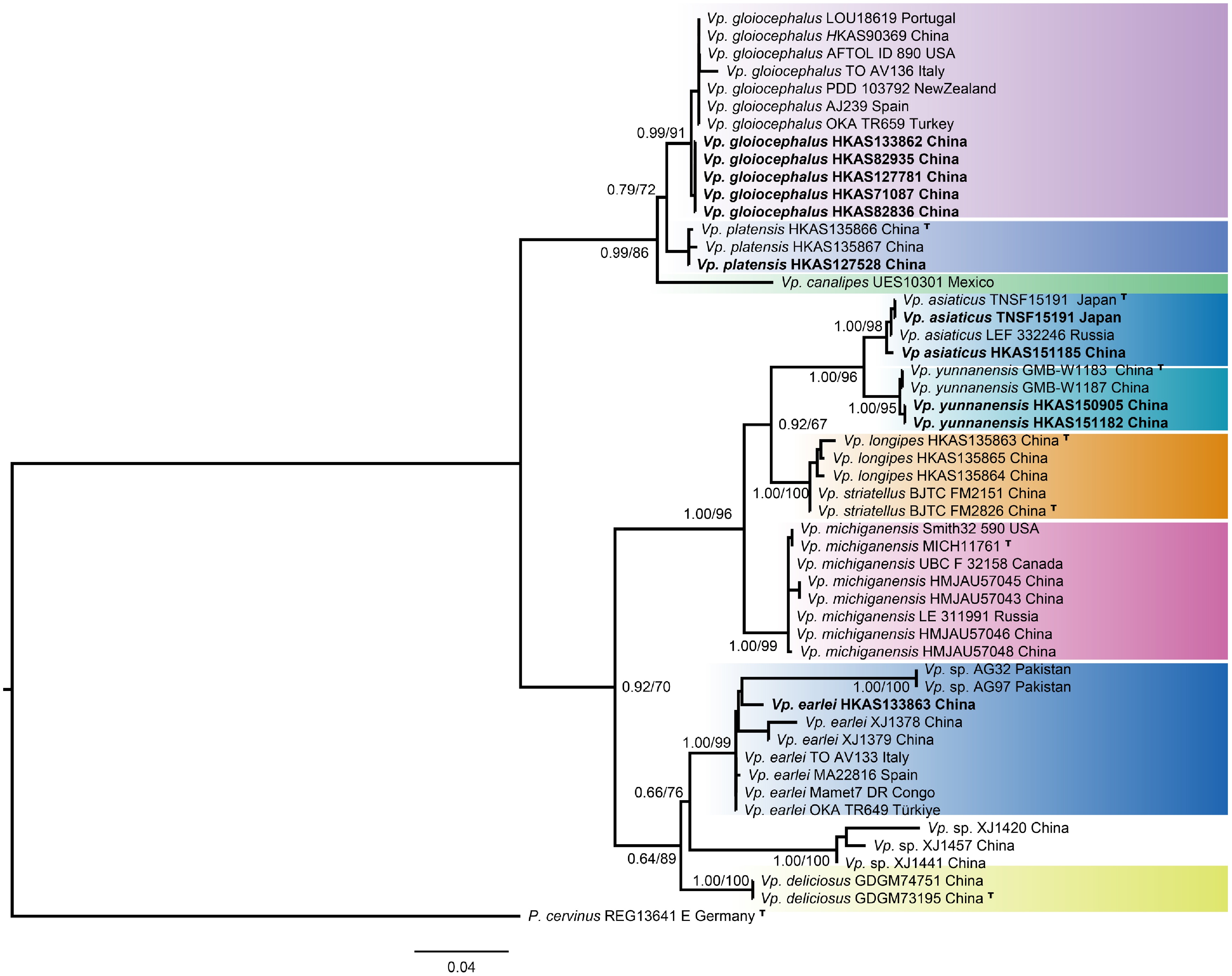
Figure 11.
The best tree from the ML analysis of Volvopluteus based on the ITS data. Bayesian posterior probabilities (PP) and Bootstrap values (BS) are shown along the branches in the format PP/BS. The tree is rooted to P. cervinus.
-
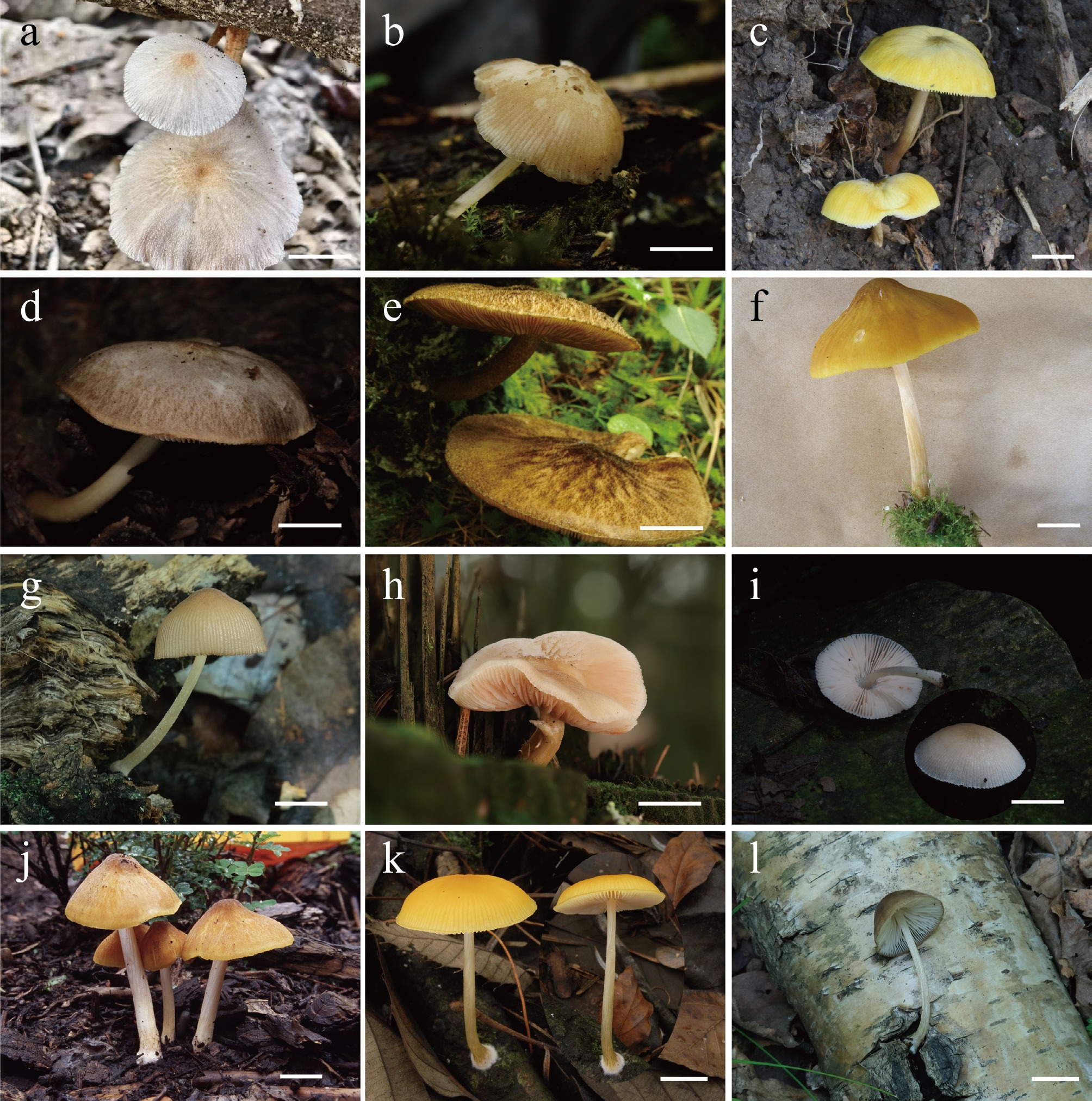
Figure 12.
Fresh basidiomes of Pluteus sect. Hispidoderma from China. (a) P. aureofuscus (HKAS 154145). (b) P. baishanzuensis (HKAS 151004). (c) P. chrysaegis (HKAS 125475). (d) P. conizatus (HKAS 151272). (e) P. granularis (HKAS 53651). (f) P. leoninus (HKAS 56048). (g) P. longistriatus (HKAS 151026). (h) P. punctatus (HKAS 151274). (i) P. semibulbosus (HKAS 114775). (j) P. ussuriensis (HKAS 45497). (k) P. variabilicolor (HKAS 107612). (l) P. velutinus (HKAS 151186).
-
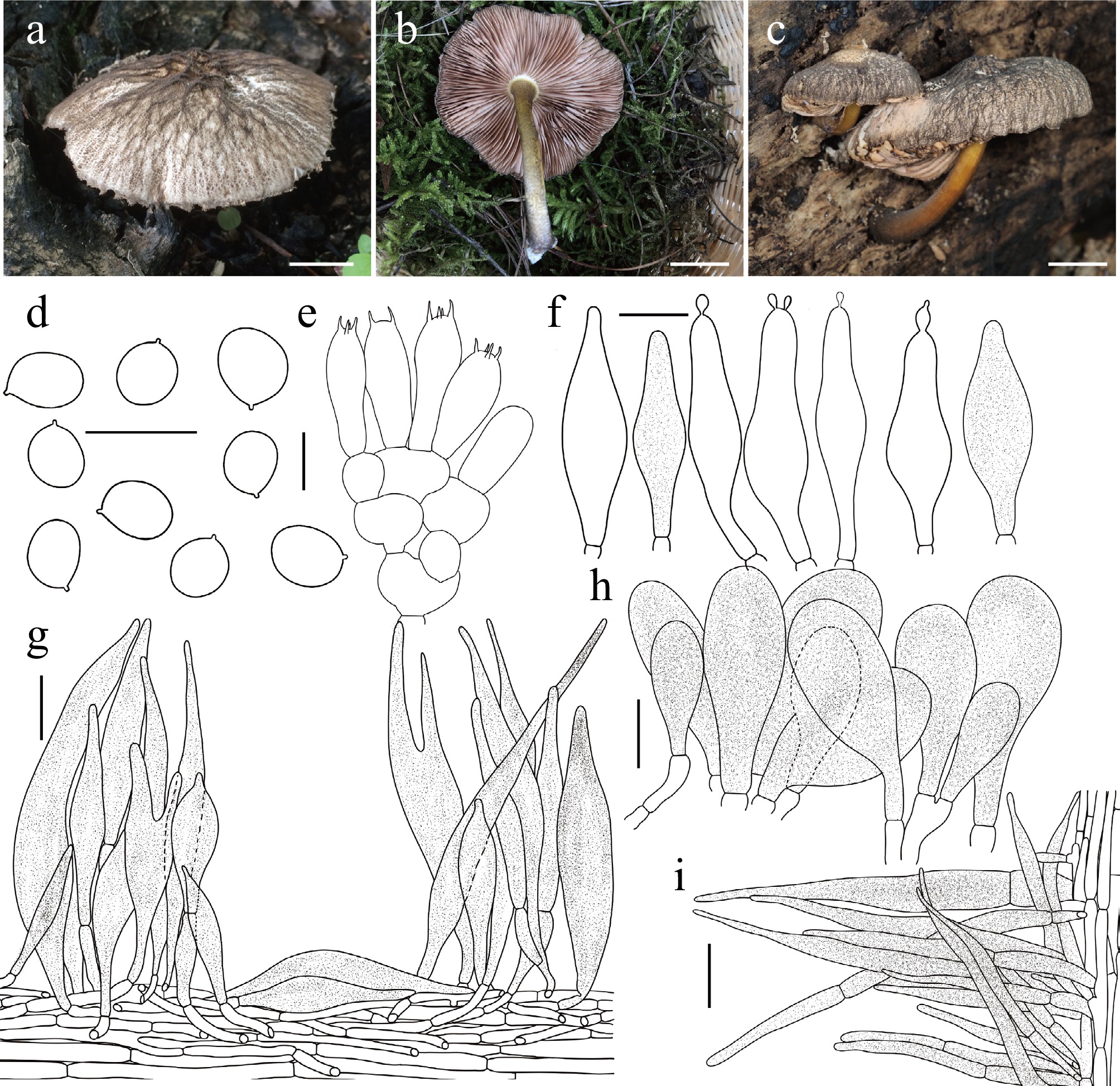
Figure 13.
Pluteus atroflavipes (HKAS 151162). (a)–(c) Basidiomes in natural habitat. (d) Basidiospores. (e) Basidia. (f) Pleurocystidia. (g) Pileipellis with terminal elements. (h) Cheilocystidia. (i) Stipitipellis with caulocystidia. Scale bars: (a)–(c) = 1 cm, (d), (e) = 10 μm, (f), (h) = 20 μm, (g), (i) = 40 μm.
-
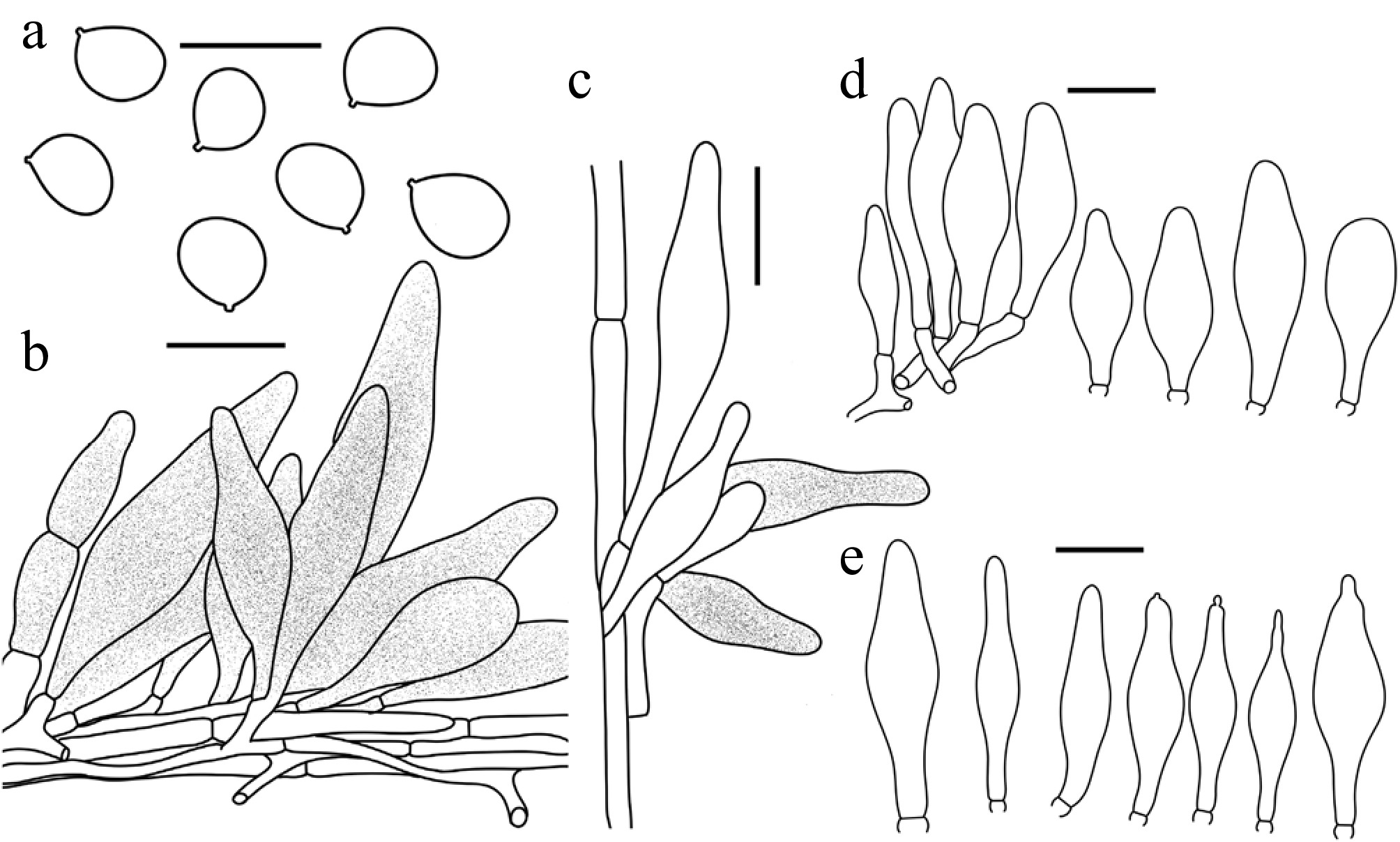
Figure 14.
Pluteus aureofuscus (HKAS 154145). (a) Basidiospores. (b) Pileipellis with terminal elements. (c) Stipitipellis with caulocystidia. (d) Cheilocystidia. (e) Pleurocystidia. Scale bars: (a) = 10 μm, (b)–(e) = 20 μm.
-
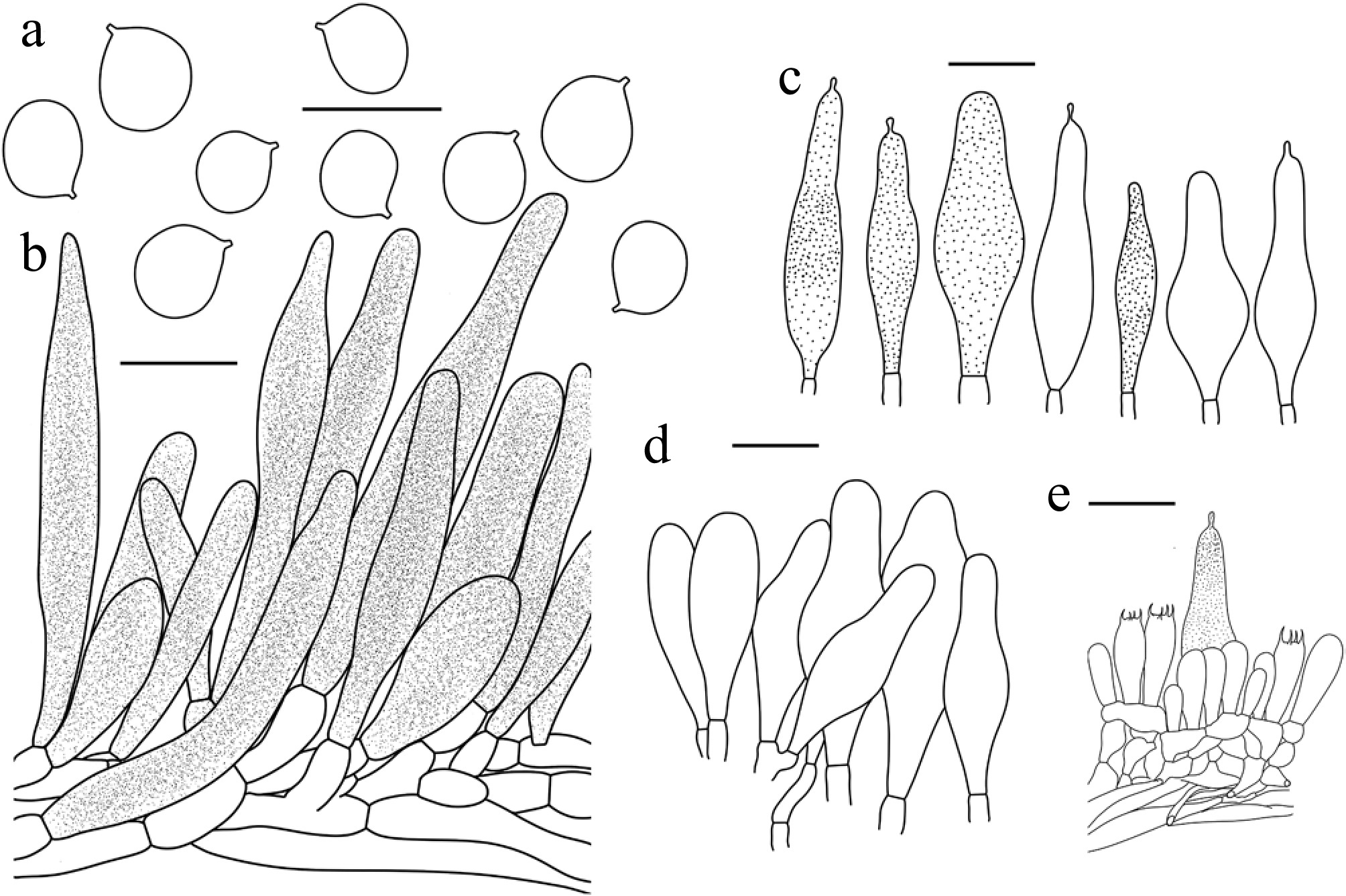
Figure 15.
Pluteus baishanzuensis (HKAS 151001). (a) Basidiospores. (b) Pileipellis with terminal elements. (c) Pleurocystidia. (d) Cheilocystidia. (e) Basidia. Scale bars: (a) = 10 μm, (b)–(e) = 20 μm.
-
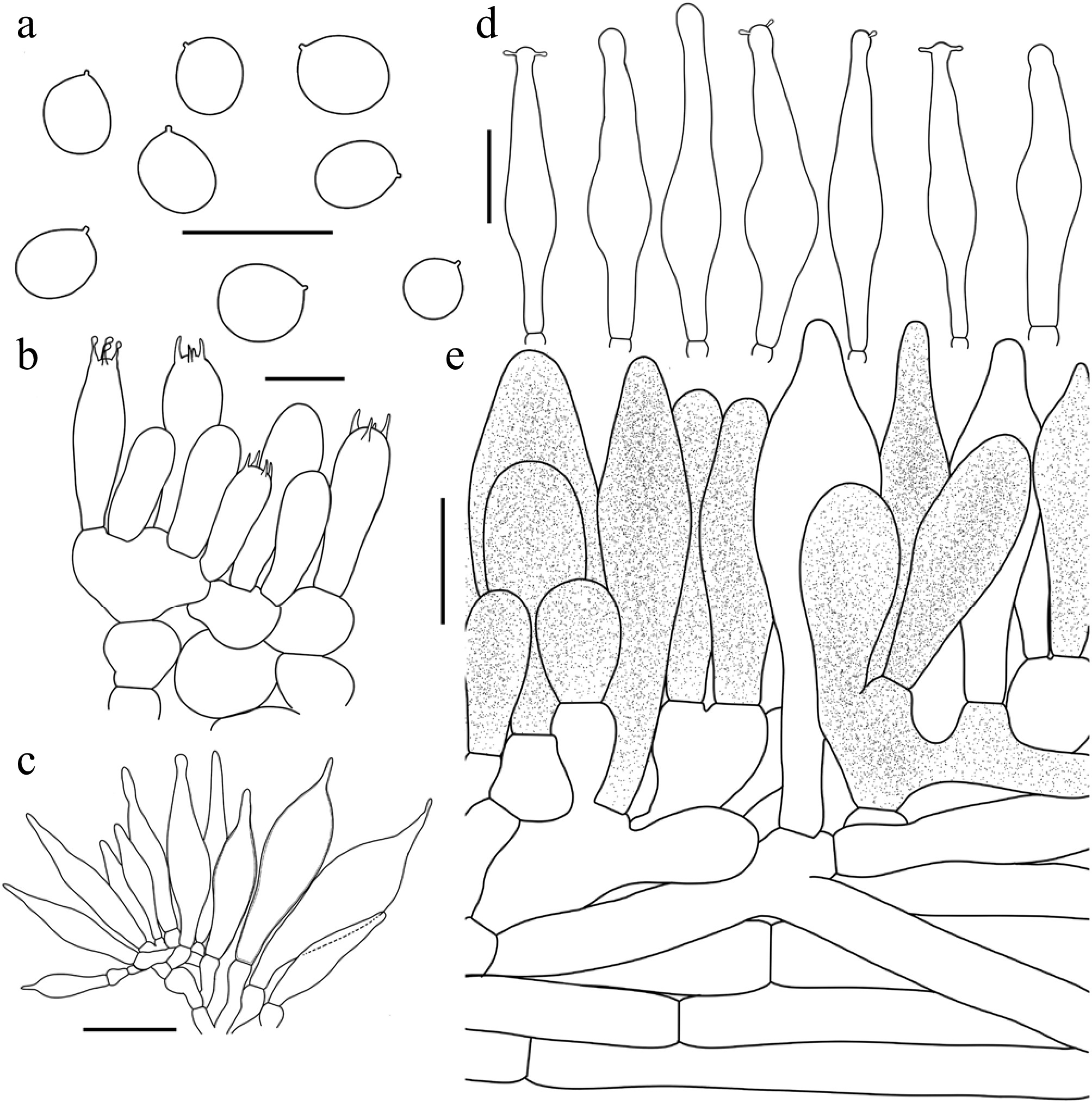
Figure 16.
Pluteus chrysaegis (HKAS 151210). (a) Basidiospores. (b) Basidia. (c) Cheilocystidia. (d) Pleurocystidia. (e) Pileipellis with terminal elements. Scale bars: (a), (b), (e) = 10 μm, (c), (d) = 20 μm.
-
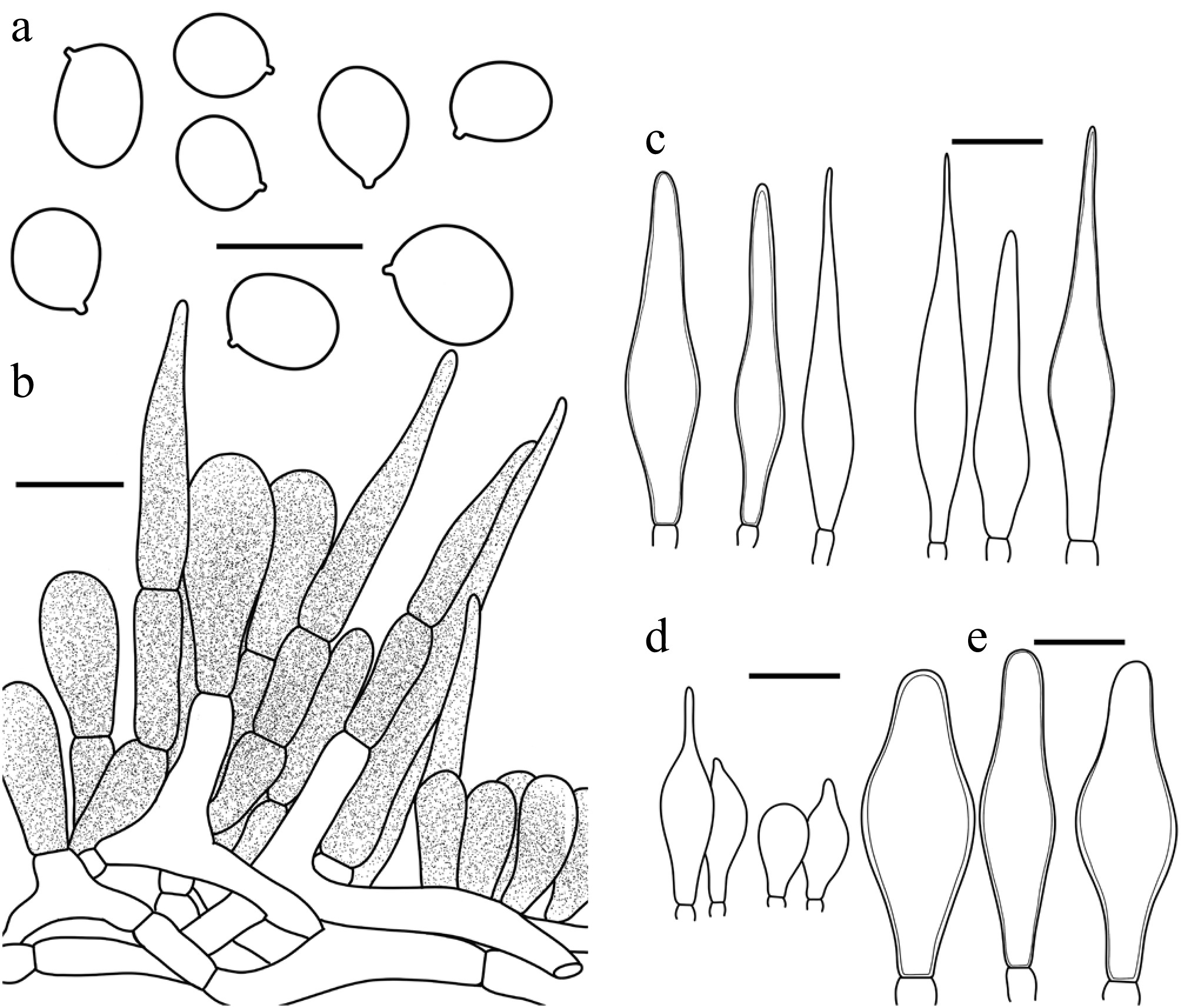
Figure 17.
Pluteus conizatus (HKAS 151272). (a) Basidiospores. (b) Pileipellis with terminal elements. (c) Cheilocystidia. (d) Caulocystidia. (e) Pleurocystidia. Scale bar: (a) = 10 μm. (b)–(e) = 20 μm.
-
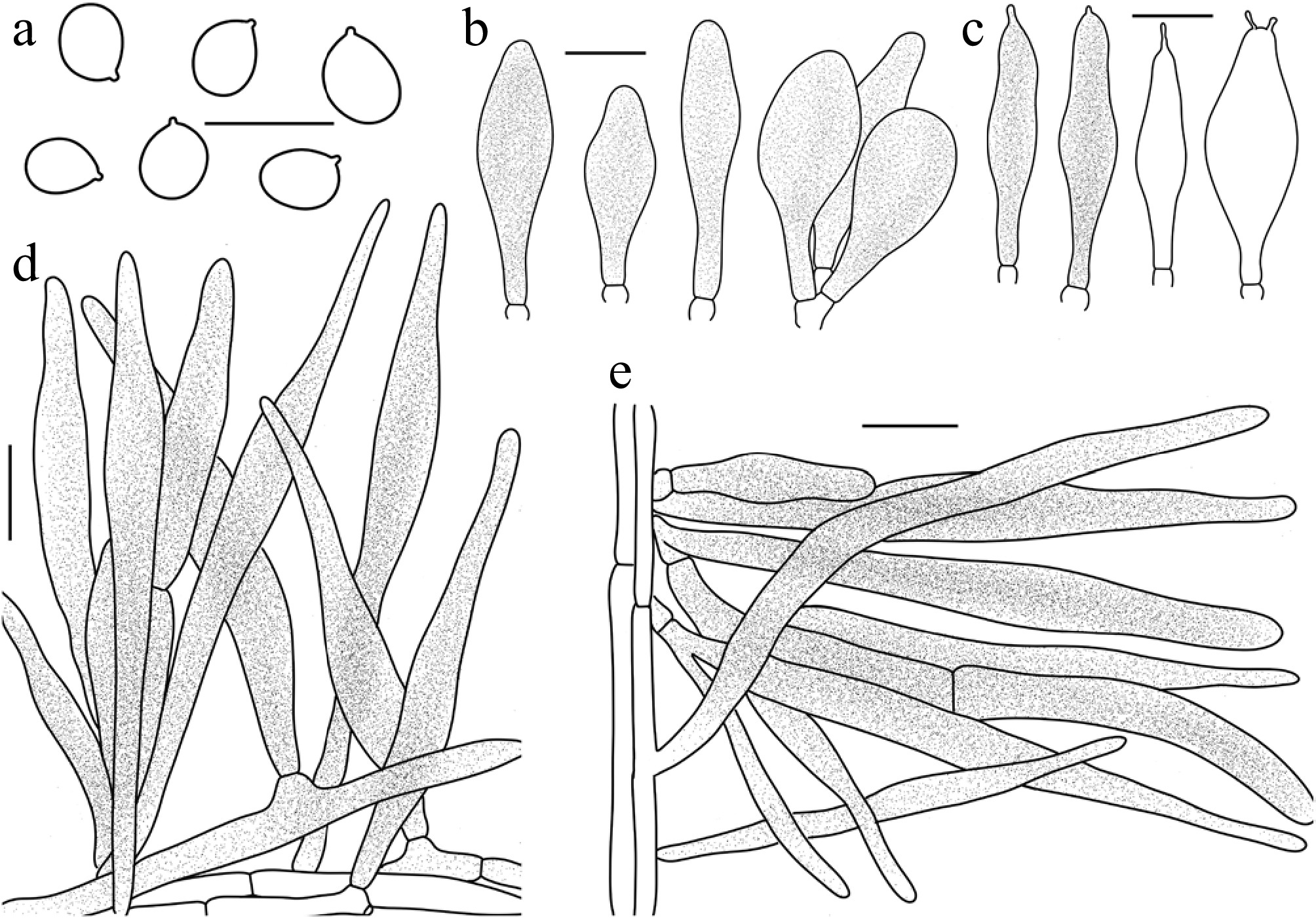
Figure 18.
Pluteus granularis (HKAS 53651). (a) Basidiospores. (b) Cheilocystidia. (c) Pleurocystidia. (d) Pileipellis with terminal elements. (e) Stipitipellis with caulocystidia. Scale bars: (a) = 10 μm, (b), (c) = 20 μm, (d)–(e) = 40 μm.
-
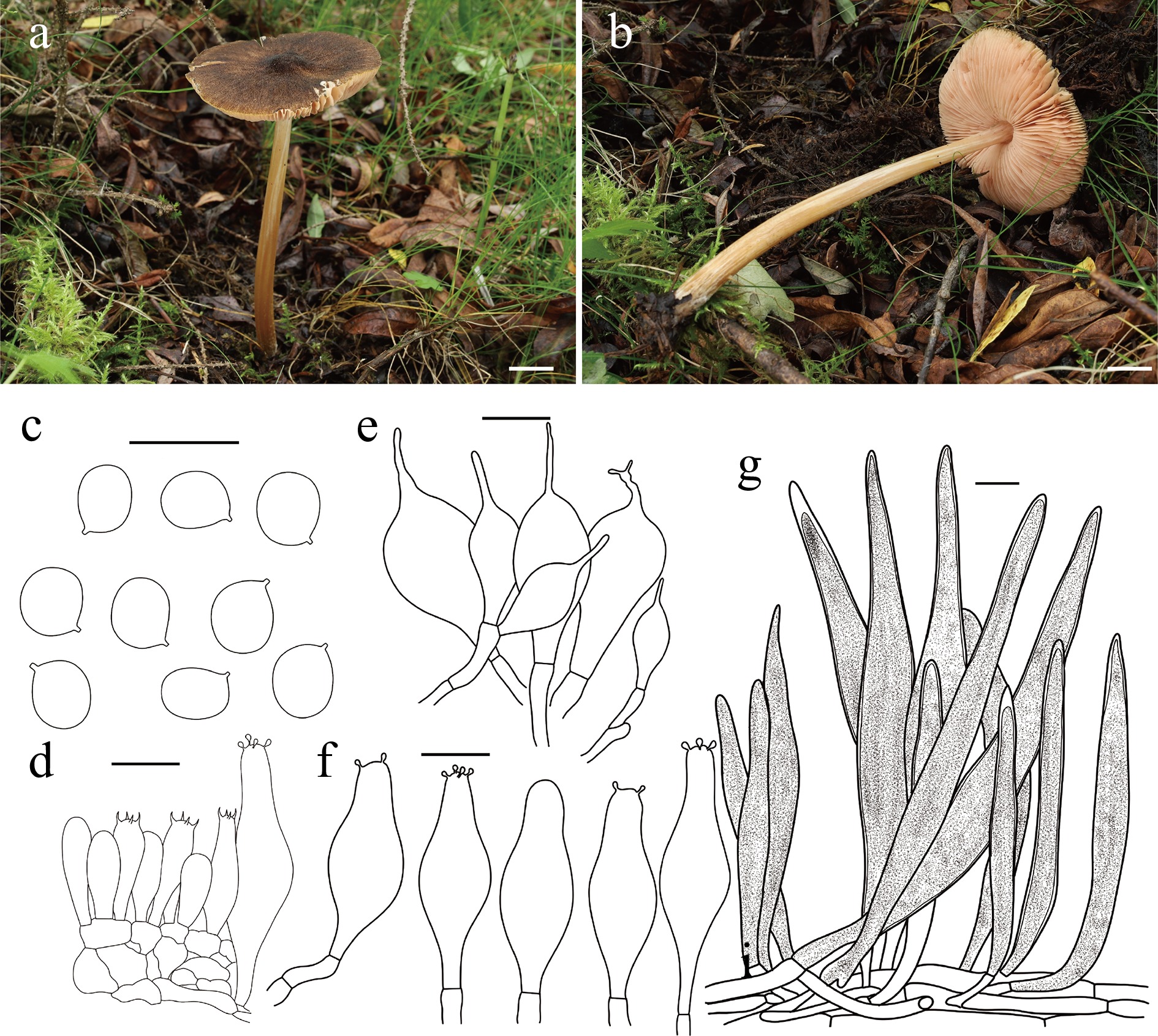
Figure 19.
Pluteus hengduanensis (HKAS 121812). (a), (b) Basidiomes in natural habitat. (c) Basidiospores. (d) Basidia. (e) Cheilocystidia. (f) Pleurocystidia. (g) Pileipellis with terminal elements. Scale bars: (a), (b) = 1 cm, (c) = 10 μm, (d)–(g) = 20 μm.
-
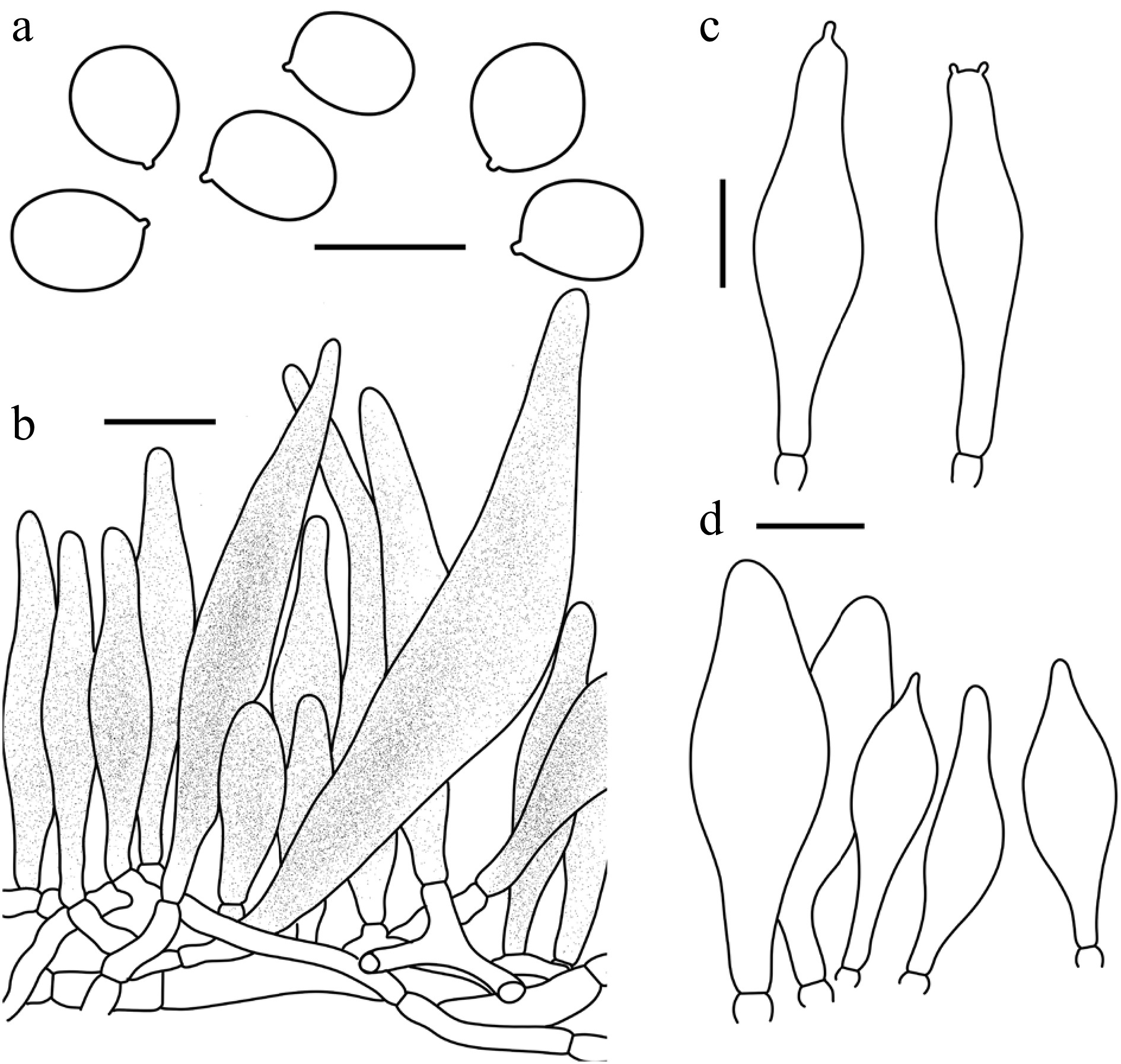
Figure 20.
Pluteus leoninus (HKAS 56048). (a) Basidiospores. (b) Pileipellis with terminal elements. (c) Pleurocystidia. (d) Cheilocystidia. Scale bars: (a) =10 μm, (b)–(d) = 20 μm.
-
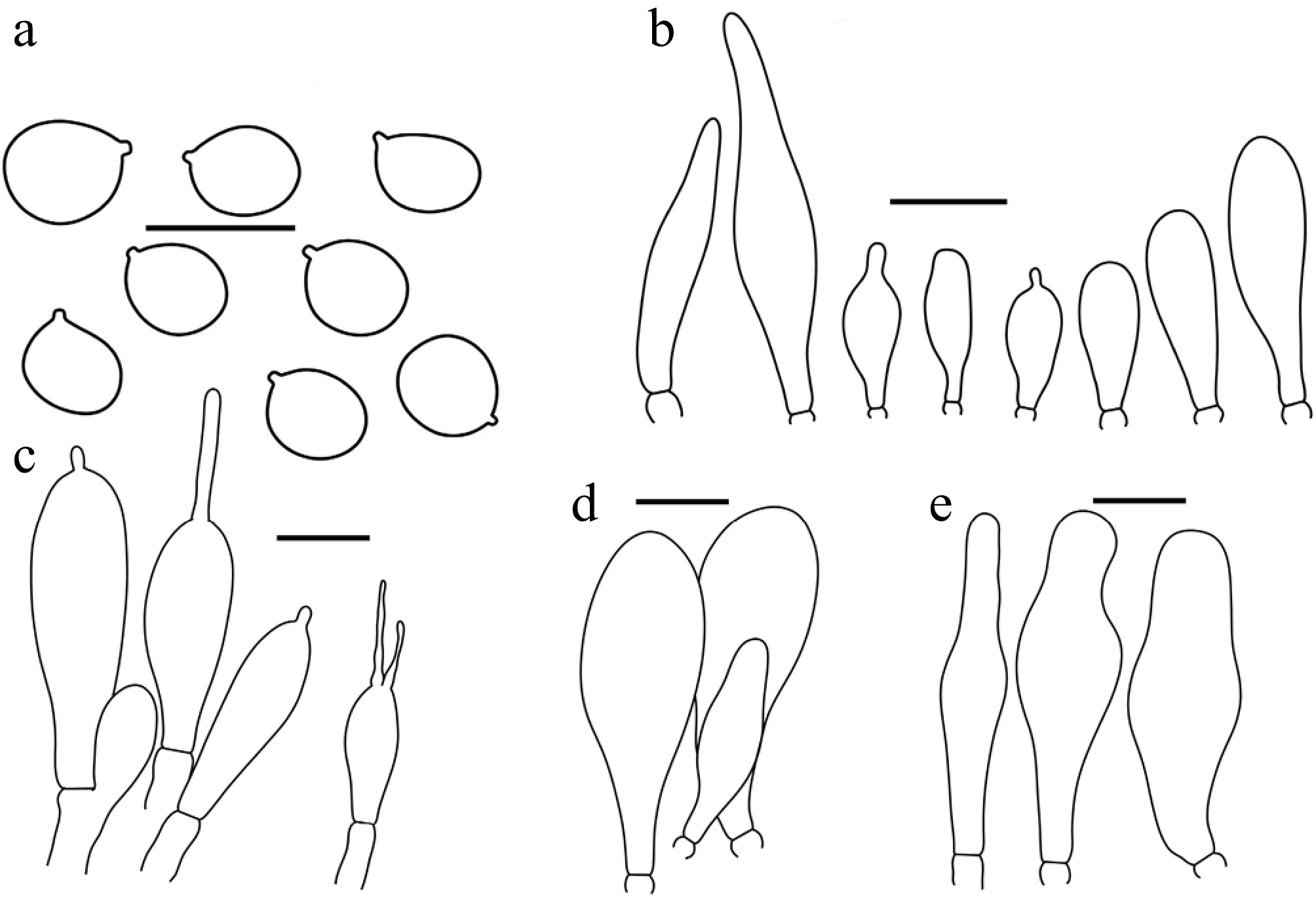
Figure 21.
Pluteus longistriatus (HKAS 151024). (a) Basidiospores. (b) Pileipellis terminal elements. (c) Caulocystidia. (d) Cheilocystidia. (e) Pleurocystidia. Scale bars: (a) =10 μm, (b)–(e) = 20 μm.
-
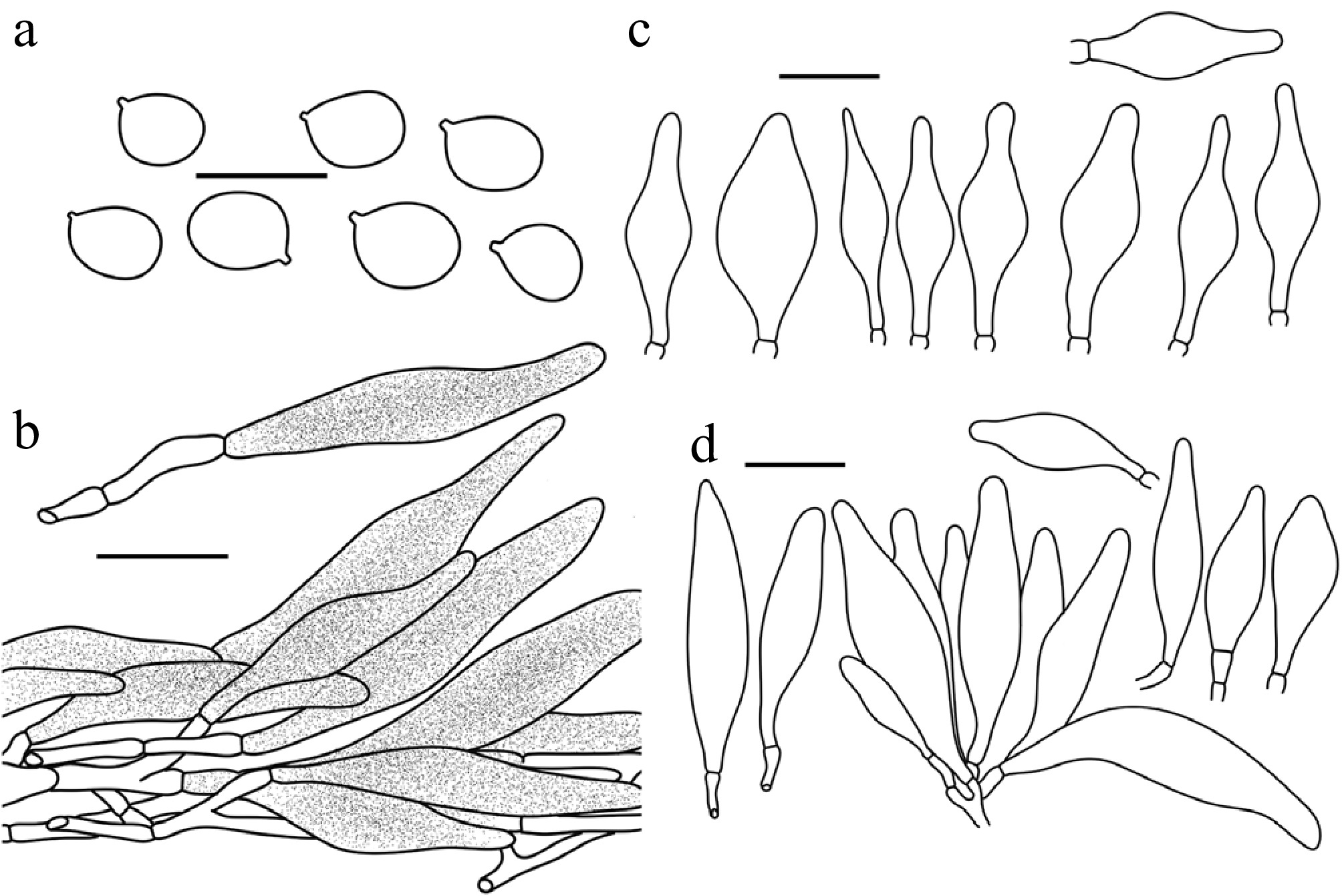
Figure 22.
Pluteus punctatus (HKAS 151274). (a) Basidiospores. (b) Pileipellis with terminal elements. (c) Pleurocystidia. (d) Cheilocystidia. Scale bars: (a) =10μm, (b)–(d) = 40 μm.
-
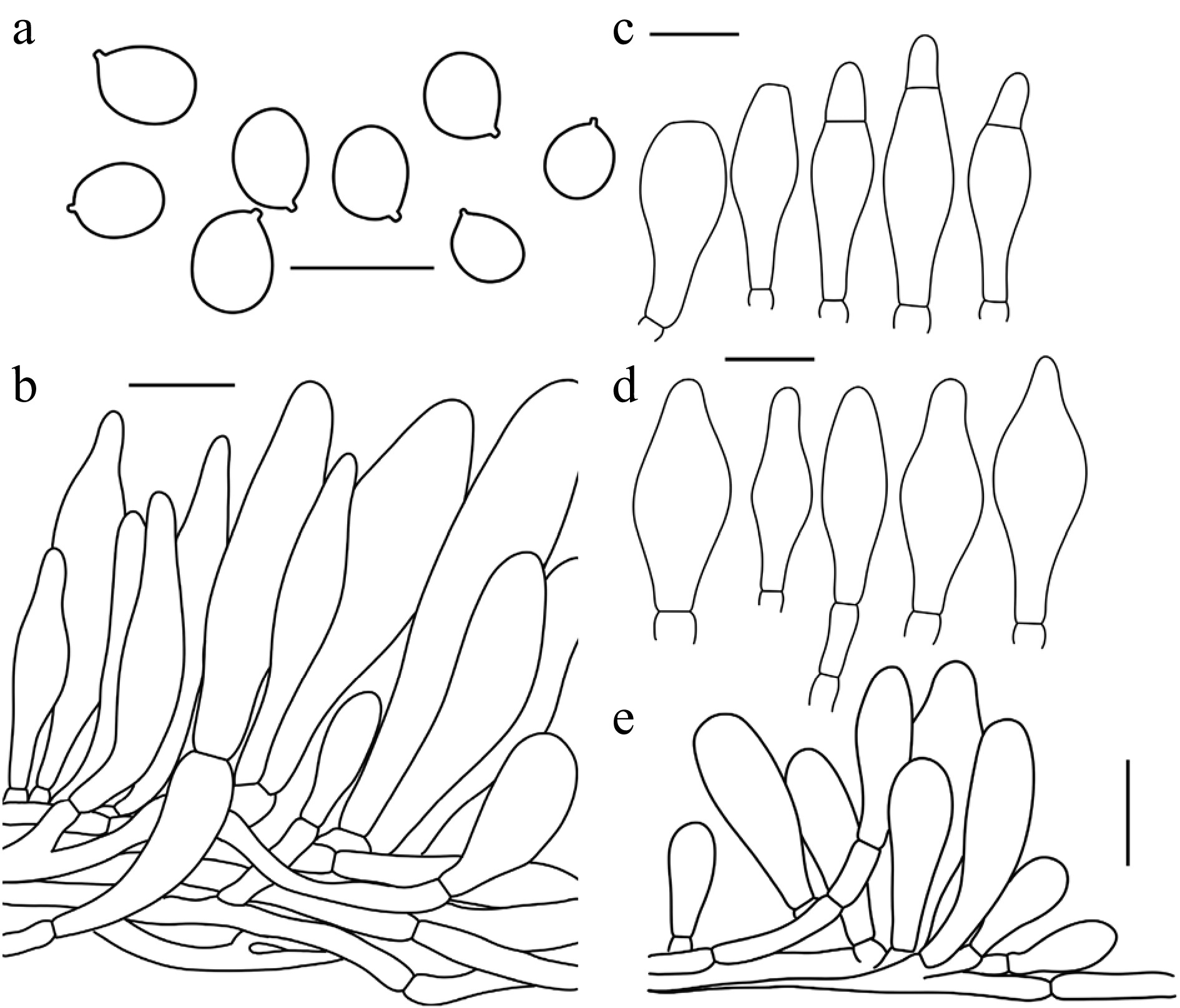
Figure 23.
Pluteus semibulbosus (HKAS 112751). (a) Basidiospores. (b) Pileipellis with terminal elements. (c) Pleurocystidia. (d) Cheilocystidia. (e) Stipitipellis with caulocystidia. Scale bars: (a) = 10 μm, (b)–(e) = 20 μm.
-
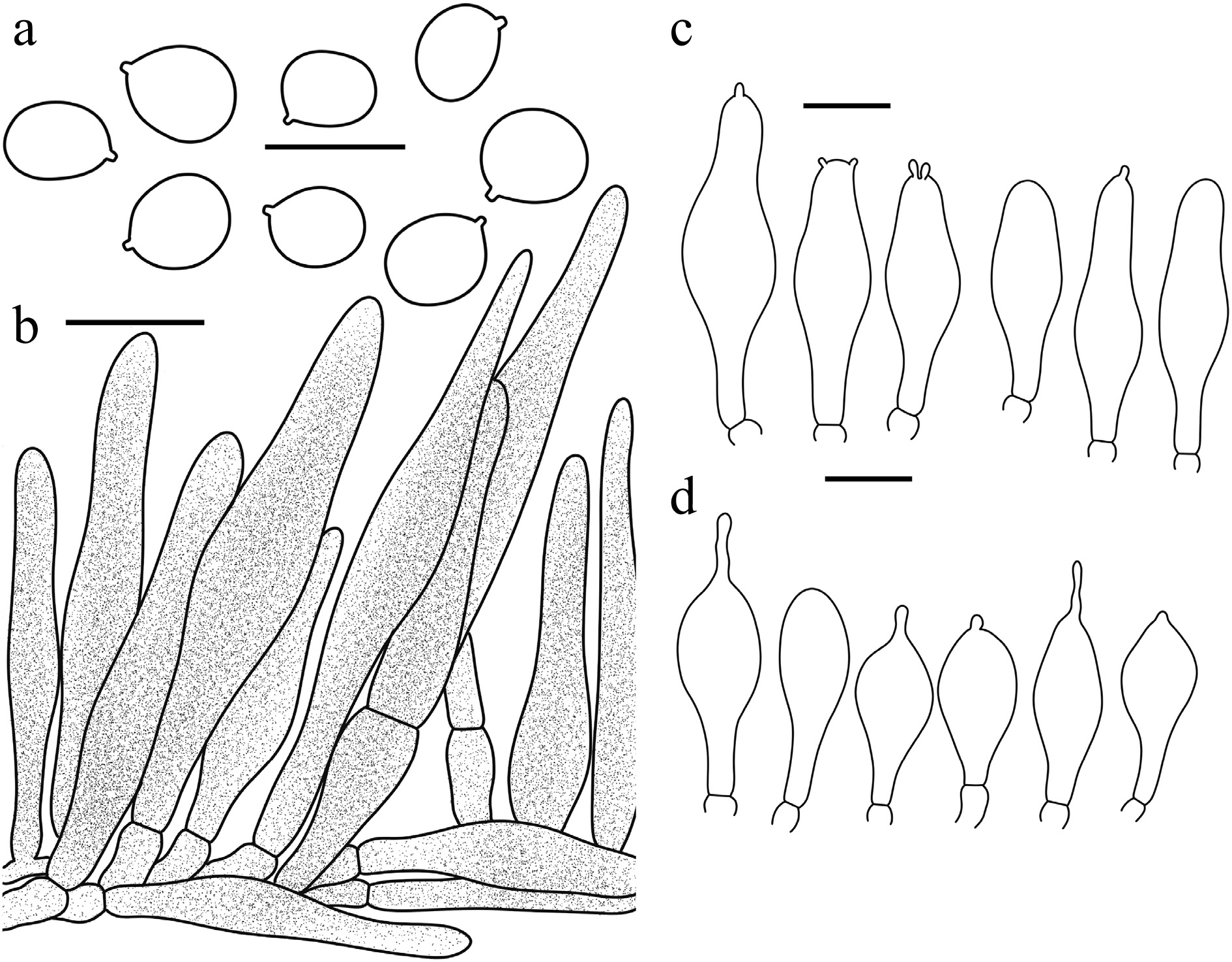
Figure 24.
Pluteus ussuriensis (HKAS 45497). (a) Basidiospores. (b) Pileipellis with terminal elements. (c) Pleurocystidia. (d) Cheilocystidia. Scale bars: (a) = 10 μm, (b)–(d) = 20 μm.
-
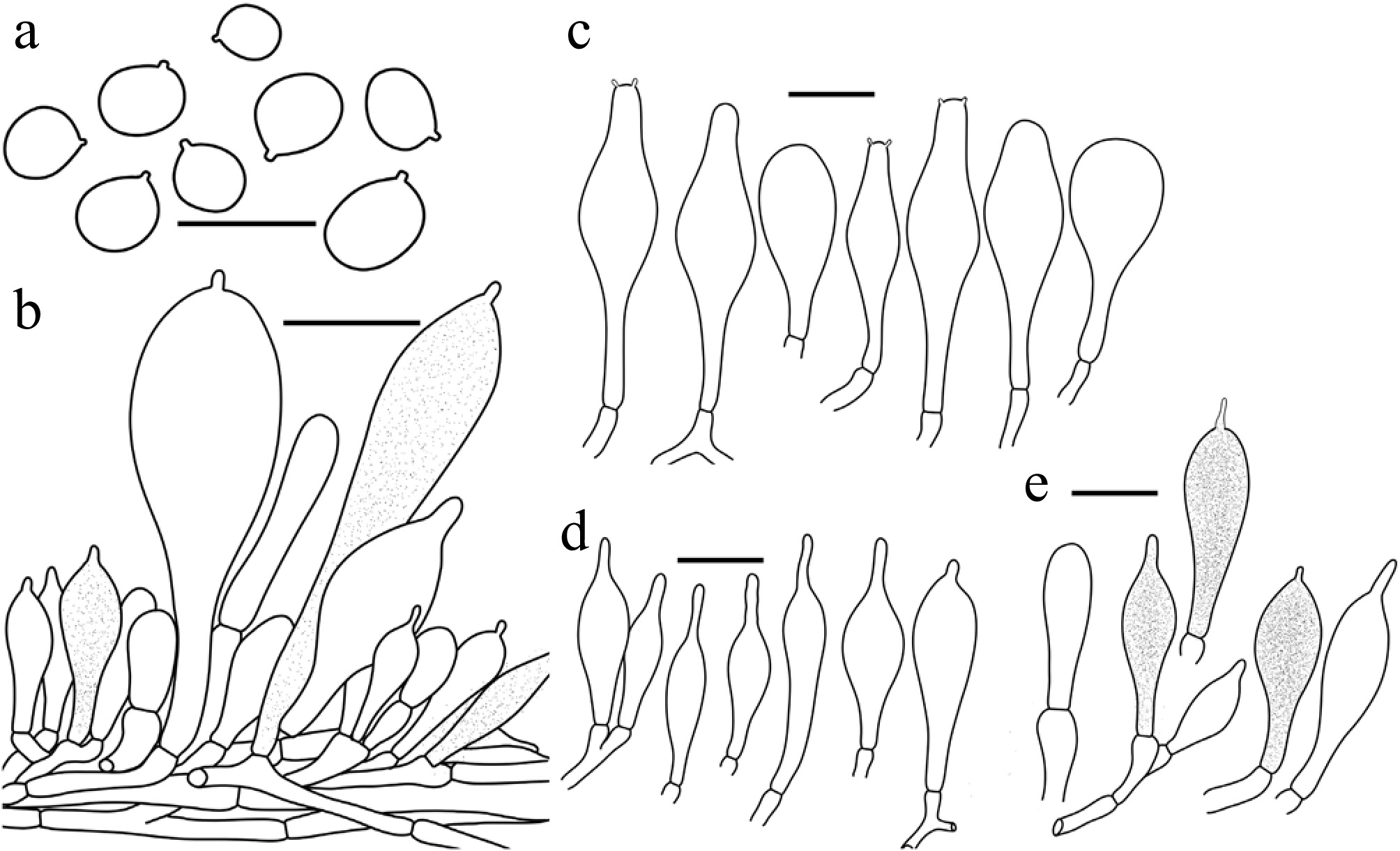
Figure 25.
Pluteus variabilicolor (HKAS 150910). (a) Basidiospores. (b) Pileipellis with terminal elements. (c) Pleurocystidia. d Cheilocystidia. (e) Caulocystidia. Scale bars: (a) = 10 μm, (b)–(e) = 20 μm.
-
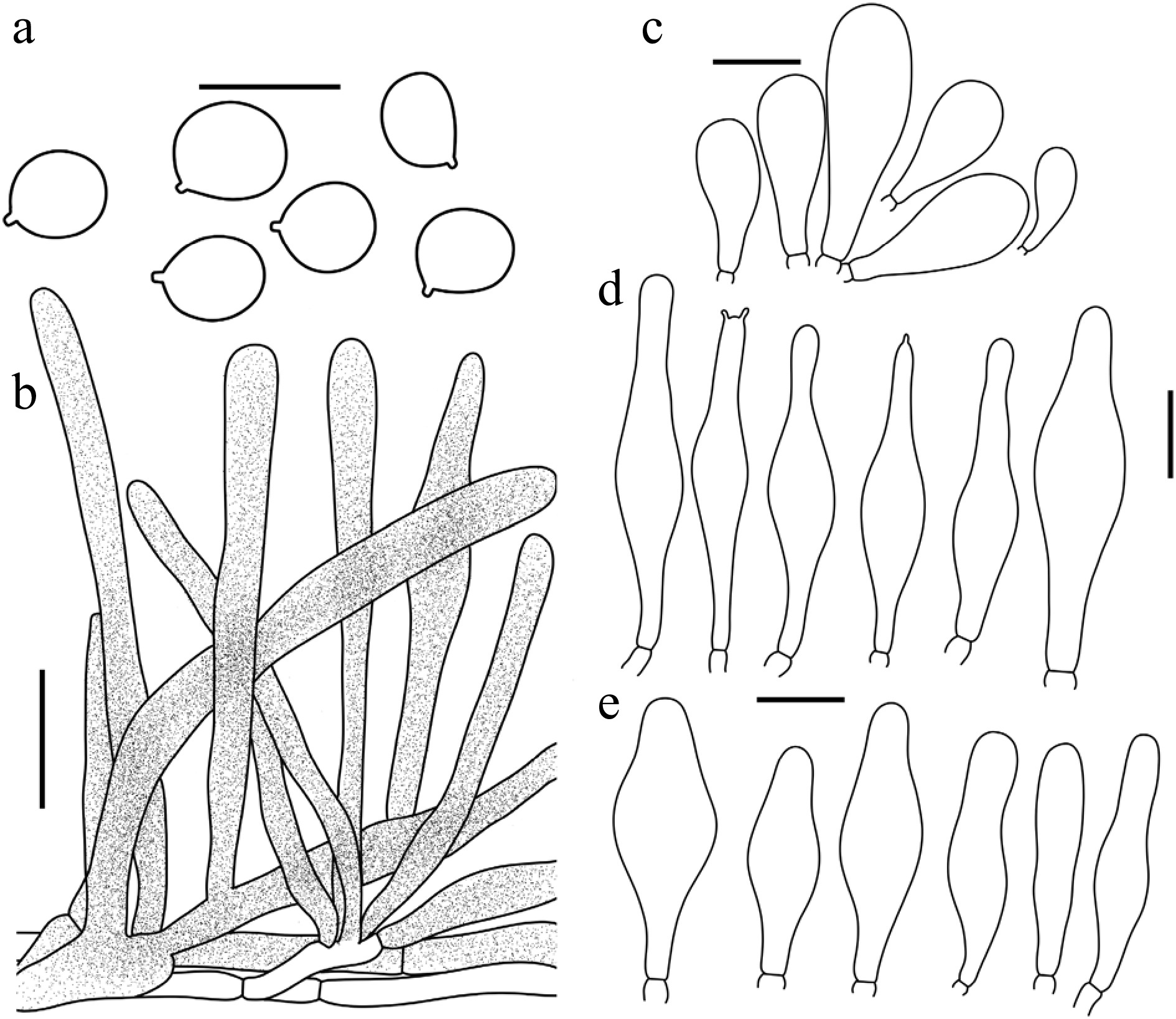
Figure 26.
Pluteus velutinus (HKAS 151186). (a) Basidiospores. (b) Pileipellis with terminal elements. (c) Caulocystidia. (d) Pleurocystidia. (e) Cheilocystidia. Scale bars: (a) = 10 μm, (b)–(e) = 20 μm.
-
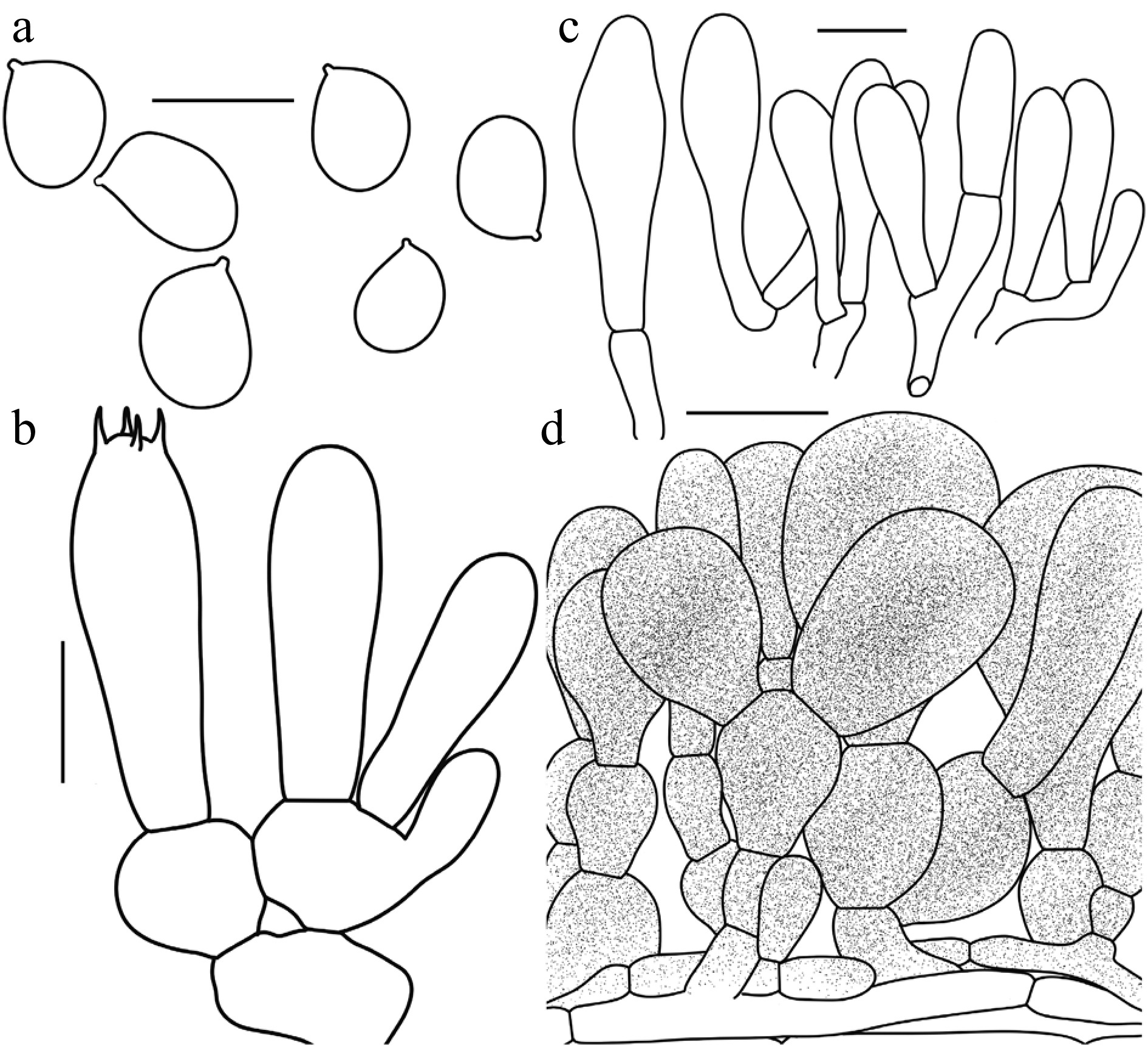
Figure 27.
Pluteus diettrichii (WU-MYC 0053278). (a) Basidiospores. (b) Basidia. (c) Cheilocystidia. (d) Pileipellis with terminal elements. Scale bars: (a), (b) = 10 μm, (c), (d) = 20 μm.
-
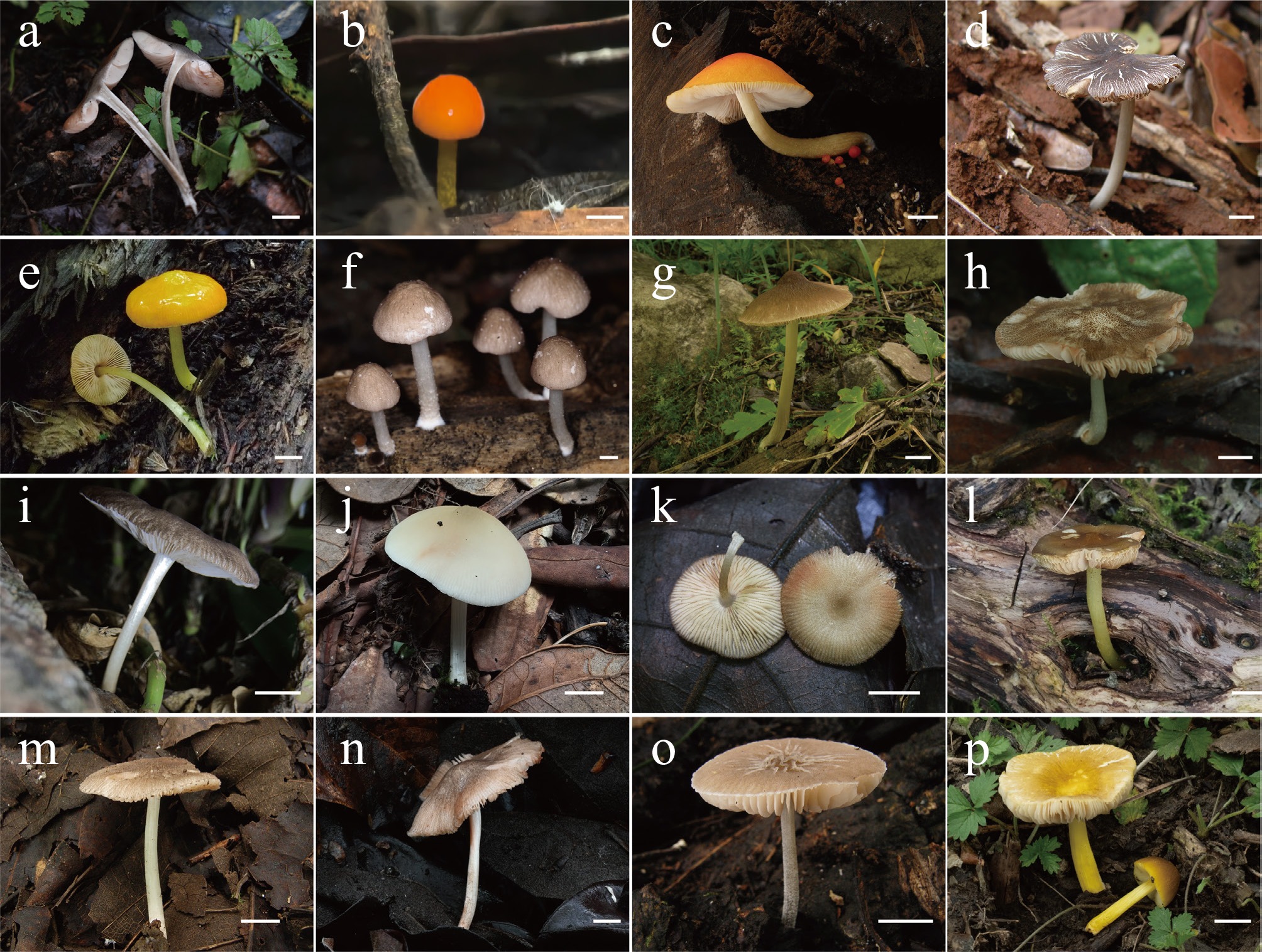
Figure 28.
Fresh basidiomes of Pluteus sect. Celluloderma and Pruinoderma from China. (a) P. assimilatus (HKAS 151184). (b) P. aurantioruber (HKAS 151280). (c) P. aurantiorugosus (HKAS 83882). (d) P. castaneorugosus (HKAS 78644). (e) P. chrysophlebius (HKAS 76357). (f) P. daqinggouensis (HKAS 151174). (g) P. poliocnemis (HKAS 58019). (h) P. fuscipruinatus (HKAS 151283). (i) P. fuscopunctatus (HKAS 151284). (j) P. phlebophorus (HKAS 151157). (k) P. podospilloides (HKAS 125335). (l) P. romellii (HKAS 151084). (m) P. squamulososulcatus (HKAS 151301). (n) P. squarrosus (HKAS 151212). (o) P. thomsonii (HKAS 112749). (p) P. vellingae (HKAS 151203).
-
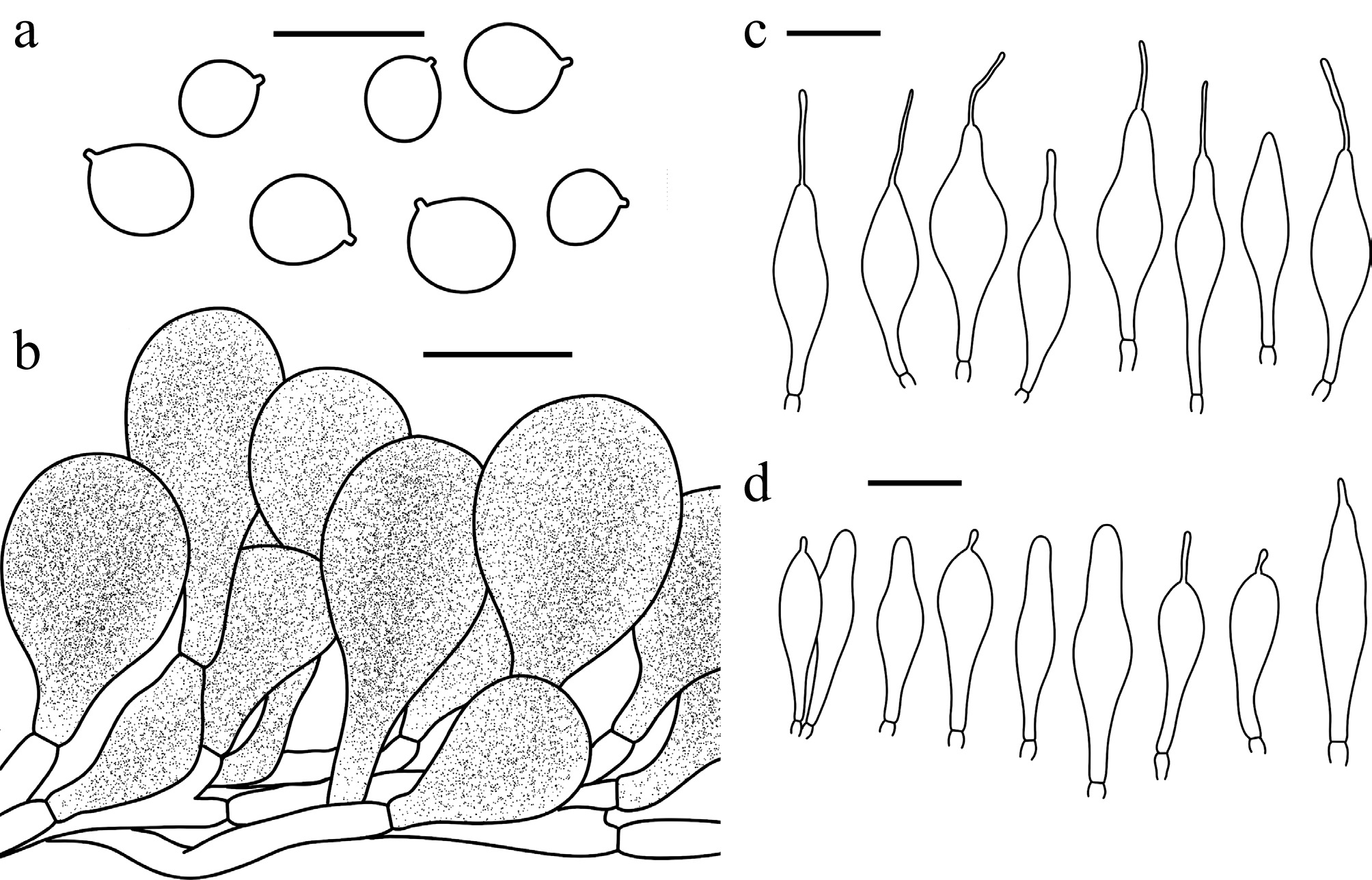
Figure 29.
Pluteus assimilatus (HKAS 151184). (a) Basidiospores. (b) Pileipellis with terminal elements. (c) Pleurocystidia. (d) Cheilocystidia. Scale bars: (a) = 10 μm, (b)–(d) = 20 μm.
-
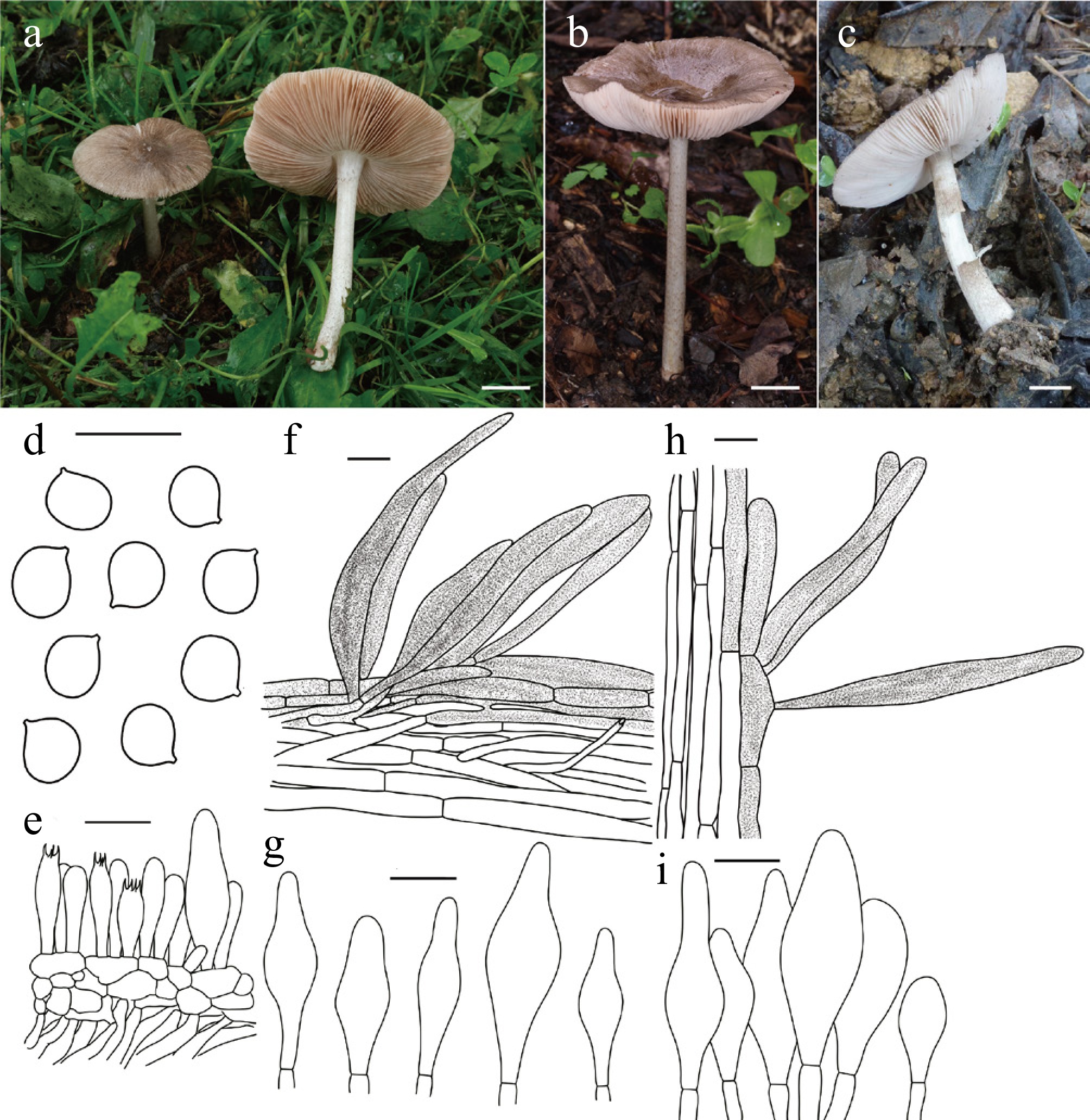
Figure 30.
Pluteus asperulus (HKAS 150923). (a)–(c) Basidiomes in natural habitat. (d) Basidiospores. (e) Basidia. (f) Pileipellis with terminal elements. (g) Pleurocystidia. (h) Stipitipellis with caulocystidia. (i) Cheilocystidia. Scale bars: (a)–(c) = 1 cm, (d) = 10 μm, (e)–(i) = 20 μm.
-
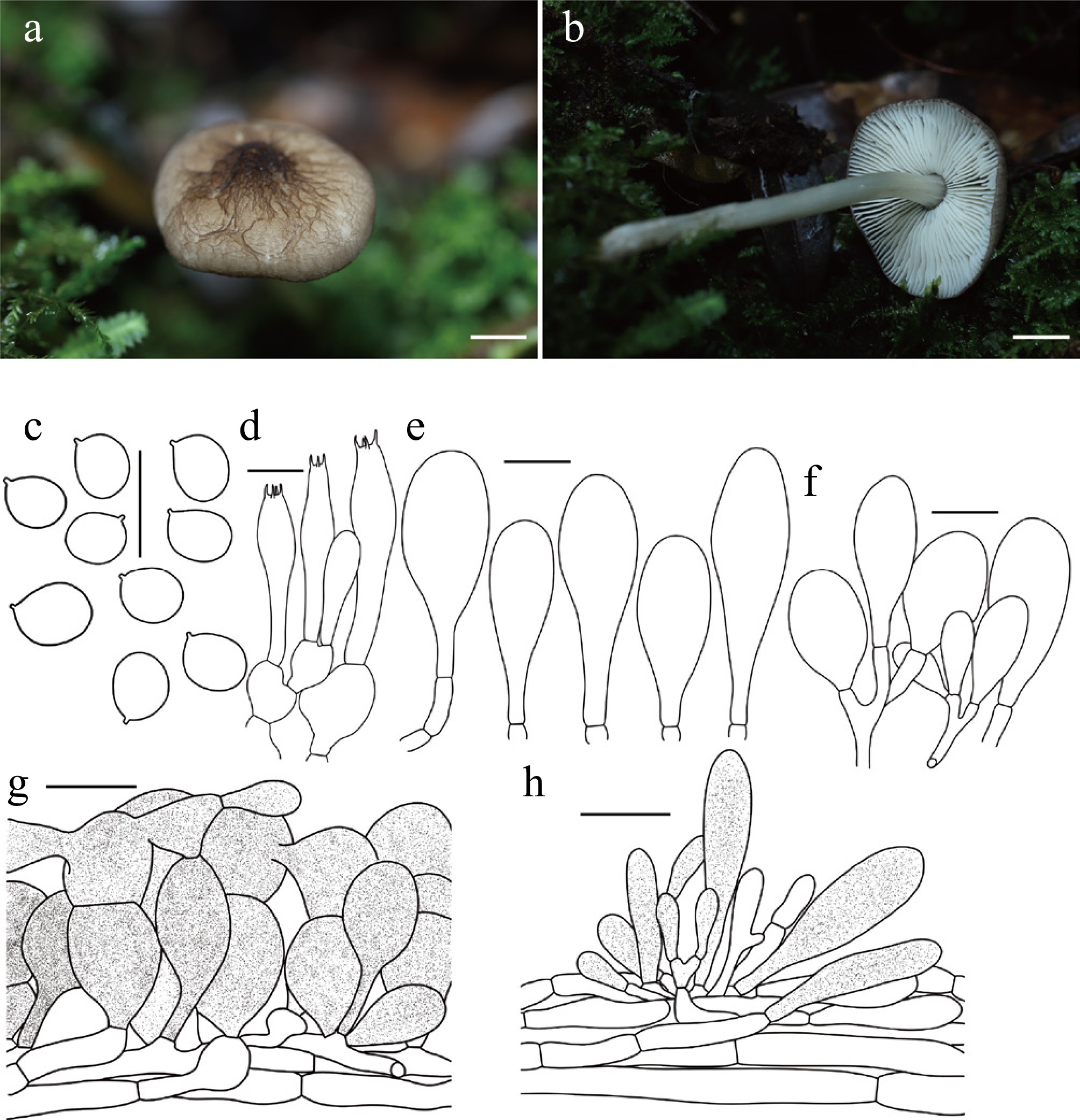
Figure 31.
Pluteus atroreticulatus (HKAS 151299). (a), (b) Basidiomes in natural habitat. (c) Basidiospores. (d) Basidia. (e) Pleurocystidia. (f) Cheilocystidia. (g) Pileipellis with terminal elements. (h) Stipitipellis with caulocystidia. Scale bars: (a), (b) =1 cm, (c), (d) = 10 μm, (e)–(h) = 20 μm.
-
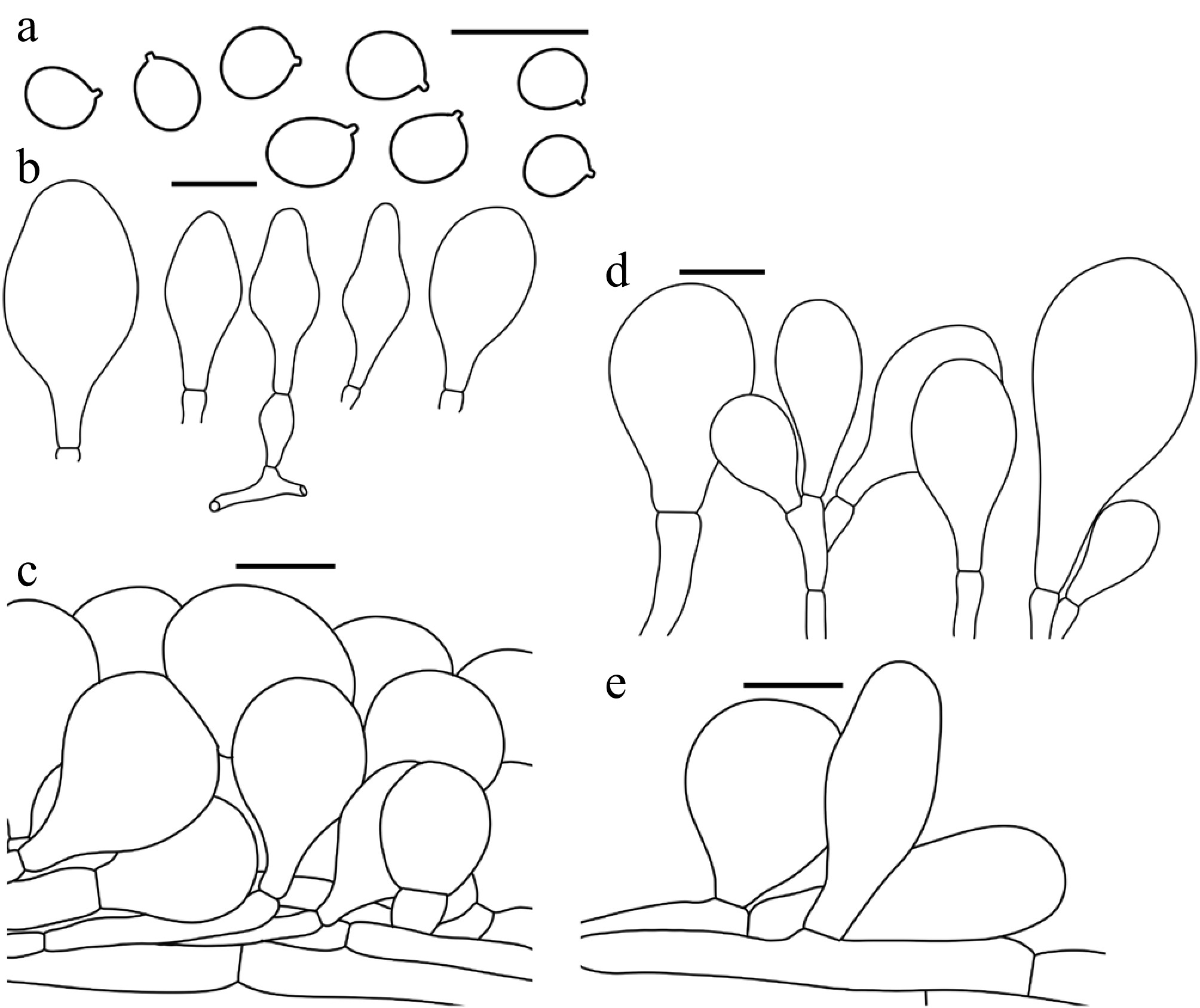
Figure 32.
Pluteus aurantiorugosus (HKAS 83882). (a) Basidiospores. (b) Pleurocystidia. (c) Pileipellis with terminal elements. (d) Cheilocystidia. (e) Stipitipellis with caulocystidia. Scale bars: (a) = 10 μm, (b)–(e) = 20 μm.
-
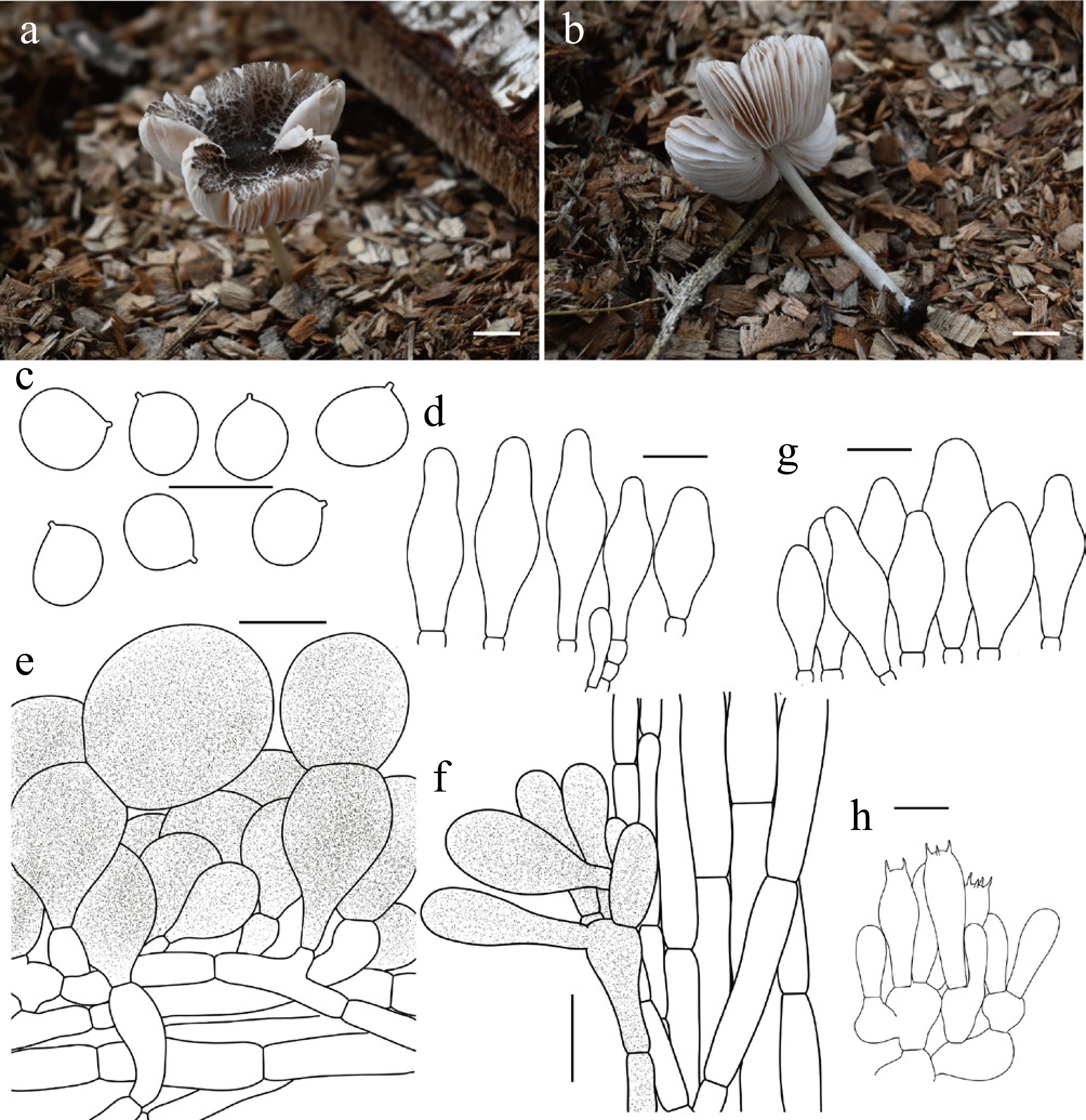
Figure 33.
Pluteus calidophilus (HKAS 151208). (a), (b) Basidiome in natural habitat. (c) Basidiospores. (d) Pleurocystidia. (c) Basidiospores. (d) Pleurocystidia. (e) Pileipellis with terminal elements. (f) Stipitipellis with terminal elements. (g) Cheilocystidia. (h) Basidia and subhymenium. Scale bars: (a), (b) = 1 cm, (c), (h) = 10 μm, (d)–(g) = 20 μm.
-
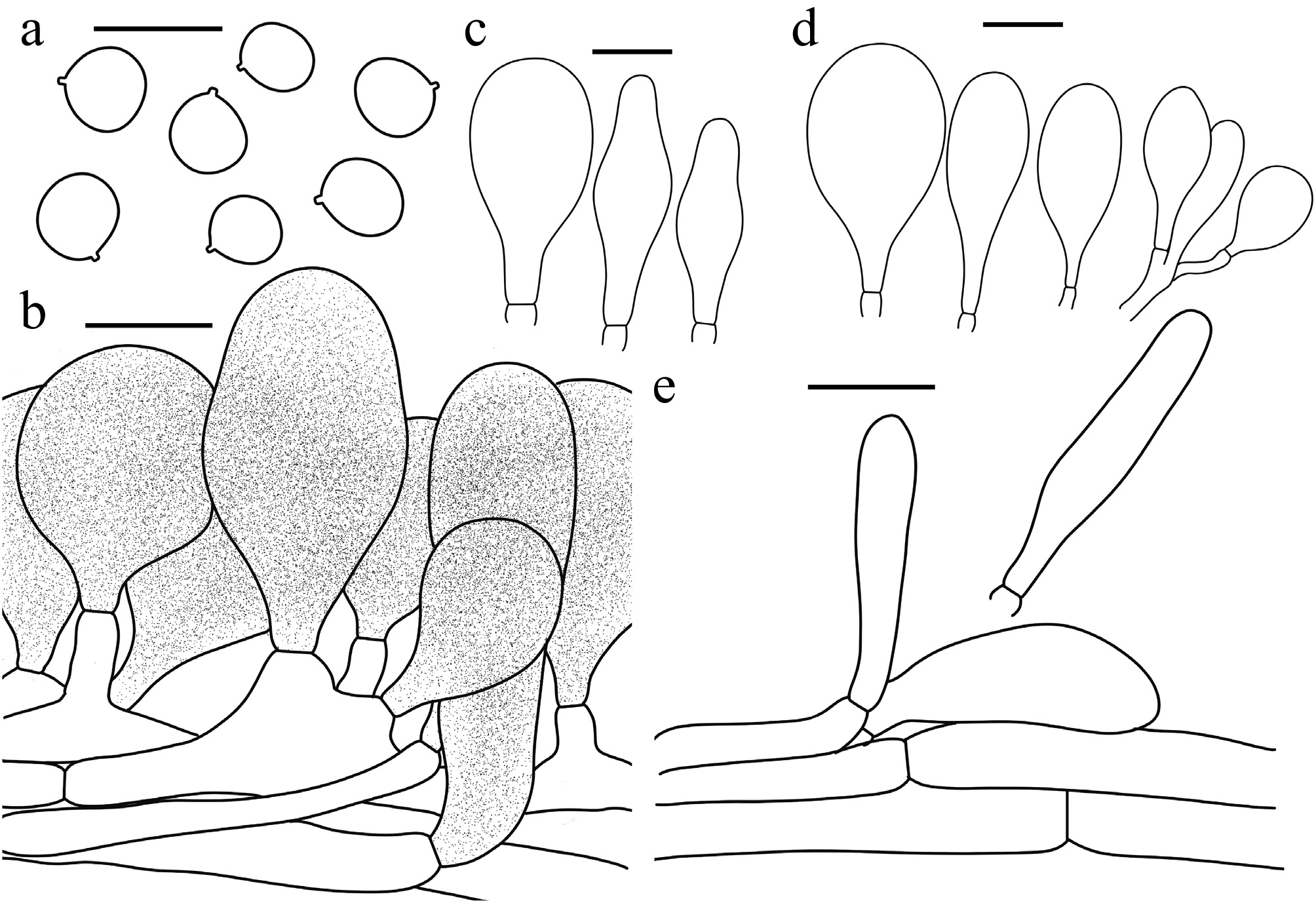
Figure 34.
Pluteus castaneorugosus (HKAS 78644). (a) Basidiospores. (b) Pileipellis with terminal elements. (c) Pleurocystidia. (d) Cheilocystidia. (e) Stipitipellis with caulocystidia. Scale bars: (a) = 10 μm, (b)–(e) = 20 μm.
-
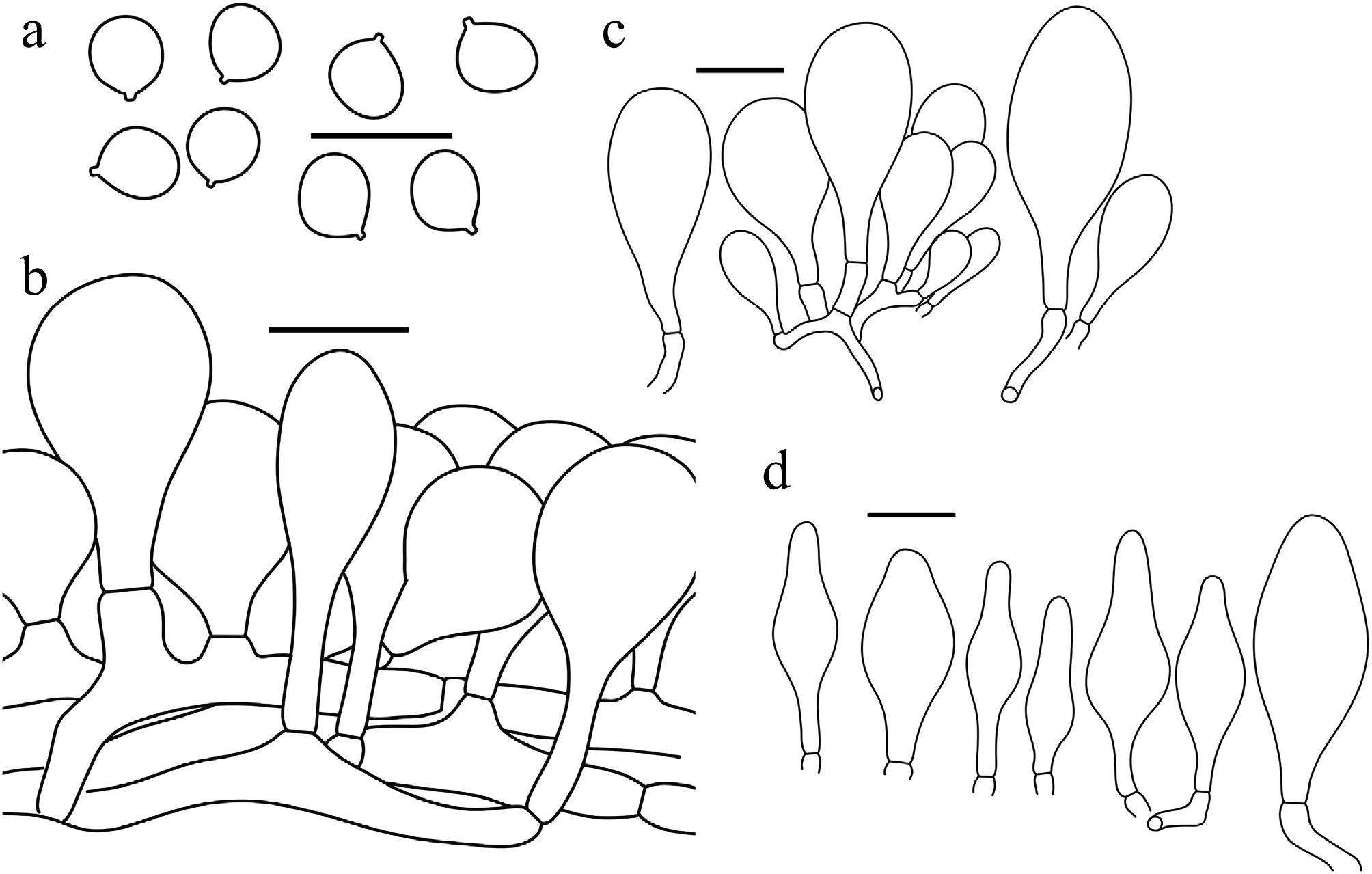
Figure 35.
Pluteus chrysophlebius (HKAS 128111). (a) Basidiospores. (b) Pileipellis with terminal elements. (c) Cheilocystidia. (d) Pleurocystidia. Scale bars: (a) = 10 μm, (b)–(d) = 20 μm.
-
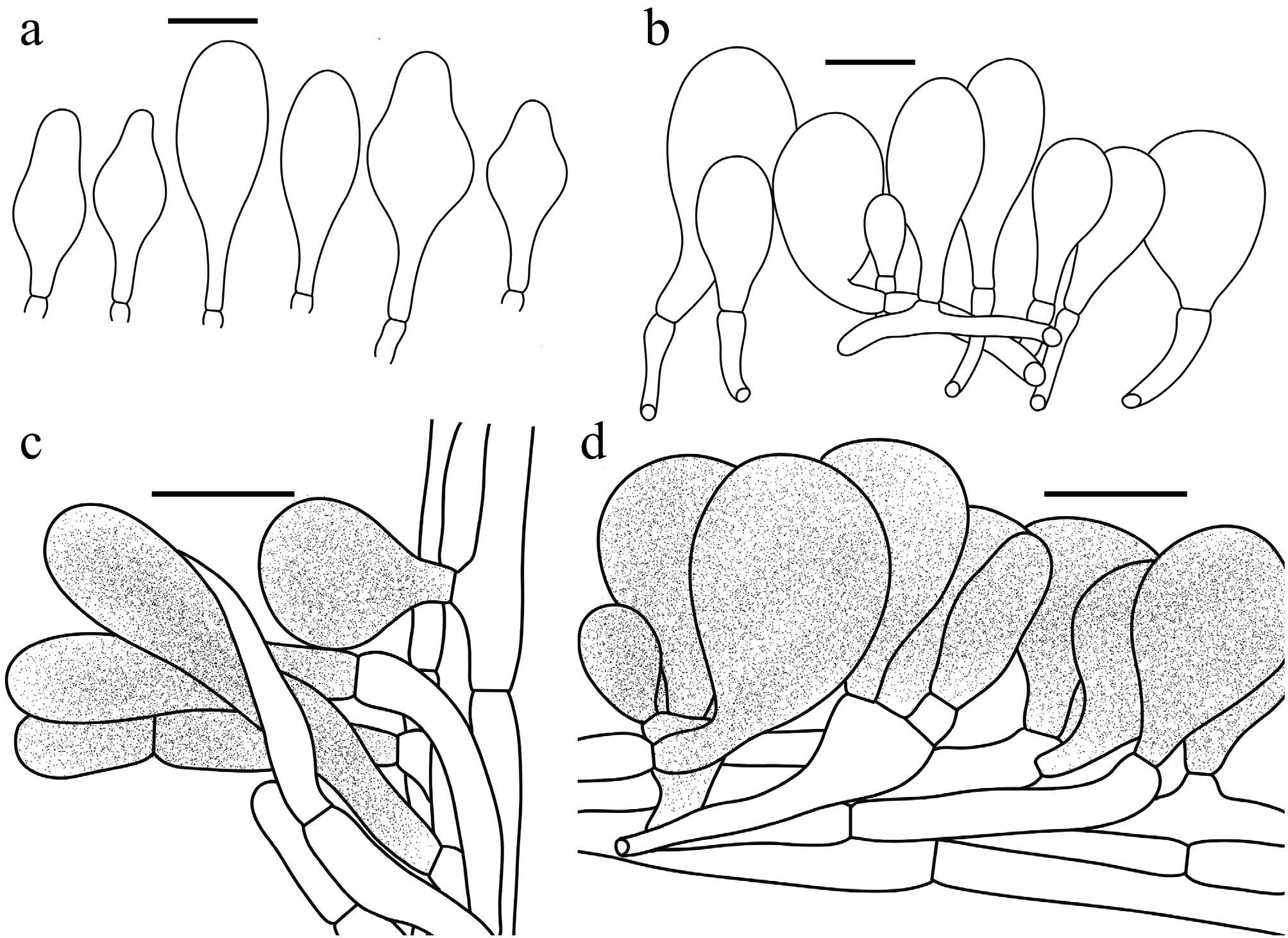
Figure 36.
Pluteus daqinggouensis (HKAS 151174). (a) Pleurocystidia. (b) Cheilocystidia. (c) Stipitipellis with caulocystidia. (d) Pileipellis with terminal elements. Scale bars: (a)–(d) = 20 μm.
-
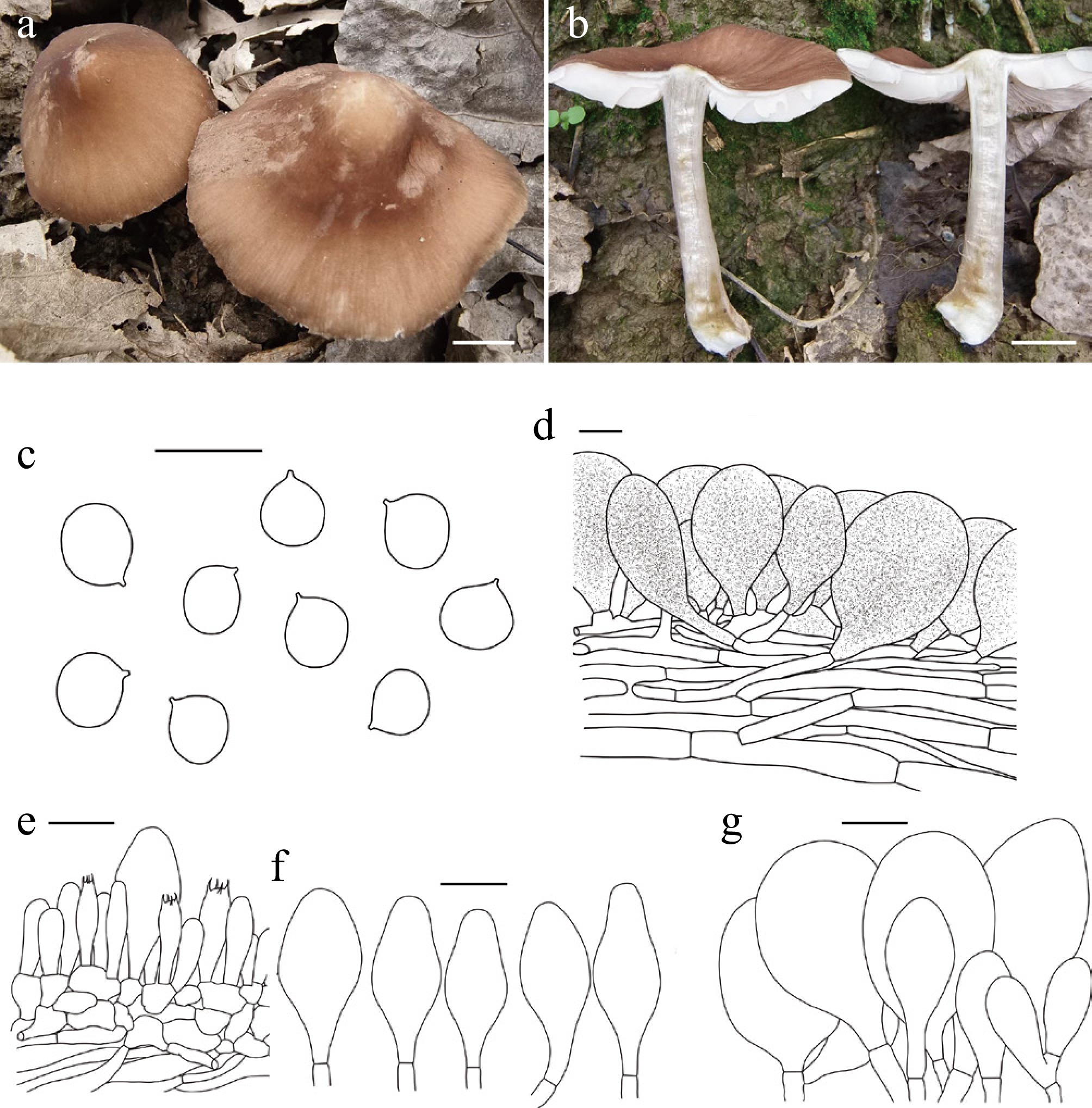
Figure 37.
Pluteus doulianus (HKAS 151279). (a), (b) Basidiome in natural habitat. (c) Basidiospores. (d) Pileipellis with terminal elements. (e) Basidia and subhymenium. (f) Pleurocystidia. (g) Cheilocystidia. Scale bars: (a), (b) = 1 cm, (c) = 10 μm, (d)–(g) = 20 μm.
-
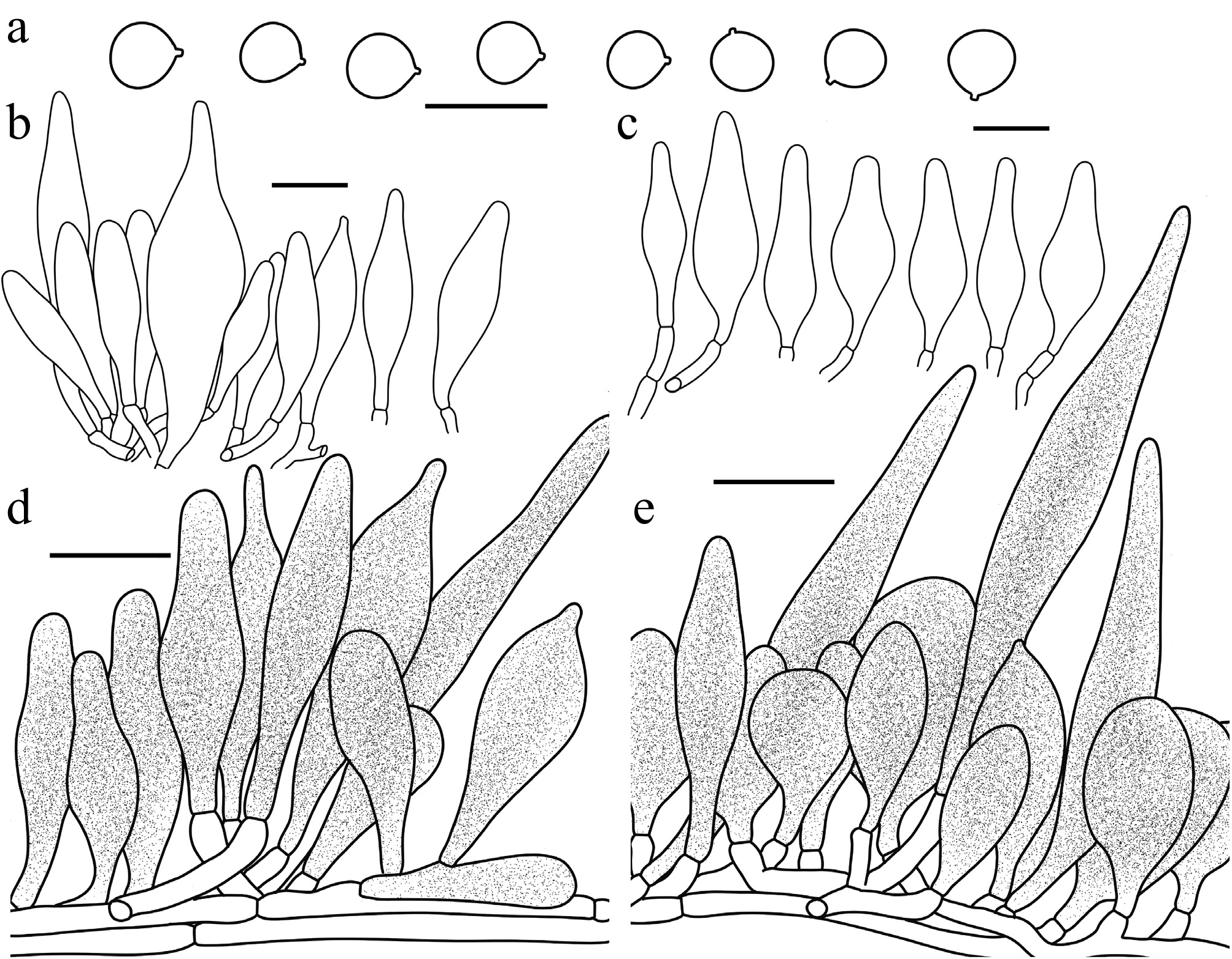
Figure 38.
Pluteus fuscopunctatus (HKAS 151284). (a) Basidiospores. (b) Cheilocystidia. (c) Pleurocystidia. (d) Stipitipellis with caulocystidia. (e) Pileipellis with two types of terminal elements. Scale bars: (a) = 10 μm, (b)–(e) = 20 μm.
-
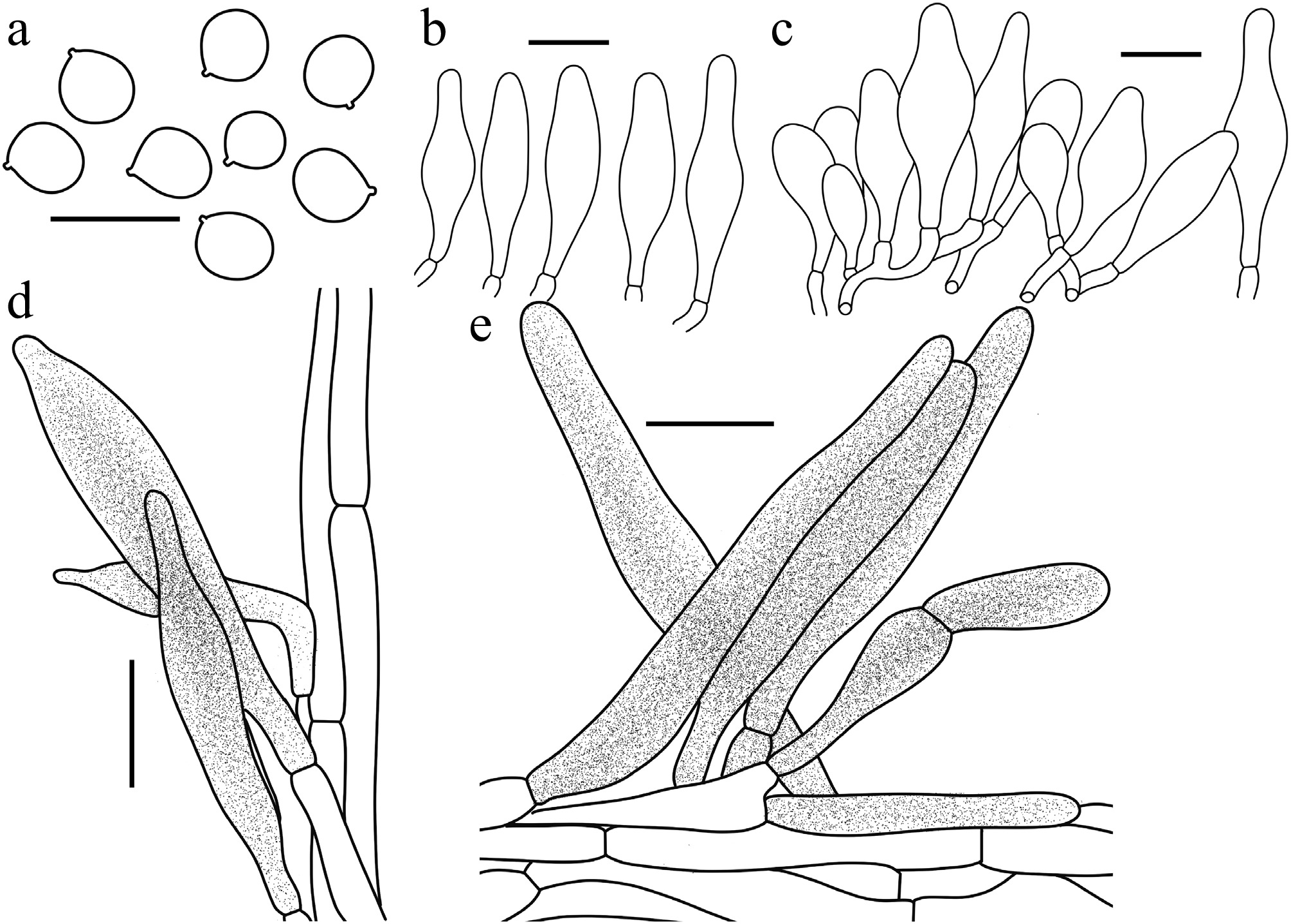
Figure 39.
Pluteus hirtellus (HKAS 151286). (a) Basidiospores. (b) Cheilocystidia. (c) Pleurocystidia. (d) Pileipellis with terminal elements. (e) Stipitipellis with caulocystidia. Scale bar: (a) =10 μm, (b)–(e) = 20 μm.
-
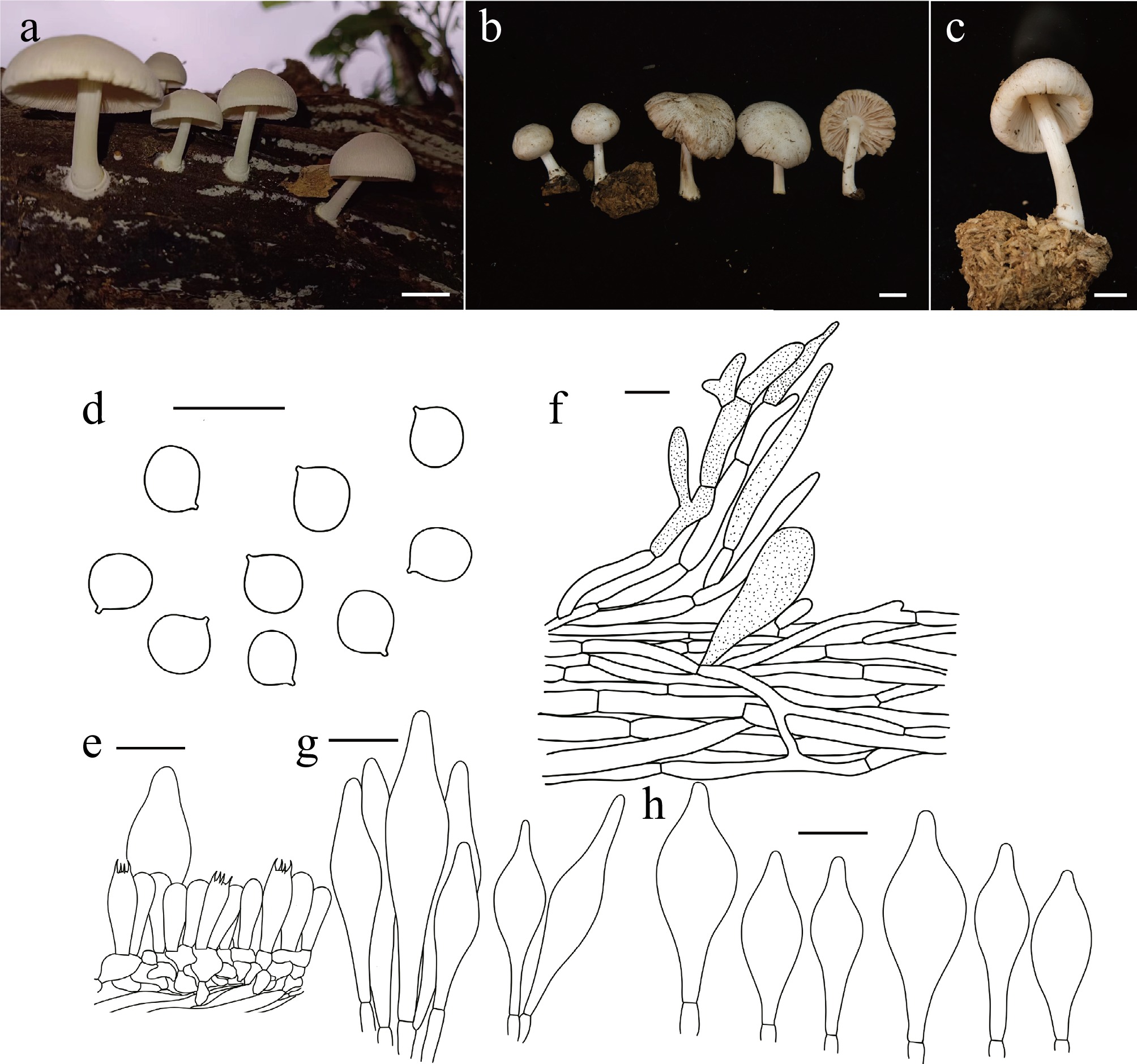
Figure 40.
Pluteus lalepiorum (HKAS 151288). (a)–(c) Basidiomes in natural habitat. (d) Basidiospores. (e) Basidia and subhymenium. (f) Pileipellis with ascending elements. (g) Cheilocystidia. (h) Pleurocystidia. Scale bars: (a)–(c) = 1 cm, (d) = 10 μm, (e)–(h) = 20 μm.
-
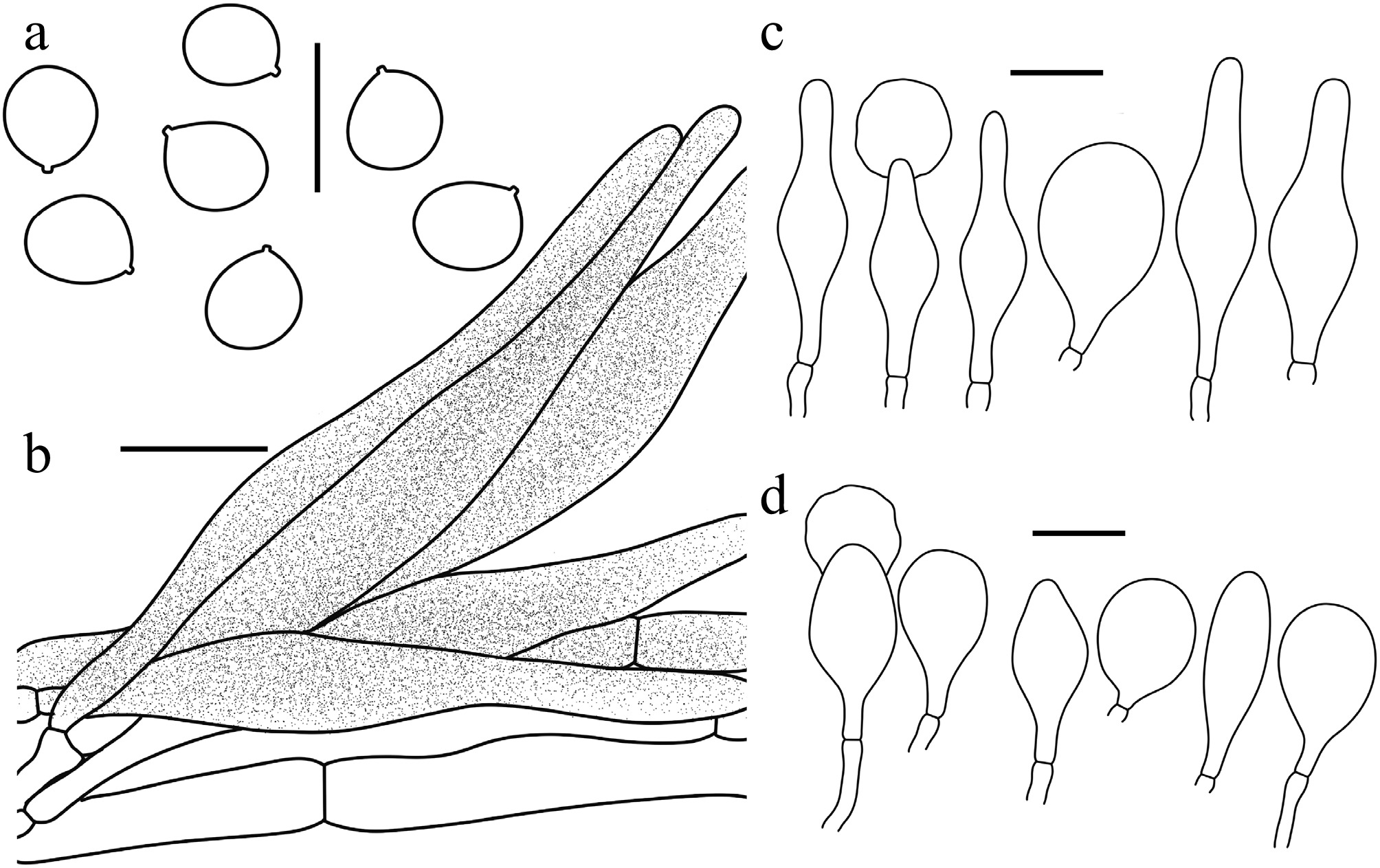
Figure 41.
Pluteus lepiotoides (HKAS 71854). (a) Basidiospores. (b) Pileipellis with terminal elements. (c) Pleurocystidia. (d) Cheilocystidia. Scale bars: (a) = 10 μm, (b)–(d) = 20 μm.
-
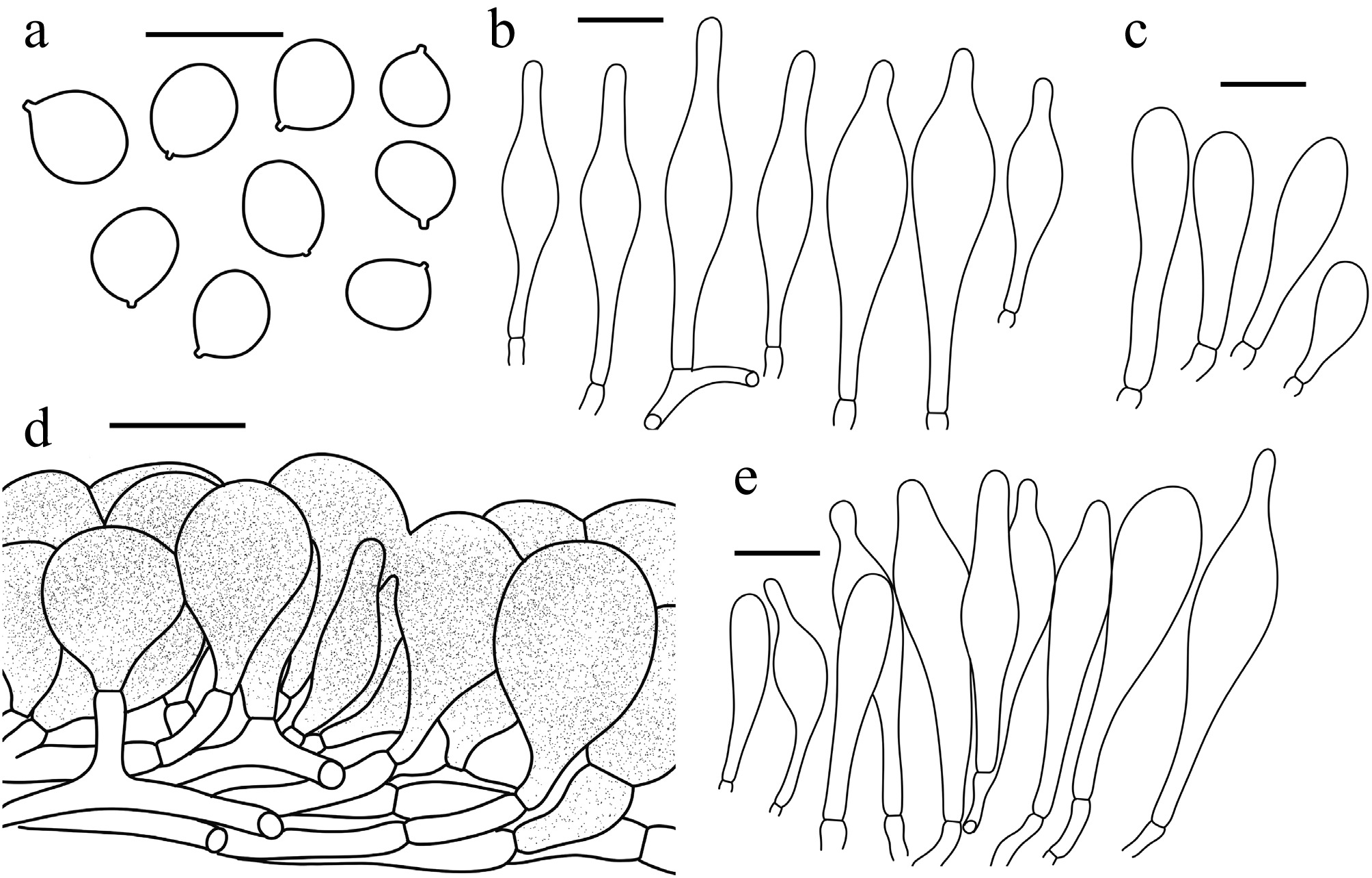
Figure 42.
Pluteus phlebophorus (HKAS 77912). (a) Basidiospores. (b) Pleurocystidia. (c) Caulocystidia. (d) Pileipellis with terminal elements. (e) Cheilocystidia. Scale bars: (a) = 10 μm, (b)–(e) = 20 μm.
-
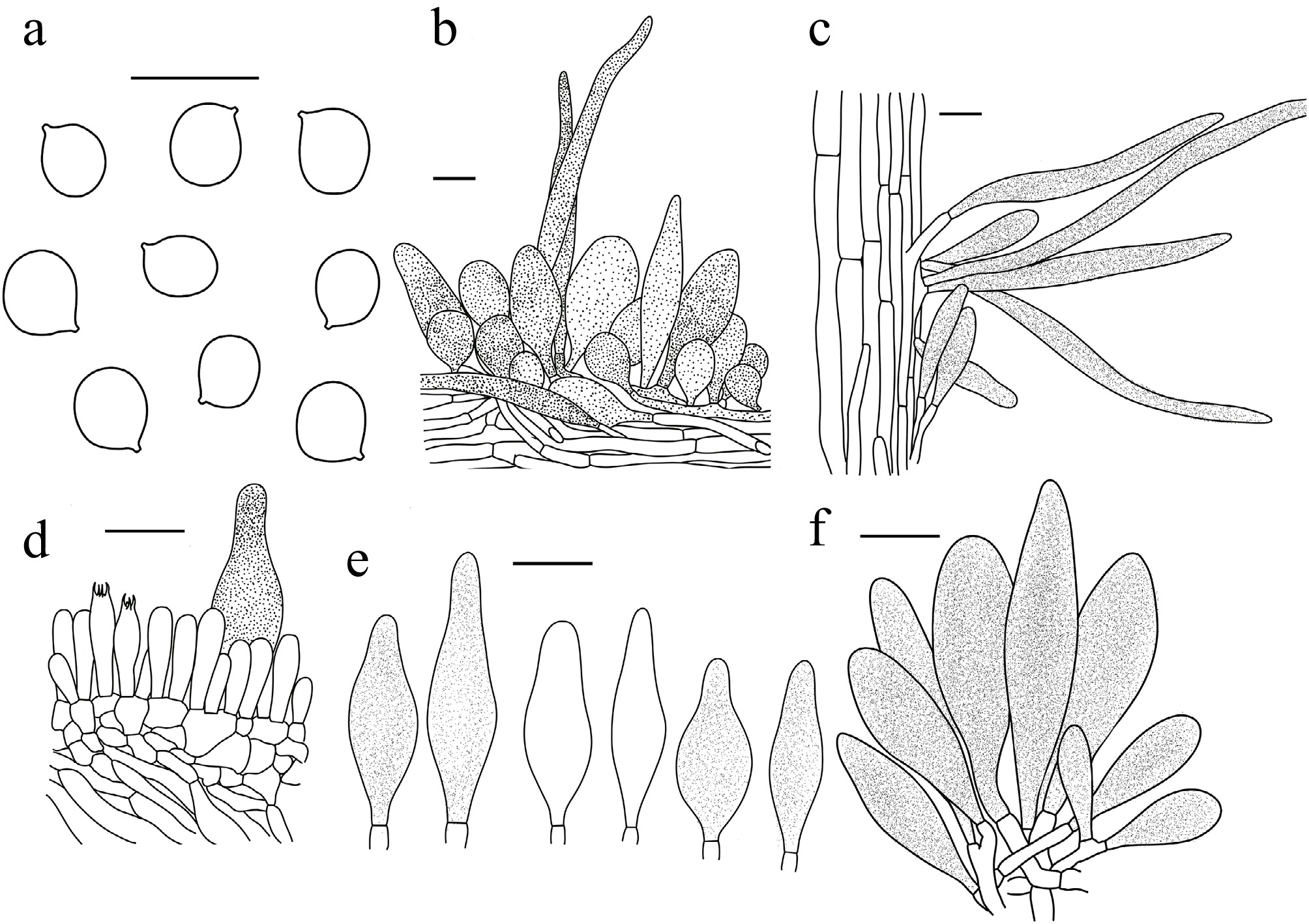
Figure 43.
Pluteus podospilloides (HKAS 151167). (a) Basidiospores. (b) Pileipellis with two types of terminal elements. (c) Stipitipellis with caulocystidia. (d) Basidia. (e) Pleurocystidia. (f) Cheilocystidia. Scale bars: (a) = 10 μm, (b)–(f) = 20 μm.
-
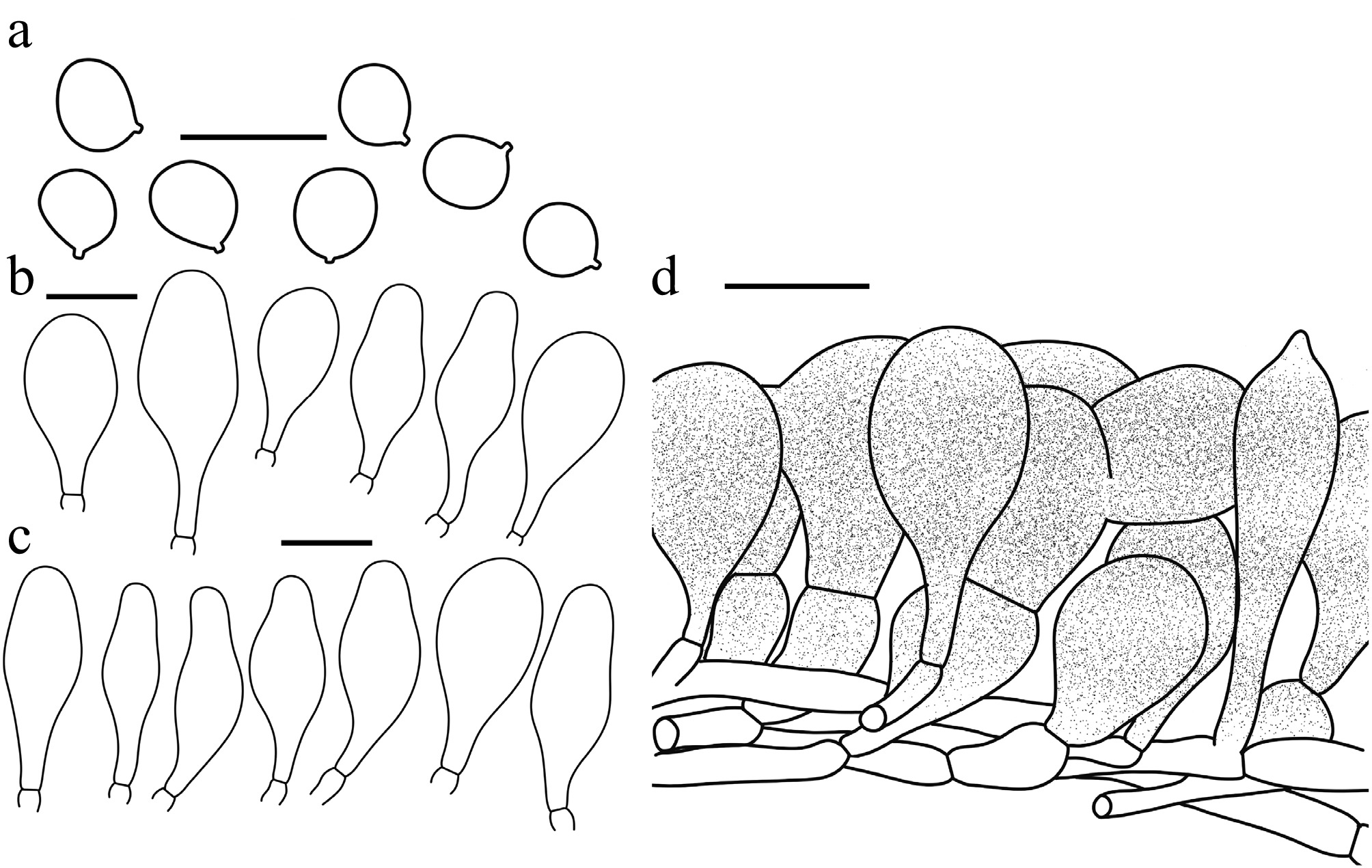
Figure 44.
Pluteus romellii (HKAS 151084). (a) Basidiospores. (b) Cheilocystidia. (c) Pleurocystidia. (d) Pileipellis with terminal elements. Scale bars: (a) = 10 μm, (b)–(d) = 20 μm.
-
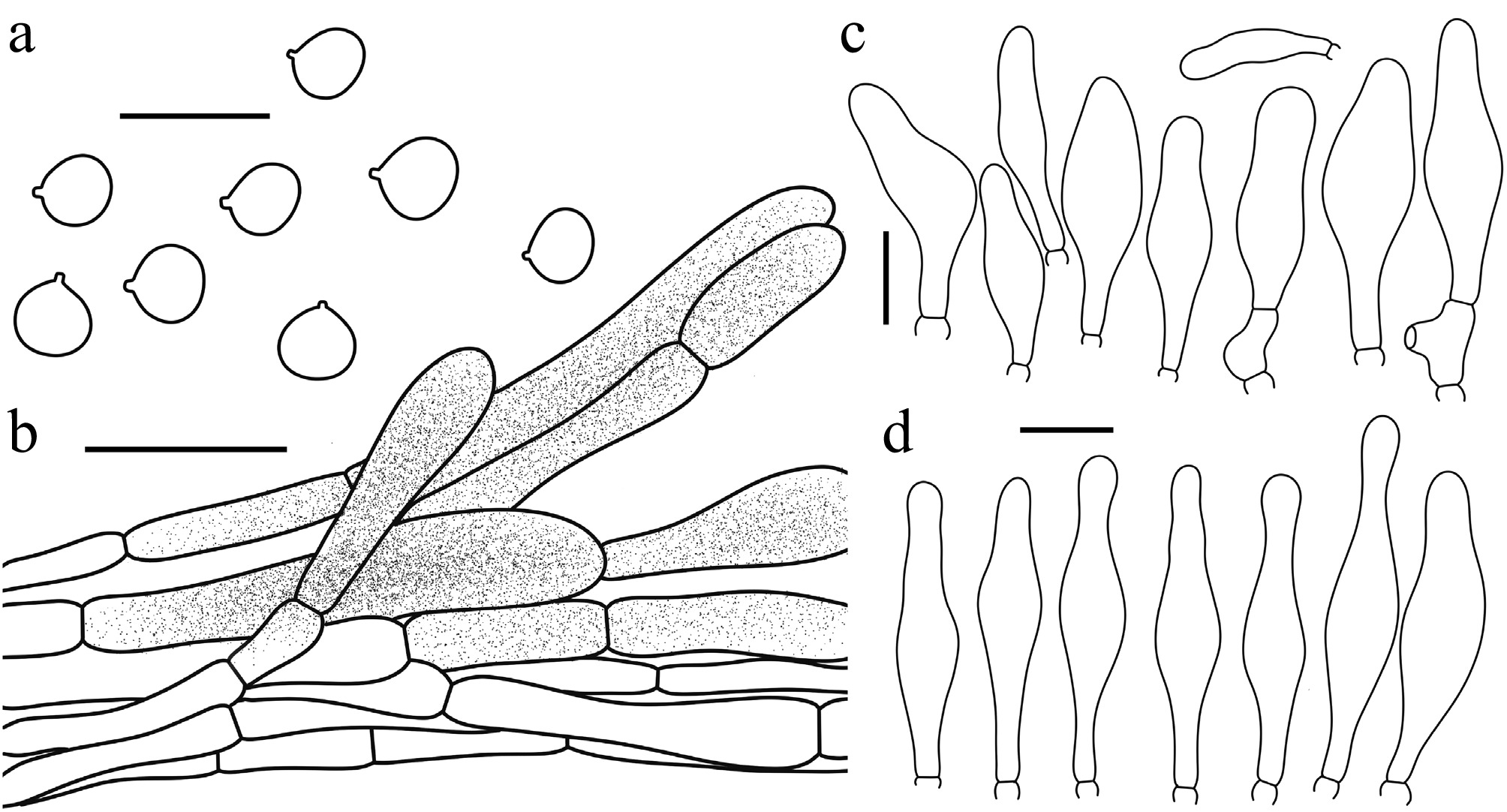
Figure 45.
Pluteus squamulososulcatus (HKAS 151301). (a) Basidiospores. (b) Pileipellis with terminal elements. (c) Cheilocystidia. (d) Pleurocystidia. (c) Scale bars: (a) = 10 μm, (b)–(d) = 20 μm.
-
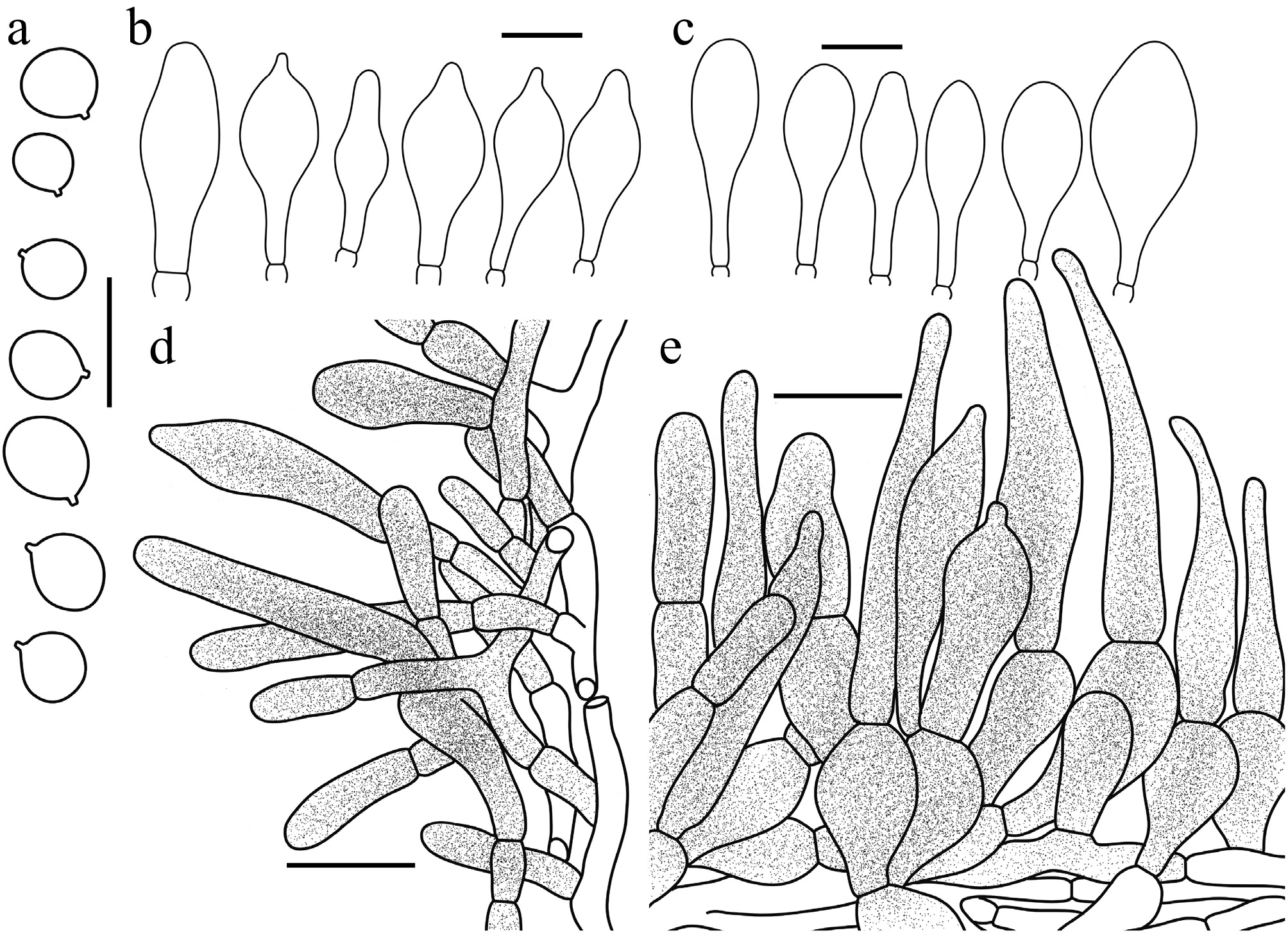
Figure 46.
Pluteus squarrosus (HKAS 151212). (a) Basidiospores. (b) Cheilocystidia. (c) Pleurocystidia. (d) Stipitipellis with caulocystidia. (e) Pileipellis with terminal elements. Scale bars: (a) = 10 μm, (b)–(e) = 20 μm.
-
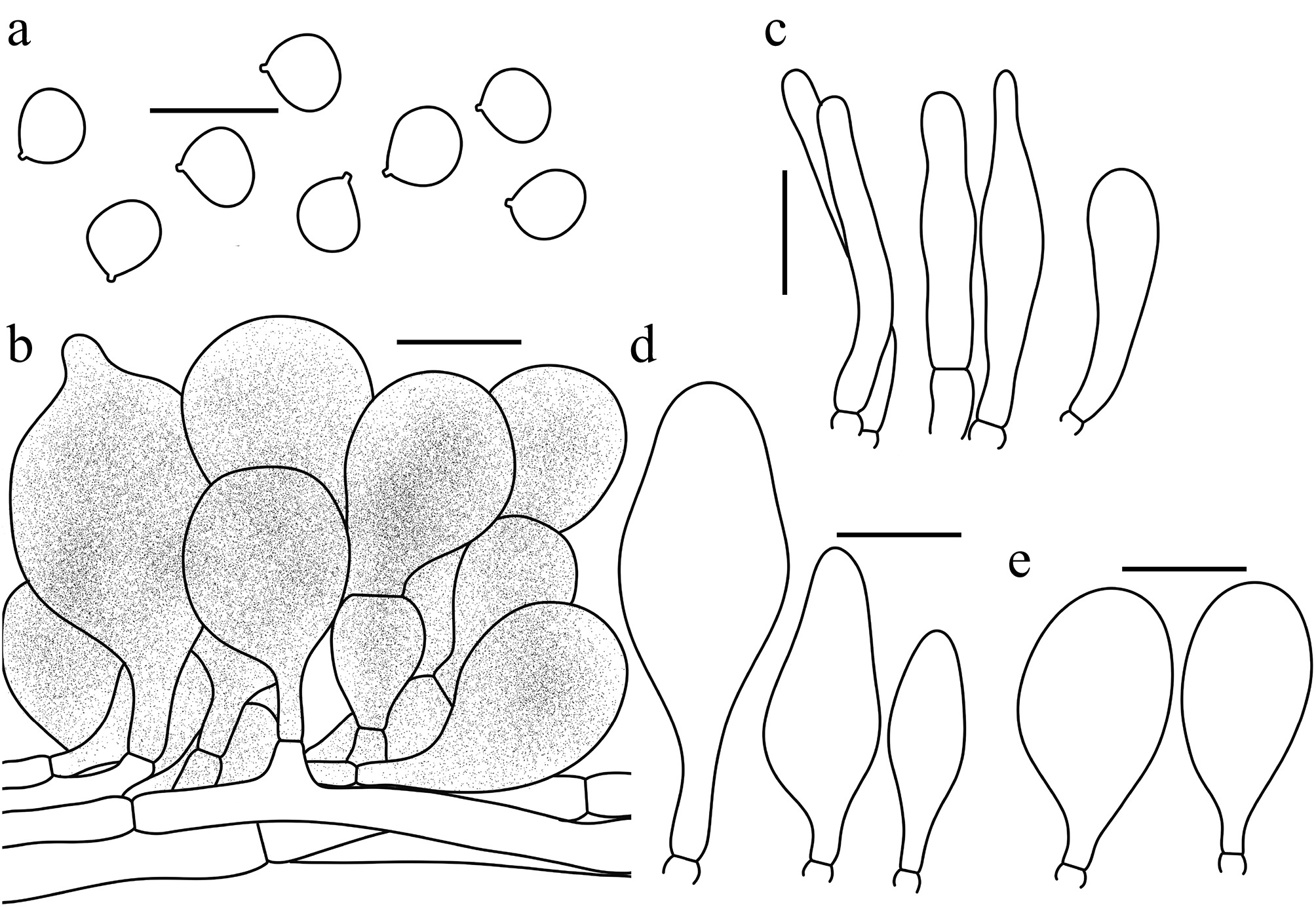
Figure 47.
Pluteus tatafuensis (HKAS 154146). (a) Basidiospores. (b) Pileipellis with terminal elements. (c) Caulocystidia. (d) Pleurocystidia. (e) Cheilocystidia. Scale bars: (a) = 10 μm, (b)–(e) = 20 μm.
-
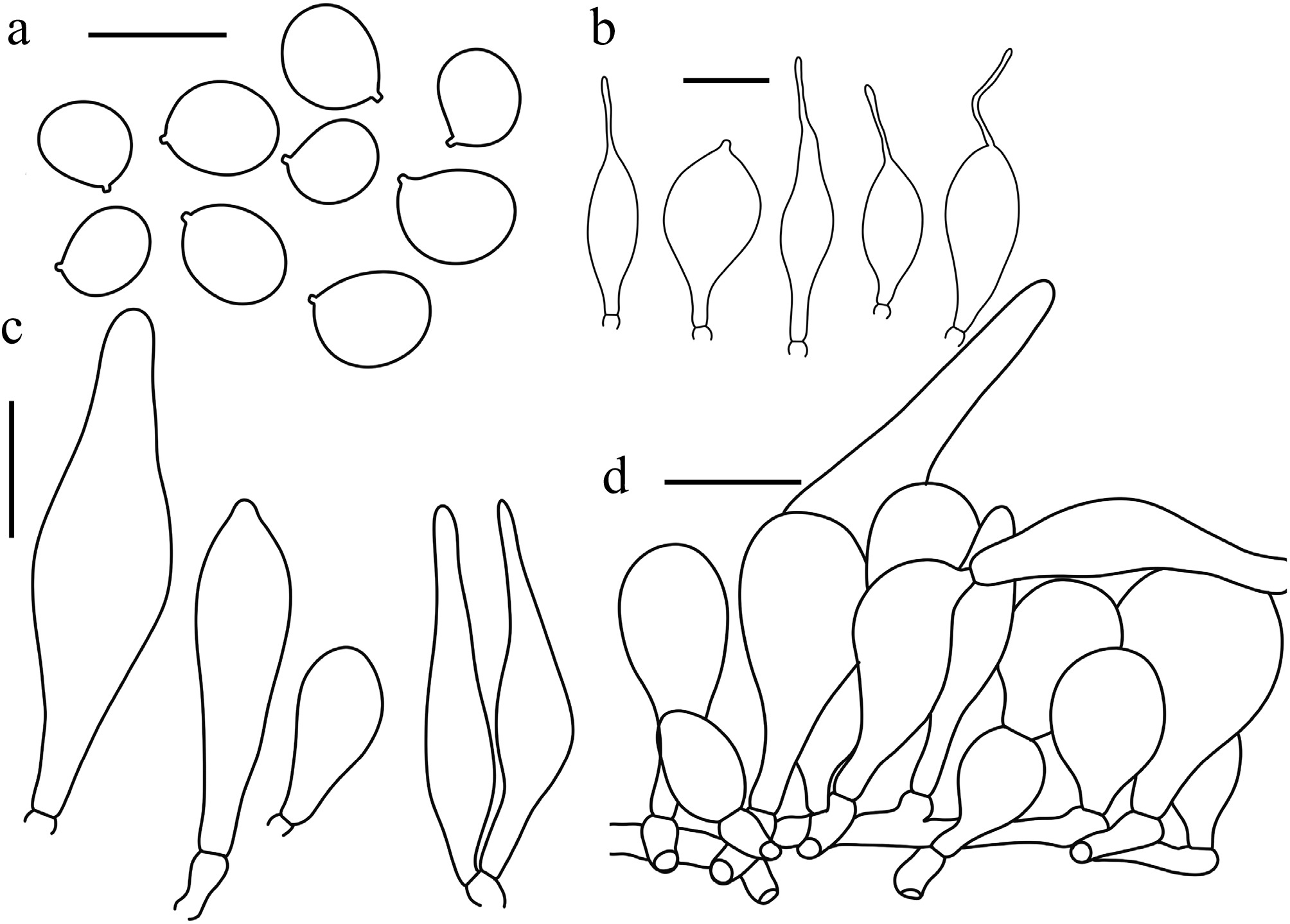
Figure 48.
Pluteus thomsonii (HKAS 112749). (a) Basidiospores. (b) Cheilocystidia. (c) Caulocystidia. (d) Pileipellis with terminal elements. Scale bars: (a) = 10 μm, (b)–(d) = 20 μm.
-
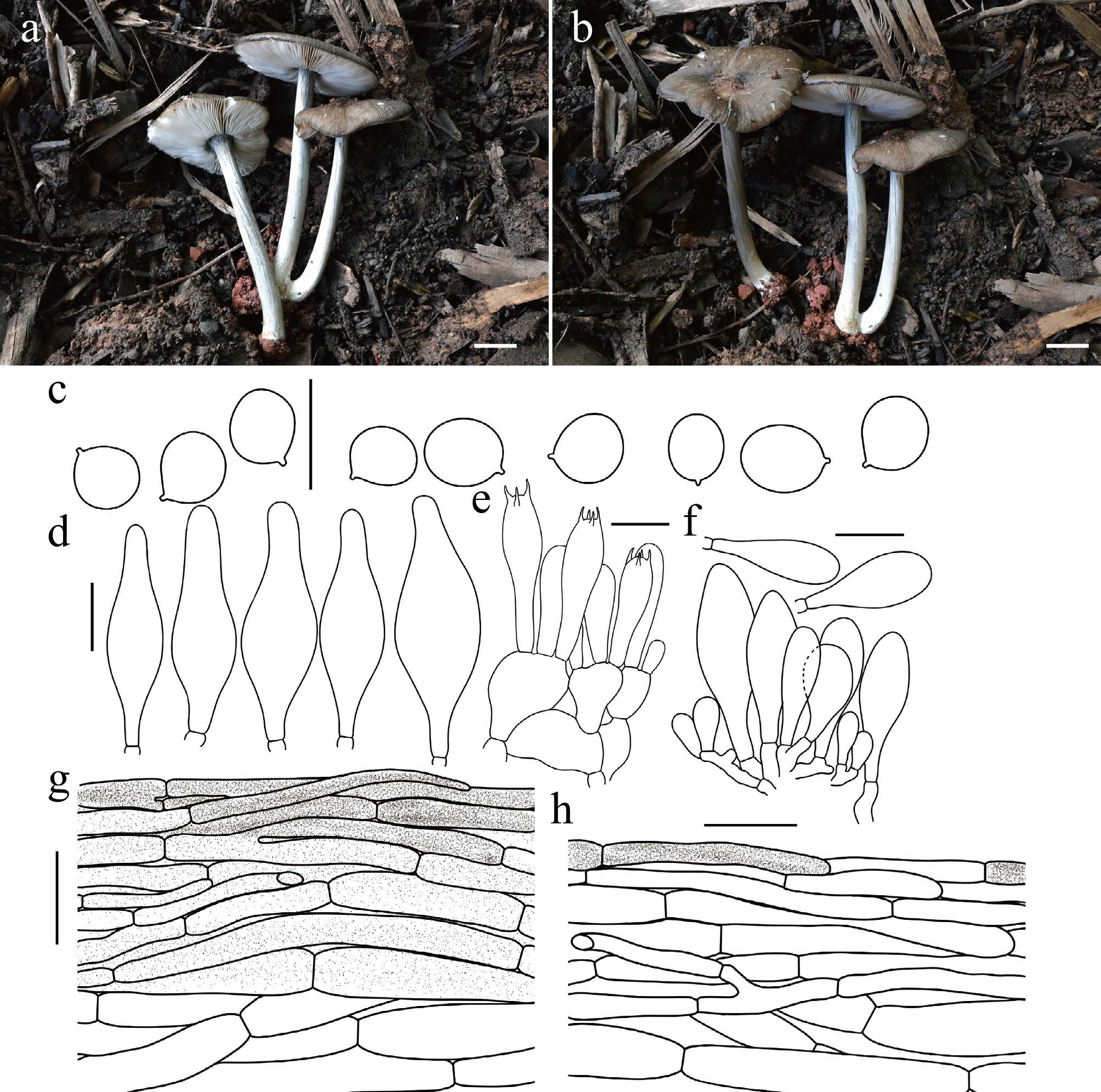
Figure 49.
Pluteus aff. argentinensis (HKAS 151209). (a), (b) Basidiome in natural habitat. (c) Basidiospores. (d) Pleurocystidia. (e) Basidia and subhymenium. (f) Cheilocystidia. (g) Pileipellis. (h) Stipitipellis. Scale bars: (a), (b) = 1 cm, (c), (e) = 10 μm, (d), (f)–(h) = 20 μm.
-
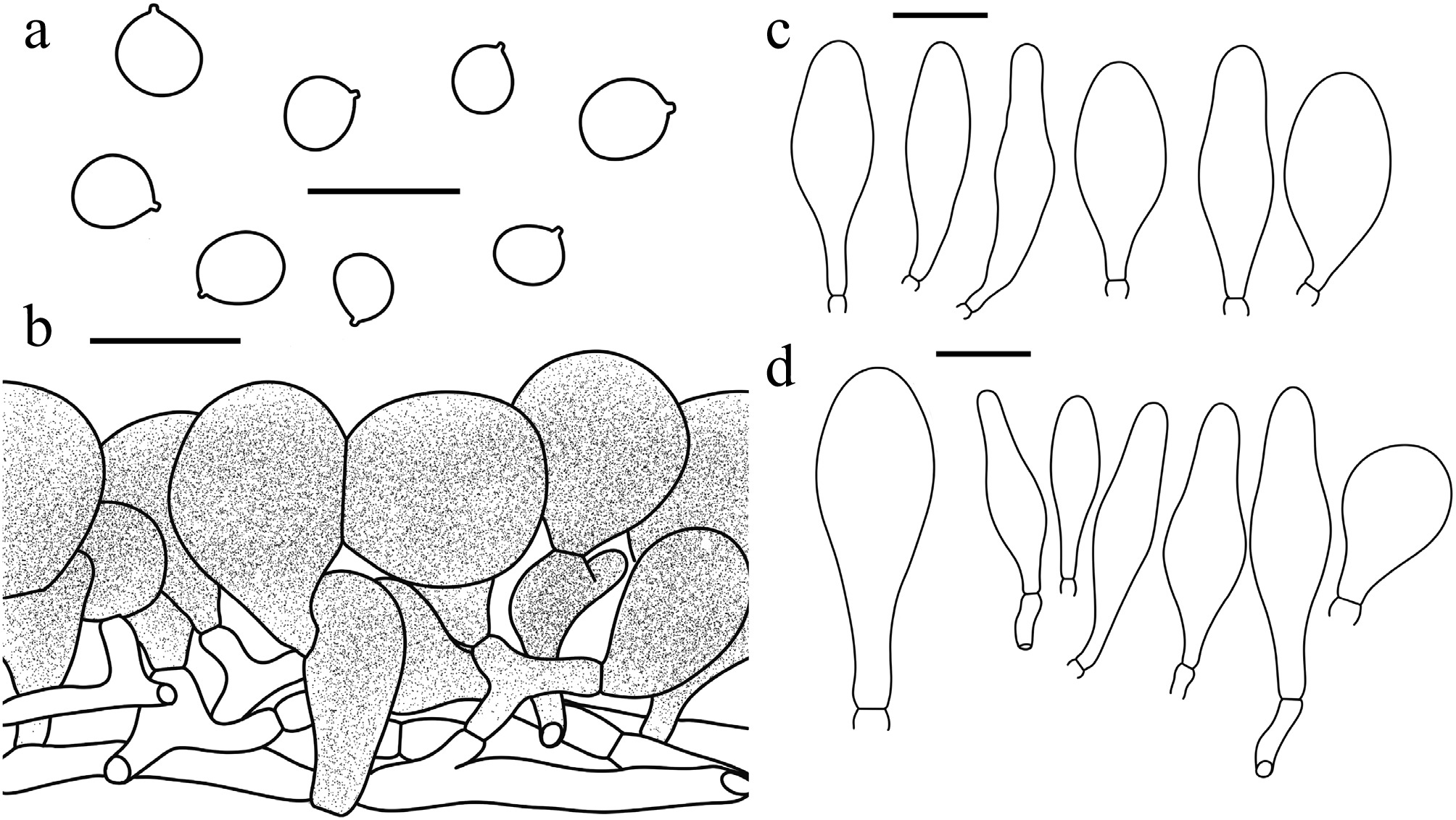
Figure 50.
Pluteus vellingae (HKAS 151203). (a) Basidiospores. (b) Pileipellis with terminal elements. (c) Pleurocystidia. (d) Cheilocystidia. Scale bars: (a) = 10 μm, (b)–(d) = 20 μm.
-
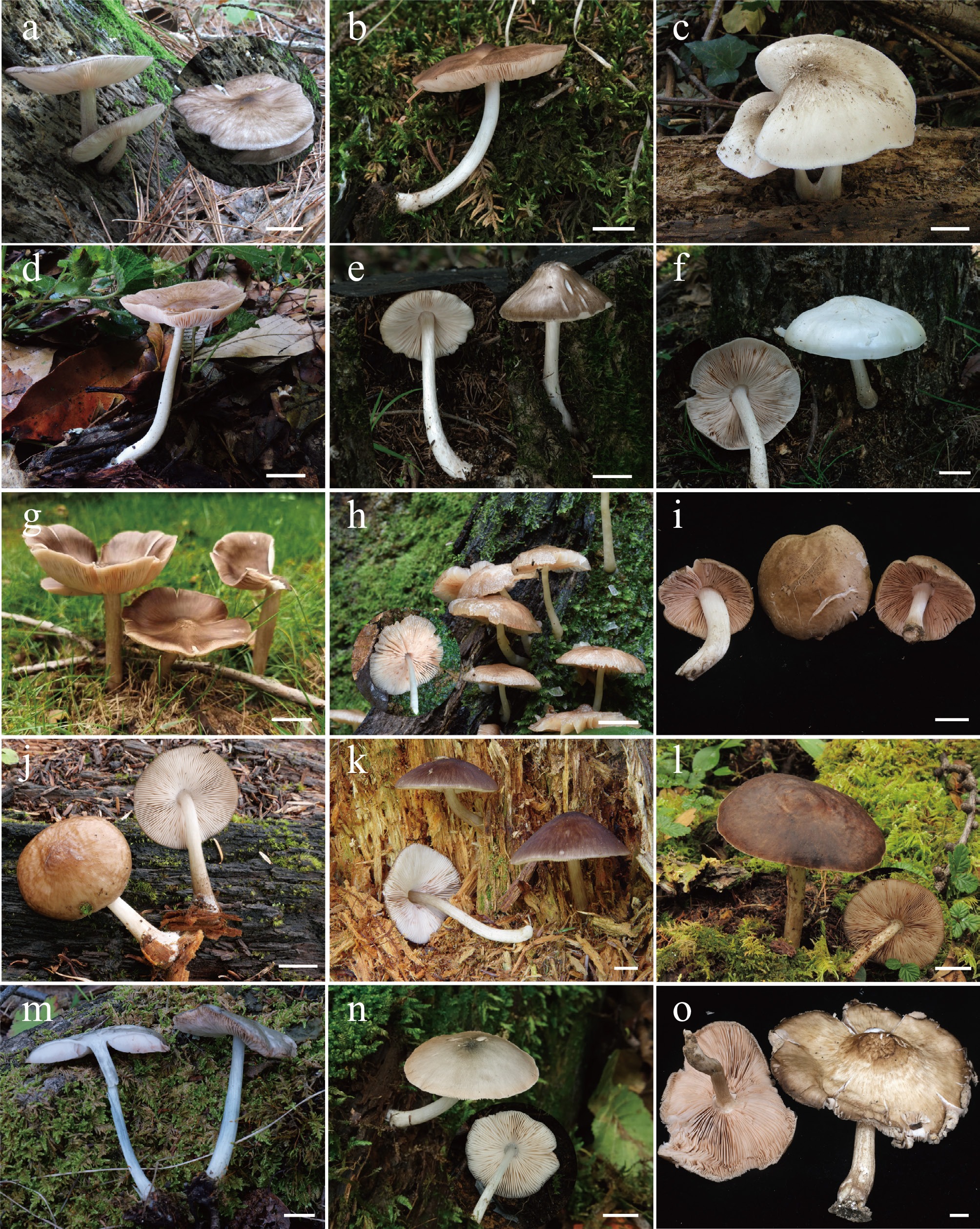
Figure 51.
Fresh basidiomes of Pluteus sect. Pluteus. (a) P. atromarginatus (HKAS 755545). (b) P. brunneidiscus (HKAS 150971). (c) P. cervinus (HKAS 104344). (d) P. conformis (HKAS 92364). (e) P. hongoi (HKAS 150936). (f) P. leucoborealis (HKAS 150930). (g) P. losulus (HKAS 151293). (h) P. padanilus (HKAS 124920). (i) P. petasatus (HKAS 151295). (j) P. pouzarianus (HKAS 119955). (k) P. purpureofuscus (HKAS 48956). (l) P. rangifer (HKAS 113167). (m) P. salicinus (HKAS 151194). (n) P. sepiicolor (HKAS 151145). (o) P. xylophilus (HKAS 151298).
-
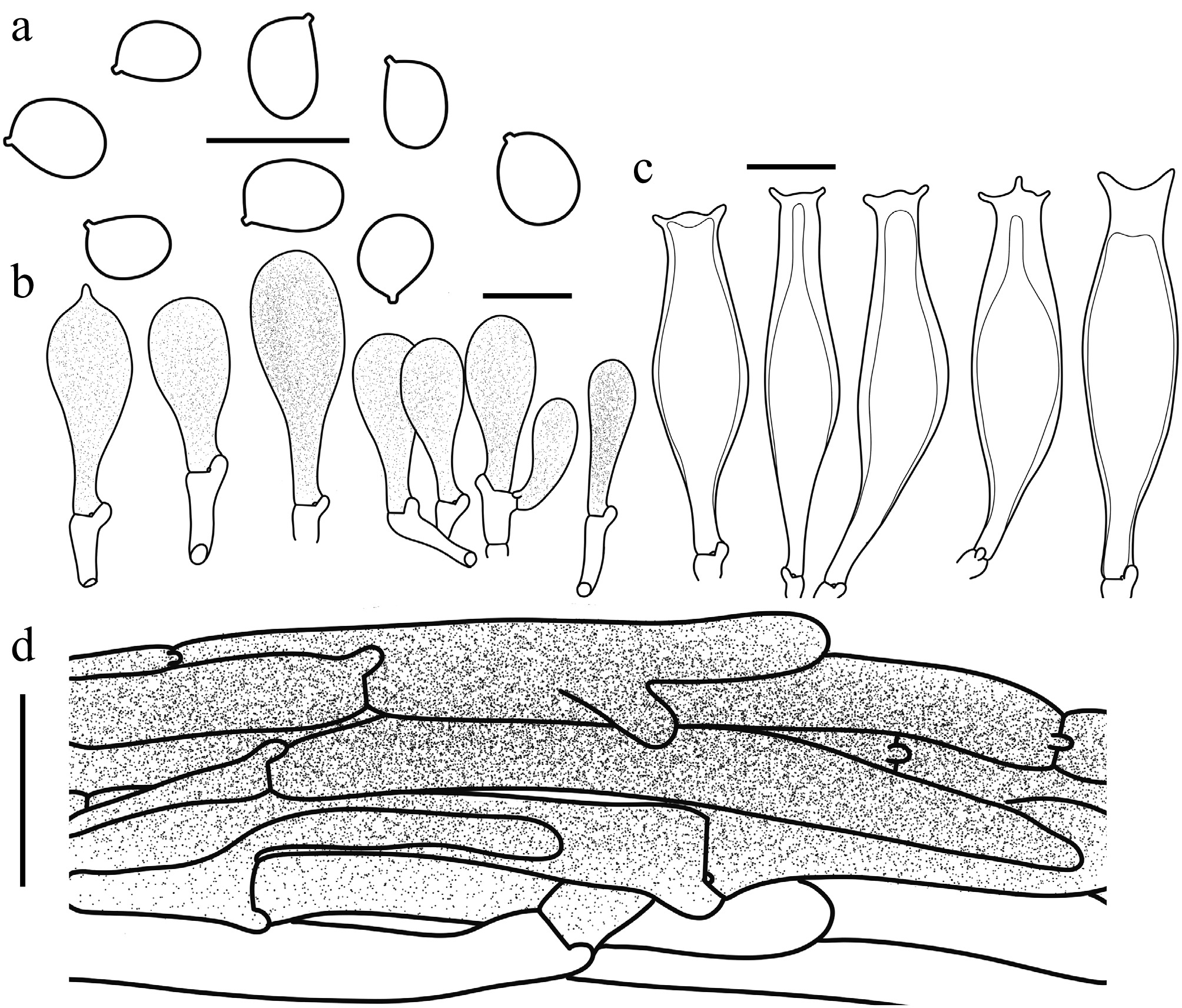
Figure 52.
Pluteus atromarginatus (HKAS 151291). (a) Basidiospores. (b) Cheilocystidia. (c) Pleurocystidia. (d) Pileipellis. Scale bars: (a) = 10 μm, (b)–(d) = 20 μm.
-
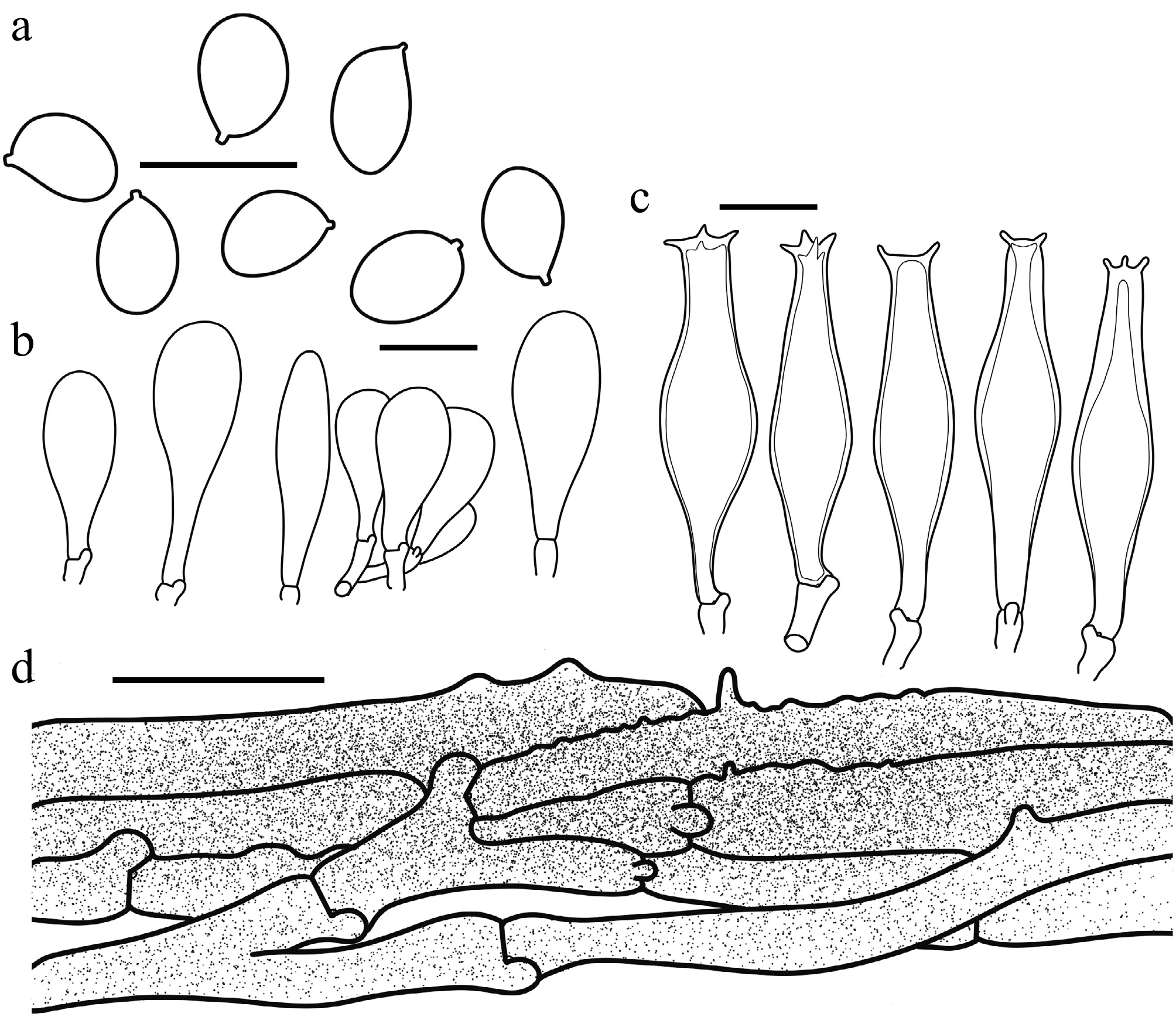
Figure 53.
Pluteus brunneidiscus (HKAS 150971). (a) Basidiospores. (b) Cheilocystidia. (c) Pleurocystidia. (d) Pileipellis. Scale bars: (a) = 10 μm, (b)–(d) = 20 μm.
-
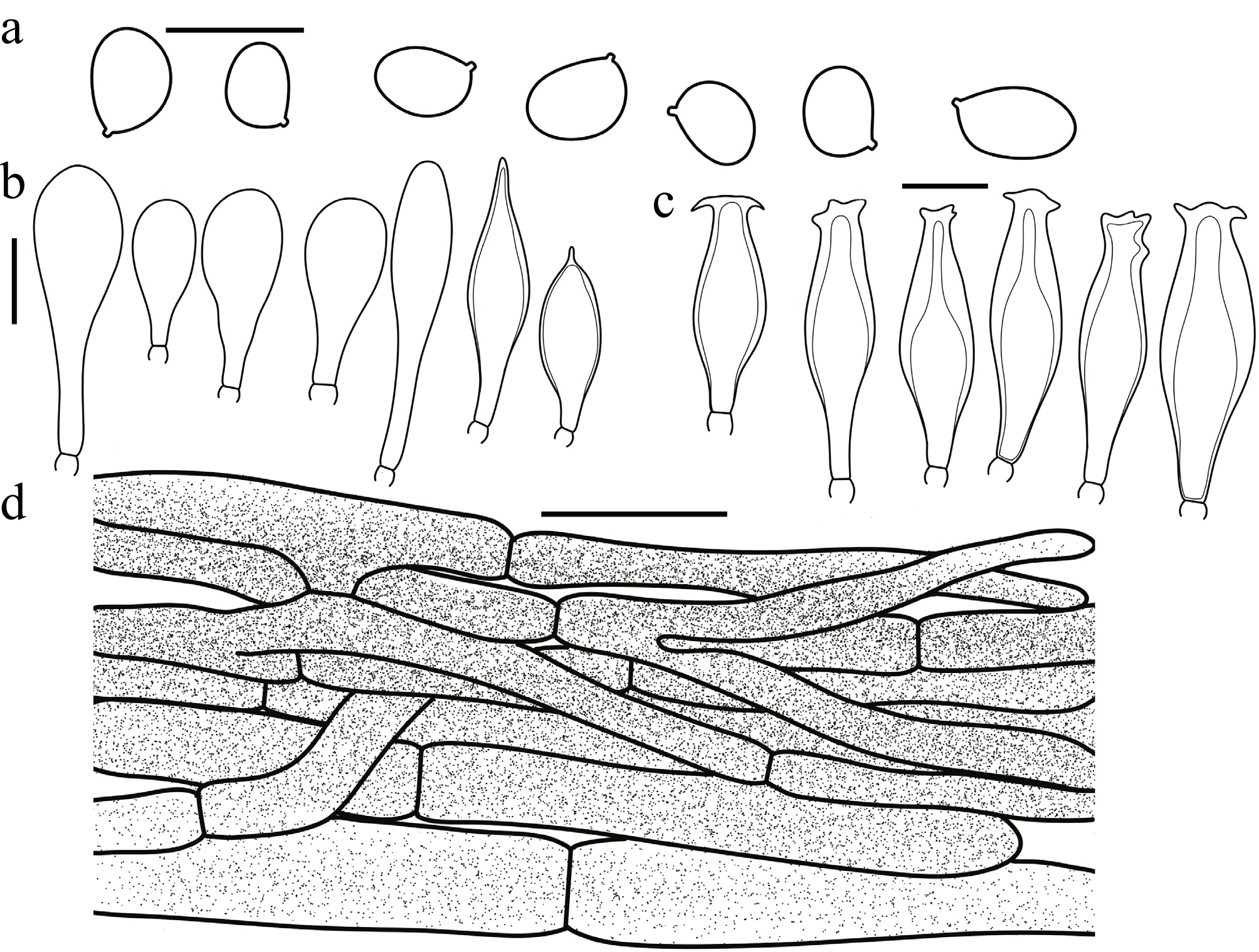
Figure 54.
Pluteus conformis (HKAS 151292). (a) Basidiospores. (b) Cheilocystidia. (c) Pleurocystidia. (d) Pileipellis. Scale bars: (a) = 10 μm, (b)–(d) = 20 μm.
-
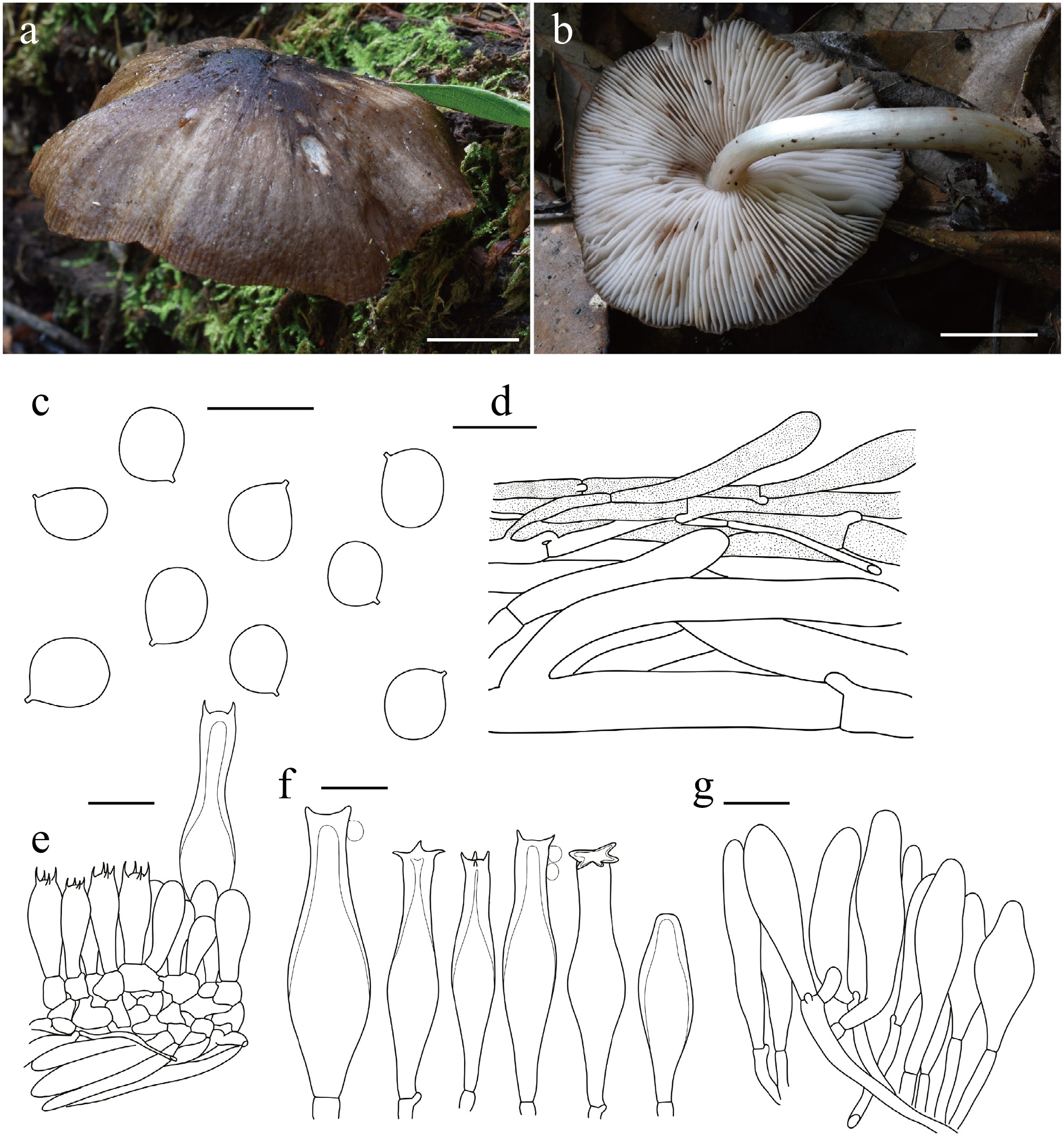
Figure 55.
Pluteus griseostriatus (HKAS 127791). (a)–(b) Basidiome in natural habitat. (c) Basidiospores. (d) Pileipellis. (e) Basidia, pleurocystidium and subhymenium. (f) Pleurocystidia. (g) Cheilocystidia. Scale bars: (a)–(b) = 1 cm, (c) = 10 μm; (d)–(g) = 20 μm.
-
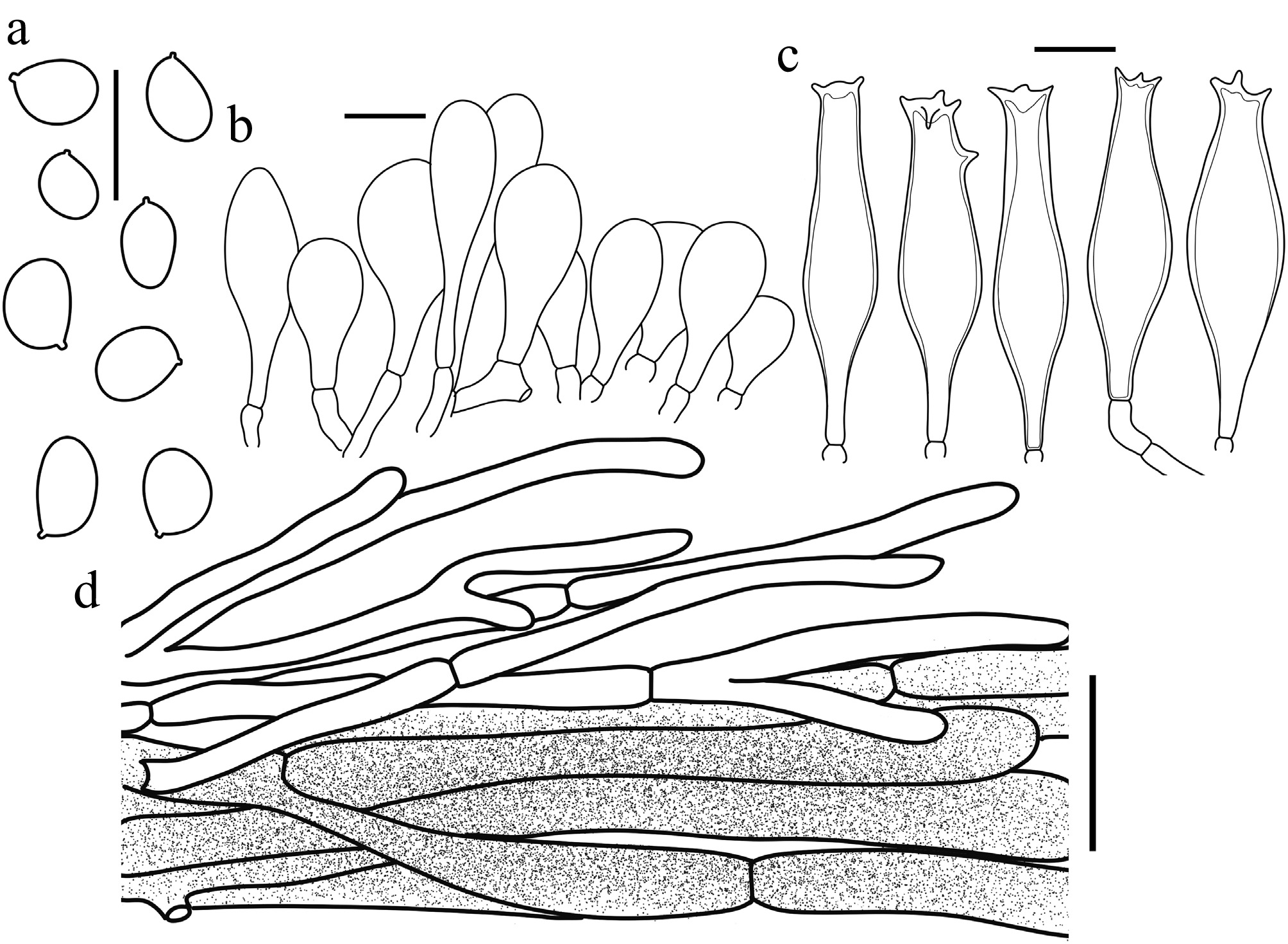
Figure 56.
Pluteus hongoi (HKAS 150974). (a) Basidiospores. (b) Cheilocystidia. (c) Pleurocystidia. (d) Pileipellis. Scale bars: (a) = 10 μm, (b)–(d) = 20 μm.
-
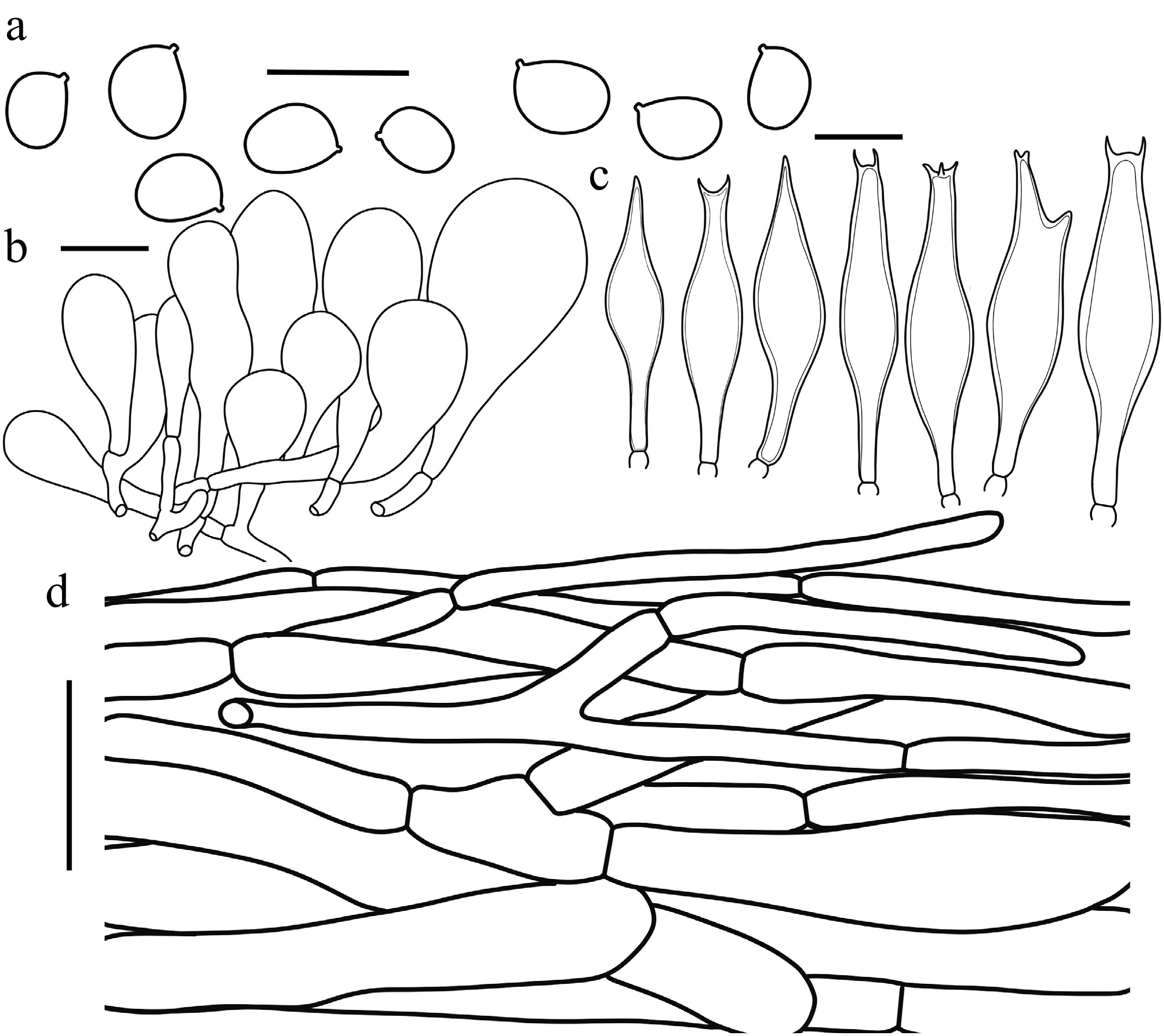
Figure 57.
Pluteus leucoborealis (HKAS 150935). (a) Basidiospores. (b) Cheilocystidia. (c) Pleurocystidia. (d) Pileipellis. Scale bars: (a) = 10 μm, (b)–(d) = 20 μm.
-
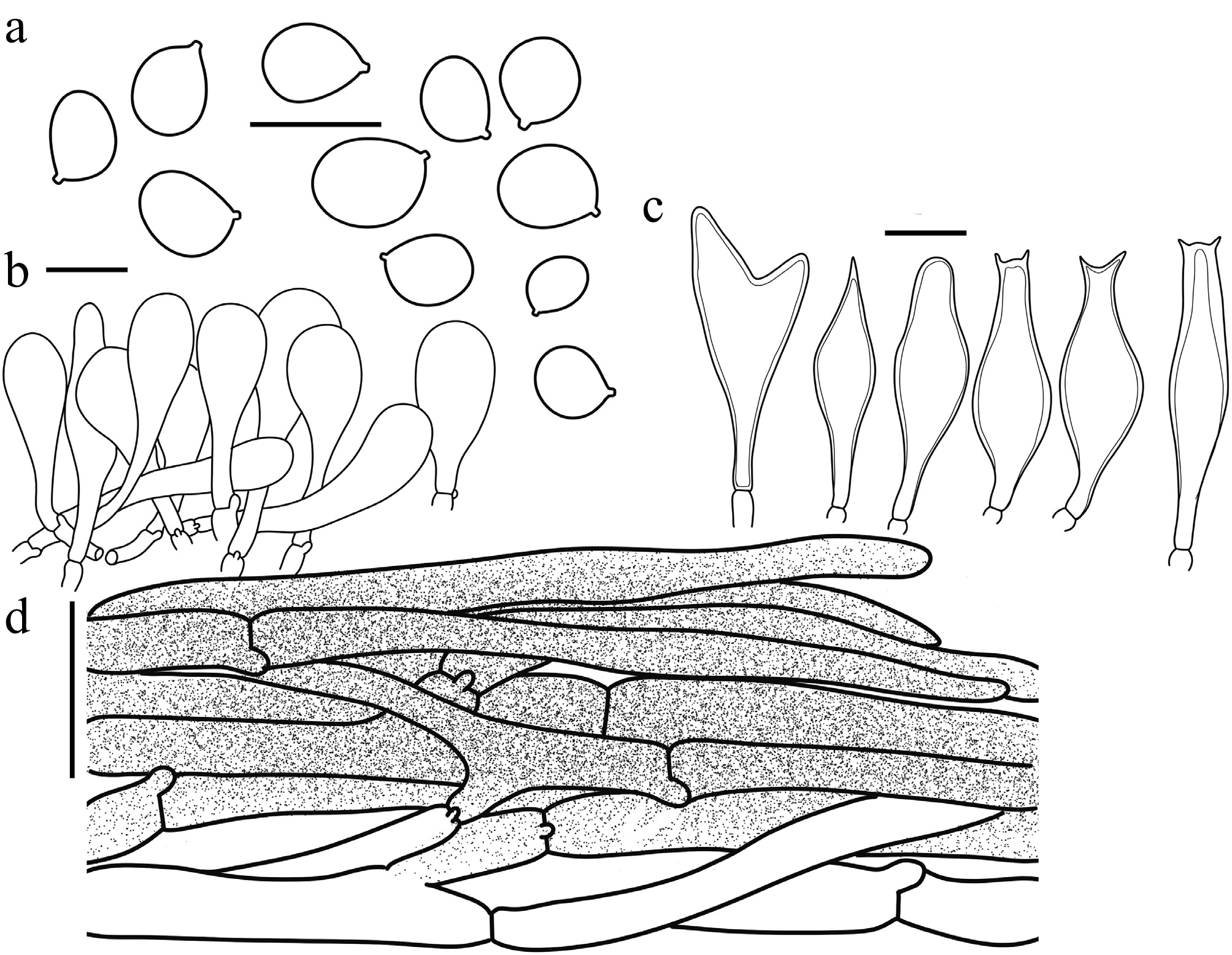
Figure 58.
Pluteus losulus (HKAS 151293). (a) Basidiospores. (b) Cheilocystidia. (c) Pleurocystidia. (d) Pileipellis. Scale bars: (a) = 10 μm, (b)–(d) = 20 μm.
-
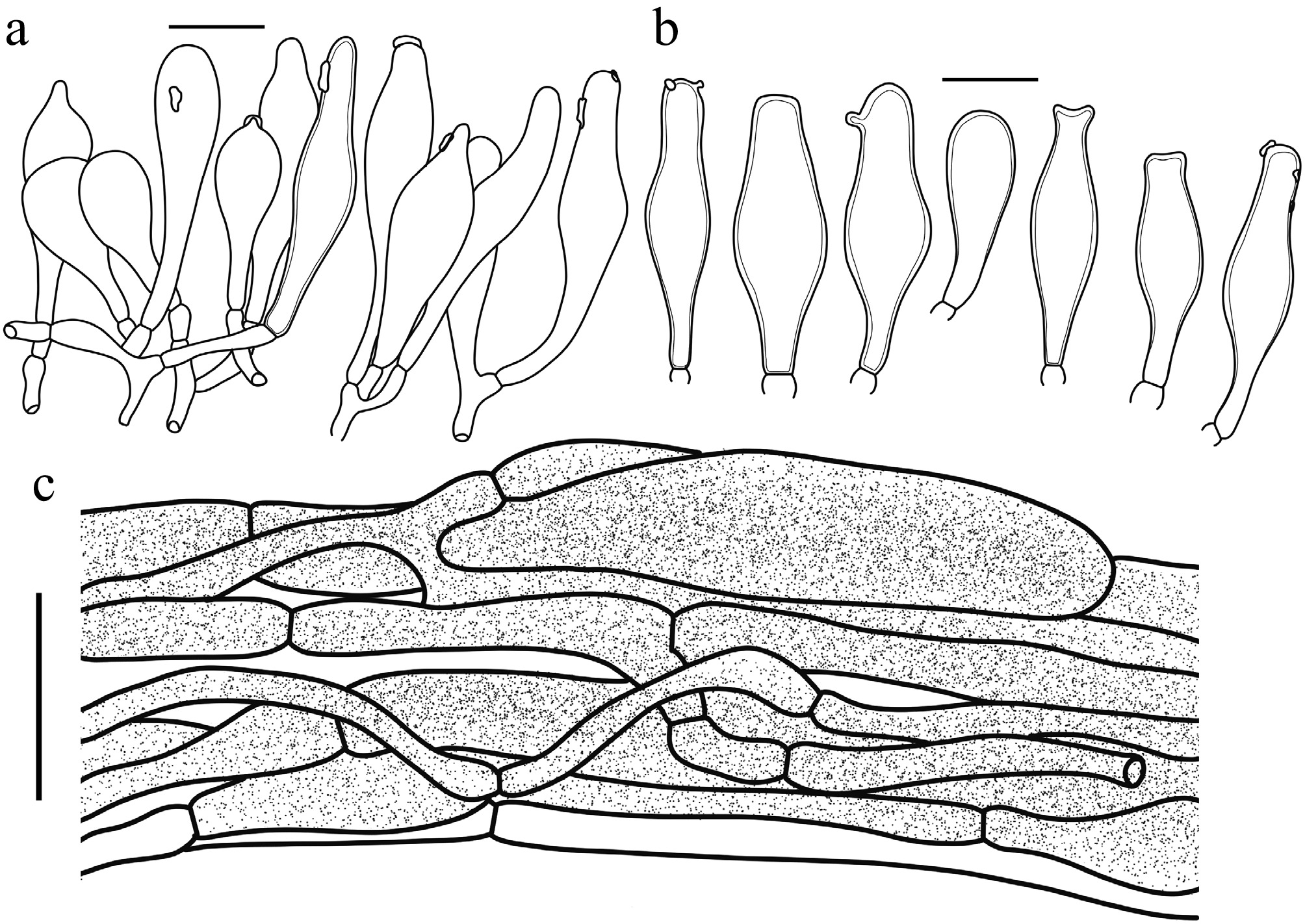
Figure 59.
Pluteus padanilus (HKAS 124920). (a) Cheilocystidia. (b) Pleurocystidia. (c) Pileipellis. Scale bars: (a)–(c) = 20 μm.
-
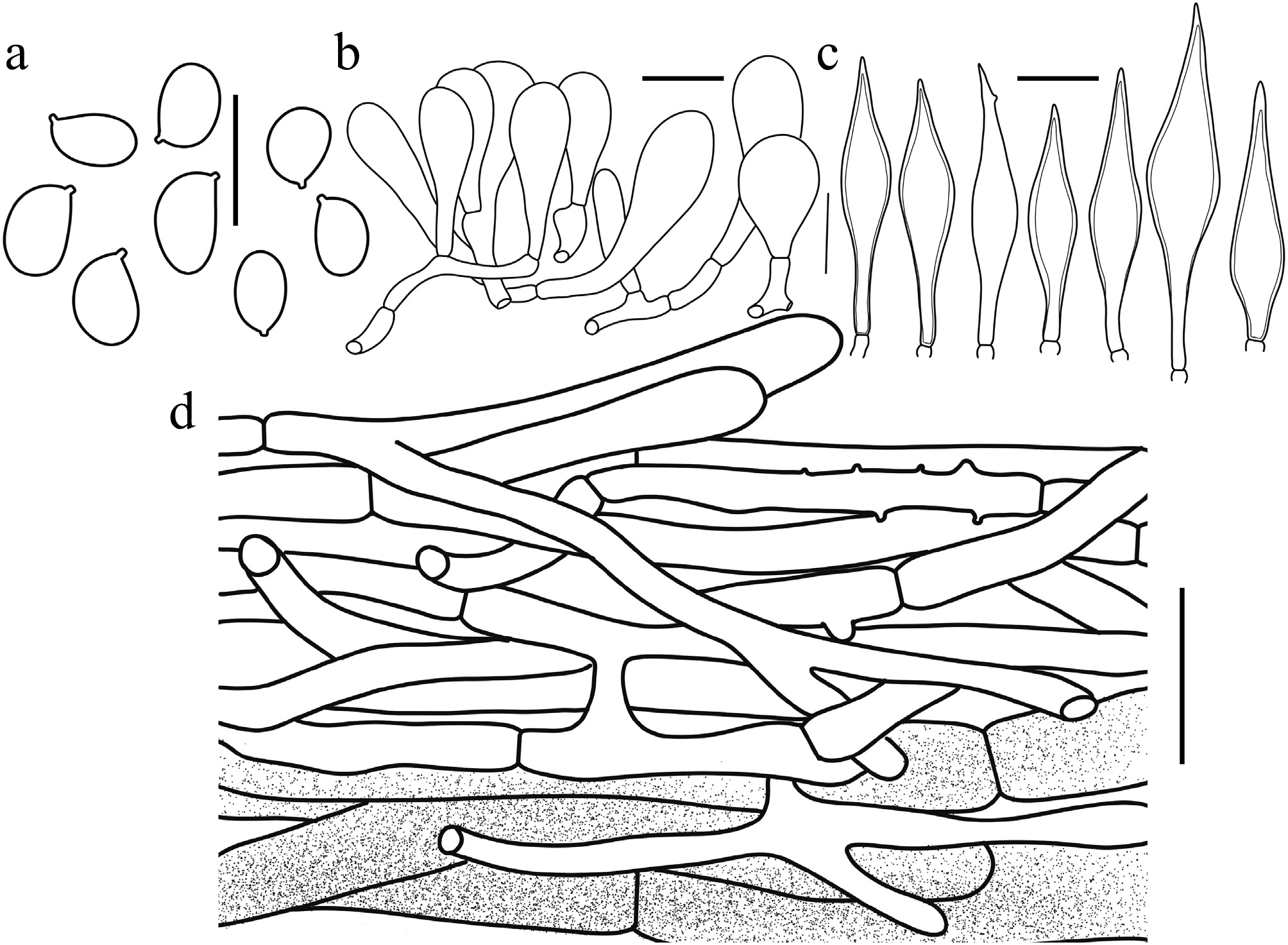
Figure 60.
Pluteus petasatus (HKAS 151276). (a) Basidiospores. (b) Cheilocystidia. (c) Pleurocystidia. (d) Pileipellis. Scale bars: (a) = 10 μm, (b)–(d) = 20 μm.
-
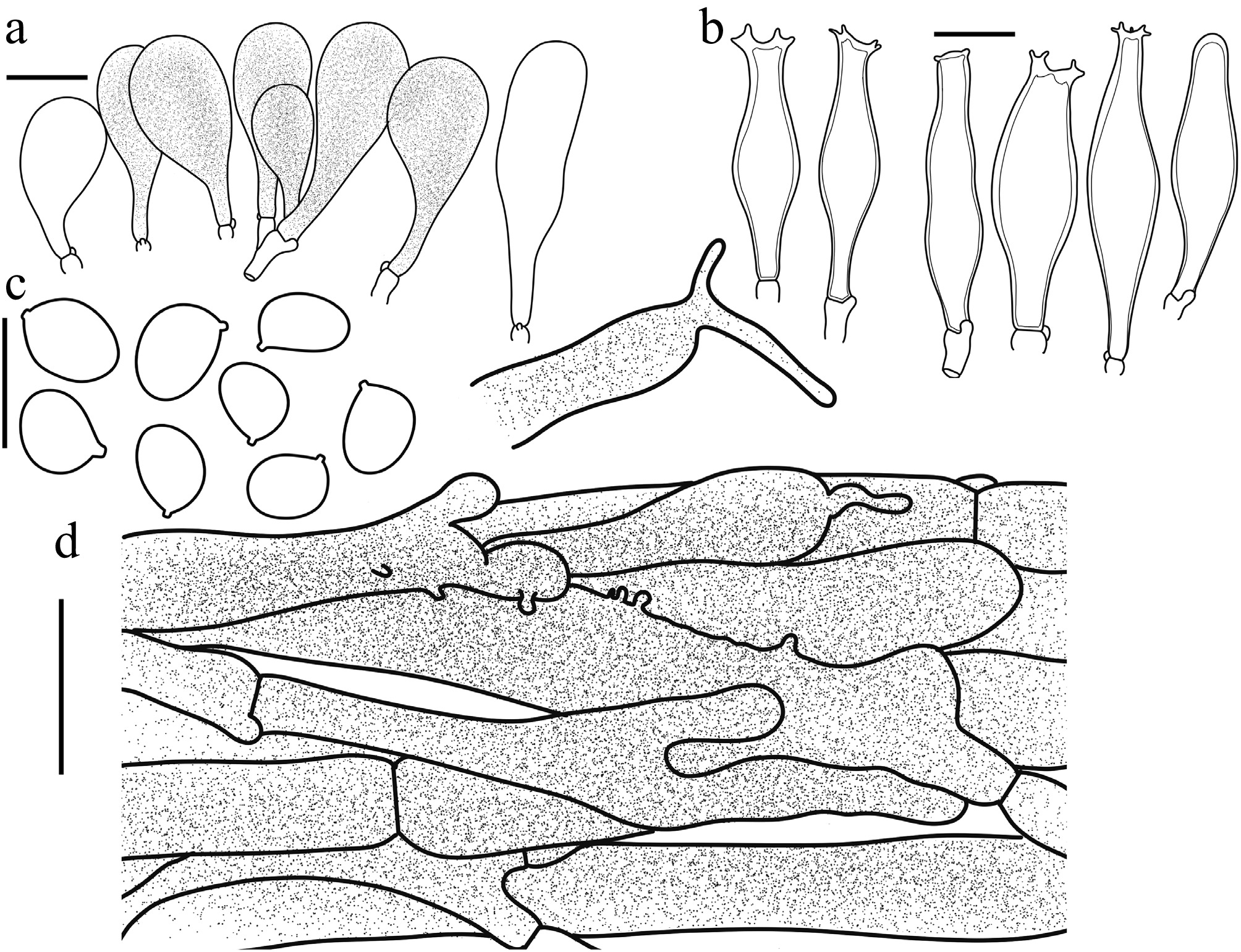
Figure 61.
Pluteus pouzarianus (HKAS 119955). (a) Cheilocystidia. (b) Pleurocystidia. (c) Basidiospores. (d) Pileipellis. Scale bars: (c) = 10 μm, (a), (b), (d) = 20 μm.
-
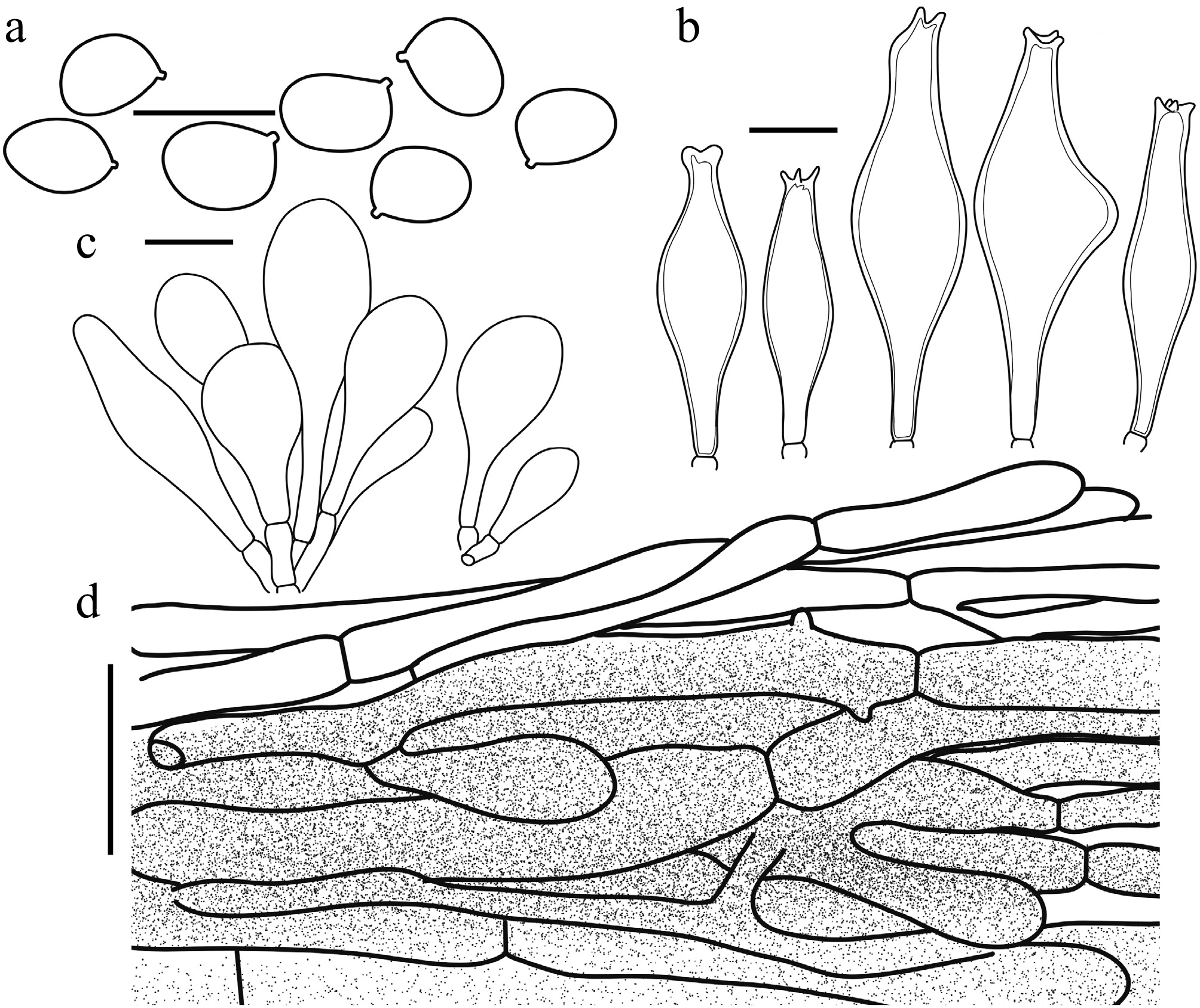
Figure 62.
Pluteus rangifer (HKAS 118267). (a) Basidiospores. (b) Pleurocystidia. (c) Cheilocystidia. (d) Pileipellis. Scale bars: (a) = 10 μm, (b)–(d) = 20 μm.
-
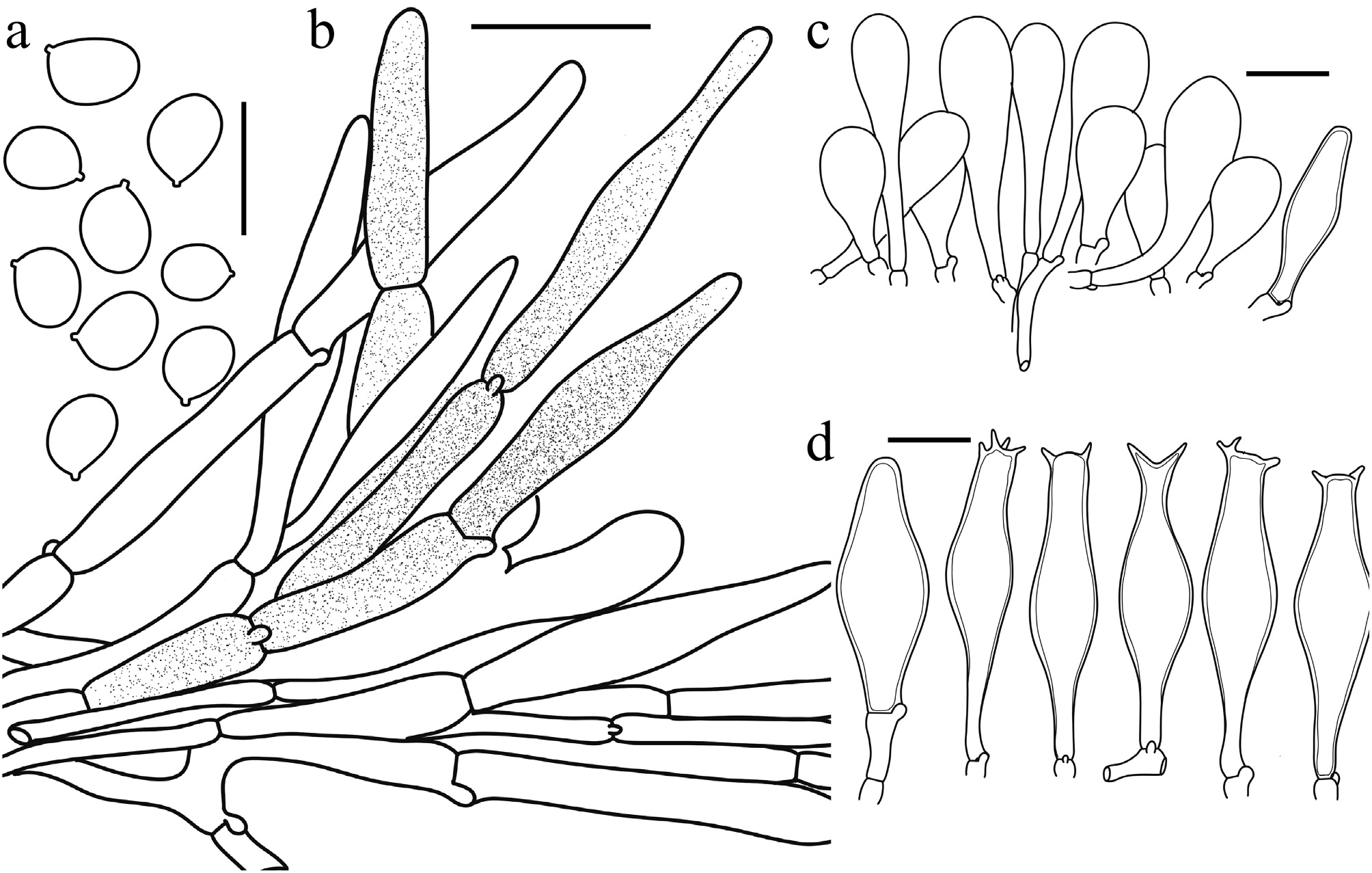
Figure 63.
Pluteus salicinus (HKAS 150960). (a) Basidiospores. (b) Pileipellis with terminal elements. (c) Cheilocystidia. (d) Pleurocystidia. Scale bars: (a) = 10 μm, (b) = 40 μm, (c), (d) = 20 μm.
-
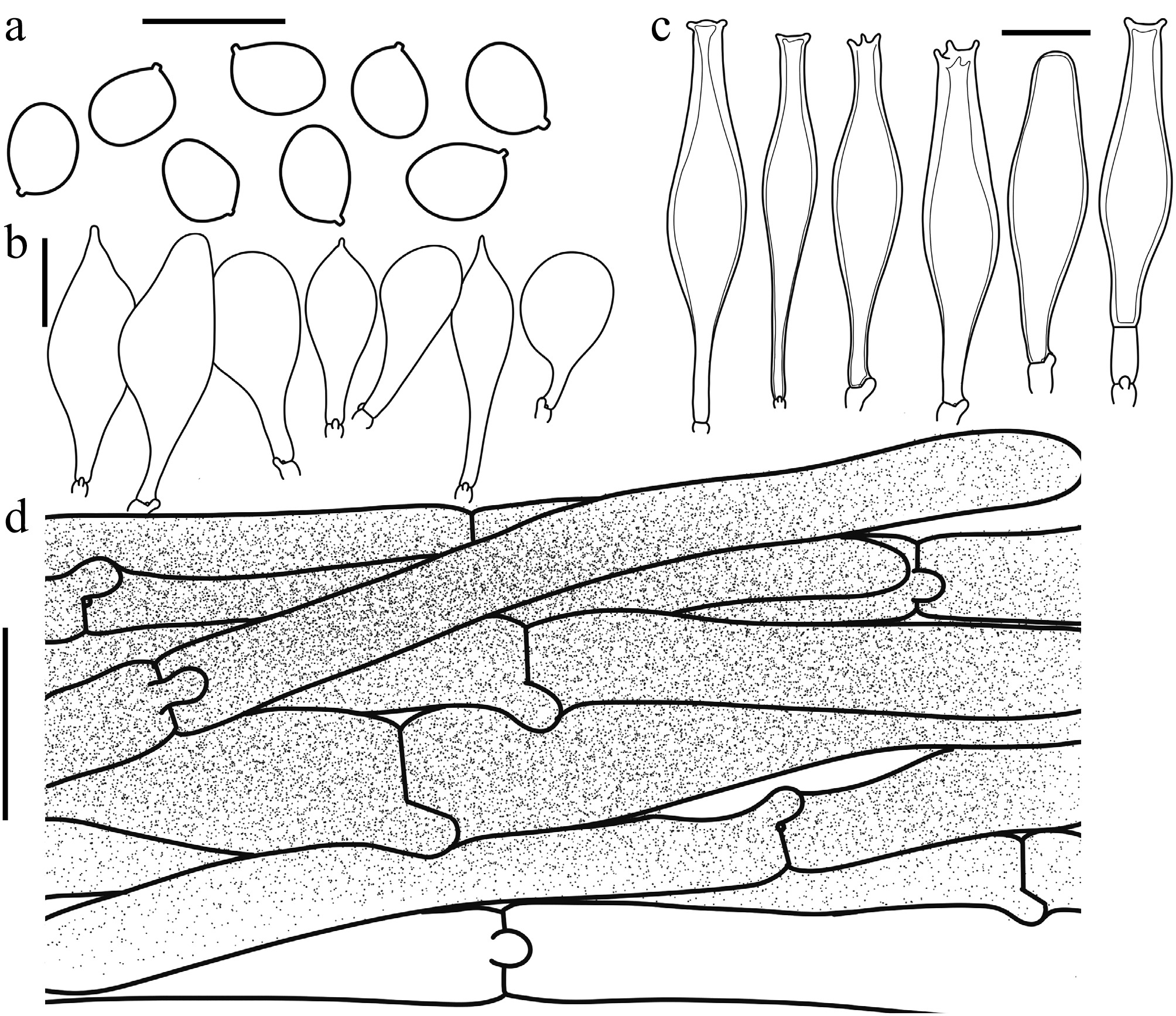
Figure 64.
Pluteus sepiicolor (HKAS 151143). (a) Basidiospores. (b) Cheilocystidia. (c) Pleurocystidia. (d) Pileipellis. Scale bars: (a) = 10 μm, (b)–(d) = 20 μm.
-
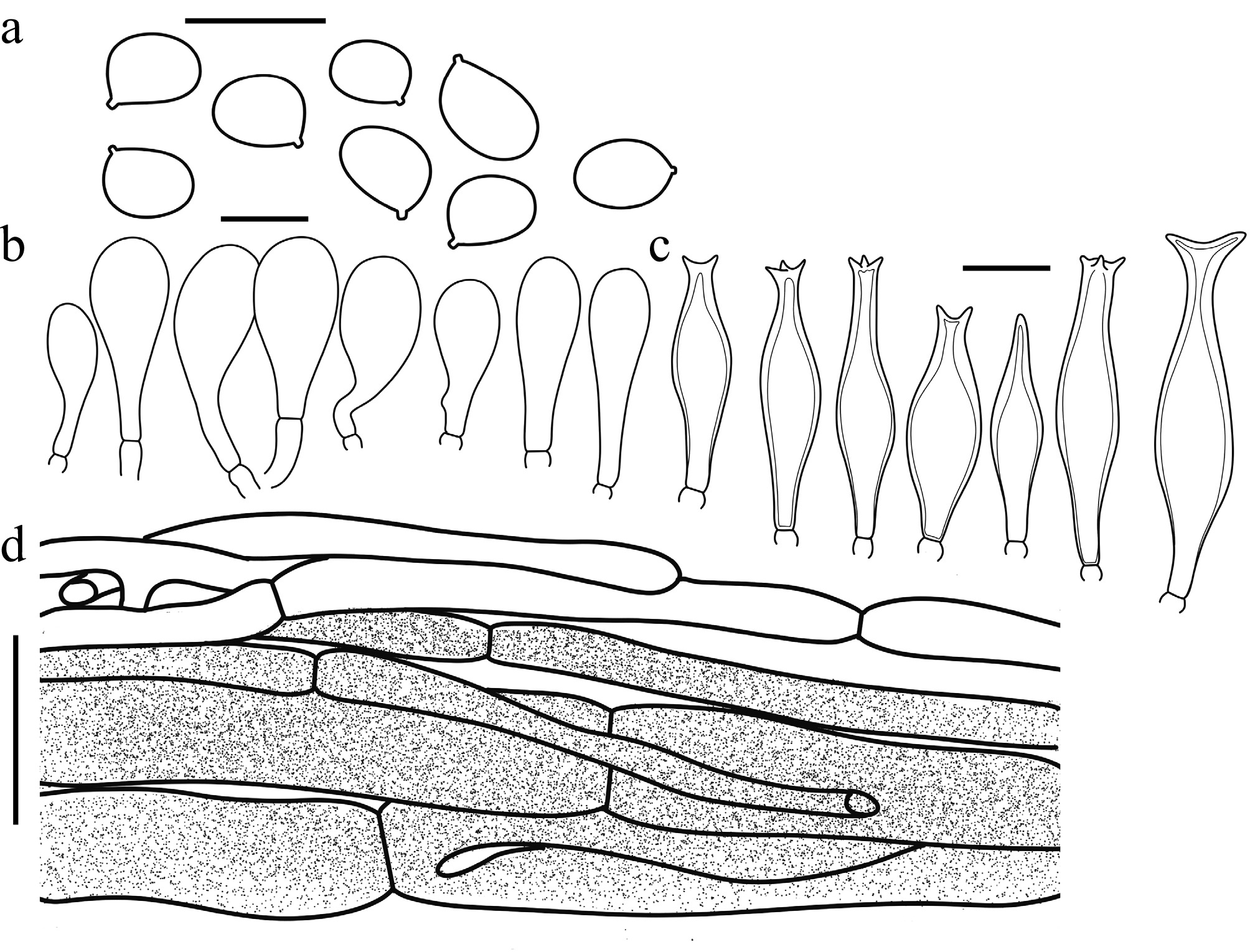
Figure 65.
Pluteus xylophilus (HKAS 151298). (a) Basidiospores. (b) Cheilocystidia. (c) Pleurocystidia. (d) Pileipellis. Scale bars: (a) = 10 μm, (b)–(d) = 20 μm.
-
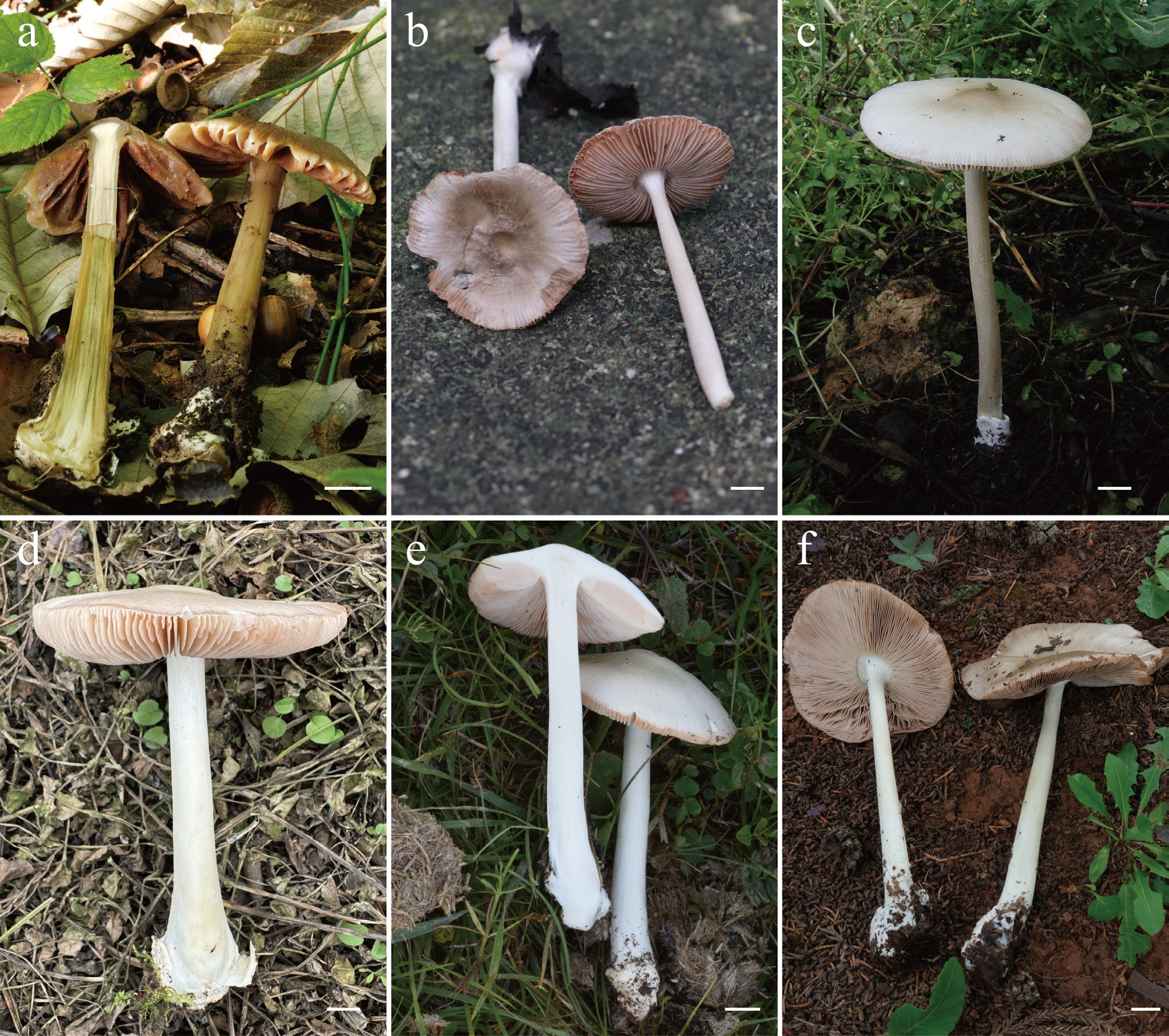
Figure 66.
Fresh basidiomes of Volvopluteus from China. (a) Vp. asiaticus (HKAS 151185). (b) Vp. earlei (HKAS 133863). (c)–(d) Vp. gloiocephalus (HKAS 71087). (e) Vp. platensis (HKAS 127528). (f) Vp. yunnanensis (HKAS 151182).
-
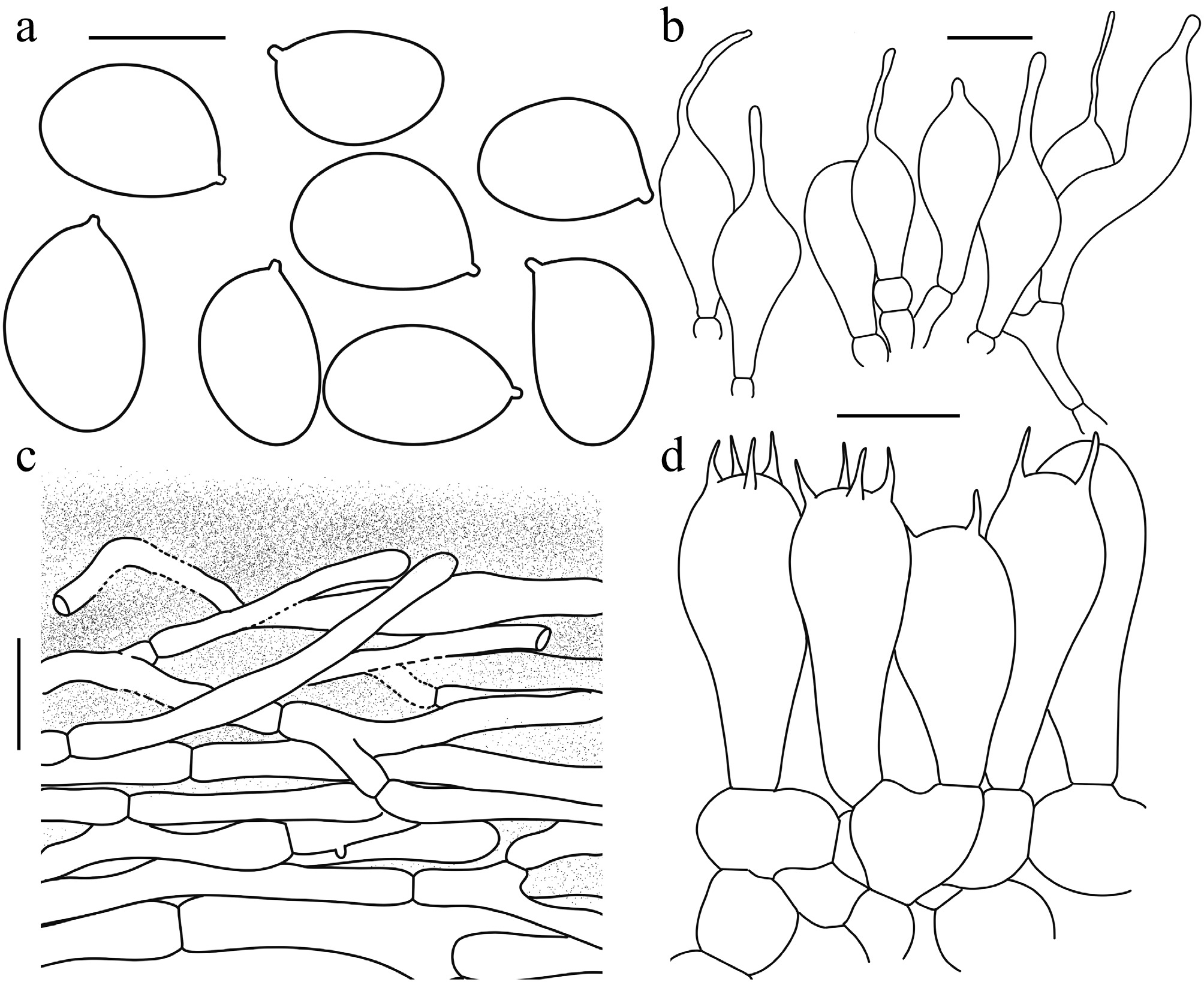
Figure 67.
Volvopluteus earlei (HKAS 133863). (a) Basidiospores. (b) Cheilocystidia. (c) Pileipellis. (d) Basidia. Scale bars: (a) = 10 μm, (b)–(d) = 20 μm.
-
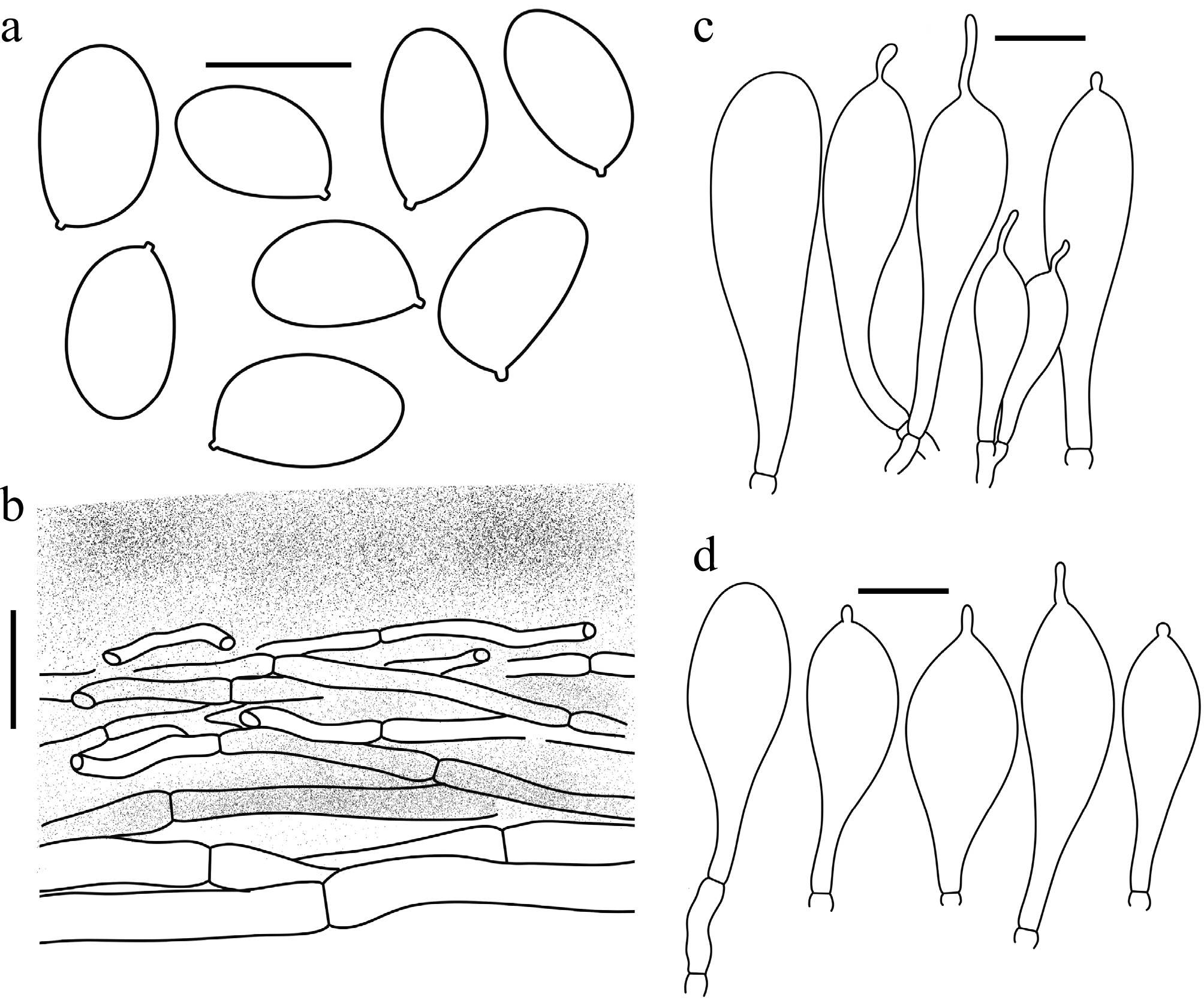
Figure 68.
Volvopluteus gloiocephalus (HKAS 133862). (a) Basidiospores. (b) Pileipellis. (c) Cheilocystidia. (d) Pleurocystidia. Scale bars: (a) = 10 μm, (b)–(d) = 20 μm.
-
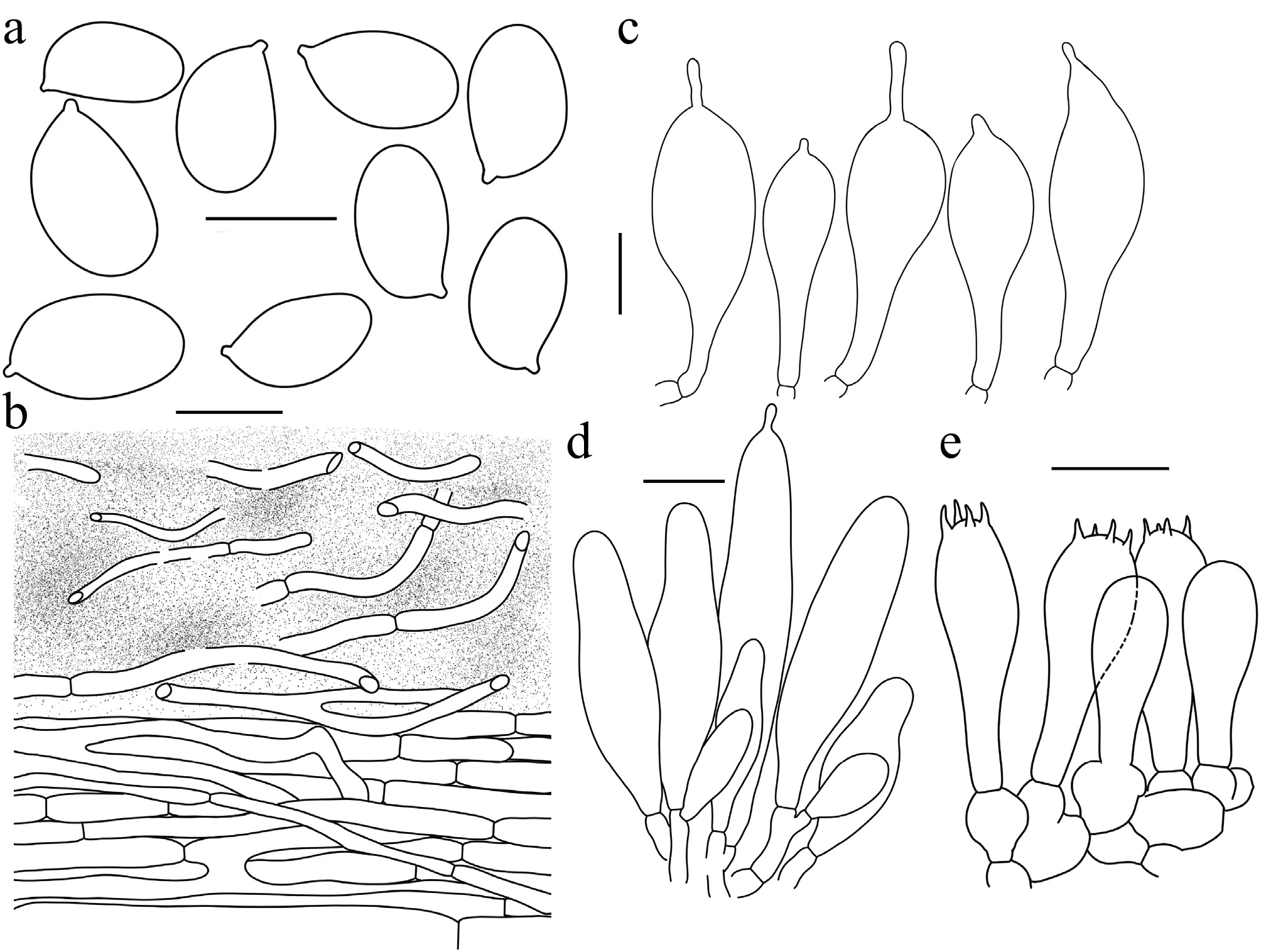
Figure 69.
Volvopluteus yunnanensis (HKAS 151182). (a) Basidiospores. (b) Pileipellis. (c) Pleurocystidia. (d) Cheilocystidia. (e) Basidia. Scale bars: (a) = 10 μm, (b)–(e) = 20 μm.
-
Topology Maximum number of reticulations Number of inferred reticulations Total log probability Network1 1 1 −472762.955509285 Network2 2 2 −472369.897910938 Network3 3 3 −472467.954269825 Network4 4 4 −470555.613078405 Network5 5 4 −472758.227455935 Network6 6 4 −472333.380005369 Table 1.
Network likelihoods derived from PhyloNet. The optimal network is in bold.
-
Tree Topology logL deltaL bp-RELL p-KH p-SH p-WKH p-WSH c-ELW p-AU T1 ((P,C),H) −9085525 710.46 0− 0− 0− 0− 0− 2.36E-154− 7.89E-06− T2 ((H,C),P) −9084814 0 1+ 1+ 1+ 1+ 1+ 1+ 1+ T3 ((P,H),C) −9085858 1043.2 0− 0− 0− 0− 0− 1.05e-312− 1.63E-104− Hispidocelluloderma. logL, log likelihood; deltaL: logL difference from the maximal logl in the set. bp-RELL, bootstrap proportion using RELL method; p-KH, p-value of one-sided Kishino-Hasegawa test; p-SH, p-value of Shimodaira-Hasegawa test; c-ELW, expected likelihood weight; p-AU, p-value of approximately unbiased (AU) test. All tests were performed with 10,000 resamplings using the RELL method. '+' signs denote the 95% confidence sets; '-' signs denote significant exclusion. Table 2.
Topology tests of three alternative hypotheses for the relationships within subgen.
-
1. Basidiomes small (pileus usually ≤ 3 cm in diam.); pileus thin and surface hygrophanous 2 1. Basidiomes medium to large (pileus usually > 3 cm in diam.); pileus not thin and not hygrophanous 5 2. Stipe base bulbose P. semibulbosus 2. Stipe base not bulbose 3 3. On decaying coniferous wood; pleurocystidia apex mucronate or rostrate with up to 2–6 μm long projection P. tenuipileus 3. On decaying deciduous wood; pleurocystidia not mucronate or rostrate 4 4. Pileus burnt yellow with distinct squamules or rugose-venose around the center; lamellae dense; basidiospores 7.0–8.0 × 6.0–7.0 μm P. jilinensis 4. Pileus white to pale yellow with brown velvety or pruinose surface; lamellae sparse; basidiospores 7.0–7.5 × 6.0–6.5 μm P. spaniophyllus 5. Pileus surface with brownish glandular dots P. baishanzuensis 5. Pileus surface without glandular dots 6 6. Pileus surface densely covered with white villi P. albivillus 6. Pileus surface not villose 7 7. Pleurocystidia apex without digitiform projections 8 7. Pleurocystidia with digitiform projections 9 8. Pileus orange-brown to fleshy brown, velvety to squamulose; basidiospores 7.5–8.7 × 5.6–6.8 μm P. velutinus 8. Pileus clay-buff to earthy yellow; basidiospores 6.5–7.5 × 5.5–6.5 μm P. hinnuleus 9. Pileus densely with dark brown granules, sometimes wrinkled or veined or almost reticulate at the center; lamellar edge dark brown or concolorous 10 9. Pileus covered without dark brown granules; lamellar edge pale or concolorous 14 10. Lamellar egde concolorous; stipe white P. umbrosoides 10. Lamellar edge dark brown; stipe with dark brown squamules 11 11. Pleurocystidia with 1−3 horns with distinct apical mucilage P. granularis 11. Pleurocystidia with 1−4 horns without apical mucilage 12 12. Temperate in distribution P. umbrosus 12. Subtropical in distribution 13 13. Lignicolous on deciduous wood; stipe yellow with dark brown squamules P. atroflavipes 13. Lignicolous on gymnosperm wood; stipe white with dark brown squamules P. costatus 14. Pileus predominantly yellow to golden yellow 15 14. Pileus pale grey-brown, grey or brown 19 15. Caulocystidia absent 16 15. Caulocystidia present P. variabilicolor 16. Tropical in distribution 17 16. Subtropical or temperate in distribution 18 17. Pileus golden-cream, finely fibrillose-flocculose; basidiospores 6–8× 6–8 μm P. aureofuscus 17. Pileus brilliant golden yellow, with darker and rugulose center; basidiospores 5.0–5.5 × 4.5–5.0 μm P. chrysaegis 18. Pileus yellow to orange or brown; basidiospores 6.0‒8.0 ×5.0‒6.5 μm P. leoninus 18. Pileus overall yellow; basidiospores 6.0–7.0 ×4.5–5.5 μm P. ussuriensis 19. Pileus cream or dark brown; pileipellis with broadly clavate or fusiform elements 20 19. Pileus yellow-brown or dark brown; pileipellis with elongate, fusoid terminal elements (>100 μm) 21 20. Cheilocystidia thin walled 22 20. Cheilocystidia thick-walled P. conizatus 21. Terrestrial on coniferous litter substrates in subalpine habitat; pileus dark brown; basidiospores 7–7.5 × 5.5–6.5 μm P. hengduanensis 21. Lignicolous on decaying spruce dead wood; pileus yellow-brown; basidiospores 7.0–8.0 × 5.5–6.0 μm P. piceicola 22. Pileus not long radial striae 23 22. Pileus long radial striae P. longistriatus 23. Pleurocystidia absent P. nankungensis 23. Pleurocystidia present 24 24. Pleurocystidia clavate to broadly clavate 25 24. Pleurocystidia fusiform P. ultraputripiceae 25. Pileus pale grey-brown, velvety to squamulose; large basidiospores 5–8.5 × 4.5–7.0 μm P. punctatus 25. Pileus dark brown, densely short-hairy; small basidiospores 4–5.5 ×3–3.5 μm P. fenghuangensis -
1. Pileipellis cutis 2 1. Pileipellis hymeniderm, trichoderm 11 2. Terminal cells elongated oblong cylindrical 3 2. Terminal cells shortly cylindrical or narrowly cylindrical 4 3. Basidiomes medium-sized; Pileus dark gray with a fuliginous striate; stipe with gray longitudinally-striate fibrils; basidiospores 5–7 × 5–7 μm P. aff. argentinensis 3. Basidiomes small-sized; pileus brown to dark brown with fibrils; stipe white; basidiospores 6–7 × 5–6.5 μm P. brunneoalbus 4. Terminal cells cylindrical 5 4. Terminal cells narrowly clavate 6 5. Pileus surface white, with brown floccules P. lalepiorum 5. Pileus pale brown to brown 9 6. Pileus fibrillose 7 6. Pileus with squamulose granules 8 7. Pileus surface without erect fibrils; stipe with lengthwise grey-brown fibrils; basidiospores 6–7.5 × 5–6.5 μm P. asperulus 7. Pileus surface with erect fibrils; stipe without lengthwise grey-brown fibrils; basidiospores 5.6–6.8 × 5.2–6.2 μm P. liaoheensis 8. Pileus white with cracking brown granules; basidiospores 7.0–7.5 (–8.0) × 5.0–6.0 (–6.5) μm P. lepiotoides 8. Pileus pale gray, squamulose; basidiospores 5.0‒6.5 × 4.3‒5.5(6) μm P. squamulososulcatus 9. Pileus with squarrose squamules P. squarrosus 9. Pileus not squarrose 10 10. Pileus dark brown; pileipellis a trichoderm, composed of narrowly clavate, cylindro-clavate, to fusiform elements P. fuscipruinatus 10. Pileus brown, pileipellis a cutis to trichodermium, composed of fusoid to fusoid-ventricose elements P. hirtellus 11. Cheilocystidia with 5–10 μm rostrum at apex 12 11. Cheilocystidia without 5–10 μm rostrum at apex 13 12. Pileus overall greyish brown, without transparent reticulate-venose over the surface P. assimilatus 12. Pileus blackish-grey, with strongly transparent reticulate-venose over the surface P. thomsonii 13. Pileus yellow, orange, or brownish-yellow 14 13. Pileus dark brown to grey 18 14. Pileus yellow, or brown, stipe yellow or white 15 14. Pileus yellow, or orange, not brown; stipe white 16 15. Often lignicolous on conifer wood (but not exclusively); basidiospores 5.7–6.2 × 5.1–5.6 μm P. vellingae 15. Often lignicolous on deciduous wood; basidiospores 6.5–7.3 × 5.3–6.1 μm P. aletaiensis/P. romellii 16. Pileus bright yellow with rugulose surface P. chrysophlebius 16. Pileus orange-red 17 17. Temperate or subalpine distribution; cheilocystidia without a short to long apical rostrum; basidiospores 6–7 × 4.5–5 μm P. aurantiorugosus 17. Subtropical distribution; cheilocystidia with a short to long apical rostrum; basidiospores 6.0–8.0 × 5.5–7.0 μm P. aurantioruber 18. Pileipellis hymeniderm, composed of two types of elements 19 18. Pileipellis euhymeniderm or hymeniderm; composed of one types of elements 22 19. Pileipellis with globose and short narrowly clavate terminal elements P. tatafuensis 19. Pileipellis with globose and oblong narrowly clavate terminal elements 20 20. Pileus with dark pruinose squamules .P. fuscopunctatus 20. Pileus without pruinose squamules 21 21. Lamellar edges colorless; pleuro- and cheilocystidia colorless P. podospileus/ P. cystidiosus 21. Lamellar edges dark brown; pleuro- and cheilocystidia colored P. podospilloides 22. Terminal cells fusiform or clavate elements 23 22. Terminal cells spheropedunculate to subglobose 24 23. Pileus brown, growing on woody debris P. daqinggouensis 23. Pileus brown with rugose surface P. castaneorugosus 24. Pileus dark brown with venose or rugose surface 25 24. Pileus not venose-rugose 26 25. Pileus rugose; stipe without fibrils; basidiospores (5.5)7–8 × (4.5)5–7 μm P. phlebophorus 25. Pileus distinctly venose; stipe with fibrils; basidiospores 6–7 ×5–6 μm P. atroreticulatus 26. Terrestrial P. doulianus 26. Lignicolous on wood chips P. calidophilus -
1. Lamellar edge dark brown (distinctly pigmented) 2 1. Lamellar edge colorless (non-pigmented) 3 2. Pileus smooth or innately radially fibrillose; basidiospores 6.0–9.5 × 4.0–6.2 μm; pileipellis with small lateral outgrowths on the terminal elements P. pouzarianus sensu lato 2. Pileus strongly radially fibrillose- squamulose; basidiospores 6.0–8.5 × 4.0–6.0 μm; pileipellis without small lateral outgrowths on the terminal elements P. atromarginatus 3. Pleurocystidia non-metuloid P. padanilus 3. Pleurocystidia metuloid 4 4. Clamp-connections present 5 4. Clamp-connections absent 11 5. Pileus surface with distinct squamules 6 5. Pileus surface strongly radially fibrillose 7 6. Lignicolous on deciduous wood; context turning blue on bruising; basidiospores 7.0–10.0 ×5.0–7.5 μm P. salicinus 6. Lignicolous on conifer wood; context without turning blue on bruising; basidiospores 7.8–8.6 × 5.0–6.2 μm P. sepiicolor 7. Pileus purple P. purpureofuscus 7. Pileus grey, brown to dark brown 8 8. Tropical distribution 9 8. Subtropical distribution 10 9. Terrestrial on grassy layers; pileus drak brown covered with radially arranged dark brown fibrils P. losulus 9. Lignicolous on deciduous wood; pileus pale brown, glabrous or with some innately fibrils at center P. griseodiscus 10 Pileipellis without small lateral outgrowths on the terminal elements; basidiospores 7–8 × 5.5–7 μm P. griseostriatus 11 Pileipellis with small lateral outgrowths on the terminal elements; basidiospores 6.5–9.6×5.0–7.1 μm P. brunneidiscus 11. Intermediate cystidia Magnus-type only P. petasatus 11. Intermediate cystidianot purely Magnus-type 12 12. Intermediate cystidia Cervinus type only 13 12. Intermediate cystidia type mixed (Cervinus type and Magnus-type) 14 13. Stipe longitudinally fibrillose; pleurocystidia commonly bifid; basidiospores 5.5–9.0 × 4.5–7.0 μm P. hongoi* 13. Stipe longitudinally fibrillose; pleurocystidia entire; basidiospores 5.4–7.5 × 4.4–5.7 μm P. conformis 14. Stipe brown P. rangifer 14. Stipe white 15 15. Lignicolous on Betula and Alnus wood; pileus white without radially arranged fibrils P. leucoborealis 15. Lignicolous not on Betula and Alnus wood; pileus brown with radially arranged fibrils P. xylophilus -
1. Cheilocystidia absent Vp. platensis 1. Cheilocystidia present 2 2. Pleurocystidia absent 3 2. Pleurocystidia present 4 3. Distributed in southern China Vp. earlei 3. Distributed in northern China Vp. longipes/ Vp. striatellus 4. Cheilocystidia without long rostrum at apex Vp. deliciosus 4. Cheilocystidia with long rostrum at apex 5 5. Margin of pileus rimose .Vp. michiganensis 5. Margin of pileus not rimose 6 6. Pileus predominantly dark grey or grey-brown; pleurocystidia with long apical excrescence (up to 10 μm) Vp. asiaticus 6. Pileus predominantly pale grey or grey-brown; pleurocystidia without long apical excrescence, often with short apical papilla 7 7. Pileus without radially appressed silky fibrils; basidiospores 10–15 × 7–8 μm Vp. gloiocephalus 7. Pileus with radially appressed silky fibrils; basidiospores 11.3–12.9 × 6.0–6.9 μm Vp. yunnanensis
Figures
(69)
Tables
(6)