-

Figure 1.
Overview of the key manual steps in analog circuit design flow. The larger the area of a step block, the higher its difficulty and importance.
-
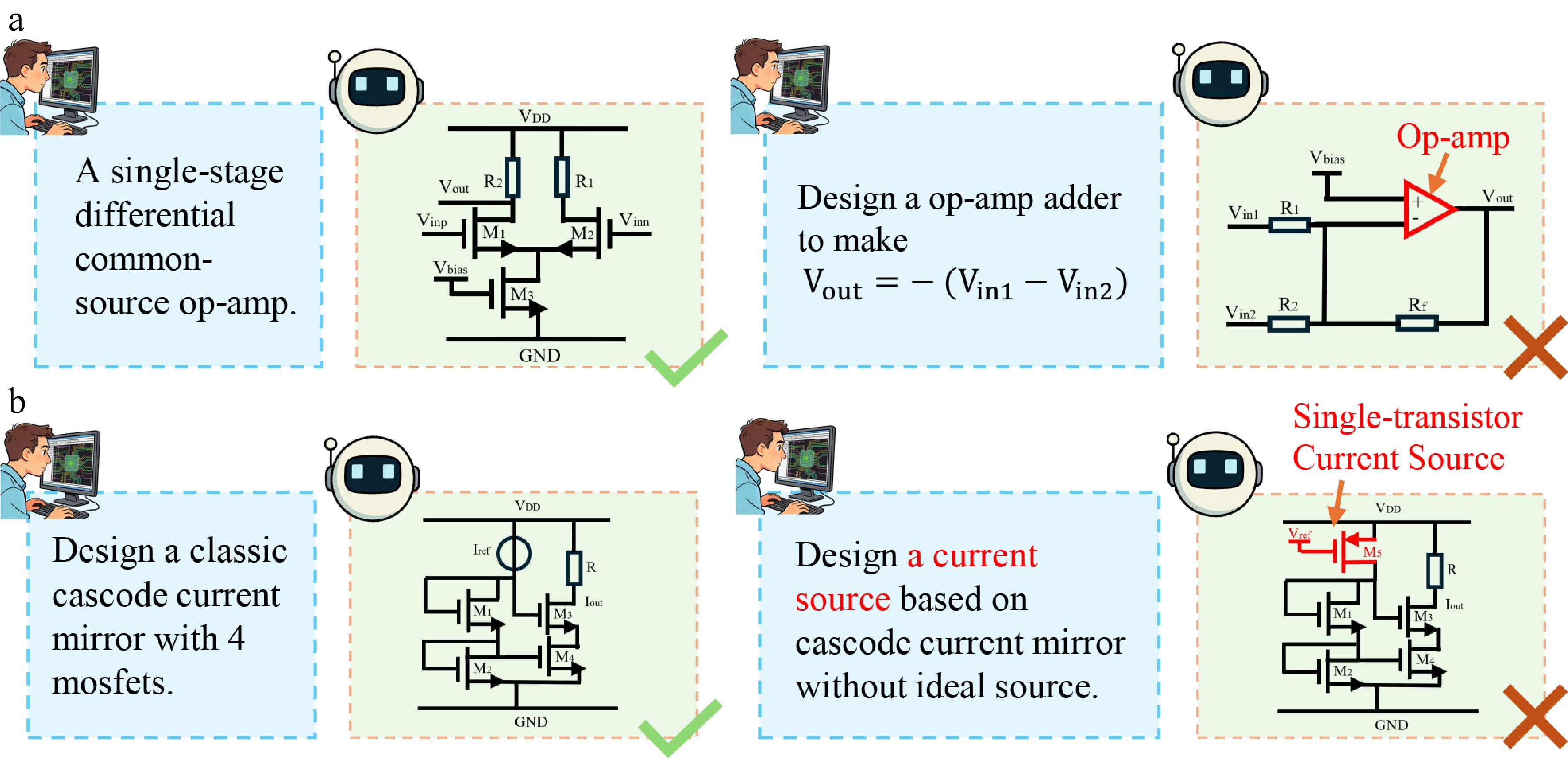
Figure 2.
Typical failures of LLMs in analog circuit design. Red marks core failure causes.
-
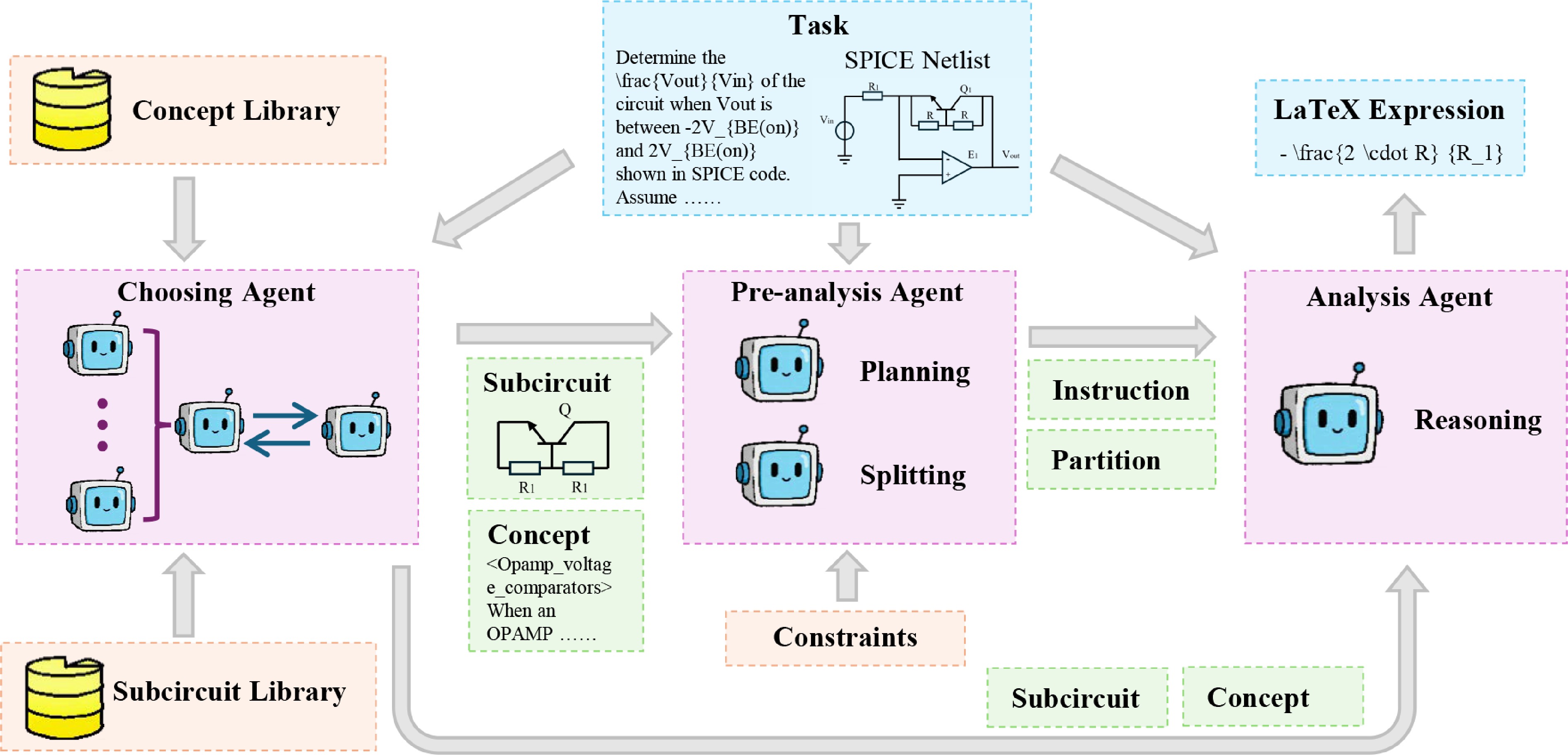
Figure 3.
The overview of ACR-Agent. The circuit analysis task is sequentially processed by the Choosing Agent and Pre-analysis Agent. It is sent to the Analysis Agent along with the selected concept and subcircuit entries, and the generated sequence of sub-tasks and function groups of circuit devices, ultimately generating LaTeX expressions. The circuits in Task and Subcircuit are all SPICE Netlists, which is simplified by circuit diagrams in the figure.
-
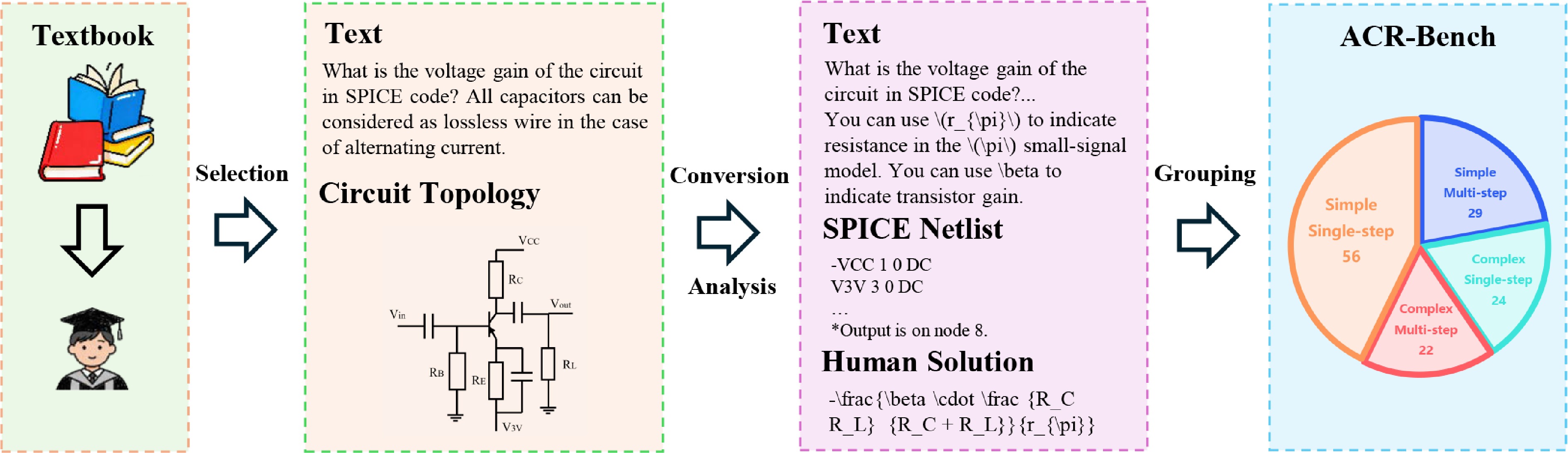
Figure 4.
The construction process of ACR-Bench. The data undergoes selection, conversion, and human analysis, and grouping to form ACR-Bench. The figure omits the depiction of human operators in the conversion, human analysis, and grouping.
-
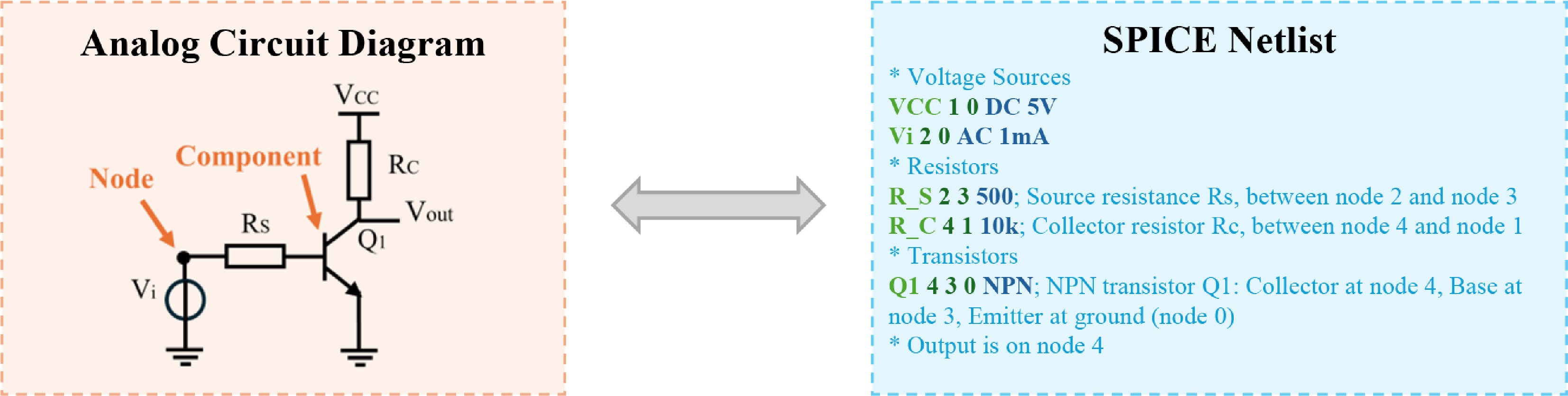
Figure 5.
Representations of the circuit. The example amplifier in diagram can be represented by the SPICE Netlist.
-
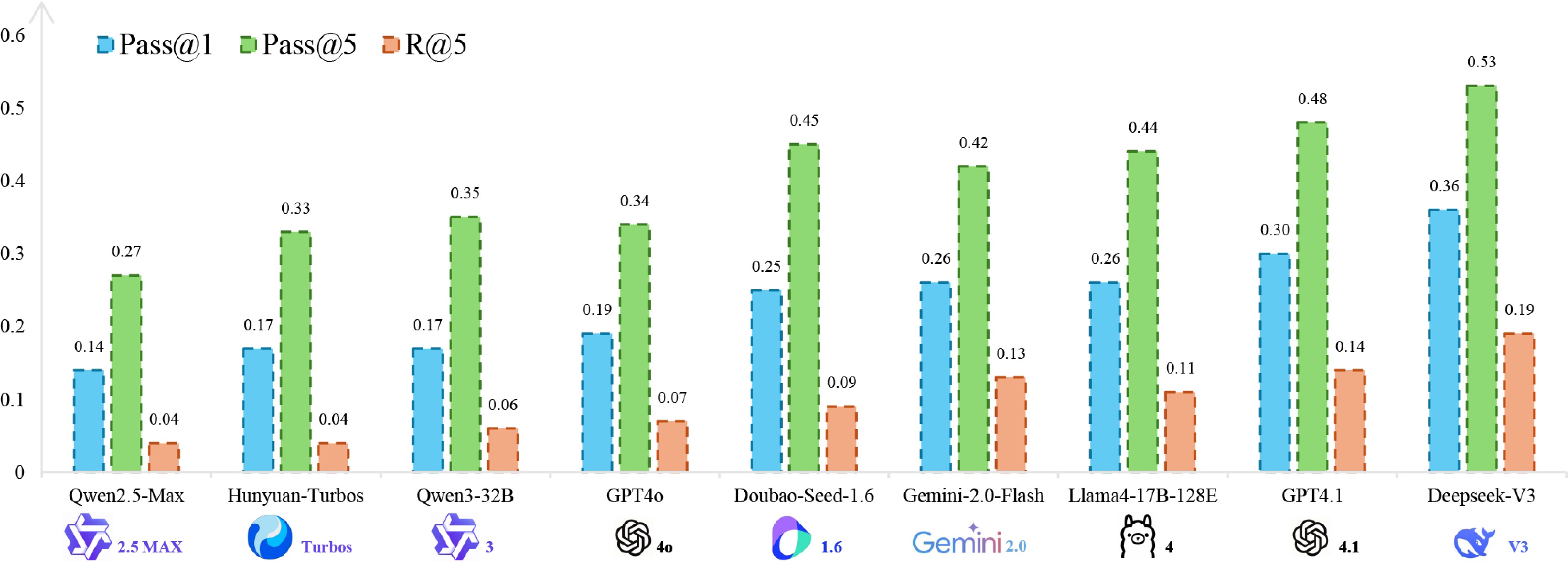
Figure 6.
The performance of different LLMs on ACR-Bench. LLMs are ranked by their
$ Pass@1 $ -
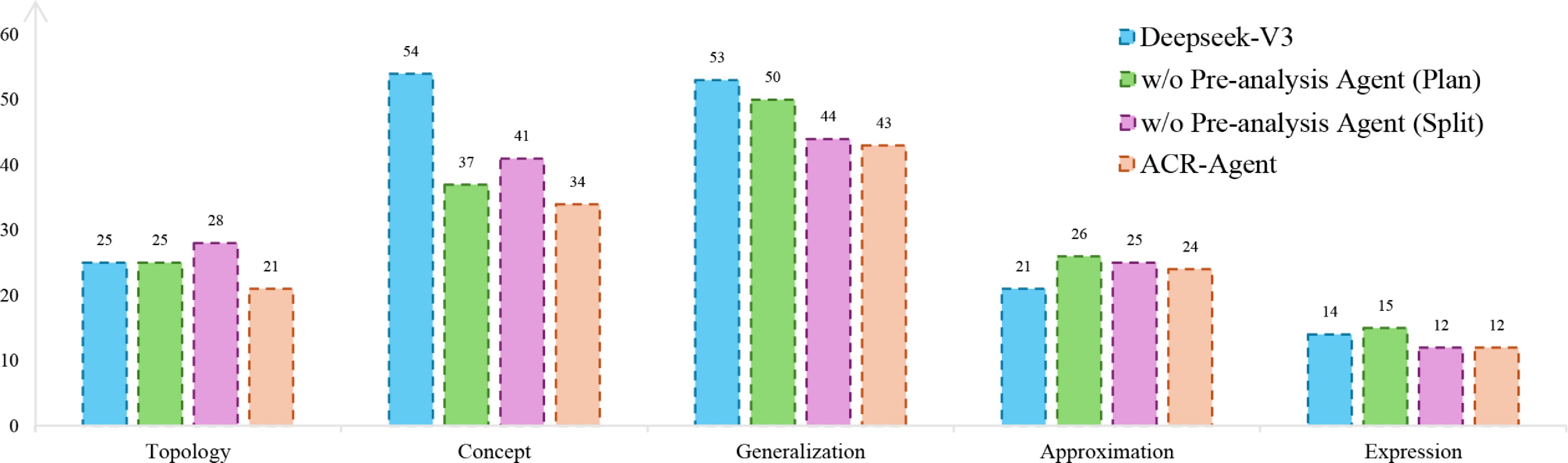
Figure 7.
Results of manual error analysis.
-
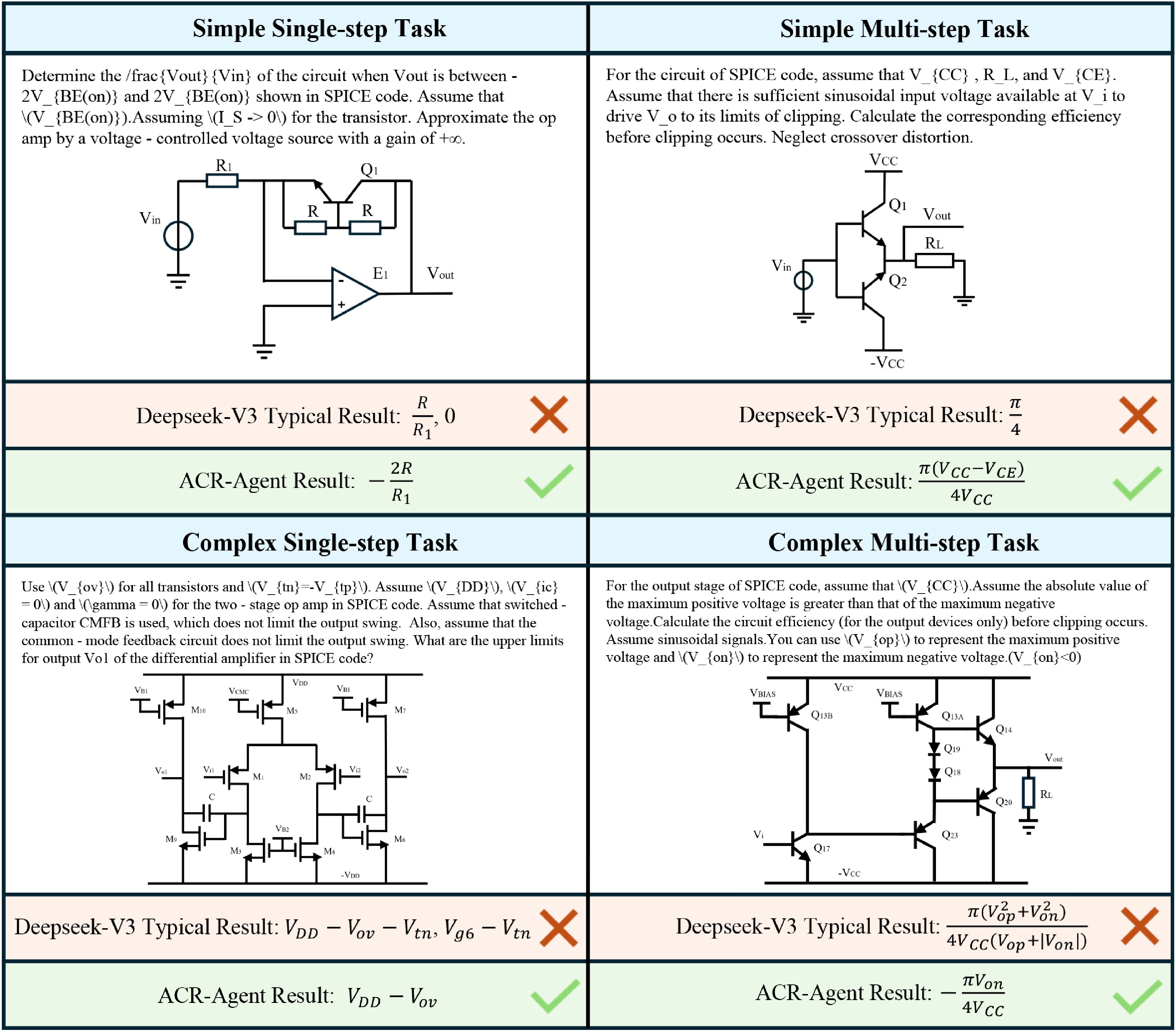
Figure 8.
Four representative tasks of successful reasoning and errors. All circuits in tasks are SPICE Netlist, which is simplified by circuit diagrams in the figure.
-
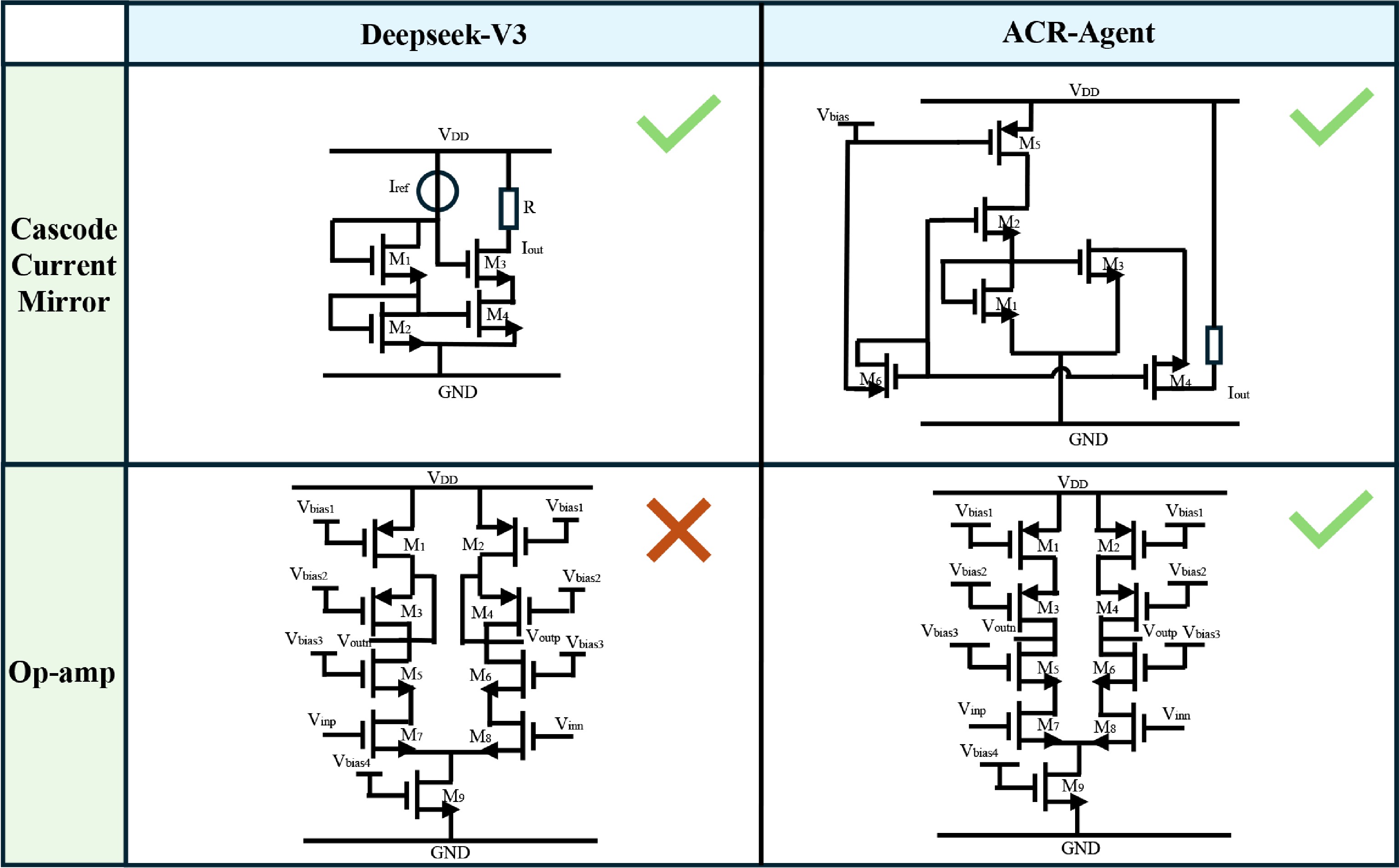
Figure 9.
Four representative design of DeepSeek-V3 and ACR-Agent based on DeepSeek-V3 in Analogcoder with utilizing subcircuit tools. All circuits in their design are PySpice code, which is simplified by circuit diagrams in the figure.
-
Require: Analog Circuit Reasoning Task $ T $ Ensure: Final Solution $ E $ 1: Agent 1: Choosing Agent $ (A_{c}) $ 2: $ L $ $ \gets $ $ L_{C} $ $ \cup $ $ L_{SC} $ $ (L_{C}) $ $ (L_{SC}) $ 3: $ (L_1,L_2,...L_n) \gets $ $ L $ 4: for each $ L_i $ $ L_n $ 5: $ s_i $ $ \gets $ $ A_{c(i)}(L_i,T) $ 6: end for 7: $ S $ $ \gets $ $ A_{c(n+1)}(L,s_1,s_2,...,s_n,T) $ 8: if $ S \not= \sum s_i $ 9: $ S' $ $ \gets $ $ A_{c(n+2)}(L,s_1,s_2,...,s_n,T,S) $ 10: while $ S' \not= S $ 11: $ S $ $ \gets $ $ (A_{c(n+1)}(L,s_1,...,s_n,T,S'),A_{c(n+2)}(L,s_1,...,s_n,T,S)) $ 12: end while 13: end if 14: Agent 2: Pre-analysis Agent $ (A_{p}) $ 15: $ L \gets A_{p(split)}(S,T,C) $ $ C $ 16: $ P \gets A_{p(plan)}(S,T,C) $ 17: Agent 3: Analysis Agent $ (A_{a}) $ 18: $ E \gets A_{a}(S,P,L,T) $ $ E $ Table 1.
ACR-Agent Workflow.
-
Dataset Analog circuits SPICE Data type Task type Expression Masala-chai[38] ✔ ✔ Real Generate ✘ Amsnet[39] ✔ ✔ Real Generate ✘ Amsbench[40] ✔ ✘ Real Reason + design ✘ Eee-bench[41] ✔1 ✘ Real Reason ✘ Analogcoder[8] ✔ ✔ Real Design ✘ Analoggenie[22] ✔ ✔ Real Design ✘ Autocircuit-rl[19] ✔ ✔ Synthetic Design2 ✘ LaMAGIC[20] ✔ ✔ Synthetic Design2 ✘ Chipnemo[5] ✔1 ✘ Real Reason + design ✘ CIRCUIT[26] ✔ ✔ Real Reason ✘ ACR-Bench ✔ ✔ Real Reason ✔ 1 Mix of analog circuit and other topics. 2 Containing only one type of typical analog circuit. Analog circuits: dataset theme on analog circuits; SPICE: whether analog‑circuit representations are SPICE netlists; Data type: source type of the dataset; Task type: target task types of the dataset; Expression: whether the output is in expression format. The bold text indicates that ACR‑Bench possesses all the characteristics listed in the table. Table 1.
Comparison between ACR-Bench and other datasets.
-
Topic Number Transistor fundamentals 6 Basic amplifiers 16 Differential amplifiers 10 Active loads 8 Output stages 19 Feedback networks 18 Operational amplifiers 28 Frequency response and compensation 16 Circuit noise 4 Non-linear circuits 6 Total 131 Table 2.
Number of ACR-Bench problems in each topic.
-
Method ACR-Bench Simple single-step Simple multi-step Complex single-step Complex multi-step Pass@1 Pass@5 R@5 Pass@1 Pass@5 R@5 Pass@1 Pass@5 R@5 Pass@1 Pass@5 R@5 Pass@1 Pass@5 R@5 GPT4.1 0.30 0.48 0.14 0.48 0.70 0.24 0.24 0.45 0.08 0.18 0.35 0.05 0.09 0.11 0.03 Analogxpert (GPT4.1) 0.30 0.51 0.12 0.44 0.68 0.21 0.27 0.48 0.04 0.23 0.45 0.05 0.09 0.17 0.05 SizingAgent (GPT4.1) 0.29 0.50 0.11 0.41 0.66 0.19 0.26 0.49 0.07 0.24 0.44 0.06 0.07 0.15 0.01 Analogcoder (GPT4.1) 0.28 0.45 0.14 0.43 0.63 0.26 0.23 0.43 0.05 0.16 0.34 0.05 0.10 0.13 0.06 Atelier (GPT4.1) 0.23 0.41 0.08 0.33 0.54 0.14 0.22 0.40 0.09 0.14 0.36 0.01 0.07 0.13 0.01 AMS-KG (GPT4.1) 0.30 0.49 0.13 0.44 0.67 0.21 0.27 0.46 0.11 0.18 0.40 0.05 0.10 0.17 0.02 ACR-Agent (GPT4.1) 0.37 0.56 0.18 0.60 0.81 0.34 0.27 0.41 0.08 0.22 0.47 0.07 0.12 0.20 0.02 DeepSeek-V3 0.36 0.53 0.19 0.54 0.71 0.34 0.24 0.44 0.13 0.25 0.52 0.06 0.15 0.23 0.06 Analogxpert (DeepSeek-V3) 0.32 0.51 0.18 0.47 0.69 0.28 0.22 0.36 0.13 0.27 0.53 0.11 0.11 0.21 0.05 SizingAgent (DeepSeek-V3) 0.34 0.56 0.16 0.53 0.79 0.29 0.20 0.42 0.05 0.26 0.52 0.11 0.10 0.19 0.03 Analogcoder (DeepSeek-V3) 0.34 0.52 0.19 0.52 0.73 0.34 0.27 0.47 0.13 0.20 0.39 0.07 0.11 0.20 0.02 Atelier (DeepSeek-V3) 0.31 0.50 0.18 0.46 0.67 0.30 0.25 0.44 0.14 0.23 0.45 0.10 0.07 0.18 0.00 AMS-KG (DeepSeek-V3) 0.37 0.53 0.21 0.55 0.71 0.36 0.26 0.38 0.14 0.31 0.59 0.13 0.10 0.22 0.01 ACR-Agent (DeepSeek-V3) 0.44 0.61 0.26 0.68 0.86 0.46 0.28 0.37 0.13 0.33 0.60 0.13 0.16 0.28 0.06 Pass@1: probability of success in one trial. Pass@5: probability of at least one success among five repeated trials. R@5: probability of success across all five repeated trials. The bold values indicate the best‑performance metrics of different methods built upon the same base model on ACR‑Bench and various tasks. Table 3.
Main results. The performance of ACR-Agent on ACR-Bench.
-
Method ACR-Bench Simple Single-step Simple Multi-step Complex Single-step Complex Multi-step Pass@1 Pass@5 R@5 Pass@1 Pass@5 R@5 Pass@1 Pass@5 R@5 Pass@1 Pass@5 R@5 Pass@1 Pass@5 R@5 DeepSeek-V3 0.36 0.53 0.19 0.54 0.71 0.34 0.24 0.44 0.13 0.25 0.52 0.06 0.15 0.23 0.06 Basic libraries 0.40 0.57 0.25 0.65 0.81 0.46 0.23 0.38 0.13 0.27 0.53 0.08 0.11 0.23 0.01 w/o Libraries 0.37 0.57 0.20 0.57 0.80 0.32 0.24 0.36 0.15 0.29 0.58 0.09 0.14 0.25 0.04 w/o Subcircuit Library 0.39 0.58 0.22 0.59 0.82 0.36 0.27 0.41 0.17 0.28 0.54 0.11 0.13 0.23 0.03 w/o Concept Library 0.41 0.60 0.21 0.64 0.86 0.39 0.27 0.43 0.12 0.32 0.53 0.10 0.10 0.22 0.00 w/o Choosing Agent 0.41 0.57 0.24 0.64 0.80 0.43 0.25 0.35 0.14 0.30 0.60 0.10 0.13 0.23 0.03 w/o Constraints 0.41 0.61 0.21 0.65 0.86 0.39 0.27 0.45 0.12 0.33 0.56 0.10 0.10 0.24 0.00 w/o Pre-analysis Agent (split) 0.42 0.58 0.24 0.65 0.84 0.41 0.30 0.45 0.16 0.25 0.48 0.11 0.14 0.23 0.03 w/o Pre-analysis Agent (plan) 0.42 0.60 0.24 0.66 0.86 0.43 0.25 0.35 0.13 0.32 0.56 0.17 0.15 0.28 0.02 ACR-Agent 0.44 0.61 0.26 0.68 0.86 0.46 0.28 0.37 0.13 0.33 0.60 0.13 0.16 0.28 0.06 Pass@1: probability of success in one trial. Pass@5: probability of at least one success among five repeated trials. R@5: probability of success across all five repeated trials. The bold values indicate the best‑performance metrics of different methods built upon the same base model on ACR‑Bench and various tasks. Table 4.
Results of ablation study.
-
Method Input tokens Cache hit tokens Output tokens Cost ( $ \text{\$} $ DeepSeek-V3 614 158 530 0.0009 ACR-Agent 8,174 5,072 1,513 0.0033 Table 5.
Token consumption of ACR-Agent on ACR-Bench.
-
Model Metrics Analogcoder (w/o tools) Analogcoder Base ACR-Agent Base ACR-Agent GPT4.1 Pass@1 0.57 0.59 0.69 0.72 Pass@5 0.68 0.70 0.90 0.96 DeepSeek-V3 Pass@1 0.54 0.60 0.63 0.69 Pass@5 0.62 0.71 0.82 0.88 Table 6.
ACR-Agent application in circuit designing on the Analogcoder benchmark.
Figures
(9)
Tables
(7)