-
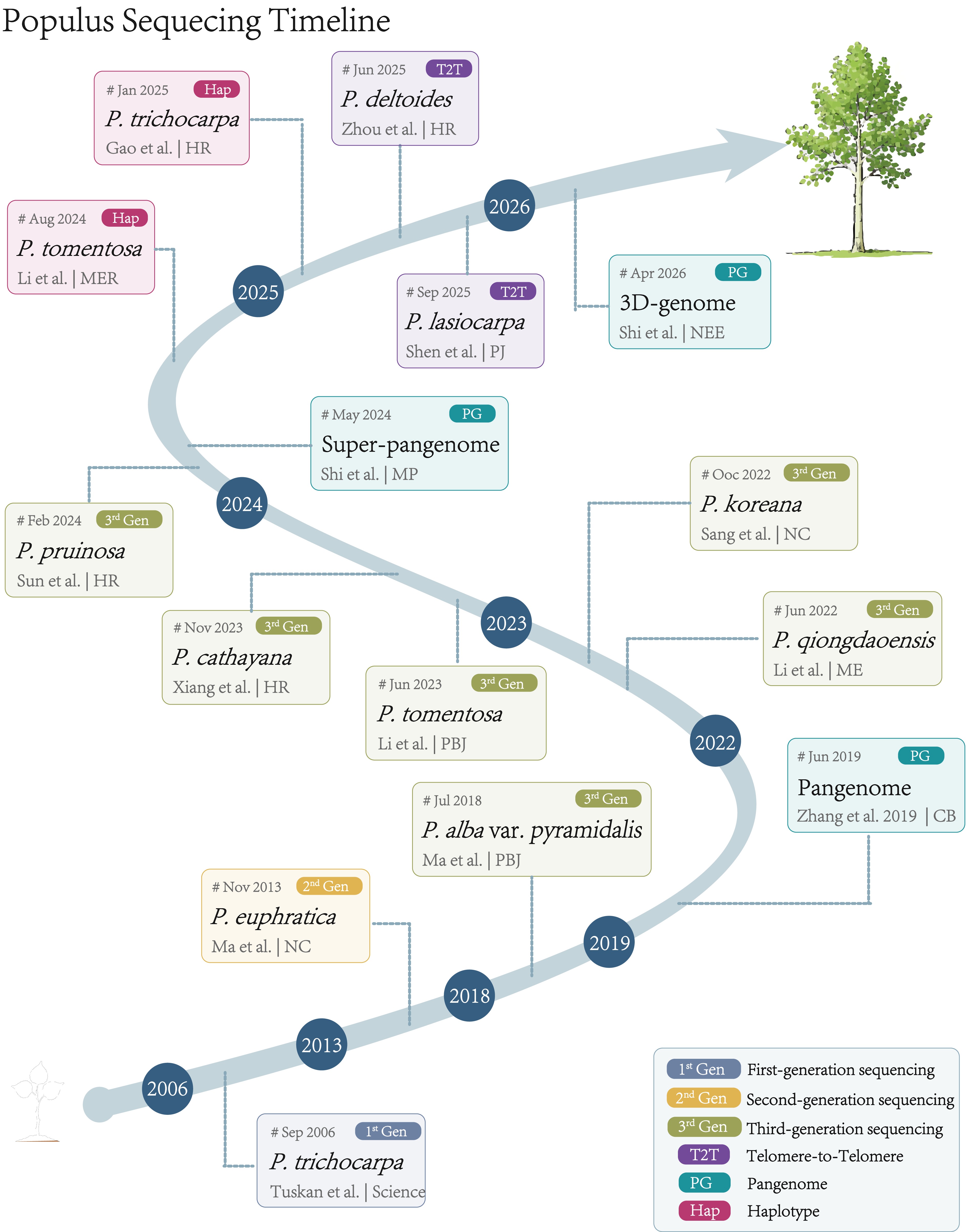
Figure 1.
Representative milestones in Populus genome sequencing and assembly over the past 20 years. The timeline summarizes major advances from the first P. trichocarpa reference genome in 2006 to recent telomere-to-telomere, haplotype-resolved, pangenome, super-pangenome, and three-dimensional (3D)-genome resources. Key representative studies are arranged chronologically along the curved timeline, with each box showing the species or genomic resource, publication date, authors, and journal abbreviation. Different colors indicate the dominant technical category of each milestone, including first-generation sequencing, second-generation sequencing, third-generation sequencing, telomere-to-telomere assembly, pangenome or super-pangenome construction, haplotype-resolved assembly, and 3D-genome resources. This timeline illustrates the transition of Populus genomics from single-reference genome construction toward high-continuity, population-scale, and structurally comprehensive genome resources. Journal abbreviations: NC, Nature Communications; PBJ, Plant Biotechnology Journal; CB, Communications Biology; ME, Molecular Ecology; HR, Horticulture Research; MP, Molecular Plant; MER, Molecular Ecology Resources; PJ, The Plant Journal; NEE, Nature Ecology & Evolution.
-
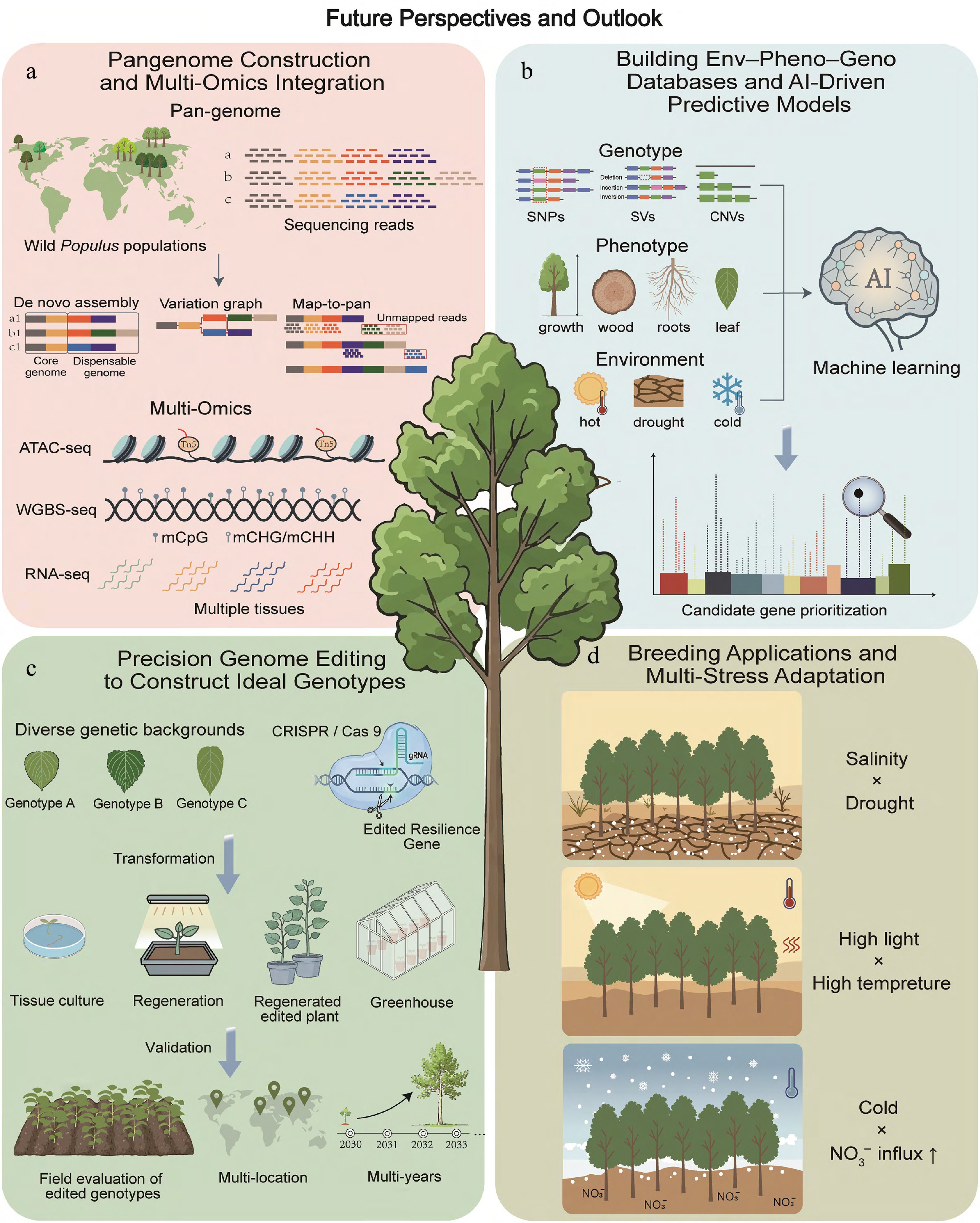
Figure 2.
Future perspectives on translating the genomic resources of Populus into predictive breeding applications across the following four directions. (a) Construction of population-scale pangenomes from wild Populus populations using de novo assembly, variation graphs, and map-to-pan strategies, integrated with multi-omics data across various tissues (e.g., assay for transposase-accessible chromatin using sequencing [ATAC-seq] for chromatin accessibility, whole-genome bisulfite sequencing [WGBS] for DNA methylation, and RNA sequencing [RNA-seq] for transcriptomics). (b) Development of integrated genotype–phenotype–environment databases that combine phenotypic and environmental data with genomic variations, including SNPs, SVs, and copy number variants (CNVs). Artificial intelligence and machine learning approaches will facilitate predictive modeling and prioritization of the candidate genes. (c) Precision genome editing across diverse genetic backgrounds to generate elite genotypes, followed by tissue culture, plant regeneration, greenhouse validation, and multilocation, multiyear field evaluations. (d) Translation of genomic discoveries into breeding applications to improve adaptations to combined stresses (e.g., salinity and drought, high light and high temperature, or nutrient uptake and cold tolerance).
Figures
(2)
Tables
(0)