-
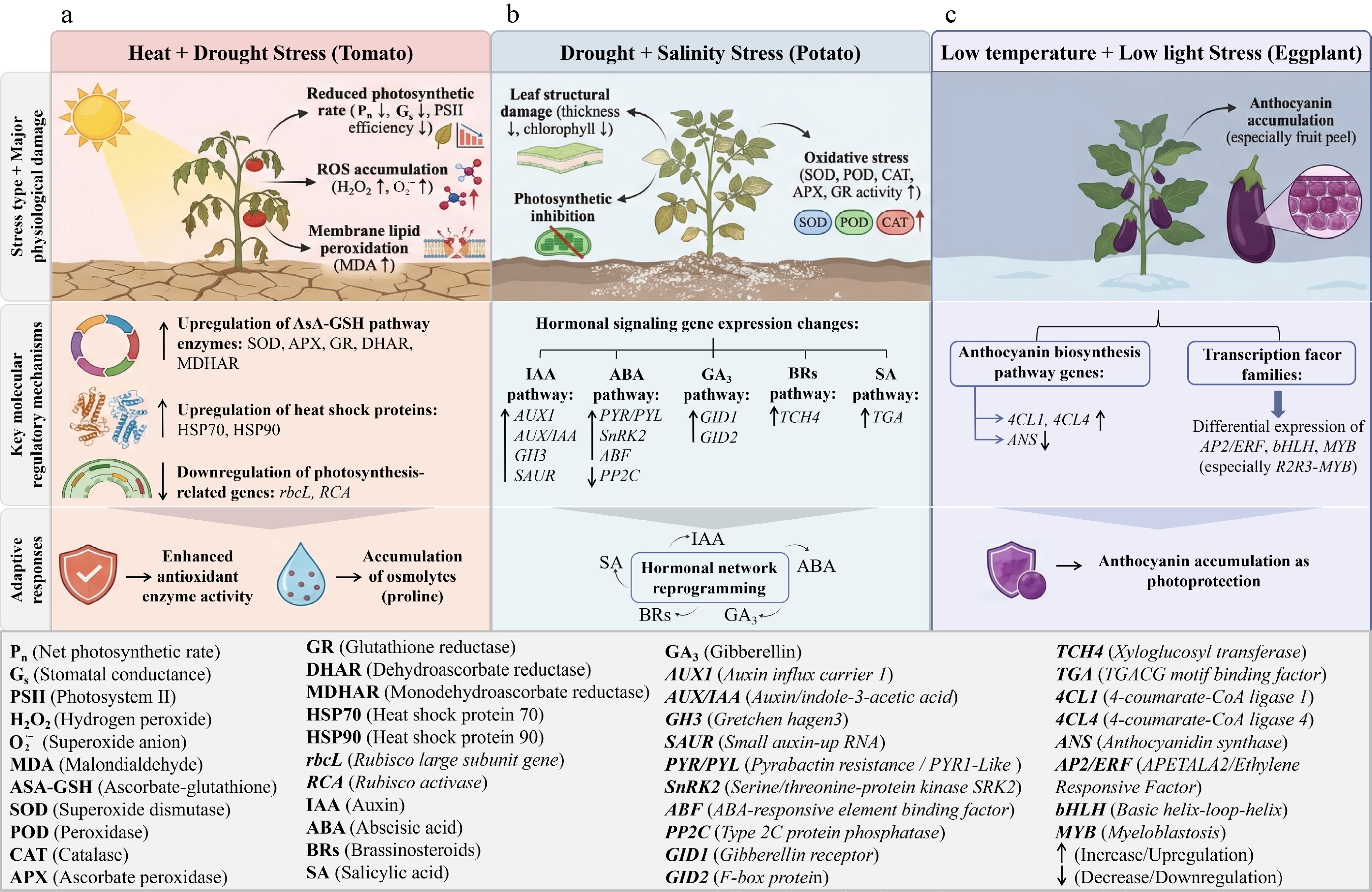
Figure 1.
Physiological and molecular responses of vegetable crops to combined abiotic stress: insights from tomato, potato, and eggplant. (a) The response of tomato to combined heat and drought stress. (b) The response of potato to combined drought and salinity stress. (c) The response of eggplant to combined low temperature and low light stress.
-
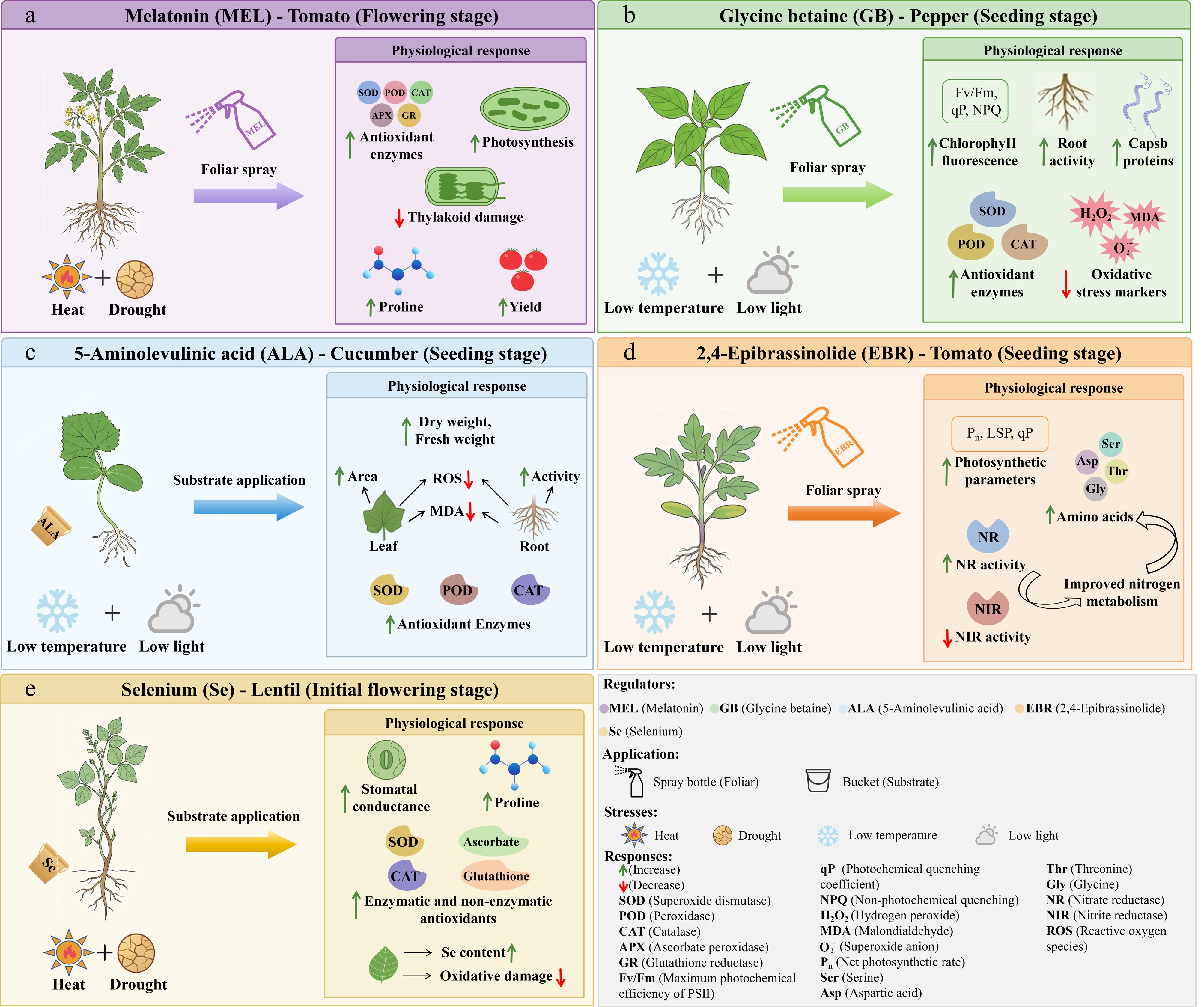
Figure 2.
Mitigation of combined abiotic stress in vegetable crops by exogenous regulators. (a) Melatonin (MEL) alleviates the combined heat and drought stress in tomato. (b) Glycine betaine (GB) alleviates the combined low temperature and low light stress in pepper. (c) 5-Aminolevulinic acid (ALA) alleviates the combined low temperature and low light stress in cucumber. (d) 2,4-Epibrassinolide (EBR) alleviates the combined low temperature and low light stress in tomato. (e) Selenium (Se) alleviates the combined heat and drought stress in lentil.
-
Vegetable crop Treatment Physiological/molecular response Ref. Solanum lycopersicum L. (1) Control: 26 °C/18 °C, irrigated once daily;
(2) Drought stress: 26 °C/18 °C, not irrigated;
(3) Heat stress: 38 °C/30 °C, irrigated once daily;
(4) Combined stress: 38 °C/30 °C, not irrigated.
The 24-d-old plants were treated for 6 d.After 6 d of combined stress, tomato plants exhibited significant reductions in canopy area and stem diameter, alongside a distinct reactive oxygen species (ROS) response characterized by a significant increase in hydrogen peroxide (H2O2) content and superoxide anion (O2·−) production rate compared to the control. [23] Solanum tuberosum L. (1) Control: 24 ± 1 °C, irrigated with Hoagland solution;
(2) Drought stress: 24 ± 1 °C, irrigated with Hoagland solution supplemented with PEG-8000 at a concentration of 0.39 g/g H2O;
(3) Heat stress: 30 ± 1 °C, irrigated with Hoagland solution;
(4) Combined stress: 30 ± 1 °C, irrigated with Hoagland solution supplemented with PEG-8000 at a concentration of 0.39 g·g−1 H2O.
The plants were treated to stress for 21 d.Exposure to combined stress triggered a significant inhibition of growth and physiological function in potato plants, characterized by a marked reduction in plant height, leaf area, cell membrane integrity, and relative water content. In contrast to these inhibitory effects, chlorophyll content was observed to increase under both drought alone and the combined stress treatment when compared to the control. [24] Capsicum annuum L. (1) Control: ambient temperature (AT) + 100% pot capacity (PC);
(2) Combined stress: (AT + 3 °C, 80% PC), (AT + 5 °C, 80% PC), (AT + 3 °C, 60% PC), (AT + 5 °C, 60% PC), (AT + 3 °C, 40% PC), (AT + 5 °C, 40% PC);
The flowering plants were treated to stress for 14 d.Two weeks of combined stress significantly reduced pepper plant height, leaf area, fruit length, and fruit diameter, while also impairing photosynthesis by decreasing the photosynthetic rate, transpiration rate, and stomatal conductance. This disruption of gas exchange, carbon fixation, and allocation ultimately led to a decline in yield compared with the control. [25] Lens culinaris Medik. (1) Control: 22−30 °C/16−19 °C, 100% field capacity;
(2) Drought stress: 22−30 °C/16−19 °C, 50% field capacity;
(3) Heat stress: 32−40 °C/21−27 °C, 100% field capacity;
(4) Combined stress: 32−40 °C/21−27 °C, 50% field capacity.
The 75% podding plants were treated to stress for 15 d.Lentil plants exposed to combined heat and drought stress exhibited delayed development, significantly shortened flowering and podding duration, and reduced seed size and weight, with sensitive genotypes showing greater decreases than tolerant ones. Compared with the control, individual drought and combined stress treatments resulted in a sharp decline in starch content within lentil seeds, accompanied by an increased rate of starch hydrolysis in both leaves and seeds, which led to the accumulation of reducing sugars. [26] Portulaca oleracea L. (1) Control: 28 °C, routinely irrigated;
(2) Drought stress: 28 °C, non-irrigated;
(3) Heat stress: 42 °C, routinely irrigated;
(4) Combined stress: 42 °C, non-irrigated.
The 21-d-old plants were treated to stress for 7 d.Combined heat and drought stress causes more severe physiological damage to purslane compared to individual stresses, as reflected by increased malondialdehyde (MDA) content, elevated electrolyte leakage (EL) and O2·− production rates, as well as enhanced activities of peroxidase (POD) and SOD. [29] Solanum lycopersicum L. (1) Control: 25 °C, water daily with a full-strength Hoagland solution (200 mL);
(2) Drought stress: irrigate with full-strength Hoagland solution (200 mL) for 7 d, then withhold irrigation for 10 d until the soil relative water content drops to 60%;
(3) Heat stress: subjected to 45 °C for 7 d;
(4) Combined stress: the plants were first subjected to severe drought stress, followed by exposure to 45 °C high temperature for 24 h.
The 15-d-old plants were treated for 6 d.Under combined stress, the transcript levels of key enzymes in the AsA–GSH pathway—superoxide dismutase (SOD), ascorbate peroxidase (APX), glutathione reductase (GR), dehydroascorbate reductase (DHAR), and monodehydroascorbate reductase (MDHAR)—were upregulated by 8- to 12-fold compared with the control. The relative expression levels of heat-shock proteins HSP70 and HSP90 increased by 7- to 8-fold under the combined stress. Compared with individual stresses, the expression of the Rubisco large subunit gene (rbcL) and Rubisco activase (RCA) was downregulated in tomato under combined heat and drought stress. [28] Solanum lycopersicum L. (1) Control: 26 °C, regular irrigation;
(2) Drought stress: after 3 d of withholding irrigation, the plants were treated to 26 °C for 2 d;
(3) Heat stress: 38 °C for 2 d, regular irrigation;
(4) Combined stress: after 3 d of withholding irrigation, the plants were treated to 38 °C for 2 d.
The 24-d-old plants were treated to stress.Compared with the control, individual drought and heat stress, combined stress specifically induced 61, 74, and 37 miRNAs, respectively, among which growth-regulating factor 3 (GRF3) was upregulated, but growth-regulating factor 4 (GRF4) was downregulated in tomato plants. [18] Solanum lycopersicum L. (1) Control: 26 °C, regular irrigation;
(2) Drought stress: after 3 d of withholding irrigation, the plants were treated to 26 °C for 36 h;
(3) Heat stress: 38 °C, regular irrigation;
(4) Combined stress: after 3 d of withholding irrigation, the plants were treated to 38 °C for 36 h.
The 24-d-old plants were treated to stress.The expression levels of 9, 14, and 8 circRNAs were significantly higher in tomato plants under combined stress than under the control, heat, and drought stress. [33] Table 1.
Physiological and molecular responses of vegetable crops to combined heat and drought stress.
-
Vegetable crop Treatment Physiological/molecular response Ref. Solanum tuberosum L. (1) Control: freshwater;
(2) Drought stress: 25% PEG-6000;
(3) Salinity stress: 200 mmol/L NaHCO3;
(4) Combined stress: 25% PEG-6000, 200 mmol·L−1 NaHCO3.
The plants were treated with stress until the full flowering stage.Compared with the control, combined stress aggravates chlorosis and reduces leaf thickness in potato, while significantly increasing the activity of enzymes. Additionally, combined stress decreased the contents of gibberellins (GAs) and auxin (IAA), while increasing the contents of abscisic acid (ABA), salicylic acid (SA), and brassinosteroids (BRs). Compared with the control, under single and combined stresses, the expression of genes related to the IAA pathway, including the auxin influx carrier (AUX1), Auxin/indole-3-acetic acid (AUX/IAA), Gretchen Hagen3 (GH3), and small auxin-up RNA (SAUR); the ABA pathway, including the ABA receptor pyrabactin resistance/PYR1-like (PYR/PYL) family genes, the positive regulator serine/threonine-protein kinase SRK2 (SnRK2), and the ABA-responsive element binding factor (ABF); the BRs pathway, including xyloglucosyl transferase (TCH4); the GA3 pathway, including gibberellin receptor (GID1) and F-box protein (GID2); and the SA pathway, including the TGACG motif binding factor (TGA) transcription factor were all upregulated in potato leaves. In contrast, the expression of PP2C, which encodes protein phosphatase 2C in the ABA pathway, was downregulated. [35] Capsicum annuum L. (1) Control: full irrigation to field capacity (FC);
(2) Drought stress: 75% of FC, 50% of FC;
(3) Salinity stress: 50 mM NaCl, 100 mM NaCl;
(4) Combined stress: 75% of FC + 50 mM NaCl, 75% of FC + 100 mM NaCl, 50% of FC + 50 mM NaCl, 50% of FC + 100 mM NaCl.
The 30-d-old plants were treated for 45 d.Combined stress exerted the more pronounced negative effects than individual stresses, primarily reflected in the decline of photosynthetic capacity, suppression of stomatal conductance and transpiration rate, and accumulation of proline and soluble sugars. [36] Brassica oleracea L. var. capitata L. (1) Control: full irrigation to field capacity;
(2) Drought stress: 80% of field capacity, 60% of field capacity;
(3) Salinity stress: 75 mM NaCl, 150 mM NaCl;
(4) Combined stress: 80% of field capacity + 75 mM NaCl, 80% of field capacity + 150 mM NaCl, 60% of field capacity + 75 mM NaCl, 60% of field capacity + 150 mM NaCl.
The plants were treated during the growth period.Compared with the non-stress control, both individual and combined stresses significantly decreased morphological parameters such as plant height, stem diameter, leaf area, and leaf number, as well as photosynthetic indicators including chlorophyll content, leaf relative water content, stomatal conductance (Gs), net photosynthetic rate (Pn), intercellular CO2 concentration (Ci), and transpiration rate, while notably increasing oxidative stress indices including electrolyte leakage (EL), malondialdehyde (MDA), and hydrogen peroxide (H2O2). [14] Solanum lycopersicum L. (1) Control: irrigation with 60 mL of water per day;
(2) Drought stress: irrigation with 20 mL of water per day;
(3) Salinity stress: irrigation with 60 mL of 200 mM NaCl solution was applied daily;
(4) Combined stress: irrigation with 20 mL of 600 mM NaCl solution was applied daily.
The 25-d-old plants were treated to stress for 8 d.Compared to drought alone, the combined drought and salinity stress significantly reduced stomatal length in the wild-type genotype 'LA1598' and decreased stomatal width as well as pore width in the cultivated genotype 'TGTB' after 8 d of treatment. Compared with salt stress alone, the combined stress significantly promoted Na+ accumulation in leaves of 'LA1598' on days 4 and 8, while significantly suppressing K+ accumulation in both leaves and roots on day 8. After 8 d of combined stress treatment, H2O2 content in both tomato genotypes was significantly higher than that in the control. [37] Table 2.
Physiological and molecular responses of vegetable crops to combined drought and salinity stress.
-
Vegetable crop Treatment Physiological/molecular response Ref. Capsicum annuum L. (1) Control: 28 °C/18 °C, 300 μmol·m−2·s−1, 12 h/12 h;
(2) Low light stress: 28 °C/18 °C, 100 μmol m−2·s−1, 12 h/12 h;
(3) Combined stress: 15 °C/5 °C, 100 μmol·m−2·s−1, 12 h/12 h.
The plants at the seven-fully-expanded-leaf stage were treated to stress for 20 d.Compared with the control, the transpiration rate, stomatal conductance (Gs), net photosynthetic rate (Pn), actual quantum yield of photosystem II (Y(II)), photochemical quenching coefficient (qP), and photochemical quenching (qL) are reduced in pepper under combined stress, while intercellular CO2 concentration (Ci), quantum yield of regulated energy dissipation (Y(NPQ)), non-photochemical quenching coefficient (qN), and non-photochemical quenching (NPQ) are increased. [39] Solanum melongena L. (1) Control: 25 °C/20 °C, 250 μmol·m−2·s−1, 12 h/12 h;
(2) Low temperature stress: 18 °C/13 °C, 250 μmol·m−2·s−1,
12 h/12 h;
(3) Low light stress: 25 °C/20 °C, 120 μmol·m−2·s−1, 12 h/12 h;
(4) Combined stress: 18 °C/13 °C, 120 μmol·m−2·s−1, 12 h/12 h.
The plants at the three-leaf-one-bud stage were treated to stress for 8 d.Compared with the control, anthocyanin content increased under both individual low temperature stress and combined stress, whereas it decreased under individual low light stress.
Compared with the control, combined stress promoted the upregulation of 4-coumarate-CoA ligase 1 (4CL1) and 4-coumarate-CoA ligase 4 (4CL4), as well as the downregulation of anthocyanidin synthase (ANS) in the anthocyanin biosynthesis pathway of eggplant, thereby inducing anthocyanin accumulation.[40] Solanum lycopersicum L. (1) Control: 25 °C/16 °C, 500 μmol·m−2·s−1, 12 h/12 h;
(2) Combined low temperature and low light stress:
15 °C/7 °C, 180 μmol·m−2·s−1, 12 h/12 h.
The plants at the three-fully-expanded-leaf stage were
treated to stress for 15 d.Combined stress inhibited photosynthesis, primarily manifested as significant decreases in light saturation point (LSP), maximum net photosynthetic rate (Amax), and dark respiration rate (Rd), along with significant increases in light compensation point (LCP) and apparent quantum efficiency (AQE) compared with the control. [41] Capsicum annuum L. (1) Control: 28 °C/18 °C, 300 μmol·m−2·s−1, 12 h/12 h;
(2) Combined stress: 10 °C/5 °C, 100 μmol·m−2·s−1, 12 h/12 h.
The plants at the six-fully-expanded-leaf stage were treated
to stress for 7 d.Compared with the control, eight key differentially expressed genes (DEGs) in the photosynthetic antenna–protein pathway were activated in pepper under combined stress. Among them, seven were downregulated, while only the gene encoding chlorophyll a-b binding protein 21 (CAB) was upregulated. Compared with the control, the expression of zeatin O-glucosyltransferase (ZOG) in the zeatin biosynthesis pathway, as well as four genes encoding zinc finger proteins (ZFPs), four genes encoding REVEILLE proteins (RVEs), and four genes encoding cyclic DOF factors (CDFs) in the circadian rhythm pathway, were all upregulated in pepper under combined stress. [38] Table 3.
Physiological and molecular responses of vegetable crops to combined low temperature and low light stress.
-
Plant species Treatment Physiological/molecular response Ref. Solanum lycopersicum L. Control: 25 °C/18 °C, 200 μmol·m−2·s−1.
Single stress:
(1) High light (HL): 700 μmol·m−2·s−1;
(2) Heat stress (HS): 37 °C;
(3) Salinity (S): 75 mM NaCl;
(4) Herbicide paraquat (PQ): 1 µM PQ.
(5) Nitrogen deficiency (N-): Ca(NO3)2 concentration was reduced by 90%;
(6) Heavy metal stress (Cd): using Cd, 10 µM CdSO4;
Combined stress:
HL, HS, S, and PQ were combined to generate different pairwise, two-, triple-, and quadruple-stress combinations.
N- and Cd- were added as single stresses, as well as in combination with HL + HS + S + PQ to generate two different five-stress and one six-stress combination.
The plants were treated to stress for 15 d.Compared to other stress treatments, combinations of five or six factors caused more severe leaf damage in tomato plants, significantly reduced photosystem II efficiency, and gradually increased malondialdehyde (MDA) content with the number of stress factors. In contrast, proline content showed an opposite trend, decreasing as the number of stressors increased. Regarding hormonal responses, abscisic acid (ABA) accumulation was observed under the S + PQ, HL + HS + S, HL + HS + S + PQ, HL + HS + S + PQ + N− and HL + HS + S + PQ + Cd + N− treatments, while a decrease in ABA levels was observed under the PQ, N−, PQ + HS, HL + HS, HL + S, HL + PQ, and HL + HS + PQ treatments. With the exception of the S + PQ and the HL + PQ treatments, salicylic acid (SA) levels decreased in tomato plants under all other stress treatments. Jasmonic acid (JA) accumulated only under the HL, HL + S, HL + PQ, and the HL + S + PQ treatments. [44] Brachypodium distachyon (L.) P.Beauv. Control: 22 °C/16 °C.
Single stress:
(1) Salt (S): for plants at the five-leaf stage, soil salinity was gradually increased to 100 mM NaCl over 4 weeks;
(2) Drought (D): for plants at 12 weeks after germination, the soil relative water content was maintained at 40% for 17 d;
(3) Heat (H): the plants at the flowering stage were treated to heat stress (34 °C/28 °C) for 4 d.
Combined stress: S + D, S + H, D + H, S + D + H.Only 37% of the commonly stress-responsive differentially expressed genes maintained similar expression patterns across triple stress and the corresponding double-stress treatments, highlighting the uniqueness of multifactorial stress responses. All stress treatments, with the exception of drought, significantly downregulated BdWAK2 (BRADI3G49170) expression. With the exception of the S + D combination, BdPTAC3 (BRADI3G28060) and BdPRORP1 (BRADI5G27596) were significantly upregulated across combined stresses. [43] Arabidopsis thaliana L. Control: 21 °C, 50 μmol·m−2·s−1, pH 5.8;
Single stress:
(1) High light (HL): 21 °C, 700 μmol·m−2·s−1, pH 5.8;
(2) Heat stress (HS): 33 °C, 50 μmol·m−2·s−1, pH 5.8;
(3) Salt: 21 °C, 50 μmol·m−2·s−1, pH 5.8, 50 mM NaCl;
(4) PQ: 21 °C, 50 μmol·m−2·s−1, pH 5.8, 0.05 μM paraquat;
Combined stress:
HL, HS, salt, and PQ were combined to generate different pairwise, triple, and quadruple stress combinations.
Acidity (21 °C, 50 μmol·m−2·s−1, buffered to pH 5.0) and Cd
(21 °C, 50 μmol·m−2·s−1, pH 5.8, 5 μM CdCl2) were added as single stresses, as well as in combination with HL + HS +
salt + PQ to generate two different five-stress and one
six-stress combination.
For stress combinations involving HL and/or HS, seeds were allowed to germinate and grow in the presence or absence of the other stress conditions (CT, acidity, Cd, salt, and/or PQ) for 6 d and then subjected to a 3-d treatment of HL and/or HS.Increasing the number of combined stress factors led to gradual declines in survival rate, root growth, and leaf chlorophyll content. 65%–85% of genes showed common responses across different single stresses, while different stress factor combinations induced the expression of specific genes. Among these combinations, PQ + HL + HS, salt + PQ + HL, and salt + PQ + HL + HS triggered the highest numbers of uniquely expressed genes. Although each stress combination exhibited unique expression signatures, a common set of genes displayed consistent responses across all multifactorial stress treatments. Among the representative conditions analyzed, 136 genes showed significant upregulation and 127 genes showed significant downregulation universally in response to the various multifactorial stress combinations. 432 upregulated genes and 428 downregulated genes were unique in response to the six-factor stress combination. [15] Table 4.
Physiological and molecular responses of vegetable crops to a combination of more than two abiotic stresses.
-
Substance Vegetable crop Method of application Treatment Function Ref. Melatonin (MEL) Solanum lycopersicum L. Plant status: 50% flowering stage;
Application method: foliar spray applied once after stress.(1) Control: absolute control (not sprayed with MEL) and stress control (not sprayed with MEL);
(2) Heat stress: ambient temperature (AT) +5 °C;
(3) Heat stress + MEL: AT + 5 °C, 80 μM MEL/100 μM MEL;
(4) Drought stress: a 20% reduction in soil water content;
(5) Drought stress + MEL: a 20% reduction in soil water content, 80 μM MEL/100 μM MEL;
(6) Combined heat and drought stress: after a 20% reduction in soil water content, the plants were exposed to AT + 5 °C;
(7) Combined heat and drought stress + MEL: after a 20% reduction in soil water content, the plants were exposed to AT + 5 °C, 80 μM MEL/100 μM MEL.Foliar application of 100 μM MEL to tomato plants under combined stress significantly reduced thylakoid membrane damage, enhanced the activities of antioxidant enzymes (superoxide dismutase, catalase, peroxidase, ascorbate peroxidase, and glutathione reductase), increased photosynthetic rate, improved relative water content and proline accumulation, and ultimately led to higher fruit yield compared with untreated plants. [59] Melatonin (MEL) Solanum lycopersicum L. Plant status: two true-leaf stage;
Application method: foliar spray applied 10 d before stress, once every other day.(1) Control: 25 °C;
(2) Control + MEL: 25 °C, 100 μM MEL;
(3) Combined heat and salinity stress: 35 °C, 75 mM NaCl;
(4) Combined heat and salinity stress + MEL: 35 °C, 75 mM NaCl, 100 μM MEL.Compared with the combined stress treatment without MEL application, foliar spraying with 100 μM MEL enhanced the antioxidant capacity of tomato plants by upregulating ascorbate peroxidase (SlcAPX), glutathione reductase 1 (SlGR1), glutathione-S-transferase (SlGST), and phospholipid hydroperoxide glutathione peroxidase
(SlPh-GPX), while downregulating dehydroascorbate reductase 1 (SlDHAR1), thereby reducing reactive oxygen species (ROS) accumulation and improving photosynthetic parameters and photosystem stability.[60] Glycine betaine (GB) Capsicum annuum L. Plant status: the sixth true leaf fully expanded;
Application method: sprayed before stress for 5 consecutive days.(1) Ambient temperature and light: day/night temperature of 28 °C/18 °C, light intensity 300 μmol·m−2·s−1;
(2) Ambient temperature and light + GB: 28 °C/18 °C, 300 μmol·m−2·s−1,
20 mM GB;
(3) Combined low temperature and
low light stress: 10 °C/5 °C,
100 μmol·m−2·s−1;
(4) Combined low temperature and
low light stress + GB:10 °C/5 °C,
100 μmol·m−2·s−1, 20 mM GB.Under combined stress, compared with the treatment without GB application, foliar spraying of GB improved photosynthetic parameters in pepper plants, including the maximum photochemical efficiency of PSII (Fv/Fm), photochemical quenching coefficient (qP), and nonphotochemical quenching (NPQ). It also enhanced root activity, increased the expression levels of genes encoding proteins Capsb A, Capsb B, Capsb C, Capsb D, Capsb S, Capsb P1, and Capsb P2, and upregulated the expression of genes for CaSOD, CaPOD, and CaCAT in pepper leaves. [54] 5-Aminolevulinic acid (ALA) Cucumis sativus L. Plant status: the first true leaf fully expanded;
Application method: root application (mixed with substrate), stress lasted for 21 d.Substrates were mixed with ALA at different concentrations: 0 (no ALA),
10, 20, and 30 mg·kg−1;
Combined low temperature and low light stress: day/night temperature of 16 °C/8 °C, light intensity
180 μmol·m−2·s−1.Compared with the control, ALA treatment reduced the accumulation of ROS and malondialdehyde (MDA) in both the roots and leaves of cucumber seedlings. It also enhanced root activity and increased antioxidant enzyme activities, thereby promoting seedling growth. Among all treatments, the application of ALA at a rate of 20 mg·kg−1 resulted in the most pronounced positive effects. [63] 24-Epibrassinolide (EBR) Solanum lycopersicum L. Plant status: the third true leaf fully expanded;
Application method: sprayed daily during stress for 15 d.(1) Ambient temperature and light: day/night temperature of 27 °C/16 °C, light intensity 500 μmol·m−2·s−1, sprayed with distilled water;
(2) Ambient temperature and light + EBR: 27 °C/16 °C, 500 μmol·m−2·s−1,
0.1 μM EBR;
(3) Combined low temperature and
low light stress: 15 °C/7 °C,
180 μmol·m−2·s−1, sprayed with
distilled water;
(4) Combined low temperature and
low light stress: 15 °C/7 °C,
180 μmol·m−2·s−1, 0.1 μM EBR.Under combined stress, compared with the untreated control, foliar application of 0.1 μM EBR significantly enhanced the activity of nitrate reductase (NR) and suppressed the activity of nitrite reductase (NIR) in tomato plants. This treatment also increased the accumulation of aspartate, threonine, serine, and glycine, while reducing the content of cysteine, methionine, arginine, and proline. Furthermore, it led to significant improvements in leaf net photosynthetic rate (Pn), light saturation point (LSP), and qP. [41] Selenium (Se) Lens culinaris Medik. Plant status: early flowering stage (101–104 d after sowing);
Application method: root application (mixed with substrate), stress lasted for 17 d.Substrates were mixed with Se at different concentrations: 0, 1.0, 2.5,
and 5.0 mg·kg−1 dry soil.
(1) Control: day/night temperature of 25 °C/15 °C, 70% of field capacity;
(2) Combined heat and drought stress: 32 °C/20 °C, 50% of field capacity.Compared with the control, Se treatment significantly increased the endogenous selenium concentration in leaves, the number of pods, and the seed yield of hyacinth bean plants. It also enhanced both enzymatic and non-enzymatic antioxidant activities, stabilized the cellular membrane structure, and improved leaf water status and functional state. Among all treatments, the addition of 2.5 mg·kg−1 dry soil Se resulted in the most significant effects. [66] Table 5.
Application of exogenous substances in enhancing the resilience of vegetable crops to combined abiotic stress.
Figures
(2)
Tables
(5)