-
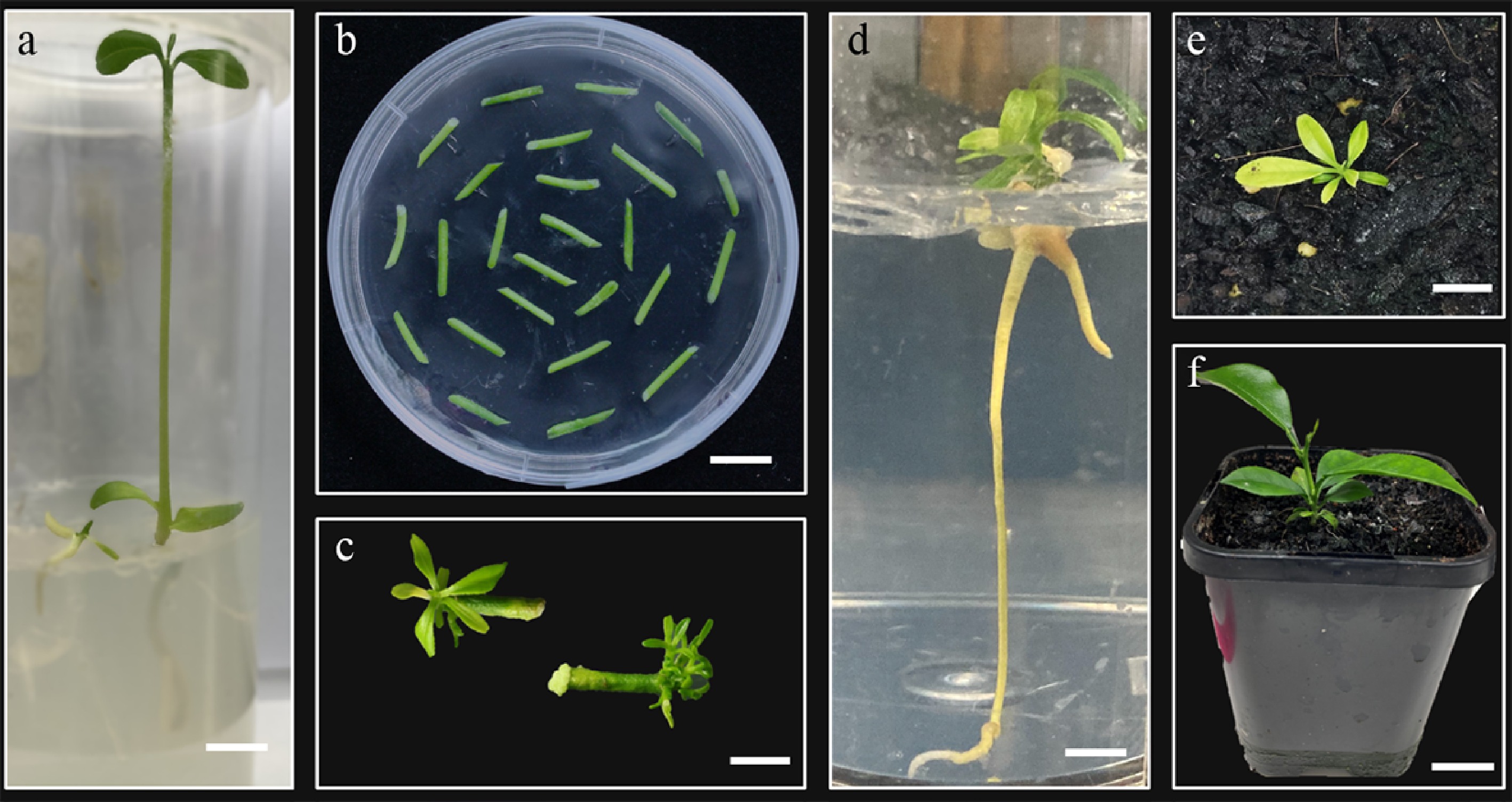
Figure 1.
A schematic representation of in vitro regeneration from epicotyl explants of sweet orange (Citrus sinensis). (a) Optimal seedling growth for excising epicotyl explants, (b) dissected epicotyls (~1 cm long) cultured in shoot regeneration media, (c) regenerated shoots from the cut end of the epicotyls, (d) elongated in vitro roots from regenerated shoots, (e) acclimatisation of plantlets 5 days after transfer to soil, and (f) a fully grown healthy sweet orange plantlet 8 weeks after transfer to soil. Scale bar = 1 cm.
-
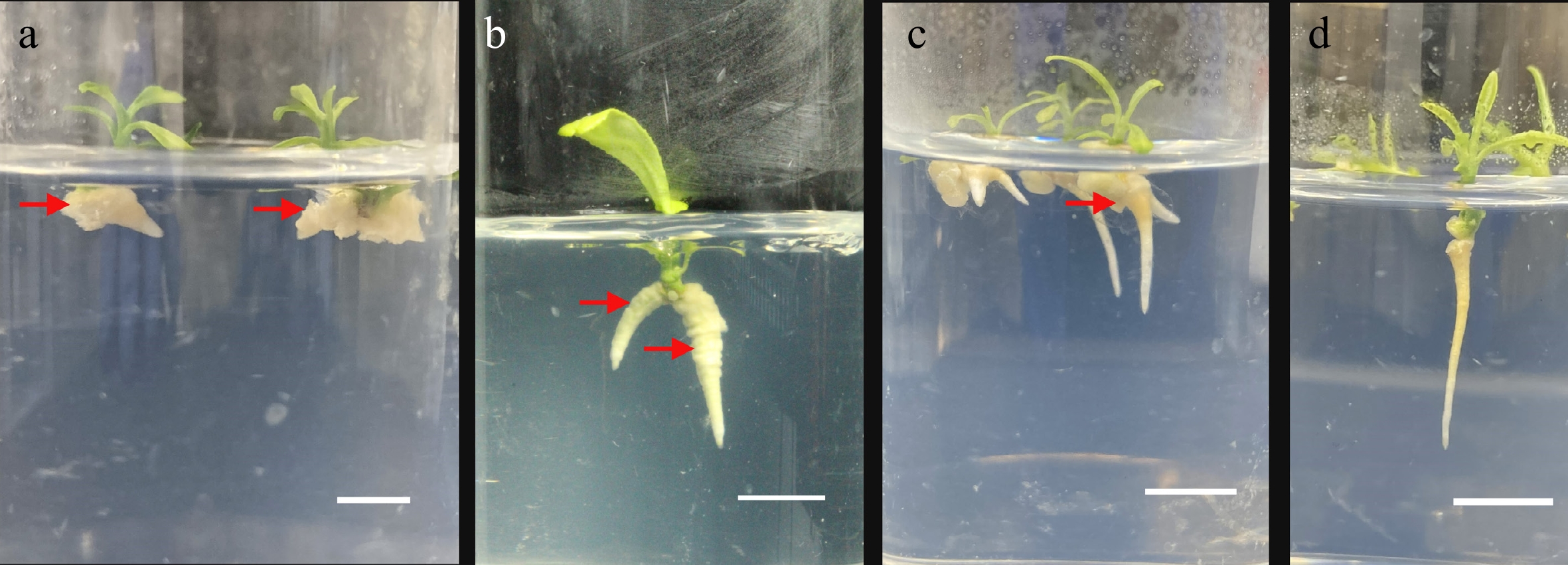
Figure 2.
Diverse root morphologies of epicotyl-regenerated sweet orange (Citrus sinensis) shoots cultured on different rooting media. (a) Callus formation at the basal end of the shoot with no visible root development in rooting media mostly containing 0.5 mg·L−1 NAA. (b) Root formation was observed; however, excessive callus formation reduced shoot vigour. (c) Callus was present at the basal region during early rooting, followed by elongation of the roots and the gradual disappearance of callus tissue. (d) Absence of callus formation with well-developed, elongated roots. (a)–(c) Callus tissues are indicated by red arrows. Scale bar = 1 cm.
-
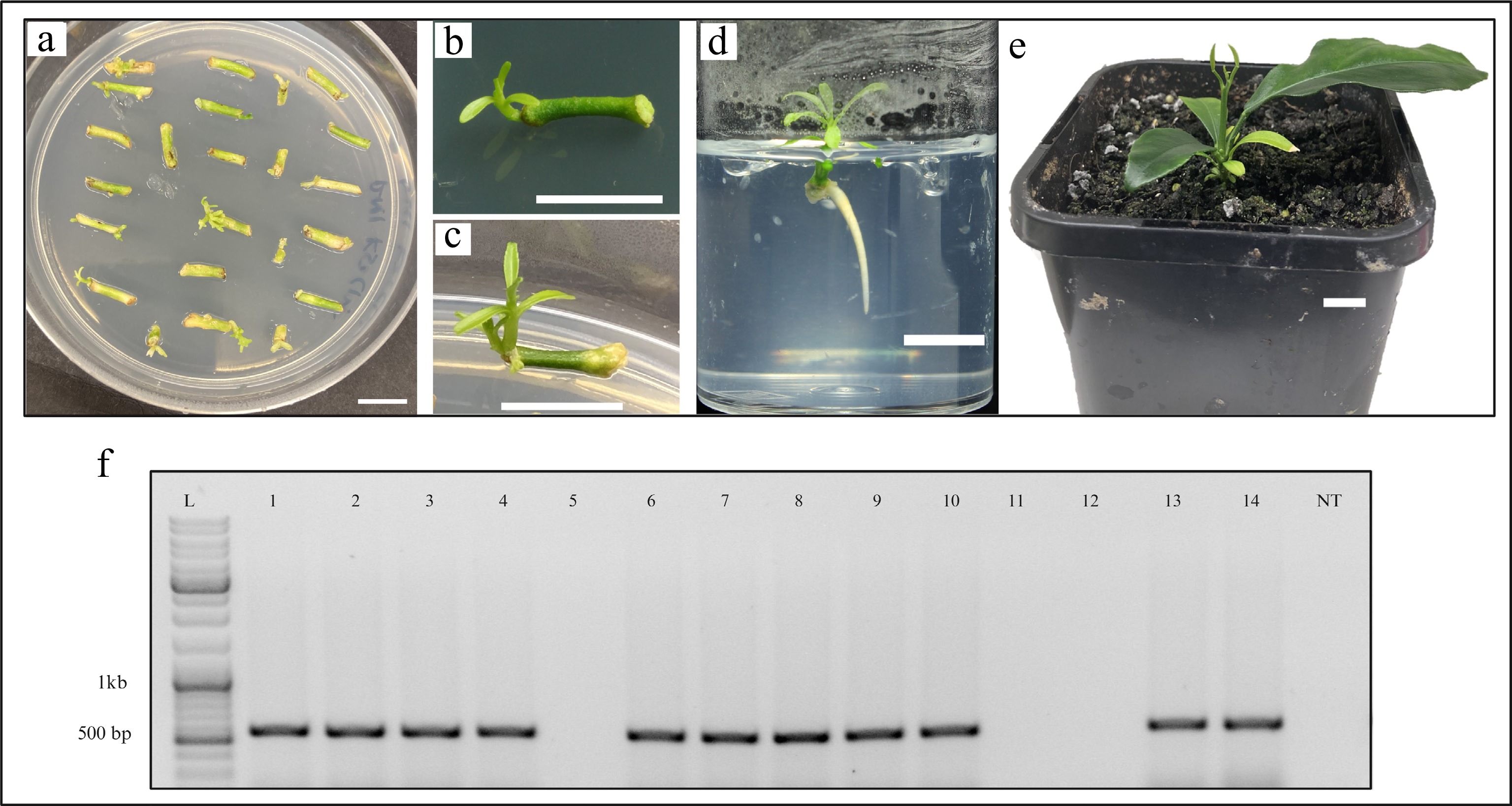
Figure 3.
Recovery and molecular confirmation of transgenic sweet orange (Citrus sinensis) lines. (a) Epicotyl explants infected with the empty CRISPR/Cas9 construct cultured on regeneration media under selection. (b), (c) Regenerated transgenic shoots on SRM2+ selection medium, (d) rooted transgenic plantlets, and (e) acclimatised transgenic plantlets 8 weeks after being transferred to soil. (f) PCR confirmation that Cas9 was integrated in regenerated sweet orange plants. Lanes from left to right; L = gene ruler ladder mix indicated with 1-kb and 500-bp bands, transgenic lines are labelled 1–14, and NT indicates a nontransformed control. n = 230 (total number of explants used in three independent experiments). (a)–(e) Scale bar = 1 cm.
-
Media Concentrations of PGRs (mg·L−1) Shoot regeneration
rate (%)Cytokinin (BAP) Auxin (IAA) Auxin (2,4-D) SRM1 2.0 0 0 75.0 ± 1.73b SRM2 3.0 0 0 90.6 ± 1.73a SRM3 2.0 0.5 0 77.1 ± 1.0b SRM4 2.0 0 0.25 0 ± 0c Values are presented as the means ± standard error. Different superscript letters indicate statistically significant differences between SRMs (one-way ANOVA followed by Tukey's HSD test, p < 0.05). n = 3 replicates with 32 explants each. Table 1.
In vitro shoot regeneration of sweet orange (Citrus sinensis) epicotyl explants cultured on various shoot regeneration media (SRMs) with different combinations of plant growth regulators (PGRs).
-
Media Concentrations of auxins (mg·L−1) Rooting
percentage (%)Callus on roots IBA NAA RTM1 0 0 29.2 ± 4.17bc − RTM2 0 0.1 8.0 ± 4.17c ++ RTM3 0 0.5 29.0 ± 4.17bc +++ RTM4 0.5 0 33.0 ± 4.17bc − RTM5 0.5 0.1 87.5 ± 7.22a ++ RTM6 0.5 0.5 70.8 ± 4.17a ++ RTM7 1.0 0 42.0 ± 4.17b − RTM8 1.0 0.1 75.0 ± 7.22a + RTM9 1.0 0.5 38.0 ± 0bd +++ RTM10 2.0 0 13.0 ± 0cd − RTM11 2.0 0.1 8.0 ± 4.17c + RTM12 2.0 0.5 25.0 ± 12.5bc +++ Values are presented as the means ± standard error. Different letters in the same column indicate statistically significant mean differences among RTMs (one-way ANOVA followed by Tukey's HSD test, p < 0.05). n = 3 replicates with eight shoots each. '+': callus formed at the beginning of root formation and disappeared after 2–3 weeks; '++': callus formation initially increased but the size of the callus reduced with root growth; '+++': the speed of callus formation was similar to that of root growth and was observed to inhibit the overall rooting process. Table 2.
Rooting responses of regenerated sweet orange (Citrus sinensis) shoots cultured on different rooting media (RTMs) containing a range of concentrations of the auxins indole-3-butyric acid (IBA) and 1-naphthalene acetic acid (NAA).
-
Treatment Shoot regeneration
rate (%)Rooting percentage (%) Transformation efficiency Control 87.0 ± 0.67 73.0 ± 2.1 N/A Empty CRISPR/
Cas9 construct41.5 ± 0.06 69.0 ± 1.1 4.8 ± 0.2% Values are presented as the means ± SE. Transformation efficiency = (Positive regenerated shoots confirmed by PCR/The total number of treated epicotyl explants) × 100. n = 230 (the total number of explants used in three independent experiments). Table 3.
Efficiency of the best-performing shoot regeneration (SRM2+) and rooting (RTM8) media for recovering transgenic sweet orange (Citrus sinensis) plants.
Figures
(3)
Tables
(3)