-
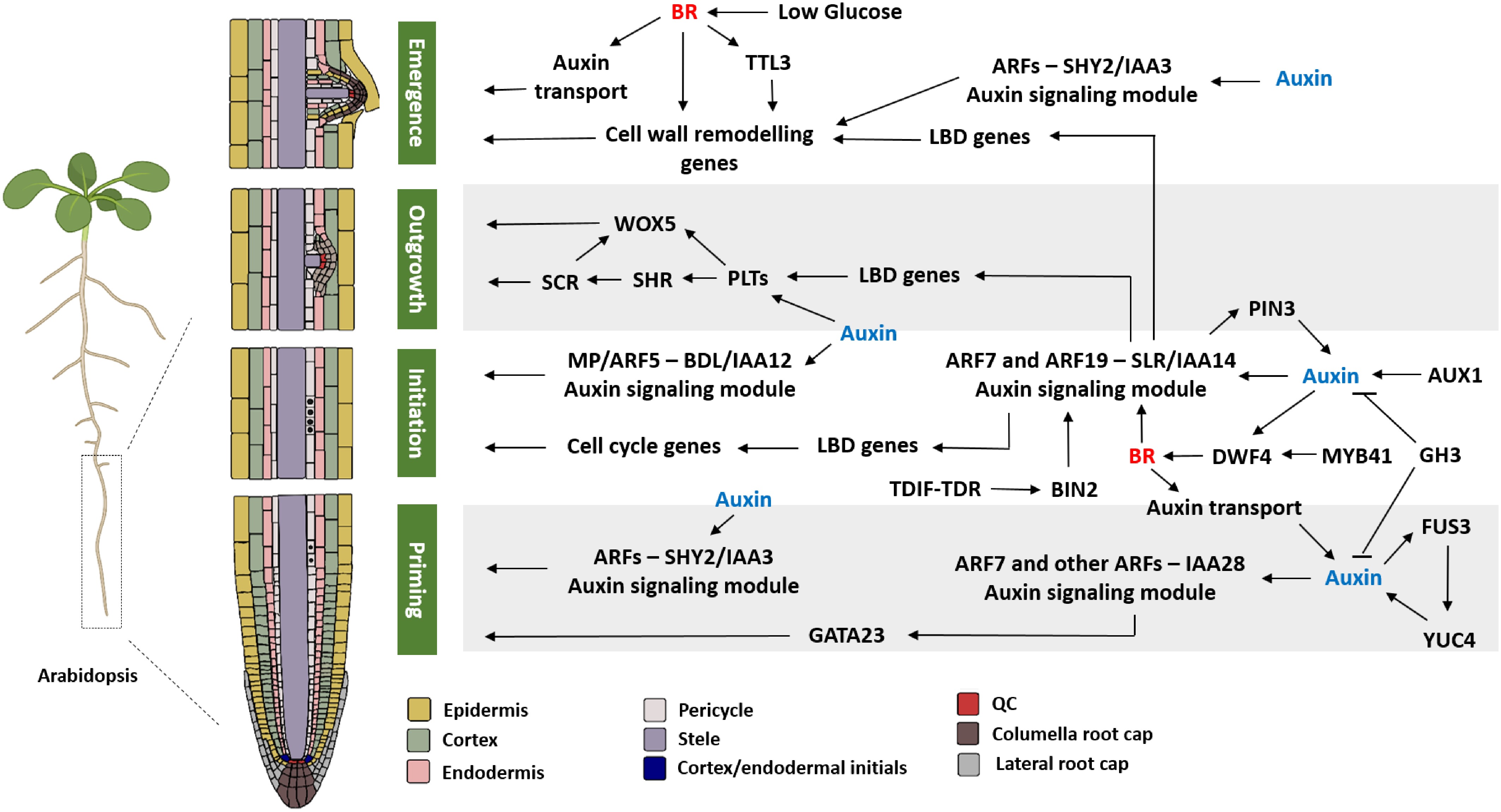
Figure 1.
Proposed model illustrating the roles of auxin, brassinosteroids (BR), and their crosstalk during different stages of lateral root (LR) development in Arabidopsis. Auxin regulates multiple stages of LR formation, including priming (LR founder cell specification), initiation, outgrowth, and emergence. During LR priming, auxin-Aux/IAA-ARF modules and subsequent activation of GATA23 specify the LRFC's identity in the XPP cells. During LR initiation, MP/ARF5-BDL/IAA12 and ARF7/ARF19-SLR/IAA14 auxin signaling modules activate downstream genes, such as LBD and cell cycle genes, which promote the cell division of LRFCs and LR primordia (LRP) formation. In parallel, peptide signaling through the non-canonical TDIF–TDR–BIN2 pathway promotes LR initiation by phosphorylating ARF7 and ARF19, thereby enhancing their transcriptional activity independently of auxin perception. Brassinosteroids (BRs) interact with the auxin signaling machinery, including auxin signaling modules and auxin transport, for promoting the LR priming and initiation processes. In the outgrowth stage, developmental regulators such as PLTs, WOX5, SCR, and SHR coordinate LRP development together with auxin-dependent LBD gene expression. BR may regulate this process by interacting with the ARF7/ARF19-SLR/IAA14 auxin signaling module. During LR emergence, BR promotes cell wall remodeling and auxin transport, facilitating primordia emergence through overlying tissues. GH3 proteins maintain auxin homeostasis during different stages of LR development by conjugating free IAA. Together, auxin and BR signaling pathways form an integrated regulatory network that coordinates LR development from LRFC specification to LR emergence.
Figures
(1)
Tables
(0)