-
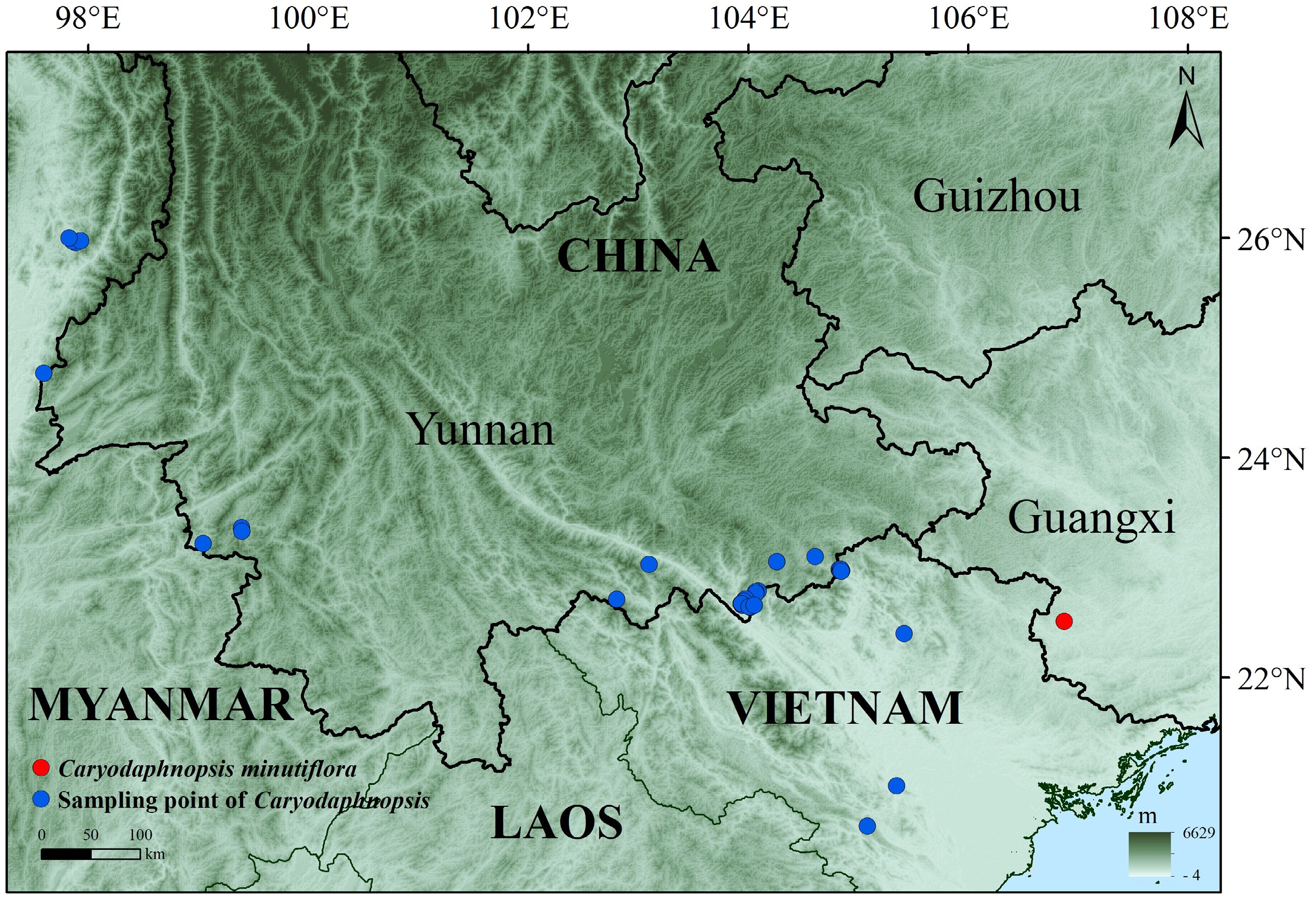
Figure 1.
Distribution map showing the new species Caryodaphnopsis minutiflora sp. nov. and other sampled Caryodaphnopsis species in Asia (Map No. GS [2024] 0650;
https://cloudcenter.tianditu.gov.cn/administrativeDivision ). -
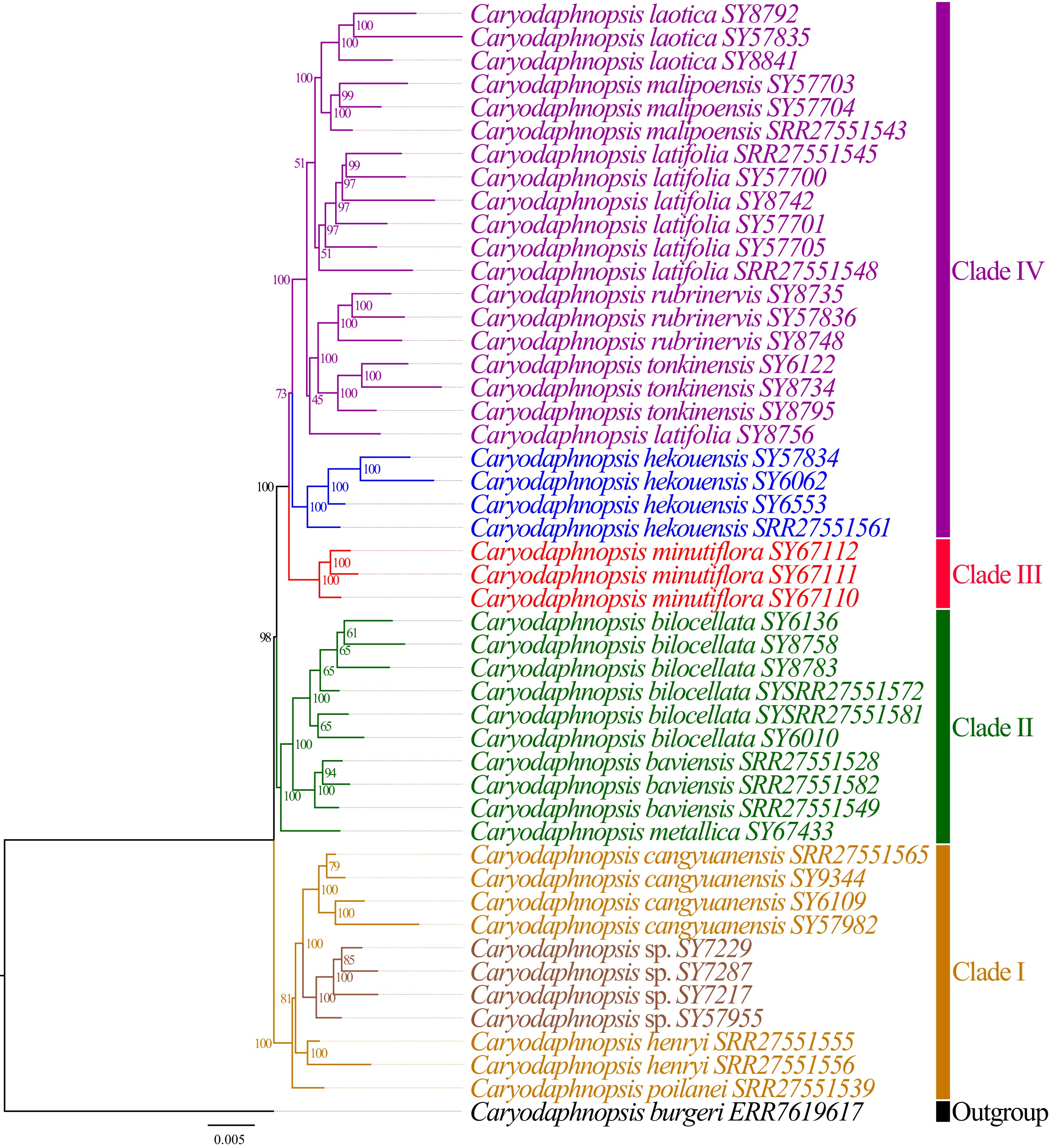
Figure 2.
Concatenation-based species tree inferred from 344 nuclear genes using IQ-TREE. C. burgeri from South America was used as the outgroup. Numbers at the nodes are bootstrap support values (ML–BS).
-
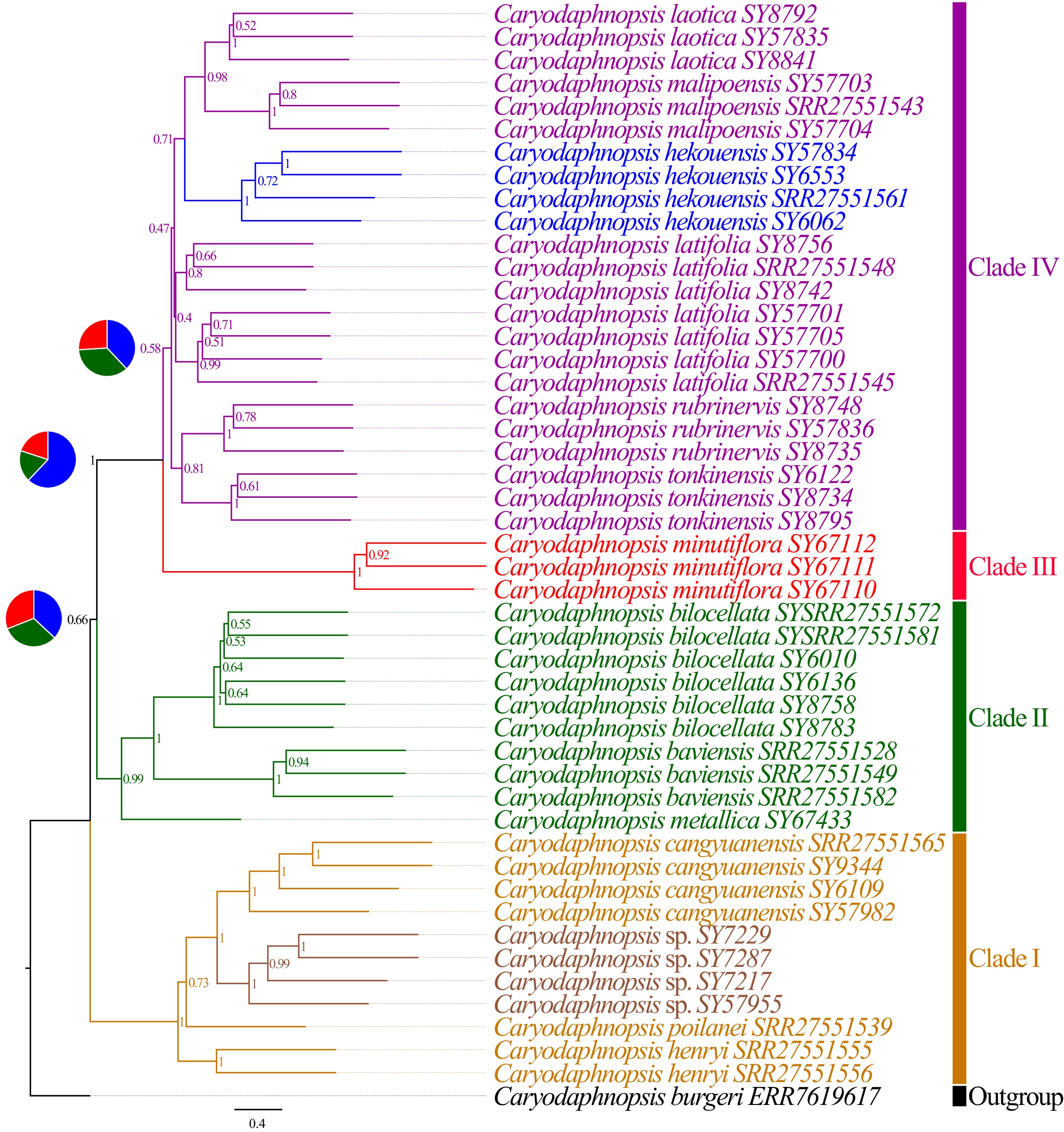
Figure 3.
Coalescent-based species tree inferred from 344 nuclear genes using ASTRAL. C. burgeri from South America was used as the outgroup. Node numbers indicate PP values. Pie charts at three backbone nodes show gene-tree concordance and conflict proportions. Blue, concordant gene trees; green, second-most-common conflict; red, all other conflicting topologies.
-
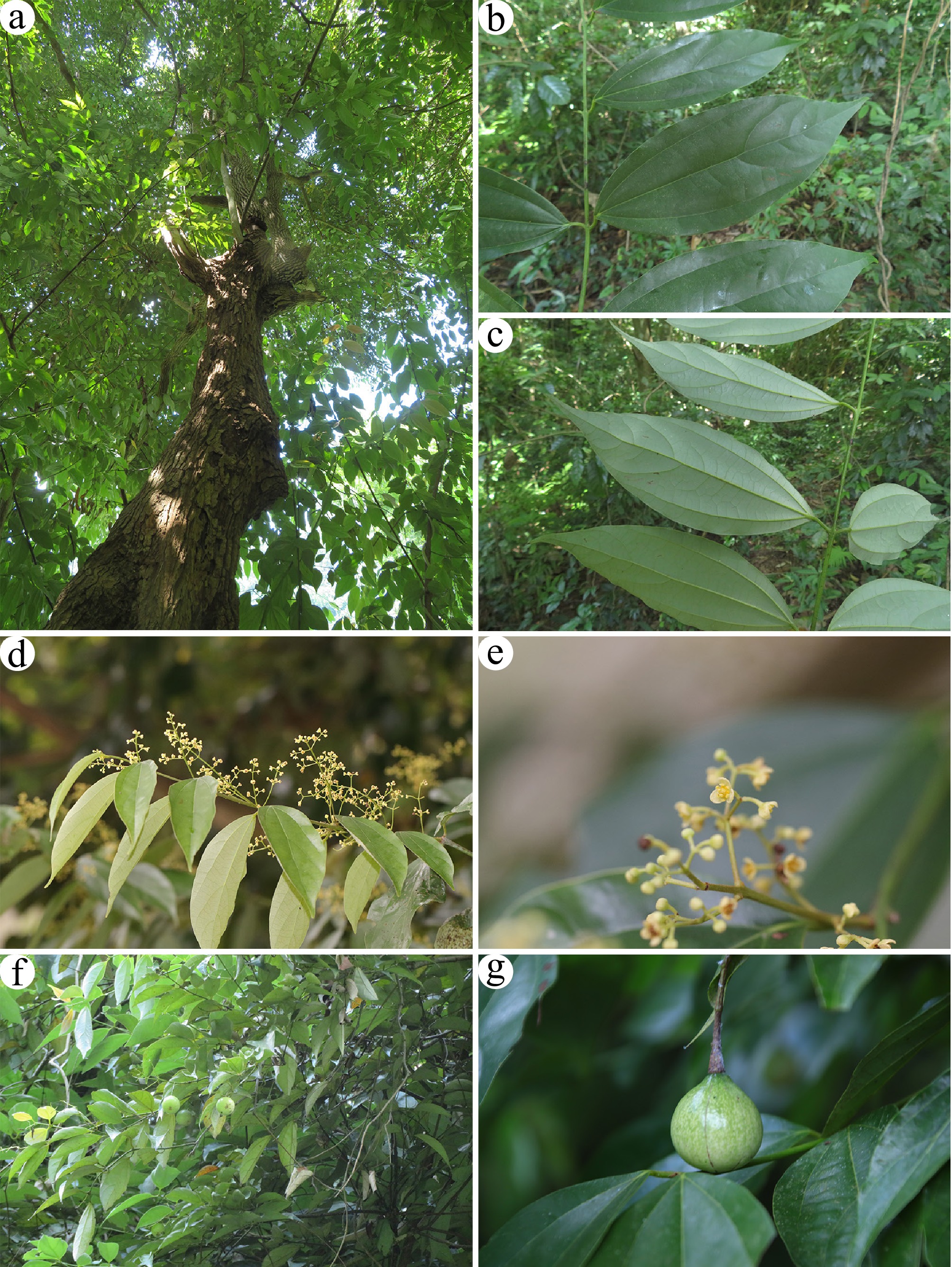
Figure 4.
Caryodaphnopsis minutiflora sp. nov. (a) Habit; (b) leaf adaxial surface; (c) leaf abaxial surface; (d) flowering branches; (e) flower; (f) fruiting branches; (g) pyriform and glabrous fruit.
-
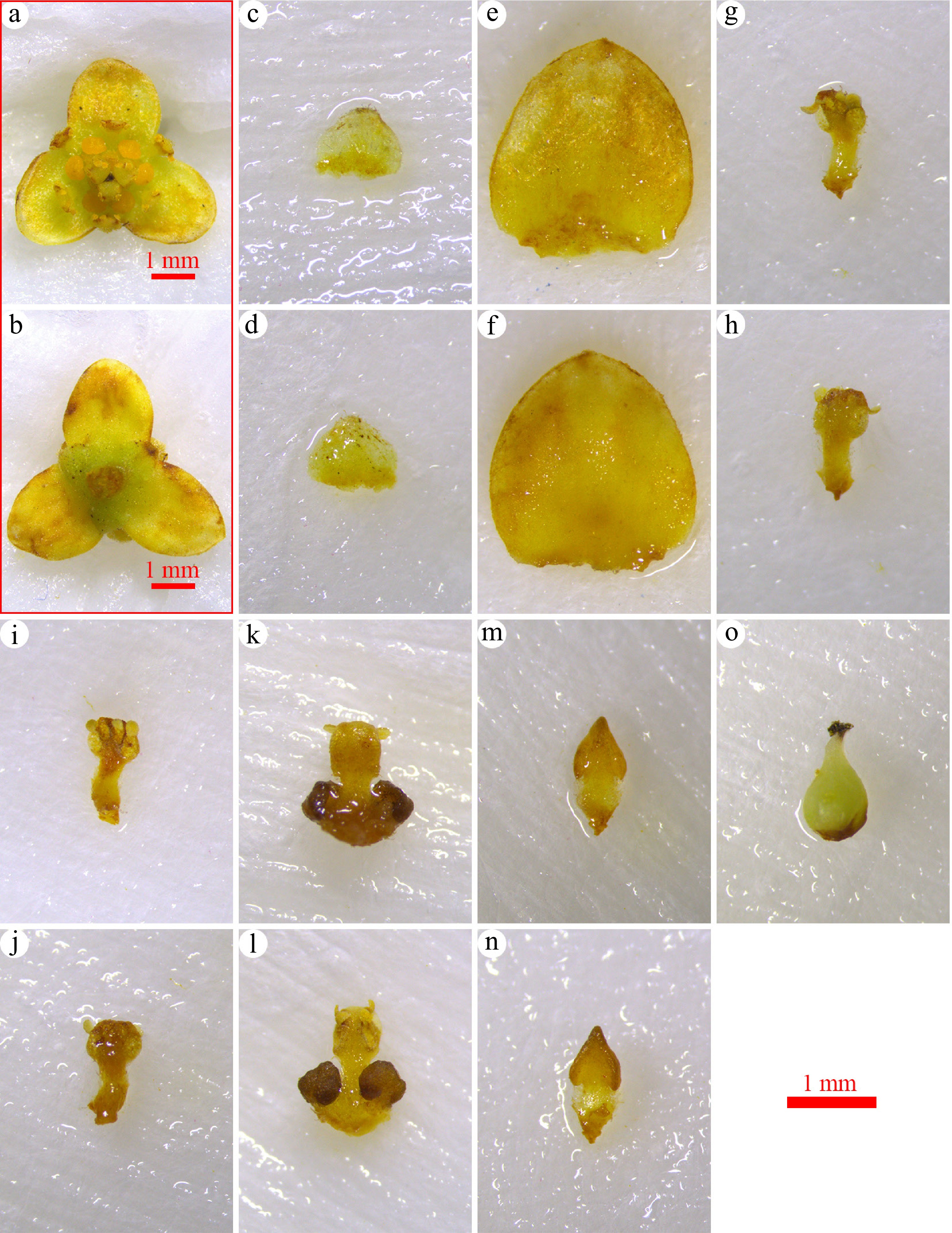
Figure 5.
Anatomical structure of a flower of Caryodaphnopsis minutiflora sp. nov. (a) Front view of the flower; (b) back view of the flower; (c) perianth lobes of the first whorl, adaxial side; (d) perianth lobes of the first whorl, abaxial side; (e) perianth lobes of the second whorl, adaxial side; (f) perianth lobes of the second whorl, abaxial side; (g) stamen of the first staminal whorl, adaxial side; (h) stamen of the first staminal whorl, abaxial side; (i) stamen of the second staminal whorl, adaxial side; (j) stamen of the second staminal whorl, abaxial side; (k) stamen of the third staminal whorl, adaxial side; (l) stamen of the third staminal whorl, abaxial side; (m) staminode of the fourth staminal whorl, adaxial side; (n) staminode of the fourth staminal whorl, abaxial side; (o) pistil. In images (c)–(o), the separated scale bar (as seen in the last image) represents 1 mm.
-
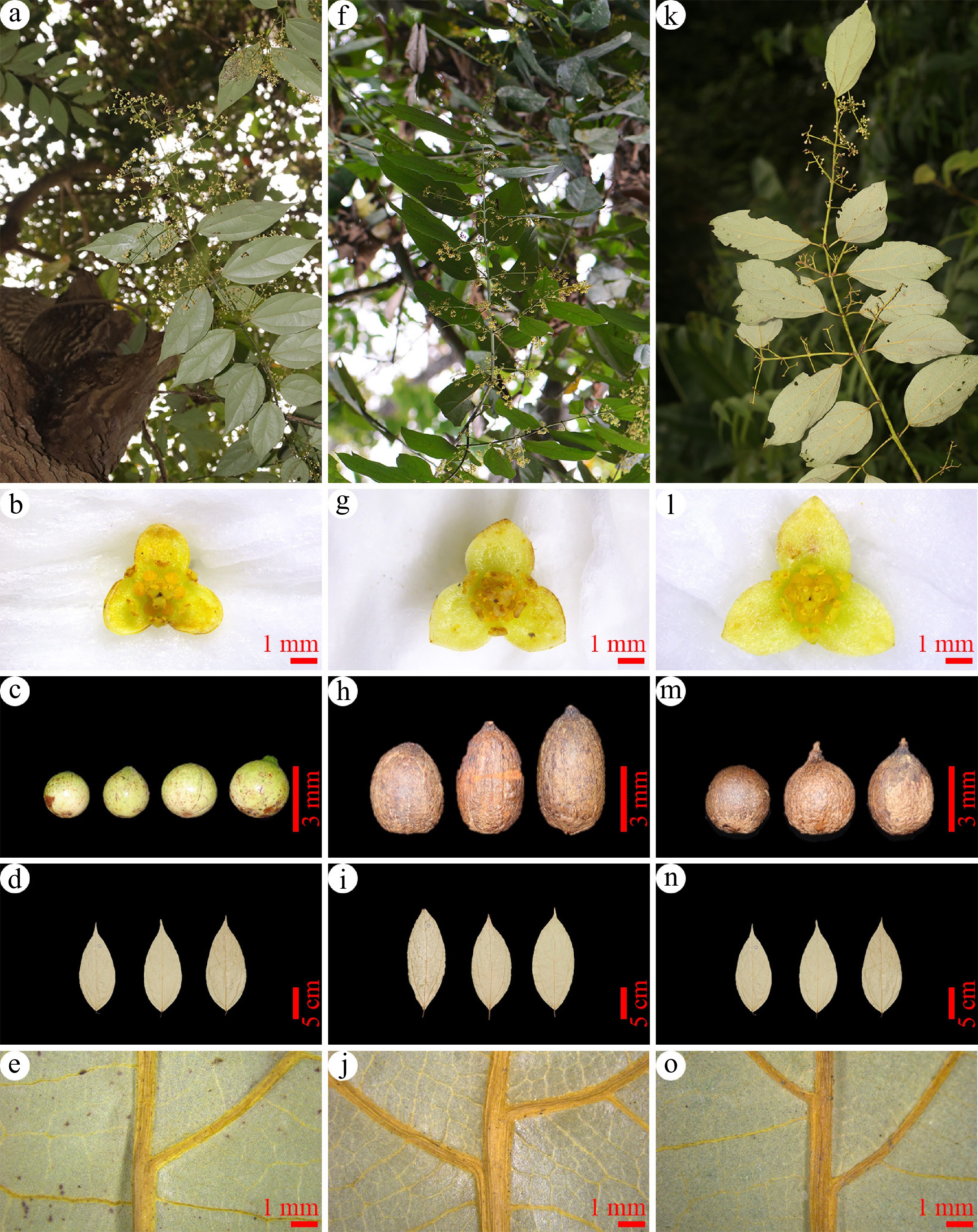
Figure 6.
Morphological comparison between Caryodaphnopsis minutiflora sp. nov., Caryodaphnopsis tonkinensis, and Caryodaphnopsis cangyuanensis. (a)−(e) C. minutiflora sp. nov.; (f)−(j) C. tonkinensis; (k)−(o) C. cangyuanensis; (a), (f), (k) inflorescence; (b), (g), (l) flower; (c), (h), (m) fruit; (d), (e), (I), (j), (n), (o) back view of the leaf.
-
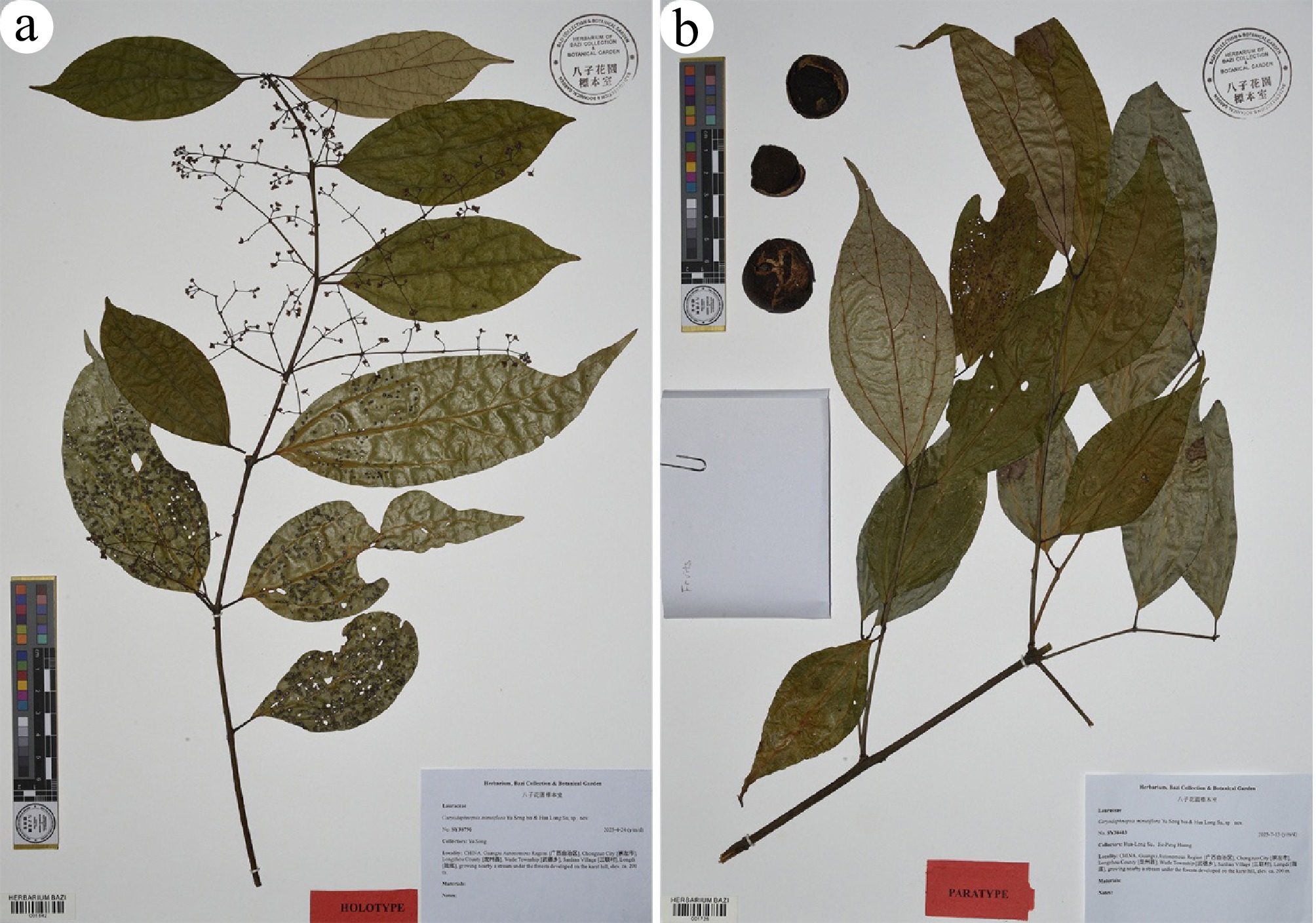
Figure 7.
Type specimens of Caryodaphnopsis minutiflora sp. nov. (a) Flowering specimen, holotype, SY38796 (BAZI barcode 001842!); (b) fruiting specimen, paratype, SY38403 (BAZI barcode 001726!).
-
Character C. minutiflora C. hekouensis C. laotica C. latifolia C. malipoensis C. rubrinervis C. tonkinensis Young branch pubescence Glabrescent Densely pubescent Densely pubescent Glabrescent Densely pubescent Densely pubescent Glabrous Leaf pubescence (abaxially and petioles) Glabrous Densely pubescent Densely pubescent Glabrous Densely pubescent Glabrescent Glabrous Fruit pubescence Glabrous Densely pubescent Densely pubescent Glabrous to glabrescent Pubescent and furfuraceous Glabrous to glabrescent Glabrous to glabrescent Anther locules Four-celled Four-celled Four-celled Four-celled Four-celled Four-celled Four-celled Outer tepals pubescence Abaxially: glabrescent; adaxially: glabrescent Abaxially: densely pubescent; adaxially: densely pubescent Abaxially: densely pubescent; adaxially: glabrescent Abaxially: densely pubescent; adaxially: densely pubescent Abaxially: densely pubescent; adaxially: glabrous Abaxially: densely pubescent; adaxially: densely pubescent Abaxially: glabrescent; adaxially: glabrescent Inflorescence size (cm) 4.2–15(–20) 3–11.2 2.5–11 10–14 1.4–4.2 6–17 2–3.5 Fruit shape Pyriform Almost ellipsoid, slightly pyriform Almost ellipsoid, slightly pyriform Subglobose Pyriform Ellipsoid Ellipsoid Fruit size (cm) 2.0–3.5 × 2.0–3.6 5.5–6 × 3.5–4 4 × 3.5 2.5 × 2.5 6.8–8.3 × 4.6–5.7 6–9 × 4–6 5.5–6 × 3.5–4 Table 1.
Morphological comparison between Caryodaphnopsis minutiflora and six congeneric species.
Figures
(7)
Tables
(1)