-
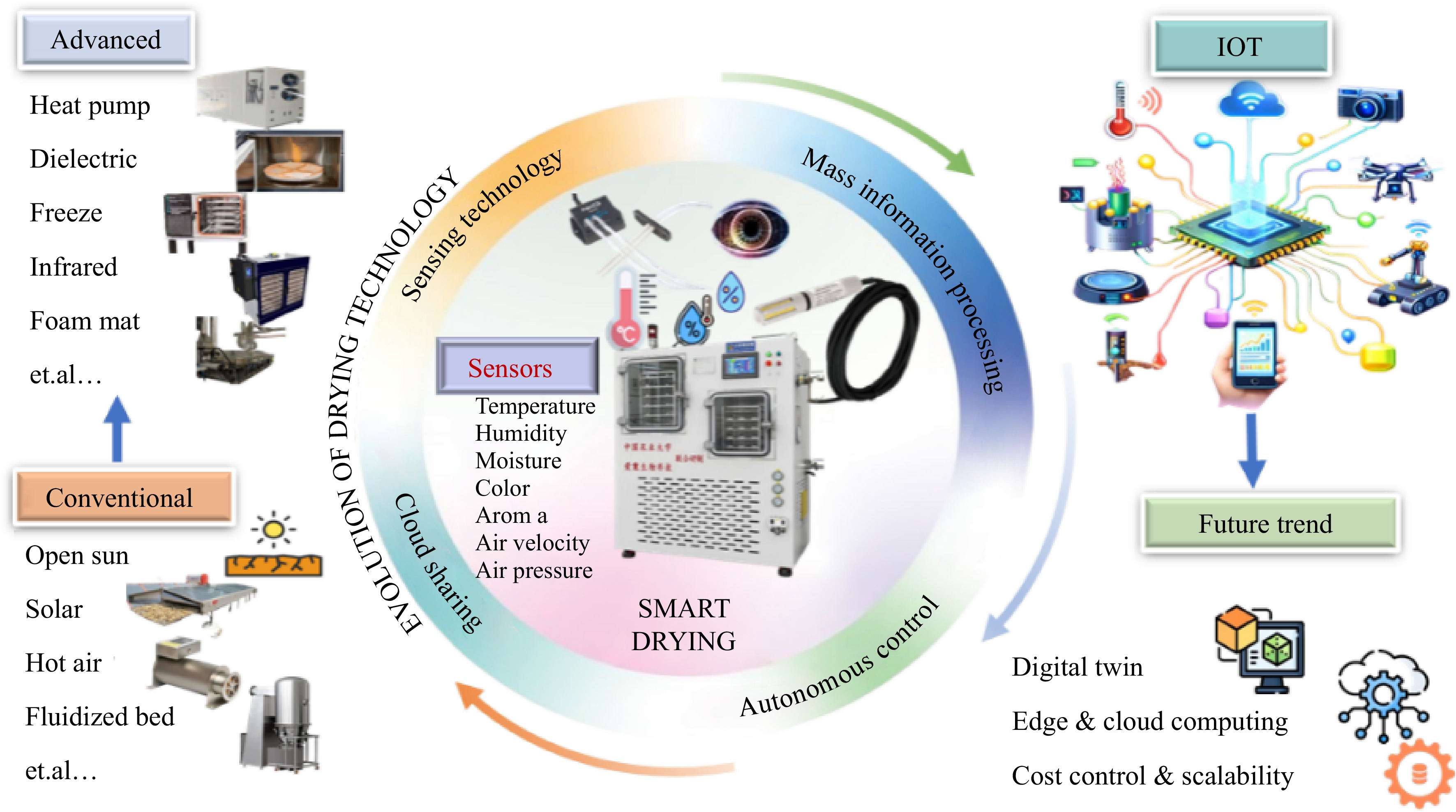
Figure 1.
Graphical abstract.
-
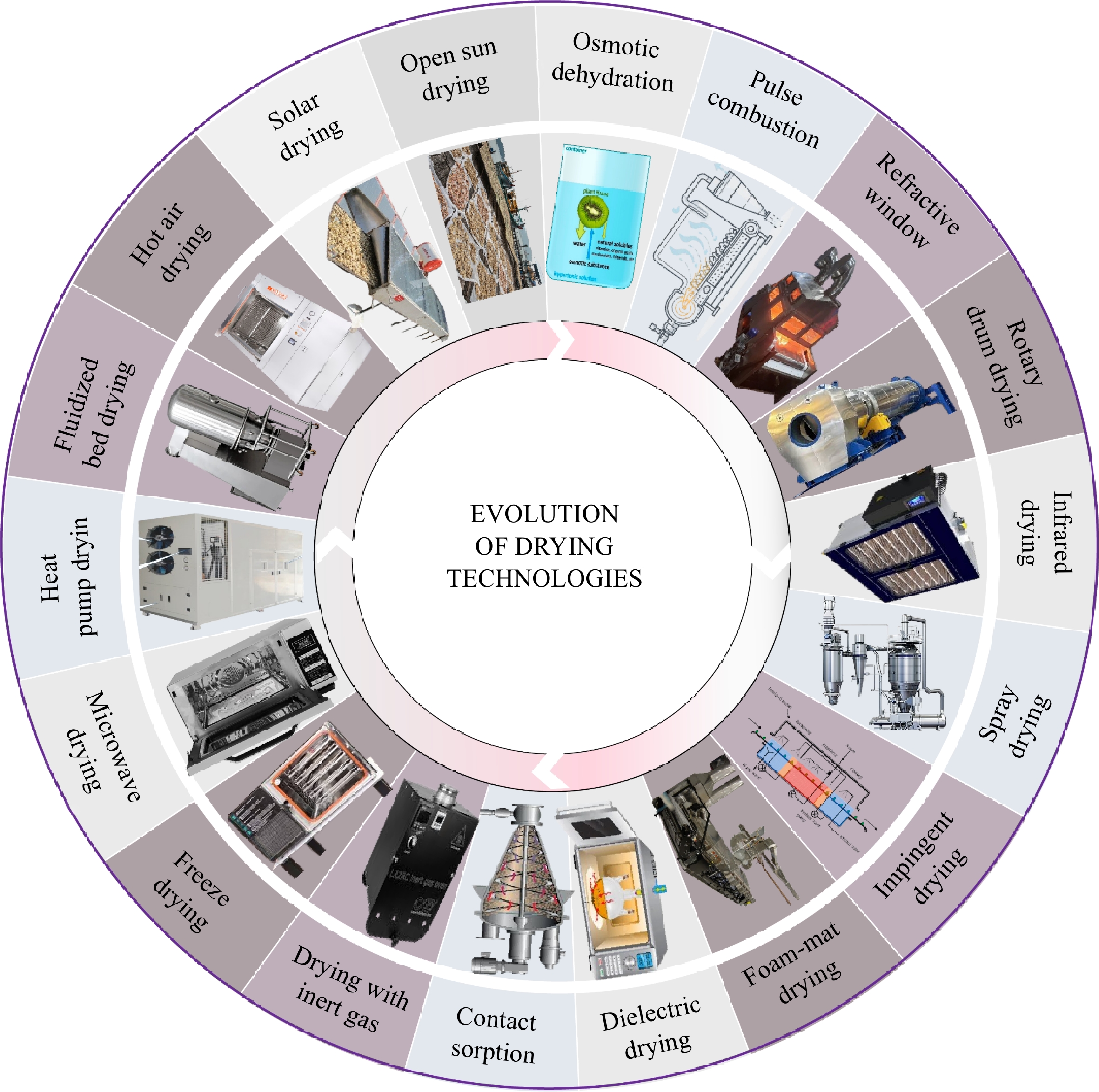
Figure 2.
Evolution of drying from conventional to advanced technologies.
-
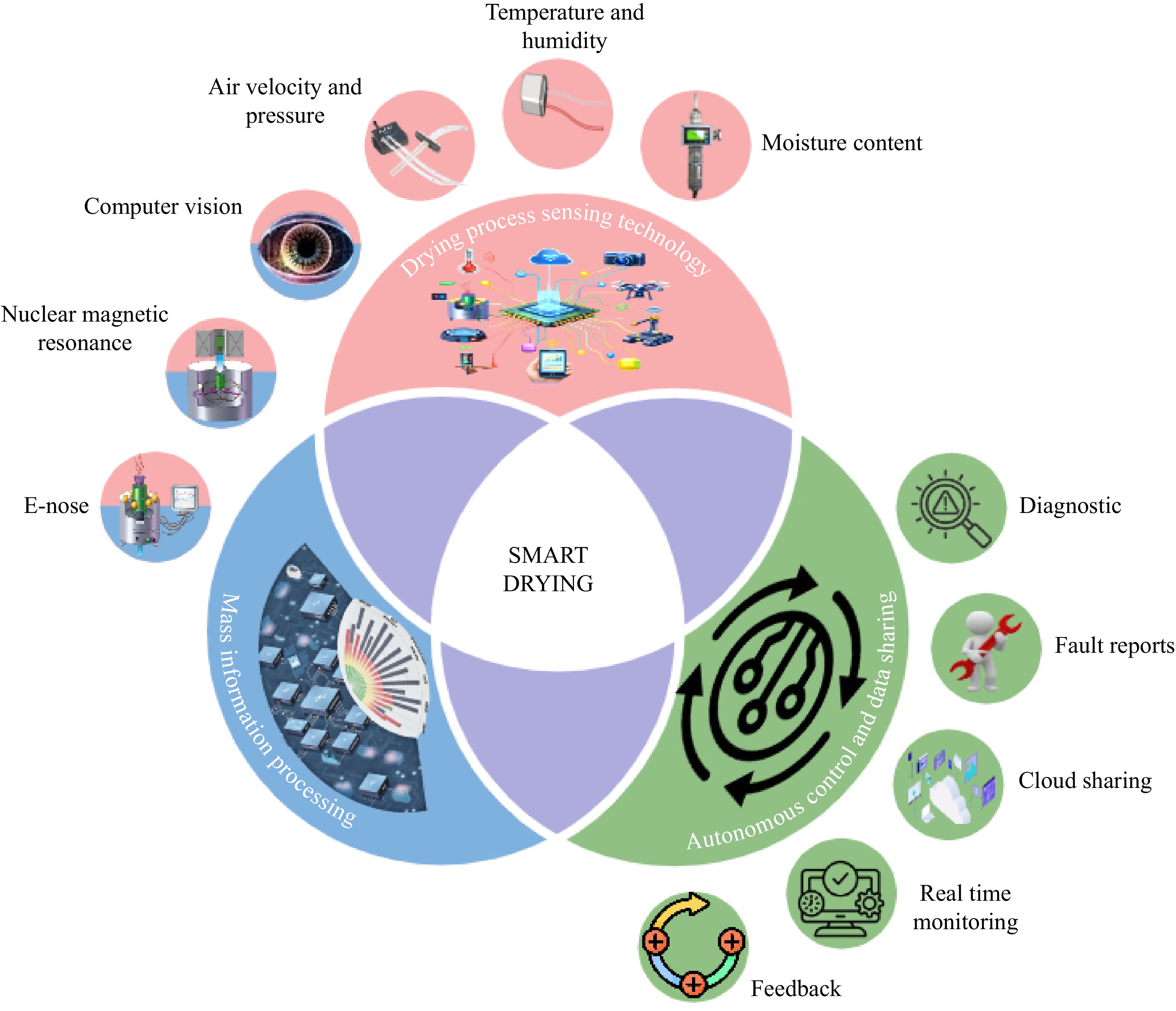
Figure 3.
The concept of smart drying.
-
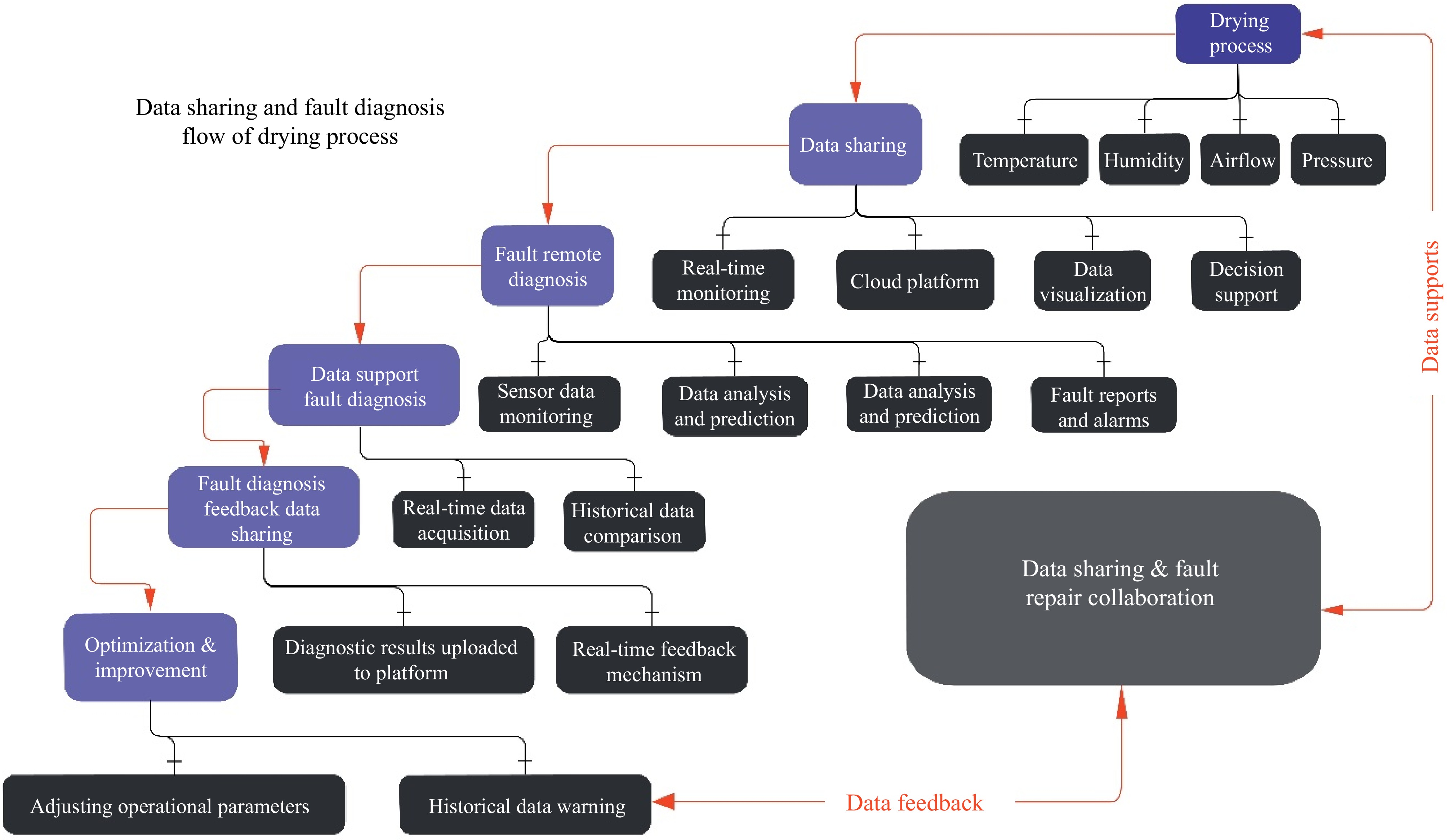
Figure 4.
Closed-loop workflow of data sharing and remote fault diagnosis in smart drying systems.
-
Drying method Typical applications Advantages Disadvantages Ref. Sun drying Grains, fruits, vegetables, fish, herbs Low cost, simple, no specialized equipment, low energy demand Weather-dependent, slow, poor control, contamination risk, uneven quality [8, 10] Air drying Herbs, meat, fish, fruits, agricultural products Simple, energy-efficient, low operating cost Long drying time, inconsistent drying, risk of microbial growth [10] Tray drying Food products, pharmaceuticals, chemicals Versatile, easy operation, suitable for batch processing High energy use, possible uneven drying, requires careful airflow control [11] Hot-air drying Fruits, vegetables, grains, herbs Faster than natural drying, widely available, scalable Energy-intensive, nonuniform drying, shrinkage, possible nutrient/color degradation [11,12] Rotary drying Minerals, biomass, grains, agricultural materials High capacity, suitable for continuous industrial operation High initial cost, high energy consumption, less suitable for delicate products [11] Fluidized bed drying Grains, powders, granules, pharmaceuticals, chemicals Efficient heat and mass transfer, uniform drying, rapid processing Not suitable for large or fragile particles, energy-intensive [13] Heat pump drying Fruits, vegetables, wood, heat-sensitive foods Energy-efficient, controlled temperature and humidity, good quality retention High initial cost, technically complex, affected by ambient conditions [14,15] Microwave drying Foods, herbs, pharmaceuticals, ceramics Rapid drying, internal heating, good nutrient retention when controlled Uneven heating, hot spots, limited penetration depth, high cost of equipment [16,18,21] Freeze-drying Pharmaceuticals, fruits, biological materials, high-value foods Excellent quality retention, preserves the structure, flavor, nutrients and bioactivity Very expensive, long processing time, high energy demand [18,21] Drying with inert solids Heat-sensitive materials, pharmaceuticals, specialty products Efficient moisture removal, low thermal damage, relatively low energy demand Limited applications, solid disposal/regeneration issues [21] Contact-sorption drying Pharmaceuticals, specialty chemicals, heat-sensitive products Energy-efficient, suitable for low-temperature drying Requires sorbent regeneration, limited industrial scope [22] Dielectric drying Wood, textiles, polymers, thick materials Volumetric/internal heating, faster drying, improved uniformity in some materials Energy-intensive, costly equipment, requires precise control [17] Flash drying Starch, pigments, ceramics, powders, dairy materials Very rapid drying, short residence time, suitable for fine particles High energy consumption, unsuitable for large particles, dust handling issues [12] Foam mat drying Fruit juices, dairy products, flavorings, heat-sensitive liquids Fast drying, good retention of volatile compounds, useful for liquids and purees Requires foam to be prepared, the products' formulation affects stability [23] Impingement stream drying Paper, textiles, food products, surface drying operations High heat transfer rate, rapid drying Energy-intensive, possible surface damage [13] Infrared drying Food products, coatings, paints, thin-layer materials Rapid surface heating, energy-efficient for thin products, simple integration Limited penetration depth, surface overheating risk [24] Osmotic drying Fruits, vegetables, fish, semimoist foods Low energy demand, good color and nutrient retention, mild processing Long processing time, solute uptake, incomplete dehydration [25] Pulse combustion drying Chemicals, minerals, food powders Rapid drying, high thermal efficiency, intense heat transfer Complex system, high initial cost, noise/vibration concerns [26] Refractance window drying Fruit purees, herbs, pharmaceuticals, thin liquid foods Gentle drying, good nutrient and color retention, faster than freeze-drying Mainly suitable for thin products, requires a water film system [27] Slush/atmospheric freeze-drying Pharmaceuticals, biological samples, high-value foods Good structure preservation, uniform drying, high quality retention Expensive, slow, technically demanding [19] Superheated steam drying Foods, biomass, sludge, industrial materials Reduced oxidation, potential energy recovery, good heat transfer Complex control, condensation risk, not suitable for all products [10] Spray drying Milk powder, juices, flavors, pharmaceuticals, encapsulated products High production rate, continuous operation, controllable powder properties High temperature exposure, not ideal for all heat-sensitive compounds, costly equipment [20,28] Hybrid drying Fruits, vegetables, grains, herbs, high-value foods Combines strengths of multiple methods, improves efficiency and quality More complex design, higher cost, optimization required [12,29] Table 1.
Applications, advantages, and disadvantages of major drying methods.
-
Sensing technology Measured parameter(s) Operating principle Advantages Limitations Typical applications in drying Thermocouples/
Resistance Temperature Detectors (RTDs)Temperature Electrical resistance or thermoelectric effect High accuracy, low cost, fast response Point measurement; limited spatial resolution Air/product temperature monitoring, control feedback Capacitive humidity sensors Relative humidity Dielectric constant variation Compact, low power, real-time response Drift under high temperature and humidity Monitoring of the drying air's humidity Gravimetric load cells Mass loss Measurements of weight change Direct indication of moisture loss Not suitable for continuous industrial lines Drying kinetics analysis, laboratory-scale drying Electrical resistance/
impedance sensorsMoisture content Conductivity variation with moisture Simple, low cost Affected by temperature and composition Online moisture estimation NIRS Moisture, chemical composition Molecular vibration absorption Nondestructive, rapid, multiparameter High cost; calibration-dependent Inline monitoring of moisture and quality HSI Moisture distribution, color, texture Spectral–spatial imaging Spatially resolved, rich information Large data volume; high computational demand Surface moisture mapping, quality assessment Machine vision (red–green–blue [RGB]/
thermal imaging)Shrinkage, color, surface temperature Image-based feature extraction Noncontact, suitable for automation Sensitive to lighting and surface conditions Recognition of the drying stage, defect detection Gas sensors (volatile organic compound [VOC] sensors) Volatile compounds Chemical adsorption or electrochemical reaction Monitoring of quality and flavor Cross-sensitivity, calibration challenges Aroma preservation, endpoint detection Microwave sensors Internal moisture Dielectric property variation Penetrates the product; internal sensing Complexity of the equipment; safety concerns Bulk moisture monitoring in thick products Table 2.
Comparison of sensing technologies used in intelligent food drying systems.
Figures
(4)
Tables
(2)