-
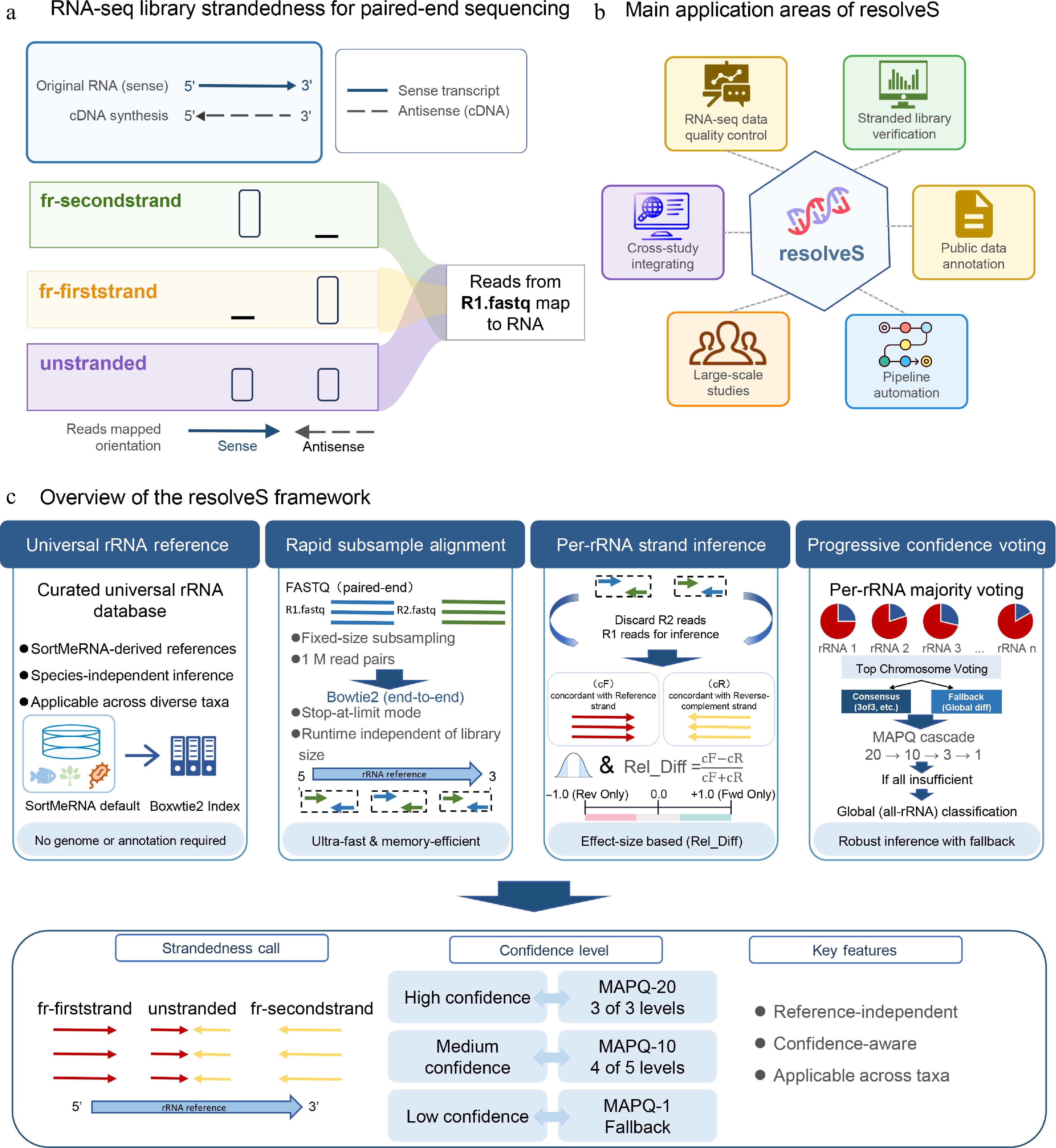
Figure 1.
Principle and pipeline overview of resolveS. (a) Schematic representation of RNA-seq library strandedness in paired-end sequencing strategies. The known original RNA transcript orientation is used for strandedness inference. In fr-secondstrand libraries, reads from R1.fastq align predominantly in the same orientation as the original RNA transcript, whereas in fr-firststrand libraries they align predominantly in the opposite orientation. Unstranded libraries exhibit no consistent orientation bias. Natural antisense transcription may contribute a minor fraction of discordant signals. (b) Main application areas of resolveS. resolveS supports multiple applications in transcriptomic data analysis, including RNA-seq data quality control, verification of stranded library information, annotation of public datasets, integration of data across studies, large-scale transcriptomic analyses, and automated pipeline construction. (c) Overview of the resolveS pipeline. A compact universal rRNA reference database derived from SortMeRNA references is indexed with Bowtie2 and used for genome-independent strandedness inference. Paired-end RNA-seq reads (R1 and R2) are sequentially processed using a fixed-depth strategy (e.g., one million read pairs), enabling runtime scalability independent of total sequencing depth. During alignment, both R1 and R2 reads are utilized to improve mapping accuracy and pairing confidence within conserved rRNA regions.
-
Input type Approach Threads number Maximum align reads Time cost (s) Memory cost (GiB) 5 samples Apptainer_image 15 1,000,000 18.7733 (0.3099) 0.3240 (0.0017) 5 samples Apptainer_image 15 4,000,000 68.0333 (4.3625) 0.3277 (0.0025) 5 samples Apptainer_image 8 1,000,000 21.1567 (0.4267) 0.2813 (0.0021) 5 samples Apptainer_image 8 4,000,000 75.1567 (2.7356) 0.2833 (0.0006) 5 samples Bash_script 15 1,000,000 21.9400 (0.5011) 0.3280 (0.0017) 5 samples Bash_script 15 4,000,000 79.6300 (2.5363) 0.3310 (0.0000) 5 samples Bash_script 8 1,000,000 19.8900 (0.5862) 0.2833 (0.0021) 5 samples Bash_script 8 4,000,000 72.6667 (4.3824) 0.2857 (0.0006) 5 samples Singularity_image 15 1,000,000 19.9367 (0.1464) 0.3267 (0.0012) 5 samples Singularity_image 15 4,000,000 65.6567 (0.4693) 0.3293 (0.0006) 5 samples Singularity_image 8 1,000,000 21.7067 (0.5609) 0.2800 (0.0017) 5 samples Singularity_image 8 4,000,000 70.7333 (0.9570) 0.2857 (0.0029) Single sample Apptainer_image 15 1,000,000 3.6867 (0.0252) 0.3227 (0.0006) Single sample Apptainer_image 15 4,000,000 10.8867 (0.2371) 0.3250 (0.0017) Single sample Apptainer_image 8 1,000,000 4.1033 (0.1159) 0.2783 (0.0006) Single sample Apptainer_image 8 4,000,000 11.7100 (0.2706) 0.2817 (0.0023) Single sample Bash_script 15 1,000,000 2.9900 (0.0300) 0.3243 (0.0006) Single sample Bash_script 15 4,000,000 9.7700 (0.6791) 0.3283 (0.0029) Single sample Bash_script 8 1,000,000 2.9767 (0.0231) 0.2810 (0.0000) Single sample Bash_script 8 4,000,000 10.7567 (0.6309) 0.2850 (0.0000) Single sample Singularity_image 15 1,000,000 3.6133 (0.1041) 0.3240 (0.0026) Single sample Singularity_image 15 4,000,000 11.5267 (0.8363) 0.3283 (0.0051) Single sample Singularity_image 8 1,000,000 3.8433 (0.0379) 0.2807 (0.0023) Single sample Singularity_image 8 4,000,000 11.5700 (0.1609) 0.2790 (0.0000) The CPU is a 13th Gen Intel® Core™ i7-13700, and storage is a WD Green SN350 1TB. The output style is Mean (Standard Deviation). 5 samples means that in many sequencing-based biological experiments, samples within the same batch are often prepared using the same library construction protocol. Therefore, it is valuable to analyze them together to obtain a more reliable conclusion. Table 1.
Benchmarking of resolveS runtime and peak memory usage under different execution settings.
-
Software Reference requirement Primary alignment target Speed/efficiency Installation friendliness Key advantage RSeQC (infer_experiment.py) Requires reference genome and annotations Genome/transcriptome Slow (requires full alignment/BAM) Conda/mamba and pip Established method. how_are_we_stranded_here Requires reference transcriptome/GTF Transcriptome (Pseudoalignment via Kallisto) Fast (seconds/sample) Conda/mamba and pip Fast for organisms with high-quality reference. Trinity/TransDecoder Workflow No (but requires massive compute) De novo assembly Extremely slow/high resource Conda/mamba and extra configuration For discovery in totally de novo context. resolveS (Ours) No reference genome required Universal rRNA database Ultra-fast (< 10 s) and low memory
(< 0.5 GiB)Portable binary and one-stop container images Applicability across nearly all species, including non-model ones. Table 2.
Comparison of resolveS with representative approaches for RNA-seq strandedness inference.
-
Tool Cores Runtime (s) Peak memory (KB) CPU utilization (%) Avg Min Max Avg Min Max Avg Min Max how_are_we_stranded_here 10 90.14 76.66 150.76 7,290,165 7,261,828 7,503,544 417.8 290.0 567.0 resolveS 10 25.38 18.05 50.51 358,330 354,076 368,756 1,118.4 1,107.0 1,124.0 how_are_we_stranded_here 20 77.53 69.59 119.89 7,590,248 7,548,824 7,993,380 559.8 417.0 834.0 resolveS 20 33.55 22.52 40.89 479,081 468,592 495,364 2,093.4 2,086.0 2,098.0 All tests were performed on 50 human paired-end RNA-seq samples from Naphade et al. (SRR13786231–SRR13786280), using the same FASTQ files and a limit of 5,000,000 read pairs for both tools, as specified by their respective built-in read-number parameters. how_are_we_stranded_here performs strand-orientation inference using Kallisto pseudoalignment (v0.50.1) together with RSeQC infer_experiment.py; resolveS is a standalone C/C++ program that detects strand orientation directly from FASTQ files. Runtime and peak memory were collected using GNU time, and CPU utilization was obtained from the %P metric. All tests were completed on the same compute node. See Supplementary File 9 for the reproducible pipeline and 1,000,000 read pairs running performance. Table 3.
Runtime performance comparison of two strand-orientation detection tools.
Figures
(1)
Tables
(3)