-
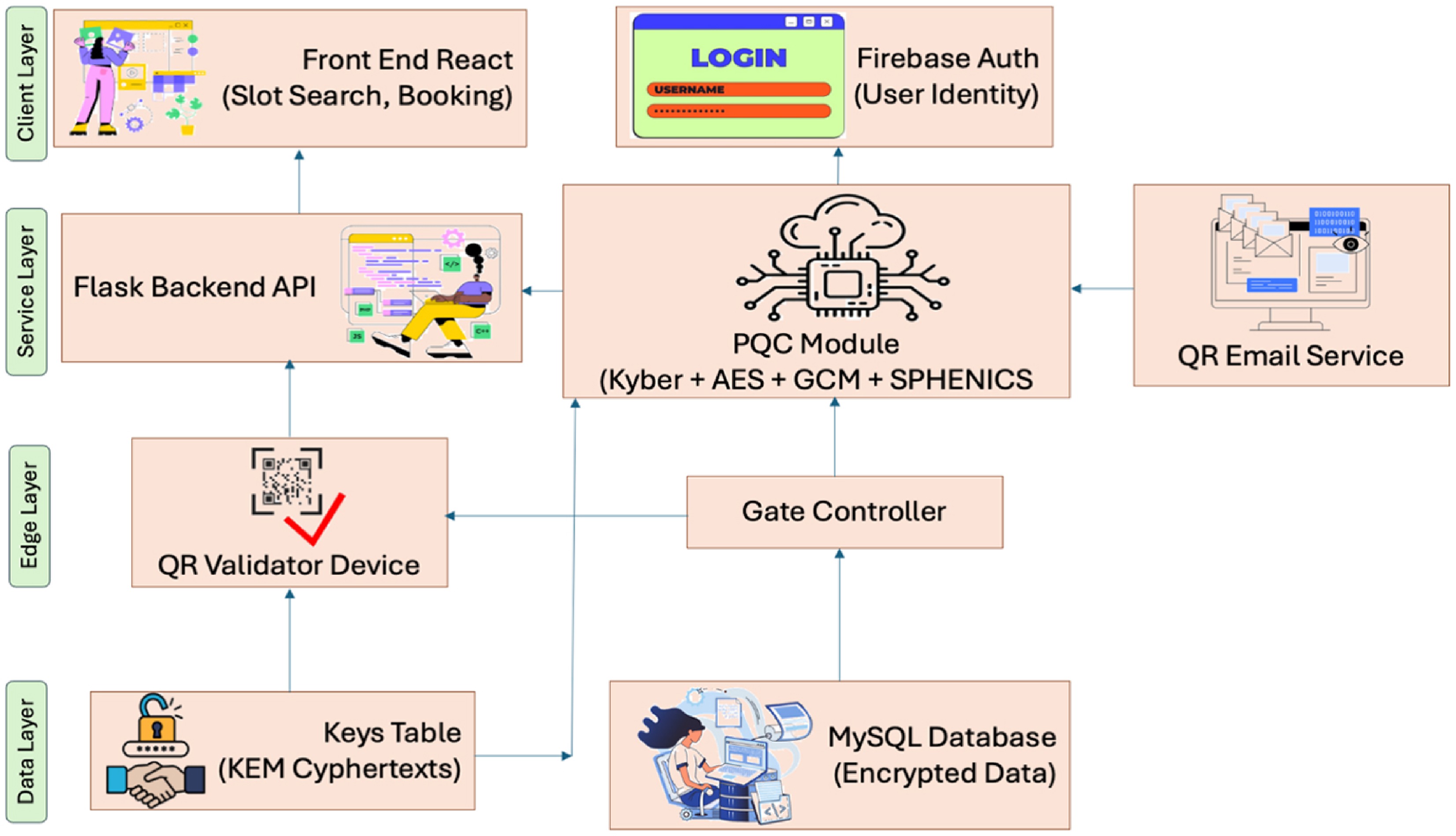
Figure 1.
A high-level overview of the proposed VishwasQ framework that depicts the relationship between the client layer and the service, edge, and data layers. The architecture features the development of user services using React, integration with Firebase for authentication, use of post-quantum cryptography (Kyber, AES-GCM, and SPHINCS+) for security, secure storage in MySQL, integration with the Ethereum blockchain and smart contracts, and QR code validation for parking accessibility.
-
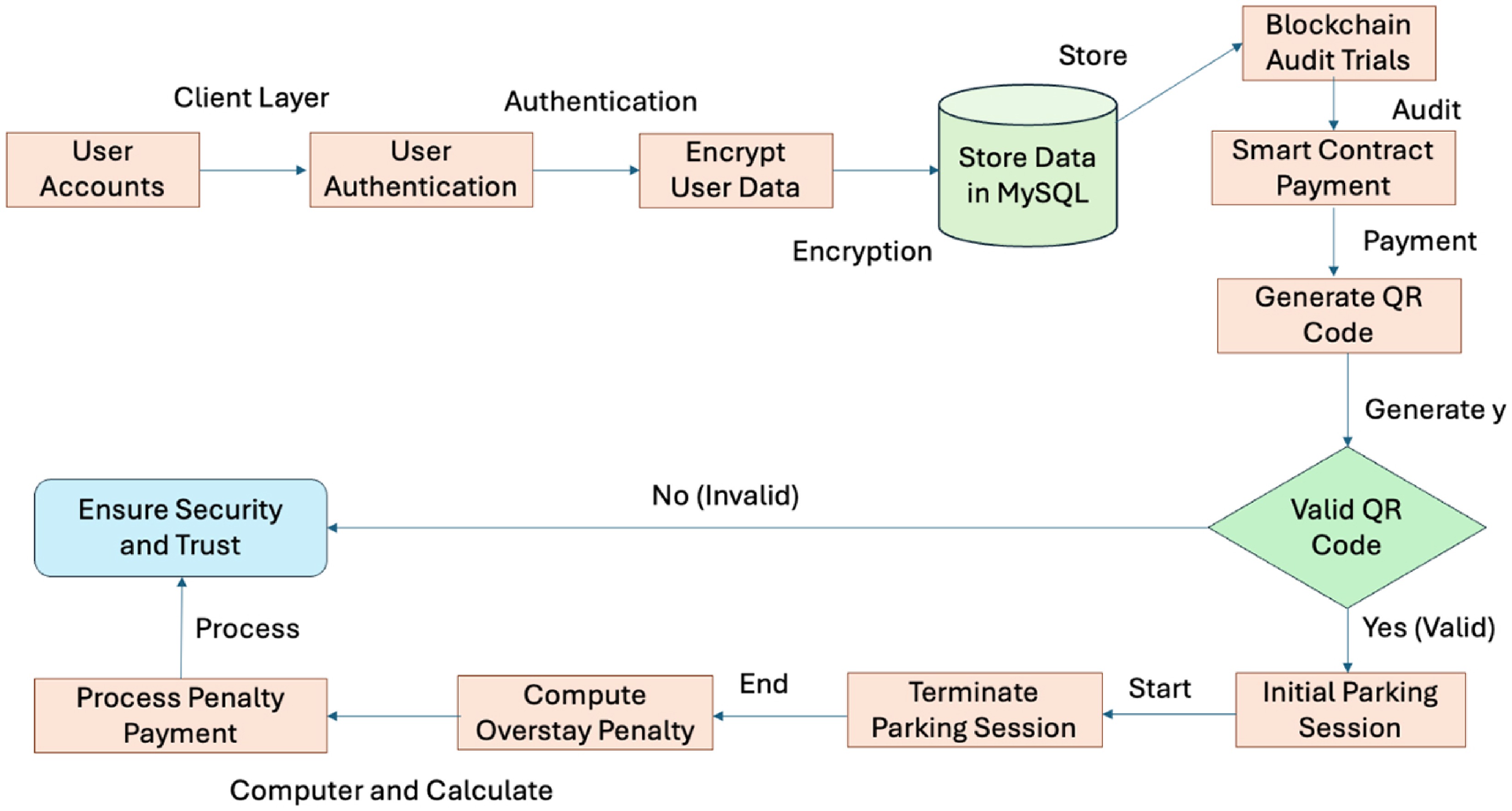
Figure 2.
Operational workflow of the proposed system starting from user authentication, parking reservation, data encryption with PQC, secure storage of data in the database, secure payment using blockchain, generation of QR and validation, parking session management, automated enforcement of penalties, and audit logging in the blockchain.
-
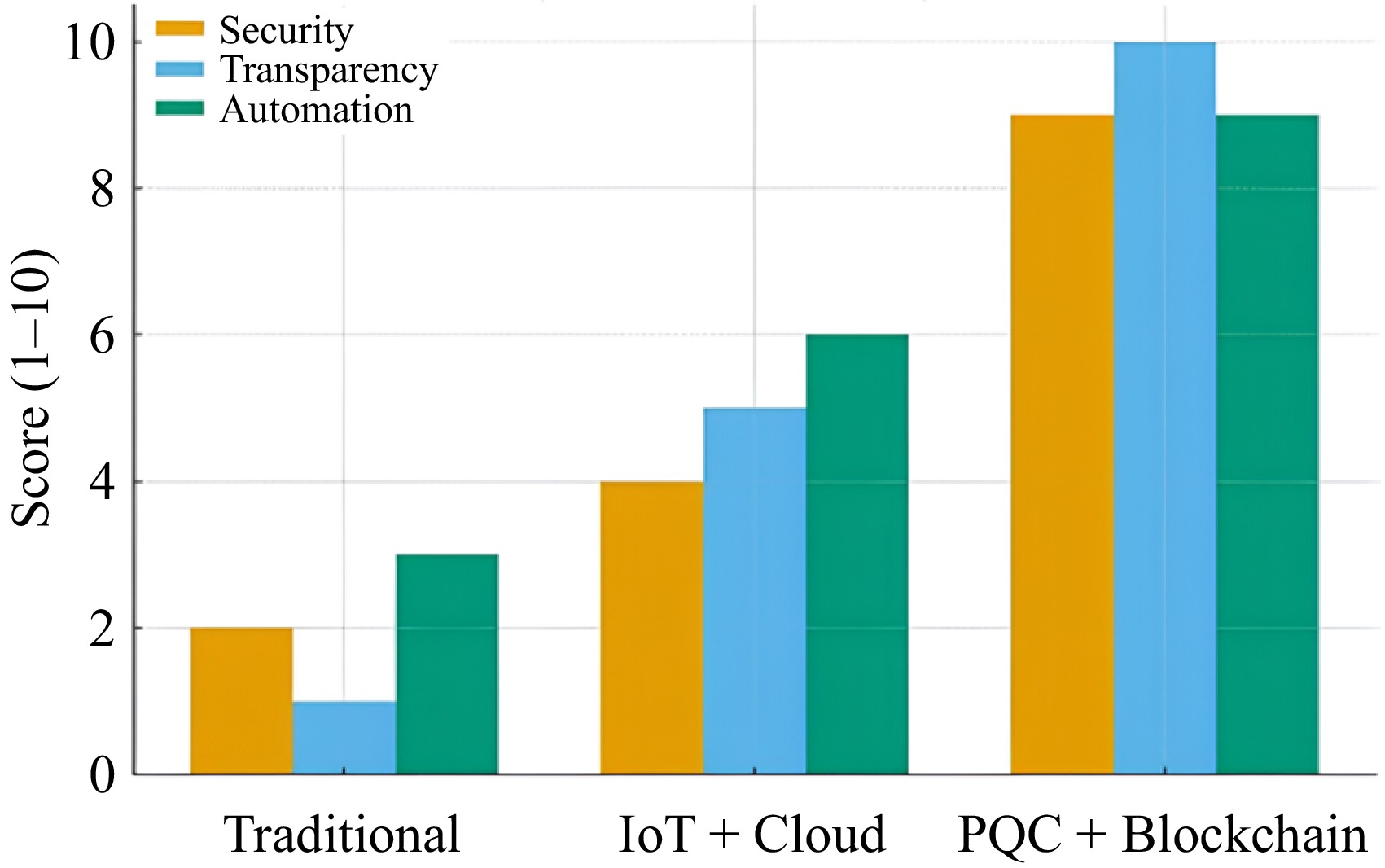
Figure 3.
Traditional, IoT-cloud-based, and the proposed PQC-blockchain parking system are compared qualitatively regarding security, transparency, and automation. The proposed framework combines the quantum resistance of cryptography with decentralized blockchain services to achieve the best overall performance.
-
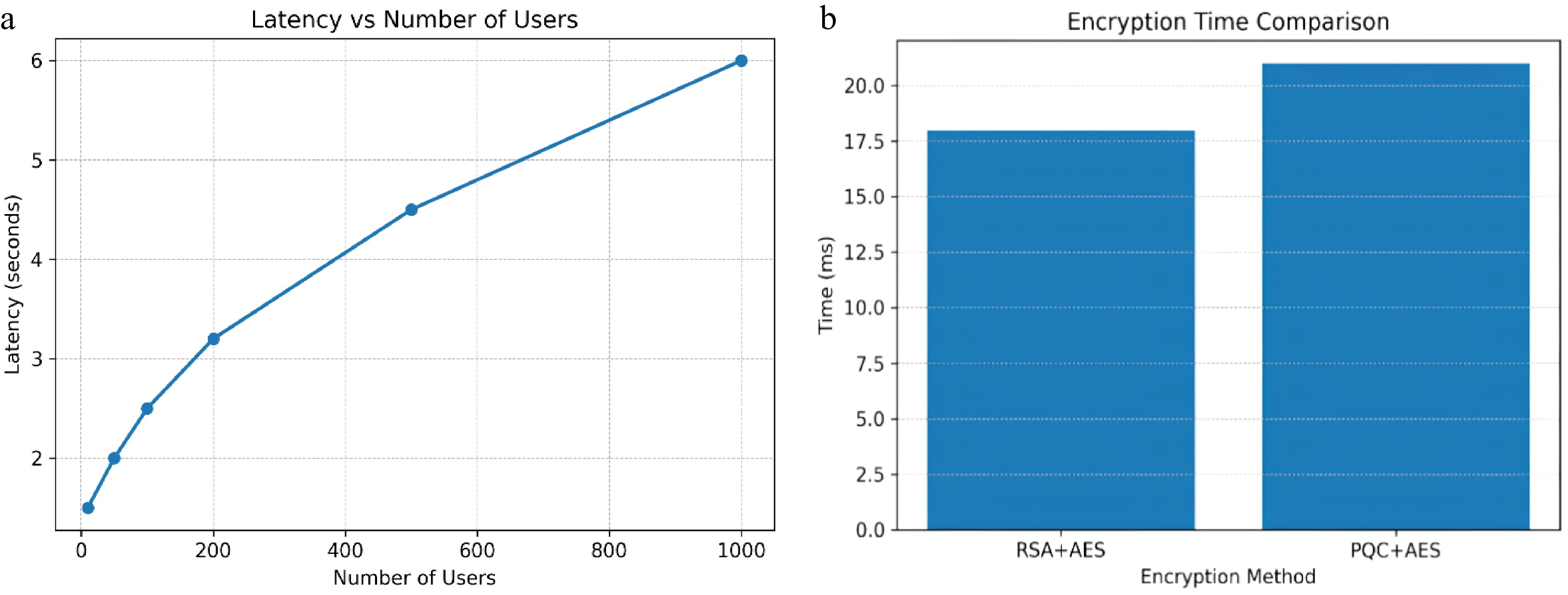
Figure 4.
Assessment of the proposed framework. Scalability characteristics of the framework. (a) System latency vs number of concurrent users. In (b), the execution time of the proposed PQC-AES scheme is compared with the conventional RSA-AES method, showing that the computational overhead of PQC is modest.
-
Research study Technology Quantum-resilience Automated penalties Immutable audit trail Access control Scalability Computational overhead Implementation status Performance evaluation Application domain Ankarboina
et al.[9]ECC, AES-GCM, and JWT × × × JWT tokens Moderate Low Prototype Throughput and registration delay Smart parking Singh et al.[10] AI, blockchain × × ✓ Mobile App Moderate Medium Prototype Slot allocation accuracy Smart parking Zhang et al.[11] IoT, blockchain, SC × ✓ ✓ RFID/NFC Moderate Medium Prototype Transaction automation Smart parking Vijayalakshmi et al.[12] Intrusion detection system × × × VANET Moderate High Prototype 97% attack detection accuracy Car parking system Alymani et al.[13] IoT, machine learning × × × Not specified High Medium Prototype Vehicle detection accuracy Smart cities Liu et al.[15] PQC, blockchain ✓ × ✓ Not specified Moderate High Research prototype Security analysis General IoT Nanwatkar
et al.[16]IoT, AI, ML, Sensors × × × Mobile/web App High Medium Prototype Smart parking automation Smart parking Aslam et al.[5] Quantum-resistant blockchain ✓ ✓ ✓ Blockchain contracts Moderate High Prototype Blockchain performance Intelligent transportation Proposed work PQC, blockchain, SC, QR ✓ ✓ ✓ QR code High Moderate
(15% over RSA)Fully implemented prototype Encryption time, blockchain latency, gas cost, QR validation time, end-to-end performance Smart parking RFID, Radio Frequency Identification; NFC, Near Field Communication. Table 1.
Summary of comparison with existing research studies.
-
Input: user booking data message, service public and private keys, and signature key pairs are the input for the PQC-based encryption protocol $ \mathrm{m} $ $ {\text{pk}}_{\text{server}} $ $ {\text{sk}}_{\text{server}} $ $ (\mathrm{pksig},\;\text{sksig}) $ Output: encrypted data tuple, decrypted message after successful verification is used as an output of the algorithm. $ (\text{msgid},\mathrm{c},\text{ct},\sigma ) $ $ \mathrm{m} $ procedure 1: $ \mathrm{ENCRYPTDATA}\;(\mathrm{message}\;\mathrm{m},{\text{pk}}_{\text{server}}) $ 2: $ (\mathrm{ct},\;\mathrm{k}) \leftarrow \mathrm{Kyber}.\mathrm{Encaps}({\text{pk}}_{\text{server}}) $ 3: $ \mathrm{c} \leftarrow \mathrm{AES}\;\mathrm{GCM}.\mathrm{Encrypt}(\mathrm{k},\;\mathrm{m}) $ 4: $ \sigma \leftarrow \mathrm{SPHINCS}\;+.\;\mathrm{Sign}\;(\text{sksig},\;\mathrm{c},\;\mathrm{ct}) $ 5: $ \mathrm{DB}.\mathrm{store}(\mathrm{msgid},\;\mathrm{c},\;\mathrm{ct},\;\sigma ) $ 6: $ {\mathrm{return}}({\mathrm{msgid}},\; {\mathrm{c}},\; {\mathrm{ct}},\; \sigma) $ end procedure procedure 7: $ \mathrm{DECRYPTDATA}\;(\mathrm{msgid},{\text{sk}}_{\text{server}}) $ 8: $ (\mathrm{c},\;\mathrm{ct},\;\sigma ) \leftarrow \mathrm{DB}.\;\mathrm{fetch}(\mathrm{msgid}) $ 9: $ \mathrm{k} \leftarrow \mathrm{Kyber}.\mathrm{Decaps}({\text{sk}}_{\text{server}},\;\mathrm{ct}) $ 10: $ \mathrm{m} \leftarrow \mathrm{AES}\;\mathrm{GCM}.\mathrm{Decrypt}(\mathrm{k},\;\mathrm{c}) $ 11: Verify σ with $ pksig $ 12: if verification succeeds, then 13: return m 14: else 15: return Failure 16: end if end procedure Table 1.
PQC-based encryption protocol for a smart parking system.
-
Input: Identity of the user, QR code identifier, server private key used as input for QR code verification data. $ \text{user} $ $ \text{QRid} $ $ {\text{sk}}_{\text{server}} $ Output: Success/failure status Parking session state updated procedure 1: $ \mathrm{V}\text{ALIDATE}\mathrm{QR}(\mathrm{user},\mathrm{QRid}) $ 2: $ \text{booking}\leftarrow \mathrm{DB}.\mathrm{fetch}(\mathrm{QRid}) $ 3: data ← PQC. Decrypt(sk server, booking. encData) 4: if $ data.valid $ 5: if $ Session.state $ 6: $ \mathrm{SmartContract}.\mathrm{updateState}(\mathrm{QRid},\mathrm{Active}) $ 7: $ \mathrm{Gate}.\mathrm{open}() $ 8: return Success 9: else if $ Session.state $ 10: $ {\mathrm{T}}_{\text{parked}}\leftarrow \text{currentTime}-\mathrm{data}.\text{startTime} $ 11: if $ {\mathrm{T}}_{\text{parked}}> \mathrm{data}.\text{allowedTime} $ 12: $ \text{Penalty}\leftarrow ({\mathrm{T}}_{\text{parked}}-\mathrm{data}.\mathrm{allowedTime})\times {\mathrm{P}}_{\text{rate}} $ 13: $ \mathrm{SmartContract}.\mathrm{deduct}(\mathrm{Penalty}) $ 14: else 15: $ \mathrm{SmartContract}.\mathrm{refund}(\mathrm{user}) $ 16: end if 17: $ \mathrm{SmartContract}.\mathrm{updateState}(\mathrm{QRid},\mathrm{Ended}) $ 18: $ \mathrm{Gate}.\mathrm{open}() $ 19: $ \text{returnSuccess} $ 20: end if 21: else 22: $ \text{returnFailure} $ 23: end if end procedure Table 2.
QR code validation protocol (simplified).
-
Input: Message identifier, parking slot, and user's account are used as input to the smart contract parking workflow $ \text{msgid} $ $ \text{slot} $ $ \text{price} $ $ \text{user} $ Output: Reserved/Active/Ended: parking session state Penalty/Refund: payment settlement procedure 1: $ \text{CREATE}\mathrm{R}\text{ESERVATION}(\mathrm{msgid},\mathrm{slot},\mathrm{price}) $ 2: $ \mathrm{require}(\mathrm{slot}.\text{available}=\mathrm{True}) $ 3: $ \mathrm{escrow}[\mathrm{msgid}]\leftarrow \text{price} $ 4: $ \mathrm{state}[\mathrm{msgid}]\leftarrow \text{Reserved} $ 5: $ \text{emit}\mathrm{Event}(\mathrm{ParkingReserved},\mathrm{msgid},\mathrm{slot},\mathrm{price}) $ end procedure procedure 6: $ \text{START}\mathrm{S}\text{ESSION}(\mathrm{msgid}) $ 7: $ \mathrm{require}(\mathrm{state}[\mathrm{msgid}]=\mathrm{Reserved}) $ 8: $ \mathrm{startTime}[\mathrm{msgid}]\leftarrow \mathrm{block}.\text{timestamp} $ 9: $ \mathrm{state}[\mathrm{msgid}]\leftarrow \text{Active} $ 10: $ \text{emit}\mathrm{Event}(\mathrm{ParkingStarted},\mathrm{msgid},\mathrm{startTime}[\mathrm{msgid}]) $ end procedure procedure $ 11\colon ~\text{END}\mathrm{S}\text{ESSION}(\mathrm{msgid}) $ 12: $ \mathrm{require}(\mathrm{state}[\mathrm{msgid}]=\mathrm{Active}) $ 13: $ \text{parkedTime}\leftarrow \mathrm{block}.\text{timestamp}-\mathrm{startTime}[\mathrm{msgid}] $ 14: if $ \text{parkedTime}> \mathrm{allowedTime}[\mathrm{msgid}] $ 15: $ \text{overtime}\leftarrow \text{parkedTime}-\mathrm{allowedTime}[\mathrm{msgid}] $ 16: $ \text{penalty}\leftarrow \text{overtime}\times \text{penaltyRate} $ 17: $ \mathrm{escrow}[\mathrm{msgid}]\leftarrow ~\mathrm{escrow}[\mathrm{msgid}]-\text{penalty} $ 18: $ \mathrm{transfer}(\mathrm{penalty},\mathrm{owner}) $ 19: end if 20: $ \text{refund}\leftarrow \mathrm{escrow}[\mathrm{msgid}] $ 21: $ \mathrm{transfer}(\mathrm{refund},\mathrm{user}[\mathrm{msgid}]) $ 22: $ \mathrm{state}[\mathrm{msgid}]\leftarrow \text{Ended} $ 23: $ \text{emit}\mathrm{Event}(\mathrm{ParkingEnded},\;\mathrm{msgid},\;\mathrm{parkedTime},\;\mathrm{penalty}) $ end procedure procedure 24: $ \text{WITHDRAW} $ 25: $ \mathrm{require}(\mathrm{msg}.\text{sender}=\mathrm{owner}) $ 26: $ \mathrm{transfer}(\mathrm{contractBalance},\mathrm{owner}) $ end procedure Table 3.
Smart contract parking workflow.
-
Layer/module Technology/tools Functionality Description Frontend layer React 18, Firebase authentication User interface and secure access Provides a scalable and responsive UI for slot search, booking, and QR display with secure user authentication and session management Backend service layer Python 3.11, Flask, PyMySQL API and business logic Handles booking requests, slot allocation, payment initiation, and communication between frontend and database PQC security module Kyber-like KEM, AES-GCM Quantum-resistant encryption Implements hybrid encryption where Kyber secures symmetric keys and AES-GCM encrypts sensitive booking data, ensuring confidentiality and integrity Database layer MySQL Data storage and management Stores encrypted user data, booking information, cryptographic keys, and signature artifacts in structured tables Blockchain layer Ethereum testnet (Sepolia/Goerli), Solidity Decentralized audit and smart contracts Enables immutable audit trails and automates booking, payment, and penalty enforcement using smart contracts Edge layer Raspberry Pi
(or similar IoT device)QR code validation and access control Performs real-time QR verification and controls physical gate access for parking entry/exit QR code module QR generator and validator Secure access mechanism Generates time-bound QR codes for booking validation and prevents unauthorized access Payment and penalty module Smart contracts (Solidity) Automated transactions Handles booking payments and penalty enforcement transparently and automatically via blockchain System integration Hybrid architecture End-to-end system coordination Integrates PQC, blockchain, backend, and IoT components to ensure secure, efficient, and real-time smart parking operations Table 2.
Technology stack and functional components of the proposed quantum-resilient trust framework.
-
Metric Baseline (RSA) Proposed (PQC + AES) Key encapsulation time (ms) 18 21 Booking encryption overhead 0 15% QR gen + email (ms) 1,500 1,700 Blockchain confirmation (s) 10–30 10–30 Table 3.
Performance summary (standard metrics).
-
Attack type Security mechanism Mitigation Replay attack QR code with time limit and blockchain verification of transactions Stops reuse of expired or duplicate transactions MITM attack Kyber-KEM, AES-256-GCM, TLS-authentication Offers private and authenticated conversations Sybil attack Identity verification with blockchain and Firebase authentication Prevents creation of fake identities without permission Denial-of-service (DoS) Smart contract verification and backend request validation Reduces malicious handling of requests and unauthorized access Smart contract attack Checks-Effects-Interactions pattern along with re-entrancy guard Prevents re-entry and unauthorized contract execution Database tampering AES-GCM encryption and unalterable blockchain audit logs Protects confidentiality and integrity of data at rest Quantum attack Kyber KEM and SPHINCS+ Resists quantum adversaries Table 4.
Security analysis of the proposed VishwasQ framework.
-
Parameter IoT-only system Blockchain-based system Proposed approach (PQC + blockchain + QR) Security-level Low (classical encryption) Medium (blockchain integrity) High (PQC + blockchain security) Quantum resistance[35] No No Yes Data integrity Vulnerable to tampering Immutable records Immutable + cryptographically secure Privacy protection Limited Moderate Strong (PQC encryption) Access control RFID/sensors Smart contract-based QR code + blockchain validation Automation of payments Manual/semi-automatic Automated via smart contracts Fully automated with penalty enforcement Transparency Low High Very high Scalability High Moderate (gas cost issues) Moderate (optimizable with layer 2) Latency Low High (blockchain delay) Moderate (optimized hybrid flow) Suitability for smart cities[36,37] Limited Good Excellent Table 5.
Smart parking framework/architecture comparative analysis.
Figures
(4)
Tables
(8)