-
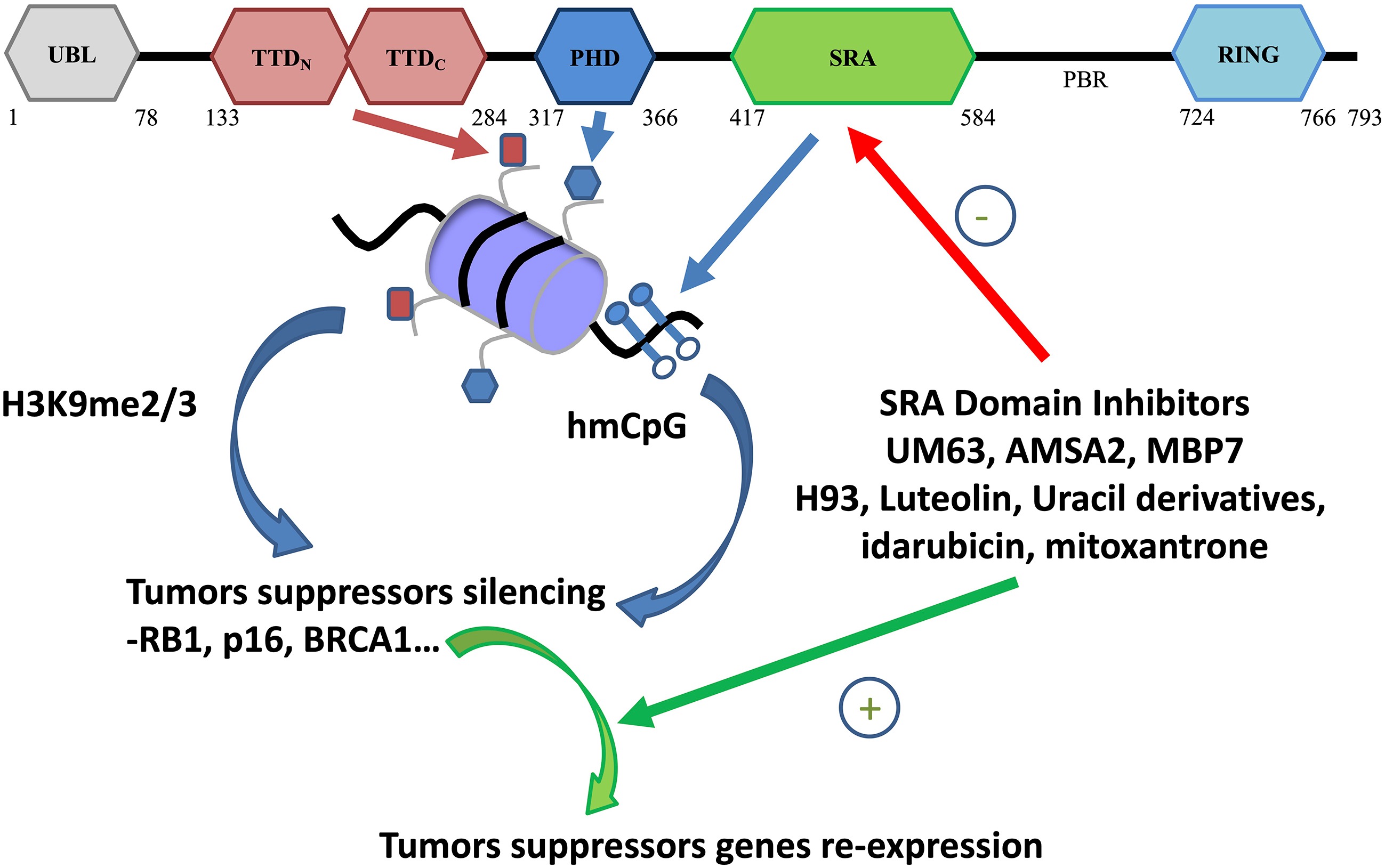
Figure 1.
Structural domains of UHRF1 and their role in tumor suppressor gene expression. The RING (Really Interesting New Gene) domain exhibits the E3 ligase activity of UHRF1. The UBL (ubiquitin-like) domain interacts with E2-ubiquitin conjugate[121]. The TTD binds di/trimethylated lysine 9 on histone H3 (H3K9me2/3; ochre rectangle on nucleosome), and the PHD binds unmodified arginine 2 on histone H3 (blue hexagon on nucleosome). The Tandem Tudor Domain (TTD) that senses the presence of di- or tri-methylated Lysine 9 of histone H3 (me2/me3K9H3) and the SRA (Set and Ring Associated) that binds to hemi-methylated DNA (hmCpGs) domain are involved in the silencing of TSGs. Various inhibitors of the SRA domain, such as UM63[122], AMSA2[122], MBP7[123], H93[124], Uracil derivatives (NSC232005)[125], idarubicin, and mitoxantrone[126], have been identified as being able to induce the re-expression of TSGs.
-
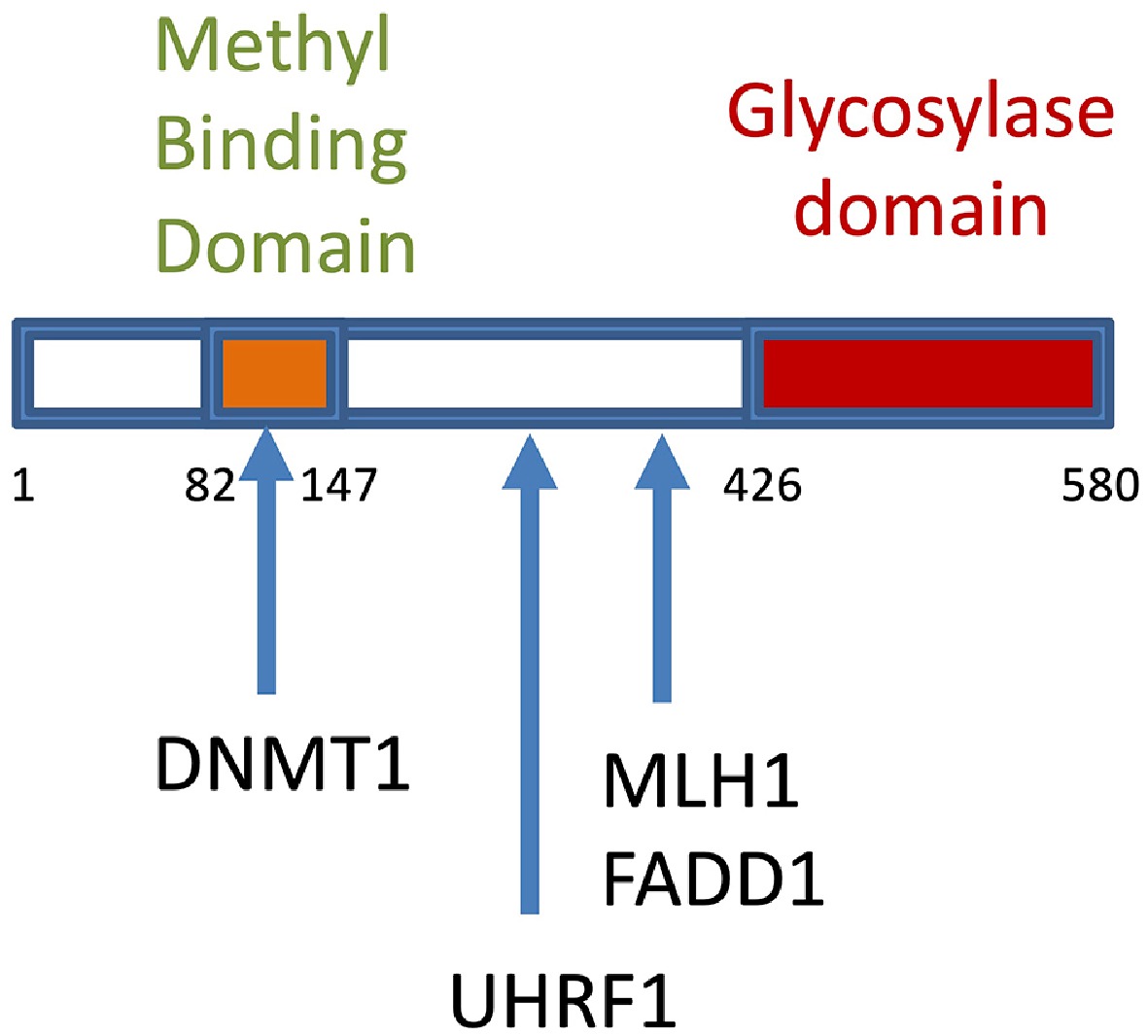
Figure 2.
Structural domains of MBD4 and interacting proteins. The region between the methyl-binding domain and the glycosylase domain is called 'the intervening region', in which the binding of UHRF1 occurs[111]. Numerals correspond to the number of amino acids delineating the structural domains of MBD4. MLH1 interacts with the glycosylase domain, whereas DNMT1 interacts with the methyl-binding domain[114,127]. MBD4 was shown to directly interact with proapoptotic Fas-associated death domain protein (FADD) in a complex with MLH1[128].
-
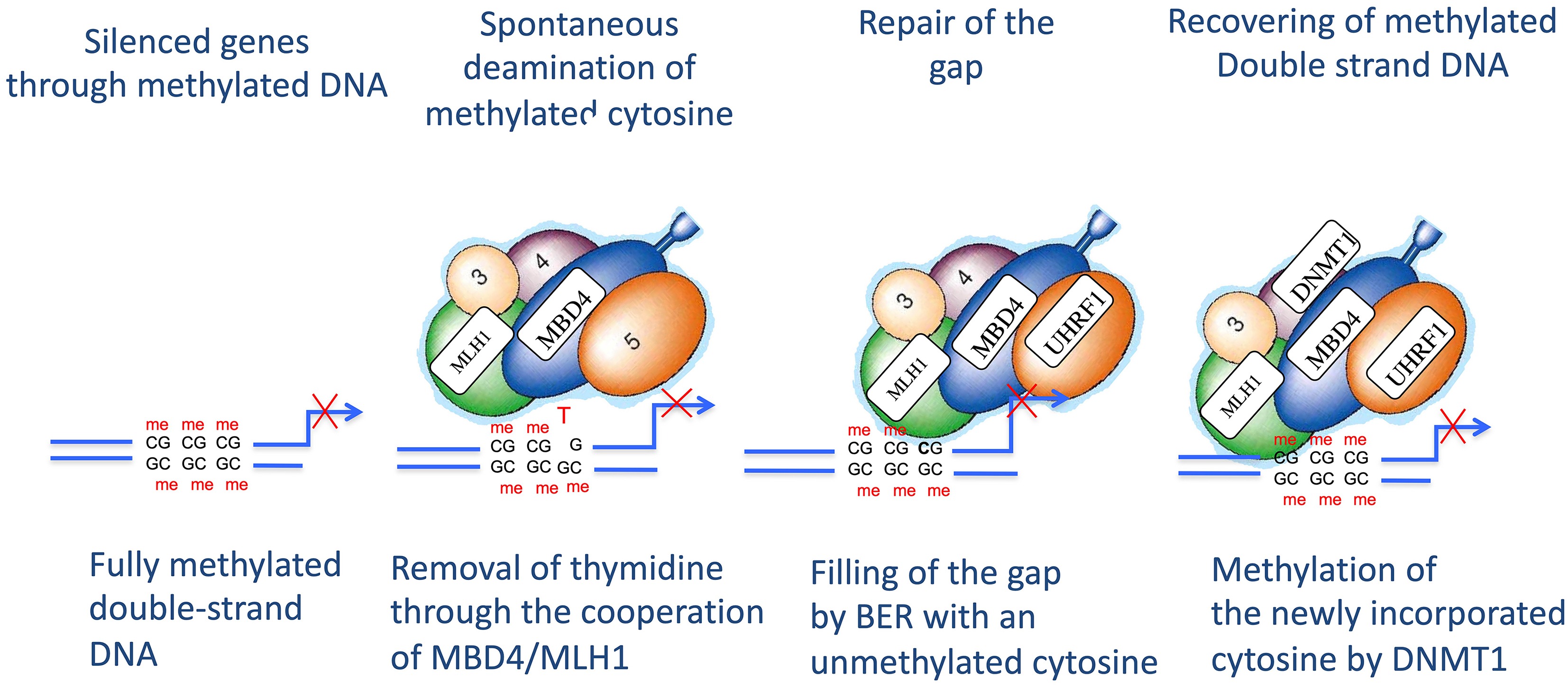
Figure 3.
Proposed model of the dialogue between UHRF1 and MBD4, in the presence of their respective partners, in relation to repairing DNA methylation patterns. After removal of the T:G mismatch by MBD4/MLH1, the gap is filled thanks to the intervention of the BER machinery. The filling of the gap generates a hemi-methylated state of the DNA that is sensed by UHRF1. The cooperation of the latter with DNMT1 allows recovery of fully methylated DNA, i.e., both DNA strands are methylated. As outlined in the text, this model assumes that the MBD4–UHRF1 complex is pre-assembled before encountering a G:T mismatch.
Figures
(3)
Tables
(0)