-
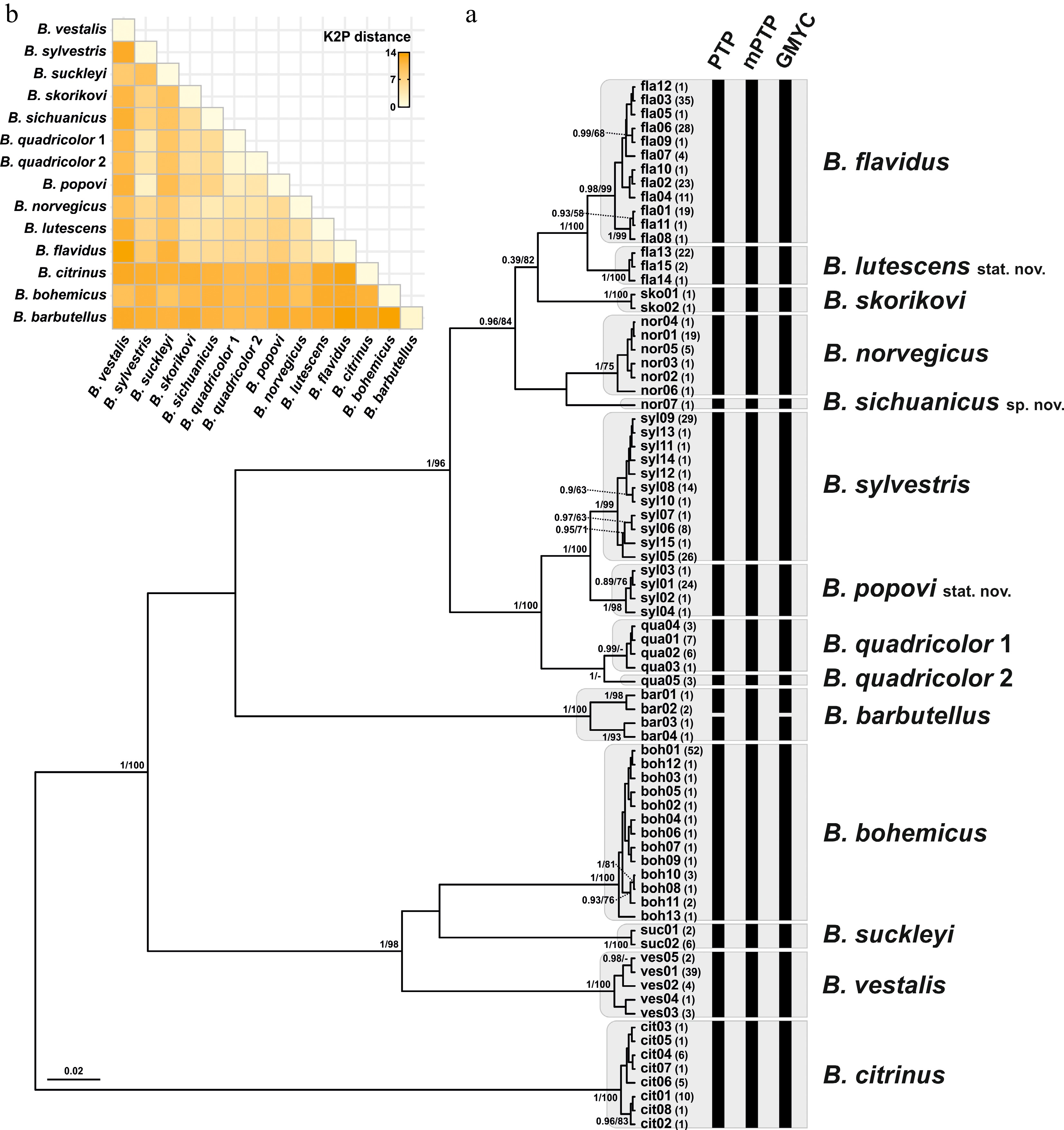
Figure 1.
Gene tree reconstruction and species delimitation of dataset DS2, based on the 555 bp-long alignment of unique haplotypes. (a) Bayesian tree, with alphanumeric codes at tips indicating the haplotype names (Supplementary Table S1), and the numbers in brackets indicating the number of sequences sharing that specific haplotype. Numbers at nodes reflect Bayesian posterior probabilities (BPP) and maximum likelihood bootstrap values (MLBS), respectively, indicated only when at least BPP > 0.9 and/or MLBS > 75. Black bars indicate the species delimitation results based on Poisson Tree Processes (PTP; single-threshold PTP including maximum likelihood mlPTP and Bayesian bPTP), and Generalized Mixed Yule Coalescent (GMYC). Species hypotheses consistently supported by multiple methods are highlighted in grey boxes. (b) Heatmap showing the mean pairwise % K2P distances within and between species, with darker colours indicating higher distances, as shown in the legend.
-
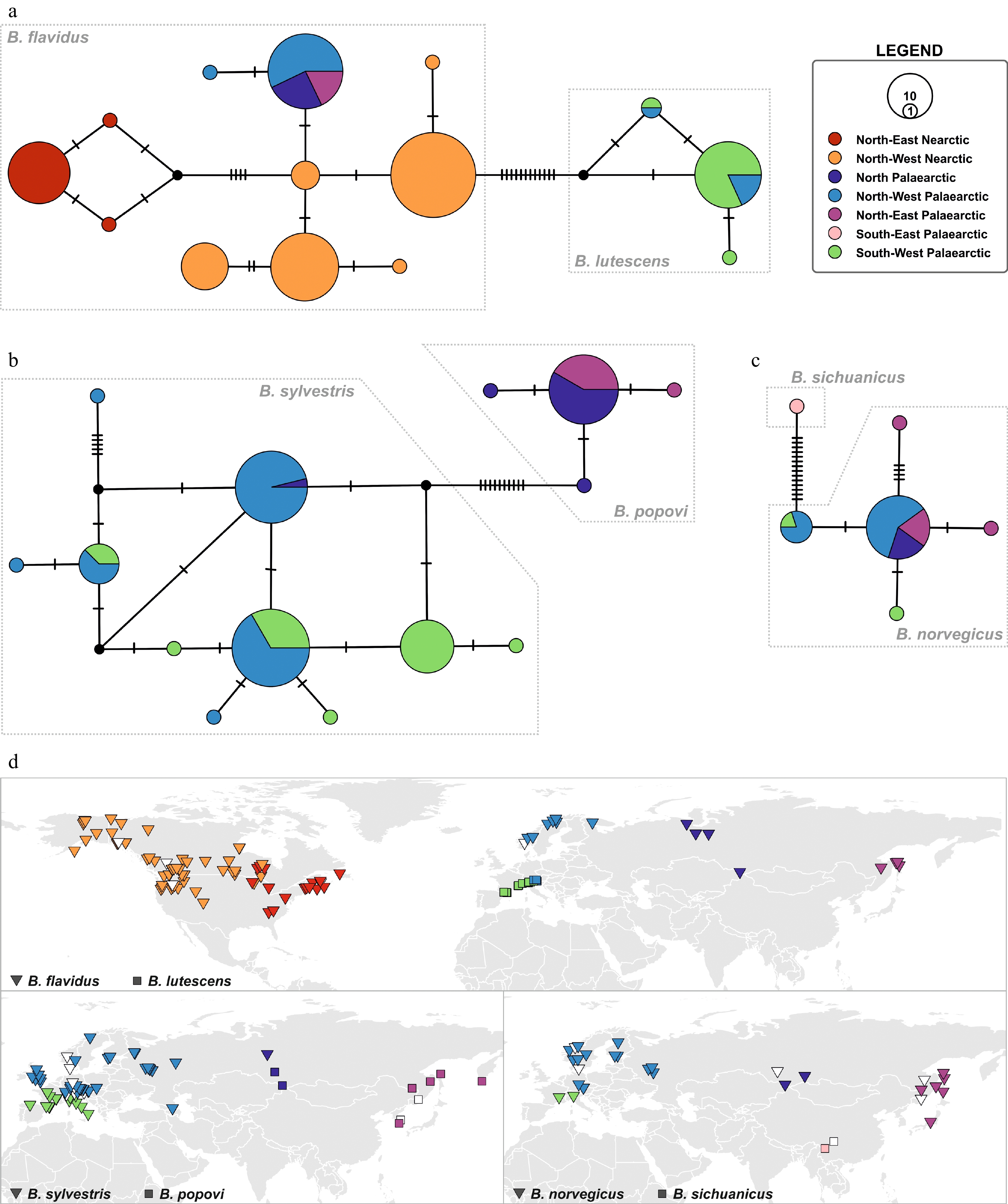
Figure 2.
Median-joining haplotype networks of (a) B. flavidus and B. lutescens stat. nov., (b) B. sylvestris and B. popovi stat. nov., and (c) B. norvegicus and B. sichuanicus sp. nov., based on sequences included in dataset DS2 prior to collapsing into unique haplotypes. Colours indicate geographic provenance, each cross-bar represents a single nucleotide change, small black circles represent putative missing haplotypes, and the size of each circle is proportional to the number of sequences sharing that specific haplotype, as indicated in the legend. (d) Geographic provenance of the species' sequences analysed in this work, with colours referring to the locality groups used in the haplotype networks. Points in white indicate sequences used in dataset DS1 only (i.e., sequences with missing or ambiguous data).
-
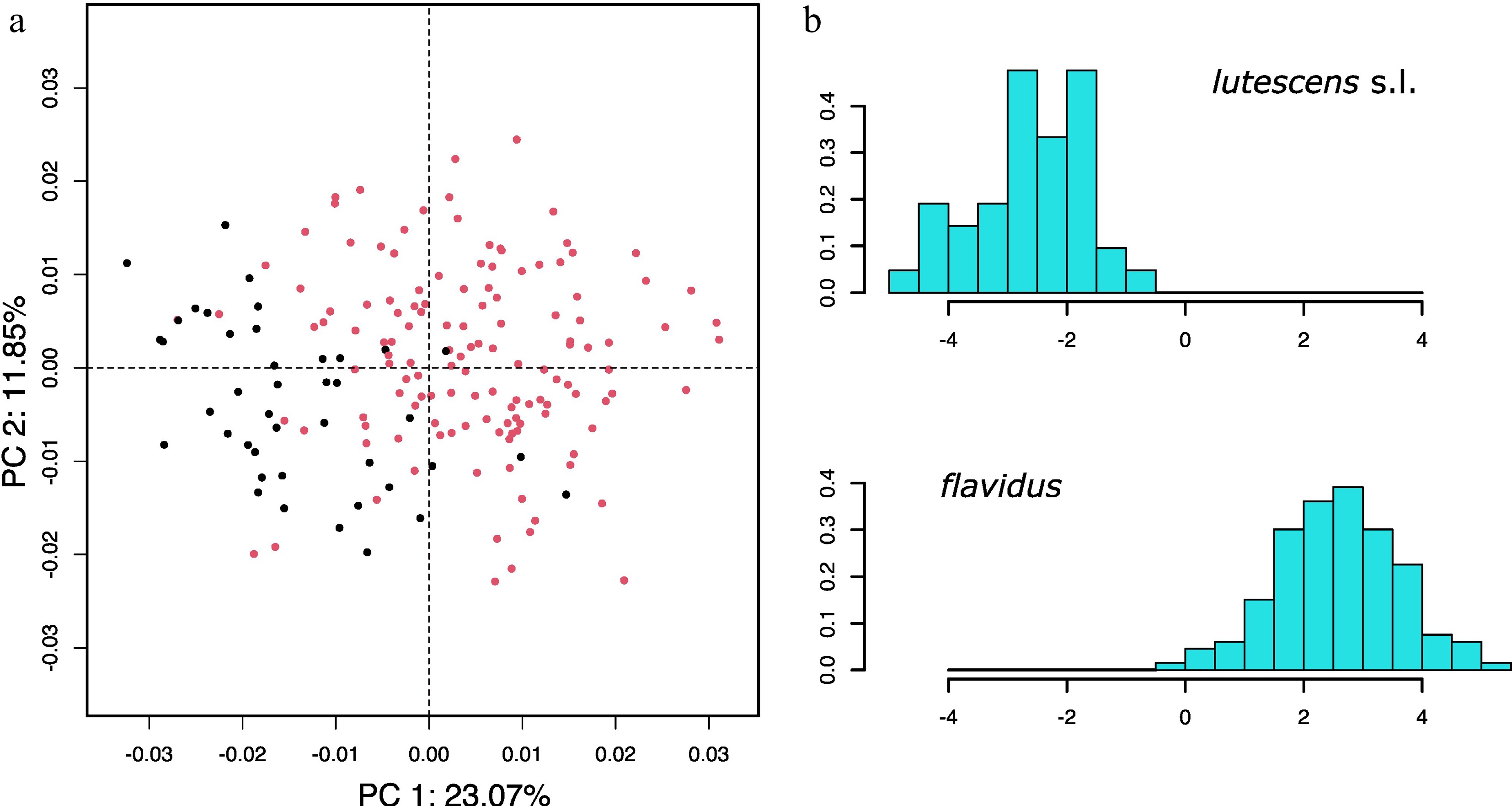
Figure 3.
Male wing morphometrics of the B. flavidus complex population groups. (a) PCA analysis of the wing venation landmarks showing the first two principal components (red: flavidus = flavidus s.s. + fernaldae, black: lutescens stat. nov. = alpium + lutescens s.s.). (b) LDA analysis of the first dimension of two groups: flavidus (flavidus s.s. + fernaldae) and lutescens stat. nov. (alpium + lutescens s.s.).
-
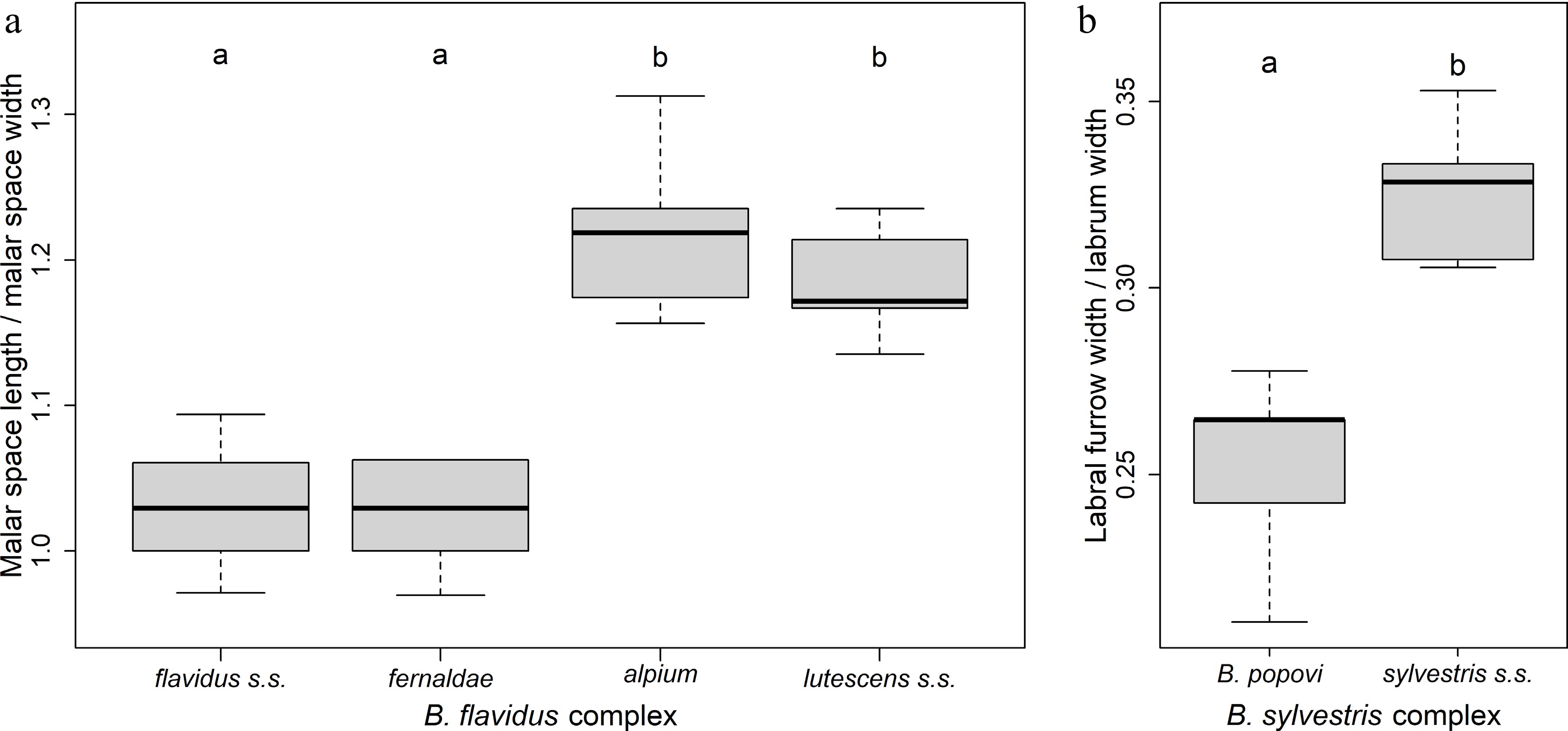
Figure 4.
Female morphometrics in the (a) B. flavidus complex: malar space ratio between length and width across the four taxa; (b) in the B. sylvestris complex: labral furrow width relative to labrum width between the two taxa. Significantly different groups are marked with a different letter; real values are in Supplementary Table S7.
-
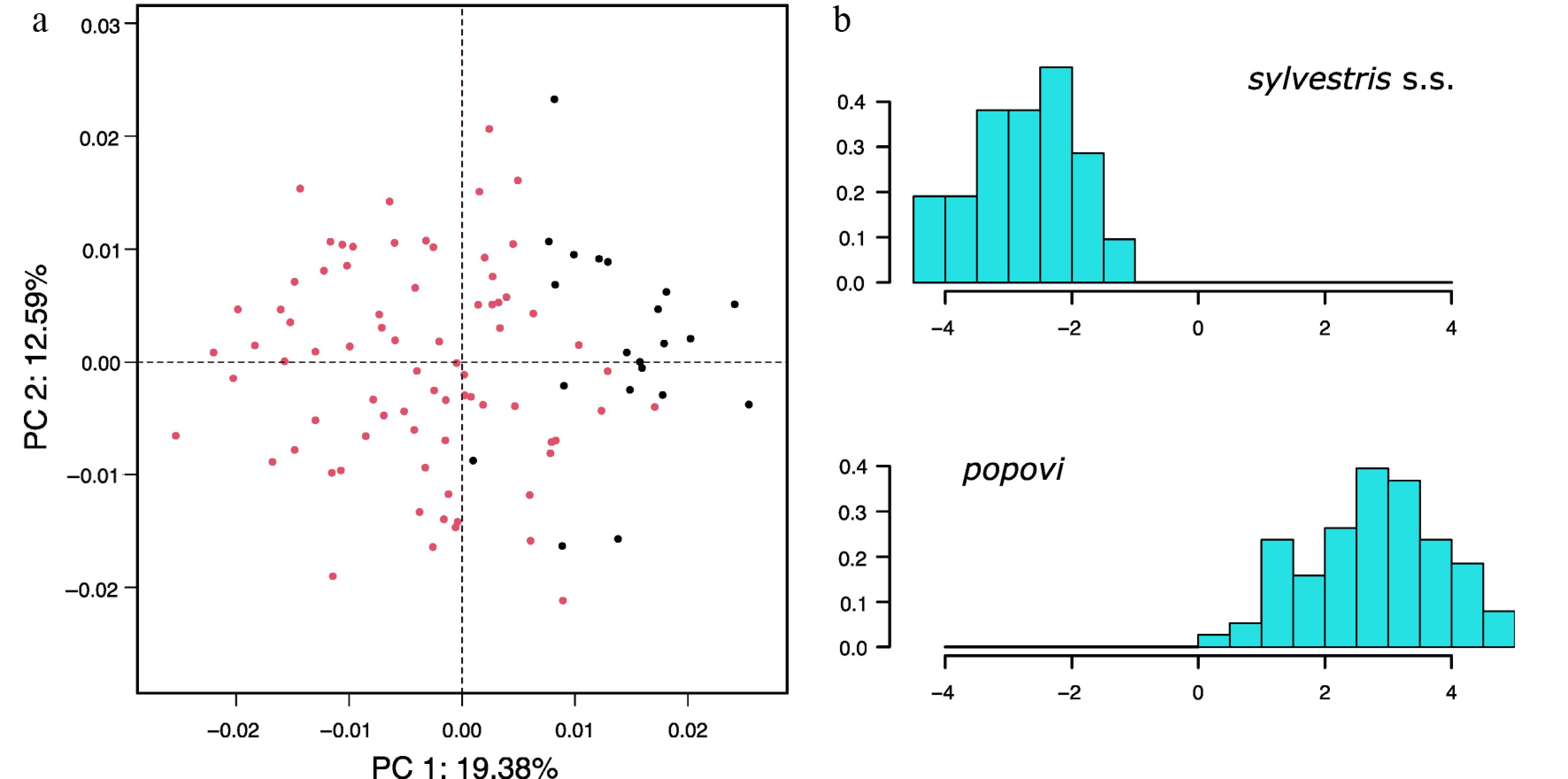
Figure 5.
Male wing morphometrics of the B. sylvestris complex population groups. (a) PCA analysis of the wing venation landmarks showing the first two principal components (red: sylvestris s.s., black: popovi stat. nov.). (b) LDA analysis of the first dimension in the two groups.
-
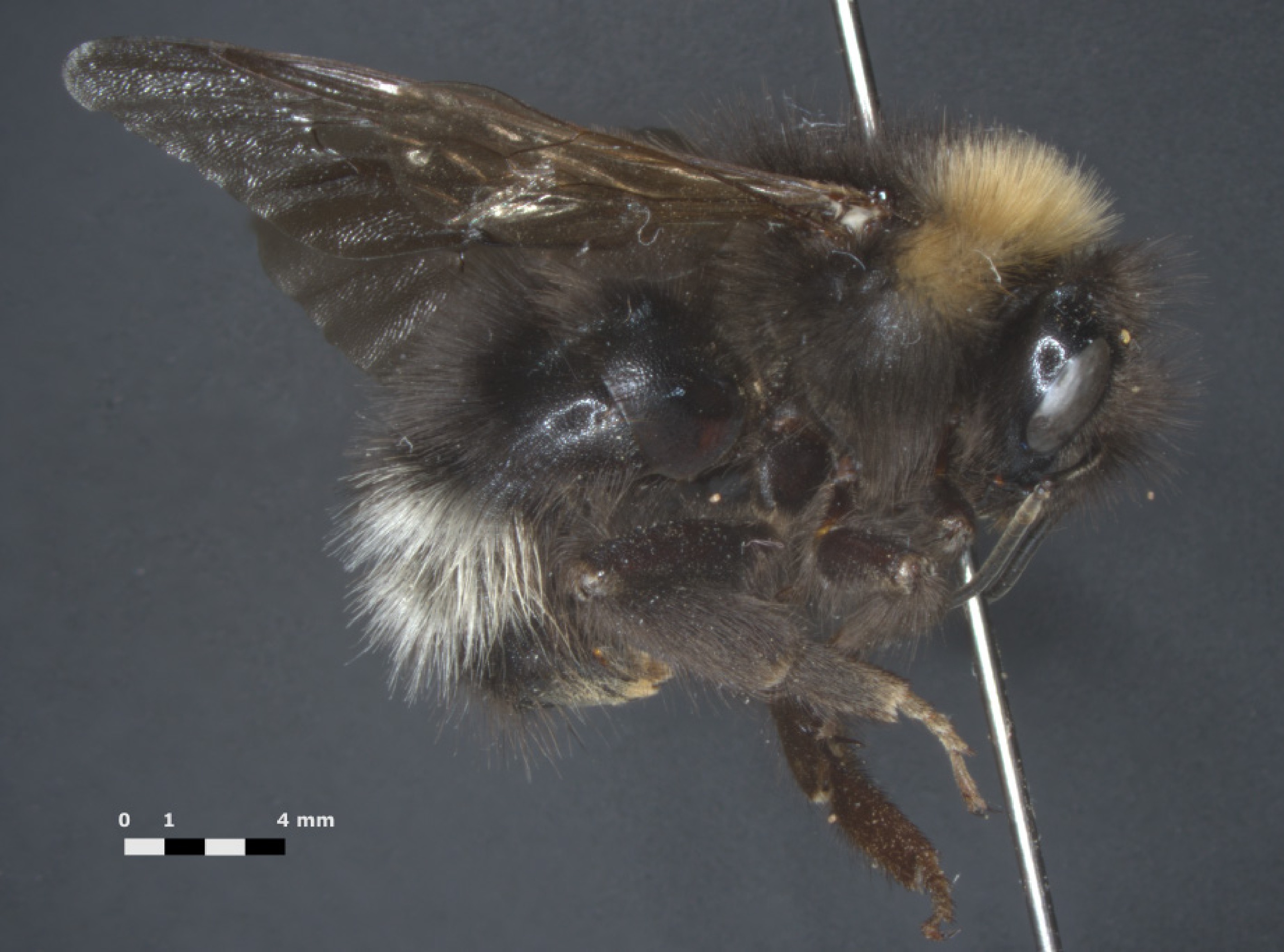
Figure 6.
B. sichuanicus Biella sp. nov. holotype, female.
-
Complex Species Sex Body part Diagnostic characters norvegicus complex Bombus norvegicus Female Head - Vertex with long and short yellow hairs; in dark specimens the vertex may have some black long hairs.
- Labral lamella more defined from the labrum and with a semicircular profile.Thorax - Collar band entirely yellow (sometimes with only a few isolated black hairs in the posterior part).
- Collar more extended and with a sublinear posterior edge between the tegualae.Abdomen - Callosities on S6 very swollen. Bombus sichuanicus sp. nov. Female Head - Vertex with long black hairs, some short plumate hairs are light in color among long black hairs.
- Labral lamella less defined from the labrum and with a more sublinear profile.Thorax - Yellow collar with many long black hairs mixed with the yellow ones.
- Yellow collar narrower and with a posterior edge concave (down-facing C shape).Abdomen - Callosities on S6 weakly swollen. sylvestris complex Bombus sylvestris s.s. Female Head - Vertex and collar band on the thorax with a dark yellow coloration, ocraceous (especially in fresh specimens).
- Labrum with a wide furrow of about 1/3 (or more) of the labrum width.
- Labral lamella wide (about 2/5 of the labrum width)Thorax - Coat more hirsute with hairs of varying length Bombus popovi stat. nov. Female Head - Vertex and collar band on the thorax with a very light yellow coloration, nearly cream-colored.
- Labrum with a narrow furrow, wide about 1/4 of the labrum width.
- Labral lamella narrow (about 1/3 of the labrum width).Thorax - Coat comparatively more even and short flavidus complex Bombus flavidus Female Head - Ocello-ocular area with sparse punctures of a smaller diameter, so that comparatively the area is less intensely dotted.
- Malar space with more scattered punctuation and of smaller diameter, the dots at a distance more than half-dot diameter; At the base of the compound eye, the punctures are closer together, while they are more spaced on the rest of the malar area.
- Malar space shorter, equal to its width or only slightly longer.Bombus lutescens stat. nov. Female Head - Ocello-ocular area with more numerous and denser punctures of larger diameter, especially towards the forehead.
- Malar space with denser and stronger punctuation, the dots at a distance less than half-dot diameter or even adjacent to each other; At the base of the compound eye (usually up to the middle of the malar area), the dots are especially coarse and nearby, while the rest of the Malar space has dense fine dots with heterogeneous diameter.
- Malar space longer than wide.Table 1.
Morphological differences in superficial characteristics of the females in the studied species complexes.
-
Clades Species delimitation algorithms Morphology and morphometrics Taxonomic evaluation B. flavidus complex 2 2 Two groups B. flavidus and B. lutescens stat. nov. B. norvegicus complex 2 2 Two groups B. norvegicus and B. sichuanicus sp. nov. B. sylvestris complex 2 2 Two groups B. sylvestris and B. popovi stat. nov. B. quadricolor 2 2 Not evaluated Needing further study B. skorikovi 1 1 Not evaluated Confirmed B. barbutellus 2 2 or 1 Not evaluated Needing further study B. bohemicus 1 1 Not evaluated Confirmed B. vestalis 1 1 Not evaluated Confirmed B. suckleyi 1 1 Not evaluated Confirmed B. citrinus 1 1 Not evaluated Confirmed The numbers indicate how many distinct groups are found by each approach. Table 2.
Summary of the process of evidence integration to reach a taxonomic conclusion for the studied species (with morphology and morphometrics evaluated only in the main target taxa).
Figures
(6)
Tables
(2)