-
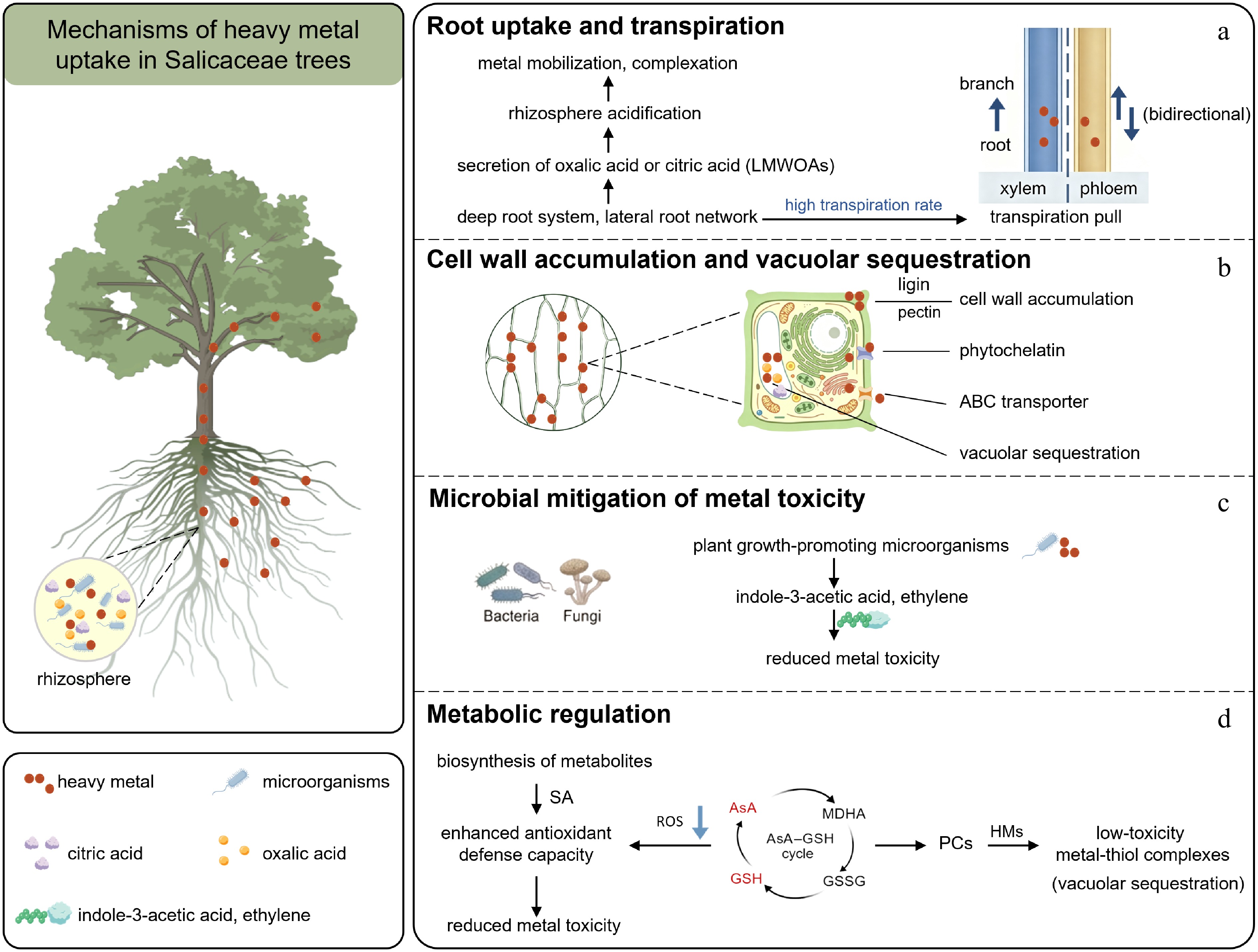
Figure 1.
Schematic diagram of integrated heavy metal uptake, translocation, detoxification, and tolerance mechanisms in Salicaceae trees. This diagram summarizes four interconnected functional modules underlying metal stress adaptation in Salicaceae trees: (a) Rhizosphere-mediated metal activation, root uptake, and transpiration-driven long-distance translocation through vascular tissues; (b) intracellular metal immobilization through cell wall binding, transporter-mediated chelation, and vacuolar compartmentalization; (c) rhizosphere-associated plant growth-promoting microorganisms that alleviate heavy metal phytotoxicity by promoting root growth and regulating metal availability; and (d) endogenous metabolic regulation, including salicylic acid-mediated signaling, reactive oxygen species scavenging, and antioxidant defense pathways. Abbreviations: HM, heavy metal; ABC transporter, ATP-binding cassette transporter; PCs, phytochelatins; GSH, glutathione; AsA-GSH cycle, ascorbate-glutathione antioxidant cycle; AsA, ascorbic acid; SA, salicylic acid; ROS, reactive oxygen species.
-
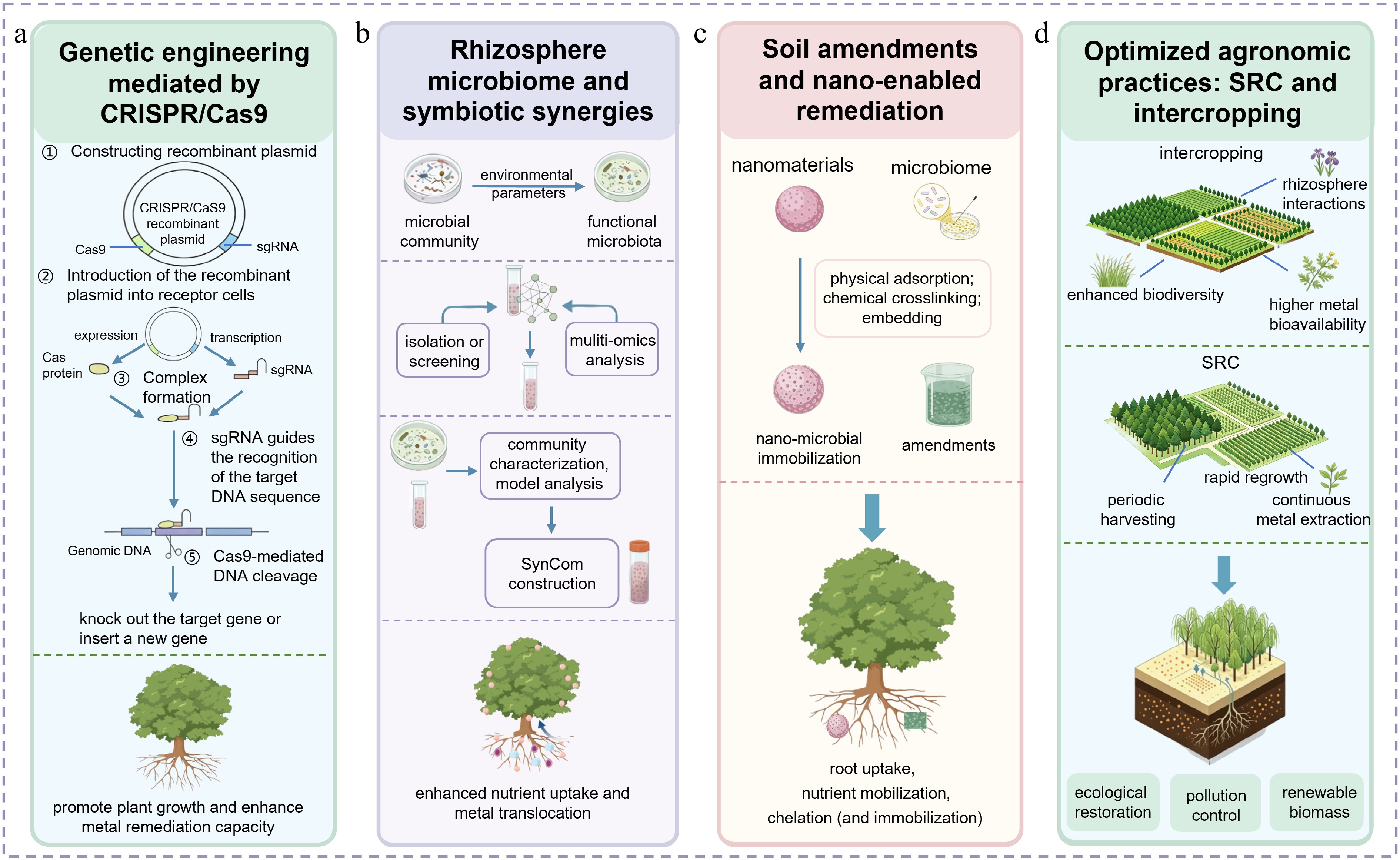
Figure 2.
Innovative strategies for enhancing metal phytoremediation efficiency in Salicaceae trees. This diagram illustrates four major strategies for improving Salicaceae-based phytoremediation in metal-contaminated soils: (a) genetic engineering, including CRISPR-based gene editing, synthetic DNA integration, and plastid engineering, which can be used to construct functional genetic circuits that enhance plant growth, metal uptake, translocation, and stress tolerance; (b) microbial symbiosis in the rhizosphere, involving the construction of synthetic microbial communities (SynComs), which can promote root colonization, regulate metal transformation, improve nutrient acquisition, and alleviate metal-induced phytotoxicity; (c) nano-enabled soil amendments, which interact with indigenous soil microbiomes to promote metal adsorption, chelation, or immobilization while improving nutrient availability; (d) sustainable agronomic practices, including short-rotation coppicing and tree-herb intercropping, which support long-term biomass production, repeated metal removal, and ecological stabilization of contaminated sites.
-
Comparisons Salicaceae-mediated phytoremediation Herbaceous hyperaccumulator-based phytoremediation Key remediation strategy Relies on high biomass production, extensive root systems, perennial growth, and repeated biomass harvesting to support long-term metal removal or immobilization[7]. Relies on exceptionally high metal concentrations in aerial tissues, usually within a short growth cycle[6]. Root architecture and remediation depth Deep and extensive root systems allow access to metals in deeper soil layers and support phytostabilization by reducing contaminant migration[16]. Shallow root systems are usually more effective in surface soils but have limited capacity to remediate deep contamination[17]. Metal uptake mechanisms Metal uptake is mediated by nutrient transporters, rhizosphere alteration, organic acid release, mycorrhizal associations, and root-soil interactions[9]. Uptake is often driven by enhanced expression of metal transporters[81]. Metal translocation Metals are partly accumulated in roots and stems, and a fraction is loaded into the xylem and transported to aboveground tissues through transpiration-driven flow[81]. High root-to-shoot translocation efficiency is facilitated by efficient xylem loading and metal-ligand complexation[6]. Sequestration and detoxification Metals are mainly immobilized in root and stem cell walls, lignified tissues, bark, and vacuoles, thereby reducing toxicity in photosynthetically active tissues[27]. Metals are often sequestered in shoot vacuoles or epidermal tissues, allowing high foliar metal concentrations while limiting cytosolic toxicity[82]. Physiological defense responses Defense relies on antioxidant regulation, lignification, cell wall binding, organic acid complexation, glutathione- and phytochelatin-mediated chelation, and tissue sequestration[28,29]. Defense is characterized by efficient intracellular detoxification, antioxidant activation, metal chelation, and vacuolar sequestration in aboveground tissues[6]. Application advantages Suitable for large-scale and long-term phytomanagement; supports ecological restoration, carbon sequestration, and potential biomass valorization under SRC systems[7]. Suitable for rapid phytoextraction of surface contamination; short growth cycles and high tissue metal concentrations facilitate experimental screening[83]. Main limitations Longer remediation cycles, lower tissue metal concentrations than hyperaccumulators, and the need for safe postharvest management of metal-enriched biomass[8]. Low biomass, shallow rooting depth, limited field-scale removal capacity, and weaker ecosystem service provision compared with woody systems[82]. Table 1.
Comparison of Salicaceae-mediated and herbaceous hyperaccumulator-based phytoremediation.
-
Species Metal(s) Cultivation Exposure/remediation duration Remediation target Main focus Underlying physiological/
ecological mechanisms or key findingsPopulus × canescens (Aiton) Sm; Populus tomentosa clones ('1316'); Populus euphratica
Salix linearistipularis; Populus yunnanensis;
Salix integraCd, Pb Hydroponics; soil 20–90 d Phytoextraction Transporter- and transcription factor-mediated phytoextraction Overexpression or activation of transporter- and transcription factor-related genes enhances metal uptake, xylem loading, and root-to-shoot translocation, thereby increasing aboveground metal accumulation and supporting harvest-based metal removal[11,47,84−86]. Salix × jiangsuensis 'J172';
Populus alba × Populus glandulosa;
Populus euramericana cv. 'NL-895';
P. deltoides cv. 'NL-3412'; Salix caprea;
Salix matsudanaPb, Cd, Al, Hydroponics; Soil 15–105 d Phytostabilization Root retention and cell wall sequestration Metals are predominantly accumulated/sequestered in roots and cell walls, with relatively low translocation to shoots. Cell-wall chelation, root sequestration, and restricted upward transport reduce metal availability and phytotoxicity[20,35,87−89]. Poplar hybrid varieties;
Salix sinopurpurea × S. integra; Salix jiangsuensis '2252';
Salix jiangsuensis '2011'Cd, Hg, Pb, and As Soil 210–730 d Phytoextraction/ phytostabilization Microbiome-assisted metal uptake and immobilization Root-associated microorganisms or mycorrhizal fungi promote plant growth and influence metal uptake in a context-dependent manner, thereby supporting either enhanced metal extraction or in situ immobilization[4,90,91]. S. alba Sr, Li Soil Long-term exposure
of the soil to natural conditionsPhytostabilization Riparian phytostabilization
and bioindicationNative S. alba showed potential as a biological indicator for Li and Sr in riparian environments[15]. Populus canescens; P. nigra Pb Sand 42 d Phytoextraction Metabolic regulation
of Pb toleranceS metabolism, organic acid accumulation, and phytohormone regulation contributed to interspecific differences in Pb tolerance and metal accumulation[92]. Populus yunnanensis Cd Soil,
substrate60–3,650 d Phytostabilization Endophyte-assisted
Cd toleranceBovista limosa PY5 alleviated Cd phytotoxicity and promoted plant growth by reducing Cd accumulation in host tissues[93]. P. deltoides; Populus canadensis Cd Soil 120 d Phytoextraction Soil-type-dependent Cd remediation Populus canadensis was more suitable for alkaline purple soil, whereas P. deltoides was more suitable for Cd-contaminated acid purple soil[94]. Salix viminalis Cd Substrate 42 d Phytoextraction Exogenous regulator-enhanced Cd tolerance Melatonin improved amino acid and saccharide metabolism in the leaves under Cd stress[95]. Table 2.
Salicaceae-mediated phytoremediation of metal contamination.
Figures
(2)
Tables
(2)