-
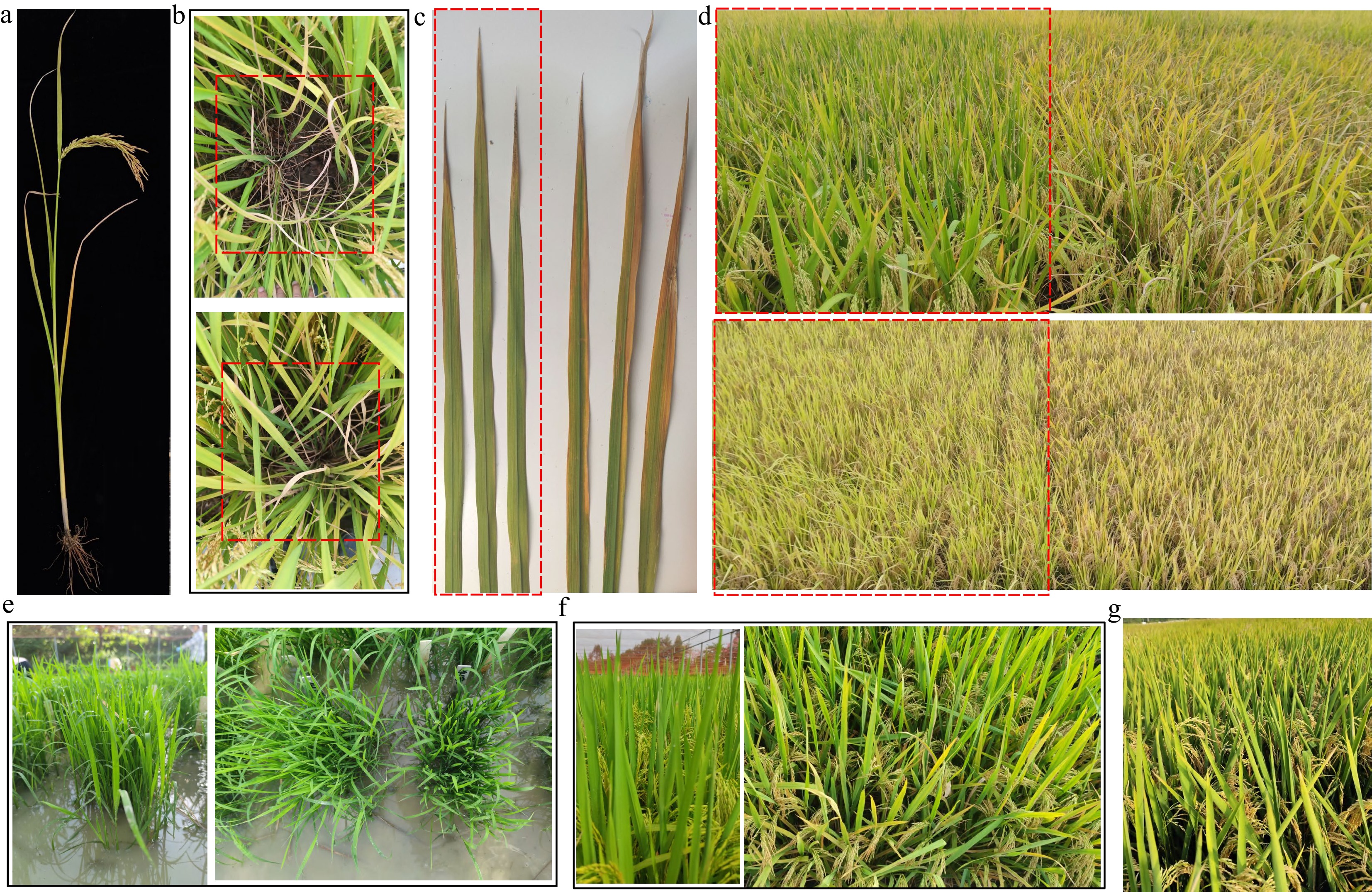
Figure 1.
Perspectives of breeders on leaf traits. (a), (b) Representative "clean" plant type at the maturity stage, characterized by the retention of only three to four functional leaves, shown in (a) a single plant and (b) in the field (clean plant type on the top). (c), (d) Desirable "ripe color" phenotype defined by delayed senescence and a golden-yellow hue, highlighted in the red dotted line boxes in both (c) individual leaves and (d) field views. (e) Leaf angle during early growth, showing the side (left) and top (right) views. (f) Optimal flag leaf angle after booting, showing the side (left) and top (right) views. (g) Slight outward leaf orientation.
-
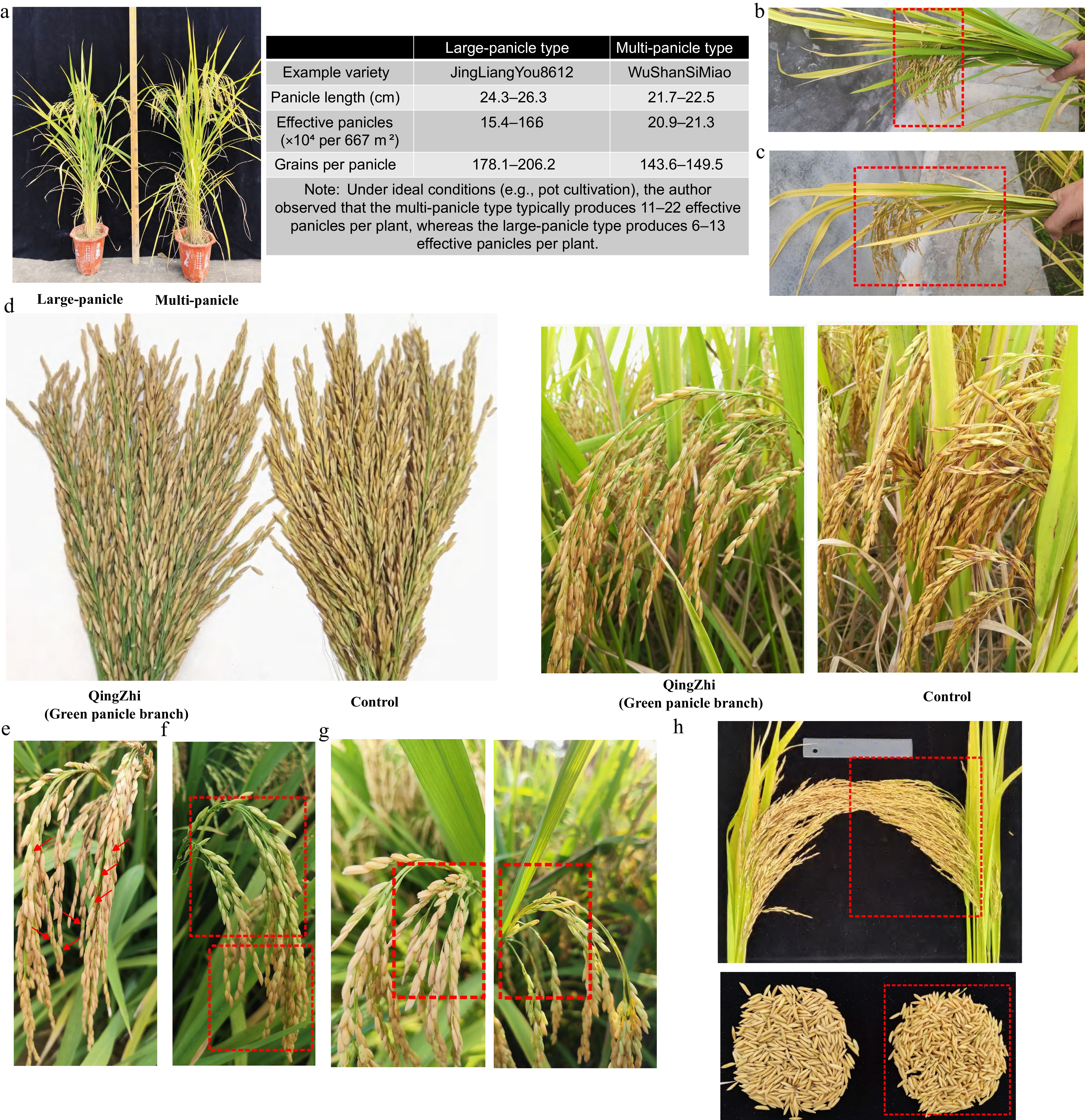
Figure 2.
Breeders' evaluation of panicle-related traits. (a) Illustrations of single plants of the large- and multi-panicle types. The table on the right presents key phenotypic contrasts between representative varieties corresponding to each ideotype, including panicle length, effective panicle number, and grains per panicle. (b) Selection for within-plant uniformity, choosing plants with a similar height and panicle size across tillers. (c) The "big and small panicle" pattern, in which the main tiller carries a larger panicle while the subsequent tillers remain smaller. (d) The green panicle branch (QingZhi) phenotype, defined by the delayed senescence of panicle branches that remain green during the grain-filling stage. Representative field images of this phenotype are shown on the right. (e), (f) Poor seed-set phenotypes: (e) Skipped seeds and (f) two-stage filling that trigger elimination by the breeders. Skipped grains represent the sporadic failure of spikelets to set or fill grains despite normal anthesis. It is characterized by irregularly distributed unfilled spikelets across the panicle (e, red arrows indicate skipped grains). Two-stage grain filling refers to a discontinuous grain development pattern characterized by two temporally distinct stages: The upper spikelets have fully matured, although the basal spikelets have not completed grain-filling (f, red dashed lines). (g) Illustration of poor basal seed set. Red dashed outlines highlight the basal region of the panicle, showing relatively good basal seed set on the left and notably reduced basal fertility on the right. (h) Examples of incomplete glume senescence observed at harvest. Red dashed boxes indicate representative incomplete glumes.
-
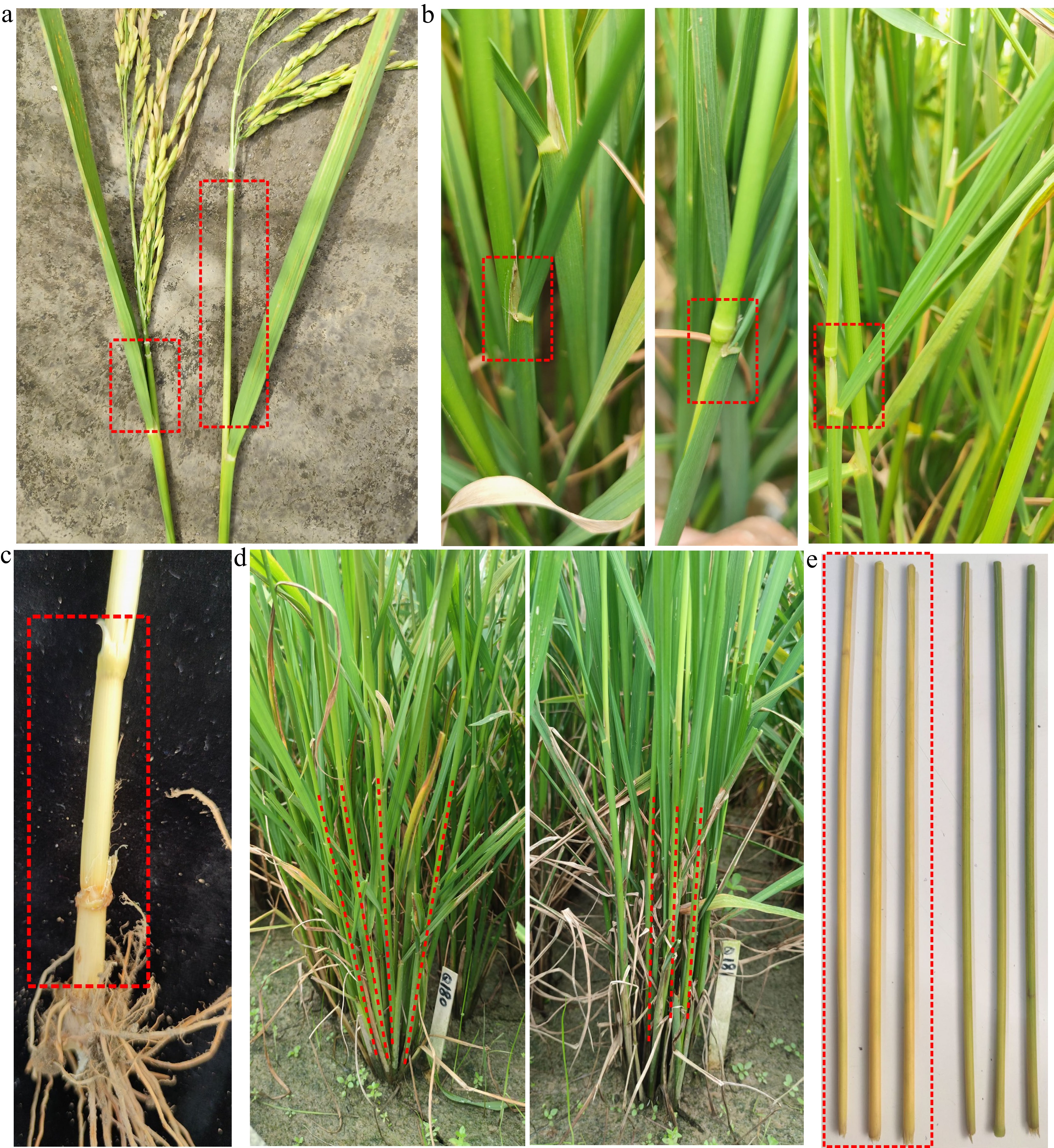
Figure 3.
Evaluation of stem traits by breeders. (a) Optimal (left) and excessively elongated (right) neck-spike internode. (b) Uppermost node enclosed by the sheath (left, indicated by the red dashed line) and failure of the uppermost node to remain enclosed within the sheath (middle and right, red dashed line). (c) A red dashed box highlights the basal internode length. (d) Dispersed stem arrangement among tillers. A red dashed line indicates the stem orientation. (e) Comparison between typical stems (right) and "lagao" stems (left).
-
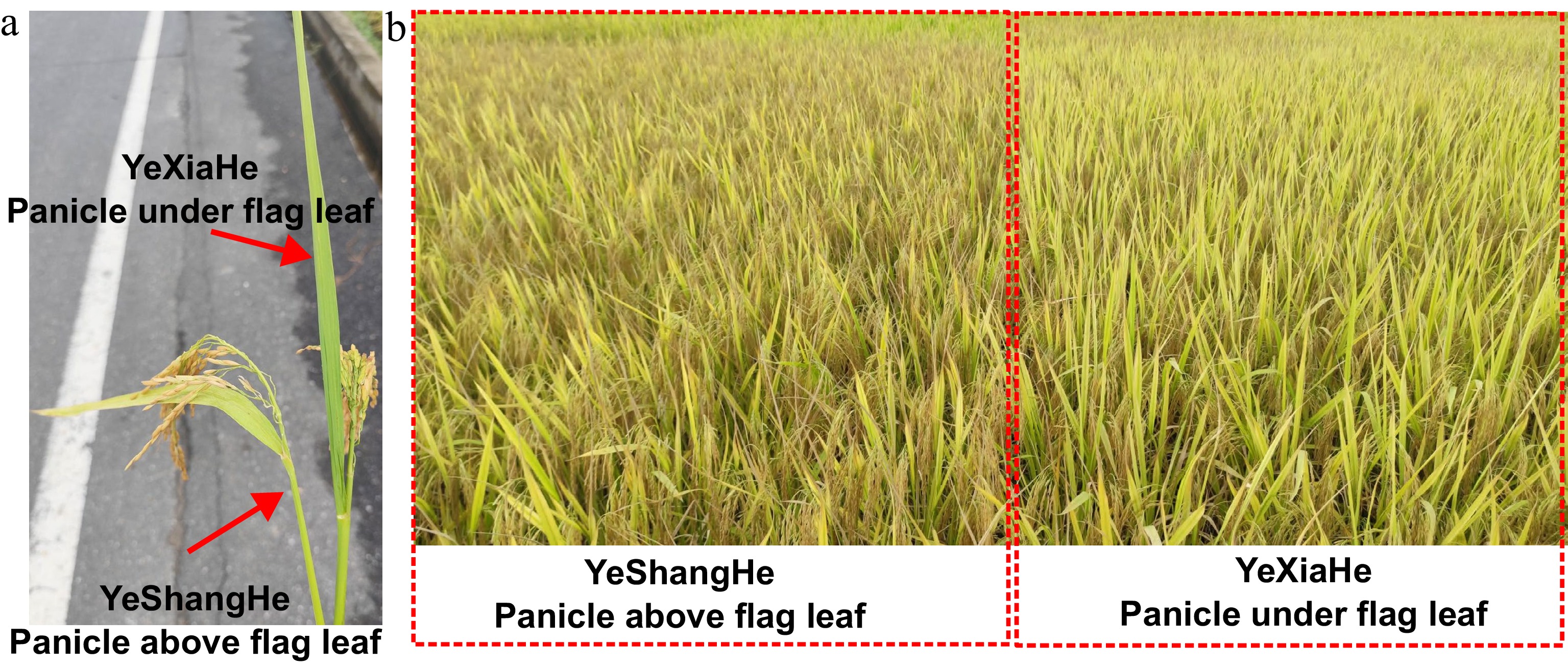
Figure 4.
Summary of leaf, panicle, and stem traits. (a) Comparative plant architectures illustrating panicles positioned above the flag leaf (YeShangHe) and below the flag leaf (YeXiaHe). (b) YeShangHe and YeXiaHe under field conditions.
-
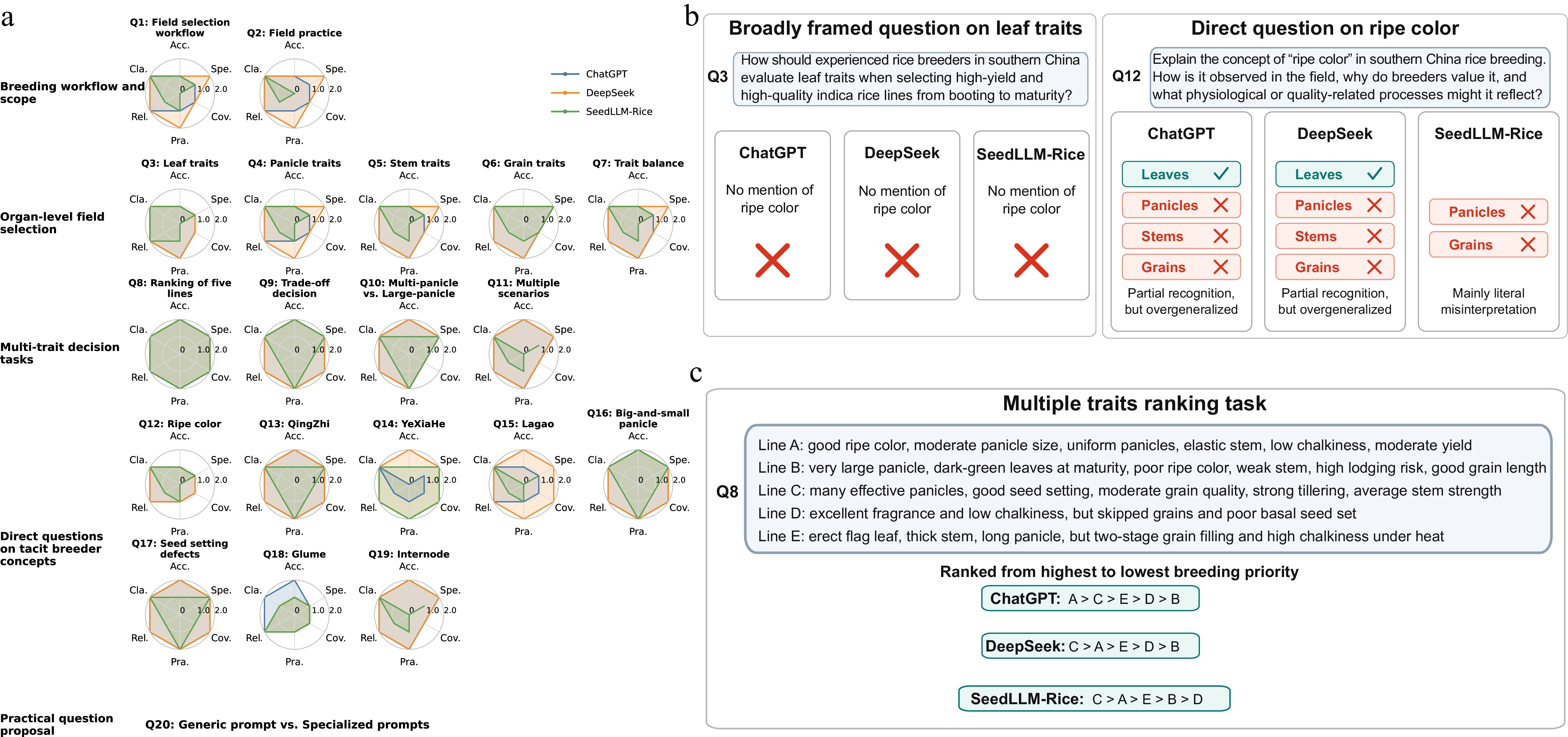
Figure 5.
Comparative scoring and representative responses of LLMs across rice breeding questions. (a) Radar plots summarizing the performance of ChatGPT, DeepSeek, and SeedLLM-Rice across rice breeding questions. Each radar plot includes six scoring criteria, namely accuracy (Acc.), clarity (Cla.), relevance (Rel.), practicality (Pra.), coverage (Cov.), and specificity (Spe.), with scores ranging from 0 to 2. Questions were grouped into five categories. (b) Representative LLM responses to a broadly framed question and a direct question on tacit breeder knowledge. (c) Representative LLM responses to a ranking task involving multiple traits.
Figures
(5)
Tables
(0)