-
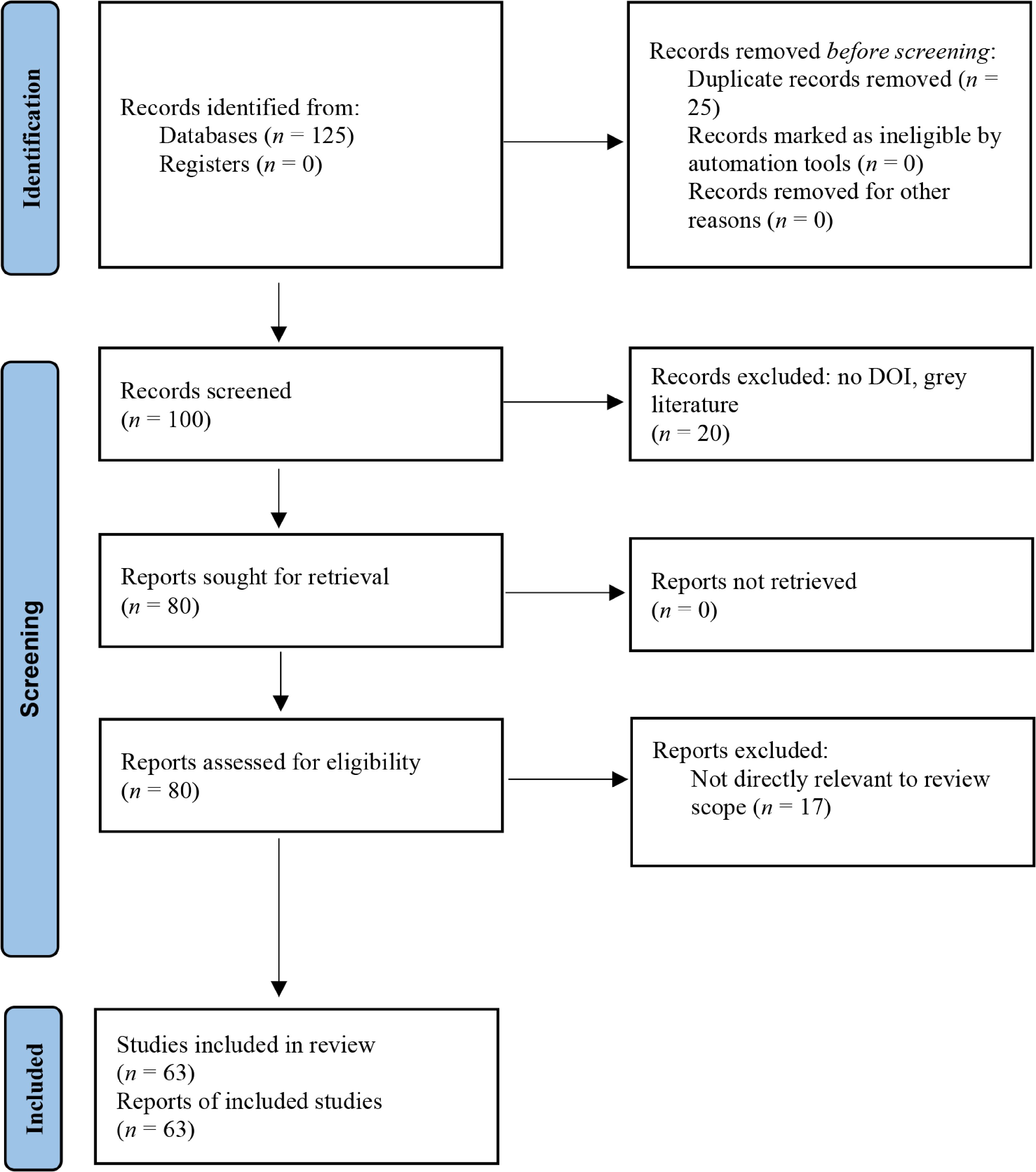
Figure 1.
Source identification, screening, and inclusion flow for this review, adapted from the PRISMA framework.
-
-

Figure 3.
Comparative sunburn vulnerability profile across key tropical fruit species. (Transcribed ratings; H = high, M = medium, L = low, Mod = moderate evidence quality, Hi = high evidence quality, Lo = low evidence quality).
-
-
S/N Search string Returned Retained Ref. 1 Solar radiation sunburn browning tropical fruits postharvest 152 30 [3,10] 2 Banana plantain postharvest senescence peel browning mechanisms 89 18 [13,14] 3 Mango sunburn UV radiation peel discolouration pigment degradation 74 16 [15,16] 4 Papaya postharvest solar heat stress quality deterioration tropics 61 11 [17,18] 5 ROS oxidative stress fruit senescence polyphenol oxidase phenylpropanoid pathway 95 12 [19,20] 6 Fruit bagging shading nets kaolin clay sunburn protection tropical orchard 83 14 [21,22] 7 1-MCP ethylene salicylic acid ascorbic acid antioxidant postharvest browning treatment 77 12 [23,24] 8 Postharvest fruit loss Africa sub-Saharan tropics food security economic impact 69 12 [5,25] Table 1.
Literature search queries, records returned, records retained, and key sources identified.
-
Injury type Primary trigger Induction threshold Key biochemical mechanism Visual symptom Photooxidative sunburn High irradiance alone; no heat required Below 30 °C possible Chlorophyll photodestruction; singlet oxygen generation; PSII photoinhibition Yellow-white bleaching; no necrosis Sunburn browning High temperature + high irradiance combined 45−52 °C surface (species-dependent) ROS overaccumulation; membrane lipid peroxidation; Polyphenol oxidase (PPO) mediated browning Brown-tan discolouration; no necrosis Epidermal necrosis Extreme radiant heat; light secondary > 52 °C surface temperature Protein denaturation; cell membrane collapse; irreversible damage Sharply delimited dead tissue; fungal entry points Sources: Fischer et al.[3]; Munné-Bosch & Vincent[10]; Racskó & Schrader[8]; Kim et al.[27]; Lal & Sahu[28]. Table 2.
Classification of solar radiation-induced fruit injury types: triggers, thresholds, mechanisms, and symptoms.
-
S/N Knowledge gap Rationale Recommended research approach Priority 1 Species-specific surface temperature thresholds for sunburn induction in banana, plantain, and papaya under tropical field conditions Mechanistic modelling of climate change impacts requires quantitative thermal thresholds; currently only citrus (47 °C) and apple are well characterised Controlled heating experiments with surface thermocouple arrays across cultivar panels; multi-site tropical field studies High 2 Preharvest molecular characterisation of solar stress response in papaya Papaya is the third most economically important tropical fruit in Africa yet has zero dedicated preharvest solar omics data Multi-omics (transcriptomics, metabolomics) field experiments analogous to Chen et al.[29] for wampee High 3 Multi-season, multi-site efficacy trials of kaolin and shade nets for smallholder producers in sub-Saharan Africa Virtually all mitigation data originate from commercial-scale operations in Egypt, Chile, and southern Europe; smallholder African context is completely absent On-farm participatory trials across West Africa, East Africa, and Southeast Asia; at least three seasons Critical 4 Solar radiation-induced lignification in banana peel Chilling-induced lignification is well characterised[30], but solar-equivalent has not been studied; understanding is needed for texture quality prediction Controlled solar exposure experiments with peel histology and lignin pathway gene expression analysis Moderate 5 Gender dimensions of solar-related postharvest loss Kikulwe et al.[31] found female-headed households suffer higher banana postharvest losses; no intervention study has disaggregated data by gender Gender-responsive PHL surveys and intervention trials in sub-Saharan Africa with sex-disaggregated outcome reporting Moderate 6 Preharvest efficacy of melatonin, 1-MCP, and salicylic acid under field solar stress conditions All biochemical intervention studies are postharvest; preharvest solar context involves continuous exposure, plant hormonal crosstalk, and developmental stage complexity not captured in postharvest experiments Controlled field applications at flowering and fruit development stages with concurrent solar monitoring High 7 sunburn-postharvest pathogen synergy Epidermal necrosis is noted to create fungal entry points, but no study in this review directly quantifies how sunburn severity affects postharvest pathogen incidence, latent infection activation, or internal quality decline Controlled inoculation trials on fruit with graded, quantified sunburn severity, tracking pathogen incidence, and internal quality parameters through storage High Table 3.
Priority knowledge gaps, rationale, and recommended research approaches.
-
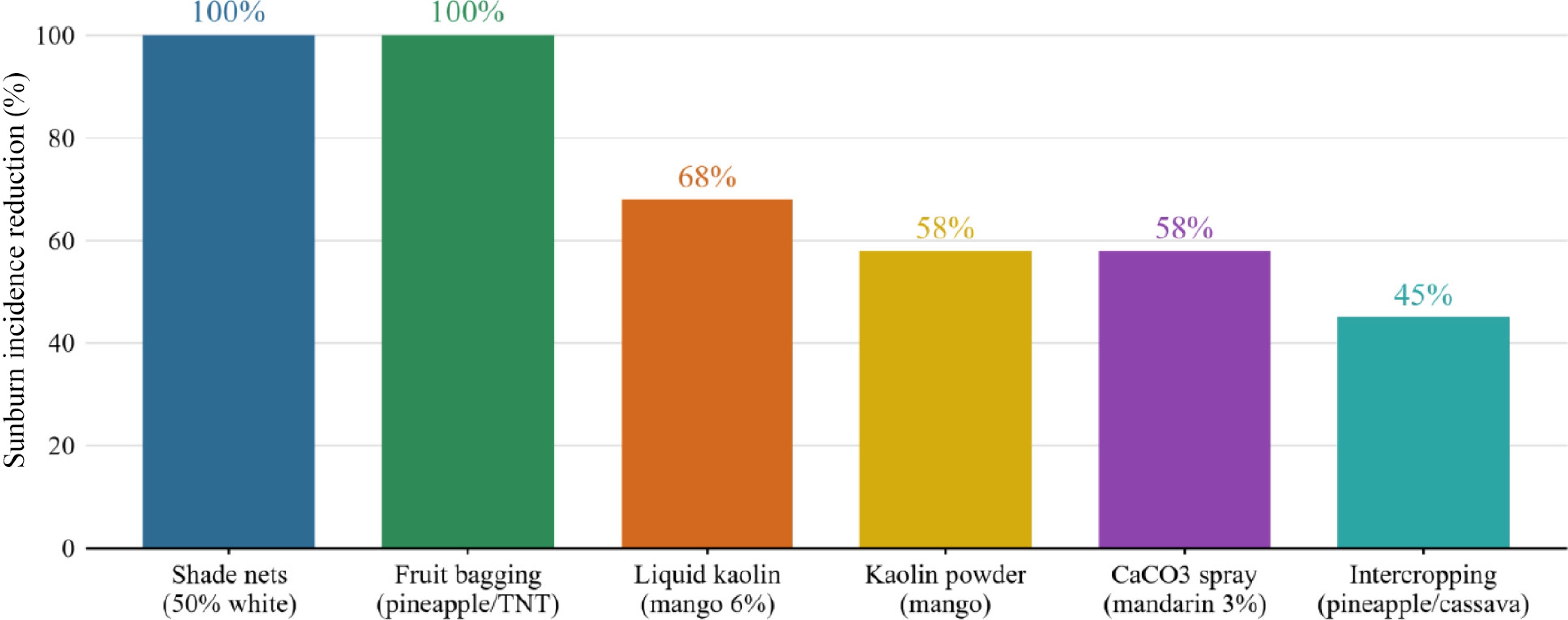
Strategy Mode of action Target species Reported efficacy Practical limitations Ref. White shade net (50%) Physical; microclimate Citrus, mango, apple ~100% reduction High capital; reusable; labour for installation. Fixed netting can delay red-blush colour development in bicolour cultivars; no disease incidence effect reported in the studies reviewed [21,53] Fruit bagging (paper/TNT) Physical; barrier Pineapple, mango, citrus ~100% reduction Very high labour; not scalable at low value. Can reduce red-blush colour development in bagged fruit, but the physical barrier may also lower incidence of some postharvest fungal infections by limiting pathogen contact [2,54] Kaolin clay film (4%−6%) Reflective mineral coating Mango, citrus, dragon fruit 58%–68% reduction Moderate cost; reapplication needed after rain. Leaves a visible white mineral residue that must be washed off before marketing, though the cited field trials report no adverse effect on underlying fruit colouration itself; disease-incidence effects not evaluated [41,22] Calcium carbonate (3%) Reflective mineral coating Citrus, tangor ~58% reduction Low cost; easily sourced; frequent reapplication. Also leaves a visible white residue requiring removal before sale; disease-incidence effects not evaluated in the cited studies [21,54] Intercropping for shade Agronomic; canopy Pineapple; broad applicability ~45% reduction Low cost; food security co-benefit; management skill needed. No direct effect on fruit surface colour reported; any disease-incidence effect would be indirect, via reduced microclimate heat and humidity stress rather than a documented antimicrobial action [2,3] 1-MCP + salicylic acid Biochemical; ethylene inhibition Banana; broad climacterics Delays senescence; reduces MDA Requires equipment; postharvest only (to date). By design, delays ripening-associated colour change, which can affect marketing timing; disease-incidence effects not evaluated in the cited studies [23,24] Melatonin
(1.5 mM)Biochemical; antioxidant Papaya; guava Extends shelf life 6−9 d ambient storage Cost; preharvest field data still limited. No adverse colour effect reported; documented to reduce anthracnose incidence in papaya, a secondary disease-suppression benefit beyond sunburn protection [17,42] Edible coatings (gum arabic, chitosan) Physical barrier + antioxidant carrier Banana, mango, guava Reduces browning index; extends shelf life Low-cost materials available locally in Africa. Coatings can alter surface gloss/appearance; chitosan-based composites have documented antimicrobial activity that may lower postharvest disease incidence, though this was not systematically evaluated across the studies reviewed here [39,55] Table 4.
Comparative synthesis of mitigation strategies for solar radiation-induced fruit injury in tropical production systems.
Figures
(4)
Tables
(4)