-
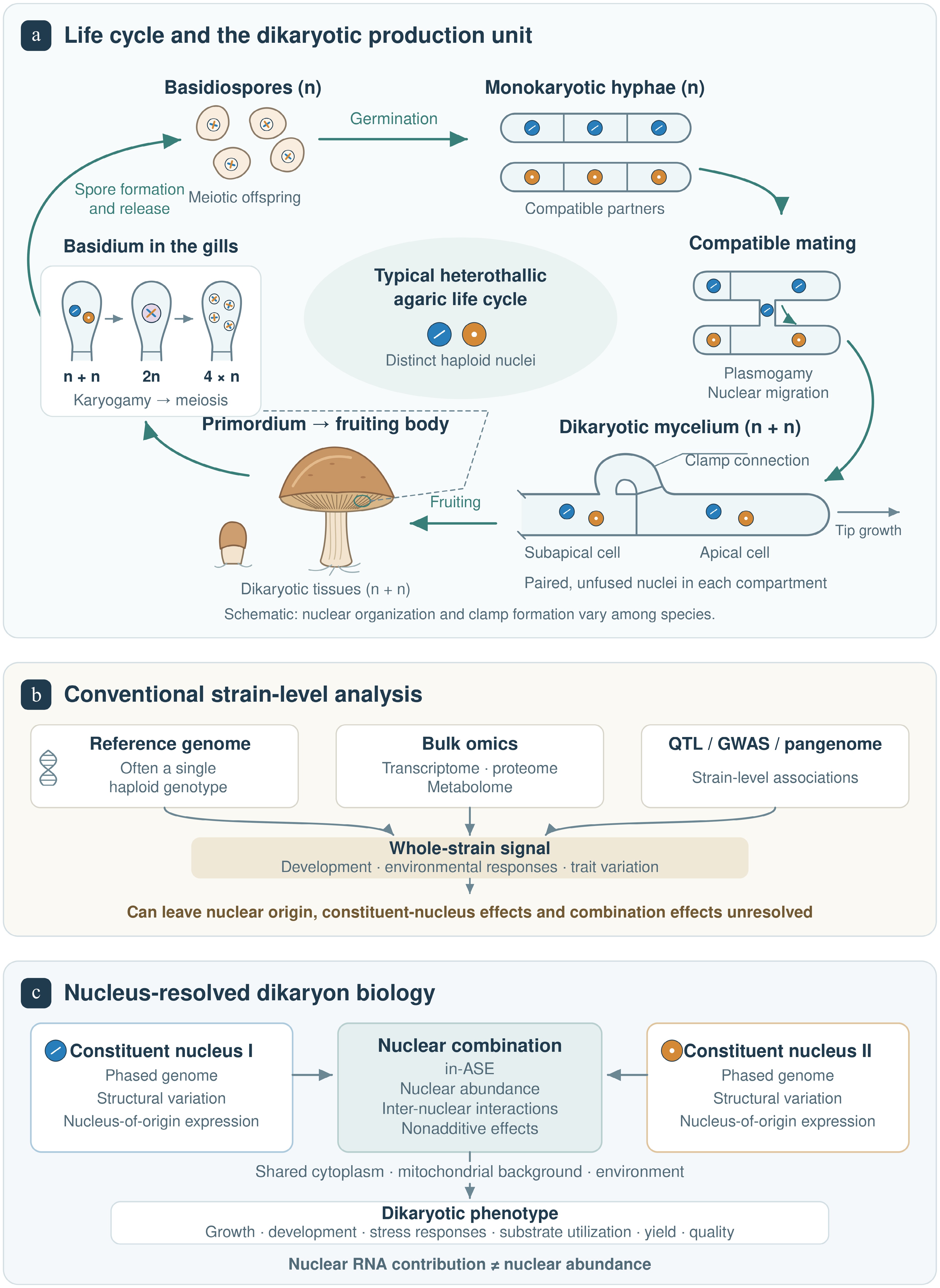
Figure 1.
From omics to dikaryon biology: a shift in the analytical unit of edible mushroom genetics. (a) A closed, schematic heterothallic agaric lifecycle. Compatible monokaryotic hyphae fuse by plasmogamy to establish a dikaryon; distinct haploid nuclei remain separate during vegetative growth. A clamp develops from the apical cell and bends back to fuse with the subapical compartment, helping restore nuclear pairing after mitosis. The mature connection and direction of tip growth are shown. Karyogamy occurs in the basidium, followed by meiosis and basidiospore formation. Blue and orange distinguish constituent nuclei within a combination; meiotic offspring can carry segregated and recombined haplotypes. Nuclear organization and clamp formation vary among species. (b) Conventional genome resources, bulk omics, and association analyses can leave the contributions of individual nuclei and their combinations unresolved. (c) Phased nuclear genomes and nucleus-of-origin expression connect constituent nuclei to combination effects and dikaryotic phenotypes in a shared cytoplasmic and mitochondrial context. Nuclear RNA's contribution is distinct from nuclear abundance. Arrows in B and C organize the analytical framework rather than imply demonstrated causality. QTL, quantitative trait locus; GWAS, genome-wide association study; in-ASE, internuclear allele-specific expression.
Figures
(1)
Tables
(0)