-
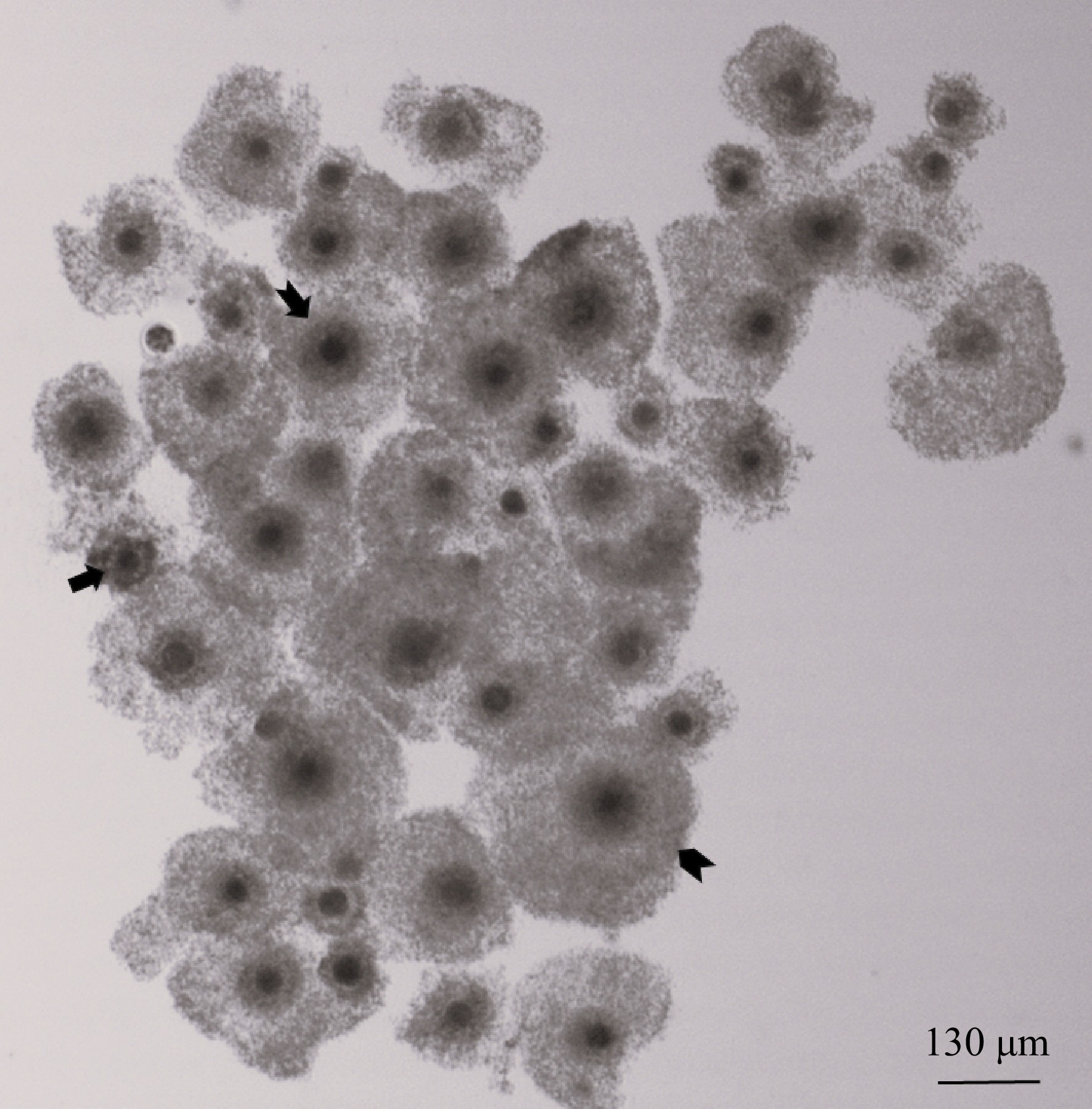
Figure 1.
Representative grading of bovine cumulus–oocyte complexes (COCs) based on cumulus cells' (CCs') morphology. Grade I (pentagon), compact, multi-layered CCs; Grade II (notched arrow), partially expanded CCs; Grade III (arrow), atretic oocytes with sparse CCs. Scale bar = 130 µm. The image was botained by the authors.
-
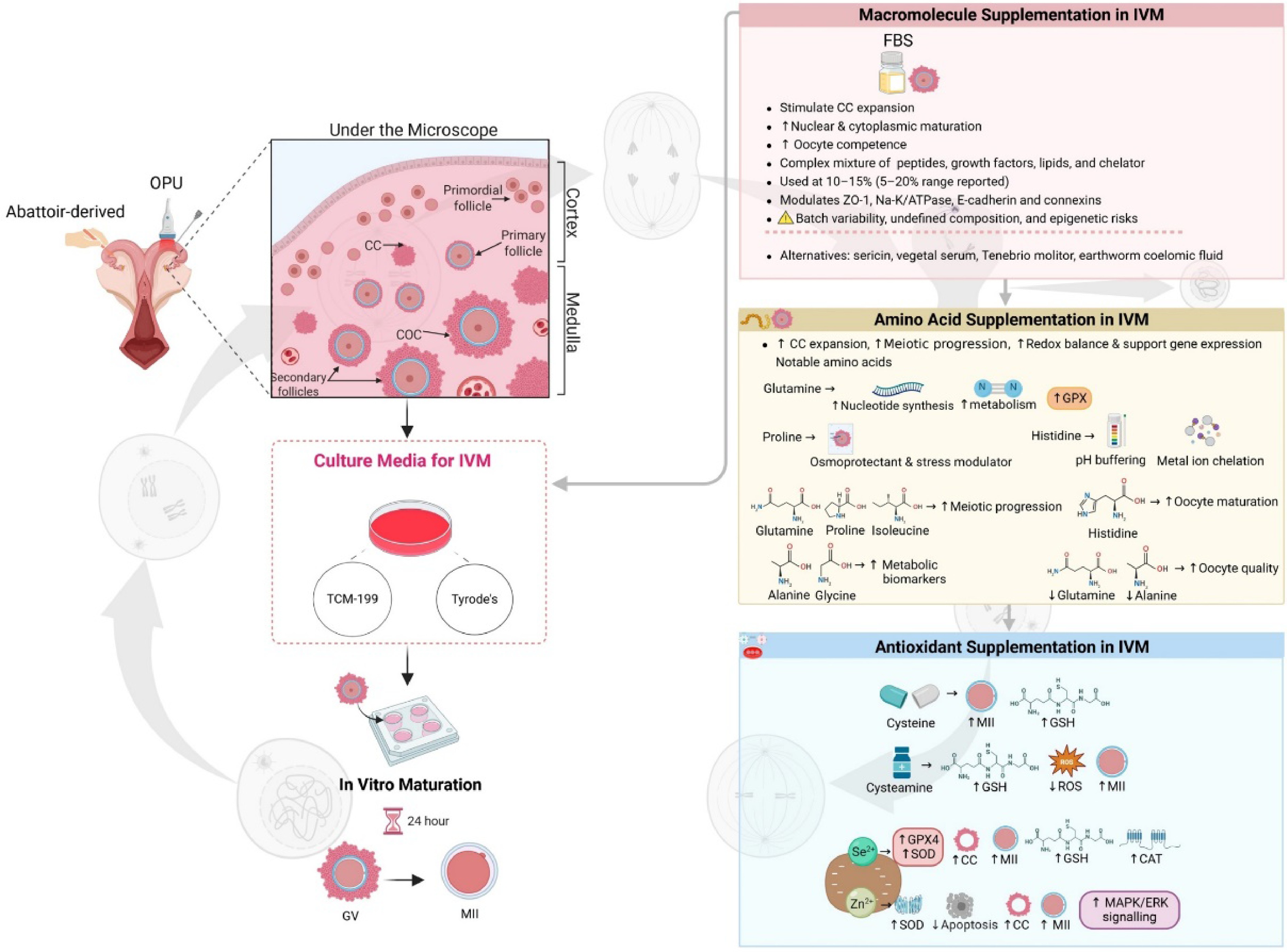
Figure 2.
Schematic overview of bovine in vitro maturation. Oocytes are collected either by OPU or from abattoir-derived ovaries. COCs are cultured in defined media (e.g., TCM-199, Tyrode's solution) for ~24 h, progressing to MII. Supplementation strategies, including macromolecules (e.g., FBS), amino acids, and antioxidants, modulate CCs' expansion, nuclear/cytoplasmic maturation, redox balance, and oocytes' developmental competence. Created by the authors using BioRender.
-
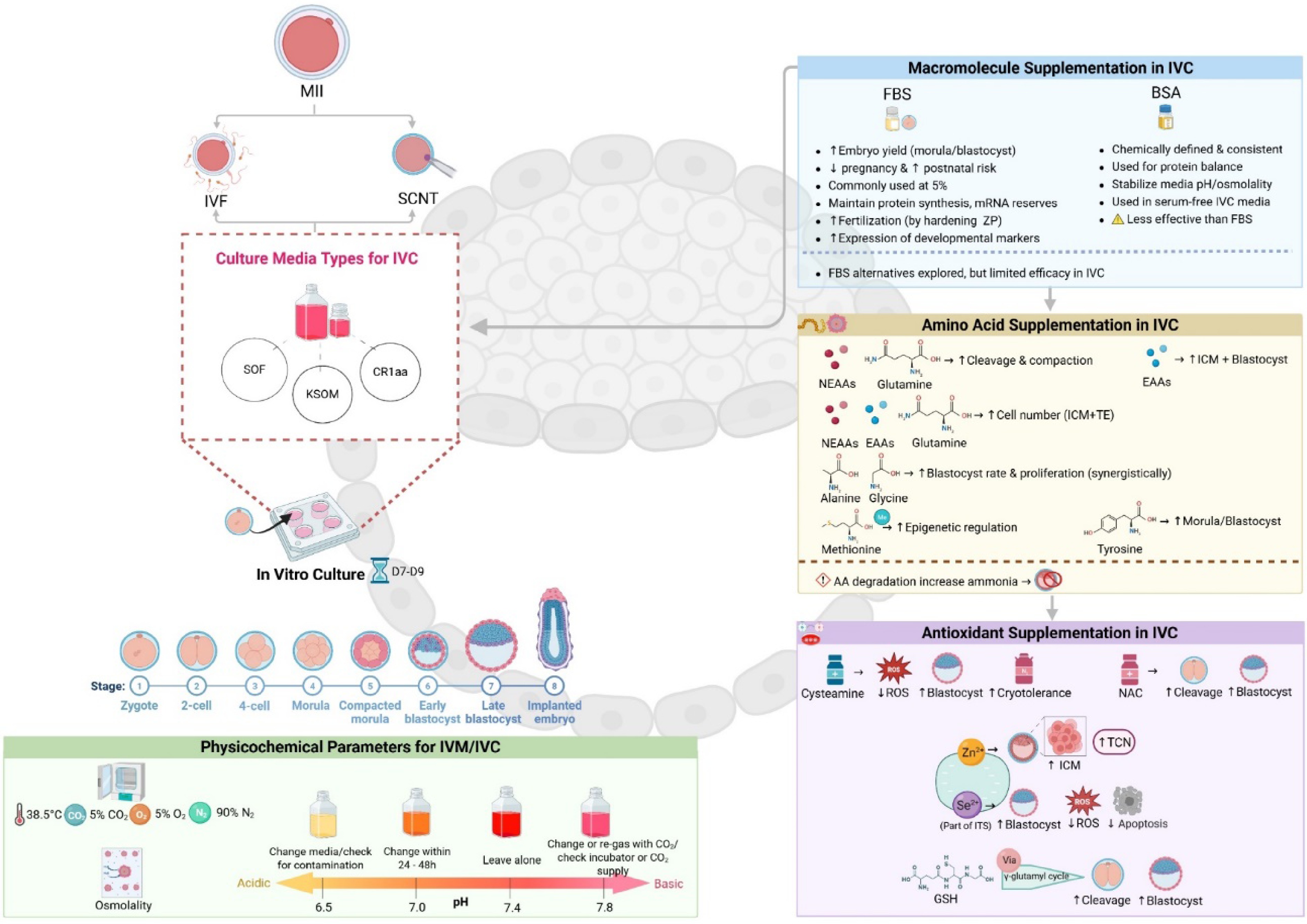
Figure 3.
Bovine in vitro culture (IVC) workflow and supplementation strategies. After maturation, oocytes are fertilized by IVF or activated by SCNT and cultured in defined media (SOF, KSOM, CR1aa) until the blastocyst stages (D7–D9). Supplementation strategies during IVC include macromolecules (FBS, BSA), amino acids (NEAAs, EAAs), and antioxidants (e.g., cysteamine, NAC, and GSH), which modulate cleavage, compaction, blastocyst quality, and redox balance. Physicochemical parameters, including pH, osmolality, gas composition, and temperature, are critical for maintaining embryos' viability and developmental competence. Abbreviations: SOF, synthetic oviductal fluid; KSOM, potassium simplex optimization medium; NEAAs, nonessential amino acids; EAAs, essential amino acids; NAC, N-acetyl cysteine; GSH, glutathione. Created by the authors using BioRender.
-
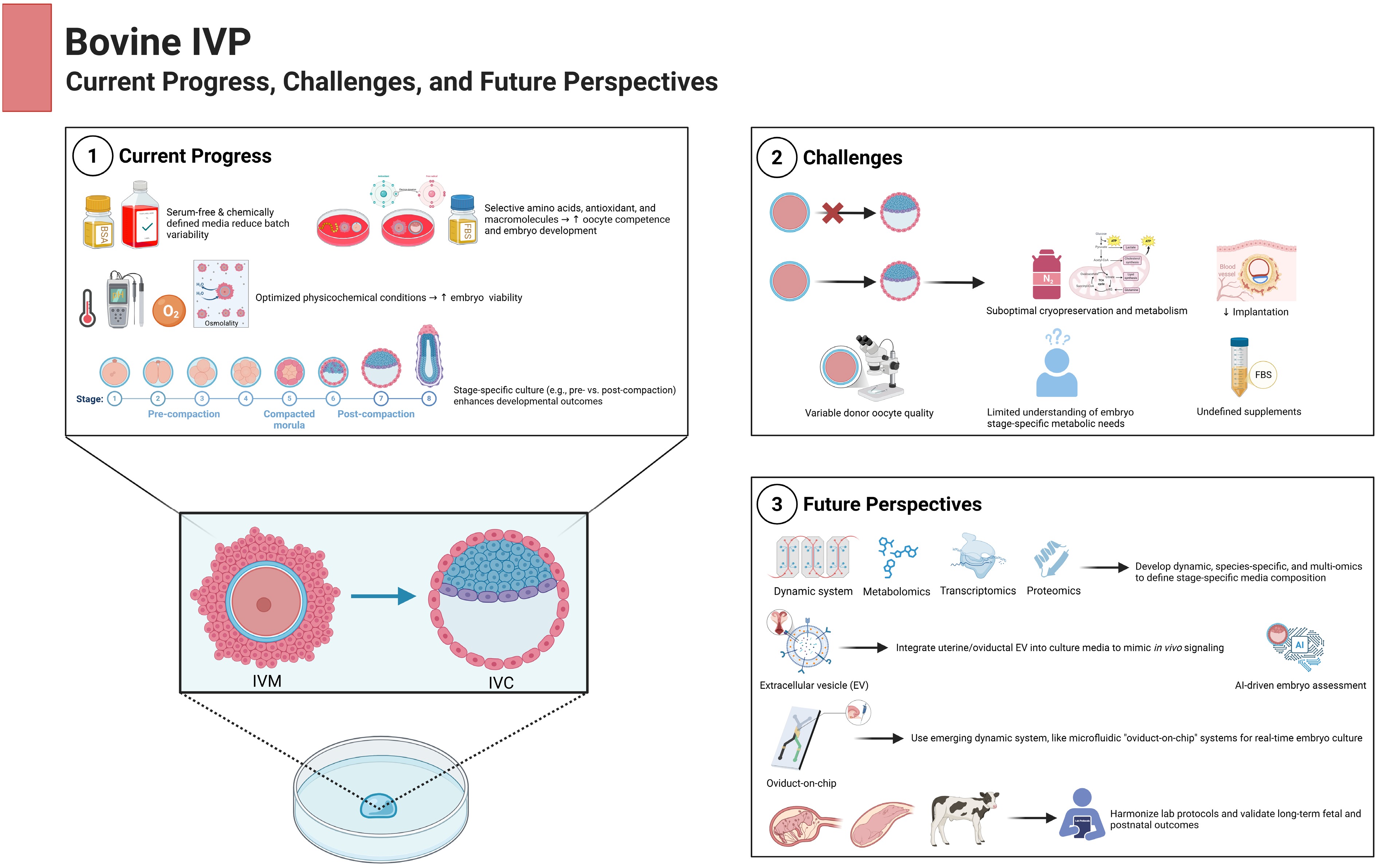
Figure 4.
Current progress, challenges, and future perspectives in bovine IVP. (1) Current progress: Advances in bovine in vitro production (IVP) include serum-free, chemically defined media, optimized physicochemical conditions, and selective supplementation strategies. (2) Challenges: Key limitations remain, including donor variability, undefined supplements, limited understanding of metabolic demands, and continued reliance on undefined supplements. (3) Future perspectives: Emerging approaches emphasize dynamic, species-specific media informed by multi-omics (metabolomics, transcriptomics, and proteomics), integration of extracellular vesicles, microfluidic "oviduct-on-a-chip" platforms, artificial intelligence-driven embryo assessment, and long-term validation of the offspring's health. Created by the authors using BioRender.
-
Year Species/
breedKey supplements %MII Key findings Ref. H MM AAs AOX GFs 2025 Buffalo 0.5 μg/mL FSH, 2 IU hCG, 1 μg/mL E2 10% FBS – 12 μg/mL cysteine – 71 hCG yielded 71% MII vs. 80.5% with LH
(0.5 µg); cleavage and blastocyst rates were similar with ↓SOD1 expression in hCG group[20] 2023 Cattle 0.01 UI/mL FSH, 50 ng/mL E2,
150 ng/mL P44 mg/mL BSA – 1 mM cysteamine 10 ng/mL IGF-1, 100 ng/mL AREG 84–87 BSA-based IVM medium achieved 84%–87% MII. NRG1 had no impact on maturation but modulated cumulus–oocyte gene expression (↓EGFR, ↑NPR2/PTX3) and post-IVF blastocyst quality [21] 2022 1 μg/mL E2 10% heat-inactivated FCS – 0.8 mM cysteine – 75.3 L-cysteine improved MII, and cytoplasmic maturation (mitochondria, cortical granules) with ↑BMP15/GDF9 expression, supporting oocyte–cumulus signaling [22] – 10% FCS L-glutamine – – 83 FCS supported higher MII, antioxidant defense (↑GPx), and IGF2/IGF1R expression. BSA was beneficial but less effective than FCS [7] 6 µg/mL FSH,
6 µg/mL LH,
1 µg/mL E210% inactivated FBS – – 10 ng/mL EGF, 100 ng/mL IGF1, or
500 ng/mL FGF290 Chemically defined IVM without serum, supplemented with gonadotropins and EGF/IGF1/FGF2, supported MII rates comparable to FBS (~88%–90%); gonadotropins were essential [17] 2021 10 µg/mL FSH,
1 µg/mL E210% FBS – 1 mM NAC 10 ng/mL EGF 83.1 NAC improved MII by increasing GSH levels, decreasing ROS and apoptosis– surpassing the effects of L-cysteine [23] 2019 Yak 5 µg/mL FSH,
5 μg/mL LH,
1 µg/mL E220% FCS – 0.6 mM cysteine 100 ng/mL IGF-1, and
10 ng/mL EGF84.4 Cysteine + IGF-1 + EGF synergistically enhanced yak oocyte maturation (84.4%), outperforming single or dual additives [24] 2017 Cattle 0.5 µg/mL FSH,
5 µg/mL LH10% FBS – 100 μM cysteamine – 91.9 Cysteamine supplementation achieved the highest MII among tested antioxidants, supporting nuclear maturation [25] 0.5 μg/mL FSH, 100 IU/mL hCG 10% FCS – – – 91.4 FCS yielded the highest MII (91.4%). Co-supplementation with antioxidants maintained comparable MII (89.7%) and reduced ROS under stress. [26] 2016 0.5 μg/mL FSH, 100 IU/mL hCG 10% FCS – 0.6 mM cysteine, 100 µM cysteamine, and 100 IU catalase – 78.2 Antioxidant tri-complex reduced ROS, increased GSH and ΔΨm while keeping MII comparable to individual antioxidant. [27] 2015 1 μg/mL FSH,
50 μg/mL hCG,
1 μg/mL E25% FCS – – – 89.6 FBS improved nuclear maturation and cortical granule migration vs. BSA, with no adverse effect on oocyte quality [28] 2010 2 mg/mL FSH,
10 μg/mL LH,
1 μg/mL E2100 μL/mL heat-inactivated FBS Glutamax-I – – 83 Serum-free FAF-BSA supported nuclear maturation similar to FBS, whereas complete serum/hormone deprivation significantly impaired maturation [29] 2000 Holstein cattle 0.5 μg/mL FSH, 0.06 IU hCG,
l μg /mL E220% heat-inactivated
ECS0.1 mg/mL
L-glutamine– – 84.5 High-quality oocytes showed superior maturation and development; serum presence further enhanced IVM outcomes [30] 1989 Cattle 5 μg/mL FSH,
1 μg/mL E220% heat-treated FCS – – – 87.9 Serum and gonadotropins improved MII to 87.9% vs. 59.2% in the control, confirming the synergistic effect [31] 1986 10 μg/mL FSH 10% FCS – – – 67 FCS in Tyrode's medium supported CCs' viability and MII, essential for FSH-induced expansion. In contrast, BSA failed to support maturation [32] – Key trends FSH + LH + E2 combination improves IVM outcomes 10% FBS/FCS-based media consistently support high MII rates Limited use;
L-glutamine is most reportedCysteamine and NAC are the
most consistent
in enhancing MIIIGF-1 and EGF are beneficial 80–91 Multi-component strategies (NAC, cysteamine, serum) reliably enhance MII – Most studies applied a 24 h IVM protocol, with minor variations: 22 h[7,23,25,27], 22–24 h[17], or 24–25 h[31]. TCM-199 was the standard basal medium; only one study used Tyrode's solution[32]. Antibiotics such as gentamicin (10–50 μg/mL)[18,25,31], amikacin (50 µg/mL)[26,27], high-dose amikacin (75–83.4 mg/mL)[21,28], and penicillin/streptomycin (varied combinations)[20,22−24,29,30,33] were routinely included to ensure aseptic conditions. One study applied a 1% antibiotic-antimycotic solution[7]. Abbreviations: MII, metaphase II; H, hormones; FSH, follicle stimulating hormone; hCG, human chorionic gonadotropin; LH, luteinizing hormone; E2, estradiol; GnRH, gonadotropin-releasing hormone; MM, macromolecules; FBS, fetal bovine serum; FCS, fetal calf serum; BSA, bovine serum albumin; FAF-BSA, fatty acid-free bovine serum albumin; AAs, amino acids; AOX, antioxidant; NAC, N-acetyl cysteine; GFs, growth factors; IGF, insulin-like growth factor-1; EGF, epidermal growth factor; AREG, amphiregulin; NRG-1, neuregulin-1; PVA, polyvinyl alcohol. Table 1.
IVM media formulations and maturation outcomes of bovine oocytes.
-
Year Species/source Key supplements CC % Blastocyst % (days) Key findings Ref. MM AAs AOX 2025 Bovine/IVF
5 mg/mL BSA – – 81 31.7 (Days 7–9) Day 7 embryos supported pregnancy rates, whereas Day 9 blastocysts showed ↑apoptosis (↑BAX/↓BCL2) and ↓ICM, indicating reduced competence with prolonged culture. [75] 2024 Undisclosed composition 84.9 35.8 (Day 8) Confined individual culture (~70 nL) yielded 35.8% blastocysts with ↓apoptosis and smaller lipid droplets vs. group culture. [76] Bovine/SCNT, ICSI, parthenogenesis – – 50 μg/mL L-ascorbic acid 82.8 33.2 (Day 7) Pre-IVM with L-ascorbic acid improved maturation (88.5%), blastocyst quality (↑cell number and H3K9ac intensity), and enhanced SCNT/ICSI reprogramming. [77] Bovine/IVF 10% FBS 750 mg NEAAs Unspecified 51.4 (AAs) 42.1 (AAs) 750 mg NEAAs + antioxidants increased cleavage and supported Day 7 blastocyst formation, underscoring their complementary roles during bovine IVC. [78] 63.3 (AOX) 42.1 (AOX) 2022 Bovine/IVF – – ITS–5 μg/mL insulin,
5 μg/mL transferrin,
5 ng/mL selenium87.4 43.3 (Day 8) Lycopene (0.2 μM) during IVM increased Day 8 blastocyst rate (56% vs. 43.3% in the control), with improved embryo quality (↑TCN, ICM/TCN; ↓ROS, ↓apoptosis), despite identical IVC conditions. [44] 2016 – 1 mM glycine – 71.1 34.6 (Day 7) Early IVC glycine under low osmolarity improved bovine blastocyst and hatching rates by Day 7, confirming its effective osmolyte and metabolic role in defined serum-free IVC systems. [79] 2015 8 mg/mL BSA-FAF – – 91.1 36.2 (Day 8) FBS (used in IVM) increased blastocysts' lipid content despite all groups using
8 mg/mL BSA during IVC. Reducing FBS (5%) lowered lipid accumulation without affecting development.[28] 2008 Bovine/ parthenogenesis (PLCZ1) 3 mg/mL BSA – – 92 33.6 PLCZ1-activated parthenotes in KSOM + BSA achieved higher cleavage and blastocyst rates, outperforming IVF and indicating the efficacy of defined serum-free IVC systems. [80] 2007 Bovine/IVF SSS – – 75.6 27.8 (Day 8) Replacing FCS with defined SSS + EGF during IVM/IVC media slightly improved blastocyst rates and altered gene expression without compromising embryo quality. [45] 2006 10% FBS – – 80.1 32.8 (Day 8) SOFaa yielded greater blastocyst formation over KSOMaa and CR1aa, with similar cell counts and apoptotic rates, while keeping gene expression profiles more similar to in vivo embryos, underscoring its physiological relevance. [81] 1997 5% FCS – – – 90.4 (Day 9) Among morula selected at 120 hours post-insemination replacing BSA with addition of FCS increased blastocyst formation (90.4% by Day 9) and hatching vs. BSA. [43] – Key trends FBS/FCS more consistently supports blastocyst formation. NEAAs and glycine are occasionally used. ITS improves developmental outcomes. 51.4–92 27.8–43.3 FBS/BSA support IVC; defined AOX improves outcomes. – SOF/mSOF served as the base medium in most studies, whereas the study by Herrick et al.[79] employed bovine oviduct epithelial cell co-culture. Standard antibiotic supplementation e.g., amikacin (84.3 mg/mL)[28], penicillin (100 U/mL), streptomycin (100 μg/mL)[45], and gentamicin sulfate (50 μg/ml)[43] was applied to ensure aseptic conditions. MM, macromolecule; AAs, amino acids; AOX, antioxidant; CC, cumulus cells; ECS, estrous cow serum; SSS, serum substitute supplement; SOF, synthetic oviductal fluid; mSOF, modified synthetic oviductal fluid; KSOMaa, potassium simplex optimization medium with amino acids; CR1aa, Charles Rosenkrans 1 with amino acids; SOFaa, synthetic oviductal fluid with amino acids; PLCZ1, phospholipase C Zeta 1; SCNT, somatic cell nuclear transfer; ICSI, intracytoplasmic sperm injection. Table 2.
IVC media formulations and developmental outcomes of bovine embryos.
Figures
(4)
Tables
(2)