-
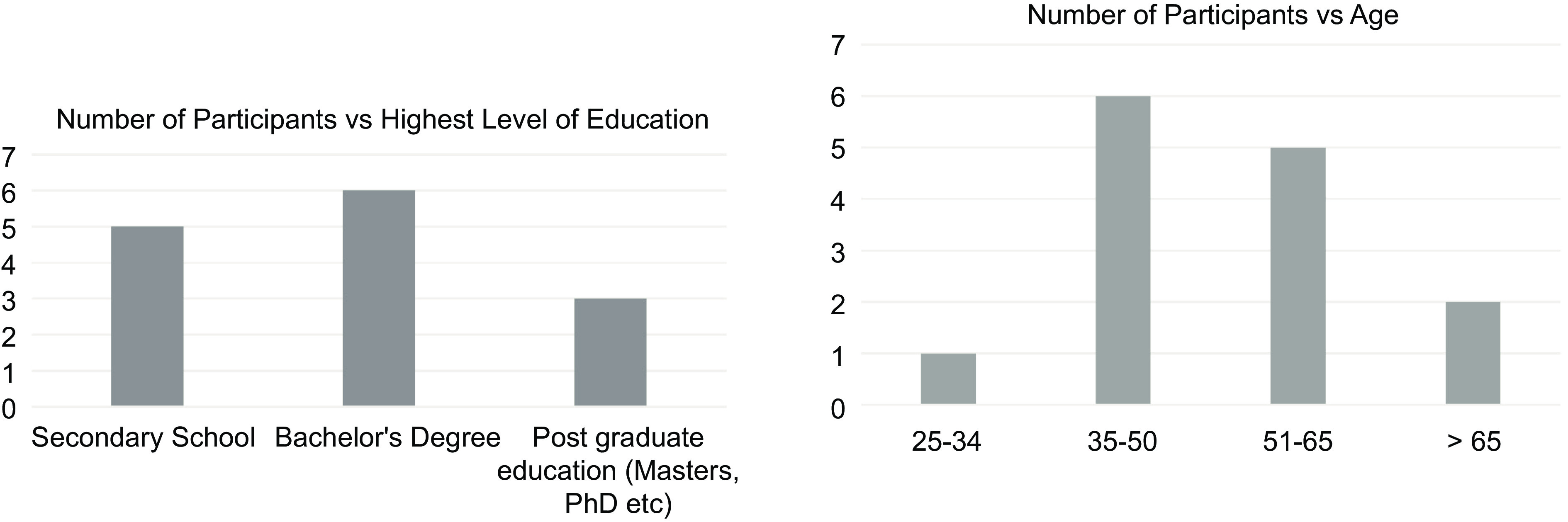
Figure 1.
Age of participants and their highest level of education.
-
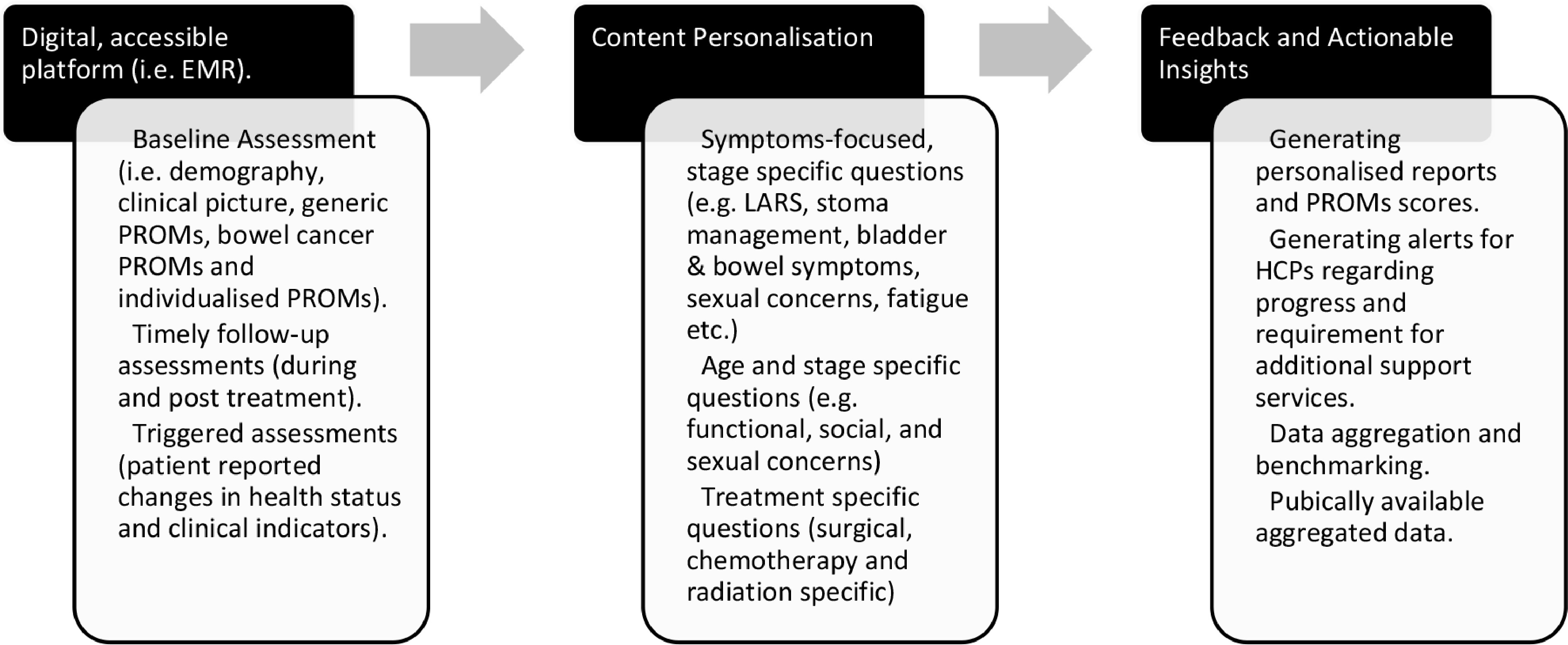
Figure 2.
Proposed systems framework.
-
Concepts Themes Subthemes Awareness of PROMs Limited understanding of PROMs Impact of disease Important outcomes of measure (1) Disease's effect on life; (2) Side effects of treatment Patient services Individualistic PROMs' design and delivery (1) Contextual and individualised; (2) Delivery and engagement Optimism regarding PROMs' potential benefits (1) Benchmarking and Support Improving patient engagement (1) Improving care and awareness; (2) Timing with Appointments and Leveraging Healthcare Relationships; (3) Feedback and Tangible Outcomes; (4) Intrinsic motivation; (5) Interactive elements; (6) Visually effective presentations Table 1.
Table of concepts, themes and subthemes.
-
Themes Subthemes Patients' statements 1. Limited understanding of PROMs • "I did a survey but didn't know it was PROMs."
• "I had read about it, but had no first-hand experience."
• "My understanding is to involve the patient in what the outcomes are going to… Well, not necessarily what they're going to be, but discussion with the patient. Also the patient's wishes and the family's wishes."
• "So for me, I guess it would be more about my expectations on my experience based on the information that I would have, as well as the information that I've been given from the professionals around me."
• "Patient-reported outcome measures, my understanding is it's about how cancer, the diagnosis, treatment, perhaps the side effects affect my life."2. Impact of bowel cancer on patients' lives Impact on daily life • "The recovery was a lot bigger than what I anticipated."
• "...if they haven't actually been through it, it's hard to probably explain some stuff. Whereas if you chat to somebody who has actually been through it, then it's like, 'Oh, okay.' And you are more likely I think, going to tell one of those people what your fears and your frights are and maybe ask some of those other questions that you may not ask your surgeon or your oncologist sort of thing."
• "So I think if it was within those first kind of couple of months, I would've said no. Or probably if I had have gotten a really long survey, I just would've left that email. I was in recovery mode and that was all I was concentrating on."
• "…bowel cancer did not register. I was told I had haemorrhoids. And so again, you're just kind of going along and believing what you thought was…"Specific symptoms and side effects • Neuropathy: "And then the neuropathy in my hands and feet. I still can't wear heels because I can't feel my feet properly, and my hands, especially when it's cold; it's like I've got really bad arthritis."
• Stoma: "I needed referrals for my stoma nurse, and I needed referrals for my district nurse that was coming out and things like that."
• Duration of recovery: "The duration of recovery was another key factor that patients identified as impacting their quality of life."3. Individualistic PROMs' design and delivery • "timing with appointments" and "getting information back"
• "…they were probably a little bit too generic, you know what I mean? I felt that they would've sent that particular survey to a patient that had possibly had surgery for a broken leg, and I'd had surgery for bowel cancer, and it just felt very generic. They weren't towards someone that had had cancer or anything."
• "…it should be tailored to that and the typical after-effects that you're getting from that... When something happens to you, generally you have these after-effects from that. If you have another circumstance, you have these sort of after-effects."
• "So if those things are well-known and well-framed, and you can answer a quiz within 15 minutes type thing, nice and easy, or, 'Have you experienced this? Have you experienced this? Have you experienced this?' Rather than a generic one that's got everything in us, a lot of things are going to be non-applicable."4. PROMs' potential benefits • "support", "follow", "treatment and outcomes"
• "…that's probably been the hugest thing for me. So probably a face-to-face survey like this would be more inclined to do."5. Improving patient engagement • "face-to-face, and there might be some changes put into action from me doing it."
• "I think it would be face-to-face. For me, it would be face-to-face and being able to kind of talk about it openly."
• "…if you had that person that did the follow-up two weeks later to see what your outcomes and kind of followed you along the process a little bit. That would work for me at least anyway."
• "…maybe either, as [name] said, I think for me, a face-to-face, whether that be even a phone call, because I think you could get a lot more information from a person or a patient over the phone than a survey."
• "I think if you could just take it home and read it in your own time, I think it would be helpful."
• "…one-on-one interaction like what we're doing here every, I don't know, whatever time period you guys can afford, depending on resources, would be quite useful to you…"Table 2.
Table of themes, subthemes and patients' statements.
Figures
(2)
Tables
(2)