-
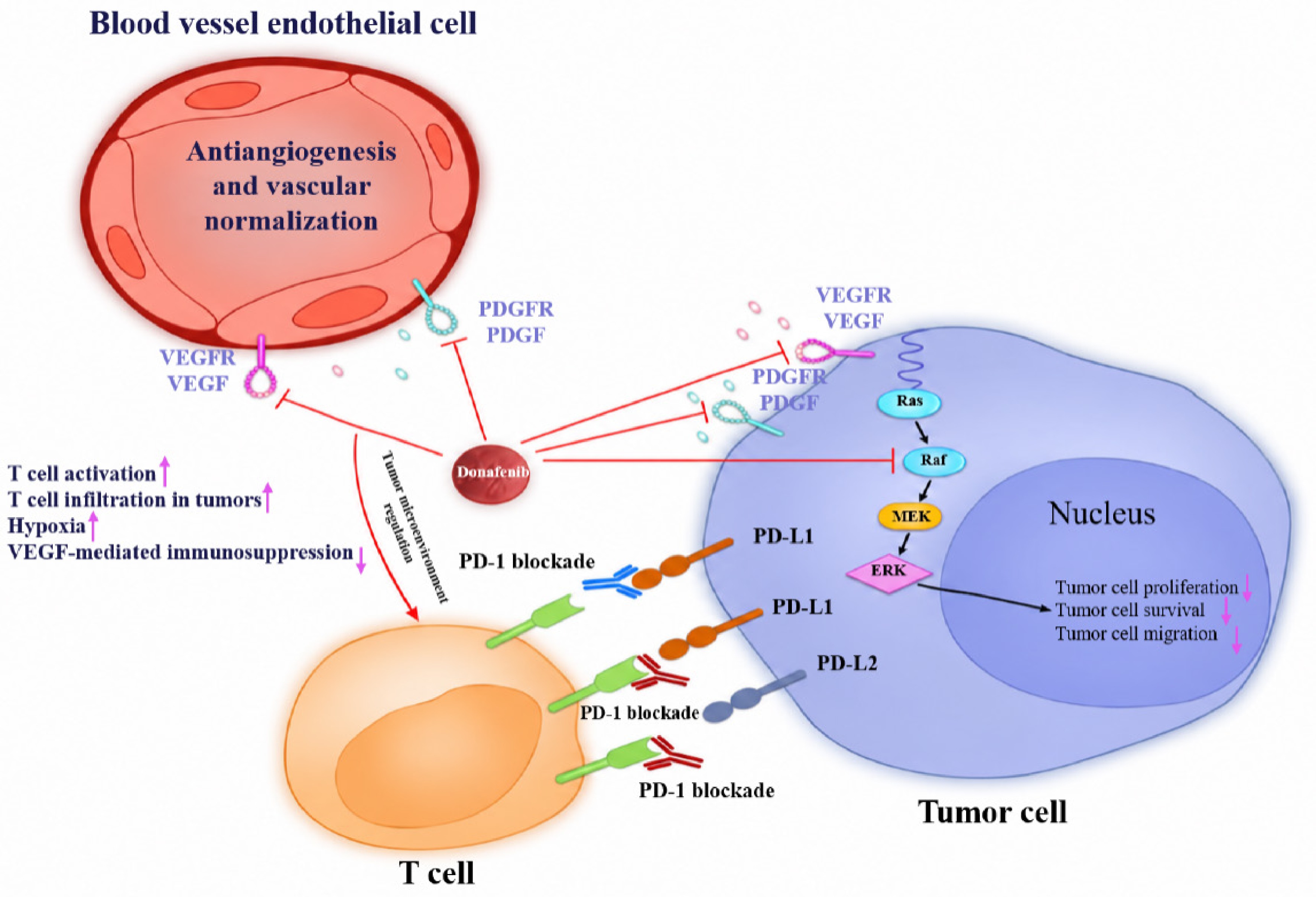
Figure 1.
Mechanism of action of donafenib.
-
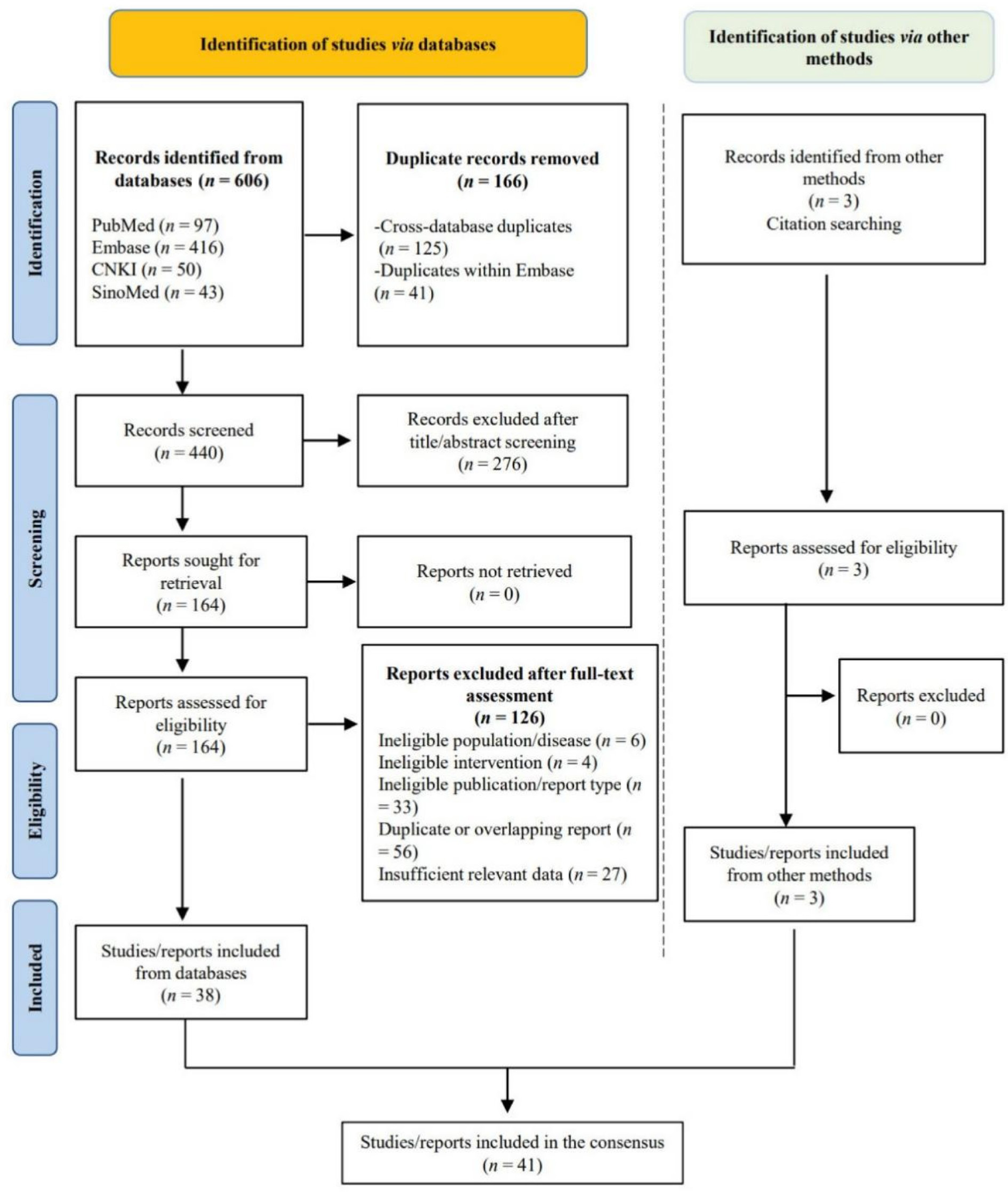
Figure 2.
PRISMA_flow diagram.
-
Treatment regimen Study design Sample size ORR DCR PFS (months) OS (months) Safety TACE + donafenib + PD-1 inhibitor vs
TACE + donafenib[32]Retrospective cohort study 166 vs 157 50.6% vs 41.4%
(mRECIST, P = 0.019)89.2% vs 82.8%
(mRECIST, P = 0.010)10.6 vs 7.9
P < 0.00118.1 vs 13.2
P < 0.001Grade ≥ 3 AEs: 33.8% vs 37.3%, P = 0.253 TACE + donafenib + tislelizumab vs
TACE + sorafenib[33]Retrospective cohort study 81 vs 88 66.7% vs 38.6%
(mRECIST, P < 0.001)82.6% vs 68.2%
(mRECIST, P = 0.033)10.9 vs 7.0
P < 0.00119.6 vs 10.9
P < 0.001Grade ≥ 3 AEs: 4.9% vs 14.8%, P = 0.041 TACE + donafenib + ICIs vs
TACE + donafenib[34]Retrospective cohort study 28 vs 41
(26 vs 26 after PSM)53.8% vs 50.0%
(mRECIST, P = 0.781)96.2% vs 73.1%
(mRECIST, P = 0.021)13.1 vs 7.2
P = 0.01723.1 vs 14.7
P = 0.021Grade ≥ 3 AEs: 10.7% vs 7.3%, P = 0.623 TACE + donafenib + ICIs vs
TACE + lenvatinib + ICIs[35]Retrospective cohort study 70 vs 36
(50 vs 30 after PSM)64.0% vs 40.0%
(mRECIST, P = 0.037)96.0% vs 80.0%
(mRECIST, P = 0.047)9.0 vs 4.62
P = 0.005NA vs 12.9
P = 0.004No significant difference in overall adverse events(P = 0.84) TACE + donafenib + ICIs[36] Retrospective single-center study 30 60.0% (mRECIST) 93.3% (mRECIST) 11.8 NA Grade ≥ 3 AEs: 40% TACE + donafenib + sintilimab[37] Prospective single-center study 30 56.7% (RECIST v1.1)
90.0% (mRECIST)93.3% (RECIST v1.1)
93.3% (mRECIST)10.2 12-month OS rate: 87.2% Grade ≥ 3 AEs: 46.7% TACE + donafenib + PD-(L)1 inhibitor[38] Retrospective single-center study 40 65.0% (mRECIST) 97.5% (mRECIST) 12.5 12- and 18-month OS rates: 91.7%, 66.8% Grade ≥ 3 AEs: 7.5% D-TACE + donafenib + atezolizumab vs
D-TACE + Lenvatinib[39]Retrospective cohort study 51 vs 54 62.7% vs 40.7% (mRECIST, P < 0.05) 84.3% vs 64.8%
(mRECIST, P < 0.05)8.7 vs 5.7
P < 0.00119.2 vs 12.3
P < 0.001Grade ≥ 3 AEs: no significant difference between groups HAIC + donafenib + atezolizumab vs
TACE[40]Retrospective cohort study 270 vs 151
(151 vs 151 after PSM)33.8% vs 11.3%
(RECIST v1.1, P < 0.01)77.9% vs 65.3%
(RECIST v1.1, P < 0.03)10.3 vs 4.9
P < 0.001NA vs 10.9
P < 0.001Grade ≥ 3 AEs: 36.4% vs 48.3%, P = 0.04 HAIC + donafenib + sintilimab[41] Prospective single-center study 36 58.3% (RECIST v1.1)
80.6% (mRECIST)94.4% (RECIST v1.1)
94.4% (mRECIST)EFS: 15.3 24-month OS rate: 59.6% Grade ≥ 3 AEs: 33.3% HAIC + donafenib + PD-1 inhibitor[42] Retrospective single-center study 64 73.4% (mRECIST) 93.8% (mRECIST) 12.3 12-month OS rate: 93.2% Grade ≥ 3 AEs: 32.8% TACE + HAIC + donafenib + PD-1 inhibitor[43] Retrospective single-center study 89 75.3% (mRECIST) 100% (mRECIST) 18.5 12- and 18-month OS rates: 81.6%, 72.4% Grade ≥ 3 AEs: 30.3% TACE/HAIC + donafenib + PD-1 inhibitor[44] Retrospective single-center study 105 58.1% (RECIST v1.1)
61.0% (mRECIST)87.6% (RECIST v1.1)
87.6% (mRECIST)11.7 12-month OS rate: 89.9% Grade ≥ 3 AEs: 77.1% Table 1.
Clinical studies of donafenib combined with TACE/HAIC and ICIs as first-line therapy for HCC.
-
Adjuvant therapy Sample size High-risk factors Efficacy Donafenib + toripalimab[51] 30 Microvascular invasion (MVI); satellite nodules; ≥ 3 lesions; PVTT invading hepatic segment or portal vein branches (left or right), with or without hepatic vein invasion 1-year RFS rate: 81.6% TACE + donafenib + tislelizumab[52] 30 Single tumor > 5 cm and MVI, with or without satellite lesions 1-year RFS rate: 89.6% TACE + donafenib[53] 40 Single lesion > 5 cm; multiple lesions; MVI; satellite lesions; resection margin < 1 cm 1-year RFS rate: 78.8% TACE + donafenib
donafenib[54]69
70Maximum tumor diameter > 5 cm; multiple lesions; MVI; major vessel invasion mRFS: 29.2 months
mRFS: 24.5 monthsHAIC + donafenib[55] 18 Single tumor > 5 cm with MVI 1-year RFS rate: 64.9% Donafenib[56] 47 Tumor > 5 cm; multiple lesions; MVI; preoperative AFP > 400 ng·mL−1 1-year RFS rate: 73.3%;
2-year RFS rate: 63.6%Table 2.
Clinical studies of adjuvant donafenib in HCC patients at high risk of recurrence.
-
Dose modification strategy Temporary drug interruption Dose reduction Permanent discontinuation HCC • Grade 3 HFSR*
• Grade ≥ 3 diarrhea
• Grade 3 hypertension despite optimal antihypertensive therapy
• Grade 3 hepatic dysfunction
• Grade 3 proteinuria
• Grade 2 gastrointestinal bleeding
• Grade 3 QT interval prolongation
• Any grade ≥ 3 non-hematologic adverse event (except those requiring permanent discontinuation)
• Grade 4 hematologic adverse event (except those requiring permanent discontinuation)First interruption: If the adverse event recovers to normal or grade ≤ 1 within 1 week, resume donafenib at the original dose. If recovery to grade ≤ 1 occurs within 2 weeks, reduce the dose to 200 mg once daily and continue treatment. Subsequent interruption: If recovery to grade ≤ 1 occurs within 2 weeks after dose reduction, further reduce the dose to 200 mg every other day and continue treatment • Grade 4 hypertension
• Grade 4 hepatic dysfunction
• Grade 3 gastrointestinal bleeding
• Grade 4 QT interval prolongation
• Life-threatening (grade 4) adverse events requiring emergency intervention, including but not limited to acute hemorrhagic shock, gastrointestinal perforation, or hypertensive crisis
• Failure to recover to grade ≤ 1 within 2 weeks of treatment interruption
• Requirement for a third treatment interruption* Grade 3 HFSR (classified as palmar-plantar erythrodysesthesia syndrome in MedDRA) is characterized by desquamation, blistering, and hyperkeratosis of the hands and feet, typically accompanied by pain. Severe cases may present with bleeding, fissures, and edema, resulting in limitations in activities of daily self-care. Table 3.
Principles of dose modification for donafenib in patients with HCC.
Figures
(2)
Tables
(3)