-
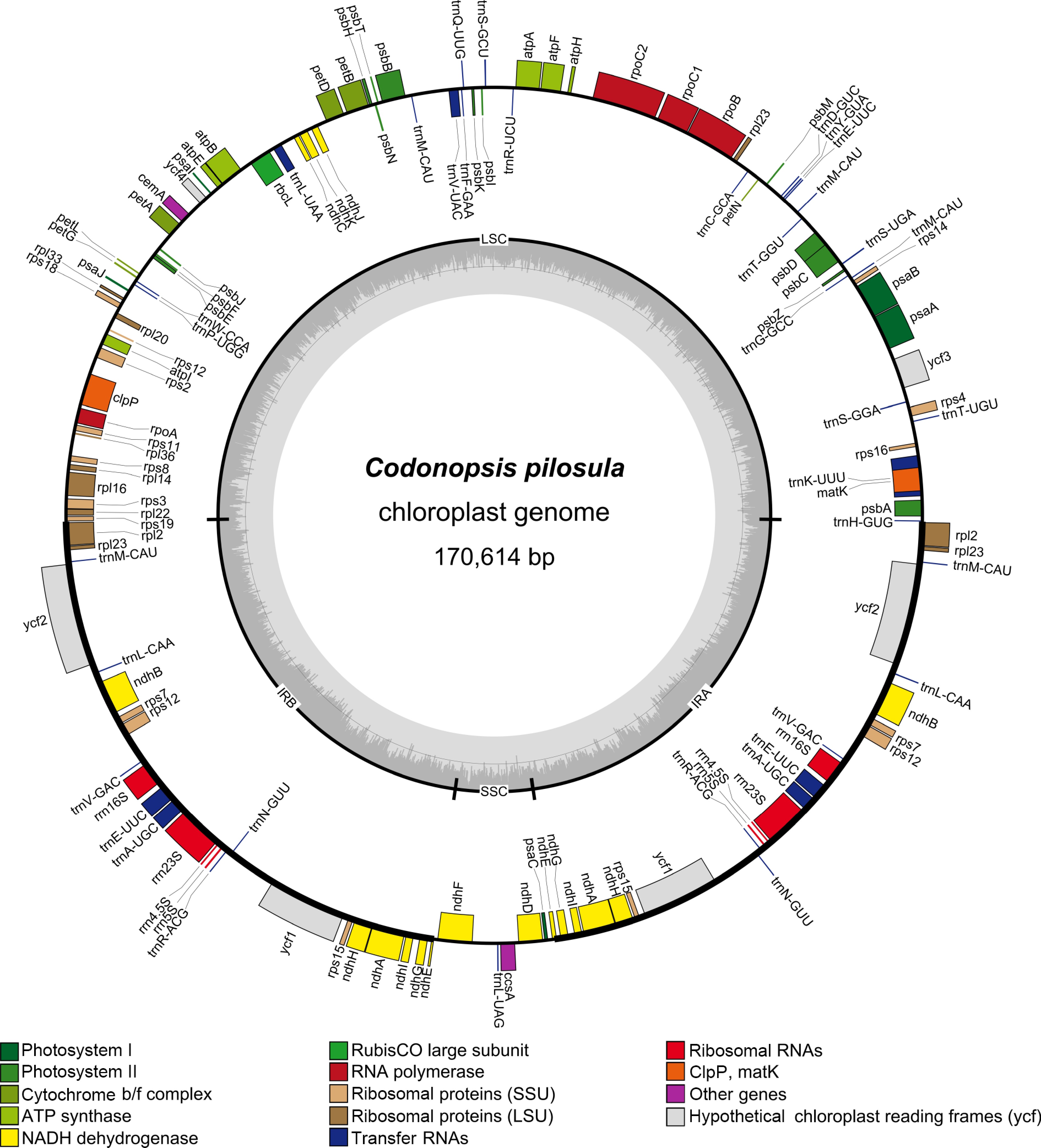
Figure 1.
Chloroplast genome map of Codonopsis pilosula. Genes shown outside the circle are transcribed counterclockwise, while those inside are transcribed clockwise. Functional gene categories are color-coded. The inner gray circle represents the GC content.
-
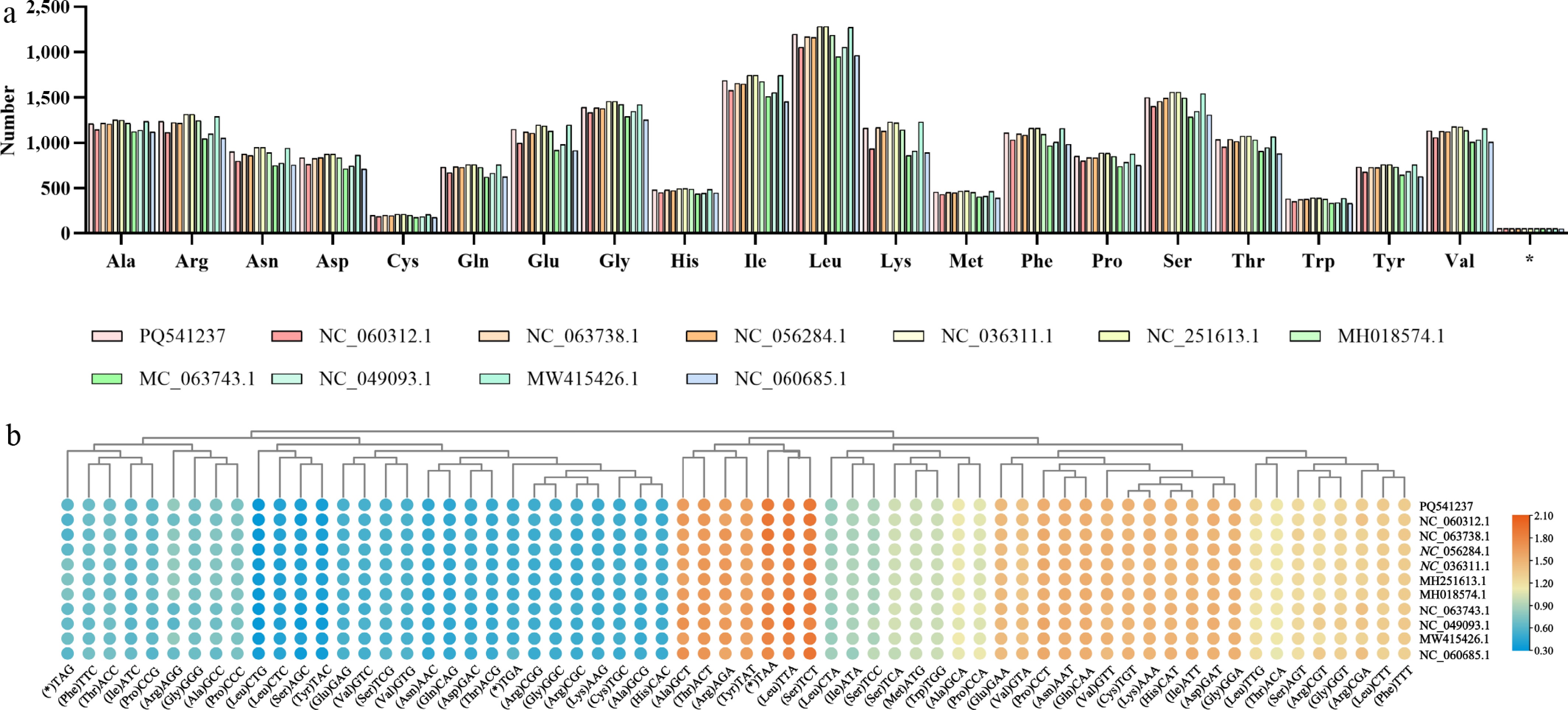
Figure 2.
Codon usage analysis of 11 Codonopsis chloroplast genomes. (a) Number of each amino acid. (b) Heatmap of relative synonymous codon usage (RSCU) values across 11 Codonopsis genomes. Rows represent species and columns represent codons. The color scale indicates RSCU values, with red representing higher bias (maximum 2.10) and blue representing lower bias (minimum 0.30).
-
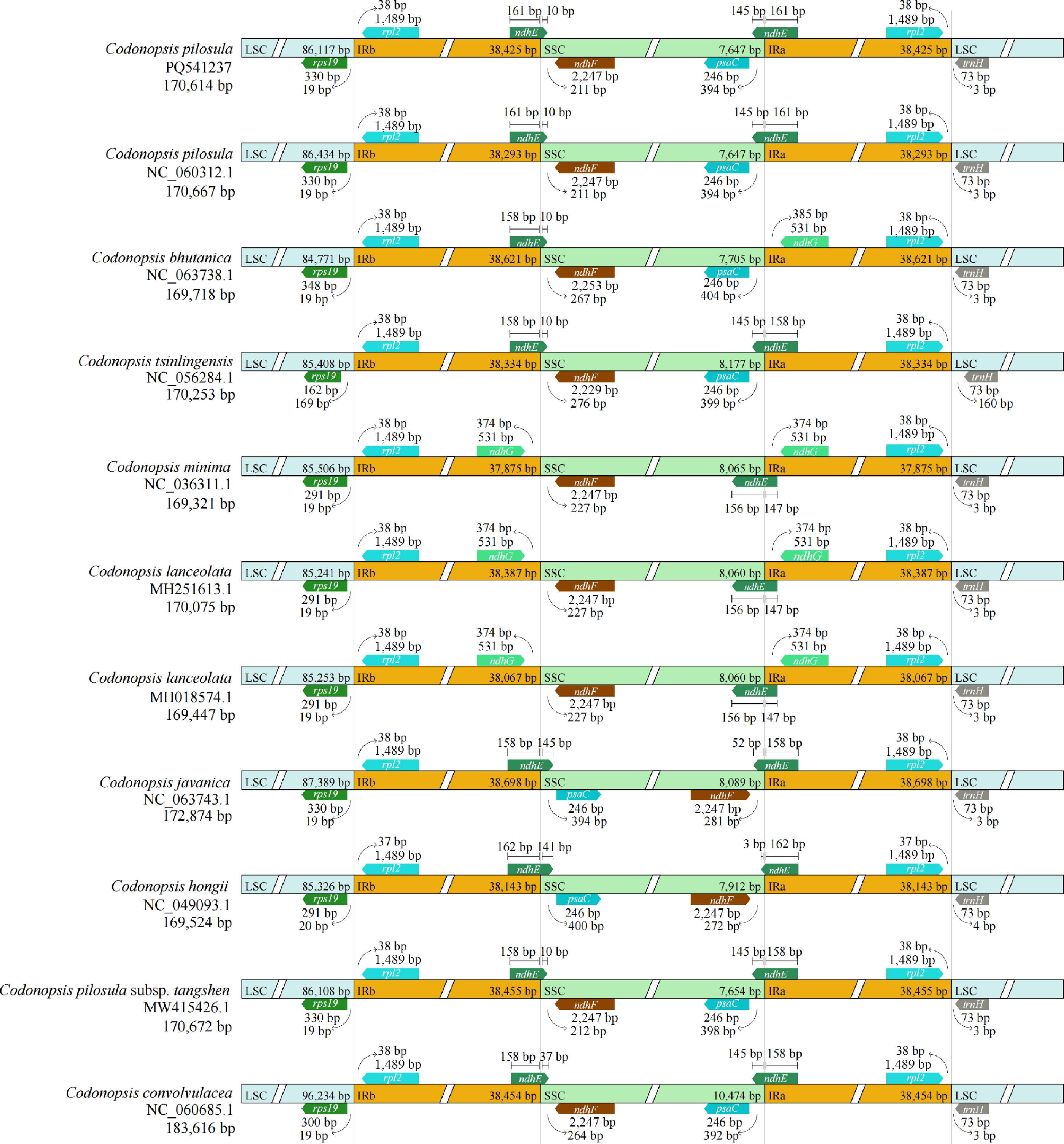
Figure 3.
Comparison of the LSC, SSC, and IR boundary regions across 11 Codonopsis chloroplast genomes. Genes near the boundaries are shown with their distances (in bp) from the junctions.
-
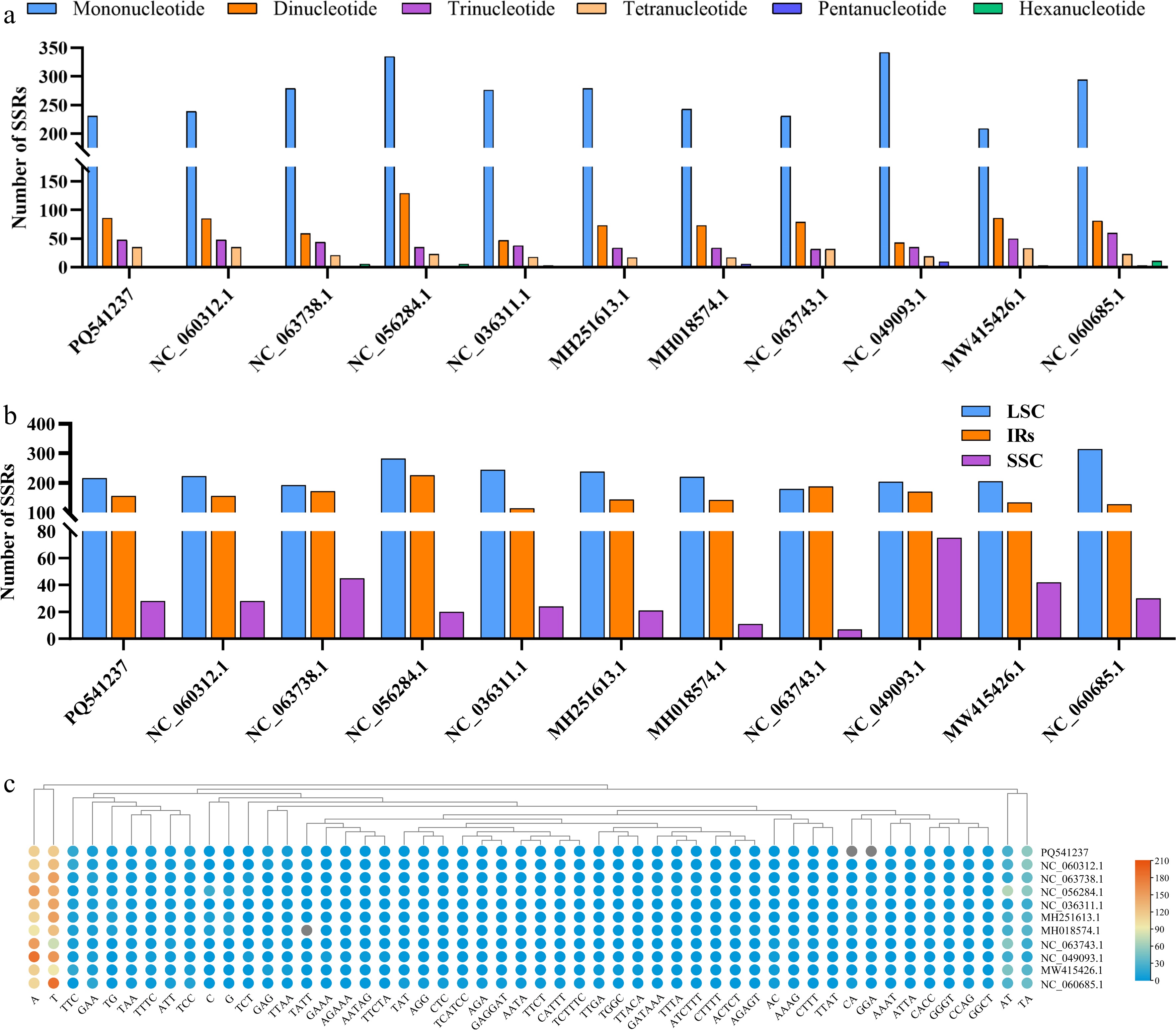
Figure 4.
Simple sequence repeat (SSR) analysis of 11 Codonopsis chloroplast genomes. (a) Number of SSRs by repeat type (mono-, di-, tri-, tetra-, penta-, hexanucleotide). (b) Distribution of SSRs across LSC, SSC, and IR regions. (c) The number of SSRs in each repeat type for each species.
-
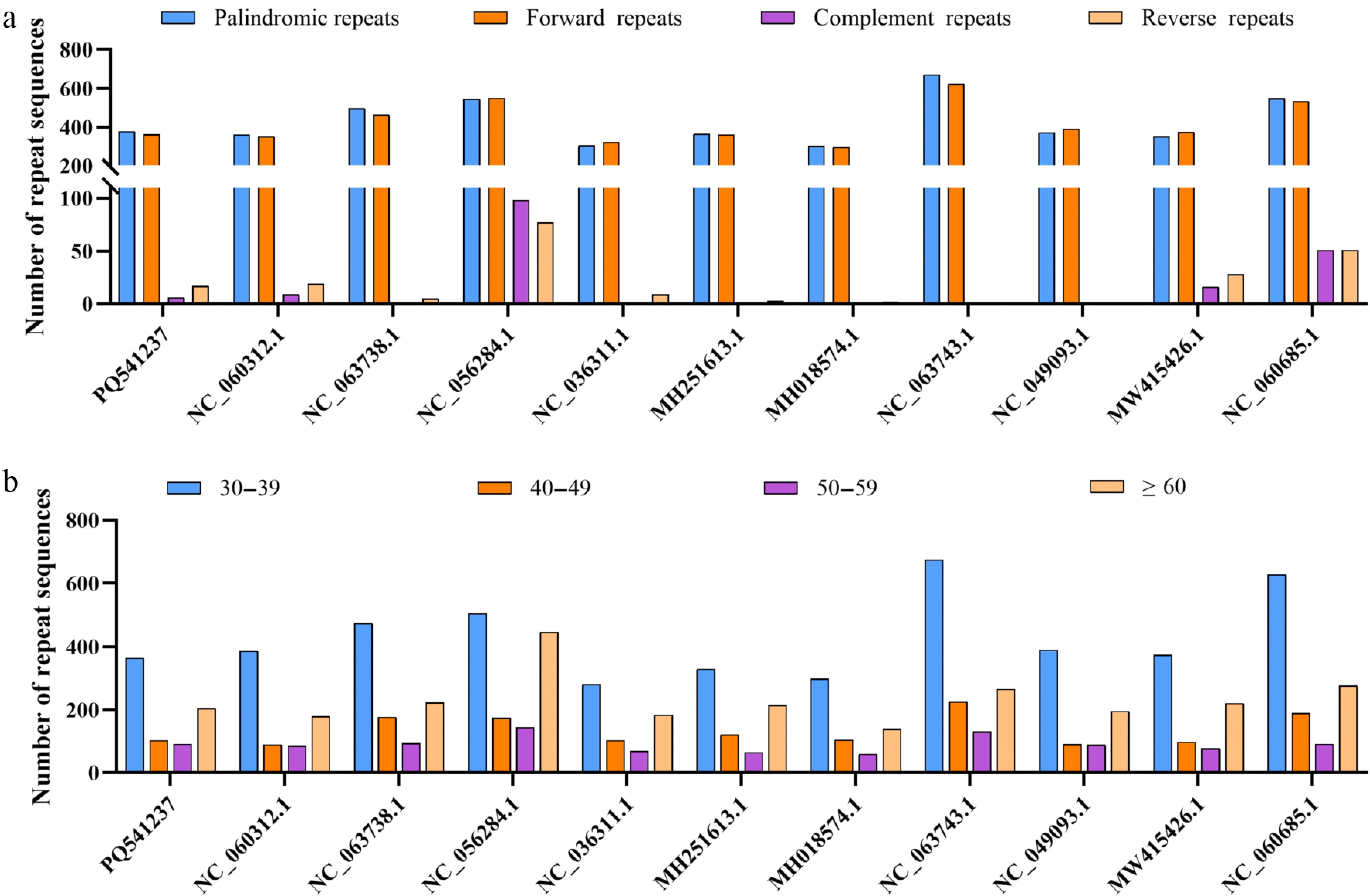
Figure 5.
Dispersed repeat analysis of 11 Codonopsis chloroplast genomes. (a). Classification and distribution of palindromic, forward, reverse, and complementary repeats. (b). Frequency distribution of dispersed repeats by length categories (30−39, 40−49, 50−59, and ≥ 60 bp).
-
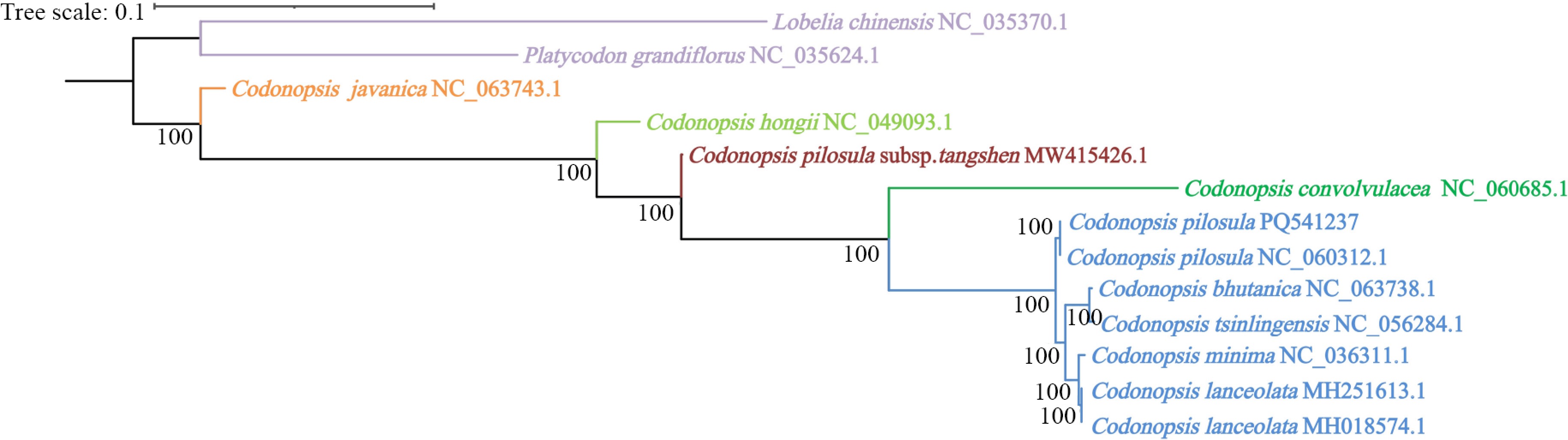
Figure 6.
The ML phylogenetic tree of 11 Codonopsis plants and allied plants. The tree was constructed using IQ-TREE 2 under the TVM + F + I + R8 model with 5,000 bootstrap replicates. Bootstrap support values (≥ 70%) are shown at the nodes.
-
Species NCBI accession number Length
(bp)GC (%) LSC IRs SSC Coding regions Reference Size (bp) GC (%) Size (bp) GC (%) Size (bp) GC (%) Size (bp) GC (%) C. pilosula PQ541237 170,614 38.14 86,117 36.74 38,425 40.31 7,647 32.13 85,992 38.68 This study C. pilosula MT982394.1/NC_060312.1a 170,667 38.13 86,434 36.73 38,293 40.30 7,647 32.13 76,092 39.16 Unpublished Codonopsis bhutanica MW149120.1/NC_063738.1 169,718 38.38 84,771 37.13 38,621 40.36 7,705 32.29 84,258 38.83 Unpublished Codonopsis tsinlingensis MN122102.1/NC_056284.1 170,253 38.34 85,408 37.02 38,334 40.46 8,177 32.24 84,012 38.94 [27] Codonopsis minima KY587457.1/NC_036311.1 169,321 38.28 85,506 36.86 37,875 40.50 8,065 32.44 88,746 38.53 [28] Codonopsis lanceolata MH251613.1 170,075 38.24 85,241 36.87 38,387 40.37 8,060 32.34 88,659 38.52 Unpublished Codonopsis lanceolata MH018574.1 169,447 38.24 85,253 36.88 38,067 40.39 8,060 32.37 83,331 38.67 [29] Codonopsis javanica MW149125.1/NC_063743.1 172,874 37.97 87,389 36.76 38,698 39.99 8,089 31.66 69,894 39.23 Unpublished Codonopsis hongii MN849357.1/NC_049093.1 169,524 38.24 85,326 36.88 38,143 40.40 7,912 32.03 72,346 39.01 [30] C. pilosula subsp. tangshen MW415426.1 170,672 38.15 86,108 36.75 38,455 40.31 7,654 32.07 90,030 38.55 [31] Codonopsis convolvulacea NC_060685.1 183,616 38.72 96,234 37.59 38,454 40.74 10,474 34.27 75,537 39.41 [32] a In this table, accession numbers separated by a slash (e.g., MT982394.1/NC_060312.1) represent identical sequences confirmed by sequence alignment. Table 1.
Summary of the 11 Codonopsis chloroplast genomes analyzed in this study.
-
Category of genes Group of genes Name of genes Genes for photosynthesis Subunits of ATP synthase atpA, atpB, atpE, atpF*, atpH, atpI Subunits of Photosystem II psbA, psbB, psbC, psbD, psbE, psbF, psbI, psbJ, psbK, psbM, psbN, psbT, psbZ Subunits of NADH-dehydrogenase ndhA*(×2), ndhB*(×2), ndhC, ndhD, ndhE(×2), ndhF, ndhG(×2), ndhH(×2), ndhI(×2), ndhJ, ndhK Subunits of cytochrome b/f complex petA, petB*, petD*, petG, petL, petN Subunits of Photosystem I psaA, psaB, psaC, psaI, psaJ Subunit of rubisco rbcL Self-replication Large subunit of ribosome rpl14, rpl16*, rpl2*(×2), rpl20, rpl22, rpl23(×3), rpl33, rpl36 DNA dependent RNA polymerase rpoA, rpoB, rpoC1, rpoC2 Small subunit of ribosome rps11, rps12(×2), rps14, rps15(×2), rps16, rps18, rps19, rps2, rps3, rps4, rps7(×2), rps8 Ribosomal RNAs rrn16S(×2), rrn23S(×2), rrn5S(×2), rrn4.5S(×2) Transfer RNAs trnH-GUG, trnK-UUU*, trnT-UGU, trnS-GGA, trnM-CAU(×5), trnG-GCC, trnS-UGA, trnT-GGU, trnE-UUC*(×3), trnY-GUA, trnD-GUC, trnC-GCA, trnR-UCU, trnS-GCU, trnQ-UUG, trnF-GAA, trnV-UAC*,
trnL-UAA*, trnW-CCA, trnP-UGG, trnL-CAA(×2), trnV-GAC(×2), trnA-UGC*(×2), trnR-ACG(×2), trnN-GUU(×2), trnL-UAGOther genes C-type cytochrome synthesis gene ccsA Envelope membrane protein cemA Protease clpP** Maturase matK Unknown genes Conserved open reading frames ycf1*(×2), ycf2*(×2), ycf3**, ycf4 *: Gene contains one intron; **: Gene contains two introns; (×2): The number of repetitive units was 2; (×3): The number of repetitive units was 3; (×5): The number of repetitive units was 5. NADH: reduced nicotinamide adenine dinucleotide. Table 2.
Annotation of the C. pilosula chloroplast genome.
Figures
(6)
Tables
(2)