








-
About this article
Cite this article
Knaisch K, Huck T, Gratzfeld P. 2017. Analysis and optimization of a solenoid coupler for wireless electric vehicle charging. Wireless Power Transfer 4(1): 13-20 doi: 10.1017/wpt.2016.11 

Analysis and optimization of a solenoid coupler for wireless electric vehicle charging
-
Author Bio:
 Katharina Knaisch received her Mechanical Engineering diploma in 2013 from the Karlsruhe Institute of Technology (KIT). She now is a Ph.D. student at the Institute of Vehicle System Technology at the KIT. Her research areas include the design and optimization of coil topologies for inductive power transfer for electric vehicles with high power.
  Tom Huck studied mechatronics at the Karlsruhe Institute of Technology (KIT). In his bachelor thesis, he analyzed coil designs for inductive power transfer. After his current internship at the Department of e-mobility at Schaeffler Group, he will aim for the master's degree in Electrical Engineering.
  Peter Gratzfeld is a full Professor at the Institute of Vehicle System Technology at the Karlsruhe Institute of Technology (KIT). He received his Ph.D. degree in Electrical Engineering from the RWTH Aachen University. From 1986 to 2008, he held several leading positions within the rail industry at Bombardier Transportation and its predecessor companies
 - Corresponding author: K. Knaisch Email: katharina.knaisch@kit.edu
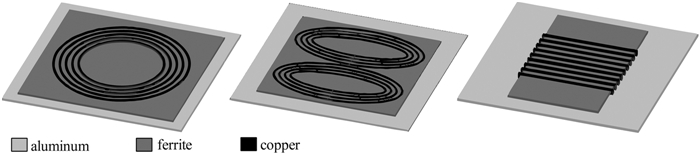
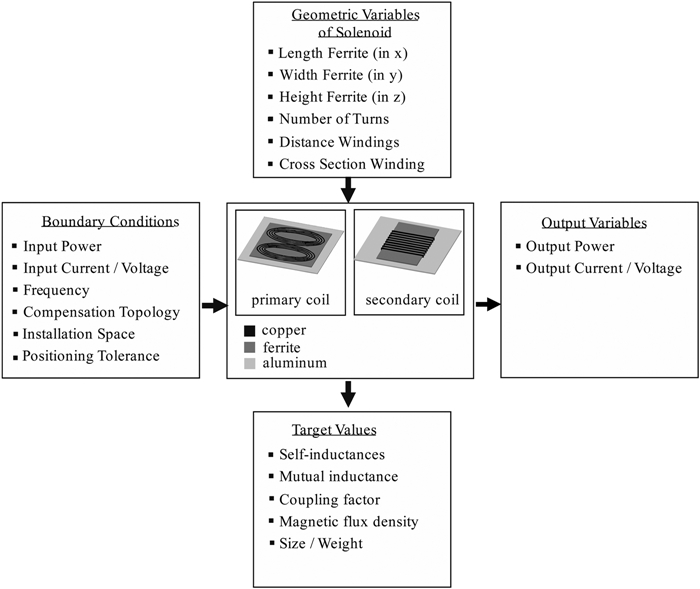
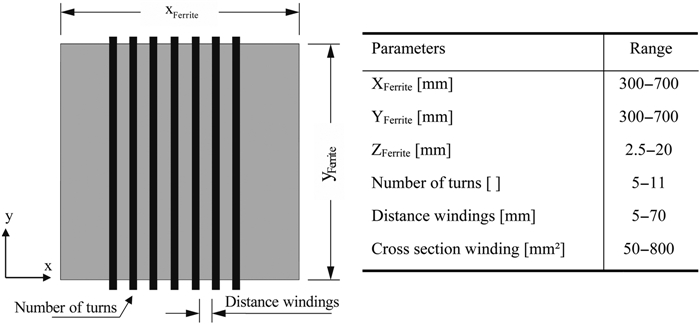
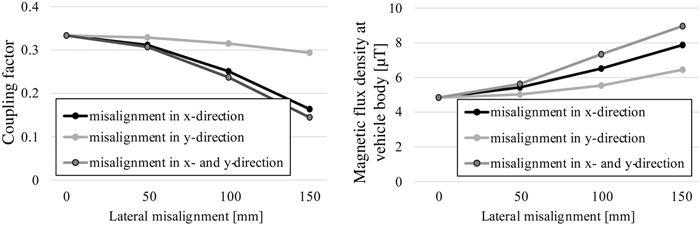
Abstract: In light of the increased interest in e-mobility, comfortable, and safe charging systems, such as inductive charging systems, are gaining importance. Several standardization bodies develop guidelines and specifications for inductive power transfer systems in order to ensure a good interoperability between different coil architectures from the various car manufacturers, wireless power transfer suppliers, and infrastructure companies. A combination of a bipolar magnetic coil design on the primary side with a secondary solenoidal coil promises a good magnetic coupling and a high-transmitted power with small dimensions at the same time. In order to get a profound knowledge of the influence and behavior of the main variables on the coil system, a detailed parameter study is conducted in this paper. Based on these findings, a solenoid was designed for a specific case of application. Further, this design is optimized. The dimensions of the system could be reduced by 50% with a constant coupling factor at the same time. Besides the reduction of the dimensions and subsequently the costs of the systems, the stray field could be reduced significantly.
-
Key words:
- Inductive power transfer /
- Electric vehicles /
- Coil design /
- Solenoid /
- Optimization