













-
Jasmine tea is a type of reprocessed tea made from tea and scented with jasmine (Jasminum Sambac) flowers, among which jasmine green tea (jasmine tea in short) is the most representative type in PR China. Owing to its attractive fragrance and various health benefits[1,2], jasmine tea has been widely popular at home and abroad[3]. In order to meet the increasing market demand, jasmine flower, the essential material, has a large-scale and increasing cultivation in PR China. In 2025, the plant area of jasmine flower in four major producing regions in PR China reached 156 km2, while its production and corresponding total agricultural output value reached 153.6 thousand tons and 7.10 billion[4].
However, the jasmine flower is vulnerable to a series of plant diseases[5,6] and insect pests[7], e.g., southern blight, Hendicasis duplifascialis. To guarantee the high yield and excellent quality, it is inevitable to apply pesticides in jasmine gardens. However, no pesticides have been registered in jasmine flowers in PR China yet[8]. Due to the lack of available pesticides and corresponding guidelines for application in jasmine, overuse and misuse of pesticides occur and raise the risk of residues[9−12]. Zhou et al.[11] detected a total of 19 pesticides in 22 real marketed jasmine samples, where the residue of 15 pesticides exceeded maximum residue limits (MRLs) established by the EU at the lower limit of analytical determination. Besides commercial samples[13], our research group discovered pesticide residues in fresh jasmine flowers from the field as well[14].
Meanwhile, it remains controversial whether pesticide residues in fresh jasmine flowers transfer to tea or not during scenting, the principal process influencing the aroma and taste of jasmine tea[15,16]. Several studies support that transfer occurs to different extents[10,17−18], varying with pesticides and scenting technique. Yuan[10] revealed that transfer of fenvalerate during scenting increased with residue in jasmine, rounds of scenting, amounts of jasmine used, and contact degree, but decreased with water content of base tea. Si et al.[17] further investigated the effects of water content of base tea, amount of jasmine flowers, scenting time, and final firing temperature on the transferring of methamidophos and fenvalerate in jasmine tea, and discovered their critical factor to be the first two parameters, respectively. However, Sun et al.[19] hold the opposite opinion that application of methamidophos, cypermethrin, deltamethrin, and fenvalerate in jasmine flowers did not raise the risk of pesticide residue in jasmine tea.
To solve the above puzzles, this article carried out research on residue behaviors, transfer rates, and risk assessment of five pesticides in jasmine tea from cultivation to consumption. According to the index of safety of pesticide application[20], the dietary risk of water-insoluble pesticides is much lower when taken in via tea infusion, because their leaching rates from tea into the infusion were lower than that of water-soluble pesticides[21]. Thus, water-insoluble pesticides, including chlorfenapyr, cypermethrin, fenpropathrin, hexaconazole, and λ-cyhalothrin, were selected for study (Fig. 1). Results of the present study provide guidance on the safe use of pesticides in jasmine tea. More importantly, this study takes a step further to understand the effect of the physicochemical properties of pesticides on dissipation in jasmine and transfer behavior during scenting.
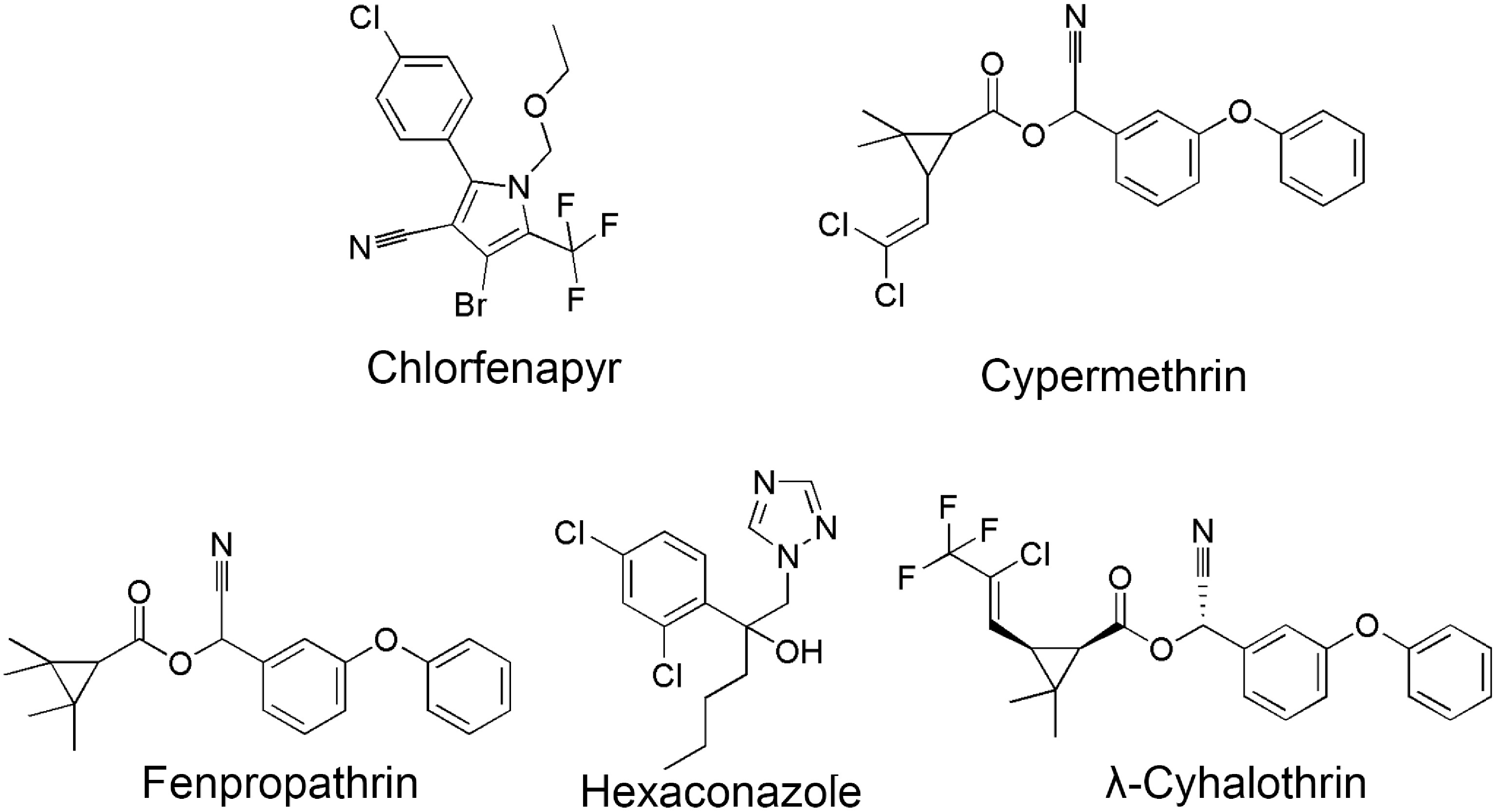
Figure 1.
Structures of five target water-insoluble pesticides: chlorfenapyr, cypermethrin, fenpropathrin, hexaconazole, and λ-cyhalothrin.
-
HPLC-grade solvents, MeCN and acetone, were supplied by Merck (Darmstadt, Germany). Analytical grade reagents, including sodium acetate (NaOAc), sodium chloride (NaCl), and magnesium sulfate (MgSO4), were provided by Shanghai No. 4 Reagent & H. V Chemical Co., Ltd (Shanghai, China). Water was obtained from Wahaha Group Co., Ltd (Hangzhou, China). The sorbents, octadecylsilane (C18, 50 µm) and primary secondary amine (PSA, 40–60 µm), were produced from Bonna Agela Technologies Co., Ltd (Tianjin, China). Pesticide standards were sourced from Alta Scientific Co., Ltd (Tianjin, China). A mixed stock standard solution at 100 mg/L was prepared using acetonitrile (MeCN). The pesticides used in the field trials were acquired from commercial sources.
Field trials, scenting processing, and sampling
-
Field trials were carried out in September 2022 at the planting base in Hengzhou City, Guangxi Province, PR China, according to the Guideline for the Testing of Pesticide Residue in Crops[22]. Each treatment was designed with triplicate plots and one blank control plot. Between those different plots, a buffer zone was set up. Three replicates were included in each plot area of 116 m2. Considering the growth rate of jasmine buds similar to tea, pesticides were applied once in jasmine gardens at the recommended application doses on tea (Supplementary Table S1). Approximately 500 g of fresh jasmine buds were collected for the dissipation experiments at intervals of 0 (2 h), 1, 2, 3, 5, 7, 11, and 14 d after spraying, respectively. Before being sprayed, a portion of fresh jasmine buds was collected, crushed, and stored as a blank sample in a refrigerator at −20 °C until analysis. About 3 kg of fresh jasmine buds were collected for the scenting processing trials at intervals of 1, 2, and 3 d (pre-harvest interval time, PHI) after spraying.
Jasmine scenting process was carried out as in the previous paper[16] with minor modification: jasmine buds were picked from 3 to 5 pm on the day of scenting. The flowers were then cared for until the open stage, at which point they were blended with the base tea for the scenting process. Blank green tea was used as the base tea in our experiment. To avoid overheating, it was crucial to rotate the tea consistently during the scenting process and maintain the temperature within the range of 35–45 °C. Upon the completion of the scenting process, the tea was separated from the flowers, followed by a final heating procedure. Jasmine tea samples were scented three times to obtain S1, S2, and S3 samples. The quantity ratio of jasmine flowers to the base tea used in the three scenting processes was 1.5, 1.2, and 1, respectively. Meanwhile, scenting time, scenting temperature, drying time, and drying temperature were consistent for three scenting processes and set at 12 h, 35 °C, 30 min, and 100 °C. Three biological replicates were set up for each sample, which were stored at −20 °C before analysis.
Sample extraction and purification
-
Target pesticides in jasmine flowers were extracted using a method described by Sun et al.[14]. To begin the extraction, ground jasmine flowers (2.0 g) were placed in a 50 mL centrifuge tube, followed by adding 10 mL MeCN/acetone (1/1, v/v). After vortexing for 1 min, the sample was allowed to stand for 30 min. Subsequently, 0.25 g NaOAc and 1.0 g MgSO4 were added, and the mixture was vortexed for another 1 min. Following centrifugation at 5,000 r/min for 5 min, a 7 mL aliquot of the upper layer was placed in a 10 mL d-SPE tube pre-filled with 175 mg C18, 175 mg PSA, and 1.05 g MgSO4. The tube was then sealed, vortexed for 1 min, and centrifuged for 5 min at 10,000 r/min. After purification, 5 mL of the supernatants was collected, evaporated to dryness, and redissolved in 1 mL MeCN. Finally, the extract was filtered through a 0.22 μm nylon filter prior to GC-MS/MS analysis.
Target pesticides in tea were extracted following the procedure described in the national standard of PR China[23] with slight modification. A 2.0 g portion of ground tea was placed into a 50 mL centrifuge tube and extracted with 10 mL MeCN/acetone (1/1, v/v). After vortexing for 1 min, the mixture was allowed to stand overnight. Following centrifugation at 5,000 r/min for 5 min, a 5 mL aliquot of the supernatant was transferred to a heart-shaped bottle and concentrated to approximately 1 mL by evaporation at 40 °C. The concentrated extract was then loaded onto a Cleanert TPT cartridge that had been pre-conditioned with 6 mL ACN/benzene (3:1, v/v). Then, target pesticides were subsequently eluted with 25 mL ACN/benzene (3:1, v/v). The collected eluate was evaporated to dryness at 40 °C and reconstituted in 1 mL ACN. Finally, the extract was filtered through a 0.22 μm nylon filter prior to GC-MS/MS analysis.
Tea infusion was prepared by brewing 3.0 g of the tea samples with 150 mL of boiling water for 5 min. Target pesticides in tea infusion were extracted following the procedure described by Wang et al.[21] with modification. A 20 mL aliquot of tea infusion was transferred to a 50 mL centrifuge tube, followed by the addition of 20 mL hexane. The mixture was vortexed for 1 min, after which 8 g NaCl was added, and the sample was shaken for another 1 min. Following centrifugation, the hexane layer was collected, and the extraction procedure was repeated once. The combined hexane fractions were evaporated to dryness, and the residue was reconstituted in 1 mL ACN for subsequent GC-MS/MS analysis. Extracts of samples with concentrations that exceeded the calibration standard range were appropriately diluted prior to GC-MS/MS analysis.
Instrumental parameters of GC-MS/MS
-
An Agilent 8890 gas chromatograph (Agilent, Stevens Creek, CA, USA) coupled to an Agilent 7000D GC/TQ mass spectrometer (Agilent, Stevens Creek, CA, USA) was utilized for analysis. The Agilent HP-5ms GC column (30 m × 0.25 mm × 0.25 µm) was employed for separation. The temperature of the transfer line and ion source was set at 280 °C. Helium (> 99.999%) and nitrogen (> 99.999%) were separately used as the carrier gas and collision gas. The constant flow rate of carrier gas was at 2.25 mL/min. The electron energy was 70 eV. The operation conditions of oven temperature were as follows: the initial temperature started from 40 °C and held for 1 min; increased to 120 °C at 40 °C/min, then reached 240 °C at 5 °C/min, finally the oven temperature was ramped to 300 °C at 12 °C/min and held for 6 min. The injection volume was 1.0 µL. The MRM conditions are shown in Supplementary Table S2.
Data processing and statistical analysis
-
The dissipation processes of five target pesticides in jasmine flowers follow first-order kinetics. The equation is shown as follows:
$ {C}_{t}={C}_{0}{e}^{-kt} $ where, Ct is the concentration of pesticide residue (mg/kg) at time t (day), C0 is the initial concentration of pesticide residue (mg/kg), and k is the degradation rate constant (day−1). Half-life (t1/2) was calculated from the k value: t1/2 = 1n2/k.
Transfer rate (TR) during scenting presents the level of pesticide transferring from jasmine flowers into base tea, as follows:
$ T R=\dfrac{\Delta M_t}{M_f}=\dfrac{\Delta R_t\times m_t}{R_f\times m_f} $ where, ΔMt and ΔRt separately refer to the increment of pesticide content (μg) and residue (mg/kg) in tea after scenting; Mf and Rf respectively indicate the pesticide content (μg) and residue (mg/kg) in jasmine flowers using for scenting; mt (kg) and mf (kg) individually refer to the weight of tea and jasmine flowers, the ratio (mt/mf) of which are 1/1.5, 1/1.2 and 1/1 during first, second and third scenting processes, respectively.
Dietary exposure risk assessment was studied based on the risk quotient (RQ) method, which is calculated by dividing an exposure value by a toxicity endpoint value. An RQ value less than 1 indicates that the risk of the pesticide to humans is acceptable, while a value higher than 1 represents an unacceptable risk. The chronic dietary risk assessment and acute dietary risk assessment were conducted by calculating chronic dietary exposure risk probability (RQc) and acute dietary exposure risk probability (RQa) as follows:
$ {RQ}_{C}=\dfrac{IEDI(mg/kg\;bw\;per\;day)}{ADI(mg/kg\;bw\;per\;day)}=\dfrac{FI\times STMR\times LR}{bw\times ADI} ; $ $ {RQ}_{a}=\frac{IES TI(mg/kg\;bw\;per\;day)}{ARfD(mg/kg\;bw\;per\;day)}=\dfrac{FI\times HR\times LR}{bw\times ARfD} $ where, ADI represents the acceptable daily intake and ARfD is the acute reference dose, obtained from Pesticide Properties DataBase; IEDI is the international estimated daily intake and IESTI is the international estimated short-time intake; STMR (mg/kg) and HR (mg/kg) are supervised median residue and the highest residue level in commercial jasmine tea samples respectively, where data below LOQ was treated as 1/2 LOQ according to WHO guidelines[24]; FI (g/person/day) is the daily food intake of tea, while bw is the average bodyweight in different region or groups of people (kg/person), both of which were obtained from Global Environment Monitoring System (GEMS)/Food Cluster Diets[25]; LR refers to the leaching rates of pesticides from jasmine tea to tea infusion during brewing (%).
-
The detection method was evaluated for its linearity, accuracy, precision, matrix effect, and limits of quantification (LOQs). The results of method validation, including the recovery, RSD, LOQ, and correlation coefficients, are given in Table 1.
Table 1. The fortified level, average recovery, RSD, correlation coefficient of linear equation, and LOQ of chlorfenapyr, cypermethrin, fenpropathrin, hexaconazole, and λ-cyhalothrin in jasmine flowers, tea, and tea infusion (n = 5).
Matrix Pesticides Fortified at 0.01 mg/kg (0.005 mg/L) Fortified at 0.1 mg/kg (0.01 mg/L) Fortified at 1 mg/kg (0.05 mg/L) R2 LOQ
(mg/kg or mg/L)Recovery (%) RSD (%) Recovery (%) RSD (%) Recovery (%) RSD (%) Jasmine Chlorfenapyr 93 3 80 1 88 6 0.9996 0.01 Flowers Cypermethrin 109 16 76 16 99 5 0.9983 0.01 Fenpropathrin 110 3 78 7 97 5 0.9999 0.01 Hexaconazole 85 6 92 3 104 3 0.9990 0.01 λ-cyhalothrin 111 9 77 7 98 5 0.9986 0.01 Tea Chlorfenapyr 87 16 83 10 93 5 0.9982 0.01 Cypermethrin 81 16 90 19 98 8 0.9918 0.01 Fenpropathrin 96 10 94 10 107 12 0.9947 0.01 Hexaconazole 97 14 75 3 95 13 0.9982 0.01 λ-cyhalothrin 88 19 113 6 102 10 0.9919 0.01 Tea Chlorfenapyr 100 4 87 10 99 4 0.9995 0.005 Infusion Cypermethrin 95 6 95 9 89 3 0.9908 0.005 Fenpropathrin 97 5 115 15 93 5 0.9988 0.005 Hexaconazole 101 2 90 4 103 2 0.9987 0.005 λ-cyhalothrin 90 6 94 18 85 4 0.9900 0.005 The linearity of the analytical method was evaluated in the range of 0.01–1 mg/L for five pesticides. The calibration curves were constructed by plotting the analyte area against analyte concentration. A regression model was then applied to the calibration data set. The linearity study showed that the correlation coefficients of the calibration curves obtained for the analytes were > 0.99 for jasmine buds, tea, and tea infusion.
To assess the accuracy and precision of the analytical method, the five target pesticides free samples were used as a blank matrix for the spiking experiments. The accuracy was determined as recovery at three different fortified levels. The precision was determined by repeated intra-day analyses and expressed as the relative standard deviation (RSD). As mentioned before, matrix enhancement effects occurred more frequently in quantification using the GC system; thus, matrix standard solutions were used in external standard quantification to eliminate ME in this study.
Results demonstrated that the recoveries of five pesticides in jasmine flower, tea, and tea infusion were in the range of 76%–111%, 75%–113%, and 85%–115%, respectively. Meanwhile, their corresponding RSDs were in the range of 1%–16%, 3%–19%, and 2%–18%, respectively. The LOQ was the minimum fortified concentration level of the analytes that could give a response quantified with satisfactory RSDs. The LOQs of these analytes in jasmine flower, tea, and tea infusion were 0.01 mg/kg, 0.01 mg/kg, and 0.005 mg/L. These results indicated that this analytical method was suitable for the determination of the five pesticide residues in these matrices.
Dissipation dynamics of pesticides and metabolites in jasmine flowers
-
The dissipation dynamics and half-lives of five targeted pesticides in jasmine buds are illustrated in Fig. 2. A gradual and continuous deterioration of these pesticide residues in the bud samples was observed. The residual dynamics of these pesticides in the bud were consistent with the first-order kinetic equation with R2 > 0.9856. The initial residues of chlorfenapyr, cypermethrin, fenpropathrin, hexaconazole, and λ-cyhalothrin were 2.31, 1.01, 1.72, 1.68, and 0.14 mg/kg, respectively. The dissipation rates follow the order: hexaconazole > chlorfenapyr > fenpropathrin > cypermethrin > λ-cyhalothrin, whose half-lives were calculated to be 1.7, 2.0, 2.4, 2.5, 4.0 d, respectively. The half-lives were in the range of 1.7–4.0 d, indicating that these pesticides dissipated rapidly in the bud. Meanwhile, the half-life of cypermethrin (2.5 d) in jasmine flower was consistent with a previous field study (half-life 2.3 d)[26] carried out in the same city.
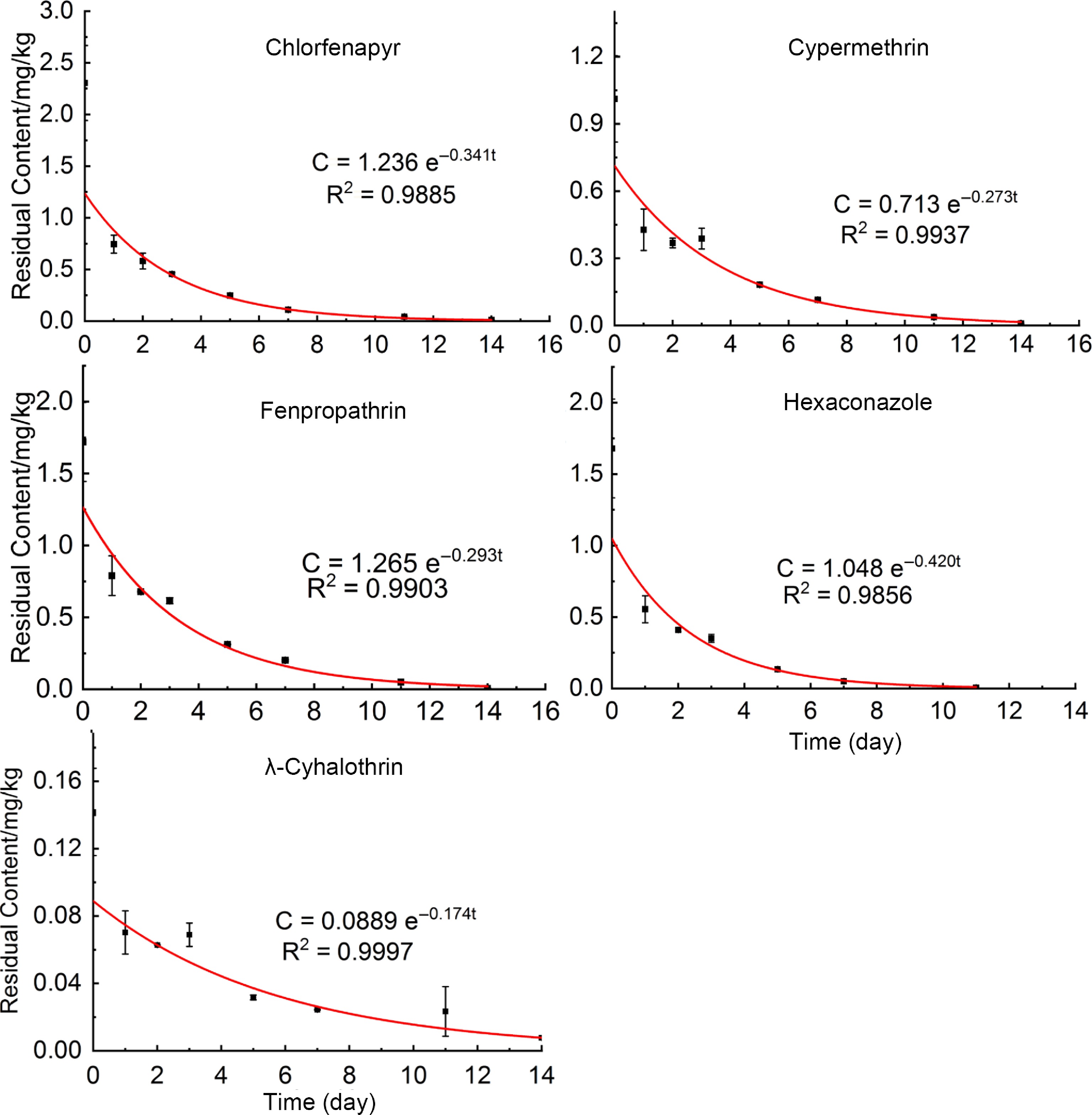
Figure 2.
The field dissipation curves of chlorfenapyr, cypermethrin, fenpropathrin, hexaconazole, and λ-cyhalothrin on the jasmine buds.
As is known, the dissipation rates of pesticides depend on the environment of experimental fields (light, temperature, humidity, etc), plants (especially their growth dilution factor), and physico-chemical properties of pesticides applied[27−29]. Half-life of cypermethrin in jasmine flower was 4 d when the field trial was carried out at Ningde City, Fujian Province[19], and 2.3–2.5 d at Nanning City, Guizhou Province. Such a difference should be attributed to the different climates of experimental fields[30]. The higher the temperature, humidity, and precipitation are, the shorter t1/2 is. Besides, the t1/2 varies with the type of plants as well. For example, t1/2 of cypermethrin follows the order: pakchoi (2.14 d) = lettuce (2.15 d) < carrot root (2.47 d) < pepper (3.52 d) when planted at the same experimental site[31]. The reason mainly lies in various growth dilutions. Generally, leafy vegetables grow faster than root vegetables and others, which leads to higher loss of pesticide residues. That is why pesticides usually dissipate faster in tea than in others types[30,32], except jasmine flowers. Close dissipation half-lives of pesticides were observed in tea and jasmine flowers[26,33], illustrating their similar growth rates. In the present study, physicochemical properties of pesticides play a major part in different dissipation rates; all dissipation dynamics of five target pesticides were studied in jasmine at the same field.
Transfer of pesticides from jasmine buds to tea during scenting
-
According to our results in Table 2, pesticide residues in jasmine flowers can transfer into tea during the scenting process, which contaminates tea and threatenes the safety of tea drinkers. In accordance with previous studies[10,17−18], pesticide residues increased in tea with scenting rounds, while decreased in jasmine flowers used for scenting: from the first to third scenting, chlorfenapyr in tea increased from ND to 0.064, 0.12 and 0.17 mg/kg; cypermethrin increased from ND to 0.021, 0.034 and 0.062 mg/kg; fenpropathrin increased from ND to 0.079, 0.12 and 0.20 mg/kg; hexaconazole increased from ND to 0.057, 0.085 and 0.11 mg/kg; λ-cyhalothrin increased from ND to 0.011, 0.020 and 0.025 mg/kg. TRs of chlorfenapyr, cypermethrin, fenpropathrin, hexaconazole, and λ-cyhalothrin varied in the range of 5.7%–10.6%, 2.9%–7.2% 5.0%–12.9%, 5.7%–7.1%, and 7.2%–11.9%, respectively. TRs during each scenting did not show much trend in Table 2. Meanwhile, the total TRs of five target pesticides after three rounds of scenting were close to each other (7.4%, 4.2%, 7.6%, 6.6%, and 10%, respectively). Their TRs were close to that of difenoconazole (5.4%) after the same scenting[33], while far lower than that of S421 after two rounds of scenting (172.9%) with a lower amount of jasmine buds[18].
Table 2. TRs of chlorfenapyr, cypermethrin, fenpropathrin, hexaconazole, and λ-cyhalothrin from jasmine buds to tea during three scentings.
Pesticide Round of
scentingResidue (mg/kg) Weight ratio
of tea to
jasmine budsTR (%) Jasmine buds Tea Chlorfenapyr 1st 0.75 0.064 1.5 5.7 2nd 0.59 0.12 1.2 7.9 3rd 0.47 0.17 1 10.6 Total 7.4 Cypermethrin 1st 0.43 0.021 1.5 3.3 2nd 0.37 0.034 1.2 2.9 3rd 0.39 0.062 1 7.2 Total 4.2 Fenpropathrin 1st 0.79 0.079 1.5 6.7 2nd 0.68 0.12 1.2 5.0 3rd 0.62 0.20 1 12.9 Total 7.6 Hexaconazole 1st 0.55 0.057 1.5 6.9 2nd 0.41 0.085 1.2 5.7 3rd 0.35 0.11 1 7.1 Total 6.6 λ-cyhalothrin 1st 0.070 0.011 1.5 10.5 2nd 0.063 0.020 1.2 11.9 3rd 0.069 0.025 1 7.2 Total 10.0 Correlation analysis of behavior and physicochemical properties of pesticides
-
To further understand the effect of pesticides' physicochemical properties on their behavior in field dissipation and transfer during scenting, the correlation analysis was conducted between logarithms of dissipation half-lives, TR during scenting and molecular weight (Mw), vapor pressure (Vp), Henry's law constant (H), water solubility (Ws), partition coefficient (Kow), organic adsorption coefficient (Koc) and melting point (Mp) (Supplementary Table S3). The corresponding correlation matrix heatmap was displayed in Fig. 3a.
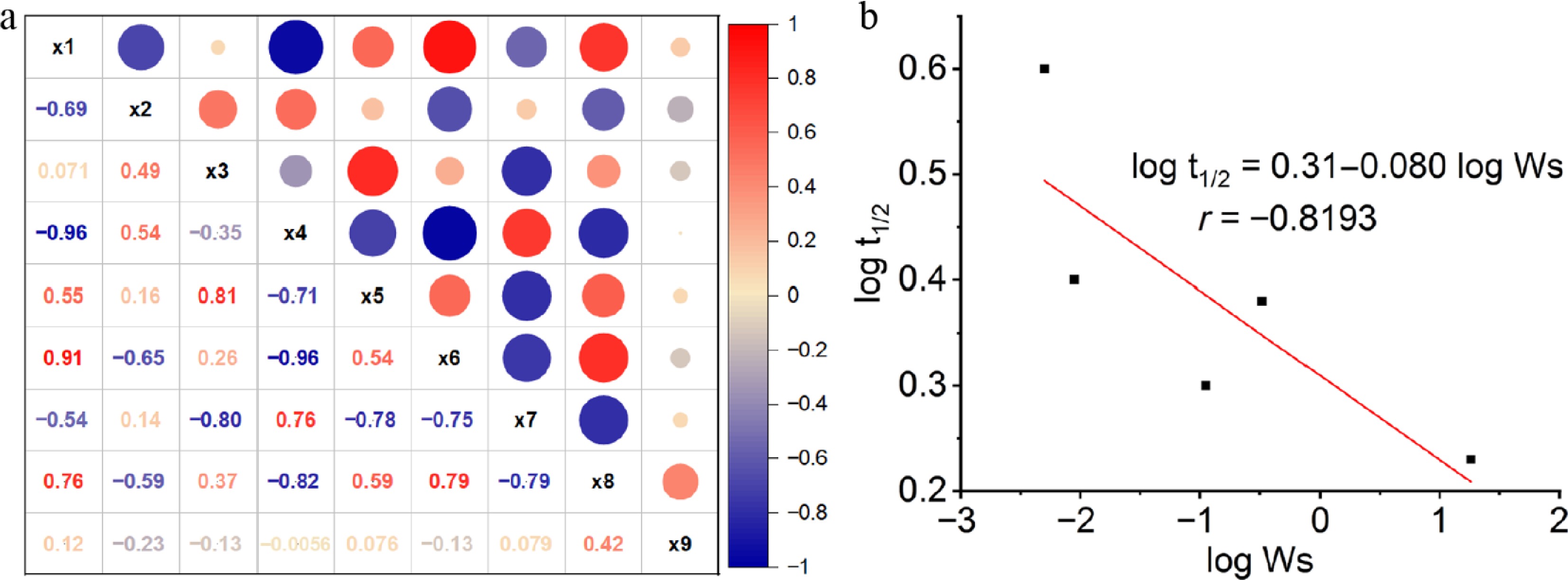
Figure 3.
Relationships between field dissipation, transfer during scenting, and physico-chemical parameters of chlorfenapyr, cypermethrin, fenpropathrin, hexaconazole, and λ-cyhalothrin: (a) Correlation matrix heatmap, where x1–9 refer to log Mw, log Vp, log H, log Ws, log Kow, log Koc, log Mp, log t1/2, and log TR, respectively. (b) Linear regression between log t1/2 and log Ws.
Dissipation half-lives were closely related to Mw, Ws, Koc, and Mp, and moderately related to Vp and Kow, whose correlation coefficients between their logarithms were 0.76, −0.82, 0.79, 0.79, −0.59, and 0.59, respectively. Meanwhile, strong correlations were observed between Ws and the other physicochemical parameters except Vp and H, whose absolute values of correlation coefficients between their logarithms were higher than 0.7. Considering the above situation, Ws is an important physicochemical parameter affecting dissipation half-lives of water-insoluble pesticides in jasmine buds. The detailed linear regression between log t1/2 and log Ws fit with the following equation: log t1/2 = 0.31 − 0.80 log Ws, with Pearson's correlation coefficient of −0.8193 (Fig. 3b). The same finding has been observed in cowpea[34] as well. As is known, pesticides in plant are dissipated mainly with photolysis, evaporation, and wash-off with water (including rainfall and non-rainfall water, e.g., fog, dew, and water vapor sorption). Thus, the higher the water solubility, the faster the pesticide dissipates, and the shorter the half-lives in field conditions. As for plants grown in a greenhouse, Kow was a more efficient indicator of the half-life order of pesticides than Ws or Vp[35].
Different from dissipation half-lives, TRs of pesticides during scenting present no correlation to the studied physicochemical parameters, appearing as nearly white circles in the matrix. This suggested that TRs during scenting were largely unaffected by water-insoluble pesticides themselves, but rather determined by the scenting processing technology, e.g., moisture content of tea base, weight ratio of tea to jasmine buds[10].
Residue levels of pesticides in jasmine tea
-
When jasmine tea was prepared after three rounds of scenting, final residues of chlorfenapyr, cypermethrin, fenpropathrin, hexaconazole, and λ-cyhalothrin in jasmine tea were 0.17, 0.062, 0.20, 0.11, and 0.025 mg/kg, respectively. As shown in Supplementary Table S4, residues of the former three pesticides were seven times lower than MRLs prescribed by different countries/organizations, except hexaconazole and λ-cyhalothrin. Their residues in jasmine tea from the first scenting exceeded MRLs prescribed by the EU and USA, which were set at the value of the lower limit of analytical determination (0.05 and 0.01 mg/kg, respectively).
Moreover, residues of five target pesticides were monitored in real jasmine tea as well. A total of 24 samples were collected from Chinese online shopping platforms in 2023. None of them was tested with hexaconazole residue, while 91.7% contained two to four kinds of pesticides. Figure 4 illustrates the distribution of pesticide residue in real samples. The violin plots of chlorfenapyr and cypermethrin residue demonstrate left-skewed distributions, with their median values closer to the higher end. Meanwhile, the distributions of fenpropathrin and λ-cyhalothrin are relatively symmetric, and their density curves present two peaks. The interquartile ranges (IQR) follow the order: fenpropathrin < cypermethrin < λ-cyhalothrin < chlorfenapyr, indicating the lowest variability for fenpropathrin residue and the highest for chlorfenapyr. The median values in Fig. 4 reveal that chlorfenapyr residue in jasmine tea was generally higher than the others.
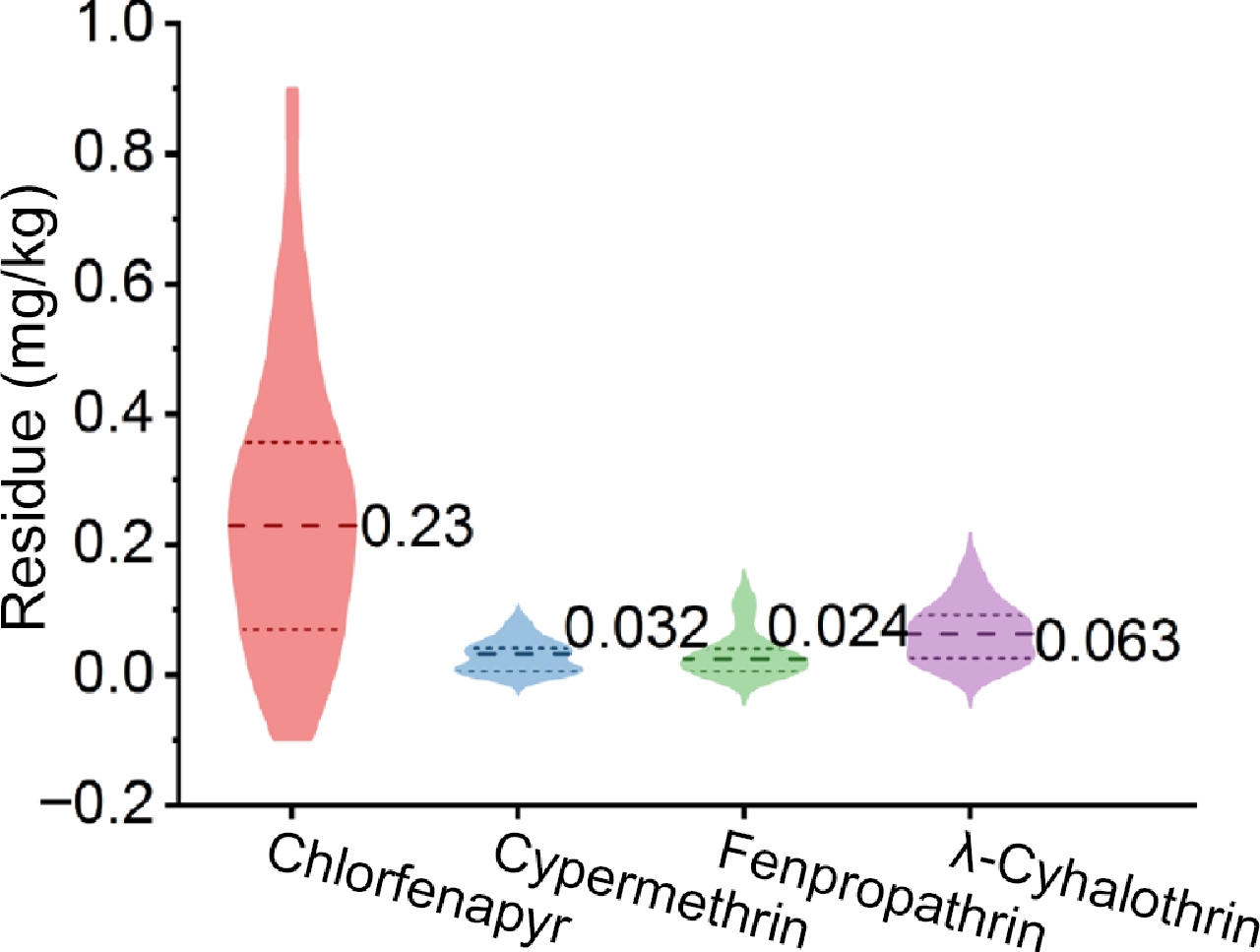
Figure 4.
The violin plot of chlorfenapyr, cypermethrin, fenpropathrin, and λ-cyhalothrin residues in 24 real jasmine tea, with the median value plotted. Hexaconazole was not detected out.
Detected frequencies of chlorfenapyr, cypermethrin, fenpropathrin, hexaconazole, and λ-cyhalothrin were 88%, 63%, 67%, 0%, and 96%, respectively. All of them complied with MRL standards in Supplementary Table S4, except λ-cyhalothrin. 96% of this batch of samples exceeded the MRL of λ-cyhalothrin in the EU or USA. Thus, application of pesticides with low MRLs, especially established at the lower limit of analytical determination (e.g., λ-cyhalothrin), should be minimized in export jasmine tea.
Dietary risk assessment of pesticides based on tea brewing
-
Though the leaching behavior of pesticides in three-rounds-scented jasmine tea has been investigated during brewing, leaching rates could not be calculated because their residues in tea infusion were lower than LOQ. Thus, LRs of five target pesticides in tea were used instead, which were previously studied by our research group[21,36] (Supplementary Table S5). In combination with the residue levels of pesticide in real jasmine tea samples above, chronic and acute risk assessments were carried out using IEDI and IESTI calculation models provided by Global Environment Monitoring System (GEMS)/ Food Contamination Monitoring and Assessment Programme[24]. The RQc and RQa of target pesticides in tea were plotted in Fig. 5. Overall, the RQc and RQa values in tea were in the range of 2.7 × 10⁻⁷−1.0 × 10⁻⁴ and 7.2 × 10⁻⁵−3.1 × 10⁻⁵, respectively. All of them were significantly lower than one, indicating that long-term and short-term dietary intakes of target pesticides via tea-drinking are acceptable.
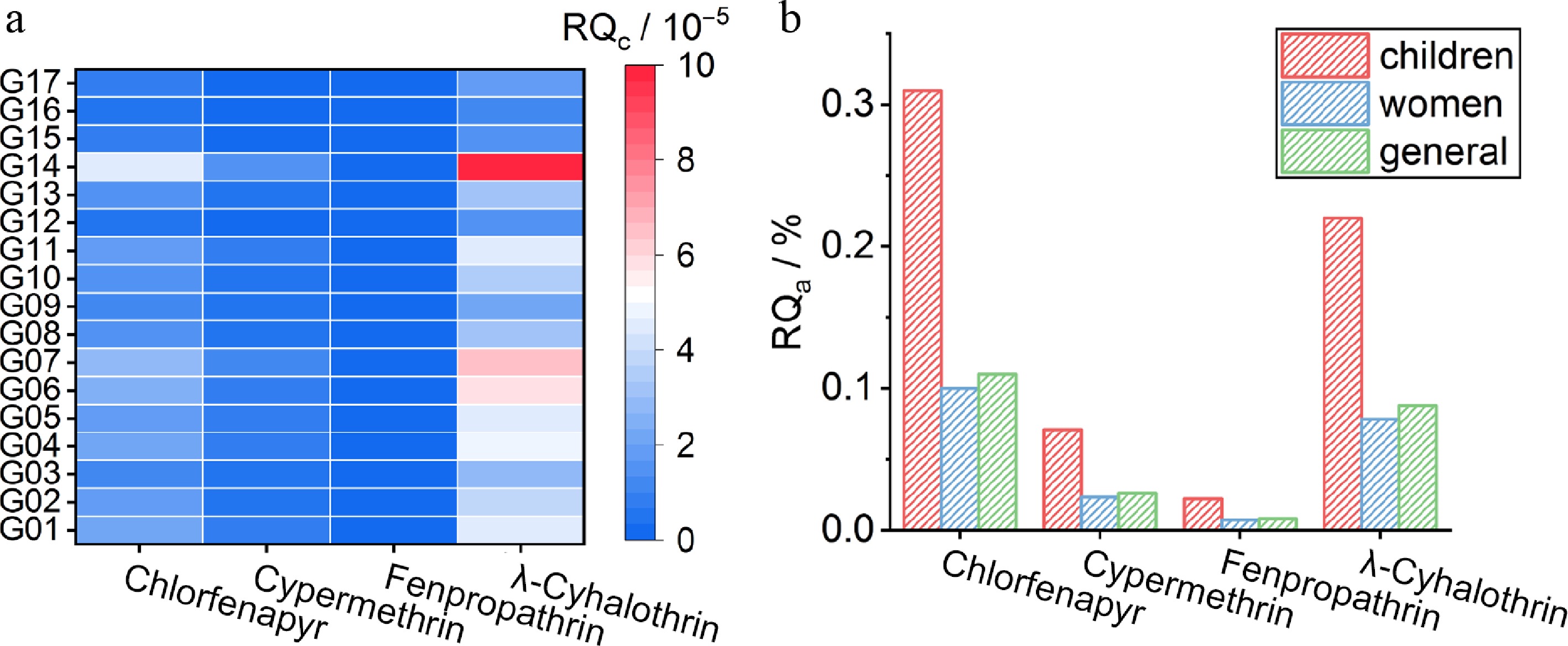
Figure 5.
Risk assessment of chlorfenapyr, cypermethrin, fenpropathrin, and λ-cyhalothrin in jasmine tea between 17 clusters of countries in GEMS: (a) G01–G17, and (b) three groups of people: children, women, and general.
When compared among countries (Fig. 5a), PR China (G09) suffered relatively lower chronic dietary intake risk, whose RQc varied between 2.7 × 10⁻⁷ and 3.9 × 10⁻⁵, while cluster G14 suffered higher chronic dietary intake risk because of their higher food intake. When compared among people (Fig. 5b), women of childbearing age (13–50 years) or the general population (> 1 year) faced a similar acute dietary risk, while children (eight months–16 years) faced a greater one owing to their lighter bodyweight. In terms of pesticides, λ-cyhalothrin and chlorfenapyr possessed relatively higher chronic and acute dietary risk, respectively. λ-cyhalothrin showed higher RQc owing to its lower ADI (Supplementary Table S5), while chlorfenapyr presents higher RQa for its larger HR value (Fig. 3).
-
This study investigated residue dissipation in a jasmine garden, transfer behavior during scenting, and distribution of five water-insoluble pesticides in jasmine tea. The dynamics of pesticides in jasmine buds fitted well with the first-order kinetic equation. They dissipated rapidly in jasmine buds with half-lives in the range of 1.7–4.0 d. Ws was found to be an important physicochemical parameter affecting the dissipation of target pesticides in jasmine buds. Pesticide residues increased in tea with scenting rounds, thus pesticides with low MRL (i.e., hexaconazole and λ-cyhalothrin in the present study) should be avoided in jasmine buds. Their TRs during scenting were in the range of 4.2%–10%, independent of physicochemical properties. At last, their dietary risk was evaluated in commercial jasmine tea. All chronic and acute dietary intakes were acceptable, even though the detailed risks varied with regions, people, and pesticides.
This study enriches our knowledge not only of the field and processing behavior of water-insoluble pesticides in jasmine tea, but also of their intrinsic influencing factors as well. Moreover, investigation into the final residue and dietary risk contributes to the rational and safe use of pesticides in jasmine tea. At last, can the correlation between transfer behavior during scenting and physicochemical properties of pesticides be more apparent when water-soluble pesticides are involved? Such a topic is worth in-depth study in the future.
-
The authors confirm their contributions to the paper as follows: study conception and design: Sun H; methodology: Liao X, Zhang X, Wang X; investigation: Liao X; software: Zhang X, Yang M, Luo F; data curation: Lan T; formal analysis: Lan T; validation: Lan T; resources: Liao X, Luo F; visualization: Sun H, Lan T; draft manuscript preparation: Sun H; writing–review and editing: Yang M, Wang X, Chen Z, Zhou L; supervision: Chen Z, Zhou L; project administration: Sun H; funding acquisition: Sun H, Zhou L. All authors reviewed the results and approved the final version of the manuscript.
-
The datasets generated during and/or analyzed in the current study are available from the corresponding author upon reasonable request.
-
The authors declare that they have no conflict of interest.
-
accompanies this paper online at: https://doi.org/10.48130/bpr-0026-0011.
- Supplementary Table S1 Product and dosage of pesticides sprayed in jasmine gardens.
- Supplementary Table S2 The optimum MRM parameters for 6 targeted pesticides.
- Supplementary Table S3 Physico-chemical parameters, dissipation half-lives in jasmine bud and transfer rate during scenting of 5 target pesticides.
- Supplementary Table S4 Final residues of 5 target pesticides in jasmine tea and corresponding MRLs prescribed by different countries/organizations (mg/kg).
- Supplementary Table S5 Detailed parameters of 5 target pesticides used in risk quotient method.
- Copyright: © 2026 by the author(s). Published by Maximum Academic Press, Fayetteville, GA. This article is an open access article distributed under Creative Commons Attribution License (CC BY 4.0), visit https://creativecommons.org/licenses/by/4.0/.
-
About this article
Cite this article
Sun H, Lan T, Liao X, Zhang X, Yang M, et al. 2026. Dissipation, transfer, and risk assessment of five water-insoluble pesticides in jasmine tea from jasmine garden to tea cup. Beverage Plant Research 6: e031 doi: 10.48130/bpr-0026-0011 

Dissipation, transfer, and risk assessment of five water-insoluble pesticides in jasmine tea from jasmine garden to tea cup
- Received: 30 January 2026
- Revised: 06 March 2026
- Accepted: 23 March 2026
- Published online: 26 August 2026
Abstract: With the increasing popularity of jasmine tea, the selection and safe use of pesticides in the jasmine garden becomes increasingly important, especially since no pesticides have been registered for jasmine flowers yet. In this study, the inherent regularity of residue behaviors and transfer rates of five water-insoluble pesticides during jasmine planting, scenting, and brewing was researched. Chlorfenapyr, cypermethrin, fenpropathrin, hexaconazole, and λ-cyhalothrin dissipated rapidly in jasmine buds with half-lives of 1.5–4.0 d. The dissipation of pesticides was strongly and inversely correlated with their own water-solubility. Meanwhile, the transfer rate of residues from jasmine to tea during scenting was in the range of 4.2%–10%, presenting no obvious correlation to physicochemical properties. The final residues of chlorfenapyr, cypermethrin, fenpropathrin, hexaconazole, and λ-cyhalothrin in jasmine tea after three rounds of scenting were 0.17, 0.062, 0.20, 0.11, and 0.025 mg/kg, respectively. Pesticides applied in the jasmine garden can transfer to jasmine tea during scenting, the extent of which increases with the rounds of scenting. There is a risk that hexaconazole and λ-cyhalothrin residues exceed MRLs, especially when they were set at the lower limit of analytical determination. Nevertheless, the chronic and acute dietary risk of five target pesticides via drinking jasmine tea was acceptable.
-
Key words:
- Jasmine tea /
- Pesticides /
- Scenting /
- Transfer /
- Risk assessment