










-
Oral anticancer therapy (OAT) has become a central component of modern cancer care. In recent years, its use has steadily increased[1]. As oral treatments are predominantly administered in outpatient settings and at patients' homes, this development is accompanied by a shift of relevant aspects of treatment management away from supervised inpatient care. Consequently, substantial demands are placed on patients' self-management and adherence[2], as well as on healthcare teams responsible for monitoring toxicity, managing side effects, and ensuring treatment safety over extended treatment periods[3,4].
This trend is especially evident in gynaecologic oncology, where long-term oral therapies such as PARP inhibitors are routinely used across a range of settings from adjuvant therapy to advanced disease. These therapies are associated with common side effects, including fatigue, gastrointestinal symptoms, and haematological toxicities, which require structured monitoring and timely intervention[4,5]. Further details of commonly used oral anticancer therapies are provided in Supplementary Table S1.
The clinical integration of OAT presents significant and widespread challenges across oncology care settings. Increasing time constraints, workforce shortages, and limited reimbursement structures restrict physicians' capacity to provide continual, individualized support for patients receiving OAT[6]. In response to these challenges, patient-centred support and coaching concepts have been proposed to complement physician-led care in oncology[7]. Consequently, oncology nurses are increasingly involved in patient education, symptom monitoring, and coordination of care. While nurse-led consultations and delegated care models have been shown to improve patient satisfaction and adherence[6,8], evidence on structured educational interventions specifically designed to prepare oncology nurses for OAT-related consultations remains limited and is largely restricted to small-scale or feasibility-oriented training initiatives[9].
Within the CAMPA project (Care Improvement for Advanced or Metastatic Breast and Ovarian Cancer Patients Treated with PARP Inhibitors), a standardized nursing consultation model for patients receiving oral anticancer therapy was previously developed and implemented across hospital-based and outpatient oncology settings. This model integrates structured consultations, standardized support materials, and digital documentation tools and has been described in a previous publication[6].
Building on this experience, the present study aimed to introduce and evaluate a targeted nursing education program designed to prepare oncology nurses for structured OAT-related consultations, using PARP inhibitors as a clinical example. The program was developed and implemented in cooperation with the Conference of Oncology Nursing (KOK). Two educational formats—a webinar and an in-person workshop—were implemented and assessed using a prospective pre–post design. The primary outcomes were changes in self-reported knowledge, confidence, and the perceived usefulness of structured support materials in clinical practice.
-
This study was designed as a prospective, single-arm, pre–post educational evaluation. It aimed to assess the effectiveness of two nursing education formats (webinar and in-person workshop) developed to prepare oncology nurses for structured consultations related to oral anticancer therapy.
As this study aimed to evaluate a newly developed educational program under real-world conditions, no formal a priori sample size calculation was performed. The sample size was determined by voluntary participation in the webinar and workshop formats during the study period and is therefore exploratory in nature.
Nursing consultation model
-
The educational program evaluated in this study was based on a standardized nursing consultation model for patients receiving oral anticancer therapy, developed within the CAMPA project. The consultation model comprises structured baseline and follow-up contacts supported by standardized checklists, patient education materials, and digital documentation tools. A detailed description of the consultation workflow and its clinical evaluation has been published previously[6] and is therefore only summarized here.
Within the CAMPA consultation model, oncology nurses assumed defined responsibilities traditionally performed by physicians. These included conducting structured consultations using standardized tools, documenting and monitoring therapy-related adverse events, and coordinating communication between patients, physicians, and other healthcare providers. The redistribution of tasks was an integral component of the consultation model and is illustrated in Fig. 1.
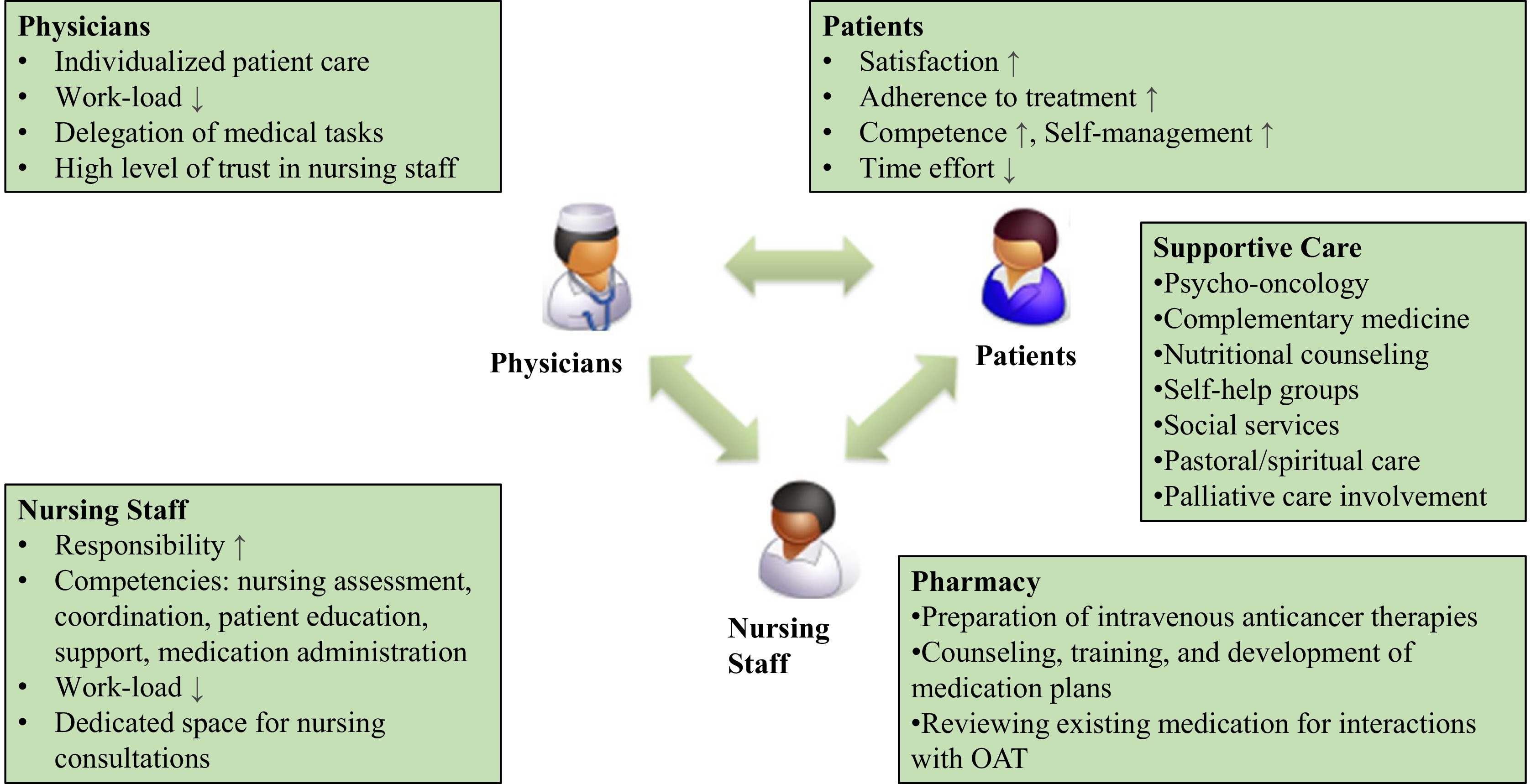
Figure 1.
New task allocation in oral anticancer therapy (OAT).
Educational and support materials
-
To support the standardized care model, CAMPA developed targeted checklists and educational materials for both patients and staff. These materials were designed to structure baseline and follow-up consultations, support systematic documentation of therapy-related issues, and facilitate interdisciplinary communication and task delegation between physicians and nurses. An overview of the materials is provided in Supplementary Table S2.
Development and evaluation of the training programs
-
Based on the experiences and data collected during the implementation of the nursing consultation model[6], specialized training programs for oncology nurses were developed. These programs were designed to prepare nursing staff for the specific requirements of caring for patients undergoing oral anticancer therapy (OAT), particularly those treated with PARP inhibitors. In addition, the training sessions aimed to gather important information on existing knowledge, identify areas for improvement, and explore the preferences of the participating nurses.
The training was offered in two formats: an online webinar and an in-person workshop. The webinar was available from June 13, 2023, to March 13, 2024. The in-person workshop took place during the annual KOK meeting in Berlin on September 9, 2023, and was designed as an interactive session at the conference. The main target group consisted of nurses already working in or planning to establish nursing consultations for OAT. However, participation was also open to all interested oncology nurses.
Both the webinar and the workshop followed the same curriculum covering principles of oral anticancer therapy, pharmacology and side-effect management of PARP inhibitors, strategies to support adherence, and the use of a digital health application (CANKADO) within the CAMPA project[10].
Before and after participation in the training, an anonymous survey was conducted. The participant survey used self-designed questionnaires approved by the ethics committee of LMU Munich. The questionnaires were developed by an interdisciplinary team with clinical and nursing expertise and reviewed for clarity and content relevance prior to use. Pre- and post-evaluation questionnaires were assigned using an anonymized personal code. The survey for workshop participants was administered on paper, while webinar participants completed the questionnaire online using the LamaPoll survey tool[11].
The questionnaires covered demographic and professional characteristics, work experience, and clinical setting. Additionally, participants were asked to self-assess their knowledge regarding oral anticancer therapy and PARP inhibitors before and after the training, as well as their familiarity with consultation workflows and patient interactions.
Self-assessment of knowledge regarding OAT and PARP inhibitors was captured using a visual analogue scale from 0% to 100%. Questions on workflows and patient management were answered using a six-point Likert scale (always, often, sometimes, rather rarely, rarely, never). For clarity, responses were later grouped into positive (always, often), neutral (sometimes, rather rarely), and negative (rarely, never) categories. Open-ended questions allowed participants to share suggestions for improving consultations and patient care.
To improve response rates among webinar participants, two reminder emails were sent via the distribution lists, requesting completion of the post-training questionnaire.
Details on dissemination activities are provided in Supplementary Table S3.
Statistical analysis
-
Pre–post comparisons within each training format (webinar and workshop) were performed using paired t-tests. Effect sizes were calculated using Cohen's d for paired samples. To assess the assumptions for parametric testing, normality of the pre–post differences was evaluated using the Shapiro–Wilk test. To compare the effectiveness of the two training formats while accounting for baseline differences, an analysis of covariance (ANCOVA) was performed with post-intervention confidence as the dependent variable, training format (webinar vs workshop) as the fixed factor, and baseline confidence as a covariate.
All analyses were conducted using Python (v3.13, Anaconda distribution) with the libraries NumPy, SciPy, and statsmodels. p-values < 0.05 were considered statistically significant.
-
A total of 95 healthcare professionals participated in the CAMPA webinar. Of these, 88.4% (84/95) completed the pre-training questionnaire, and 29.5% (28/95) completed the post-training evaluation, corresponding to typical response rates for online evaluations[12].
The in-person workshop held at the KOK annual meeting (September 2023) was attended by 22 individuals, including 20 nurses. All participants completed the pre- and post-training questionnaires. An overview of demographic and participant structure is provided in Supplementary Table S4.
As not all participants answered all questionnaire items, the number of respondents may vary slightly between individual analyses.
Knowledge status and gains
-
At the beginning of the training sessions, participants were asked to self-assess their knowledge and confidence in handling oral tumor therapy (OTT) and PARP inhibitors. PARP inhibitors were analysed separately from oral anticancer therapy (OAT) in general, as they served as the primary clinical example for the nursing consultation model and the educational intervention evaluated in this study. In addition, their increasing use in gynaecologic oncology, particularly in long-term and maintenance settings[13], supports a differentiated analysis of knowledge levels and training effects.
Despite high specialization among participants, there was considerable potential for improvement. Webinar participants rated their knowledge of PARP inhibitors at 27.8% (on a 0%–100% scale), and workshop participants at 21.1%. For OTT, the values were 41.8% (webinar) and 33.2% (workshop).
Figure 2 presents a detailed breakdown of knowledge levels and gains across all categories on a 0%–100% scale. For the statistical analysis of self-assessed knowledge and knowledge gain, only those webinar participants who completed both the pre- and post-training questionnaires (n = 27 for PARP inhibitors, n = 26 for OAT in general) were included. Therefore, these data cannot be directly mapped to the previously described overall participant structure.
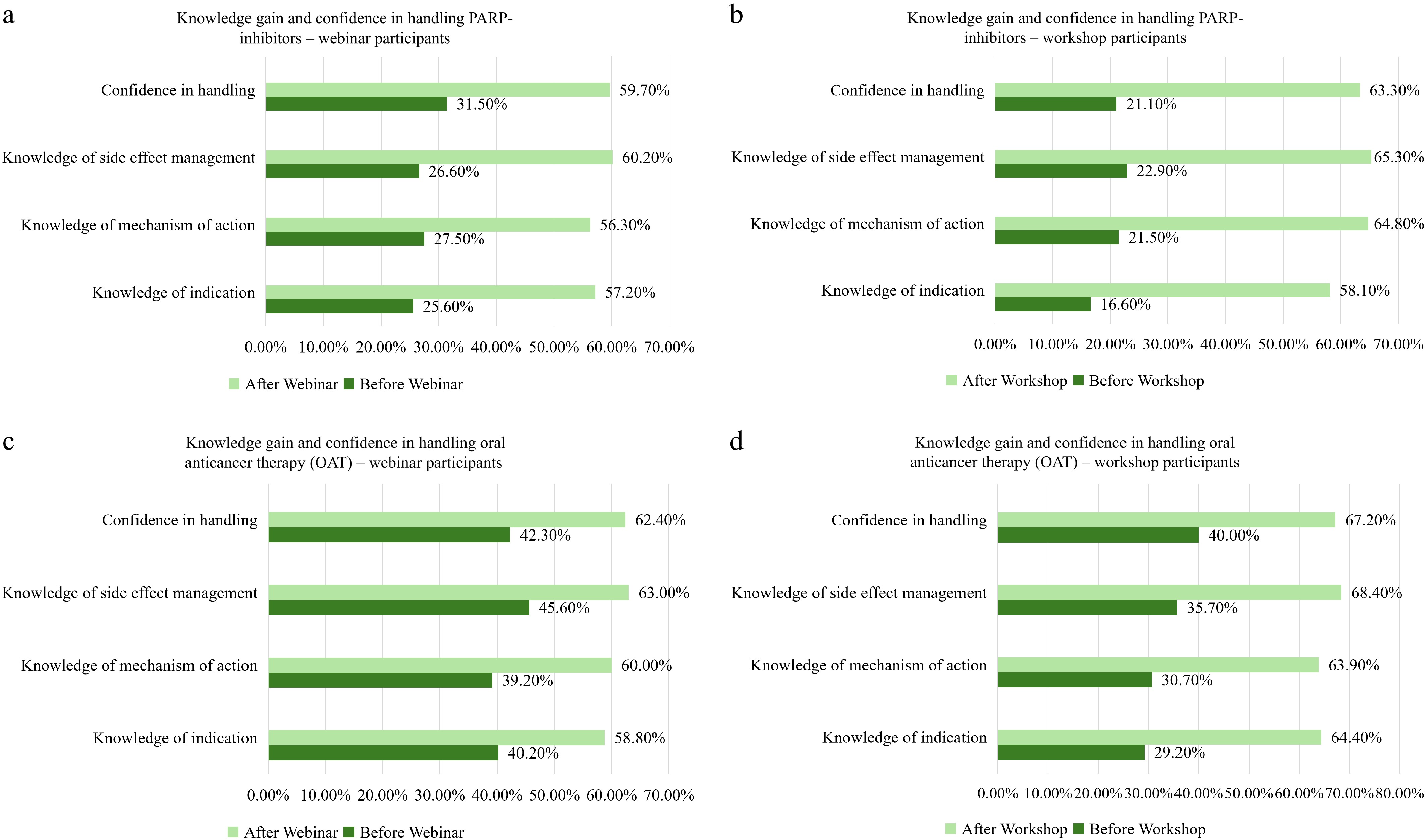
Figure 2.
Knowledge and confidence in handling PARP inhibitors and oral anticancer therapy (OAT) before and after educational interventions. (a) Knowledge gain and confidence in handling PARP inhibitors—webinar participants (scale 0%–100%, n = 27). (b) Knowledge gain and confidence in handling PARP inhibitors—workshop participants (scale 0%–100%, n = 22). (c) Knowledge gain and confidence in handling oral anticancer therapy (OAT)—webinar participants (scale 0%–100%, n = 26). (d) Knowledge gain and confidence in handling oral anticancer therapy (OAT)—workshop participants (scale 0%–100%, n = 22).
Following the training, both formats led to substantial increases in self-reported confidence. In the workshop group, confidence in handling PARP inhibitors increased from 23.3% to 66.5%, while in the webinar group, confidence increased from 31.4% to 60.4%.
These improvements were statistically significant in both groups. In the workshop group, a paired t-test showed a significant increase (t = −11.49, p < 0.001) with a very large effect size (Cohen's d = 2.45). In the webinar group, a significant increase was also observed (t = −7.08, p < 0.001) with a large effect size (Cohen's d = 1.36).
Normality testing using the Shapiro–Wilk test indicated no significant deviation from a normal distribution for the pre–post differences (workshop: p = 0.62; webinar: p = 0.16), supporting the use of parametric testing.
Overall, both training formats resulted in marked improvements in knowledge and confidence. Descriptively, the workshop showed slightly higher gains across most domains, which was confirmed by the adjusted analysis. To further compare the effectiveness of both formats while accounting for baseline differences, an ANCOVA model was performed. This analysis demonstrated that the workshop format was associated with significantly higher post-intervention confidence compared to the webinar (β = 14.02, p = 0.012).
Preferences for training formats
-
Format preferences differed: 54.5% (12/22) of workshop participants favored the in-person format, while 45.5% (10/22) preferred the webinar. Among webinar participants, 75.9% (60/79) favored the online format, and 24% (19/79) preferred in-person training.
Use of digital and analog medication management
-
Only a small number of nurses documented medication intake digitally (webinar: 5/28 (17.9%), workshop: 1/22 (4.5%)). In contrast, 81.8% (18/22, workshop) and 50% (14/28, webinar) distributed paper-based medication diaries to patients. Nevertheless, many participants viewed digital documentation as valuable and expressed interest in adopting it in the future (14/22 [63.6%] in the workshop, 19/28 [67.9%] in the webinar).
Evaluation of the trainings
-
The trainings were positively evaluated, with mean satisfaction ratings of 89.4% for the webinar and 86.7% out of 100% for the workshop. Participants most frequently highlighted the practical relevance of the nursing materials, particularly the structured checklists (96.4% [27/28] webinar; 100% [22/22] workshop), as well as information on side-effect management (96.4% [27/28] webinar; 95.5% [21/22] workshop). Additional supporting materials were also rated as highly useful by the majority of participants in both formats (webinar: 96.4% [27/28], workshop: 100% [22/22]).
Status quo and potential for improvement in nursing consultations
-
Nurse-led consultations were already established in 28.9% (24/83) of webinar participants and 31.8% (7/22) of workshop participants. In an open-ended question, the most frequently reported need for implementing structured nursing consultations was the availability of checklists and information materials (reported by 16 webinar and 3 workshop participants). Further commonly mentioned requirements included protected time and dedicated physical space for consultations (five webinar and two workshop participants), as well as a clearer scientific basis for billing (three workshop participants). Improved interdisciplinary communication was also identified as an area for further development by several respondents.
Use of information materials
-
Checklists were considered helpful but rarely used in practice. Among workshop participants, 95.5% (21/22) found them useful for initial visits, but only 22.7% (5/22) used them. For follow-up visits, 90.9% (20/22) considered checklists helpful, yet only 9.5% (2/21) used them. A similar pattern appeared among webinar participants: 92.6% found checklists useful, but only 10.7% used them.
Patient education materials were used more frequently: 81.8% (18/22) of workshop participants used therapy calendars, and 63.6% (14/22) found them helpful.
-
This study evaluated a nursing education program delivered as a webinar and an in-person workshop designed to prepare oncology nurses for structured consultations related to oral anticancer therapy, with PARP inhibitors serving as a clinical example. In a prospective pre–post design, significant improvements in self-assessed knowledge and confidence were observed across both training formats. In addition, participants reported a high perceived usefulness of the structured support materials provided, highlighting the relevance of practice-oriented educational tools in this context.
The observed increase in self-assessed knowledge and confidence following both training formats indicates that targeted, practice-oriented education can effectively support oncology nurses in managing oral anticancer therapy. The larger gains observed in the in-person workshop compared with the webinar may reflect the interactive nature of face-to-face formats, which allow for direct exchange, case-based discussion, and immediate feedback. Nevertheless, the substantial improvements achieved through the webinar demonstrate that digital education formats can also meaningfully enhance competencies, particularly when content is structured and closely aligned with clinical practice. This observation is further supported by the ANCOVA analysis, which demonstrated that the workshop format remained significantly more effective than the webinar even after adjusting for baseline confidence levels. The large effect sizes observed in both training formats may partly reflect the use of self-reported measures as well as relatively low baseline confidence levels, which allow for substantial improvements following targeted educational interventions. In addition, the immediate post-intervention assessment may have contributed to the magnitude of the observed effects.
Previous studies have highlighted the importance of structured support for patients receiving oral anticancer therapy, particularly regarding adherence, symptom management, and patient empowerment[14]. Nurse-led consultations and non-physician support models have been shown to improve self-management and continuity of care in oncology settings[15]. However, most existing work has focused on patient-centred outcomes or the implementation of care models[6,8] rather than on the systematic evaluation of educational interventions aimed at preparing nursing staff for these roles.
In this context, the present study contributes additional evidence by specifically evaluating nurse-focused training formats and demonstrating measurable improvements in knowledge and confidence following both in-person and digital education. While previous work has shown that targeted training can enhance professional competencies in oncology nursing more broadly[16,17], the current findings extend this evidence to the specific context of oral anticancer therapy and PARP inhibitors.
Beyond the observed educational effects, the findings of this study have implications for the implementation of nurse-led consultations in routine oncology care. The high perceived usefulness of structured support materials suggests that practical tools, such as checklists and patient education resources, may facilitate the translation of newly acquired knowledge into daily clinical practice. In particular, the combination of standardized consultation frameworks and targeted training may support task delegation and interdisciplinary collaboration in settings where physicians' time resources are limited[6,14].
Digital support concepts have been shown to complement clinical care pathways in oncology. Digital therapy accompaniment and eHealth-based support tools have been associated with improvements in patient-reported outcomes and continuity of care in the context of oral anticancer therapy[18,19]. In this context, nurse-focused training programs may serve as an essential prerequisite for the effective integration of such digital and organizational support structures into daily practice.
Although the training program was developed within the CAMPA project and implemented in the context of the German healthcare system, the underlying challenges addressed—namely the increasing use of oral anticancer therapy, the need for structured patient support, and the expansion of nursing roles—are shared across many oncology care settings[14−16]. The use of both webinar and in-person formats further suggests that nurse-focused educational interventions can be flexibly adapted to different institutional and organizational contexts.
This study has several strengths and limitations that should be considered when interpreting the findings. A key strength is the evaluation of two complementary educational formats under real-world conditions, allowing comparison of in-person and digital training approaches within the same educational framework. In addition, the study focused on nurse-specific outcomes and addressed an area that has received limited attention in previous research on oral anticancer therapy.
Several limitations should be acknowledged. The study followed a single-arm pre–post design without a control group, and the sample size was determined by voluntary participation, limiting causal inference. Furthermore, outcomes were based on self-reported measures, and the questionnaires used were self-developed and not formally psychometrically validated, which may affect comparability with other studies and potentially overestimate actual knowledge gains. While these instruments were specifically designed to capture training-related changes in knowledge and confidence, the present study does not allow conclusions regarding the sustainability of these effects in routine clinical practice. Finally, long-term effects on clinical practice and patient outcomes were not assessed and warrant further investigation.
The findings of this study suggest that targeted, practice-oriented education can support oncology nurses in assuming expanded roles in the management of oral anticancer therapy. Future research should build on these results by evaluating the long-term sustainability of training effects, their impact on clinical workflows, and potential associations with patient-centred outcomes such as adherence and symptom burden. In addition, the development and validation of standardized assessment instruments for nursing education in oral anticancer therapy would strengthen future evaluations. Taken together, these results highlight the potential of structured nurse-focused training programs as a component of interdisciplinary strategies to address the growing complexity of oral anticancer therapy in oncology care.
-
This study demonstrates that a targeted nursing education program delivered through both webinar and in-person formats is associated with improved self-assessed knowledge and confidence among oncology nurses involved in oral anticancer therapy. Structured, practice-oriented training combined with standardized support materials may facilitate the implementation of nurse-led consultations in routine oncology care.
Not applicable.
-
The study was conducted in accordance with the Declaration of Helsinki, and the protocol was approved by the Ethics Committee of LMU Munich (21-0848). Informed consent for participation was obtained from all subjects involved in the study. During the preparation of this work, Sophie Winkler used ChatGPT (OpenAI, GPT-5, 2025–2026) for language refinement and assistance with phrasing and manuscript editing. The authors reviewed and edited all content produced with the assistance of this tool, verified its accuracy, and take full responsibility for the integrity and originality of the final manuscript. This work represents the authors' own intellectual contribution, and no AI tool is credited as an author.
-
The authors confirm their contributions to the paper as follows: formal analysis, writing – original draft, visualization: Winkler S; investigation: Winkler S, Milani V, Hirschberg L, Henze F, Wuerstlein R; resources: Winkler S, Milani V, Hirschberg L; writing – review and editing: Winkler S, Milani V, Hirschberg L, Henze F, Paradies K, Schinköthe T, Haidinger R, Hempel D, Mahner S, Koenig A, Trillsch F, Theurich S, Harbeck N, Wuerstlein R; conceptualization: Milani V, Henze F, Paradies K, Schinköthe T, Haidinger R, Hempel D, Mahner S, Koenig A, Trillsch F, Theurich S, Harbeck N, Wuerstlein R; methodology: Milani V, Wuerstlein R; validation: Milani V; funding acquisition: Henze F, Wuerstlein R; project lead, supervision, project administration: Wuerstlein R. All authors reviewed the results and approved the final version of the manuscript.
-
The datasets generated and/or analyzed during the current study are available from the corresponding author upon reasonable request.
-
Valeria Milani received research funding, honoraria, and travel expenses, or served as a member of advisory boards from Amgen, AstraZeneca, Celgene, Daiichi-Sankyo, Eisai, Exact Sciences, MSD, Novartis, Pfizer, Roche, Sandoz/Hexal, Teva, Lilly, BeiGene, BMS, Gilead, and Miltenyi. Sven Mahner received research funding, advisory board, honoraria, or travel expenses from AbbVie, AstraZeneca, Clovis, Eisai, GlaxoSmithKline, Hubro, Medac, MSD, Novartis, Nykode, Olympus, PharmaMar, Pfizer, Roche, Sensor Kinesis, Teva, and Tesaro. Fabian Trillsch received research funding, honoraria, and travel expenses, or served as a member of advisory boards from AstraZeneca, Clovis, Eisai, ImmunoGen, Medac, MSD, PharmaMar, Roche, and Tesaro/GSK. Alexander Koenig received honoraria for lectures and/or case demonstrations from RG Gesellschaft für Information und Organisation mbH, MEDEA GmbH, and APTITUDE Health, as well as travel support from Daiichi-Sankyo. Nadia Harbeck received research funding, honoraria, and travel expenses or served as a member of advisory boards from AstraZeneca, Daiichi-Sankyo, Gilead, Lilly, MSD, Novartis, Pierre-Fabre, Pfizer, Roche, Sanofi, Sandoz, and Seagen. Rachel Wuerstlein served as advisor, consultant, speaker and travel grant: Agendia, Amgen, Aristo, AstraZeneca, Celgene, Clovis Oncology, Daiichi-Sankyo, Eisai, Exact Sciences, Gilead, Glaxo Smith Kline, Hexal, Lilly, Medstrom Medical, MSD, Mundipharma, Mylan, Nanostring, Novartis, Odonate, Paxman, Palleos, Pfizer, Pierre Fabre, PINK, PumaBiotechnolgogy, Riemser, Roche, Sandoz/Hexal, Sanofi Genzyme, Seattle Genetics/Seagen, Stemline, Tesaro Bio, Teva, Veracyte, Viatris, FOMF, Aurikamed, Clinsol, Pomme Med, medconcept, MCI.
-
accompanies this paper online at: https://doi.org/10.48130/ejcc-0026-0014.
-
# Authors contributed equally: Sophie Winkler, Valeria Milani
- Supplementary Table S1 Overview of oral anticancer agents currently approved and available for gynecologic oncology in Germany.
- Supplementary Table S2 Support materials developed as part of the CAMPA project for nurses and patients.
- Supplementary Table S3 Dissemination activities of the CAMPA nursing education program.
- Supplementary Table S4 Participant structure and demographics of webinar and workshop participants.
-
Copyright © 2026 by the author(s).
European Journal of Cancer Care published by Maximum Academic Press on behalf of John Wiley & Sons Ltd. This is an open access article under the terms of the Creative Commons Attribution License, which permits use, distribution and reproduction in any medium, provided the original work is properly cited. -
About this article
Cite this article
Winkler S, Milani /V, Hirschberg L, Henze F, Paradies K, et al. 2026. Support services and nursing education for oral anticancer therapy with PARP inhibitors: evaluation from the CAMPA project. European Journal of Cancer Care 2026: e020 doi: 10.48130/ejcc-0026-0014 

Support services and nursing education for oral anticancer therapy with PARP inhibitors: evaluation from the CAMPA project
- Received: 05 September 2025
- Revised: 28 March 2026
- Accepted: 30 March 2026
- Published online: 27 October 2026
Abstract: The number of patients receiving oral anticancer therapies, such as poly (ADP-ribose) polymerase inhibitors for advanced breast and ovarian cancer, is steadily increasing. These treatments place high demands on both patients and healthcare teams. In Germany, nursing consultations are an emerging concept to improve care quality and personalized patient support. Tailored training programs and structured materials are essential to support their implementation. This prospective educational study evaluated two training formats, a webinar and an in-person workshop, designed to prepare oncology nurses for structured consultations related to oral anticancer therapy using poly (ADP-ribose) polymerase inhibitors as a clinical example. Participants completed structured pre- and post-training questionnaires assessing knowledge, confidence, and practical utility. Training included pharmacology, management of side effects, patient communication, digital tools, and structured consultation materials including checklists, patient calendars, and consultation guides. A total of 117 healthcare professionals participated (95 webinar participants and 22 workshop participants). Both formats led to significant gains in knowledge and confidence (workshop: 23.3% to 66.5%; webinar: 31.4% to 60.4%; both p < 0.001), with large effect sizes. The workshop format was associated with significantly higher post-intervention confidence compared with the webinar. Structured materials were rated as highly relevant and applicable in clinical practice, with 96%–100% of participants reporting them to be helpful. Both workshop and webinar formats effectively improved confidence in managing oral anticancer therapy. While both approaches were beneficial, in-person training showed additional advantages. Structured materials appear to be an important facilitator for implementing nurse-led consultations in oncology care.
-
Key words:
- Oral anticancer therapy;
- PARP inhibitors;
- Nursing consultation;
- Training;
- Oncology;
- Delegation;
- Webinar;
- Workshop