










-
Cancer is a significant global public health issue. According to the latest projections released by the International Agency for Research on Cancer, there were nearly 20 million new cancer cases worldwide in 2022, and this number is projected to reach 35 million by 2050[1]. In recent years, with advancements in screening and diagnostic techniques, cancer survival rates have gradually risen, allowing more patients to live with cancer for extended periods. Cancer survivors refer to cancer patients who have completed conventional treatment and are in a stable follow-up phase[2]. Data from China's National Cancer Center shows that the 5-year survival rate for cancer in China has increased from 30.9% to 40.5%, indicating a rapid rise in cancer survivors returning to normal work and life.
Return-to-work (RTW) is a critical step toward recovery for cancer survivors, referring to an individual who is forced or voluntarily leaves their job because of illness or other reasons and then returns to their original job or finds a new job[3]. RTW can improve their self-identity, professional belonging, and quality of life[4], while alleviating the pressure on social labor resources and, to some extent, reducing the economic burden on families and society[5]. A follow-up study by So et al.[6] found that approximately 40% of cancer survivors returned to work within 6 months after completing treatment. However, cancer survivors often encounter numerous challenges during their reintegration into the workforce, such as a post-treatment decline in physical function, a significant psychological burden, and a lack of social roles, which make it difficult for them to adjust and adapt to the changes brought by the disease[7].
For cancer survivors who have experienced major health crises, the process of returning to the workplace involves a series of unique multidimensional challenges related to physical, psychological, and social factors[8], and their RTW adaptability may change over time. RTW adaptability refers to the ability of cancer survivors to effectively utilize internal and external resources to cope with stress during the process of returning to work, thereby maintaining a balance between work and physical and mental health[9]. The theory of adaptation experiences and coping resources among patients with cancer returning to work[9] posits that RTW adaptation is a dynamic process centered on "rebuilding the self" and includes the three stages of focused recovery, restored efficacy, and adjustment planning. During this process, patients need to mobilize not only personal resources, such as confidence in their ability to return to work, positive thinking, and psychological resilience, but also external resources, such as emotional support from family, professional advice from medical staff, support from supervisors, understanding from colleagues, and peer support from other patients. These resources help them cope with the physical and psychological challenges of returning to work and facilitate their comprehensive recovery and social reintegration.
Insufficient RTW adaptability may not only hinder the long-term career development of cancer survivors but also adversely affect their physical and psychological recovery and quality of life[10]. The process of physical, psychological, and social adaptation among cancer survivors returning to work is dynamic and complex[11] and is influenced by multiple factors, including educational level, age, social support, and cancer type[12]. Previous longitudinal studies have primarily focused on whether and when cancer survivors return to work, their RTW trajectories, and sustained employment, whereas limited attention has been given to dynamic changes in RTW adaptability. Evidence suggests that some cancer survivors experience persistently low work functioning after returning to work and may subsequently face recurrent sick leave or unemployment[13,14]. To date, research specifically addressing RTW adaptability among cancer survivors has mainly used cross-sectional designs, making it difficult to capture dynamic changes in adaptability over time[15,16].
Given the individual differences among cancer survivors and the influence of multidimensional factors such as physical and mental functioning, social support systems, and environmental adaptability, RTW adaptability among cancer survivors may exhibit diverse developmental trajectories[17,18]. To reveal the diversity and complexity of this process, a person-centered analytical method is needed to identify and describe the developmental trajectories of different subgroups[19]. Latent class growth analysis (LCGA), a person-centered statistical method for analyzing longitudinal data, can identify distinct patterns of change and developmental trajectory subgroups across different time points and estimate the proportion of each class in the overall sample, thereby providing a methodological basis for identifying the developmental trajectories of RTW adaptability among cancer survivors[20]. Therefore, this study used LCGA to explore heterogeneity in RTW adaptability among cancer survivors.
Consequently, this study tracked changes in RTW adaptability among cancer survivors during the first 6 months after completing treatment completion, used LCGA to identify distinct developmental trajectories, and analyzed the factors influencing trajectory-group membership. The findings may provide the basis for accurately identifying different categories of RTW adaptability and implementing targeted interventions, thus promoting cancer survivors' RTW.
-
This study was an observational longitudinal study, and we strictly followed the STrengthening the Reporting of OBservational studies in Epidemiology (STROBE) reporting guidelines throughout the conduct of the study.
Participants
-
From April 2023 to August 2024, a convenience sampling method was used to select 412 cancer survivors registered in the archives of the chemotherapy department and radiotherapy department of a tertiary hospital in Nantong, and the Nantong Cancer Rehabilitation Association as study subjects. The inclusion criteria were as follows: (1) A confirmed diagnosis of malignant tumors through clinical, imaging, and histopathological examinations, with pathological Stages I−IV; (2) cancer survivors who had completed the primary phase of cancer treatment and had been deemed medically fit to return to work by a specialist, including those receiving ongoing maintenance endocrine therapy; (3) normal work status prior to diagnosis; (4) an age range of 18–60 years; (5) clear verbal communication and the ability to comprehend and complete the assessment; and (6) awareness of their cancer diagnosis and voluntary participation in the study. The exclusion criteria were (1) the presence of other severe diseases or complications, (2) cognitive impairment, or (3) a history of psychiatric disorders.
Data collection procedure
-
This study assessed cancer patients at the end of their primary treatment phase, and at 3 and 6 months post-treatment. Previous research has identified the 3 and 6 months following cancer treatment as crucial periods for managing treatment-related effects, making decisions about returning to work, and resuming daily activities[14]. Therefore, data collection in this study included two phases: A baseline survey and a follow-up survey. The baseline survey was conducted when patients were about to be discharged after completing their treatment phase, with the researchers guiding them to complete the questionnaire in person. After completion, the researchers reviewed the questionnaires on-site, and if any omissions or unclear information were found, the researchers contacted the patients promptly to supplement the information, ensuring the data's completeness. To minimize loss to follow-up, the researchers maintained contact with the patients via WeChat. Follow-up surveys were conducted at 3 and 6 months after treatment, using electronic questionnaires distributed through the Wenjuanxing platform. After data collection, two research team members independently entered and cross-checked the data to ensure accuracy.
Sample size calculation
-
This study involved three repeated measures and used LCGA to identify the latent trajectory categories. Therefore, the sample size was estimated according to the requirements of the repeated measures design and the latent category model. First, on the basis of the sample size estimation table for a single-group repeated measures design[21], each subject was measured three times. The correlation coefficients were set as γ = 0.5,
$\bar{r} $ Ethics
-
This study was conducted in accordance with the principles of the Declaration of Helsinki and was approved by the Ethics Committee of the Affiliated Hospital of Nantong University (approval No. 2023-K097-01). Before enrolment, the researchers explained the study's purpose, procedures, and the questionnaire completion requirements to all participants to ensure that they fully understood the study and participated voluntarily. Written informed consent was obtained from all participants before data collection. Participants had the right to decline to answer any question or withdraw from the study at any time.
Measures
General information questionnaire
-
According to the research objectives, this study reviewed relevant literature in databases such as PubMed, Cochrane Library, China National Knowledge Infrastructure (CNKI), China Biomedical Literature Database, and Wanfang Data Platform; referred to related studies; screened factors that may affect cancer survivors' RTW adaptability; and developed a general data survey questionnaire. The content included the cancer survivors' sociodemographic information (age, gender, place of residence, educational level, marital status, type of family, with or without minor children, occupation type, type of work unit, type of work, main economic sources, per capita monthly family income, medical payment methods, current working status) and disease-related information (cancer type, clinical staging, therapy method, time since diagnosis, any complications, and comorbidity with other chronic diseases).
The RTW adaptability scale for cancer patients
-
The RTW adaptability scale, developed by Guo et al.[22], includes three subscales: Focused rehabilitation, efficiency reconstruction, and adjustment planning. The adaptation experience and coping resources of patients with cancer returning to work theory (ARTWS) comprises 24 items and uses a 5-point Likert scale (1 = strongly disagree, 5 = strongly agree). The total score ranges from 24 to 120, and higher scores reflecting better RTW adaptability. The Cronbach's α coefficients for this scale were 0.910, 0.935, and 0.953 at the three time points in this study.
The social support rating scale
-
The social support rating scale (SSRS), developed by Xiao et al.[23], is an assessment tool that encompasses three dimensions: Objective support, subjective support, and utilization of social support. This tool comprises 10 items and the total scale score ranges from 12 to 66. Scores of ≤ 22 indicate low social support, those of 23–44 indicate moderate social support, and those of 45–66 indicate high social support. In this study, the Cronbach's α coefficients for the scale at three time points were 0.710, 0.776, and 0.791.
Statistical methods
-
Statistical analysis was conducted using SPSS 25.0 and Mplus 8.3 software. Given that this study involved three follow-up measurements and experienced data loss, a χ2-test was performed to examine the mechanisms of missing data. The results showed no significant differences between the lost and retained groups in terms of gender (p = 0.943), educational level (p = 0.068), marital status (p = 0.370), type of work (p = 0.068), and current working status (p = 0.477). At the T1 time point, no significant differences were observed in RTW adaptability between the two groups (p = 0.932), indicating that the data loss was not caused by structural bias but by complete random missingness. Consequently, the full information maximum likelihood (FIML) method was used for missing data imputation. Quantitative data conforming to a normal distribution are described using the mean and standard deviation (M ± SD), whereas those deviating from a normal distribution are presented as median and quartiles. Categorical data are described as frequencies, percentages, or percentage rates, with intergroup comparisons conducted using χ2-tests or Fisher's exact probability method. The heterogeneity of RTW adaptability trajectories among cancer survivors was analyzed using LCGA. The logistic regression was used to analyze the influencing factors of different trajectory categories; p < 0.05 indicated that the difference was statistically significant.
-
This study conducted three follow-up measurements among cancer survivors, administered at three time points: Treatment completion, 3 months after treatment, and 6 months after treatment. The first measurement distributed 426 questionnaires, with 412 valid responses collected. During the second follow-up, 2 respondents died, 10 respondents proactively withdrew from the research, and 15 respondents declined to participate further. In total, 385 valid questionnaires were collected, resulting in the loss of 27 participants. The third follow-up recorded 1 death, 5 respondents with poor mental status, 23 respondents declining to participate further, and 11 respondents proactively withdrawing from research. In total, 345 valid questionnaires were collected, resulting in the loss of 40 participants. T1, T2, and T3 in the following text represent the first, second, and third measurements, respectively. The respondents included 97 males and 315 females, aged 27−59 years (M = 44.95, SD = 6.71), with 150 having minor children and 261 without. Table 1 details the demographic and disease-related characteristics of the cancer survivors.
Table 1. Demographic and disease-related data of cancer survivors (n = 412).
Variables Categories Frequency (n) % Gender Male 97 23.5 Female 315 76.5 Age group < 40 years 90 21.8 41−60 years 322 78.2 Place of residence Urban 246 59.7 Rural 166 40.3 Educational level Middle school and below 161 39.1 High school and junior college 149 36.2 Undergraduate course and above 102 24.8 Marital status Married 383 93.0 Single/divorced/widowed 29 7.0 Type of family Nuclear family 219 53.2 Stem family 163 39.6 Expanded family 14 3.4 Reorganized family 5 1.2 Single-parent family 11 2.7 With or without
minor childrenYes 150 36.4 No 261 63.3 Occupation type Farmers/workers 69 16.7 Professional and technical personnel 50 12.1 Government agencies/enterprises/
public institutions62 15.0 Self-employed business 231 56.1 Type of work unit State-owned enterprises and institutions 184 44.7 Individuals/freelancers 162 39.3 Private enterprises 66 16.0 Type of work Mental labor 156 37.9 Manual labor 135 32.8 Manual and mental labor 121 29.4 Main economic
sourcesPersonal labor income 219 53.2 Spouse's or child's income 178 43.2 Other 15 3.6 Per capita monthly family income < US${\$} $423 102 24.8 US${\$} $423−1,126 196 47.6 Medical payment
methodsUrban and rural residents' health insurance 45 10.9 New rural cooperative medical insurance 88 21.4 Employees' medical insurance 230 55.8 Commercial critical illness insurance 49 11.9 Current working
statusNot working/sick leave 299 72.6 On the job 113 27.4 Cancer type Cancer of the respiratory system 44 10.7 Breast cancer 198 48.1 Cancer of the reproductive system 42 10.2 Cancer of the digestive system 72 17.5 Other 56 13.6 Clinical staging I 51 12.4 II 177 43.0 III 140 34.0 IV 44 10.7 Therapy method Only surgical treatment 28 6.8 Only radiation and chemotherapy 49 11.9 Surgery combined with other treatments 335 81.3 Time since
diagnosis< 6 months 90 21.8 6−10 months 111 26.9 ≥ 11 months 211 51.2 Any complications Yes 58 14.1 No 354 85.9 Comorbidity with other chronic diseases Yes 84 20.4 No 328 79.6 Common method bias
-
Since both the variables of job RTW adaptability and social support in this study were measured through questionnaires, common method bias may have occurred. To address this, the Harman single-factor method was used to test for common method bias[24]. The results revealed that at the T1, T2, and T3 time points, the number of factors with eigenvalues greater than 1 was 8, 7, and 5, respectively. The variance explained by the first factor was 25.50%, 31.21%, and 37.52% at these time points, which are all below the 40% threshold. Therefore, no significant common method bias was detected in this study, and the data can be analyzed.
LCGA of cancer survivors' RTW adaptability
-
To investigate potential individual differences in work adaptation among cancer survivors, LCGA was used to examine the model's trajectories. This study systematically evaluated the fit of one to five latent class models (see Table 2). The results showed that as the number of latent classes increased, the Akaike information criterion (AIC), BIC, and adjusted BIC (aBIC) values progressively decreased, with all entropy values remaining above 0.8. In a comparison of the two-class latent model with the three-class latent model, for the three-class latent model, the entropy value of 0.875 is closer to 1 than the entropy value of 0.848 observed for the two-class latent model, indicating that the model achieves higher accuracy when grouped into three classes. When we examined the four-class latent model, there were no significant differences in the Lo–Mendell–Rubin adjusted likelihood ratio test (LMR) and bootstrap likelihood ratio test (BLRT) (p > 0.05). With the five-class latent model, subgroups comprising only 8.3% and 11.2% of the probability distribution were identified. These small proportions likely reflect extreme cases in the dataset, offering limited clinical interpretability, lacking generalizability, and increasing the risk of model overfitting. Through comprehensive considerations of model simplicity, statistical robustness, and practical interpretability, this study concluded that the three-class latent model better aligns with the research objectives.
Table 2. Results of the fit of the latent category growth model for cancer survivors' RTW adaptability.
Model AIC BIC aBIC Entropy LMR BLRT Class probability 1 1,973.746 1,993.852 1,977.986 − − − 1 2 1,335.956 1,368.124 1,342.739 0.848 < 0.001 < 0.001 0.626/0.374 3 1,034.526 1,078.757 1,043.852 0.857 0.006 0.008 0.352/0.206/0.442 4 892.087 948.381 903.956 0.841 0.618 0.626 0.243/0.104/0.282/0.371 5 723.917 792.275 738.330 0.878 0.020 0.022 0.269/0.187/0.112/0.349/0.083 Latent profile analysis models and fit indices. AIC, Akaike information criterion; BIC, Bayesian information criterion; aBIC, adjusted BIC; LMR, Lo–Mendell–Rubin adjusted likelihood ratio test; BLRT, bootstrap likelihood ratio test. Boldface highlights the data supporting the selection of the corresponding category. On the basis of an analysis of the intercepts and slopes across different latent categories, we identified three distinct developmental trajectories of cancer survivors' RTW adaptability. Figure 1 illustrates the trajectory changes within these subgroups. The first latent category (n = 145, 35.2% of patients) exhibited a moderate baseline level with a stable, gradual decline over time (intercept α = 3.525, p < 0.001; slope β = −0.066, p = 0.003), termed the "moderate-level gradual decline group". The second category (n = 85, 20.6% of patients) showed the lowest initial level with a rapid decline (intercept α = 2.961, p < 0.001; slope β = −0.219, p < 0.001), designated as the "low-level rapid-declining group". The third category (n = 182, 44.2% of patients) demonstrated the highest baseline level with a gradual upward trend (intercept α = 4.050, p < 0.001; slope β = 0.049, p < 0.001), labeled the "high-level slow-rising group". Kruskal–Wallis H-test results revealed significant differences in RTW adaptability between subgroups at time points T1−T3 (H = 304.792, 293.825, 201.376; p < 0.001). This indicates that the heterogeneity subgroups in the developed reintegration trajectories demonstrate strong discriminative power.
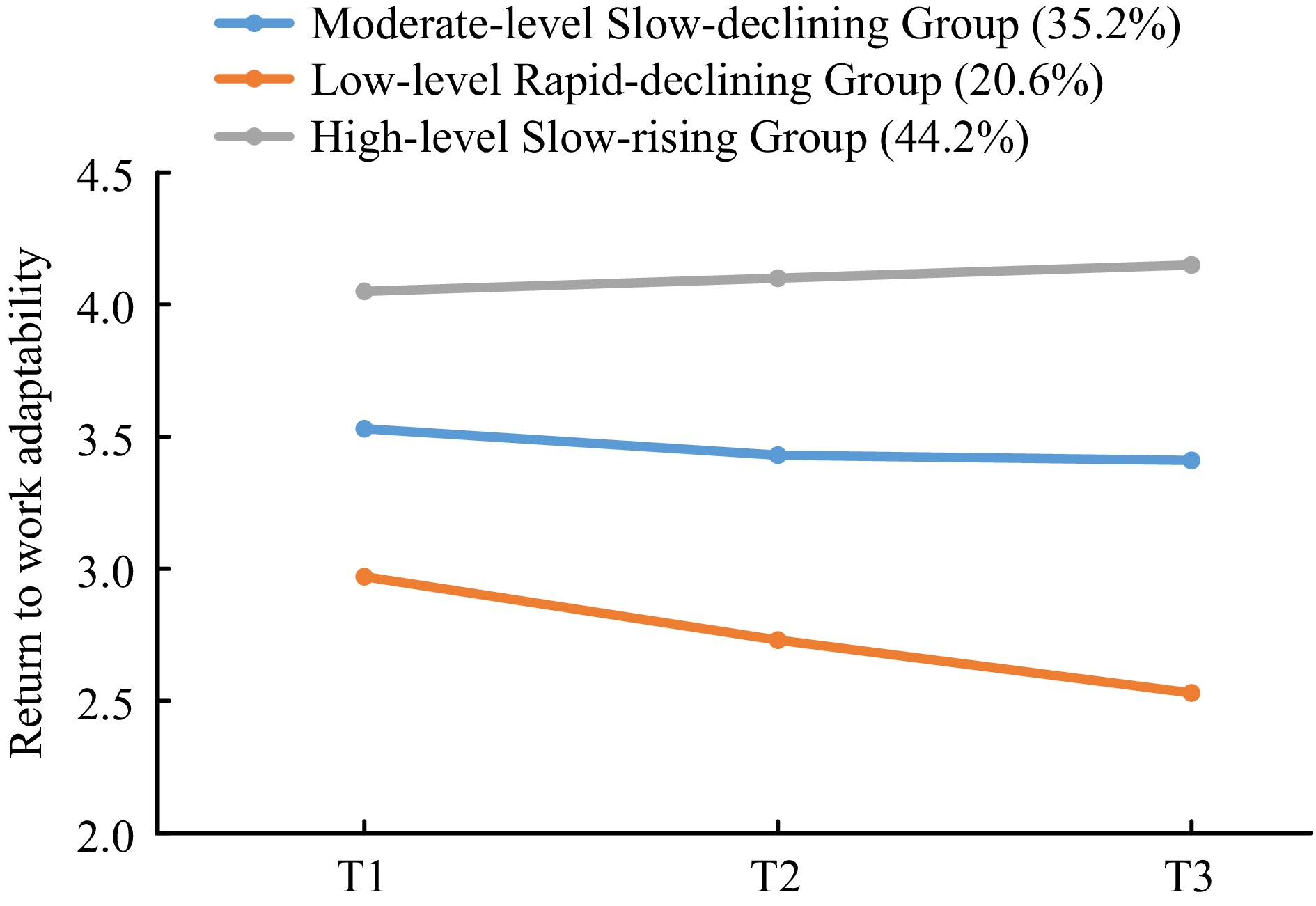
Figure 1.
Trajectory of adaptive potential subgroups for cancer survivors returning to work.
Analysis of the factors influencing the development trajectory of cancer survivors' RTW adaptability
-
After identifying three distinct potential categories through LCGA analysis, we conducted a χ2-test to examine differences in the general data of cancer survivors in various categories of the RTW adaptability trajectory. Using the three reintegration categories as dependent variables, we incorporated 12 significant single-factor analysis variables as independent variables in the logistic regression analysis. Social support was analyzed as a continuous variable at its original value, with the categorical variables assigned values as described below. The work adaptation subscale was categorized as follows: Moderate-level slow-declining group = 1; low-level rapid-declining group = 2; and high-level slow-rising group = 3. Age groups were classified as < 40 = 1, 41–60 years = 2. Educational levels included middle school and below = 1, high school and junior college = 2, and undergraduate course and above = 3. Occupation types were farmers or workers = 1, professional and technical personnel = 2, government agencies or enterprise or public institutions = 3, and self-employed = 4. Employment types were state-owned enterprises and institutions = 1, individuals or freelancers = 2, and private enterprises = 3. Work type was primarily mental labor = 1, primarily manual labor = 2, and both = 3. The main economic sources were personal labor income = 1, spouse's or child's income = 2, and others = 3. Per capita monthly family income was < US
${\$} $ ${\$} $ ${\$} $ Table 3. Univariate analysis of the adaptive development trajectory categories of cancer survivors returning to work.
Variables Categories Moderate-level slow-declining
group (n = 145)Low-level rapid-declining
group (n = 85)High-level slow-rising
group (n = 182)χ2 p-value Gender Male 36 16 45 1.326 0.515 Female 109 69 137 Age group < 40 years 33 9 48 8.566 < 0.05 41−60 years 112 76 134 Place of
residenceUrban 87 42 117 5.336 0.069 Rural 58 43 65 Educational
levelMiddle school and below 59 57 45 64.099 < 0.001 High school and junior college 63 22 64 Undergraduate course and above 23 6 73 Marital status Married 137 76 170 2.205 0.332 Single/divorced/widowed 8 9 12 Type of family Nuclear family 80 43 96 8.588 0.378 Stem family 58 31 74 Expanded family 4 5 5 Reorganized family 1 3 1 Single-parent family 2 3 6 With or without
minor childrenYes 54 24 72 3.048 0.218 No 91 60 110 Occupation type Farmers/workers 27 21 21 26.428 < 0.001 Professional and technical personnel 15 7 28 Government agencies/enterprises/public institutions 18 3 41 Self-employed 85 54 92 Type of
work unitState-owned enterprises and institutions 61 26 97 23.820 < 0.001 Individuals/freelancers 61 33 68 Private enterprises 23 26 17 Type of work Mental labor 52 11 93 47.041 < 0.001 Manual labor 56 45 34 Manual and mental labor 37 29 55 Main economic
sourcesPersonal labor income 71 26 122 34.095 < 0.001 Spouse's or child's income 66 55 57 Other 8 4 3 Per capita monthly
family income< US${\$} $423 54 34 14 63.867 < 0.001 US${\$} $423−1,126 70 34 92 > US${\$} $1,126 21 17 76 Medical payment
methodsUrban and rural residents' health insurance 16 10 19 34.558 < 0.001 New rural cooperative medical insurance 33 33 22 Employees' medical insurance 71 35 124 Commercial critical illness insurance 25 7 17 Baseline work
statusNot working/sick leave 124 74 101 47.836 < 0.001 On the job 21 11 81 Cancer type Respiratory system 11 9 24 24.224 < 0.01 Breast cancer 77 40 81 Reproductive system 10 19 13 Alimentary system 27 11 34 Other 20 6 30 Clinical staging I 18 7 26 8.672 0.193 II 65 31 81 III 45 33 62 IV 17 14 13 Therapy
methodOnly surgical treatment 9 3 16 3.755 0.440 Only radiation and chemotherapy 15 13 21 Surgery combined with other treatments 121 69 145 Time since
diagnosis< 6 months 34 18 38 9.324 0.053 6−10 months 50 22 39 ≥ 11months 61 45 105 9.324 0.053 Any
complicationsYes 20 18 20 4.986 0.083 No 121 60 147 Boldface indicates statistical significance (p < 0.001; p < 0.01; p < 0.05). As shown in Table 4, using the high-level slow-rising group as a reference, the probability of cancer survivors with high school and junior college education, a family per capita monthly income < US
${\$} $ ${\$} $ ${\$} $ Table 4. Multivariate logistic regression analysis of cancer survivors' RTW adaptive development trajectory categories.
Dependent variable Independent variable Categories B value SE value Wald χ2 p-value OR (95% CI) Class 1 vs Class 3 Age group < 40 years −0.201 0.341 0.347 0.556 0.818 (0.420–1.596) Educational level Middle school and below 0.637 0.455 1.956 0.162 1.891 (0.774–4.616) High school and junior college 1.048 0.380 7.590 < 0.01 2.851 (1.353–6.008) Per capita monthly
family income< US${\$} $423 2.644 0.474 31.131 < 0.001 14.063 (5.556–35.593) US${\$} $423−1,126 0.982 0.356 7.623 < 0.01 2.669 (1.330–5.358) Baseline work status Not working/sick leave 1.682 0.348 23.384 < 0.001 5.377 (2.719–10.634) Occupation type Farmers/workers −0.107 0.434 0.060 0.806 0.899 (0.384–2.104) Professional and technical personnel −0.213 0.476 0.201 0.654 0.808 (0.318–2.052) Government agencies/enterprises/public institutions 0.102 0.494 0.043 0.836 1.107 (0.421–2.913) Type of work unit State-owned enterprises and institutions −0.219 0.479 0.209 0.648 0.803 (0.314–2.056) Individuals/freelancers −0.532 0.447 1.418 0.234 0.587 (0.245–1.410) Type of work Mental labor 0.186 0.361 0.264 0.607 1.204 (0.593–2.446) Manual labor 0.562 0.384 2.139 0.144 1.754 (0.826–3.722) Medical payment methods Urban and rural residents' health insurance −1.756 0.594 8.737 < 0.01 0.173 (0.054–0.553) New rural cooperative medical insurance −1.210 0.553 4.786 < 0.05 0.298 (0.101–0.882) Employees' medical insurance −1.828 0.460 15.773 < 0.001 0.161 (0.065–0.396) Cancer type Respiratory system −0.594 0.588 1.022 0.312 0.552 (0.175–1.747) Breast cancer −0.049 0.447 0.012 0.913 0.953 (0.397–2.286) Reproductive system −0.017 0.633 0.001 0.978 0.983 (0.284–3.396) Alimentary system 0.107 0.506 0.045 0.833 1.113 (0.413–2.998) Main economic sources Personal labor income −1.238 0.820 2.282 0.131 0.290 (0.058–1.445) Spouse's or child's income −1.268 0.831 2.324 0.127 0.282 (0.055–1.436) Social support −0.058 0.021 7.720 < 0.01 0.944 (0.906–0.983) Class 2 vs Class 3 Age group < 40 years −1.093 0.472 5.359 < 0.05 0.335 (0.133–0.846) Educational level Middle school and below 0.984 0.614 2.564 0.109 2.674 (0.802–8.915) High school and junior college 0.883 0.579 2.328 0.127 2.418 (0.778–7.516) Per capita monthly
family income< US${\$} $423 1.444 0.527 7.514 0.006 4.239 (1.509–11.906) US${\$} $423−1,126 −0.021 0.421 0.002 0.960 0.979 (0.429–2.234) Baseline work status Not working/sick leave 1.484 0.439 11.428 < 0.001 4.409 (1.865–10.420) Occupation type Farmers/workers −0.351 0.488 0.519 0.471 0.704 (0.271–1.831) Professional and technical personnel 0.121 0.599 0.040 0.841 1.128 (0.349–3.649) Government agencies/enterprises/public institutions −0.359 0.766 0.219 0.640 0.698 (0.156–3.136) Type of work unit State-owned enterprises and institutions −0.855 0.538 2.538 0.112 0.425 (0.148–1.219) Individuals/freelancers −1.257 0.497 6.393 < 0.05 0.285 (0.107–0.754) Type of work Mental labor −0.728 0.491 2.201 0.138 0.483 (0.185–1.263) Manual labor 0.400 0.426 0.882 0.348 1.491 (0.647–3.436) Medical payment
methodsUrban and rural residents' health insurance −1.425 0.750 3.608 0.058 0.240 (0.055–1.046) New rural cooperative medical insurance −0.698 0.682 1.046 0.306 0.498 (0.131–1.895) Employees' medical insurance −1.538 0.608 6.392 < 0.05 0.215 (0.065–0.708) Cancer type Respiratory system 0.103 0.742 0.019 0.890 1.108 (0.259–4.743) Breast cancer 0.334 0.616 0.294 0.588 1.396 (0.418–4.665) Reproductive system 1.375 0.733 3.521 0.061 3.955 (0.941–16.632) Alimentary system 0.498 0.697 0.509 0.475 1.645 (0.419–6.454) Main economic sources One's own labor income −0.988 0.965 1.049 0.306 0.372 (0.056–2.467) Spouse's or child's income −0.693 0.965 0.515 0.473 0.500 (0.075–3.315) Social support −0.084 0.026 10.507 < 0.01 0.920 (0.875–0.968) Category 1 represents the moderate-level slow-declining group; Category 2 represents the low-level rapid-declining group; Category 3 represents the high-level slow-rising group. The educational level control group includes those with an undergraduate education and above; the family per capita monthly income control group is > ${\$} $1,126; the baseline work status control group is on the job; the medical payment method control group uses commercial critical illness insurance; the age group control group spans 41−60 years; and the occupation type control group is other. Boldface indicates statistical significance (p < 0.001; p < 0.01; p < 0.05). Using the high-level slow-rising group as a reference, the probability of cancer survivors with a family per capita monthly income < US
${\$} $ -
This study is the first to explore the exploration of group heterogeneity in cancer survivors' RTW adaptability. Through latent class growth analysis (LCGA), we identified three latent categories in their adaptation trajectories: a moderate-level slow-declining group, a low-level rapid-declining group, and a high-level slow-rising group. The results of this study are similar to the findings of Zhang et al.[25], and the potential categories of psychological and social adaptation in cancer survivors can be divided into the persistent severe maladjustment group, the persistent moderate maladjustment group, and the good adaptation group.
Heterogeneous trajectories of RTW adaptability among cancer survivors
-
In this study, the high-level slow-rising group comprised 44.2% of the participants. These individuals exhibited the highest initial levels of RTW adaptability, which gradually increased over time. This finding indicates that cancer survivors in this group demonstrated strong adaptability during the RTW process, enabling them to adjust effectively and maintain a high level of psychosocial adaptation. This pattern may be attributable to higher levels of self-efficacy and perceived social support, which may have enabled them to respond more actively to challenges related to illness, environmental changes, and career transitions, thereby alleviating negative psychological states[26]. In addition, the gradual increase in RTW adaptability may reflect the time needed to manage the handover of work responsibilities, adjust workloads, and re-establish a balance between work and health after returning to work[10].
The medium-level slow-declining group accounted for 35.2% of the participants. These individuals exhibited moderate initial levels of RTW adaptability, followed by a gradual downward trend over time. This finding indicates that although these participants possessed some coping capacity and access to social support at the end of the primary treatment phase, their RTW adaptability gradually diminished as they encountered ongoing challenges during the transition from cancer treatment to recovery and the resumption of occupational roles. This pattern may be attributable to a progressive imbalance between work and health as job demands, multiple role responsibilities, and persistent symptoms accumulated over time[27], ultimately resulting in a gradual decline in RTW adaptability.
The low-level rapid-declining group comprised 20.6% of the participants. These individuals exhibited the lowest initial levels of RTW adaptability, followed by a sustained and rapid decline from treatment completion to 6 months after treatment. This finding indicates that cancer survivors in this group may not have established a stable state of RTW adaptation by the end of treatment and that their existing adaptive capacity may have been insufficient to manage the ongoing challenges associated with the transition from cancer treatment to recovery and the resumption of occupational roles. Previous studies have shown that cancer survivors may continue to experience symptoms such as fatigue, pain, and psychological distress after returning to work and that these symptoms are significantly associated with impaired work functioning[6,28]. When cancer survivors struggle to meet job demands because of physical limitations or psychological distress, recurring work-related frustrations may undermine their self-efficacy and coping abilities, thereby hindering their RTW adaptation[29]. Compared with the gradual decline observed in the medium-level group, this group experienced a more rapid accumulation of adaptation difficulties over a relatively short period, resulting in a steeper decline. This finding suggests that these individuals constitute a high-risk group that should be identified early and prioritized for close follow-up during the early post-treatment period.
Factors associated with heterogeneous trajectories of RTW adaptability among cancer survivors
-
This study reveals that cancer survivors' RTW adaptability is shaped by personal factors including age, educational level, and working status. First, those under 40 years are more likely to belong to the high-level slow-rising group, a finding consistent with previous research. Younger cancer survivors aged 15−39 years demonstrate stronger resilience in coping with the physical and psychosocial changes caused by illness, actively enhancing work engagement and adapting to job transitions with greater confidence[30]. Second, cancer survivors with high school or college education are more likely to belong to the moderate-level slow-declining group. This aligns with Altherr's conclusion[31] that higher education correlates with stable employment, health insurance, and employee benefits, whereas lower-educated cancer survivors often lack sufficient health knowledge, self-management skills, and psychosocial adaptability, making their reintegration process more challenging. Finally, cancer survivors who are unemployed or on sick leave are more likely to fall into either the moderate-level slow-declining or low-level rapid-declining groups. Their interrupted employment not only results in significant productivity loss and financial burden but also increases their vulnerability to cancer-related stigma and social discrimination[32].
Our research found that social factors such as household income, medical payment methods, type of work unit, and social support are influencing factors in the adaptive trajectory of cancer survivors returning to work. First, cancer survivors with a per capita monthly family income below US
${\$} $ ${\$} $ ${\$} $ Third, cancer survivors who work as self-employed individuals or freelancers are more likely to belong to the high-level slow-rising group. A qualitative study revealed that self-employed individuals are more eager to work and have their own businesses, allowing them to flexibly choose suitable working hours, and their families and friends can provide more emotional and practical support[36]. Furthermore, this study reveals that cancer survivors with higher levels of social support are more likely to be categorized in the high-level slow-rising group. This finding aligns with Zhao's research conclusions, demonstrating that social support as a coping resource significantly influences psychosocial adaptation[15]. A prospective study found that patients' perceived social support remains relatively stable during the first year after diagnosis[37]. Multisource external support from family, peers, supervisors, and workplaces helps cancer survivors adopt positive coping strategies to adapt to the disease, thereby improving treatment tolerance, reducing anxiety and depression, and promoting post-recovery social functioning[38,39]. For cancer survivors, a stable social support network not only alleviates short-term psychological distress but also profoundly impacts long-term quality of life and vocational rehabilitation.
Furthermore, the study found no significant impact of occupation type, type of work, or cancer type on the outcomes. This may partly stem from these variables' long-term stability, which is less susceptible to short-term fluctuations. Additionally, our categorization of these variables lacked sufficient granularity. Future research should conduct more in-depth studies to further explore correlations among these factors and different classifications of RTW adaptability trajectories.
Implications for clinical practice
-
This study reveals several key findings. Cancer survivors demonstrate distinct trajectories in their RTW adaptability, with significant individual variations in the initial adaptation levels and rates of change. Healthcare professionals should promptly identify cancer survivors showing rapidly deteriorating adaptation, providing enhanced long-term follow-up and interventions. Continuous psychosocial rehabilitation guidance and social resource support should be offered to strengthen cancer survivors' psychological resilience and mitigate the decline in adaptation. In clinical practice, medical staff and occupational therapists should provide tailored work-related recommendations, encouraging active communication with family members, peers, employers, and healthcare professionals to develop practical reintegration plans. Government agencies should improve workplace support systems for RTW, facilitating better social and professional integration for cancer survivors.
Limitations
-
This study has four major limitations. First, because of limitations in the research conditions, the study only conducted a 6-month follow-up of cancer survivors, with a relatively short follow-up period that failed to comprehensively reflect the long-term trajectory of RTW adaptability. Future studies could expand the sample size and extend the follow-up duration to more fully demonstrate the changes in RTW adaptability during long-term recovery. Second, the relatively limited sample size, which included only cancer survivors from Nantong, Jiangsu Province, may limit the generalizability of the findings regarding how the individual characteristics of cancer survivors from different regions influence RTW adaptability trajectories. Future research should conduct large-scale, multicenter surveys incorporating more cancer survivors from diverse geographical and cultural backgrounds to enhance the representativeness and generalizability of the findings. Third, when exploring potential influencing factors of RTW adaptability, this study primarily focused on social support and general demographic variables, failing to adequately consider other potentially important factors such as psychological resilience, self-efficacy, and family support. Therefore, future studies should incorporate more relevant variables for analysis to further strengthen the interpretative power and practicality of the research. Fourth, breast cancer survivors accounted for 48.1% of the sample, which may have influenced the estimated trajectory patterns and limited the generalizability of the findings to other cancer populations. Participants were also heterogeneous in their cancer type, disease stage, treatment, and occupational characteristics. Although cancer type was not independently associated with trajectory group membership in the adjusted analysis, the small sample sizes of several cancer subgroups limited stratified comparisons. Future multicenter studies with a more balanced distribution of cancer types are needed to validate these trajectories and their associated factors.
-
This study is the first to confirm significant heterogeneity in cancer survivors' RTW adaptability, with three distinct trajectories identified: The moderate-level slow-declining group, the low-level rapid-declining group, and the high-level slow-rising group. Factors influencing these developmental trajectories include age, educational level, baseline work status, per capita monthly family income, occupation type, medical payment methods, and social support. Healthcare professionals need to move beyond traditional intervention models and establish differentiated, risk-based strategies. For the high-risk low-level rapid-declining group in particular, integrating multilevel resources through reconstructing self-efficacy and optimizing career planning can enhance this group's members' psychosocial functioning, thereby facilitating the achievement of comprehensive rehabilitation goals for cancer survivors.
The authors wish to thank the Beijing Health Alliance Charitable Foundation and Nantong University for supporting this research and also like to express gratitude to funding programs for supporting this study. We gratefully acknowledge all study participants, who took their time to participate in this study.
-
In carrying out this study, we obtained informed consent from all participants. This study was approved by the Affiliated Hospital of Nantong University (No. 2023-K097-01). Additionally, to ensure the privacy of each participant, we anonymized the data for this study.
-
The authors confirm their contributions to the paper as follows: designed and supervised the study, contributed to drafting the manuscript, and provided critical revisions for important intellectual content: Guo Y, He X; material preparation, data collection, and data analysis: Shi S, Dai H, Shi Y, Shen P, Ma LY, Zhang J; written the first draft of the manuscript: Shi Y, Guo Y, Shi S; responsible for manuscript revision and editing: Shi S, Dai H, He X. All authors reviewed the results and approved the final version of the manuscript.
-
The data that support the findings of this study are available from the corresponding author upon reasonable request.
-
The authors declare that they have no conflict of interest.
-
# Authors contributed equally: Yujie Guo, Shuyuan Shi, Heting Dai, Yue Shi
-
Copyright © 2026 by the author(s).
European Journal of Cancer Care published by Maximum Academic Press on behalf of John Wiley & Sons Ltd. This is an open access article under the terms of the Creative Commons Attribution License, which permits use, distribution and reproduction in any medium, provided the original work is properly cited. -
About this article
Cite this article
Guo Y, Shi S, Dai H, Shi Y, Shen P, et al. 2026. Trajectories and influencing factors of cancer survivors' return-to-work adaptability. European Journal of Cancer Care 2026: e019 doi: 10.48130/ejcc-0026-0020 

Trajectories and influencing factors of cancer survivors' return-to-work adaptability
- Received: 10 July 2026
- Revised: 21 August 2026
- Accepted: 22 September 2026
- Published online: 23 October 2026
Abstract: In recent years, advances in cancer screening, diagnosis, and treatment have significantly improved patients' survival rates. In parallel, the number of cancer survivors returning to work has increased rapidly. This study aims to explore the trajectory of cancer survivors' return-to-work adaptability and to analyze its influencing factors. From April 2023 to August 2024, we conducted a convenience sample of 412 cancer survivors from the chemotherapy and radiotherapy departments of a tertiary hospital in Jiangsu Province and the Nantong Cancer Rehabilitation Association. Participants completed questionnaires, including a general information questionnaire, the assessment scale for cancer patients' adaptability to return to work, and the social support rating scale, at the end of treatment and 3 and 6 months later. Latent class growth analysis was used to examine the trajectories of return-to-work adaptability, and multivariate logistic regression assessed the influence of demographic, disease-related, and social support factors on these trajectories. A low-level rapid-declining group (20.6%), a moderate-level slow-declining group (35.2%), and a high-level slow-rising group (44.2%) were found. Multivariate logistic regression analysis revealed that age, education level, baseline work status, type of work unit, medical payment methods, and social support were significant predictors of the developmental trajectory of cancer survivors' return-to-work adaptability. Healthcare professionals should prioritize survivors with poor return-to-work adaptation. By implementing multidisciplinary supportive rehabilitation interventions, they can help survivors rebuild self-efficacy, adjust their career plans in a timely manner, improve physical and mental functioning, and better adapt to and reintegrate into society.
-
Key words:
- Cancer survivors /
- Return to work /
- Social support