












-
Patient-reported outcome measures (PROMs) are increasingly used in cancer care to assess patients' perspectives on their health and wellbeing. These standardised questionnaires capture important information about health-related quality of life (HRQoL), including aspects such as physical functioning and the ability to participate in family and social life[1,2]. Although PROMs are valuable tools for understanding the patients' experience and guiding clinical decision-making[3,4], the results are often presented in a numerical format that is not easily accessible by patients[5]. This difficulty in understanding PROM data and communicating the results in a comprehensible manner may limit the utility of PROMs in patient-centred care.
To address this challenge, researchers are exploring innovative ways to communicate PROMs' results to patients. For example, some studies have focused on personalised narratives. Patient narratives are stories that illustrate personal experiences with disease, health, and treatment[6,7]. Research suggests that narratives may be more engaging and easier to recall than numerical data, potentially improving patients' understanding of and adherence to treatment plans[5,8].
The use of personalised narratives to convey PROMs' results is particularly relevant in the context of bowel cancer care. Patients with bowel cancer experience a range of physical, psychological, and social challenges throughout their treatment journey[9]. Providing patients with clear and meaningful information about their health status is essential for empowering them to actively participate in shared decision-making and self-management[6,10].
Despite the potential benefits of personalised narratives, there is limited research on their application in communicating PROMs' results to cancer survivors, including those with bowel cancer[4]. One study, focused on various cancer types, found that patients valued both numerical and narrative formats of PROMs' feedback, but for different purposes[5]. Although numbers facilitated action and prompted discussions with healthcare providers, narratives provided emotional support and a sense of recognition[2].
In the context of bowel cancer care, PROMs hold particular relevance. Patients frequently experience complex physical, psychological, and social challenges throughout diagnosis, treatment, and survivorship[9]. Measuring HRQoL can identify these challenges, yet the incorporation of PROMs into cancer registries remains inconsistent. Clinical quality registries—such as the Bowel Cancer Outcomes Registry (BCOR) in Australia and New Zealand—systematically collect data to evaluate and improve outcomes, but the inclusion of PROMs within such registries is limited[11]. Integrating PROMs at this level could provide a more comprehensive understanding of patients' recovery trajectories and long-term wellbeing.
This study aims to explore bowel cancer patients' perspectives on the measurement of outcomes and quality of life, and to inform the development of a systems framework for integrating PROMs into bowel cancer care and clinical registries such as BCOR. By incorporating patients' voices directly into the design process, we aim to bridge the gap between conceptual PROM frameworks and their practical, meaningful use in real-world care.
-
The study utilised a mixed-methods patient-centred approach, combining semi-structured interviews and focus groups to explore patients' perspectives on bowel cancer outcomes. Ethical approval was obtained prior to commencement, ensuring compliance with standards for research involving human participants. Participants were approached by email or phone, and recruited through Bowel Cancer Australia and local surgeon networks, using convenience sampling to include diverse individuals according to age, gender, and treatment experiences. Informed consent was obtained and recorded verbally from all participants. Data collection involved an online survey for demographic information, four individual interviews, and three focus groups using the nominal group technique (NGT) as described by Van de Ven and Delbecq[12] to foster equitable participation and consensus-building. Interviews and focus groups, conducted virtually by the primary author (functioning in the role of a research fellow who had no prior relationship with these patients), followed a set of predetermined open-ended questions to ensure thematic continuity. The primary researcher is a qualified general surgeon with experience conducting semi-structured interviews and focus groups. All sessions were recorded, transcribed, and analysed using NVivo software. Data was then coded by two individual authors (HIO and HA), with a third author functioning as a consensus builder. A concurrent thematic analysis used an inductive approach, consistent with Braun and Clarke's methodology, to identify patterns and themes, achieving thematic saturation after engaging 15 participants. Triangulation validated the findings by cross-referencing insights from the interviews and focus groups, ensuring consistent and credible results.
-
The study included 15 participants recruited through Bowel Cancer Australia and local surgeon networks. All participants were bowel cancer patient volunteers who engaged in either semi-structured interviews or focus groups. Four participants participated in individual interviews. The remaining 11 participants were divided into groups of 3 or 4 for focus groups. Thematic saturation occurred after the final focus group, indicating that sufficient data had been collected to reach meaningful conclusions. Additionally, 14 participants responded to an online demographic survey. Patients aged 35–65 years were represented, with only two patients over 65 years old and one under 35 years; the level of education was across a spectrum from secondary education to tertiary and quaternary (Fig. 1). This spread is important in sampling representative patient groups to assess considerations in PROMs.
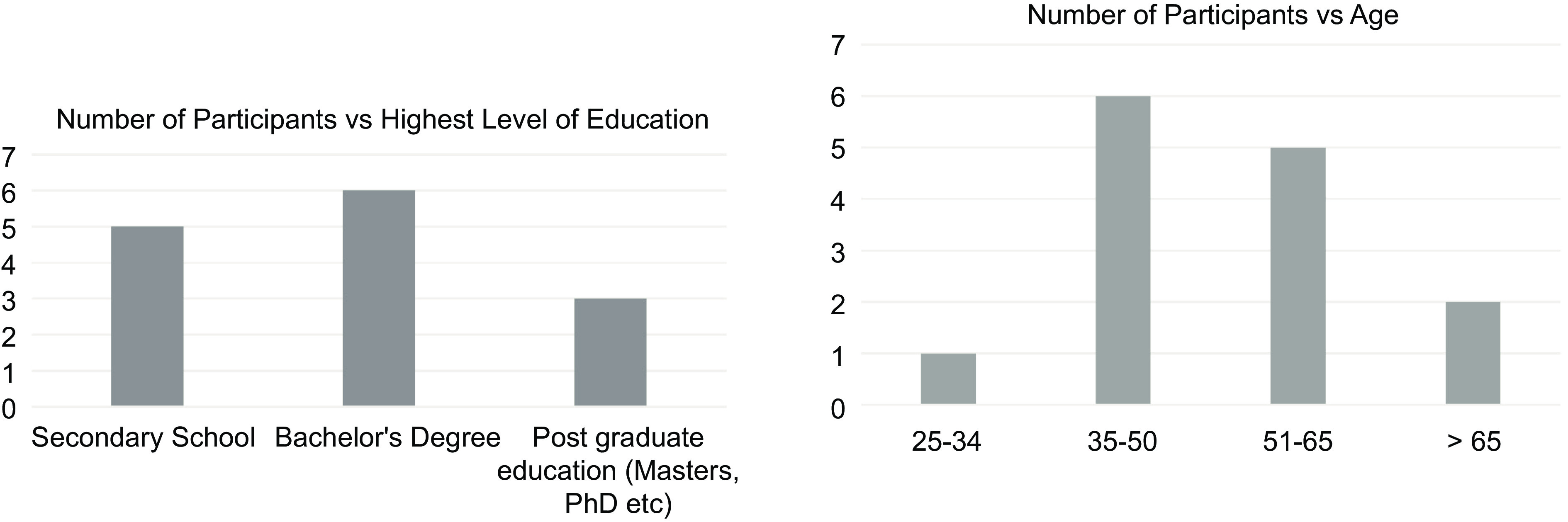
Figure 1.
Age of participants and their highest level of education.
This thematic analysis examines qualitative data from the patient interviews and focus groups to understand their perspectives on PROMs in the context of bowel cancer. Below, we present the key themes identified in the study (Table 1), along with illustrative patient statements that are further exemplified in Table 2, and subsequently discuss them in further detail.
Table 1. Table of concepts, themes and subthemes.
Concepts Themes Subthemes Awareness of PROMs Limited understanding of PROMs Impact of disease Important outcomes of measure (1) Disease's effect on life; (2) Side effects of treatment Patient services Individualistic PROMs' design and delivery (1) Contextual and individualised; (2) Delivery and engagement Optimism regarding PROMs' potential benefits (1) Benchmarking and Support Improving patient engagement (1) Improving care and awareness; (2) Timing with Appointments and Leveraging Healthcare Relationships; (3) Feedback and Tangible Outcomes; (4) Intrinsic motivation; (5) Interactive elements; (6) Visually effective presentations Table 2. Table of themes, subthemes and patients' statements.
Themes Subthemes Patients' statements 1. Limited understanding of PROMs • "I did a survey but didn't know it was PROMs."
• "I had read about it, but had no first-hand experience."
• "My understanding is to involve the patient in what the outcomes are going to… Well, not necessarily what they're going to be, but discussion with the patient. Also the patient's wishes and the family's wishes."
• "So for me, I guess it would be more about my expectations on my experience based on the information that I would have, as well as the information that I've been given from the professionals around me."
• "Patient-reported outcome measures, my understanding is it's about how cancer, the diagnosis, treatment, perhaps the side effects affect my life."2. Impact of bowel cancer on patients' lives Impact on daily life • "The recovery was a lot bigger than what I anticipated."
• "...if they haven't actually been through it, it's hard to probably explain some stuff. Whereas if you chat to somebody who has actually been through it, then it's like, 'Oh, okay.' And you are more likely I think, going to tell one of those people what your fears and your frights are and maybe ask some of those other questions that you may not ask your surgeon or your oncologist sort of thing."
• "So I think if it was within those first kind of couple of months, I would've said no. Or probably if I had have gotten a really long survey, I just would've left that email. I was in recovery mode and that was all I was concentrating on."
• "…bowel cancer did not register. I was told I had haemorrhoids. And so again, you're just kind of going along and believing what you thought was…"Specific symptoms and side effects • Neuropathy: "And then the neuropathy in my hands and feet. I still can't wear heels because I can't feel my feet properly, and my hands, especially when it's cold; it's like I've got really bad arthritis."
• Stoma: "I needed referrals for my stoma nurse, and I needed referrals for my district nurse that was coming out and things like that."
• Duration of recovery: "The duration of recovery was another key factor that patients identified as impacting their quality of life."3. Individualistic PROMs' design and delivery • "timing with appointments" and "getting information back"
• "…they were probably a little bit too generic, you know what I mean? I felt that they would've sent that particular survey to a patient that had possibly had surgery for a broken leg, and I'd had surgery for bowel cancer, and it just felt very generic. They weren't towards someone that had had cancer or anything."
• "…it should be tailored to that and the typical after-effects that you're getting from that... When something happens to you, generally you have these after-effects from that. If you have another circumstance, you have these sort of after-effects."
• "So if those things are well-known and well-framed, and you can answer a quiz within 15 minutes type thing, nice and easy, or, 'Have you experienced this? Have you experienced this? Have you experienced this?' Rather than a generic one that's got everything in us, a lot of things are going to be non-applicable."4. PROMs' potential benefits • "support", "follow", "treatment and outcomes"
• "…that's probably been the hugest thing for me. So probably a face-to-face survey like this would be more inclined to do."5. Improving patient engagement • "face-to-face, and there might be some changes put into action from me doing it."
• "I think it would be face-to-face. For me, it would be face-to-face and being able to kind of talk about it openly."
• "…if you had that person that did the follow-up two weeks later to see what your outcomes and kind of followed you along the process a little bit. That would work for me at least anyway."
• "…maybe either, as [name] said, I think for me, a face-to-face, whether that be even a phone call, because I think you could get a lot more information from a person or a patient over the phone than a survey."
• "I think if you could just take it home and read it in your own time, I think it would be helpful."
• "…one-on-one interaction like what we're doing here every, I don't know, whatever time period you guys can afford, depending on resources, would be quite useful to you…"Themes
Limited understanding of PROMs
-
Despite PROMs being considered important from a clinicians or researchers' perspective, patients' understanding and awareness of the presence and importance of PROMs is lacking. This also applied to patients who had completed PROM questionnaires as part of previous studies or care. Many participants expressed limited awareness, with comments such as:
"I did a survey but didn't know it was PROMs"
or
"I had read about it, but had no first-hand experience."
This lack of familiarity highlighted the need for more effective communication with patients surrounding PROMs to support informed engagement and enhance their practical value in healthcare settings.
Use of PROMs to evaluate the impact of bowel cancer on patients' lives
-
Evaluation of the impact of bowel cancer on an individual's daily living was one of the crucial themes emerging from the data. Patients consistently emphasised that PROMs should encompass the wide-ranging and multifaceted effects of bowel cancer and its treatment, moving beyond a focus on clinical outcomes alone, reflecting their desire to see this improve within their treatment journey. The following were the subthemes emerging from the patients' narratives.
Effect on life
-
Patients particularly highlighted the importance of assessing how the illness and its treatment affect their day-to-day lives. This includes a focus on mental health, especially anxiety, physical activity levels, and overall quality of life. These areas were frequently noted as critical to patients, demonstrating their significance in shaping the lived experience of managing bowel cancer. They also expressed a need for support which may not have been met during their individual treatment courses.
"But I guess the thing that probably surprised me the most, 'cause I've looked after people post-stomas and pre-stomas, I've handed out bowel prep and now I have to have my own medicine. So I'm a lot more sympathetic, but I must admit the actual bowel cancer journey, I did not expect at all the amount of impact that it has— ... Yeah, like I used to enjoy going to the gym, now I'm terrified of walking around a lap of the block with the dog for fear of pooing myself. So that's a bigger impact on my life than I actually ever thought imaginable."
Side effects of treatment
-
Patients also underscored the necessity of monitoring treatment-related side effects that interfere with daily functioning. Commonly mentioned concerns included bowel issues such as abdominal pain, bloating, and urgency, as well as neuropathy and challenges related to stoma management for those with stomas. The duration of recovery was another key factor that patients identified as impacting their quality of life. These insights reflect the diverse and complex challenges patients face, highlighting the need for PROMs to fully capture the depth and the enduring impact of their experiences during and after treatment.
"The recovery was a lot bigger than what I anticipated."
"I needed referrals for my stoma nurse, and I needed referrals for my district nurse that was coming out and things like that."
Individualistic PROMs' design and delivery
-
Patients expressed specific preferences regarding the design and delivery of PROMs, advocating for an individualistic approach that considers their needs and priorities. The subthemes that emerged from the data is as follows.
Contextual and individualised
-
This emerged as a key aspect of PROMs' design, with patients expressing a desire for tools tailored to their specific circumstances, age, and treatment stage. For instance, "age-specific symptoms" and "contextual or individualised" are mentioned as important considerations. There was also an overriding feeling of wanting to break away from "generic" questionnaires in order to reflect their individual experiences through a more bespoke approach. This reflects a fine line that needs to be drawn between collecting quantifiable, comparative data and capturing the essence of each patients' individual experience (as described in the narrative below). Timing may be crucial in the delivery of PROMs, as instruments delivered at optimum timing throughout the treatment course may provide the context required to make the most of PROM instruments. Furthermore, the specific details of each patients' treatment could trigger specific instruments, such as the case of rectal cancer treatment, which may differ from right colon tumours in the impact and side effect profile, and therefore quality of life after treatment.
"…it should be tailored to that and the typical after-effects that you're getting from that... When something happens to you, generally, you have these after-effects from that. If you have another circumstance, you have these sort of after-effects."
Delivery and engagement
-
Patients suggested aligning PROMs' administration with existing appointments, leveraging the patient–healthcare provider relationship to encourage participation. They also emphasised the importance of providing feedback on the results and highlighting tangible outcomes to maintain engagement. This is evident in their narratives, explicitly highlighting the need for "timing with appointments" and "getting information back".
PROMs' potential benefits
-
Despite their limited familiarity with PROMs, patients expressed optimism about their potential benefits in improving care and empowering patients. The narratives were descriptive of how PROMs could be delivered and benefited.
Benchmarking and support
-
Patients saw value in using PROMs to track their progress, benchmark against others, and identify areas where they might need additional support, especially during the period between treatment completion and follow-up. This is reflected in the emphasis on "benchmarking, predicting outcomes, open-source information" and "highlighting issues post treatment". The patients' words resonated across their narratives, which included "support", "follow", "treatment and outcomes".
Improving care and awareness
-
Patients believed that PROMs could contribute to improved consistency in care by providing valuable data to healthcare providers, potentially leading to more informed decision-making and better patient education. Some even saw potential in using PROMs' data to educate the wider community about bowel cancer and its impact.
Improving patient engagement
-
Several suggestions related to enhancing patient engagement appeared upon questioning patients on how to improve engagement in participating in PROM-focused surveys.
Feedback and tangible outcomes
-
Patients expressed a desire for more tangible feedback, such as receiving information on how their input is being used, which would motivate continued engagement.
Intrinsic motivation
-
Patients indicated that altruism and personal motivation, such as being able to contribute improving their own care and the care of others after them, plays a critical role in their willingness to engage with PROMs.
Timing with appointments and leveraging healthcare relationships
-
Patients highlighted the important role of rapport and established relationship of trust with their healthcare providers in encouraging participation, while maintaining convenience by aligning PROMs' collection with their healthcare appointments.
A systems framework for PROMs' introduction
-
Drawing on the principles and recommendations from the patient group, and the current literature, this study proposes a systems framework (Fig. 2) for delivering individualistic and timely questionnaires for benchmarking and monitoring the progress of bowel cancer patients throughout their treatment journey. The systems framework necessitates its integration at the population level to accomplish the outcomes desired by our patients who were undergoing treatment for bowel cancer. This is in line with the contemporary integration of PROMs into bowel cancer registries worldwide, providing an invaluable scaffolding for the incorporation of PROMs, extending the scope of a registry beyond the traditional metrics of morbidity and mortality.
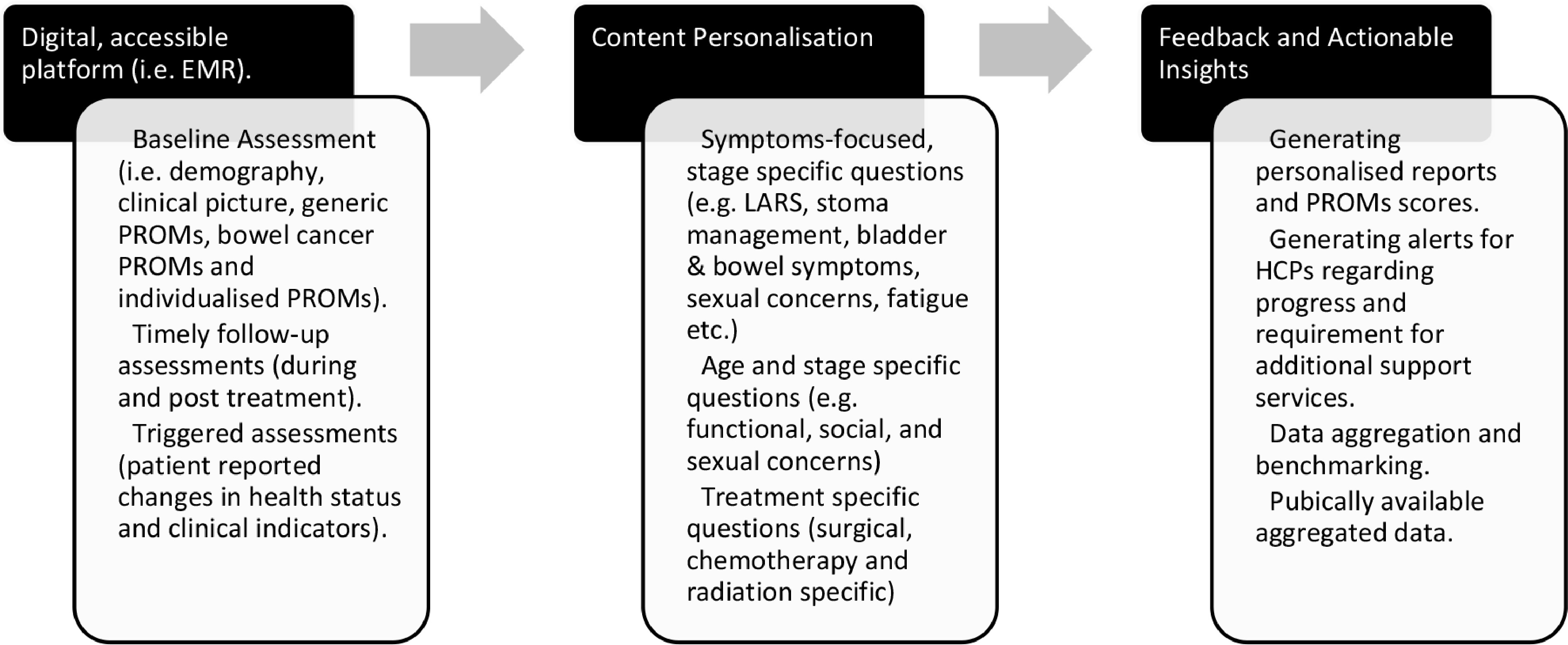
Figure 2.
Proposed systems framework.
-
PROMs are vital tools in healthcare for monitoring individual patients' progress and benchmarking healthcare service delivery. Research has shown multiple key successes of PROMs in enhancing communication between patients and healthcare professionals, detecting a lack of progress, and targeting symptom management[13]. The primary goal of investigating our patients' perspectives on bowel cancer outcomes is to enhance communication, understand their motivation, and identify barriers to participation in PROMs in order to propose the integration of PROMs to the cancer registries, which aligns with the interest of all involved stakeholders, particularly our patients.
Our patients' narratives revealed that awareness of PROMs is often lacking, which is echoed within the literature as a common challenge in PROMs' implementation[5]. A solution-focused approach to this challenge would involve providing our patients with clear, concise, and easy-to-understand information about PROMs, their purpose, and how the feedback will be used. Utilisation of graphs, charts, or other visual aids to present numerical data in a more accessible manner ties into the theme of improving patient engagement. Furthermore, offering personalised summaries of the findings and combining numerical scores with narrative explanations tailored to each participant's situation may be helpful. As highlighted in the study by Boomstra et al., some patients may prefer numerical feedback for tracking progress, although others might find narrative formats more emotionally supportive[5]. Offering both options could cater to diverse preferences.
Our second theme captures the broad and multifaceted biopsychosocial impact of bowel cancer on patients' daily lives, which highlights the importance of using PROMs that comprehensively assess these domains, moving beyond a narrow focus on clinical outcomes alone. Hence, selecting PROMs that have demonstrated reliability and validity in measuring relevant aspects of patients' experiences in bowel cancer may address the patients' voice. For instance, the European Organisation for Research and Treatment of Cancer Core Quality-of-Life Questionnaire (30-item version) (EORTC QLQ-C30) is a widely used instrument for assessing HRQoL in cancer patients[5,14]. The cntent validity of the tools used may be achieved by involving patients in the selection process, conducting cognitive interviews to assess comprehension, and reviewing the content against established frameworks for assessing quality of life in cancer. The 'BREAST-Q' is a successful example of a PROM implemented in routine practice[15].
The implementation of PROMs requires buy-in from both patients and their healthcare professionals. Challenges in PROMs' implementation from the perspectives of healthcare professionals is well documented in the literature. The healthcare professionals may have limited knowledge of PROMs or hold negative attitudes towards their implementation[3,16]. Administrative difficulties in administering and barriers in terms of local governance may also preclude the routine use of PROMs. Increased awareness of PROMs and demonstrating their benefits in patient care could help to stimulate discussion and spur on further efforts to improving both the quality of the instruments used as well as the accuracy and efficiency of data collection. Utilising electronic health records could facilitate data management and generate automated reports, enhancing efficiency and reducing the administrative burden[17].
The third theme highlights that one size does not fit all when it comes to PROMs. This is of interest in PROMs' design and delivery to consider individual patients' needs and priorities. This necessitates a move away from generic questionnaires towards a more personalised approach during appointments, leveraging the established patient–provider relationship to foster participation. This is intertwined with the theme of creating optimism by empowering patients to track their own progress and be part of a more robust system of informed decision-making. Studies underscore the centrality of patients' involvement in PROMs, with some advocating for patient-led approaches in cancer research[18,19] and others highlighting healthcare providers' view of PROMs as a tool to amplify patients' voices and enhance engagement[16,20].
Focusing on using PROMS as tools to inform patients understanding of their individual patient journey, to facilitate improved conversations with healthcare providers about the quality of life impacts of treatment, and to be an active rather than a passive data point are key. Patients are interested and happy to contribute to data that will improve care, but there needs to be tangible communication with patients and an opportunity for patients to have their quality of life concerns addressed.
The study proposes a systems framework for the optimum introduction of PROMs and advocates for a digital platform incorporating baseline and follow-up assessments, triggered assessments based on patient-reported changes and clinical indicators, and content personalisation based on symptoms, age, stage, and treatment specifics. Integrating the proposed systems framework into existing bowel cancer registries may enable a patient-centred approach to the introduction of PROMs.
The proposed systems framework provides a roadmap for this also represents an opportunity to incorporate the multiple disciplines essential to the care of bowel cancer patients such as oncology, social work, palliative care, thereby capturing a more holistic picture of the spectrum of the patients' journeys through bowel cancer.
The limitations of this study are that the sample of patients did not include elderly patients, and consideration of alternatives to digital approaches may need to be considered in ensuring the engagement of less technology-literate patients, as well as consideration of non-English speaking patients and appropriate translation of PROMs materials.
-
Recording quality of life metrics should be a routine part of quality registry input. Patients are willing to engage in PROMs once they have been explained adequately and there is tangible feedback of the results both for the improvement of their care and the wider bowel cancer community. Integrating quality of life metrics in an accessible and dynamic way into cancer registries is needed to drive progress. The proposed framework in this study could serve as a roadmap towards the practical integration of routine PROM collection.
Our co-author Nicole Cooper is sadly deceased. She was a patient representative and tremendous advocate for improving bowel cancer care and patients experience. She provided the inspiration and initial idea and work for this project and we acknowledge her immense contribution to this and to bowel cancer care in Australia. We also acknowledge the input of all our patients who participated in this study. Additionally, a portion of this manuscript, in its preliminary phase was presented as an ePoster at the Royal Australasian College of Surgeons 92nd Annual Scientific Congress in Christchurch from 6–10th May 2024. This manuscript expands upon that presentation with additional data, analysis, and discussion.
-
Ethical review was obtained through the Austin Health Human Research and Ethics Committee (reference: HREC90889). Informed consent for participation was obtained from all subjects involved in the study. Artificial intelligence not used in the preparation of this manuscript.
-
The authors confirm their contributions to the paper as follows: study conception and design: Ong HI, Mohan H, Smart P, Cooper N; data collection: Ong HI; analysis and interpretation of the results: Ong HI, Aurora H, Mohan H; draft manuscript preparation, review and editing: Ong HI, Aurora H, Mohan H, Smart P; supervision and context: Smart P, Proud D, Burgess A, Warrier S, Heriot A; validation: Proud D, Burgess A, Warrier S, Heriot A. All authors reviewed the results and approved the final version of the manuscript.
-
The datasets generated during and/or analyzed during the current study are not publicly available because they contain potential personally identifying factors but are available from the corresponding author on reasonable request.
-
The authors declare that they have no conflict of interest.
-
Copyright © 2026 by the author(s).
European Journal of Cancer Care published by Maximum Academic Press on behalf of John Wiley & Sons Ltd. This is an open access article under the terms of the Creative Commons Attribution License, which permits use, distribution and reproduction in any medium, provided the original work is properly cited. -
About this article
Cite this article
Ong HI, Aurora H, Heriot A, Cooper N, Proud D, et al. 2026. Our co-author Nicole Cooper is sadly deceased. She was a patient representative and tremendous advocate for improving bowel cancer care and patients experience. European Journal of Cancer Care 2026: e021 doi: 10.48130/ejcc-0026-0021 

Patient perspectives on patient-related outcome measures in bowel cancer and implications for a systems framework for their implementation in bowel cancer care
- Received: 17 March 2026
- Revised: 20 March 2026
- Accepted: 13 May 2026
- Published online: 30 October 2026
Abstract: Patient-reported outcome measures (PROMs) provide patients with avenues to report on the effects of treatment on their quality of life. Although it is agreed that quality of life should be measured and there has been increasing adoption of PROMs, there are few data on how this impacts patients' experience and how PROMs should be introduced at the registry level. This study aimed to take a patient-centred approach to examine patients' views of how quality of life is measured to inform future integration of PROMs in cancer registries. Bowel cancer patient volunteers were recruited to participate in semi-structured interviews and focus groups until thematic data saturation. Qualitative exploration was undertaken of 15 patients' views. Most participants (80%) had a limited understanding of the concept of PROMs and their purposes, but expressed that PROMs specific to their circumstances would yield better results and motivate engagement. They suggested that PROMs could provide open-source data for patients to benchmark their progress. Overwhelmingly, tthe participants felt that there was a void between completion of treatment and follow-up where support could be required. Despite a limited awareness of PROMs, our participants valued its potential in promoting patient empowerment while improving outcomes. Contextualising the delivery of appropriate PROMs to the patients' treatment course would improve engagement. Wider adoption of PROMs has the potential to improve our understanding of the recovery timeline from a patient perspective and should inform patient care allowing more patient-centred follow up and timely delivery of support.