











-
Ginger (Zingiber officinale Roscoe) is an economically important perennial herbaceous crop belonging to the genus Zingiber of the family Zingiberaceae. 'Yunnan Xiaohuangjiang' is highly valued for its distinctive flavor, bright appearance, and abundant bioactive constituents, including zingerone, gingerols, and shogaols[1]. In commercial production, ginger is conventionally propagated vegetatively using mature underground rhizomes as planting materials. However, this propagation method has a relatively low multiplication rate[2], and repeated vegetative propagation can lead to the gradual accumulation of pathogens and a decline in product quality and disease resistance[3], thereby becoming one of the major constraints on the sustainable development of the ginger industry. At present, shoot tip tissue culture has been widely adopted for the production of virus-free ginger planting materials. Nevertheless, the multiplication coefficient during subculture remains relatively low, generally ranging from 3.7 to 4.3[4−6]. Although some tissue culture systems have achieved multiplication coefficients of 6.2–7.6, their subculture cycle may extend to 45–50 d[7−9], substantially limiting the efficiency and scalability of in vitro ginger propagation. Therefore, optimizing culture conditions to improve shoot proliferation and plantlet growth while maintaining physiological quality is important for the efficient production of high-quality ginger planting materials.
Photoperiod, light intensity, and spectral composition are key environmental factors influencing the morphological development, physiological processes, and metabolic processes of in vitro plantlets[10,11]. Plants perceive and respond selectively to different wavelengths of light[12], and spectral composition can therefore be manipulated to regulate plant morphogenesis and development under controlled in vitro conditions. Recent studies have demonstrated that light quality is an important environmental signal in plant tissue culture and can affect callus induction, shoot and root organogenesis, plantlet growth, and acclimatization during micropropagation. In particular, red and blue wavelengths play important roles in regulating photosynthesis, photomorphogenesis, and biomass accumulation, while their effects may vary substantially among plant species and genotypes[13]. Thus, precise manipulation of spectral composition provides a potential means of engineering the in vitro light environment to achieve desired plant growth and physiological responses.
Compared with conventional fluorescent lamps with relatively fixed spectral characteristics, light-emitting diode (LED) systems offer advantages in energy efficiency and, more importantly, allow flexible adjustment of spectral composition and light intensity[14]. This spectral controllability enables LED systems to function not merely as light sources but as environmental regulation tools for manipulating plant morphogenesis and metabolism under controlled cultivation conditions[15]. Increasing evidence indicates that different LED spectra or spectral combinations can produce distinct effects on the growth and physiological characteristics of plantlets. Previous studies have shown that monochromatic red or blue light alone is unfavorable for plant growth and may reduce photosynthetic performance[16]. In contrast, combined red and blue light is more effective than white light in promoting leaf area expansion and biomass accumulation in tomato seedlings[17]. Red–blue light has been reported to promote chlorophyll accumulation and photosynthesis-related gene expression in tissue-cultured seedlings of Nauclea officinalis[18]. Several studies have suggested that blue light enhances the photosynthetic capacity per unit leaf area by increasing stomatal aperture[19]. Blue light also facilitates the biosynthesis and accumulation of secondary metabolites[20]. Both far-red light and visible light have been reported to induce floral bud differentiation[21]. Among these, far-red light can be efficiently utilized by plants to promote leaf expansion, enhance canopy light interception, and increase the overall photosynthetic rate of shaded leaves[22,23]. In Nasturtium officinale microshoot cultures, different LED wavelengths and combinations significantly affected biomass accumulation, photosynthetic pigments, and soluble sugars, demonstrating that spectral regulation can influence both plant growth and the accumulation of bioactive compounds under in vitro conditions[24]. In ginger, Gnasekaran et al. reported that different LED spectral qualities affected chloroplast ultrastructure and adventitious bud anatomy in in vitro Z. officinale var. rubrum Theilade plantlets, while high genetic similarity was maintained among regenerated plantlets[25]. These characteristics make LED systems particularly suitable for the precise and reproducible regulation of the in vitro light environment.
Beyond its direct effects on plant growth, the controllability of LED spectra provides an opportunity to integrate light regulation with modern crop improvement strategies. In molecular breeding and genetic engineering, controlled environmental inputs are increasingly important for evaluating genotype-dependent phenotypes and for dissecting the interactions between genetic background and environmental signals. Because LED systems allow specific wavelength bands and their relative proportions to be adjusted reproducibly, spectral regulation can be used as an auxiliary environmental input for phenotypic screening of breeding materials, genetically engineered lines, or molecularly selected germplasm. In tissue culture, such controlled light environments may be particularly useful because environmental conditions can be standardized during the regeneration, proliferation, and early growth of plant materials.
Current studies on in vitro propagation of ginger have primarily focused on optimizing shoot-tip sterilization protocols, reducing microbial contamination, and improving the types and concentrations of plant growth regulators in the culture medium. Although previous research has demonstrated that LED spectral quality can affect the physiological and structural characteristics of in vitro ginger plantlets, systematic evaluation of different red, blue, and far-red spectral combinations during ginger subculture remains limited. Therefore, in this study, Z. officinale 'Yunnan Xiaohuangjiang' was used as the experimental material to investigate the effects of different combinations of red, blue, and far-red light on adventitious shoot proliferation, rooting, leaf chlorophyll content, and soluble substance accumulation during in vitro culture. The findings are expected to provide both a theoretical basis and technical support for improving the quality and propagation efficiency of in vitro ginger plantlets and for developing more precisely controlled LED lighting strategies for ginger micropropagation.
-
The experiment was conducted in the tissue culture laboratory of the College of Horticulture, Nanjing Agricultural University, from December 2025 to July 2026. Healthy adventitious shoots induced from shoot-tip explants of Z. officinale Roscoe 'Yunnan Xiaohuangjiang' were used as the experimental materials. Stem segments approximately 1.0 cm in length were retained and cultured on Murashige & Skoog (MS) medium supplemented with 0.1 mg·L−1 NAA, 2.0 mg·L−1 6-benzyladenine (6-BA), 30 g·L−1 sucrose, and 7 g·L−1 agar. All cultures were placed on the same tissue culture racks before the LED spectral treatments were initiated. The interval between successive subcultures was 40 d.
Experimental design
-
White light (W, 410–790 nm) was used as the control, and six LED spectral combinations consisting of red light (R, 660 nm), blue light (B, 460 nm), and far-red light (FR, 730 nm) at different spectral ratios were established, as listed in Table 1. The spectral distributions of all treatments are presented in Fig. 1. Each culture rack was enclosed with black light-shielding fabric to ensure that the experimental LED lighting served as the sole light source for plantlet growth. The photosynthetic photon flux density (PPFD) was maintained at 35 ± 2 μmol·m−2·s−1 for all treatments. The day and night temperatures were maintained at 23 ± 2 °C and 18 ± 2 °C, respectively, with a photoperiod of 10 h·d−1, a relative humidity of 55%, and a CO2 concentration of 400 μmol·mol−1.
Table 1. Spectral parameters of different LED spectral treatments.
Treatment Peak wavelength
λp (nm)Full width at half
maximum Δλ (nm)PPFD
(μmol·m−2·s−1)W 410~790 − 36 R1B1 660/460 17–18 36 R2B1 660/460 19 36 R3B1 660/460 17–19 36 R4B1 660/460 16–18 35 R3B3FR1 660/460/730 17–19 35 R4B2FR1 660/460/730 18–20 35 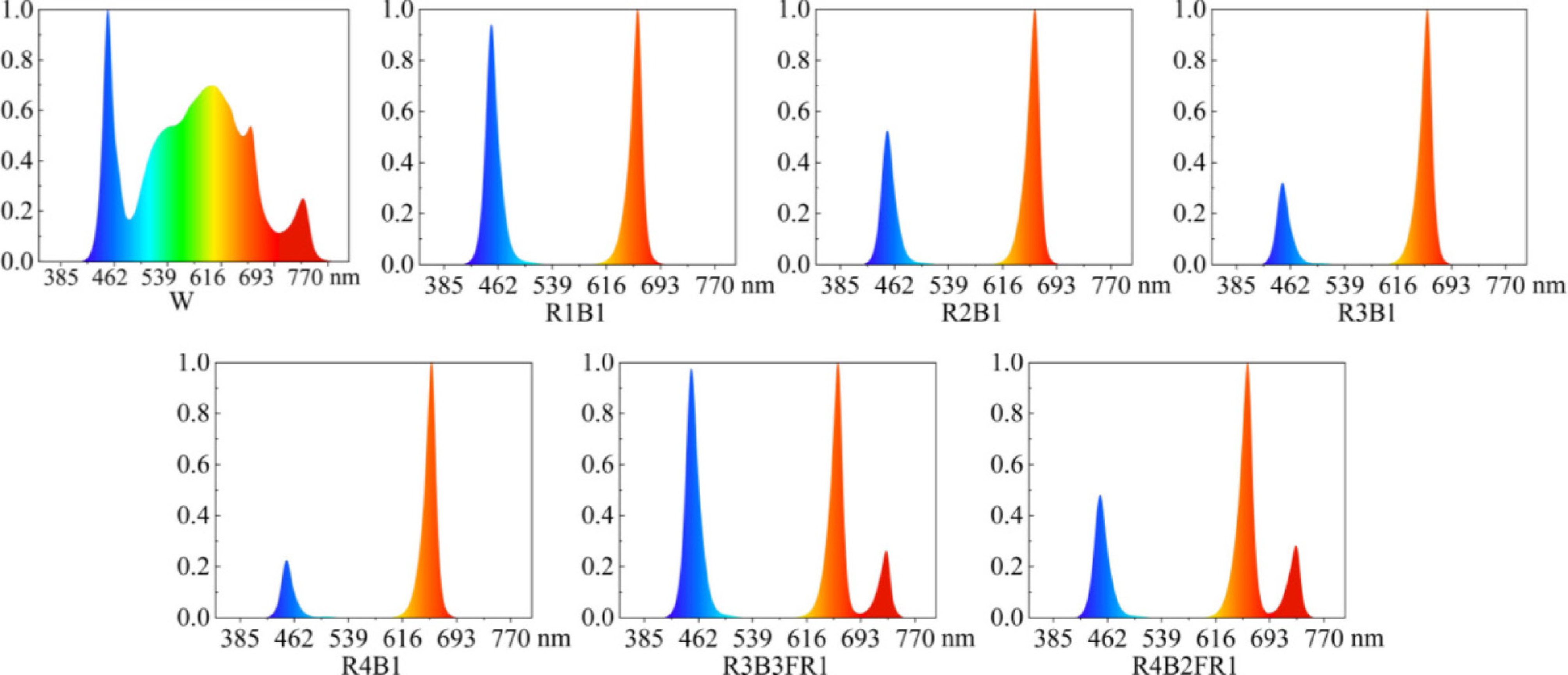
Figure 1.
Spectral distribution profiles of different LED treatments.
Measurements and methods
Morphological and growth parameters
-
After 40 d of subculture, three clustered shoots were randomly selected from each treatment for morphological measurements. The proliferation coefficient was calculated as the ratio of the number of regenerated shoots to the total number of inoculated explants. Plant height (measured from the stem base to the shoot apex), stem diameter, and root length were determined using a digital vernier caliper. Fresh weight of clustered shoots was measured using an analytical balance. The shoots were initially dried at 105 °C for 10 min and subsequently oven-dried at 70 °C to a constant weight before dry weight was determined using an analytical balance. Each measurement was performed with three biological replicates.
Physiological parameters
-
Fresh leaves of in vitro plantlets of Z. officinale 'Yunnan Xiaohuangjiang' were collected, and the midribs were removed prior to physiological analyses. The contents of chlorophyll a, chlorophyll b, and carotenoids were determined according to the method described by Zhang et al.[18]. Soluble protein content was determined using the Coomassie Brilliant Blue staining method. Soluble sugar content was determined using the anthrone colorimetric method[26].
Comprehensive evaluation
-
A membership function analysis was performed to comprehensively evaluate all measured parameters and identify the optimal LED spectral combination for the subculture proliferation stage of Z. officinale 'Yunnan Xiaohuangjiang'. The membership function was calculated using the following equation:
$ \mathrm{U(X)=(X-X}_{\mathrm{min}}\mathrm{)/(X}_{\mathrm{\max}}\mathrm{-X}_{\mathrm{min}}\mathrm{)}\ $ where, U(X) represents the membership function value, X is the measured value of a given parameter, and Xmax and Xmin represent the maximum and minimum values of that parameter, respectively.
Statistical analysis
-
Experimental data were organized using Microsoft Excel 2019. Statistical analyses were performed using IBM SPSS Statistics 27.0. One-way analysis of variance (ANOVA) followed by Duncan's multiple range test (DMRT) was used to determine significant differences among treatments, with p < 0.05 considered statistically significant. Data are presented as mean ± SD (n = 3). Figures were generated using Origin 2024.
-
As shown in Fig. 2, the proliferation coefficient of adventitious shoots differed significantly among the LED spectral treatments compared with the white light (W) control. Under different red-to-blue spectral combinations, the proliferation coefficient of adventitious shoots ranged from 5.67 to 7.67. R2B1 and R3B1 resulted in significantly higher proliferation coefficients than the other treatments, reaching 7.00 and 7.67, respectively, which represented increases of 61.66% and 77.14%, respectively, relative to W. Under different red–blue–far-red spectral combinations, R4B2FR1 achieved the highest proliferation coefficient, which was 61.66% and 10.58% higher than those of W and R3B3FR1, respectively.
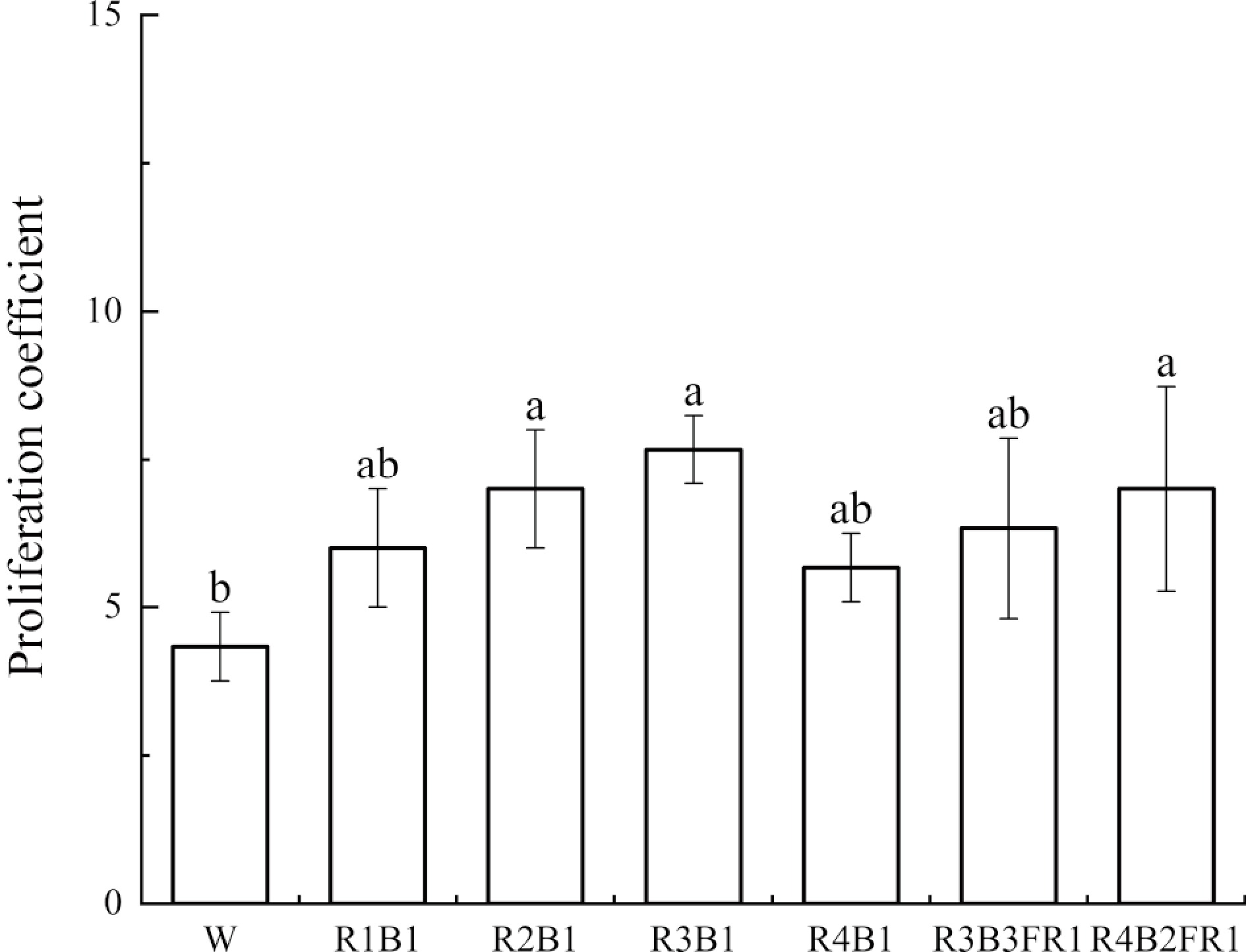
Figure 2.
Effects of different LED spectral combinations on the subculture proliferation coefficient of adventitious shoots. Note: Different lowercase letters in the same column indicate significant differences among treatments at the 0.05 level. The same below.
Effects of different LED spectral combinations on the morphological characteristics of adventitious shoots
-
As shown in Table 2, the different LED spectral treatments resulted in significant differences in plant height, stem diameter, fresh weight, dry weight, root length, and root number of adventitious shoots relative to the W treatment. The morphological performance of individual clustered shoots and the overall growth status of ginger plantlets within culture bottles under various light-spectrum treatments are presented in Fig. 3. Under different red-to-blue spectral combinations, R2B1 resulted in the greatest stem diameter, fresh weight, and dry weight of clustered shoots, which were 26.87%, 57.14%, and 22.22% higher than those under W, respectively. R3B1 resulted in the greatest mean plant height and fresh weight, which increased by 24.50% and 59.74%, respectively, relative to W. However, the stem diameter of adventitious shoots under R3B1 was 12.35% lower than that under R2B1. Under different red–blue–far-red spectral combinations, R4B2FR1 resulted in the highest fresh weight and dry weight of clustered shoots, which were 45.89% and 14.81% higher than those under W, respectively, whereas the average root length decreased by 18.46%. Furthermore, relative to R1B1, R3B3FR1 increased plant height, stem diameter, fresh weight, and dry weight by 5.19%, 5.61%, 18.94%, and 11.54%, respectively. However, relative to R2B1, R4B2FR1 resulted in a decrease in plant height, fresh weight, and dry weight to varying degrees.
Table 2. Effects of different LED spectral combinations on the morphological characteristics of adventitious shoots.
Treatment Mean plant
height (mm)Stem
diameter (mm)Fresh weight of shoot
clusters (g)Dry weight of shoot
clusters (g)Root number per
shoot clusterRoot length (mm) W 28.53 ± 4.10d 2.68 ± 0.71c 2.31 ± 0.14c 0.27 ± 0.02cd 13.00 ± 1.00abc 33.97 ± 0.45a R1B1 30.65 ± 2.79cd 3.03 ± 0.47abc 2.64 ± 0.31bc 0.26 ± 0.03cd 15.33 ± 1.53a 29.98 ± 2.33ab R2B1 33.98 ± 2.64ab 3.40 ± 0.31a 3.63 ± 0.86a 0.33 ± 0.01a 14.67 ± 3.06ab 30.82 ± 2.67ab R3B1 35.52 ± 3.12a 2.98 ± 0.34abc 3.69 ± 0.71a 0.28 ± 0.03bcd 11.33 ± 1.15bc 28.75 ± 3.06b R4B1 31.89 ± 1.25bc 2.85 ± 0.60bc 3.17 ± 0.36abc 0.25 ± 0.02d 10.33 ± 0.58c 28.46 ± 1.09b R3B3FR1 32.24 ± 1.67bc 3.20 ± 0.30ab 3.14 ± 0.21abc 0.29 ± 0.01bc 14.00 ± 3.00ab 30.13 ± 1.70ab R4B2FR1 32.66 ± 1.65bc 3.15 ± 0.26abc 3.37 ± 0.12ab 0.31 ± 0.02ab 14.67 ± 0.58ab 27.70 ± 3.75b 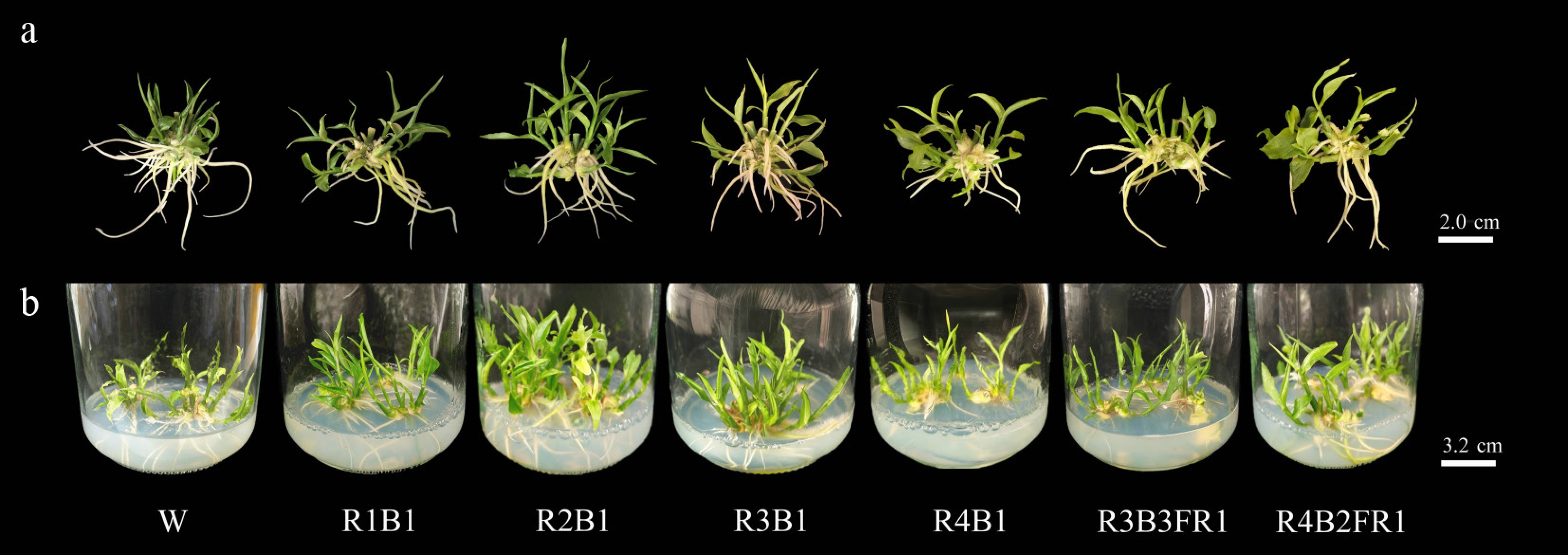
Figure 3.
Effects of different LED spectral combinations on the overall growth and morphology of in vitro multiple shoots. Note: (a) morphology of subcultured in vitro ginger plantlets; (b) growth status of in vitro ginger plantlets in culture bottles.
Effects of different LED spectral combinations on leaf pigment contents of in vitro ginger plantlets
-
As shown in Fig. 4, different LED spectral combinations exerted distinct effects on leaf pigment contents in Z. officinale 'Yunnan Xiaohuangjiang'. Under different red-to-blue spectral combinations, R1B1 resulted in significantly higher chlorophyll a, total chlorophyll, and carotenoid contents than the other treatments, which increased by 36.07%, 36.59%, and 33.06%, respectively, relative to W. R4B1 resulted in the lowest chlorophyll a and total chlorophyll contents. The highest chlorophyll b content was observed under R2B1, representing a 9.05% increase relative to W. In addition, R3B3FR1 significantly reduced chlorophyll a and carotenoid contents relative to R1B1. Relative to R2B1, the chlorophyll b content was significantly lower under R4B2FR1.
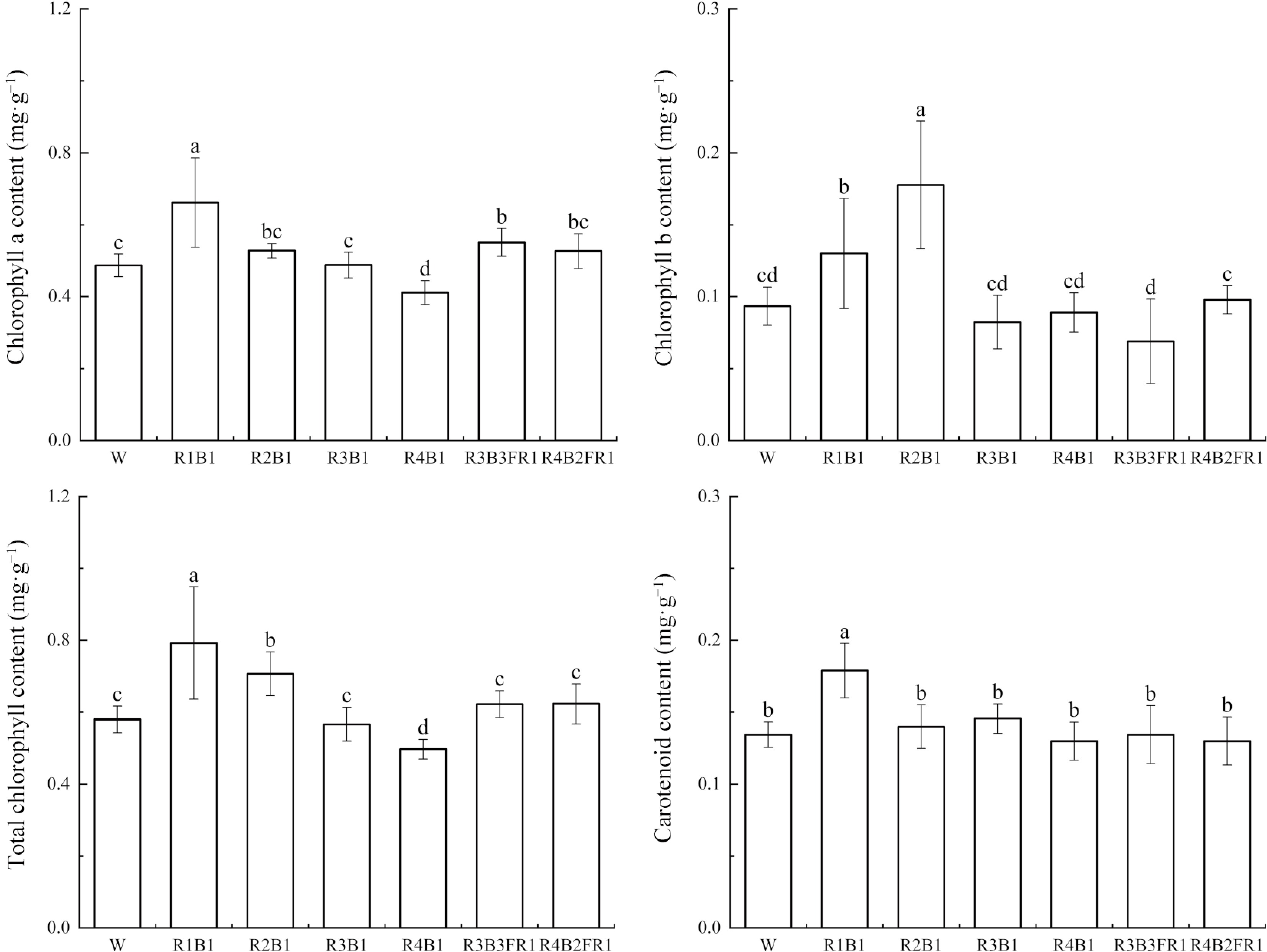
Figure 4.
Effects of different LED spectral combinations on leaf pigment contents.
Effects of different LED spectral combinations on soluble substance contents in leaves of in vitro ginger plantlets
-
As shown in Fig. 5, the soluble protein content in leaves ranged from 2.51 to 3.16 mg·g−1 under different LED spectral treatments and was significantly lower than that under W in all cases. The highest soluble protein content was recorded in W (3.30 mg·g−1), followed by R1B1, which was 4.21% lower than W. The lowest soluble protein contents were observed under R3B1 and R4B1, which decreased by 21.19% and 23.88%, respectively, relative to W.
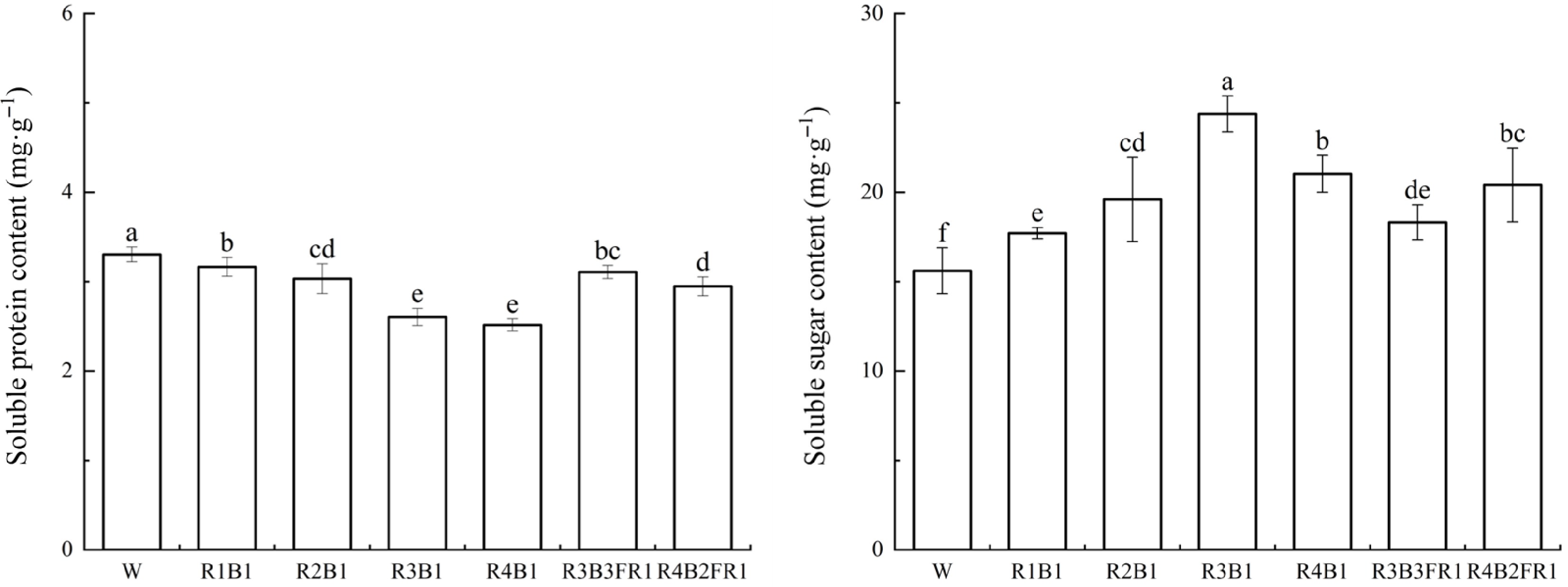
Figure 5.
Effects of different LED spectral combinations on the contents of soluble protein and soluble sugar in leaves.
Under different red-to-blue spectral combinations, the soluble sugar content ranged from 17.71 to 24.37 mg·g−1, with the highest value observed under R3B1, representing a 56.09% increase over W. R4B1 produced the second-highest soluble sugar content. Under different red–blue–far-red spectral combinations, the highest soluble sugar content was obtained under R4B2FR1, reaching 20.39 mg·g−1, which was 30.56% higher than that under W. Furthermore, compared with R1B1, the soluble sugar content under R3B3FR1 increased by 3.51%. Compared with R2B1, the soluble sugar content under R4B2FR1 increased by 4.01%.
Comprehensive evaluation
-
To comprehensively evaluate the effects of different combinations of red, blue, and far-red spectral combinations on adventitious shoot development and to identify the optimal LED spectral combinations for the subculture stage of Z. officinale 'Yunnan Xiaohuangjiang', a membership function analysis was performed using the proliferation coefficient, morphological traits (including plant height and stem diameter), leaf pigment contents, and soluble substance contents as evaluation indices. The calculated results are presented in Table 3. The comprehensive evaluation ranked R2B1 first, followed by R1B1, whereas R4B1 received the lowest overall score.
Table 3. Comprehensive evaluation.
W R1B1 R2B1 R3B1 R4B1 R3B3FR1 R4B2FR1 Proliferation coefficient 0.00 0.50 0.80 1.00 0.40 0.60 0.80 Mean plant height (mm) 0.00 0.30 0.78 1.00 0.48 0.53 0.59 Stem diameter (mm) 0.00 0.49 1.00 0.42 0.24 0.72 0.65 Fresh weight of shoot clusters (g) 0.00 0.24 0.96 1.00 0.62 0.60 0.77 Dry weight of shoot clusters (g) 0.25 0.13 1.00 0.38 0.00 0.50 0.75 Root length (mm) 0.53 1.00 0.87 0.20 0.00 0.73 0.87 Root number per shoot cluster 1.00 0.36 0.50 0.17 0.12 0.39 0.00 Total chlorophyll content (mg·g−1) 0.28 1.00 0.71 0.23 0.00 0.42 0.43 Carotenoid content (mg·g−1) 0.09 1.00 0.20 0.32 0.00 0.09 0.00 Soluble protein content (mg·g−1) 1.00 0.82 0.66 0.11 0.00 0.75 0.55 Soluble sugar content (mg·g−1) 0.00 0.24 0.46 1.00 0.62 0.31 0.54 Mean 0.29 0.55 0.72 0.53 0.23 0.51 0.54 Overall ranking 6 2 1 4 7 5 3 -
In recent years, light-emitting diode (LED) lighting has been increasingly applied in plant tissue culture owing to its high energy efficiency and flexible spectral regulation. The ability to precisely manipulate spectral composition provides an effective approach for establishing controlled light environments and regulating morphogenetic responses during in vitro plant propagation. Current studies on ginger tissue culture have mainly focused on the effects of monochromatic red or blue light on callus induction and shoot proliferation, or on the growth responses of in vitro plantlets under white light supplemented with individual red, blue, or green wavelengths[27]. However, the effects of different LED spectral combinations on adventitious shoot proliferation of Z. officinale 'Yunnan Xiaohuangjiang' have received limited attention. In the present study, under different red-to-blue spectral combinations, both the proliferation coefficient and fresh biomass of clustered shoots increased progressively with increasing proportions of red light and reached their highest values under R2B1 and R3B1. The greatest stem diameter and dry biomass were obtained under R2B1, whereas the average root length gradually decreased with increasing red light proportion and reached the lowest value under R4B1. These results suggest that the balance between red and blue light is an important factor determining the allocation of growth responses between shoot proliferation and root development in ginger plantlets. Under the conditions tested in this study, increasing the proportion of red light initially promoted shoot proliferation and biomass accumulation, whereas a relatively higher proportion of blue light appeared to favor root development. This finding is consistent with previous studies in strawberry and basil[28,29]. However, the proliferation coefficient of ginger adventitious shoots declined markedly under R4B1, accompanied by the lowest root number and root length. This response may be associated with the reduced proportion of blue light, which was accompanied by weaker root development. The resulting reduction in root number and length may have limited the capacity of the plantlets to acquire nutrients from the culture medium, thereby contributing to the decline in shoot proliferation under R4B1. Furthermore, supplementation with 14% far-red light (R3B3FR1) under a 1:1 red-to-blue spectral combination significantly increased plant height and shoot biomass compared with R1B1. The response suggests that a relatively small proportion of far-red radiation can further modify the growth response of ginger plantlets under a balanced red-to-blue background. This finding is consistent with previous observations in soybean[30]. From the perspective of controlled cultivation, this finding suggests that fine-tuning the spectral composition, rather than just increasing the intensity of a single wavelength, might be an effective way to boost biomass accumulation during ginger subculture.
Photosynthetic pigments reflect the capacity of plants to capture and utilize light energy and are closely associated with plant growth, quality, and tolerance to environmental stress. Previous studies have shown that blue light promotes chloroplast development[31], increases chlorophyll content compared with white light[32], and that the absence of blue light often results in abnormal plant growth[33]. In contrast, monochromatic red light has been reported to reduce carotenoid accumulation in lettuce[34], whereas other studies have demonstrated that red light can enhance chlorophyll and carotenoid content in eggplant leaves compared with blue light[35]. The differences between studies also highlight that spectral responses depend on species and genotypes, suggesting that a single wavelength is usually not the best choice for pigment accumulation. In the present study, the highest total chlorophyll and carotenoid contents were observed under R1B1, which agrees with the findings reported by Cammarisano et al[36]. Moreover, supplementation with far-red light significantly reduced total chlorophyll and carotenoid contents without affecting plant biomass. This phenomenon may be associated with the shade-avoidance response induced by far-red light. Leschevin et al. further suggested that the reduction in carotenoid content under far-red light primarily results from inhibited carotenoid biosynthesis rather than enhanced degradation[37]. Notably, the spectral treatment that maximized pigment accumulation did not necessarily produce the greatest biomass. This finding suggests that optimization of the in vitro light environment should consider both plant physiological status and adventitious shoot proliferation rather than relying on a single growth or biochemical indicator.
Soluble proteins function not only as important osmotic regulators but also as essential components of numerous enzymes in plants[38]. Previous studies have demonstrated that blue light upregulates genes associated with nitrogen metabolism and protein biosynthesis and alleviates protein degradation by regulating reactive oxygen species signaling[39,40]. In contrast, red light has been reported to promote HY5 accumulation and regulate nitrogen metabolism-related genes, thereby providing sufficient substrates for amino acid and protein synthesis[41]. In the present study, the highest soluble protein content was observed under W. Under different red-to-blue spectral combinations, soluble protein content gradually decreased with increasing red light proportion and reached the lowest value under R4B1. This result differs from that reported in potato by Pannico et al.[42], suggesting that the optimal spectral composition for soluble protein accumulation varies among plant species. Furthermore, supplementation with 14% far-red light also reduced soluble protein content to varying degrees. The contrasting responses of soluble protein accumulation and shoot biomass further indicate that spectral optimization should be evaluated using multiple physiological and growth-related parameters.
Changes in soluble sugar content reflect carbon metabolism during plant growth and development. Previous studies have shown that red light enhances the expression of sugar metabolism-related genes[43], and that monochromatic red light promotes soluble sugar accumulation in kiwifruit leaves more effectively than monochromatic blue light[44]. Li et al. further reported that combined red and blue light promotes soluble sugar biosynthesis more effectively than white light[45]. Consistent with these findings, soluble sugar content increased significantly with increasing proportions of red light in the present study, indicating that red light facilitates soluble sugar accumulation in ginger leaves[46]. In addition, supplementation with far-red light further promoted soluble sugar accumulation. The increase in soluble sugar content under red-enriched and far-red-supplemented treatments may indicate enhanced carbon assimilation or altered carbon partitioning; however, further measurements of photosynthetic rate and carbohydrate metabolism would be required to distinguish between these possibilities. The accumulation of soluble sugars may also contribute to the physiological quality of tissue-cultured plantlets, although whether this response improves their performance during ex vitro acclimatization requires further investigation.
The results obtained in this study demonstrate that different LED spectral combinations optimized different aspects of ginger plantlet performance. The membership function analysis provided a quantitative means of integrating these multiple parameters and identified R2B1 as the treatment with the most favorable overall performance. The superior comprehensive performance of R2B1 may reflect an appropriate balance between red and blue radiation that supports shoot multiplication, biomass accumulation, and soluble sugar accumulation without causing the unfavorable root and physiological responses observed under more strongly red-enriched treatments. Thus, R2B1 can be considered the most suitable spectral condition among those tested for the subculture proliferation of Z. officinale 'Yunnan Xiaohuangjiang'. From a bioengineering standpoint, spectral composition serves as a finely tunable environmental factor for in vitro culture systems. Nevertheless, the optimal spectral regime obtained in the present study is cultivar- and condition-dependent. Further verification is therefore needed before extending these findings to other ginger genotypes or alternative culture systems. The controllability of LED spectral composition also provides potential opportunities for integrating light regulation with crop germplasm innovation. In molecular breeding, genetically selected materials can exhibit different responses to environmental signals, and standardized light conditions can improve the comparability of phenotypic evaluations. LED spectral regulation could therefore be used as an auxiliary environmental input for screening breeding populations or molecularly selected germplasm according to propagation capacity, plantlet vigor, pigment accumulation, or other target traits. In genetic engineering studies, controlled spectral environments may further facilitate the comparison of gene-edited or transgenic lines by reducing variation caused by uncontrolled light conditions and by revealing genotype-dependent responses to specific spectral cues. Such applications could help connect molecular-level genetic modification with measurable plant phenotypes during early developmental stages.
The differential accumulation of photosynthetic pigments and soluble sugars observed in the present study also suggests a potential pathway for integrating spectral regulation with nutritional trait improvement. LED spectra can act as environmental signals that modify carbon allocation and the accumulation of photosynthetically related metabolites, while genetic engineering can be used to target the metabolic pathways underlying nutritional traits. Combining these approaches could provide a two-level strategy in which genetic modification establishes the metabolic capacity of a germplasm, whereas controlled LED spectra modulate the expression or accumulation of target compounds during in vitro culture. For ginger, such an integrated strategy may be explored for improving nutritionally or functionally important compounds, including pigments, soluble carbohydrates, and other specialized metabolites. However, this potential application requires further validation through transcriptomic, metabolomic, and functional genetic studies.
From an engineering perspective, the present results establish LED spectral composition as a quantifiable and adjustable environmental parameter rather than merely a conventional cultivation condition. The combination of defined spectral ratios, measurable phenotypic responses, and comprehensive performance evaluation provides a framework for optimizing light environments according to specific production or breeding objectives. Such a controllable platform could potentially be integrated with molecular breeding, genetic engineering, and metabolic engineering approaches to facilitate genotype screening and the controlled enhancement of target plant traits.
-
Overall, this study demonstrates that LED spectral composition can serve as a precisely controllable environmental parameter for regulating the proliferation, biomass accumulation, and physiological characteristics of in vitro-cultured Z. officinale 'Yunnan Xiaohuangjiang'. Among the tested spectral combinations, R2B1 showed the most favorable overall performance in subculture proliferation and promoted fresh and dry biomass accumulation in clustered shoots. However, the optimal spectral condition varied among physiological traits, with R1B1 favoring photosynthetic pigment accumulation and R3B1 promoting soluble sugar accumulation. Comprehensive evaluation using the membership function method identified R2B1 as the most suitable spectral condition for ginger subculture proliferation under the tested culture conditions. The quantitative responses observed in this study, including a 61.66%–77.14% increase in proliferation coefficient under R2B1, R3B1, and R4B2FR1 relative to white light, a 57.14% increase in fresh weight and a 22.22% increase in dry weight under R2B1, and increases of 36.59% and 33.06% in total chlorophyll and carotenoids under R1B1, demonstrate the potential of spectral regulation for targeted improvement of key propagation and physiological traits. These findings establish LED spectral composition as a controllable environmental input for optimizing in vitro cultivation conditions.
Beyond micropropagation, controlled LED spectral regulation may serve as an auxiliary platform for crop germplasm innovation by providing standardized environmental conditions for phenotypic evaluation of molecularly selected, gene-edited, or genetically engineered materials. The combination of controlled spectral inputs with molecular breeding or genetic engineering may also provide a future strategy for modulating the accumulation of nutritionally or functionally important compounds. Further integration with transcriptomic, metabolomic, and functional genetic approaches will be required to validate these applications. Thus, LED spectral regulation provides a promising engineering interface between controlled plant cultivation, micropropagation, and future crop breeding and quality-improvement strategies.
The authors sincerely thank the Tissue Culture Laboratory of the College of Horticulture, Nanjing Agricultural University, for providing the experimental facilities and technical support throughout this study. We also thank our colleagues for their valuable discussions and technical assistance during the experiments. In particular, we are deeply grateful to Professor Sheng Shu for his valuable guidance, constructive suggestions, and continuous support throughout the design and implementation of this research, as well as the preparation of the manuscript.
-
This study only utilised plant explants for experiments; therefore, ethics approval was not required. During the preparation of this work, Li R used ChatGPT (GPT-5.5; OpenAI) solely for language refinement. Li R reviewed and edited all content produced with the assistance of this tool, verified its accuracy, and takes full responsibility for the integrity and originality of the final manuscript. ChatGPT was accessed through a personal, non-institutionally licensed account.
-
The authors confirm their contributions to the paper as follows: study conception and design: Li R, Shu S, Wang J, Lu J; data collection: Li R; analysis and interpretation of results: Yu W, Xiao L, Xue Y, Yao F; draft manuscript preparation: Li R, Shu S. All authors reviewed the results and approved the final version of the manuscript.
-
All data generated or analyzed during this study are included in this published article.
-
The authors declare that they have no conflict of interest.
-
Copyright © 2026 by the author(s).
Engineering in Life Sciences published by Maximum Academic Press on behalf of John Wiley & Sons Ltd. This is an open access article under the terms of the Creative Commons Attribution License, which permits use, distribution and reproduction in any medium, provided the original work is properly cited. -
About this article
Cite this article
Li R, Wang J, Lu J, Yu W, Xiao L, et al. 2026. Engineering ginger (Zingiber officinale) micropropagation via designed LED light spectra. Engineering in Life Sciences 26: e017 doi: 10.48130/els-0026-0018 

Engineering ginger (Zingiber officinale) micropropagation via designed LED light spectra
- Received: 28 July 2026
- Revised: 22 September 2026
- Accepted: 28 September 2026
- Published online: 28 October 2026
Abstract: Adventitious shoot segments derived from shoot tip explants of Zingiber officinale 'Yunnan Xiaohuangjiang' were used to evaluate LED spectral regulation as a controllable environmental input for regulating shoot proliferation, plantlet growth, photosynthetic pigment accumulation, and soluble substance accumulation during in vitro culture. Different red, blue, and far-red spectral combinations were applied to establish controlled light environments, and quantitative responses in proliferation, biomass accumulation, root development, photosynthetic pigments, and soluble substances were evaluated. Among the tested spectral combinations, R2B1, R3B1, and R4B2FR1 produced the highest proliferation coefficients, representing increases of 61.66%–77.14% relative to white light (W). R2B1 increased the fresh and dry weights of clustered shoots by 57.14% and 22.22%, respectively, and increased stem diameter by 26.87% relative to W. R1B1 resulted in the highest total chlorophyll and carotenoid contents, with increases of 36.59% and 33.06%, respectively, relative to W, whereas R3B1 increased soluble sugar content by 56.09%. Comprehensive evaluation using the membership function method identified R2B1 as the spectral treatment with the most favorable overall performance under the tested culture conditions. These results demonstrate that controlled adjustment of LED spectral composition can generate distinct and measurable responses in key propagation and physiological parameters of ginger plantlets. The findings provide a quantitative basis for LED spectral regulation to optimize controlled in vitro cultivation conditions and improve the efficiency and quality of ginger micropropagation.