














-
Poplars (Populus spp.) are fast-growing trees widely used for timber production and ecological restoration, providing substantial economic and environmental benefits[1,2]. However, poplar is a relatively water-demanding species and highly sensitive to soil water deficits. Consequently, drought is a major environmental factor limiting growth and productivity. Prolonged drought disrupts physiological and metabolic processes, impairs root water uptake, induces stomatal closure, reduces photosynthetic capacity, and suppresses plant growth. Sustained water deficit also causes leaf wilting and chlorosis, accelerates senescence, and triggers premature abscission, reducing wood yield and quality. Considering the increasing frequency and intensity of drought events under global climate change, it is critical to elucidate the mechanisms underlying drought responses in trees and develop drought-tolerant poplar varieties.
The ethylene response factor (ERF) family, a major subfamily of the AP2/ERF superfamily, encodes key transcriptional regulators that recognize and bind to GCC-box cis-elements via a conserved AP2/ERF domain of 60–70 amino acids, thereby modulating downstream target gene expression. ERFs play important roles in plant drought responses by regulating hormone signaling[3], anthocyanin accumulation[4], osmotic adjustment[5], antioxidant defenses[6], root hair development[7], stomatal behavior[8], and stress-responsive gene expression[9]. In woody plants, several ERFs have been implicated in drought adaptation. For example, drought-induced PtoERF15 upregulates PtoMYC2b, activating secondary wall and xylem vessel-related genes, thereby inducing adaptive morphological changes in xylem vessels under drought stress[10]. PalERF2 rapidly triggers stomatal closure and enhances drought tolerance by directly activating the positive regulator of stomatal closure, PalRD20, and repressing the ABA pathway inhibitor PalSAG113[11]. PtaERF194 enhances drought tolerance by improving WUE, limiting water loss, and maintaining high water potential. It is also involved in ABA signal transduction and ROS scavenging[12]. Together, these findings indicate that ERFs constitute important components of drought-responsive regulatory networks in Populus.
In Arabidopsis thaliana, the homolog of Populus PtrERF54, AtERF16 (AT5G21960), has been functionally characterized as a downstream TF in the ethylene-signaling pathway. Studies have shown that AtERF16 negatively regulates the expression of RESISTANCE TO POWDERY MILDEW 8.1 (RPW8.1), thereby preventing excessive activation of cell death and immune responses. Loss-of-function mutations in AtERF16 enhance disease resistance[13]. Another study has revealed that AT5G21960 binds to a carbohydrate metabolic signal-responsive element (CMSRE-1) in the promoters of sweet potato storage protein genes, where it plays an essential role in the sugar-responsive expression of sporamin and β-amylase genes[14]. Collectively, these studies established that ERF16-related TFs serve as versatile regulators of metabolic, hormonal, and stress signalling. However, the functional roles and regulatory mechanisms of their homologs in woody plants, particularly those under drought stress, remain largely unexplored.
The early responsive to dehydration (ERD) genes are defined by their rapid activation under drought stress and are widely used as markers of stress responses. To date, 16 ERD genes (AtERD1–AtERD16) have been annotated in A. thaliana[15]. Among these, AtERD1 is induced by dehydration but acts independently of the ABA signaling pathway[16], whereas AtERD15 is negatively regulated by ABA signaling to prevent hyperactive stress responses[15]. AtERD5 encodes a precursor of proline dehydrogenase (oxidase), which is regulated at the level of mRNA accumulation in both dehydrated and rehydrated plants[17]. Arabidopsis AtERD7 (AT2G17840) encodes a lipid droplet-localized protein; loss of its function results in altered membrane lipid composition and reduced membrane fluidity under cold stress, indicating its critical role in membrane remodeling during stress responses[18,19]. Moreover, AtERD7 accumulates under various stress conditions and plays essential roles in both stress regulation and development. A triple mutant lacking AtERD7 and its homologs exhibits embryonic lethality[19]. Despite these advances in elucidating ERD7 functions, the upstream transcriptional regulatory mechanisms governing ERD7 expression in response to environmental signals remain elusive.
To address these knowledge gaps, we performed a comparative transcriptomic analysis across five Populus taxa and integrated weighted gene co-expression network analysis (WGCNA) to identify a conserved drought-responsive TF, PtrERF54, and its potential downstream target, PtrERD7. Subsequently, using molecular interaction assays, we demonstrated that PtrERF54 acts as a direct upstream transcriptional activator of PtrERD7 and further evaluated the functional relevance of these two genes in drought adaptation by generating stable poplar overexpression lines. Collectively, the findings of this study establish the PtrERF54–PtrERD7 module as a key regulator of drought resistance in poplar, providing new theoretical insights and valuable genetic resources for drought-tolerant breeding in tree species.
-
In this study, we used two poplar genotypes: P. trichocarpa (genotype 'Nisqually-1') and the hybrid P. alba × P. glandulosa '84K'. For P. trichocarpa, tissue culture seedlings were subcultured on hormone-free Murashige and Skoog medium, with the pH adjusted to 5.78–5.83. The medium was supplemented with 30 g L−1 sucrose and solidified using 0.6% (w/v) agar. For the '84K' hybrid, plantlets were rooted in Woody Plant Medium containing the same concentrations of sucrose (30 g L−1) and agar (0.6% w/v), with the pH adjusted to 5.78–5.83. Both genotypes were cultivated in a controlled-environment chamber at 23–25 °C under a 16-h light/8-h dark photoperiod.
Twelve plants of each species, Populus tomentosa, P. trichocarpa, and P. deltoides, were grown in a 1:1:1 (v/v/v) mix of vermiculite, nutrient soil, and turfy soil in a greenhouse for 2 months (16 h light/8 h dark, 20–24 °C, 40%–50% relative humidity). After 2 months of acclimation, plants of each species were divided into drought and control groups (n = 6 per group). Before the treatments, the soil in all pots was saturated with water and allowed to drain for 2 h. The drought-treated group was then subjected to water deprivation for 6 d, whereas the control group received regular watering. On day 6, leaves from the same position were collected, immediately frozen in liquid nitrogen, and stored at −80 °C.
Reverse transcription-quantitative polymerase chain reaction (RT-qPCR)
-
RT-qPCR was performed using three independent biological replicates, each comprising four technical replicates, to ensure data reliability. The SYBR Premix Dimer Eraser (Perfect Real Time) (TaKaRa, Tokyo, Japan) was used for all reactions, and 18S served as an internal control to normalize the data[20]. Gene expression levels were quantified using the comparative 2−ΔΔCᴛ method, as described by Livak & Schmittgen[21]. Primers for the target genes were designed using the DNAMAN 10 software (Lynnon Biosoft, Quebec, QC, Canada). The primer sequences are listed in Supplementary Table S1.
Gene cloning and plant transformation
-
The coding sequences (CDSs) of PtrERF54 and PtrERD7, excluding the termination codon, were isolated from P. trichocarpa. These sequences were cloned into the pBI121-EGFP-1 vector under the CaMV35S promoter (35S), yielding constructs 35S::PtrERF54-EGFP-1 and 35S::PtrERD7-EGFP-1. Primers used for amplification are listed in Supplementary Table S1. Each recombinant plasmid was then transformed into the Agrobacterium tumefaciens strain GV3101. These constructs were subsequently transformed into '84K' poplar via an Agrobacterium-mediated method following the protocol of Liu et al.[22].
Yeast one-hybrid (Y1H) assay
-
A 2,000 bp promoter sequence upstream of the PtrERD7 start codon was obtained from the P. trichocarpa genome and analyzed for putative ERF-binding motifs using PlantTFDB (
https://planttfdb.gao-lab.org/ ). To examine interactions between PtrERF54 and the promoter of PtrERD7, the promoter fragments were cloned into the pBait-AbAi vector using SacI and XhoI restriction sites. Concurrently, the CDS of PtrERF54 was amplified and inserted into the pGADT7 vector using the EcoRI and XhoI restriction sites to obtain the construct pGADT7-PtrERF54. The Y1H assay was performed using the Matchmaker Gold Y1H Library Screening System (Clontech Laboratories, Mountain View, CA, USA) according to the manufacturer's instructions[23].Transient expression assay in Nicotiana benthamiana leaves
-
For the transient expression assays, the full-length CDS of PtrERF54 was amplified and cloned into the pGreen II 62-SK vector using the BamHI and SalI restriction sites to generate the effector construct. For the reporter construct, the promoter fragments of PtrERD7 were inserted into the SalI and BamHI sites of the pGreen II 0800-LUC vector. A. tumefaciens GV3101 cultures carrying the effector and reporter plasmids were mixed at a 1:1 ratio, and the resulting mixture was co-infiltrated into the abaxial side of N. benthamiana leaves. After 72 h of incubation in a growth chamber, the infiltrated leaf discs were harvested and treated with 1 mM D-Luciferin, Potassium Salt (BN11009; Biorigin, Beijing, China). After 5 min of dark adaptation, firefly (LUC) and Renilla luciferase activities were measured using the Dual-Luciferase Assay Kit (Beyotime Biotechnology, Shanghai, China) according to the manufacturer's instructions. Luminescence images were captured using the NightOWL II LB983 in vivo imaging system (Berthold Technologies, Bad Wildbad, Germany).
Chromatin immunoprecipitation qPCR (ChIP-qPCR)
-
ChIP-qPCR was performed to examine the in vivo binding of PtrERF54 to the PtrERD7 promoter. The PtrERF54-GFP overexpression poplar lines and GFP-expressing transgenic control lines were used for this assay. Leaf tissues were crosslinked with 1% formaldehyde, and chromatin was sheared to 300–500 bp fragments. Immunoprecipitation was performed using an anti-GFP antibody (AE119; ABclonal, Wuhan, China). After DNA purification, qPCR was performed using primers that specifically amplify the PtrERD7 promoter region containing the predicted AP2/ERF-binding motif.
Gas exchange analyses
-
Photosynthetic parameters were measured using a Li-6400 portable photosynthesis system (LI-COR Biosciences, Lincoln, NE, USA). The measurements were performed on the ninth to the eleventh fully expanded leaves of PtrERF54-overexpressing (PtrERF54-OE) and wild-type (WT) poplar plants grown in a greenhouse under well-watered conditions for 1.5 months. Light and carbon dioxide (CO2) response curves were obtained on the same day. The measured parameters included net photosynthetic rate (Pn), stomatal conductance (Gs), transpiration rate (Tr), and instantaneous WUE (iWUE = Pn/Tr).
The light response curves were measured under the photosynthetically active radiation (PAR) levels of 1,500, 1,200, 1,000, 800, 600, 400, 200, 150, 100, 50, and 0 µmol m−2 s−1, with ambient CO2 concentrations maintained at 450 µmol mol−1 (controlled by the Li-6400 system). The CO2 response curves were determined under external CO2 concentrations of 1,800, 1,500, 1,250, 1,000, 800, 600, 400, 300, 200, 150, 100, 50, and 0 µmol mol−1, with PAR maintained at 800 µmol m−2 s−1.
For WT and PtrERD7-OE poplar plants, the Pn and Tr values were measured on the sixth to the eighth fully expanded leaves using the Li-6400 portable photosynthesis system under a PAR value of 800 µmol m−2 s−1 and a CO2 concentration of 400 µmol mol−1, between 09:00 and 11:00 a.m.
Drought tolerance experiment
-
To evaluate drought tolerance, the PtrERF54-OE, PtrERD7-overexpressing (PtrERD7-OE), and WT poplar lines were subjected to short-term drought stress. One-month-old tissue-cultured PtrERF54-OE (OE3, OE5), PtrERD7-OE (OE6, OE11), and WT plants with uniform growth and consistent developmental stages (approximately 9 cm in height) were selected. Six individuals from each line were transplanted into plastic pots (10 × 10 × 10 cm) filled with an equal-volume mix of vermiculite, nutrient soil, and turfy soil, and then cultivated in a controlled greenhouse environment at 20–25 °C with a 16-h/8-h light/dark photoperiod. The plants were grown for 3 months until they reached a height of approximately 35 cm.
Before drought treatment, all plants were grown under well-watered conditions, with relative soil moisture content (RSMC) maintained at 70% by daily weighing and replenishing water loss[24,25]. In the drought-treated group, watering was withheld, causing RSMC to gradually decrease from 70%, whereas all other conditions remained unchanged. After 6 days, RSMC reached approximately 25% (ψSoil = −1.25 MPa). RSMC was calculated as (fresh weight − dry weight)/(saturated water weight − dry weight) × 100%[24]. Soil water potential was measured using a PSYPRO Water Potential System with C-52 sample chambers (Wescor Inc., Logan, UT, USA). Phenotypic changes were recorded using a digital camera, and leaf samples were collected before and after the drought stress treatments to measure leaf relative water content (RWC), relative electrical conductivity (REC), and the activities of peroxidase (POD) and superoxide dismutase (SOD).
Physiological index analyses
-
Approximately 0.1 g of leaf tissue was homogenized with the corresponding extraction buffer on ice. The homogenate was centrifuged at 8,000 × g for 10 min at 4 °C, and the resulting supernatant was kept on ice for later enzyme activity assays. Enzymatic activity was measured using commercial assay kits (POD Kit, BC0095; SOD Kit, BC5165; Beijing Solarbio Science and Technology Co. Ltd, Beijing, China). POD activity was determined spectrophotometrically at 470 nm, and SOD activity was measured at 450 nm. Each assay was performed in 12 replicates (three biological replicates × four technical replicates).
REC and leaf RWC were measured as previously described[26]. For the REC assay, leaf samples (0.1 g fresh weight) were excised and placed in 4-mL centrifuge tubes containing 3 mL of distilled water. The initial electrical conductivity (V1) was measured after incubation at 37 °C for 4 h, followed by boiling for 10 min. After cooling to room temperature, the final electrical conductivity (V2) was measured. REC was calculated as the ratio of V1 to V2 (V1/V2 × 100%). RWC was determined using leaf samples excised from the same nodal position on each plant. The fresh weight (M1) was recorded, and the leaves were submerged in distilled water for 5–6 h until fully water-saturated. After saturation, excess surface water was removed by blotting, and the turgid weight (M2) was determined. The samples were oven-dried at 105 °C for 30 min, further dried at 65 °C until constant weight, and then the dry weight (M3) was measured. Leaf RWC was calculated as (M1 − M3)/(M2 − M3) × 100%. Twelve replicates (three biological replicates × four technical replicates) were used.
Photosynthetic performance was assessed using a Dual-PAM-100 fluorometer (Walz, Effeltrich, Germany). Before the measurements, all plants were dark-adapted for 15 min. The maximum photochemical efficiency of photosystem II (PSII) (Fv/Fm) and non-photochemical quenching (NPQ) were determined according to the protocol described by Li et al.[27].
Phylogenetic and promoter cis-element analysis
-
Full-length ERF protein sequences were aligned using MUSCLE, implemented in MEGA[28]. A phylogenetic tree was constructed using the neighbor-joining method.
The 2,000 bp genomic sequences upstream of the translation start site of each ERF gene were extracted from the P. trichocarpa reference genome (V3.1) and used as putative promoter sequences. Cis-acting regulatory elements within these promoter regions were identified using the PlantCARE database[29]. The identified elements were classified according to their annotated functions, and their distributions among ERF genes were summarized and visualized using TBtools[30].
Transcriptome data processing
-
We obtained transcriptome data for five Populus taxa, P. tomentosa, P. trichocarpa, P. alba × P. davidiana, P. davidiana, and P. deltoides, from the NCBI Sequence Read Archive (SRA) database (
www.ncbi.nlm.nih.gov/sra ). The data were downloaded in FASTQ format using the SRA Toolkit and mapped to the P. trichocarpa genome (V3.1) using HISAT[31] with default options. In total, 55 RNA-seq samples were collected, encompassing 27,644 genes (Supplementary Table S2). To ensure consistency across different samples and conditions, transcript expression levels were normalized by calculating Z-scores based on transcripts per million (TPM).Gene Ontology enrichment analysis
-
Gene Ontology (GO) enrichment analysis of differentially expressed genes (DEGs) was performed using TBtools v2.452[30]. The go-basic.obo ontology file was retrieved from the Gene Ontology database (
http://geneontology.org/ ) through TBtools. All genes with GO annotations in the Populus trichocarpa reference annotation v3.1 available from the Phytozome platform[32,33] were used as the background gene set. Significantly enriched GO terms were identified using a threshold of p < 0.05.WGCNA using the WGCNA package in R
-
WGCNA was performed to identify genes co-expressed with PtrERF54 and explore PtrERF54-associated downstream pathways under drought stress. As PtrERF54 has been prioritized as a conserved drought-induced ERF gene across the five Populus taxa, WGCNA was used for PtrERF54-centered co-expression analysis rather than for its initial identification. The RNA-seq datasets from the five Populus taxa were used to construct the gene network. Genes with a maximum TPM value < 1 across all samples were removed before analysis. The remaining genes were used to construct a signed weighted co-expression network using the WGCNA package in R, following the method described by Langfelder & Horvath[34]. A soft thresholding power of 10 was selected for network construction. The blockwiseModules function was used to automatically detect transcriptional modules using dynamic tree cutting. The minimum module size was set to 30 genes, and modules with highly similar eigengene expression profiles were merged using a threshold of 0.25. Other parameters were maintained at their default settings, and after module detection, the weighted co-expression network was exported as an edge table using an edge weight threshold of 0.10. Genes directly connected to PtrERF54 in this network were extracted to construct a PtrERF54-centered co-expression network. Candidate downstream genes were further prioritized based on their network connections with PtrERF54, drought-responsive expression consistency across Populus species, functional annotation related to dehydration or stress responses, and the presence of AP2/ERF-related cis-elements in their promoter regions.
Statistical analyses
-
Statistical analyses were performed using Microsoft Excel 2010 (Microsoft Corp., Redmond, WA, USA) and SPSS v25 (IBM Corp., Armonk, NY, USA). All data are presented as means ± standard error. Relative gene expression levels were compared using a one-way analysis of variance (ANOVA) followed by the least significant difference post hoc test for multiple comparisons (* p < 0.05; ** p < 0.01). Before performing ANOVA, the assumptions of normality and homogeneity of variance were verified.
-
To explore the involvement of the ERF family in drought responses, we first analyzed the promoter regions of 175 ERF genes in the P. trichocarpa genome. The cis-element enrichment analysis revealed that ERF promoters are significantly enriched for salinity-, drought-, and wounding stress-related motifs, as well as motifs responsive to hormone-related pathways, including those of ABA, auxin, and JA (Supplementary Fig. S1). Collectively, these findings suggest that ERFs are widely involved in stress-responsive regulatory networks.
To elucidate the transcriptional regulatory programs underlying drought responses in Populus, we compared the drought-induced differential expression profiles across the five Populus taxa: P. tomentosa, P. trichocarpa, P. alba × P. davidiana, P. davidiana, and P. deltoides. Under drought stress, we identified 11,227, 2,992, 2,156, 2,007, and 3,340 differentially expressed genes (DEGs) in these five species, respectively (Fig. 1a). Among these, 4,737 genes were differentially expressed in at least two species (Fig. 1a). A functional enrichment analysis of these shared DEGs indicated a significant over-representation of multiple biological processes and molecular functions, with strong enrichment of catalytic, oxidoreductase, protein kinase, and TF activities (Supplementary Table S3). The enriched biological processes included cell wall modification, protein phosphorylation, cell recognition, carbohydrate metabolism, cell division, response to abiotic stimuli, and defense responses (Supplementary Table S3).
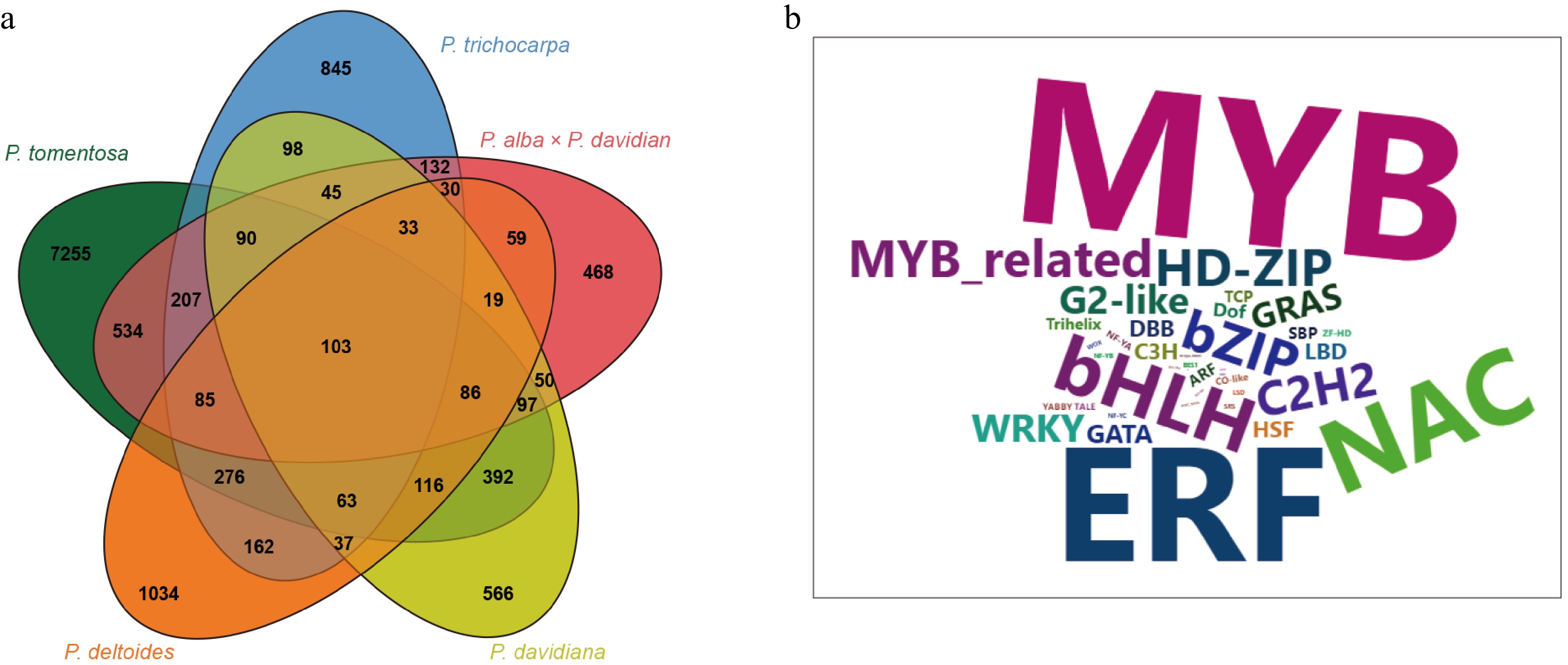
Figure 1.
Ethylene-responsive factors (ERFs) are key transcription factors involved in drought stress responses in Populus. (a) Venn diagram showing the overlap of differentially expressed genes (DEGs) under drought stress among five Populus taxa: P. tomentosa, P. trichocarpa, P. alba × P. davidiana, P. davidiana, and P. deltoides. (b) Word cloud showing all differentially expressed transcription factors (TFs). Font size reflects the frequency of occurrence, with larger fonts denoting higher representation across species.
TFs play pivotal roles in drought responses by reprogramming stress-induced gene expression. Here, we identified 369 drought-responsive TFs spanning 40 families (Supplementary Table S4), highlighting the complexity of the regulatory networks activated in Populus under water-deficit conditions. Among these, the myeloblastosis (MYB) and ERF families were significantly enriched (Fig. 1b). ERF TFs are well-established regulators of abiotic stress responses, including drought responses, largely by regulating the expression of stress-responsive genes[35]. The ERF genes used in this study were assigned based on their phylogenetic classification within the Populus ERF family. Among the 175 ERF family members in Populus, 50 were differentially expressed under drought stress in at least two poplar species (Supplementary Table S5). Moreover, these genes did not exhibit any preferential distribution across the different branches of the ERF phylogenetic tree (Supplementary Fig. S2). Notably, three genes, Potri.002G141200 (ERF37), Potri.018G038100 (ERF54), and Potri.016G126100 (ERF156), were differentially expressed in all five poplar species (Supplementary Fig. S2; Supplementary Table S5), indicating that these genes play broad roles in drought stress response in poplars. Among these, ERF54 exhibited the strongest differential expression, making it a prime candidate for further investigation.
Construction of the co-expression networks of ERF54 under drought stress in Populus
-
To further delineate ERF-mediated transcriptional regulatory networks under drought stress in Populus, we performed WGCNA using drought-stress transcriptomes from the five Populus taxa. Genes with a maximum TPM < 1 were excluded, and the remaining 26,022 genes were clustered into 25 co-expression modules, each designated with a distinct color (Supplementary Fig. S3). Using ERF54 as a hub gene, we identified genes whose expression patterns were significantly correlated with its expression pattern and constructed an ERF54-centered co-expression network (Fig. 2a). To further validate the stability of the co-expression relationships across different poplar species, we conducted RT-qPCR analysis of ERF54 and its top three co-expressed genes in P. tomentosa, P. trichocarpa, and P. deltoides (Fig. 2b–e). The results demonstrated that ERF54 homologs were significantly upregulated under drought stress in all three species (Fig. 2b). Similarly, the homologs of three co-expressed genes, Potri.004G174100 (ERD7), Potri.006G260100 (WAKL), and Potri.008G159400 (APG1), exhibited expression patterns consistent with those of ERF54 under drought stress (Fig. 2c–e). ERD7 exhibited the highest correlation with ERF54 (R = 0.89; p = 2.17 × 10⁻¹⁹) and showed the most significant changes under drought stress.
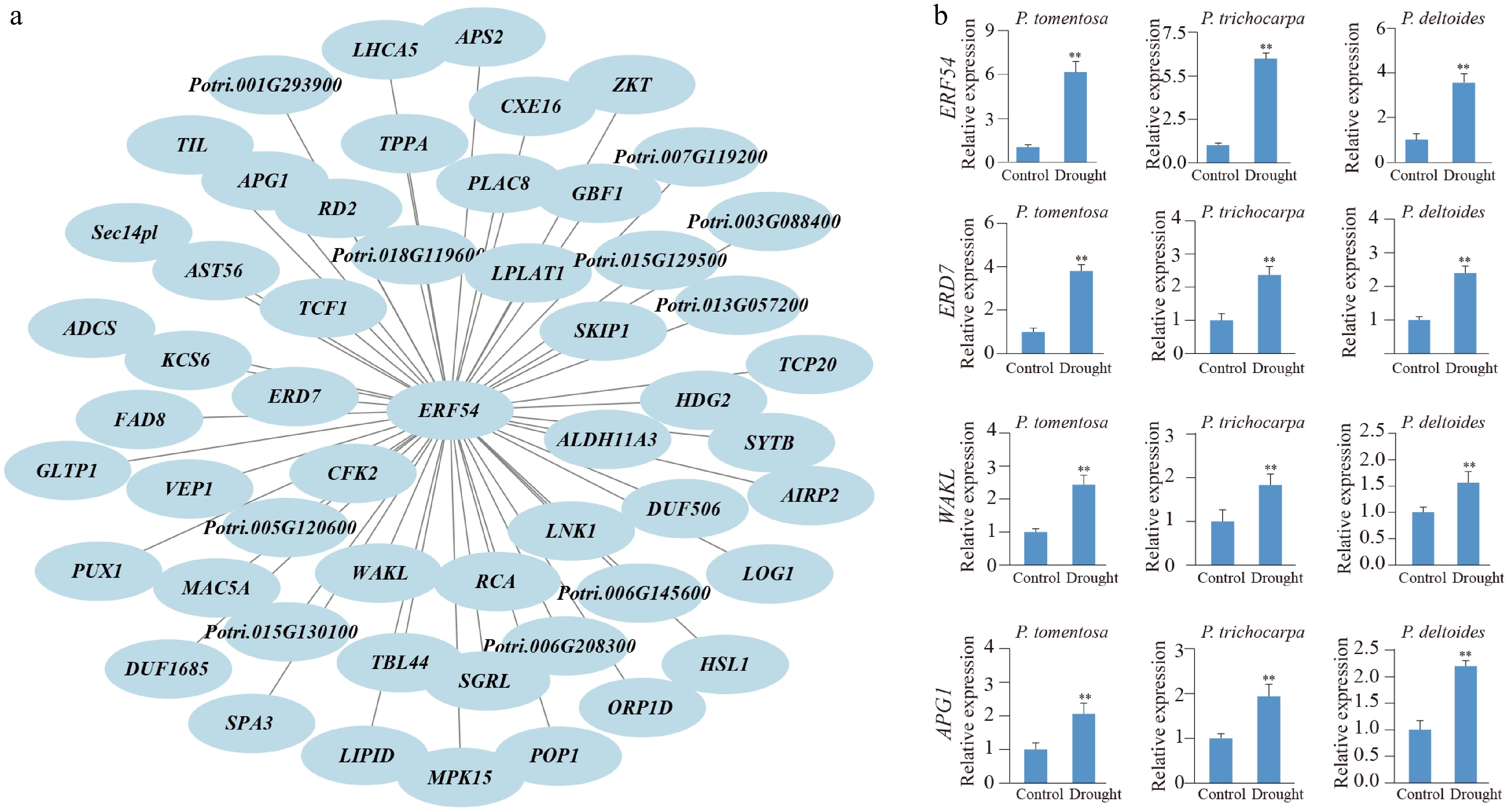
Figure 2.
Co-expression network centered on ERF54 and expression validation across Populus species. (a) Drought-responsive gene co-expression network centered on ERF54, constructed using weighted gene co-expression network analysis across five Populus taxa. Nodes represent genes, and edges indicate significant co-expression relationships. (b)–(e) Reverse transcription-quantitative polymerase chain reaction validation of ERF54 and selected co-expressed genes (ERD7, WAKL, and APG1) in P. tomentosa, P. trichocarpa, and P. deltoides under drought stress. Data represent means ± SE (n = 3 biological replicates, each with four technical replicates). Asterisks denote significant differences compared with the control: ** p < 0.01.
Based on multiple lines of evidence, ERD7 was selected for further functional characterization. First, ERD7 exhibited the strongest co-expression relationship with ERF54, showing a high correlation coefficient in the ERF54-centered WGCNA network (Fig. 2a). Second, the drought-induced expression pattern of ERD7 was highly consistent with that of ERF54 across the representative Populus species, as further validated by RT-qPCR (Fig. 2b, c). Third, the functional annotation of ERD7 is directly relevant to drought stress, as ERD genes are widely recognized as early dehydration-responsive genes involved in plant stress adaptation. Finally, the promoter sequence analysis revealed putative AP2/ERF-related binding motifs in the ERD7 promoter (Supplementary Fig. S4). Taken together, these results support the selection of ERD7 for subsequent functional characterization.
PtrERF54 overexpression improves iWUE by reducing transpiration
-
To explore the biological functions of ERF54 in poplar, we cloned ERF54 from P. trichocarpa and designated it PtrERF54. Subsequently, we generated transgenic '84K' (P. alba × P. glandulosa) plants overexpressing PtrERF54 under the control of the CaMV35S promoter (PtrERF54-OE). The RT-qPCR analysis revealed variable PtrERF54 transcript accumulation in transgenic lines. Among them, PtrERF54-OE3 and PtrERF54-OE5 exhibited the highest expression levels, with 9.86-fold and 8.85-fold increases relative to those in the WT control, respectively (Supplementary Fig. S5); therefore, they were selected for subsequent analyses.
To further elucidate the physiological basis of enhanced drought tolerance in the transgenic lines, we measured leaf gas-exchange parameters using the Li-6400 portable photosynthesis system under controlled CO2 concentration and PAR. Both CO2- and light-response curves revealed that PtrERF54-OE plants maintained net photosynthetic rates (Pn) comparable to those of WT plants (Fig. 3a, e). In contrast, stomatal conductance (Gs) and transpiration rate (Tr) were consistently lower in the PtrERF54-OE lines than in WT plants under both CO2- and light-saturating conditions (Fig. 3b, c, f, and g). As photosynthetic carbon assimilation remained largely unchanged, the reduction in Tr led to a significant increase in iWUE in PtrERF54-OE lines (Fig. 3d, h).
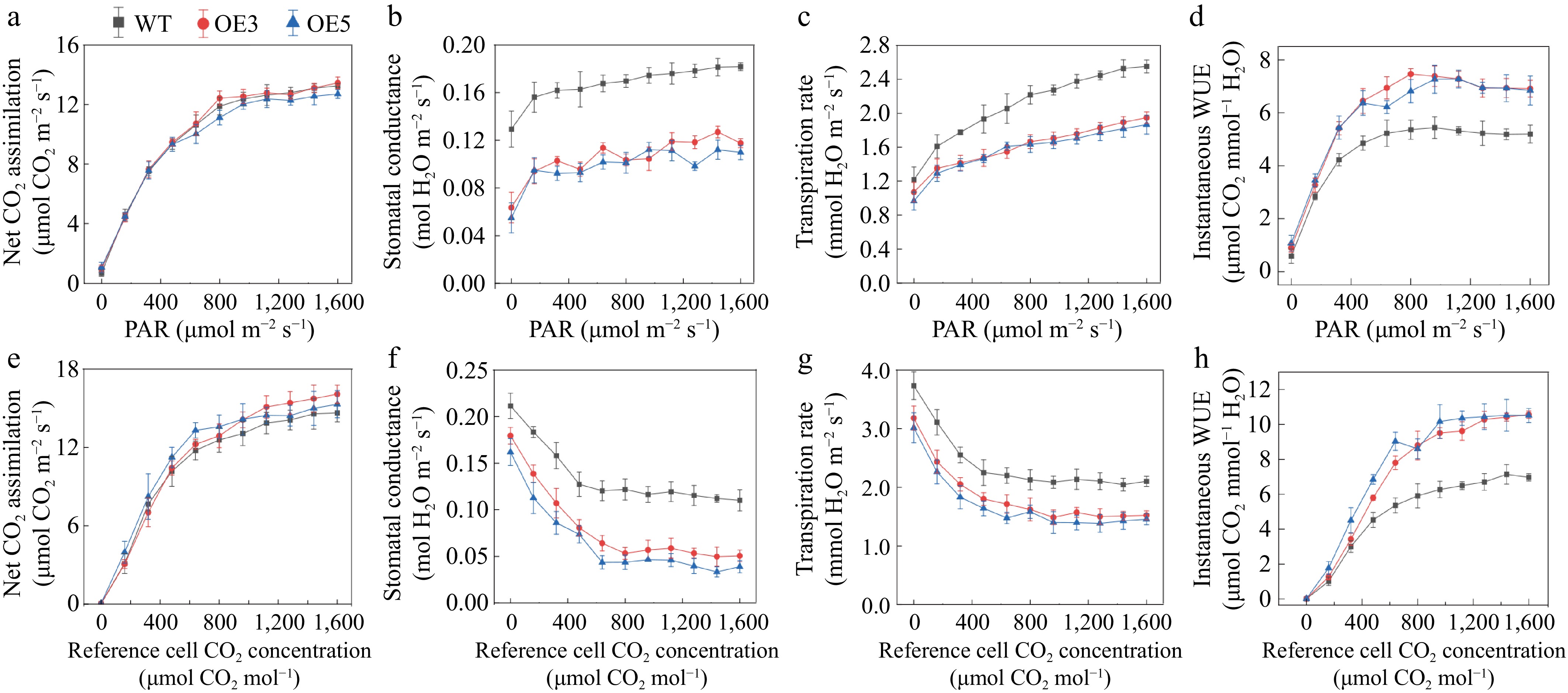
Figure 3.
PtrERF54 overexpression improves iWUE. Light response curves of (a) net photosynthetic rate (Pn), (b) stomatal conductance (Gs), (c) transpiration rate (Tr), and (d) instantaneous water-use efficiency (iWUE). CO2 response curves of (e) Pn, (f) Gs, (g) Tr, and (h) iWUE. Data represent means ± SE (n = 3 biological replicates, each with three technical replicates).
PtrERF54 overexpression enhances drought tolerance in Populus
-
To assess the effects of PtrERF54 overexpression on drought tolerance, PtrERF54-OE (OE3 and OE5) and WT poplars were grown under identical conditions and subjected to drought stress, followed by a 2-day re-watering period. By day 6 of the drought treatment, the WT plants exhibited severe wilting, whereas the transgenic lines exhibited only mild wilting symptoms (Fig. 4a). After re-watering, the WT plants recovered poorly, whereas PtrERF54-OE lines largely regained their normal morphology (Fig. 4a). The physiological measurements were consistent with phenotypic observations. Following drought stress, the PtrERF54-OE plants maintained significantly higher leaf RWC than did WT plants, indicating improved water retention (Fig. 4b). REC, an indicator of cell membrane integrity, increased under drought stress in both WT and PtrERF54-OE plants; however, the increase was substantially lower in PtrERF54-OE plants, with REC values ranging from 24.8% to 27.9%, compared with 52.6% in WT plants (Fig. 4c). Moreover, the PtrERF54-OE lines exhibited a higher maximum photochemical efficiency of PSII (Fv/Fm) and increased NPQ under drought conditions, suggesting better maintenance of photosynthetic performance and enhanced photoprotective capacity (Fig. 4d, e). To further evaluate oxidative stress responses, we quantified the activity of the major antioxidant enzymes POD and SOD. Under drought stress, both POD and SOD activities were significantly higher in PtrERF54-OE lines than in the WT plants (Fig. 4f, g).
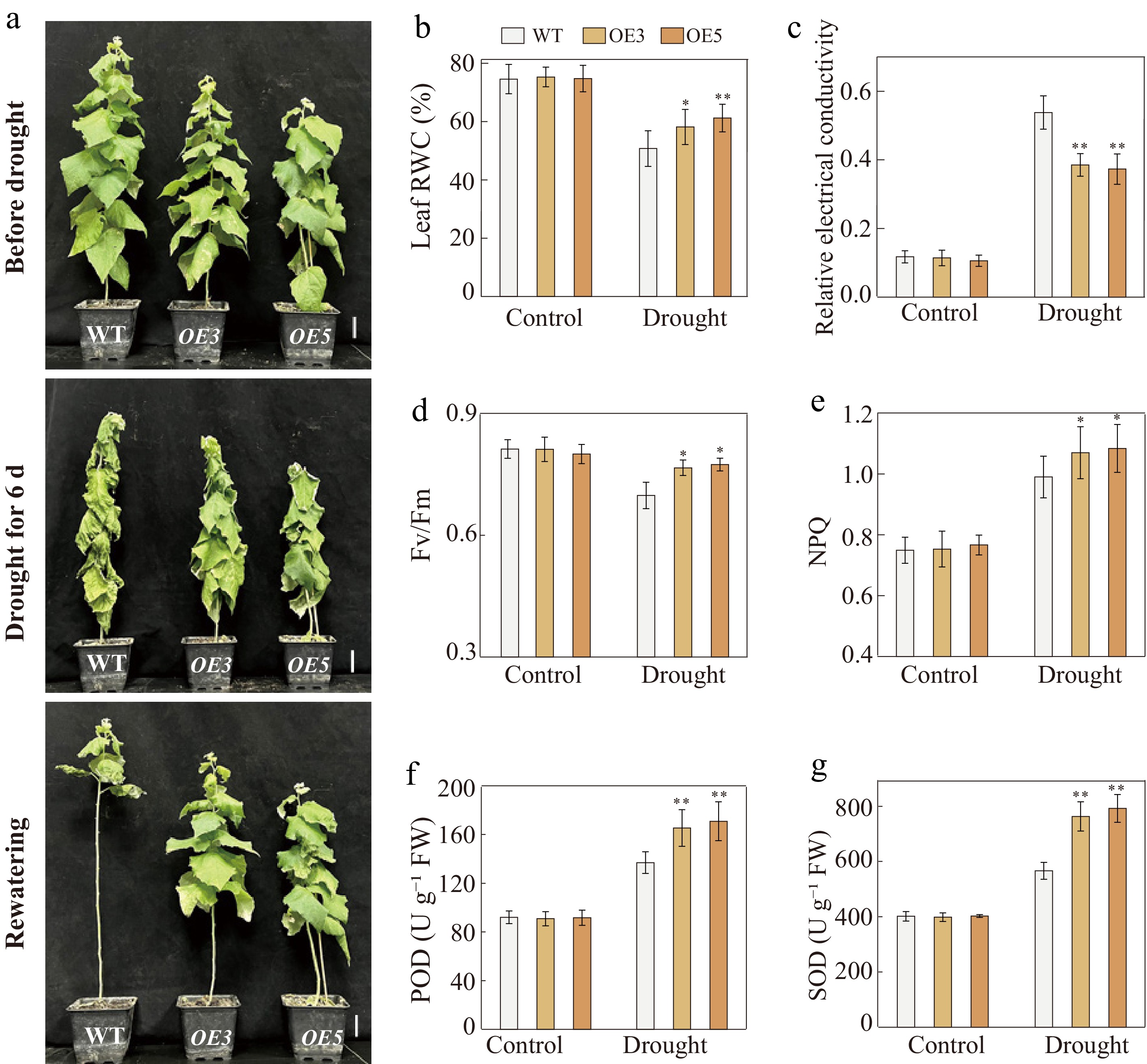
Figure 4.
PtrERF54 enhances drought tolerance in poplar. (a) Morphological comparison between wild-type (WT) and PtrERF54-overexpressing (PtrERF54-OE) poplar lines following drought stress. Scale bar = 5 cm. (b) Leaf relative water content (RWC) and (c) relative electrical conductivity (REC), indicating water status and membrane integrity. (d) Maximum photochemical efficiency of photosystem II (Fv/Fm) and (e) non-photochemical quenching (NPQ) under drought stress. Enzymatic activities of (f) peroxidase (POD) and (g) superoxide dismutase (SOD) as indicators of antioxidant responses. Data represent means ± SE (n = 3 biological replicates, each with four technical replicates). Asterisks denote significant differences compared with the control: * p < 0.05; ** p < 0.01.
PtrERF54 binds to the PtrERD7 promoter and activates its transcription
-
The RT-qPCR analysis confirmed the significant upregulation of PtrERD7 in PtrERF54-OE lines compared with that in WT lines, consistent with the WGCNA results (Fig. 5a). To investigate whether PtrERF54 directly regulates PtrERD7, we analyzed the PtrERD7 promoter sequence and identified putative PtrERF54-specific binding motifs (Supplementary Fig. S4). Subsequently, Y1H assays were performed to validate protein–DNA interactions. These results demonstrated that PtrERF54 directly binds to the PtrERD7 promoter. Yeast co-transformed with pGADT7-PtrERF54 and pAbAi-PtrERD7pro grew on selective medium (SD/−Leu) supplemented with 200 ng mL−1 aureobasidin A (AbA), confirming this binding interaction (Fig. 5b). The ChIP-qPCR analysis revealed a significant enrichment of the PtrERD7 promoter fragment harboring the putative ERF-binding site in the PtrERF54-GFP transgenic lines relative to that in the GFP-only control, confirming the in vivo binding of PtrERF54 to the PtrERD7 promoter (Fig. 5c). To further assess the regulatory effects of PtrERF54 on PtrERD7 expression, we performed a dual-luciferase reporter assay in N. benthamiana. The PtrERD7 promoter fragments were cloned into the pGreen II 0800-LUC vector and co-infiltrated with the 35S::PtrERF54 effector construct into tobacco leaves (Fig. 5d). After 72 h, the luciferase activity was significantly enhanced in the presence of PtrERF54, indicating that PtrERF54 activates PtrERD7 transcription (Fig. 5e). Taken together, these results demonstrate that PtrERF54 directly binds to the PtrERD7 promoter and acts as a transcriptional activator, indicating that PtrERD7 is a downstream target of PtrERF54 in the drought-response regulatory network of poplars.
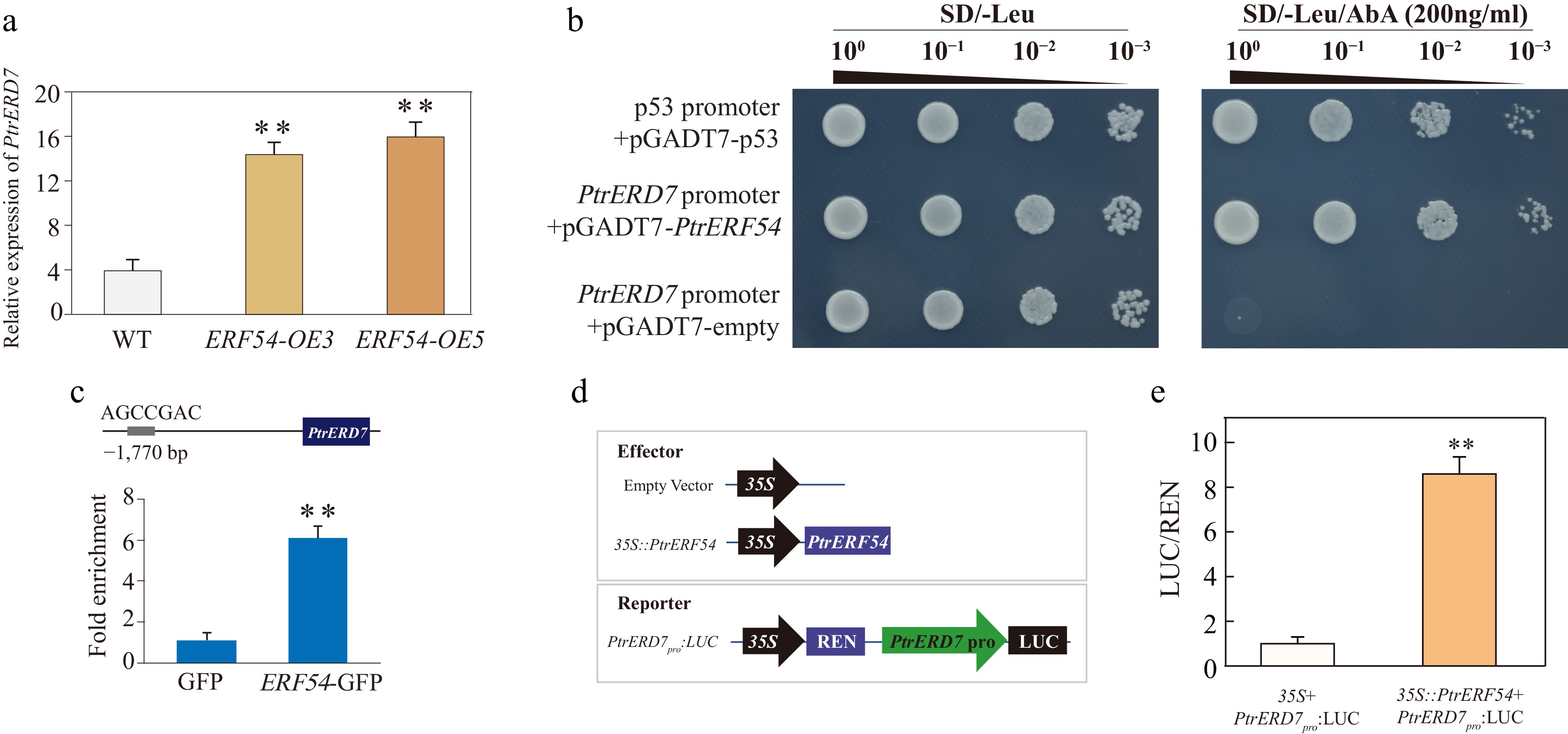
Figure 5.
PtrERF54 binds to the PtrERD7 promoter and regulates its expression. (a) Relative expression level of PtrERD7 in wild-type (WT) and PtrERF54-overexpressing (PtrERF54-OE) poplar lines as determined by RT-qPCR. (b) Yeast one-hybrid assay showing that PtrERF54 binds to the PtrERD7 promoter. Yeast strains co-transformed with pGADT7-PtrERF54 and pAbAi-PtrERD7 pro grew on selective medium (SD/-Leu) supplemented with 200 ng mL−1 aureobasidin A (AbA). (c) ChIP-qPCR analysis showing the enrichment of the PtrERD7 promoter fragment containing the predicted AP2/ERF-binding motif by PtrERF54-GFP. GFP-only transgenic plants served as the negative control. (d) Schematic representation of the constructs used in the dual-luciferase reporter assay, including the effector and reporter constructs. (e) A dual-luciferase reporter assay was used to assess transactivation of the PtrERD7 promoter by PtrERF54 in N. benthamiana leaves. Effector and reporter constructs were co-infiltrated, and luciferase (LUC) activity was measured 72 h later. Values were normalized to REN (Renilla luciferase) activity, with the empty effector vector serving as the control. Data represent means ± SE (n = 3 biological replicates, each with four technical replicates). Asterisks denote significant differences compared with the control: ** p < 0.01.
PtrERD7 overexpression improves drought tolerance in Populus
-
To assess the effects of PtrERD7 overexpression on drought tolerance, PtrERD7-OE (OE6 and OE11) and WT poplars were grown under identical conditions and subjected to drought stress, followed by a 2-day re-watering period. By day 6 of the drought treatment, WT plants exhibited pronounced wilting and partial shoot tip desiccation, whereas the PtrERD7-OE lines displayed only mild wilting symptoms (Fig. 6a). After 2 d of re-watering, WT plants recovered poorly, whereas PtrERD7-OE plants substantially recovered their normal morphology (Fig. 6a). After drought stress, the PtrERD7-OE lines maintained significantly higher RWC than WT plants, indicating a superior water-retention capacity (Fig. 6b). REC increased in both genotypes under drought stress but was significantly lower in the transgenic lines (~34.61%) than in WT plants (~52.55%), indicating reduced membrane damage (Fig. 6c). Under drought stress, Pn decreased in both genotypes; however, the PtrERD7-OE lines maintained significantly higher Pn than WT plants (Fig. 6d). Similarly, Tr decreased in all plants under drought stress; however, the decline was more pronounced in the PtrERD7-OE lines. By day 6, Tr in OE6 and OE11 was reduced by approximately 39% and 51%, respectively, relative to WT plants (Fig. 6e). To further investigate their oxidative stress responses, we measured the activities of POD and SOD. Both POD and SOD activities were significantly elevated in the PtrERD7-OE lines under drought conditions compared with those in WT plants (Fig. 6f, g). Collectively, these results demonstrate that the overexpression of PtrERD7 enhances drought tolerance in poplar by mitigating oxidative stress, reducing membrane damage, and maintaining higher photosynthetic activity while reducing transpiration rates relative to WT plants under water-deficit conditions.
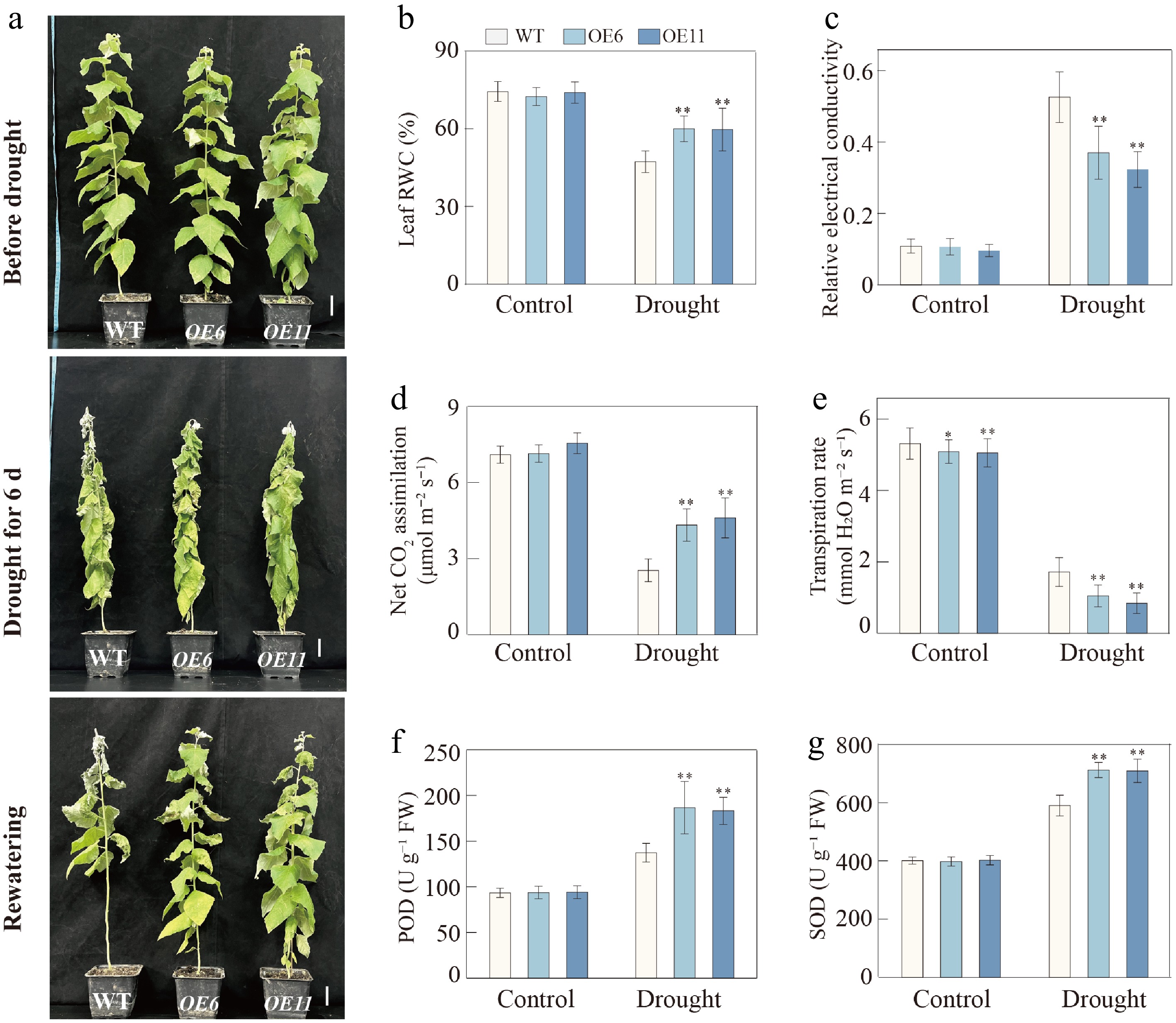
Figure 6.
Overexpression of PtrERD7 enhances drought tolerance in poplar. (a) Morphological comparison between wild-type (WT) and PtrERD7-overexpressing (PtrERD7-OE) poplar lines after drought treatment. Scale bar = 5 cm. (b) Leaf relative water content (RWC) and (c) relative electrical conductivity, indicating water retention capacity and membrane integrity, respectively. (d) Net photosynthetic rate and (e) transpiration rate under drought conditions. Activities of the antioxidant enzymes (f) peroxidase (POD) and (g) superoxide dismutase (SOD) in response to drought stress. Data represent means ± SE (n = 3 biological replicates, each with four technical replicates). Asterisks denote significant differences: * p < 0.05; ** p < 0.01.
-
Drought stress is a major limiting factor for the growth and productivity of Populus species, highlighting the importance of identifying core regulatory modules that can be leveraged to improve drought resistance[26,36,37]. Previous studies have established that ERFs function not only in plant development[38,39] but also in regulating responses to biotic[40,41] and abiotic stresses[10,42−44]. Consistent with these observations, our comparative transcriptomic analysis across the five Populus taxa (P. tomentosa, P. trichocarpa, P. alba × P. davidiana, P. davidiana, and P. deltoides) highlighted the involvement of the ERF family in drought adaptation (Fig. 1). The promoter analysis of 175 ERF genes in P. trichocarpa revealed a significant enrichment of cis-acting elements associated with stress- and hormone-responsive pathways (Supplementary Fig. S1), supporting a broad regulatory role for ERFs in abiotic stress signaling. Among drought-responsive ERFs, ERF54 exhibited the most pronounced and consistent induction across the five species (Supplementary Fig. S2), which prompted us to prioritize it for functional characterization.
To assess the ability of PtrERF54-OE plants to mitigate drought-induced photosynthetic inhibition, we compared the gas-exchange parameters between PtrERF54-OE and WT plants. PtrERF54-OE plants exhibited significantly reduced Gs and Tr values compared with WT plants. Notably, this decline did not affect Pn, resulting in a substantially enhanced iWUE (Fig. 3). Although sustained low Gs typically impedes CO2 diffusion into leaves, thereby limiting photosynthesis, the maintained Pn in PtrERF54-OE plants may suggest a compensatory mechanism. We hypothesized that this compensation might involve an elevated Rubisco activation state or enhanced carboxylation efficiency, thereby sustaining efficient carbon fixation despite limited intercellular CO2 availability[27].
The analysis of chlorophyll fluorescence parameters provided further physiological insights (Fig. 4d, e). The maximum photochemical efficiency of PSII (Fv/Fm), which typically declines with increasing stress severity, was significantly higher in PtrERF54-OE plants than in WT plants. Concurrently, NPQ, a key indicator of photoprotective heat dissipation, was higher in the transgenic lines under drought stress than in WT plants. The increase in NPQ serves as a photoprotective mechanism, reflecting the plant's capacity to dissipate excess light energy as heat and protect the photosynthetic apparatus from excess light exposure. This process represents a conserved strategy that prioritizes survival[45,46]. We attributed the higher Fv/Fm to the superior antioxidant capacity and water status of PtrERF54-OE plants, which collectively minimized photo-oxidative damage to PSII reaction centers. Higher NPQ suggests that the PtrERF54-OE plants rapidly activate photoprotection, leading to elevated NPQ, which facilitates the efficient dissipation of excess light energy, thereby effectively minimizing PSII photodamage and preserving a high Fv/Fm ratio. Taken together, these findings demonstrate that PtrERF54 overexpression confers enhanced cellular protection and optimizes photochemical efficiency under drought stress.
Furthermore, the overexpression of either PtrERF54 or PtrERD7 significantly enhanced drought tolerance in poplars. Under drought stress, both transgenic lines (PtrERF54-OE and PtrERD7-OE) exhibited higher leaf RWC, elevated activities of antioxidant enzymes (POD and SOD), and lower REC than those of WT plants (Figs 4, 6). These results indicate that both PtrERF54 and PtrERD7 effectively maintain cellular homeostasis under drought stress by improving water retention and activating the antioxidant system, thereby protecting the structural and functional integrity of cell membranes[25,47]. Under drought stress, the PtrERD7-OE lines also exhibited higher Pn and lower Tr (Fig. 6d, e). PtrERD7 overexpression may help maintain photosynthetic performance by preserving the functionality of the photosynthetic apparatus while reducing water loss, resulting in a substantial improvement in iWUE.
The comparative transcriptomic analysis revealed that ERF54 was consistently induced under drought stress in all five tested species (P. tomentosa, P. trichocarpa, P. alba × P. davidiana, P. davidiana, and P. deltoides) (Supplementary Fig. S2). The co-expression relationship between ERF54 and ERD7 was validated by RT-qPCR in three representative species, which showed a consistent upregulation pattern (Fig. 2b–e). Although functional validation was performed in the hybrid '84K' poplar (P. alba × P. glandulosa), a widely used model genotype for poplar genetic transformation, the ERF54 and ERD7 homologs in this genotype shared high sequence identity with the corresponding genes from the five analyzed species. The direct binding of PtrERF54 to the PtrERD7 promoter (Fig. 5; Supplementary Fig. S4), together with the drought-tolerant phenotypes observed in PtrERF54-OE and PtrERD7-OE lines, suggests that this regulatory module functions similarly across different poplar genetic backgrounds. Therefore, we propose that the PtrERF54–PtrERD7 module represents an evolutionarily conserved regulatory axis for drought response in the genus Populus.
Although our experiments demonstrated that the PtrERF54–PtrERD7 module enhances drought tolerance in poplar under controlled conditions, field environments are characterized by recurrent drought cycles, soil heterogeneity, and combined stresses, such as heat, nutrient deficiency, and pathogen attack. In this study, the PtrERF54-OE lines exhibited reduced Gs and Tr without compromising Pn, leading to improved iWUE, a trait that may contribute to improved performance under fluctuating precipitation (Fig. 3). The enhanced antioxidant capacity and membrane integrity may contribute to improved tolerance under variable field conditions (Fig. 4).
Notably, in this study, overexpression lines were generated only for PtrERF54 and PtrERD7. Although these lines clearly demonstrated the positive roles of both genes in drought tolerance, loss-of-function evidence remains lacking. Future studies employing CRISPR–Cas9-mediated gene knockout or knockdown approaches in poplar are essential to further validate the functional necessity of the PtrERF54–PtrERD7 module in drought responses. In addition, we noted that PtrERF54 overexpression led to a moderate reduction in plant growth under normal watering conditions, suggesting that it may be worthwhile to explore stress-inducible or tissue-specific promoters to uncouple drought-tolerance benefits from growth penalties. Alternatively, fine-tuning the expression levels of these genes via promoter editing using the CRISPR–Cas9 system, or moving the functional module directly into elite poplar cultivars, could help accelerate the molecular breeding of drought-tolerant poplars.
-
Our findings reveal a PtrERF54–PtrERD7 transcriptional module that enhances drought resilience in poplar by improving iWUE, strengthening antioxidant defenses, and maintaining membrane integrity, thereby providing mechanistic insights into how ERF TFs orchestrate drought responses in woody plants. The conserved drought-inducible expression of ERF54 and ERD7 across diverse poplar species suggests that this module represents an evolutionarily conserved regulatory axis for adaptation to water deficit within the genus Populus. Future work employing CRISPR–Cas9-mediated knockout lines and stress-inducible promoter strategies will be essential to validate gene function and mitigate potential growth-defense trade-offs.
-
The authors confirm their contributions to the paper as follows: study conception: Li P, Sang YL; data curation: Niu MX, Dong WC; experiments: Zhang ZC, Lu JX, Meng XR; data analysis and manuscript preparation: Niu MX, Dong WC, Li P; manuscript revision: Niu MX, Li P. All authors reviewed the results and approved the final version of the manuscript.
-
The data were obtained from publicly available resources.
-
The authors declare that they have no conflict of interest.
-
accompanies this paper online at: https://doi.org/10.48130/forres-0026-0028.
-
# Authors contributed equally: Mengxue Niu, Wanchen Dong
- Supplementary Table S1 Gene-specific primer pairs used in this study.
- Supplementary Table S2 Transcription profiling (RNA-seq) datasets used in this study.
- Supplementary Table S3 GO terms for the DEGs.
- Supplementary Table S4 Differentially expressed transcription factors identified under drought stress in Populus.
- Supplementary Table S5 Differential expression profiles of ERF family genes across five Populus taxa under drought stress.
- Supplementary Fig. S1 Distribution of cis-acting elements in the promoter regions (2,000 bp) of Populus trichocarpa ERF family genes.
- Supplementary Fig. S2 Phylogeny and differential expression of Populus ERF genes.
- Supplementary Fig. S3 WGCNA cluster dendrogram and module assignment.
- Supplementary Fig. S4 Predicted AP2/ERF-related cis-elements in the PtrERD7 promoter.
- Supplementary Fig. S5 Quantification of PtERF54 expression in different transgenic lines.
- Copyright: © 2026 by the author(s). Published by Maximum Academic Press, Fayetteville, GA. This article is an open access article distributed under Creative Commons Attribution License (CC BY 4.0), visit https://creativecommons.org/licenses/by/4.0/.
-
About this article
Cite this article
Niu MX, Dong WC, Zhang ZC, Lu JX, Meng XR, et al. 2026. Conserved ERF54-mediated activation of ERD7 enhances drought resilience in Populus. Forestry Research 6: e028 doi: 10.48130/forres-0026-0028 

Conserved ERF54-mediated activation of ERD7 enhances drought resilience in Populus
- Received: 15 January 2026
- Revised: 25 July 2026
- Accepted: 31 August 2026
- Published online: 29 September 2026
Abstract: Understanding the conserved transcriptional regulatory mechanisms underlying drought stress responses across diverse Populus species is critical for enhancing the drought resilience of woody plants. In this study, we conducted a comparative transcriptomic analysis of five Populus taxa, which revealed PtrERF54, an ethylene response factor (ERF), as a core drought-inducible transcription factor consistently upregulated under drought conditions. Weighted gene co-expression network analysis further revealed PtrERD7 as a candidate downstream gene co-expressed with PtrERF54. To elucidate the functional role of PtrERF54, we generated overexpression lines for PtrERD7 and PtrERF54 in the hybrid poplar (Populus alba × P. glandulosa '84K'). Both PtrERF54- and PtrERD7-overexpressing (OE) plants (PtrERF54-OE and PtrERD7-OE, respectively) exhibited significantly enhanced drought tolerance, as evidenced by reduced leaf wilting, lower relative electrical conductivity, elevated antioxidant enzyme activity, and improved photosynthetic performance under drought stress conditions. Notably, PtrERF54-OE lines maintained reduced stomatal conductance and transpiration rates without compromising photosynthetic carbon assimilation, thereby increasing instantaneous water-use efficiency. Yeast one-hybrid and ChIP-qPCR assays demonstrated that PtrERF54 directly binds to the PtrERD7 promoter, while dual-luciferase assays showed that PtrERF54 activates PtrERD7 transcription. Collectively, our results establish a conserved PtrERF54–PtrERD7 transcriptional module that modulates drought responses in Populus, providing novel insights into the genetic basis of water deficit adaptation and offering candidate targets for breeding drought-resilient trees.
-
Key words:
- PtrERF54 /
- PtrERD7 /
- Drought stress /
- Poplar /
- Weighted gene co-expression network analysis