












-
Soil contamination by toxic metals, including heavy metals and metalloids, is often coupled with multiple edaphic stressors, such as soil acidity and nutrient deficiency[1]. Because of their persistence and nondegradability, toxic metals can interact with co-occurring edaphic stressors to impair the soil biogeochemical function, inhibit vegetation recovery, and accelerate land degradation, particularly in mining areas[2]. Under these circumstances, woody plant-based phytoremediation has emerged as a cost-effective and ecologically sustainable strategy for the long-term management of mine tailings, brownfields, and other degraded soils[3].
The effectiveness of phytoremediation depends largely on the selection of plant genotypes/ecotypes with appropriate functional traits, including metal uptake capacity, translocation efficiency, stress resilience, biomass production, and the ability to interact with beneficial rhizosphere microorganisms[4]. Compared with herbaceous species, woody plants have distinct advantages for remediating large-scale contaminated sites. Their deep and extensive root systems enable access to contaminants in deeper soil layers, whereas their perennial growth habit and high biomass production support long-term immobilization or removal of metals. A recent meta-analysis has indicated that metal(loid) stress generally decreases woody plants' biomass by approximately 18%–25% but increases metal accumulation in both above- and below-ground tissues, with the responses varying according to metal type and plant tissue[5].
Salicaceae species, particularly Populus (poplar) and Salix (willow), are promising woody candidates for phytoremediation and afforestation on degraded lands. Under short-rotation coppicing (SRC) management, these fast-growing trees produce substantial aboveground biomass and develop extensive root systems[6,7]. Although Salicaceae are generally not classified as hyperaccumulators, their high biomass production, perennial growth habit, and strong root-soil interactions can partly compensate for their moderate metal accumulation capacity, making them suitable for long-term immobilization or removal of metals[8]. Their remediation potential is supported by coordinated physiological mechanisms. In the rhizosphere, roots can secrete low-molecular-weight organic acids (LMWOAs), such as oxalic and citric acids, which acidify the rhizosphere microenvironment, chelate metal ions, and enhance metal bioavailability for root uptake[9]. Following root uptake, metals may be immobilized by cell wall binding, transported through the xylem as organic acid complexes, or sequestrated into specific tissues such as the bark, cortex, and senescent xylem[10,11]. This tissue-specific sequestration may reduce metal accumulation in metabolically active photosynthetic tissues and maintain physiological homeostasis under metal stress.
At the molecular level, metal tolerance and accumulation in Salicaceae are regulated by complex regulatory networks involving metal transporters, transcription factors, stress-responsive proteins, and metabolic pathways[12]. Recent advances in multi-omics approaches, particularly transcriptomics and metabolomics, have improved our understanding of metal stress responses in Salicaceae. Under cadmium (Cd) stress, genes encoding the ATP-binding cassette (ABC), zinc/iron regulated protein (ZIP), and multidrug and toxic compound extrusion (MATE) transporters, together with members of the WRKY (WRKYGQK) and NAC (NAM, ATAF1/2, and CUC2) transcription factor families, are significantly upregulated in Shanxin poplar, suggesting their involvement in metal transport and detoxification pathways[12]. Transcriptomic analyses of PyWRKY48-overexpressing poplars have further revealed differentially expressed genes (DEGs) associated with ABC transport protein, heavy metal binding protein, xylem transportation and loading proteins, which may contribute to enhanced Cd accumulation[13]. Additionally, the identification of root-specific promoters in poplar species such as Nanlin 895 (Populus deltoides × Populus euramericana) provides useful genetic tools for improving Salicaceae-based phytoremediation[14].
Despite these advances, existing studies have largely focused on individual physiological or molecular traits, whereas the coordinated mechanisms linking the rhizosphere, metal transport, detoxification, and remobilization remain insufficiently explored. This review systematically summarizes the multilevel mechanisms underlying metal tolerance and accumulation in Salicaceae, from the rhizosphere to tissue-specific sequestration and molecular regulation. It further discusses emerging strategies to enhance remediation efficiency, including genetic engineering and microbiome- and nano-enabled technologies. By integrating physiological traits with molecular and ecological perspectives, this review provides a framework for the sustainable phytomanagement and ecological restoration of metal-contaminated soils.
-
The phytoremediation efficiency of Salicaceae trees is largely determined by coordination between root architecture and high transpiration capacity. These traits regulate the mobilization and translocation of toxic metals from soil to aboveground tissues[15]. Unlike herbaceous hyperaccumulators, which often depend on specialized symplastic transport and cellular sequestration, Salicaceae trees rely on expansive root-soil interfaces, transpiration-driven mass flow, and sustained perennial biomass accumulation to facilitate long-term phytoremediation (Fig. 1, Table 1).
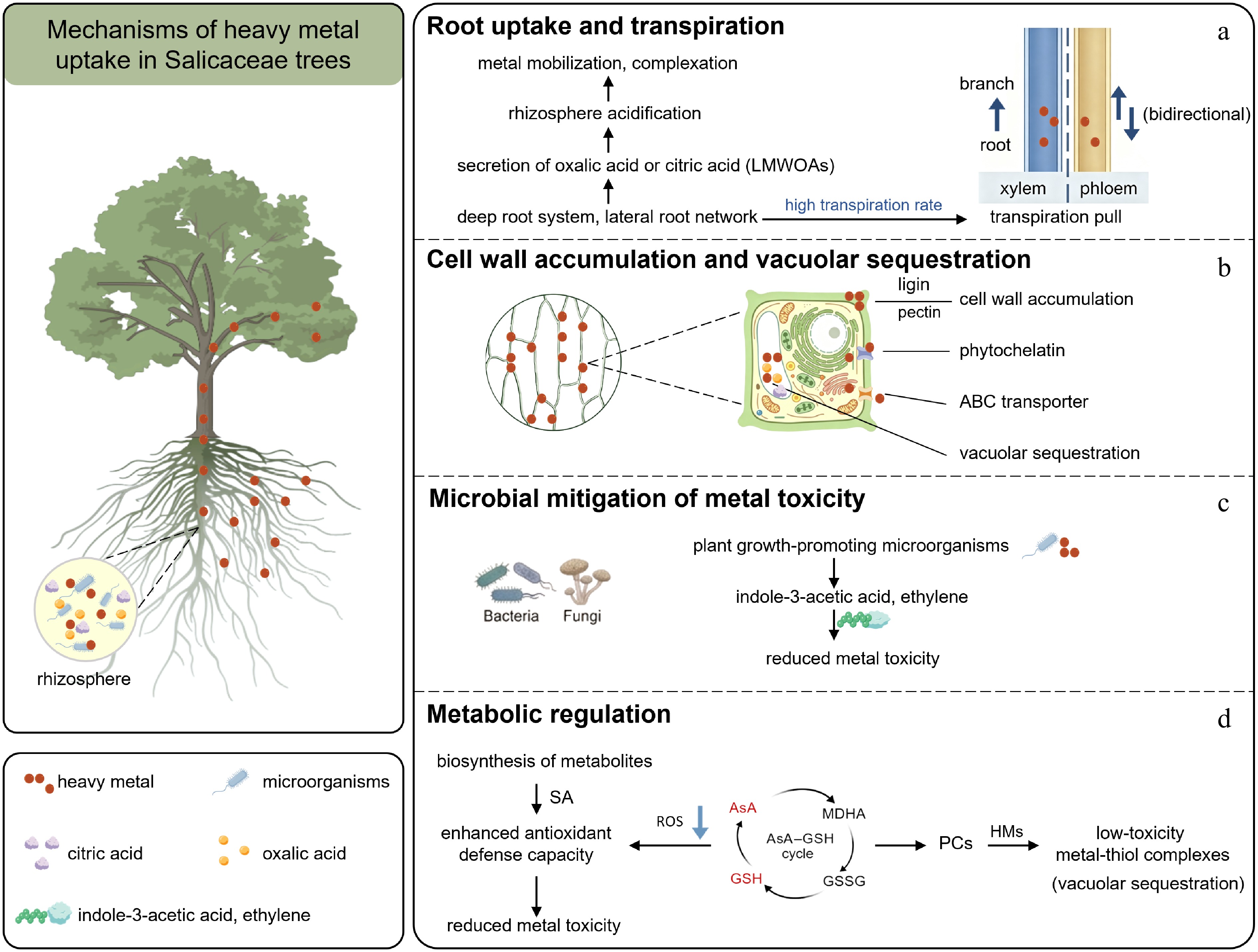
Figure 1.
Schematic diagram of integrated heavy metal uptake, translocation, detoxification, and tolerance mechanisms in Salicaceae trees. This diagram summarizes four interconnected functional modules underlying metal stress adaptation in Salicaceae trees: (a) Rhizosphere-mediated metal activation, root uptake, and transpiration-driven long-distance translocation through vascular tissues; (b) intracellular metal immobilization through cell wall binding, transporter-mediated chelation, and vacuolar compartmentalization; (c) rhizosphere-associated plant growth-promoting microorganisms that alleviate heavy metal phytotoxicity by promoting root growth and regulating metal availability; and (d) endogenous metabolic regulation, including salicylic acid-mediated signaling, reactive oxygen species scavenging, and antioxidant defense pathways. Abbreviations: HM, heavy metal; ABC transporter, ATP-binding cassette transporter; PCs, phytochelatins; GSH, glutathione; AsA-GSH cycle, ascorbate-glutathione antioxidant cycle; AsA, ascorbic acid; SA, salicylic acid; ROS, reactive oxygen species.
Table 1. Comparison of Salicaceae-mediated and herbaceous hyperaccumulator-based phytoremediation.
Comparisons Salicaceae-mediated phytoremediation Herbaceous hyperaccumulator-based phytoremediation Key remediation strategy Relies on high biomass production, extensive root systems, perennial growth, and repeated biomass harvesting to support long-term metal removal or immobilization[7]. Relies on exceptionally high metal concentrations in aerial tissues, usually within a short growth cycle[6]. Root architecture and remediation depth Deep and extensive root systems allow access to metals in deeper soil layers and support phytostabilization by reducing contaminant migration[16]. Shallow root systems are usually more effective in surface soils but have limited capacity to remediate deep contamination[17]. Metal uptake mechanisms Metal uptake is mediated by nutrient transporters, rhizosphere alteration, organic acid release, mycorrhizal associations, and root-soil interactions[9]. Uptake is often driven by enhanced expression of metal transporters[81]. Metal translocation Metals are partly accumulated in roots and stems, and a fraction is loaded into the xylem and transported to aboveground tissues through transpiration-driven flow[81]. High root-to-shoot translocation efficiency is facilitated by efficient xylem loading and metal-ligand complexation[6]. Sequestration and detoxification Metals are mainly immobilized in root and stem cell walls, lignified tissues, bark, and vacuoles, thereby reducing toxicity in photosynthetically active tissues[27]. Metals are often sequestered in shoot vacuoles or epidermal tissues, allowing high foliar metal concentrations while limiting cytosolic toxicity[82]. Physiological defense responses Defense relies on antioxidant regulation, lignification, cell wall binding, organic acid complexation, glutathione- and phytochelatin-mediated chelation, and tissue sequestration[28,29]. Defense is characterized by efficient intracellular detoxification, antioxidant activation, metal chelation, and vacuolar sequestration in aboveground tissues[6]. Application advantages Suitable for large-scale and long-term phytomanagement; supports ecological restoration, carbon sequestration, and potential biomass valorization under SRC systems[7]. Suitable for rapid phytoextraction of surface contamination; short growth cycles and high tissue metal concentrations facilitate experimental screening[83]. Main limitations Longer remediation cycles, lower tissue metal concentrations than hyperaccumulators, and the need for safe postharvest management of metal-enriched biomass[8]. Low biomass, shallow rooting depth, limited field-scale removal capacity, and weaker ecosystem service provision compared with woody systems[82]. As fast-growing woody plants, Salicaceae trees generally develop extensive, highly branched root systems with well-developed lateral roots. For instance, the main roots of Salix alba were reported to reach depths of 1.46 and 1.73 m after 5 and 7 years of growth, respectively, whereas the roots of the herbaceous hyperaccumulator Sedum plumbizincicola were concentrated primarily within the upper 2–10 cm of soil[16,17]. Under metal stress, Salicaceae trees have high root biomass, thereby expanding the absorptive surface and improving their element uptake efficiency[18]. This architectural divergence provides a distinct advantage for the remediation of deep-seated contamination. The ability of poplar and willow roots to extend several meters into the soil profile facilitates metal extraction from the subsoil and weathered bedrock. In addition, extensive root networks contribute phytostabilization by reducing the vertical migration of contaminants toward groundwater[19]. When combined with high biomass production under SRC management, these root traits enable Salicaceae species to maintain long-term remediation potential in large-scale contaminated sites, particularly where shallow-rooted herbaceous hyperaccumulators are less effective[20].
High transpiration capacity is another key physiological trait supporting metal uptake and long-distance transport in Salicaceae. In Salix and Populus, transpiration pull generates a continuous hydraulic gradient that drives the convective mass flow of dissolved ions, such as Cd2+, toward the root surface and subsequently through the xylem. For example, the transpiration efficiency in P. deltoides × P. nigra has been reported to reach 2.5 g dry weight (DW)
$ \cdot $ In addition to hydraulic transport, Salicaceae trees actively modulate the rhizosphere to enhance metal bioavailability. For instance, Populus species can secrete LMWOAs, mainly oxalic and citric acids, together with protons, into the rhizosphere[9]. This rhizosphere acidification promotes the mobilization of metals from poorly available soil fractions. Once mobilized, LMWOAs function as ligands that form relatively stable metal-organic acid complexes, thereby reducing free-ion toxicity while facilitating xylem loading and systemic transport[26]. Salicaceae species primarily adopt a rhizosphere-mediated metal activation and tissue sequestration strategy, followed by apoplastic immobilization, lignified tissue sequestration, or vascular transport as metal-ligand complexes, thereby limiting metal toxicity in photosynthetically active tissues[27]. The integrated strategy makes these woody species particularly suitable for the long-term phytomanagement of contaminated sites where low metal bioavailability limits conventional remediation.
Structural barriers and physiological defense mechanisms
-
In addition to root architecture and transpiration-driven uptake, Salicaceae species have developed structural and physiological defense mechanisms to mitigate metal toxicity and sustain phytoremediation capacity in environments contaminated by multiple metals. Compared with herbaceous species, Salicaceae species rely more on structural sequestration to balance metal uptake with internal detoxification (Table 2). At the cellular level, cell wall adsorption and vacuolar sequestration are two major detoxification strategies that reduce metal mobility and toxicity. The cell walls of Populus and Salix are enriched with lignin and polysaccharides (e.g., cellulose, hemicellulose, and pectin), which provide abundant hydroxyl, carboxyl, and amino groups for the binding and chelation of metal ions[28]. At the tissue level, metals such as Cd and zinc (Zn) are preferentially accumulated in the bark, phloem, cortex, and senescent xylem, thereby limiting their accumulation in photosynthetically active tissues[29]. For instance, P. nigra and S. alba can retain more than 60% of absorbed Pb, nickel (Ni), and chromium (Cr) within their roots, thereby preserving physiological function[30]. However, this accumulation pattern is physiologically plastic and may vary with genotype, nutrient status, and metal availability. Foliar-dominant Zn accumulation has been reported in P. nigra under low-nutrient conditions, whereas root-dominant immobilization has been observed in transgenic poplars with enhanced storage capacity[31].
Table 2. Salicaceae-mediated phytoremediation of metal contamination.
Species Metal(s) Cultivation Exposure/remediation duration Remediation target Main focus Underlying physiological/
ecological mechanisms or key findingsPopulus × canescens (Aiton) Sm; Populus tomentosa clones ('1316'); Populus euphratica
Salix linearistipularis; Populus yunnanensis;
Salix integraCd, Pb Hydroponics; soil 20–90 d Phytoextraction Transporter- and transcription factor-mediated phytoextraction Overexpression or activation of transporter- and transcription factor-related genes enhances metal uptake, xylem loading, and root-to-shoot translocation, thereby increasing aboveground metal accumulation and supporting harvest-based metal removal[11,47,84−86]. Salix × jiangsuensis 'J172';
Populus alba × Populus glandulosa;
Populus euramericana cv. 'NL-895';
P. deltoides cv. 'NL-3412'; Salix caprea;
Salix matsudanaPb, Cd, Al, Hydroponics; Soil 15–105 d Phytostabilization Root retention and cell wall sequestration Metals are predominantly accumulated/sequestered in roots and cell walls, with relatively low translocation to shoots. Cell-wall chelation, root sequestration, and restricted upward transport reduce metal availability and phytotoxicity[20,35,87−89]. Poplar hybrid varieties;
Salix sinopurpurea × S. integra; Salix jiangsuensis '2252';
Salix jiangsuensis '2011'Cd, Hg, Pb, and As Soil 210–730 d Phytoextraction/ phytostabilization Microbiome-assisted metal uptake and immobilization Root-associated microorganisms or mycorrhizal fungi promote plant growth and influence metal uptake in a context-dependent manner, thereby supporting either enhanced metal extraction or in situ immobilization[4,90,91]. S. alba Sr, Li Soil Long-term exposure
of the soil to natural conditionsPhytostabilization Riparian phytostabilization
and bioindicationNative S. alba showed potential as a biological indicator for Li and Sr in riparian environments[15]. Populus canescens; P. nigra Pb Sand 42 d Phytoextraction Metabolic regulation
of Pb toleranceS metabolism, organic acid accumulation, and phytohormone regulation contributed to interspecific differences in Pb tolerance and metal accumulation[92]. Populus yunnanensis Cd Soil,
substrate60–3,650 d Phytostabilization Endophyte-assisted
Cd toleranceBovista limosa PY5 alleviated Cd phytotoxicity and promoted plant growth by reducing Cd accumulation in host tissues[93]. P. deltoides; Populus canadensis Cd Soil 120 d Phytoextraction Soil-type-dependent Cd remediation Populus canadensis was more suitable for alkaline purple soil, whereas P. deltoides was more suitable for Cd-contaminated acid purple soil[94]. Salix viminalis Cd Substrate 42 d Phytoextraction Exogenous regulator-enhanced Cd tolerance Melatonin improved amino acid and saccharide metabolism in the leaves under Cd stress[95]. Vacuolar sequestration further contributes to intracellular detoxification. After entering the cytosol, metal ions can be transported across the tonoplast by ABC transporters and metal cation transporters. In the vacuole, metals form stable complexes with organic acids, such as oxalic and citric acids, or with cysteine-rich peptides such as phytochelatins (PCs)[32]. This sequestration reduces the interference of metals with cytosolic metabolism and allows Salicaceae to tolerate relatively high metal loads despite their generally nonhyperaccumulating characteristics.
Metal uptake and distribution are mediated by both apoplastic and symplastic pathways, involving ion channels and carrier proteins[32]. In Populus roots, Cd exposure upregulates genes encoding ABC transporters (PaABC), heavy metal-binding proteins (PaHIPP), and xylem-loading transporters (PaNPF and PaBSP), thereby enhancing Cd flux[13]. Meanwhile, stress-induced lignification forms an important physical barrier. Under Cd stress, Salix matsudana roots develop thickened vascular cell walls, with 73%-83% of accumulated Cd immobilized in the cell walls[10]. This response is associated with the activation of lignin biosynthetic genes, including cinnamoyl-CoA reductase 1 (SmCCR1) and cinnamyl alcohol dehydrogenase 7 (SmCAD7), which promote phenolic polymer deposition and restrict both apoplastic bypass flow and symplastic metal movement[10].
In addition to cellular sequestration and root immobilization, long-term metal tolerance in Salicaceae depends on coordinated metabolic and redox regulation. Woody perennials can redirect carbon (C) and nitrogen (N) fluxes toward the biosynthesis of detoxification-related metabolites, whereas glycolysis and the tricarboxylic acid (TCA) cycle provide C skeletons and adenosine triphosphate (ATP) for stress responses. Salicinoids, a characteristic class of phenolic metabolites in Salicaceae, represent an important C-based defense. UGT71L1-mediated glycosylation of salicyl alcohol generates diverse salicinoid derivatives[33]. Under metal stress, salicinoids can be hydrolyzed to release salicylic acid (SA), which functions as a defense-priming signal by activating antioxidant enzymes and stress-responsive proteins[34]. Phenolic compounds also act as nonenzymatic antioxidants, scavenging reactive oxygen species (ROS), reducing lipid peroxidation, and maintaining membrane integrity. Sulfur- and N-containing metabolites provide complementary detoxification through metal chelation and redox regulation. Glutathione (GSH) serves as both a precursor for PC synthesis and a key component of the ascorbate-glutathione (AsA-GSH) cycle[19]. PCs chelate divalent metal ions such as Cd2+ and Zn2+, forming low-toxicity complexes that are subsequently sequestered in the vacuoles[35]. LMWOAs further contribute to metal complexation in the xylem sap, facilitating long-distance transport[36]. Meanwhile, the AsA-GSH cycle and antioxidant enzymes (e.g., SOD, peroxidase [POD], CAT, and ascorbate peroxidase [APX]) scavenge metal-induced hydrogen peroxide (H2O2) and maintain cellular redox balance. Proline accumulation further contributes to stress tolerance by maintaining cell turgor, protecting subcellular structures, and buffering cytosolic acidification.
Overall, metal tolerance in Salicaceae is supported by an integrated tolerance network linking metabolic resource allocation, SA-mediated signaling, GSH-dependent chelation, antioxidant regulation, and structural immobilization. The phenylpropanoid pathway further reinforces this network by promoting lignin biosynthesis and metal immobilization within lignified matrices[29]. Therefore, the resilience of Salicaceae depends not only on individual defense metabolites but also on the coordinated maintenance of structural integrity, metabolic function, and redox homeostasis under metal stress.
In addition to physiological and metabolic defenses, transcription factor families connect metal stress perception with the regulation of metal transport, cellular detoxification, and redox homeostasis in Salicaceae[12]. Among these regulators, WRKY transcription factors have been most extensively characterized. In poplar, PyWRKY48 promotes Cd accumulation by inducing genes associated with metal binding and xylem loading, including PaABC, PaHIPP, PaNPF, and PaBSP, whereas PyWRKY75, PyWRKY71, and PsnWRKY95 enhance Cd tolerance or accumulation primarily through antioxidant regulation and ROS scavenging[13,37−39]. These findings position WRKY transcription factors as key coordinators of metal translocation and oxidative stress defense.
Other transcription factor families regulate complementary components of this network. The MYB transcription factor PeRAX2 represses the expression of PeANN1, thereby limiting Cd uptake and maintaining ROS homeostasis, whereas MYB103 has been associated with root cell wall remodeling[40,41]. The abscisic acid (ABA)-responsive basic leucine zipper (bZIP) transcription factor PtrAREB3 links hormonal signaling to Cd tolerance by regulating genes involved in antioxidant defense, metal transport, and ABA metabolism[42]. NAC, ethylene-responsive factor (ERF) and basic helix-loop-helix (bHLH) transcription factors also respond strongly to metal stress in Populus and Salix, although their functions are supported predominantly by expression-based evidence[12]. Collectively, these transcription factor families form an interconnected regulatory network that coordinates metal uptake and translocation with cell wall modification, intracellular detoxification, and redox homeostasis in Salicaceae.
Seasonal dynamics and remobilization
-
The phytoremediation efficiency of Salicaceae species is strongly influenced by seasonal growth dynamics and metal remobilization. Unlike annual herbaceous hyperaccumulators, Salicaceae trees are exposed to seasonal changes in temperature and photoperiod, accompained by changes in metabolic activity during perennial growth, which collectively regulate metal uptake, xylem-to-phloem translocation, and tissue-specific remobilization[43]. For example, Populus balsamifera accumulates substantial amounts of mercury (Hg) during the growing season, with the highest concentrations observed in senescent leaf litter (1,153–2,425 ng
$ \cdot $ $ \cdot $ Perennial growth exposes Salicaceae to metal stress over years or decades, resulting in sustained transcriptional regulation of the genes involved in metal tolerance, sequestration, and structural modification[12]. For example, Cd stress upregulated ABCG25 in Shanxin poplar, potentially enhancing Cd tolerance via increased cuticular wax deposition[12]. The Cd-induced protein CIPAS8 has also been identified as a regulator of root Cd influx and downstream metal transporter activity[47]. Seasonal redistribution has direct implications for coppice management. In P. deltoides, leaf Cd content decreased by 65% from summer to winter, suggesting that the nongrowing season (dormancy) may be accompanied by low-intensity metal uptake or immobilization in the roots[48]. These uptake and redistribution patterns indicate that coppicing should be timed after autumnal metal translocation to the stems but before leaf abscission to maximize metal removal efficiency. Thus, understanding seasonal metal dynamics provides a physiological basis for optimizing harvesting regimes and sustaining metal tolerance and sequestration capacity across successive growth cycles.
-
Genetic engineering, including transgene overexpression, clustered regularly interspaced short palindromic repeats (CRISPR)/CRISPR-associated protein 9 (Cas9)-mediated gene knockout, and targeted knock-in, enables the stable modification of genetic information and the remodeling of traits associated with metal uptake, sequestration, and stress tolerance[49]. Moreover, epigenetic regulation modulates gene expression without altering DNA sequences, providing a reversible mechanism for stress resistance[50]. Genetic engineering and epigenetic regulation influence responses to metals through different mechanisms. In Salicaceae, overexpression of PtHMA4 enhanced Zn accumulation, whereas PtPCS1 promoted Cd tolerance and sequestration through phytochelatin synthesis[51]. The Salix suchowensis gene SsIRT9 also modulated Cd flux and increased Cd accumulation when expressed in tobacco (Nicotiana benthamiana)[52]. At the transcriptomic level, PagALKBH1A-mediated N6-methyladenosine (m6A) mRNA demethylation negatively regulated Cd tolerance in '84K' poplar (P. alba × Populus tremula var. glandulosa) by affecting ABA-responsive, salt-stress-responsive, and cell wall remodeling pathways[53].
CRISPR/Cas9 enables targeted modification of endogenous genes. In poplar, editing CESA4 altered the cell wall architecture and biomass utilization, demonstrating the feasibility of modifying cell-wall-associated traits through genome editing[54]. By contrast, transgenic coexpression of ZIP6 and HMA9 enhanced root Cd uptake and long-distance translocation without reducing vegetative growth or biomass production[55]. CRISPR/Cas9-mediated genome editing extends phytoremediation improvement from single-gene modification to pathway-level engineering. Targeting genes associated with metal transport, chelation, hormonal signaling, and root exudation may enable the coordinated regulation of metal uptake, translocation, and tolerance (Fig. 2)[56]. Despite its potential, the application of CRISPR/Cas9 in woody perennials faces several challenges. Genotype-dependent transformation and regeneration limit editing efficiency in many commercially important poplar genotypes[57]. High heterozygosity complicates the design of guide RNA, allele-specific targeting, and the recovery of biallelic edits, whereas the outcrossing nature of trees hinders the fixation of edited traits[58]. Moreover, gene-edited trees with integrated T-DNA may be regulated as transgenic organisms, limiting field evaluations and their subsequent deployment[59]. Progress therefore depends on more broadly applicable transformation systems, efficient delivery of editing reagents, and long-term assessment of editing stability and ecological safety.
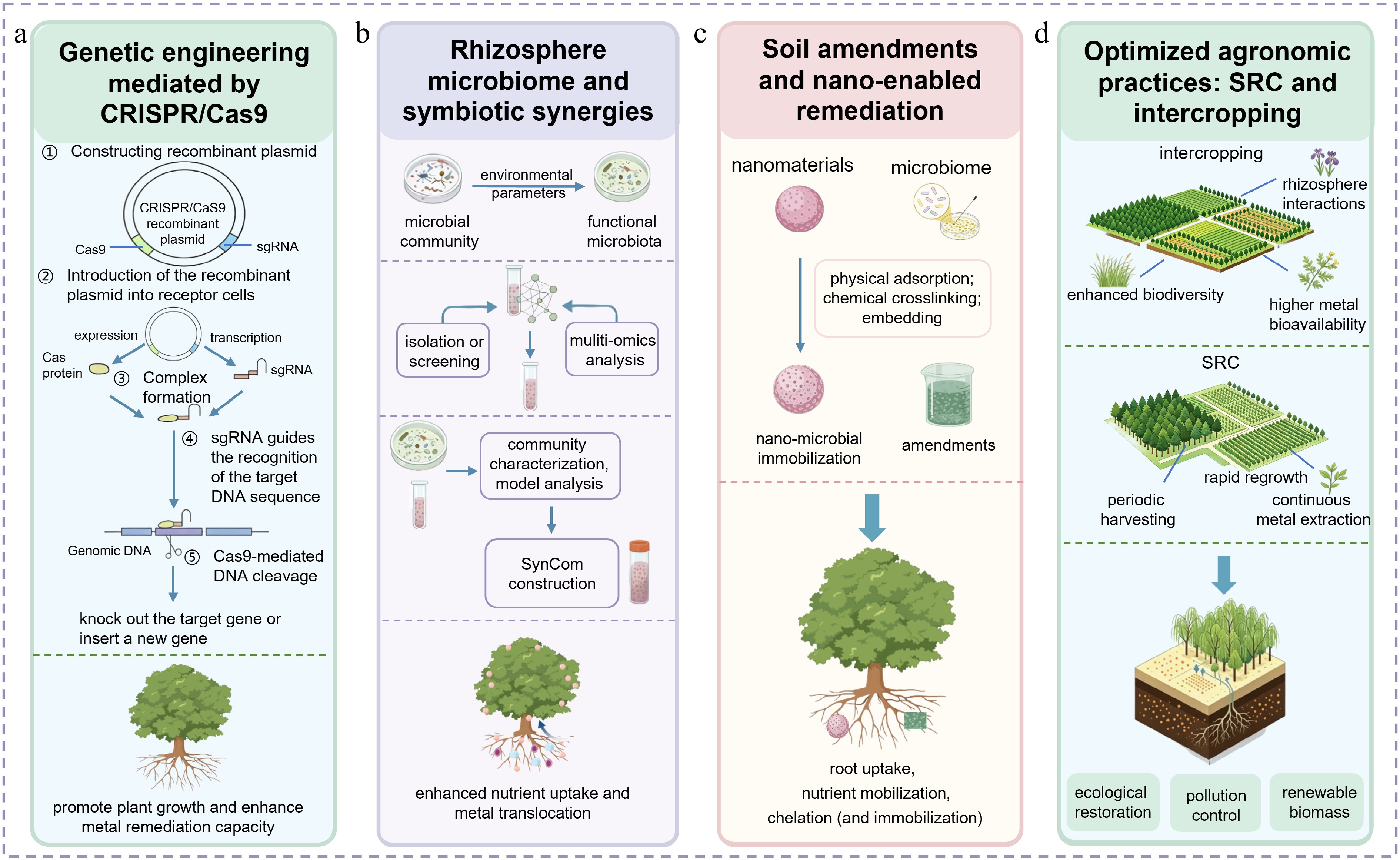
Figure 2.
Innovative strategies for enhancing metal phytoremediation efficiency in Salicaceae trees. This diagram illustrates four major strategies for improving Salicaceae-based phytoremediation in metal-contaminated soils: (a) genetic engineering, including CRISPR-based gene editing, synthetic DNA integration, and plastid engineering, which can be used to construct functional genetic circuits that enhance plant growth, metal uptake, translocation, and stress tolerance; (b) microbial symbiosis in the rhizosphere, involving the construction of synthetic microbial communities (SynComs), which can promote root colonization, regulate metal transformation, improve nutrient acquisition, and alleviate metal-induced phytotoxicity; (c) nano-enabled soil amendments, which interact with indigenous soil microbiomes to promote metal adsorption, chelation, or immobilization while improving nutrient availability; (d) sustainable agronomic practices, including short-rotation coppicing and tree-herb intercropping, which support long-term biomass production, repeated metal removal, and ecological stabilization of contaminated sites.
Rhizosphere microbiome and SynCom-mediated phytoremediation
-
Rhizosphere microorganisms are pivotal regulators of interactions at the plant-soil interface and represent important biological targets for optimizing phytoremediation. Plant growth-promoting microorganisms (PGPMs) can alleviate metal toxicity by altering the metals' availability through pH regulation, redox reactions, precipitation, and the secretion of organic chelators. They also promote plant growth by producing or regulating phytohormones, such as indole-3-acetic acid and ethylene, thereby improving root development and stress tolerance[60]. For example, high Cd accumulating Salix '51-3' can selectively recruit beneficial rhizobacteria, including Bacillus and Pseudomonas, which enhance plant biomass production and Cd extraction[4]. Rhizosphere microorganisms associated with Populus euphratica, such as Phyllobacterium, also exhibit strong resistance to heavy metal stress and facilitate Zn translocation from the roots to aboveground tissues, thereby mitigating metal-induced phytotoxicity[61].
Plant growth-promoting fungi (PGPF) and arbuscular mycorrhizal fungi (AMF) further enhance Salicaceae-mediated phytoremediation by regulating rhizosphere processes and host physiological responses. For instance, inoculation with Serendipita indica reduced soil pH and stimulated extracellular enzyme activities, thereby increasing P and Cd availability, facilitating P uptake, and enhancing Cd accumulation in the shoots of Salix suchowensis[3]. AMF extend the effective absorptive surface of roots through extensive hyphal networks and regulate host responses, such as cell wall lignification and antioxidant defense, thereby enhancing HM tolerance[62]. In P. deltoides, Glomus intraradices enhanced metal immobilization in roots while limiting the upward transport of toxic ions, thus improving phytostabilization efficiency[63]. Conversely, Funneliformis mosseae alleviated Cd phytotoxicity in Populus yunnanensis by reducing total Cd uptake and available Cd in the rhizosphere[64]. These findings indicate that microbial symbionts can either promote phytoextraction or enhance phytostabilization, depending on the host genotype, microbial function, and soil conditions.
Despite these benefits, the field application of isolated microbial strains is often limited by narrow functional spectra and inconsistent colonization. These limitations are mainly associated with low competitive fitness relative to indigenous microbiota and poor adaptability to fluctuating soil environments. Synthetic microbial communities (SynComs) have therefore emerged as a promising biotechnological framework for improving the stability and functional reliability of microbiome-assisted phytoremediation. SynComs are rationally designed microbial assemblages composed of taxonomically and functionally complementary strains[65]. For phytoremediation, two ecological properties of SynComs are particularly important: functional redundancy, which maintains core remediation and plant growth-promoting functions under environmental stress, and metabolic cross-feeding, which supports stable and persistent rhizosphere colonization[66]. This strategy is particularly relevant for Salicaceae species because their extensive root systems, relatively conserved exudate profiles, and well-characterized rhizosphere microbiomes provide a useful basis for constructing host-specific SynComs. For example, SynComs increased shoot biomass by 26%–48%, root biomass by 58%–82%, and leaf N content by 8%–10% in P. alba × Populus glandulosa '84K'[67]. Furthermore, SynComs can promote growth by mitigating oxidative stress, regulating osmolytes, and maintaining ion homeostasis[68]. Collectively, rhizosphere-mediated microbial synergy can significantly influence biomass production, metal uptake, and phytostabilization efficiency in Salicaceae, providing a scalable strategy for improving phytoremediation performance from controlled pot experiments to large-scale field trials.
Soil amendments and nano-enabled remediation
-
Soil amendments and nanomaterials (NMs) provide effective and cost-efficient approaches for enhancing Salicaceae-based phytoremediation. Biochar (BC), as a multifunctional soil amendment with high porosity and abundant surface functional groups, can adsorb and immobilize heavy metals while improving the rhizosphere microenvironment for beneficial microorganisms. Bone BC has been shown to increase the survival rate of Salix jiangsuensis '172' (SJ-172), decrease heavy metal availability, and improve soil fertility by increasing N and P contents. It also enhanced the accumulation of multiple metals, including Cd, Pb, Mn, and Cu, in SJ-172[69]. In Salix J1010, soil bacterial communities were more sensitive to BC than fungal communities; BC-stimulated rhizosphere bacterial clusters promoted root growth and subsequently improved Cd translocation[70]. Conventional organic amendments, such as straw returning and green manuring, can increase soil pH, available P, and organic matter, thereby promoting the transformation of heavy metals from exchangeable to residual fractions. These practices also enhance microbial metabolic activity and improve plant antioxidant defense. In Populus cathayana, exogenous Fe application mitigated Cd phytotoxicity by increasing net photosynthetic rate and total biomass, although high Fe availability promoted aboveground Cd accumulation through the remodeling of root cell walls[41].
Recent advances in nanotechnology have provided new opportunities to improve phytoremediation efficiency. Low-dose NMs, such as nano-silica, nano-sulfur, and nano-iron oxide, can enhance metal tolerance by reinforcing cell wall sequestration, modulating detoxification-related gene expression, and scavenging ROS[71]. Smart nano-delivery systems further enable the controlled and stimulus-responsive release of bioactive molecules, overcoming the rapid degradation and low bioavailability associated with conventional bulk amendments[72]. These systems may be engineered to respond to heavy metal-induced oxidative stress in Salicaceae.
Importantly, NMs can also function as nano-priming agents that induce endogenous resistance by activating stress memory, systemic defense responses, and hormonal signaling. For example, nano-sulfur altered the abundance or expression of rhizosphere-associated microbial genes associated with Cd tolerance and sulfur metabolism, including czcC, cysH, dsrA, and soxB in Salix chaenomeloides[73]. Additionally, NMs can serve as nonviral delivery platforms for CRISPR/Cas9 components, potentially overcoming the low efficiency of Agrobacterium-mediated transformation and reducing reliance on intensive tissue culture. This approach may facilitate transgene-free editing of polygenic metal tolerance traits and accelerate the development of improved remediation cultivars[74]. To maximize nano-enabled phytoremediation, integrated transcriptomic and metabolomic analyses are needed to identify genotype-specific metabolic bottlenecks and molecular targets in Salicaceae. For instance, comparative studies on Salix suchowensis P294 showed that Cd-tolerant genotypes exhibit stronger root transcriptional responses and higher accumulation of chelating metabolites, including organic acids, amino acids, and flavonoids[75]. These findings provide insights for NM-mediated interventions. However, despite their efficiency and low-dose advantages, the long-term ecological biosafety of NMs requires rigorous evaluation to ensure the environmental sustainability of nano-remediation.
Optimized agronomic practices: SRC and intercropping
-
Salix species exhibit great potential for Cd remediation because of their rapid growth, easy propagation, high biomass production, and capacity to tolerate elevated Cd concentrations without obvious growth inhibition or physiological damage. Their major advantage depends on high-flux Cd phytoextraction under SRC systems[76]. Agronomic practices, particularly SRC management and intercropping, provide cost-effective and ecologically compatible strategies for improving the remediation efficiency of Salicaceae species[24]. SRC management involves periodic harvesting, typically every 2−5 years, to stimulate shoot regrowth, ensuring continuous metal accumulation in new shoots and removing metal-enriched tissues from contaminated sites[77]. This practice takes advantage of the strong resprouting capacity of Salicaceae and supports long-term phytomanagement while enabling potential biomass valorization, such as bioenergy production. Intercropping further enhances remediation performance by increasing plant diversity, reshaping the rhizosphere microenvironment, and regulating metal bioavailability in contaminated soils[78]. Root-zone interactions in intercropping systems can mitigate the adverse effects of heavy metals on soil enzyme activity and microbial diversity[79]. For instance, intercropping Salix with herbaceous species, such as Lolium perenne, Iris lactea and Bidens pilosa, increased metal accumulation and overall remediation efficiency[80]. Collectively, SRC management and intercropping enhance the phytoremediation potential of Salicaceae by integrating repeated biomass harvesting, rhizosphere regulation, and multispecies complementarity. These agronomic strategies provide a scalable framework for the long-term phytomanagement of metal-contaminated lands and reconcile ecological restoration and renewable biomass production in degraded mining soils.
-
Although Salicaceae-mediated phytoremediation has great potential for metal-contaminated soils, several critical challenges should be addressed before its broad field application. Field-scale remediation is often limited by soil heterogeneity, including spatial variation in metal distribution, pH, nutrient availability, organic matter content, and competing ions. These factors influence metal speciation, bioavailability, root uptake, microbial activity, and ultimately remediation efficiency, making field performance less predictable than that observed under controlled conditions. In complex contaminated soils, competitive ions may further interfere with the adsorption, mobilization, and extraction of target heavy metals by both amendments and plant tissues.
Biosafety and ecological risk assessments are also critical for long-term application. The deployment of transgenic or genome-edited Populus genotypes requires careful evaluation of gene flow to wild relatives, trait stability, and ecological consequences under field conditions. Meanwhile, chemical modifiers such as EDTA and soil amendments may alter metal mobility and the microbial community structure. Although these amendments can enhance the availability or immobilization of metals, they may also increase the risk of secondary metal leaching or cause unintended shifts in the soil microbial composition and function. Therefore, long-term ecological risk assessments are necessary to ensure the environmental safety of Salicaceae-based phytomanagement.
Post-harvest management of metal-enriched biomass remains another major bottleneck. Periodic coppicing can remove metal-loaded tissues from contaminated sites, but improper handling may cause secondary pollution. Standardized protocols are therefore required for biomass collection, transportation, disposal, and valorization. Emerging approaches, including bioenergy conversion and controlled pyrolysis, offer promising options for converting contaminated biomass into value-added products while reducing the environmental risks. These strategies may also support circular-economy-oriented phytomanagement by integrating pollution control with biomass resource utilization.
Future research should focus on several priority directions. First, multi-omics technologies, encompassing genomics, transcriptomics, metabolomics, ionomics, and microbiomics, should be integrated to identify regulatory networks governing metal accumulation and stress resilience in Salicaceae. Second, microbial applications should shift from empirical inoculation of isolated strains toward the rational design of customized SynComs. These SynComs should be matched to Salicaceae root exudates (e.g., specialized phenolics) to improve rhizosphere colonization, functional stability, and plant-microbe synergy. Third, artificial intelligence (AI), machine learning, remote sensing, and image-based phenotyping can support data integration and predictive modeling in Salicaceae-mediated phytoremediation. By integrating multi-omics and rhizosphere microbiome datasets, these tools may help identify gene-microbe-metal interaction networks, screen candidate SynComs, and predict metal migration and plant growth performance under field conditions. However, their application requires high-quality datasets, robust field validation, and interpretable modeling frameworks. Fourth, the evaluation of Salicaceae-mediated phytoremediation should extend beyond removal efficiency. Life cycle assessment (LCA) and carbon footprint accounting can provide a more comprehensive evaluation of the remediation costs, environmental benefits, C sequestration potential, and biomass utilization. Overall, integrating genetic improvement, rhizosphere microbiome engineering, AI-assisted prediction, LCA, and sustainable biomass management will be essential for advancing Salicaceae-mediated phytoremediation from experimental validation to field-scale, environmentally sustainable application.
-
The authors confirm their contributions to this study as follows: original draft: Cui J, Luo Z, Liu C; conceptualization: Cui J, Luo Z, Liu C, Tong R, Yu H, Ma C, Cao Y, Yan W; visualization: Cui J, Luo Z, Liu C; review and editing: Ma C, Cao Y, Yan W; funding acquisition, supervision: Cao Y. All authors reviewed the results and approved the final version of the manuscript.
-
Data sharing is not applicable to this article as no datasets were generated or analyzed during the current study.
-
The authors declare that they have no conflict of interest.
- Copyright: © 2026 by the author(s). Published by Maximum Academic Press, Fayetteville, GA. This article is an open access article distributed under Creative Commons Attribution License (CC BY 4.0), visit https://creativecommons.org/licenses/by/4.0/.
-
About this article
Cite this article
Cui J, Luo Z, Liu C, Tong R, Yu H, et al. 2026. Salicaceae for phytoremediation of metal-contaminated soils: mechanisms, enhancement strategies, and sustainable applications. Forestry Research Advances 1: e016 doi: 10.48130/fra-0026-0013 

Salicaceae for phytoremediation of metal-contaminated soils: mechanisms, enhancement strategies, and sustainable applications
- Received: 09 May 2026
- Revised: 05 September 2026
- Accepted: 10 September 2026
- Published online: 12 October 2026
Abstract: Toxic metal contamination threatens soil health, ecosystem stability, and sustainable land use. Salicaceae species, particularly Populus and Salix, are promising woody candidates for phytoremediation owing to their rapid growth, extensive root systems, high transpiration capacity, and large biomass production under short-rotation coppice management. This review summarizes the physiological, structural, and molecular mechanisms that enable metal tolerance and accumulation in Salicaceae. Key processes include rhizosphere-mediated metal mobilization, root uptake, transpiration-driven translocation of metals, phloem-mediated remobilization, and tissue-specific sequestration. At the cellular and tissue levels, cell wall binding, vacuolar sequestration, metal chelation, and antioxidant defense collectively reduce metal toxicity and maintain cellular homeostasis. Seasonal dynamics further influence metal remobilization and harvest efficiency in perennial remediation systems. Additionally, we discuss advanced biotechnological approaches that could be used to enhance Salicaceae-based phytoremediation. By integrating tree physiological resilience with biotechnology and short-rotation coppicing, this review provides a framework for developing efficient and sustainable woody phytoremediation systems for metal-contaminated soils.