












-
Forest ecosystems play an important role in mitigating climate change through carbon sequestration, biodiversity conservation, and the provision of essential ecosystem services. Under China's 'dual carbon' goals, enhancing forest quality, maintaining carbon sink stability, and strengthening ecosystem resilience have become central challenges in forestry research. China possesses the world's largest planted forest area, yet monoculture plantations have led to declining stand productivity, reduced species diversity, soil degradation, and compromised ecosystem stability[1,2]. Mixed-species plantations offer a promising solution to these problems. Bamboo, known for its rapid growth, short rotation, versatile uses, and high economic returns, represents a particularly promising pathway in this context[3,4]. Moso bamboo (Phyllostachys edulis) is the most widely distributed and economically important bamboo species in China, accounting for roughly 75% of the national bamboo forest area. Its rapid growth rate and short rotation cycle make it a highly efficient carbon sink, with annual carbon sequestration rates ranging from 5.09 to 9.43 t C ha−1 yr−1[5,6]. However, intensive monoculture management, characterized by high-intensity harvesting, understory clearance, and heavy fertilization, has caused widespread soil fertility decline, biodiversity loss, and reduced long-term productivity[7,8]. Establishing bamboo–tree mixed forests by integrating bamboo with woody species is expected to combine bamboo's rapid carbon sequestration with the long-term carbon storage capacity of trees, thereby improving stand structure and soil quality through interspecific complementarity.
Despite these potential benefits, several uncertainties hinder the broader adoption of bamboo–tree mixtures. One is the net direction of interspecific effects, i.e., whether bamboo and trees compete or facilitate each other. The answer depends largely on species composition and mixing ratio, and findings across studies often contradict one another without systematic synthesis. Another uncertainty concerns the mechanisms that drive nutrient cycling. Mixing can alter litterfall quantity, composition, and decomposition, potentially enhancing soil nutrient availability, but the underlying biogeochemical pathways remain unclear. A third uncertainty involves ecosystem stability: different mixture types may confer different levels of resistance and resilience to disturbance. In this review, we define 'ecosystem stability' as the capacity of a forest system to maintain its structure, functions, and processes under disturbance, i.e., resistance (the ability to withstand disturbance), resilience (the speed of recovery), and long-term productivity maintenance[9]. We evaluate 'nutrient cycling efficiency' through turnover time, nutrient resorption efficiency, and the balance between mineralization and immobilization.
Given these knowledge gaps, we structure this review around three interconnected questions. We first characterize the main mixing types, i.e., bamboo–broadleaf, bamboo–conifer, and other mixtures, and their structural differences. We then examine how mixing alters litter inputs and decomposition dynamics, which serve as the entry point for soil nutrient supply, and analyze the role of soil microbial communities in mediating these processes. We further synthesize these findings to explain how optimized nutrient cycling translates into enhanced ecosystem stability across three dimensions, i.e., resistance, resilience, and long-term productivity maintenance. Finally, we identify knowledge gaps and future research priorities.
-
Moso bamboo is a monopodial species native to China, characterized by rapid growth, short rotations, and extensive clonal integration via underground rhizomes. These traits, when combined with intensive monoculture management, create a paradox: over time, pure bamboo stands experience declining soil fertility, reduced biodiversity, and compromised long-term productivity. Long-term observations by Lou et al.[7] revealed that after approximately 15 years of monoculture management, pure stands enter a distinct decline phase, with average diameter at breast height dropping by 3.9 cm and yield falling by 17%. Broadleaf admixture offers a solution to this problem. When Moso bamboo is mixed with tree species that exhibit niche differentiation, such as Castanopsis chinensis, Alniphyllum fortunei, or Castanopsis fargesii, the competitive pressure that drives decline in pure stands is partially relieved. In natural communities, Moso bamboo generally displays pronounced niche differentiation from most associated broadleaf species, with niche overlap indices (Lhi) below 0.5 except for C. fargesii (Lhi = 0.509)[10]. This spatial and resource partitioning creates the foundation for facilitative interactions rather than pure competition.
The mixing ratio, however, is not a matter of 'more is better'. Growing evidence indicates that the effects of bamboo-broadleaf mixing on soil properties are non-linear, i.e., different ecological functions respond to mixing proportions along distinct thresholds, and the optimal ratio for one indicator may not be optimal for another. Soil microbial biomass nitrogen (N) peaks at 20%~30% broadleaf proportion, whereas microbial biomass carbon (C) peaks at 30%~40%[11]. Soil organic C accumulation, according to a meta-analysis of 111 studies, maximizes at 45%~65% mixing ratios[12]. These divergent optima are not contradictory; rather, they reflect the fact that different ecological processes, i.e., N transformation, C sequestration, and microbial community dynamics, are governed by different mechanisms and thus respond to mixing ratios along different trajectories. A recent study across three broadleaf species, Castanopsis chinensis, Alniphyllum fortunei, and Choerospondias axillaris, found that the bamboo–C. axillaris mixture exhibited notably higher soil C, N, and phosphorus (P) contents than the other two, particularly at a 10%~20% mixing ratio where soil organic C reached 46.50 g kg−1[13]. The same mixture also showed the highest activities of invertase, urease, and catalase. The 10%~20% mixing ratio also corresponded to better soil microbial activity, suggesting that moderate broadleaf proportions may optimize the soil microenvironment for microbial functioning. These findings point to a crucial insight, i.e., the optimal mixing ratio depends on what you are trying to optimize. There is no single universal ratio; management objectives, whether enzyme activity enhancement, C sequestration, or economic yield, should guide the decision, with site conditions such as precipitation and elevation further modulating the thresholds[12].
If mixing ratio determines the magnitude of the effect, tree species identity determines its quality. Tree species matters as much as the ratio. Bamboo–C. axillaris mixtures consistently outperformed bamboo–C. chinensis and bamboo–A. fortunei mixtures across most soil quality indicators[13]. The superior performance of C. axillaris (commonly known as southern wild walnut) is likely attributable to its functional traits, i.e., it is a deciduous broadleaf species with high litter production, a relatively low C : N ratio, and a deep root system that complements the shallow-rooted Moso bamboo[13]. The effects of tree species on enzyme activity depend on litter quality, and the effects of mixing ratio on microbial biomass depend on changes in soil nutrient availability. This suggests that species selection is not interchangeable. The chemical composition of litter, root architecture, and resource demand of the companion species all shape the outcome. However, research on species selection remains limited, resulting in a lack of operational guidelines and constraining the scientific management of bamboo–broadleaf mixed forests. In current practice, many bamboo–broadleaf mixed forests have evolved from natural secondary forest conversions or through expansion of degraded bamboo stands under extensive management, rather than through deliberate design. A multi-objective evaluation system that matches species combinations and mixing ratios to specific site conditions and benefit targets is needed.
Bamboo–conifer mixed forests
-
Broadleaf and conifer mixtures represent contrasting strategies for managing bamboo-dominated stands (Fig. 1). If broadleaf mixtures offer a path toward soil fertility restoration, conifer mixtures present a more complex picture, one defined not by simple superiority or inferiority but by a trade-off between nutrient cycling efficiency and long-term soil stability. Moso bamboo's shallow root system, rapid growth, and extensive clonal integration interact with coniferous companions, i.e., deep-rooted, slow-growing species such as Chinese fir (Cunninghamia lanceolata) and Masson pine (Pinus massoniana), in ways that differ fundamentally from their interactions with broadleaf species[14]. Bamboo–conifer mixed forests are widely distributed across southern China's hilly regions. Like their broadleaf counterparts, these mixtures improve certain soil properties. Qi et al.[15] reported 1.04%~9.41% reductions in bulk density and over 4.17% increases in maximum water-holding capacity within the 0~60 cm layer, alongside higher organic matter, total N, and available P compared to pure stands. Ming et al.[16] found that an 8:1:1 configuration (bamboo : Chinese fir : broadleaf) increased Moso bamboo crown width by 111.7% and canopy volume by 118.5% relative to pure stands.
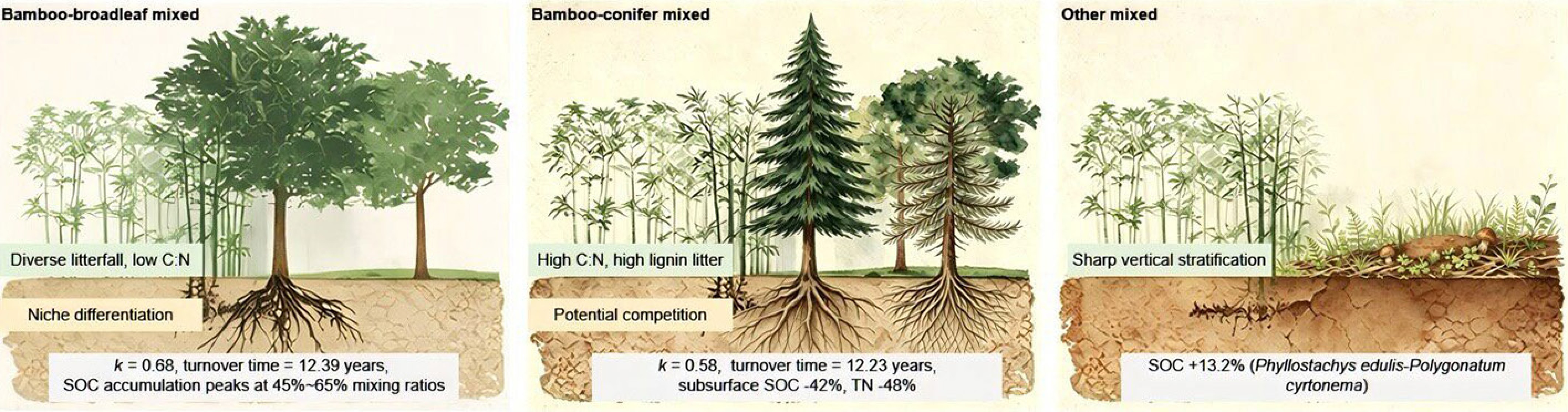
Figure 1.
Schematic comparison of three bamboo-tree mixed forest types: bamboo–broadleaf (BB) mixtures, bamboo–conifer (BC) mixtures, and other mixed forest types (bamboo-based agroforestry). Key indicators include canopy structure, root distribution patterns, decomposition rate constant (k), nutrient turnover time, and soil carbon/nitrogen dynamics. Decomposition rate constants (k = 0.68 for BB; k = 0.58 for BC) are from Song et al.[17]. Nutrient turnover times (12.39 years for BB; 12.23 years for BC) and the contrasting depth-dependent patterns of soil C and nitrogen dynamics (SOC −42%, TN −48% in BC subsurface layers) are from Liu et al.[14] and Yan et al.[18]. SOC accumulation in BB mixtures peaks at 45%~65% mixing ratios[12]. Data for bamboo-based agroforestry (SOC + 13.2% in P. edulis–P. cyrtonema) are from Wang et al.[19].
Where bamboo–conifer mixtures excel is in nutrient cycling efficiency. Comparative studies across three forest types, namely pure Moso bamboo (I), bamboo-broadleaf mixed (II), and bamboo-conifer mixed (III), have revealed a consistent pattern. The nutrient turnover time follows the order I > II > III, with values of 31.89, 12.39, and 12.23 years, respectively[14]. Bamboo–conifer mixtures thus achieve the fastest nutrient turnover among the three forest types, cycling nutrients more than 2.5 times faster than pure bamboo stands. The cycling coefficient follows the same order (III > II > I), indicating that bamboo–conifer and bamboo–broadleaf mixtures require fewer nutrient elements to sustain tree growth than pure bamboo stands[14]. In terms of soil C turnover, bamboo–fir mixed stands also exhibit the highest soil organic C turnover rates among forest types, with a turnover time of 17.98~20.13 years, and the highest annual soil C sequestration[14]. These findings point to a clear strength of bamboo–conifer mixtures, i.e., they accelerate the circulation of nutrients and C, making them potentially suitable for management scenarios where rapid nutrient recovery or short-term productivity is the priority. However, the efficiency advantages of bamboo–conifer mixtures come with a trade-off. Recent depth-profile analyses (0~100 cm) by Yan et al.[18] revealed that bamboo–Chinese fir mixtures exhibited substantial total N depletion, with parallel reductions in subsurface layers (20~40 cm: −42% SOC, −48% TN). This depletion reflects microbial N mining, whereby microorganisms decomposing N-poor, lignin-rich coniferous litter are forced to acquire N from existing soil organic matter, accelerating the decomposition of native soil C and N. The net effect is a redistribution of nutrients from subsurface soil pools toward more active surface cycling, rather than a net loss in all cases. But the direction of this redistribution, and whether it constitutes a problem, depends on management objectives. Surface soils may show short-term gains in organic matter and available nutrients, but subsurface C and N stocks are drawn down over time. No such depletion was detected in bamboo–broadleaf mixtures. A recent study further demonstrated that bamboo expansion into coniferous forests substantially reduced microbial C use efficiency and destabilized soil organic C by suppressing mineral-associated organic C formation, with mineral-associated organic C and microbial necromass C reduced by 47.94% and 20.70%, respectively[20]. Although bamboo–fir mixed stands exhibited the highest total SOC and particulate organic C contents, the elevated POC/MAOC ratio indicated reduced SOC stability[20]. The contrasting dynamics of bamboo–conifer vs bamboo–broadleaf mixtures in litter decomposition and soil C stabilization will be examined in detail in section Impact of bamboo-tree mixtures on nutrient cycling.
Mixing ratio and species selection matter in bamboo–conifer mixtures as much as they do in bamboo–broadleaf systems. Density thresholds compound the challenge. Zheng & Wang[21] found that Moso bamboo rhizome quality and underground structure were optimized when Chinese fir density ranged from 900 to 1,350 stems ha−1, with a higher proportion of healthy rhizomes. At 2,100 stems ha−1, however, rhizome length decreased, indicating that excessive conifer density exacerbates interspecific competition rather than enhancing complementarity. The non-linear response of bamboo rhizome development to conifer density mirrors the non-linear responses of soil properties to mixing ratio observed in bamboo–broadleaf mixtures, a reminder that optimal mixing proportions are context-dependent. Some studies suggest that at 1:1 mixing ratios, foliar C : N ratios are lowest, and anthropogenic regulation of soil C may be required to control bamboo expansion[22]. At this ratio, active silvicultural intervention, such as thinning or rhizome pruning, may be necessary to prevent bamboo from suppressing conifer growth entirely[23]. The choice of conifer species also matters. Bamboo–Chinese fir and bamboo–Masson pine mixtures may differ in their effects on soil properties, though direct comparative studies remain limited. Notably, mixed-species systems, including bamboo with Chinese fir or broadleaved trees, may enhance SOC stability through diversified litter inputs and improved soil enzyme activity[18]. Bamboo–conifer mixtures are most effective when management objectives prioritize rapid nutrient turnover and efficient C cycling, and when the associated risks of subsurface C and N depletion are adequately monitored and mitigated.
Other mixed forest types
-
Beyond bamboo–broadleaf and bamboo–conifer mixtures, bamboo has also been integrated with medicinal plants, edible fungi, vegetables, and other understory crops, a diverse array of practices often referred to collectively as bamboo-based agroforestry. These systems differ fundamentally from tree–bamboo mixtures in both ecological function and management objectives, yet research on them remains considerably less developed. Several factors account for this gap. The sheer diversity of potential combinations makes systematic study challenging; many systems have emerged from local farming practices rather than designed experiments, resulting in limited mechanistic understanding, and research has been biased toward yield and profitability rather than ecological processes[19,24]. Despite these limitations, bamboo-based agroforestry possesses distinctive features that warrant attention. The sharper vertical stratification between bamboo and low-stature understory species can more fully exploit light, water, and nutrient resources across soil depths. Many understory crops provide rapid economic returns within months to a year, bridging income gaps between bamboo harvesting cycles. The introduction of diverse understory species also alters litter quality and quantity, shaping soil microbial communities in ways that may differ fundamentally from tree–bamboo mixtures[25].
The limited evidence available suggests both opportunities and risks[26,27]. Studies on bamboo–medicinal plant systems have shown that intercropping can increase soil organic C and available N while enhancing microbial diversity, yet may also lead to soil acidification and potassium depletion[24]. For instance, Polygonatum cyrtonema intercropping under Moso bamboo increased soil organic C by 13.2% and available N by 32.6% in the 0~30 cm layer compared to monoculture[19], while planting Polygala fallax and Sarcandra glabra substantially increased available sulfur and zinc content[24]. However, intercropping medicinal herbs can also result in soil acidification and potassium depletion, with exchangeable potassium content in the 0~30 cm layer averaging 14.7% lower than in monoculture[24]. Bamboo–edible fungus systems have demonstrated substantial increases in bamboo biomass and soil organic C[27,28]. Ganoderma lucidum cultivation substantially enhanced bamboo aboveground biomass by 30.2% to 40.2%, with soil total organic C and mineral-associated organic C increasing by 14.23% to 34.73% and 27.13% to 120.71%, respectively[28]. The sustained increase in mineral-associated organic C suggests that fungal cultivation may enhance microbially mediated C transformation processes, favoring the formation of more stable carbon pools. Yet the effects on carbon pool composition are not uniformly positive; particulate organic carbon declined substantially in the third year of cultivation, reflecting an accelerated shift from fast-cycling to slow-cycling carbon components[28]. Bamboo–vegetable and bamboo–pulse intercropping have shown variable effects depending on crop species, underscoring the context-dependence of these systems. Looking forward, bamboo-based agroforestry represents an underexplored frontier with significant potential. Future research should prioritize mechanistic studies of belowground interactions, long-term assessments of sustainability, and comparative evaluations across species and environmental gradients.
-
Plant nutrient requirements and stoichiometric homeostasis are fundamental to understanding resource acquisition, allocation, and conservation strategies, which in turn determine litter quality and its interaction with decomposer communities. For bamboo–tree mixtures, the chemical composition of bamboo litter, and thus its compatibility with litter from companion species, is a direct consequence of bamboo's internal nutrient regulation strategies. Characterizing bamboo's nutrient demands and stoichiometric traits therefore provides the theoretical foundation for explaining why bamboo–broadleaf and bamboo–conifer mixtures produce fundamentally different effects on decomposition and nutrient cycling (Fig. 2). Bamboo species can accumulate 30 to 40 macro- and micronutrients[29], among which C, N, and P are the most ecologically consequential. Moso bamboo leaves contain 478.30 mg g−1 of C, which is comparable to or slightly higher than the terrestrial plant average, reflecting substantial investment in structural tissue. More revealing are the N and P concentrations. Foliar N and P average 22.20 and 1.90 mg g−1, respectively, yielding a C : N : P ratio of approximately 380:16:1 and an N : P ratio of about 14.40[30,31]. The N : P ratio is widely used as a diagnostic indicator of nutrient limitation. Koerselman & Meuleman[32] proposed, based on fertilization experiments across diverse plant communities, that N : P < 14 indicates N limitation, N : P > 16 indicates P limitation, and ratios between 14 and 16 suggest either N or P limitation or co-limitation by both nutrients. This threshold framework has since been extensively applied in forest ecosystem nutrient limitation diagnostics. However, the applicability of these thresholds varies considerably across ecosystems and species, with reported threshold values for N limitation ranging from 6.7 to 16 and for P limitation from 12.5 to 26.3. For Moso bamboo, foliar N : P ratios have been reported to fall between 12 and 16 across different studies and sites, placing bamboo at the boundary between N limitation and N–P co-limitation. Some studies suggest that bamboo growth is primarily constrained by N availability, while others indicate that P limitation may be equally or more important, particularly for older bamboo stands. This ambiguity likely reflects site-specific variation in soil properties, management intensity, and bamboo age structure, and suggests that the nature of nutrient limitation in Moso bamboo may shift along environmental gradients rather than following a single, fixed pattern.
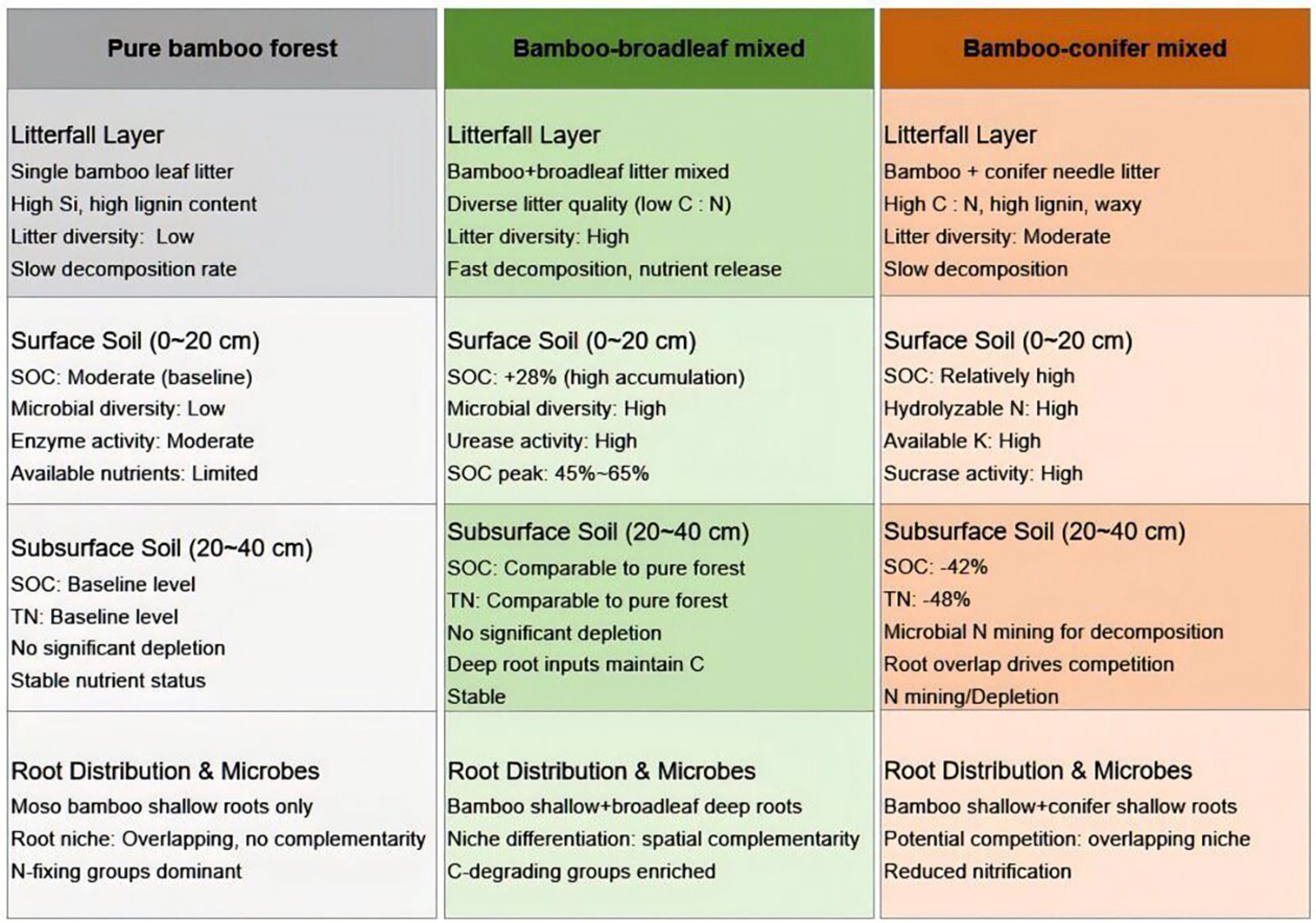
Figure 2.
Contrasting belowground ecological processes in pure Moso bamboo forests vs bamboo–broadleaf (BB) and bamboo–conifer (BC) mixed forests. The figure illustrates four key dimensions: litter layer and inputs, surface soil (0~20 cm) biogeochemical properties, subsurface soil (20~40 cm) carbon and nitrogen dynamics, and root distribution and microbial community composition. BB mixtures maintain balanced soil nutrient profiles without detectable subsurface depletion, whereas BC mixtures exhibit substantial SOC depletion (−42%) and TN depletion (−48%) in the subsurface layer driven by microbial nitrogen mining[18]. Surface soil properties for BB and BC mixtures are derived from Liu et al.[14] and Zhang et al.[11]; microbial community composition data are from Hong[33]; decomposition parameters are from Song et al.[17]. Abbreviations: SOC, soil organic carbon; TN, total nitrogen.
The stoichiometric signature of bamboo, i.e., high C : N ratio, high lignin content, and elevated silicon concentration, is not merely a passive chemical profile but a consequence of active, organ-specific homeostatic regulation. Recent studies have revealed that Moso bamboo employs a unique compartmentalized homeostasis mechanism. Through large-scale field investigations, nutrient addition experiments, and data synthesis across broad geographical and soil nutrient gradients, Wang et al.[34] demonstrated that bamboo decouples N and P regulation across tissues. Leaves maintain strict N : P homeostasis, functioning as photosynthetic factories that ensure stable core metabolic function regardless of external P fluctuations, while woody tissues, i.e., culms and branches, serve as flexible reservoirs that dynamically store or mobilize P based on soil P availability. This mechanism, termed cross-organ compartmentalized homeostasis, resolves the classical tension between stoichiometric homeostasis and phenotypic plasticity, allowing bamboo to achieve both the certainty of stable leaf stoichiometry and the flexibility of adjustable woody tissue nutrient storage. This strategy has been further corroborated in other bamboo species and across different research contexts. Shen et al.[35] investigated N and P stoichiometric homeostasis in leaves of different-aged Moso bamboo and found that, under the same soil N and P conditions, leaf N and P contents decreased substantially with increasing bamboo age. The internal stability index of N and P in bamboo leaves followed the order H_N : P > H_N > H_P, indicating that bamboo's internal stability is most tightly coupled to the elements that are most limiting. Phosphorus limitation on growth and development was reportedly greater for aged bamboo than for young bamboo, suggesting that nutrient limitation shifts with developmental stage. Organ-specific stoichiometric differences are also well documented. A study on nutrient allocation patterns in Moso bamboo and its varieties found that carbon allocation followed the order branches > culms > leaves > roots, N allocation followed leaves > branches > roots > culms, and P allocation was highest in leaves, followed by branches, roots, and culms[36]. These intra-plant variations reflect the distinct functional roles of different organs in carbon assimilation, nutrient storage, and structural support. The ecological significance of this compartmentalized strategy is profound. By maintaining strict N : P homeostasis in leaves while allowing P flexibility in woody tissues, bamboo buffers its photosynthetic organs from soil P limitation and microbial competition. This yields lower leaf N : P variability than 75 out of 91 co-occurring tree species, and sustains approximately 25% higher annual productivity than other forest types, including evergreen broadleaf, deciduous broadleaf, and coniferous forests. Studies on Moso bamboo forests with different productivity levels have also demonstrated that the stoichiometric ratios of major nutrient elements in bamboo stands possess inherent stability, consistent with the stoichiometric homeostasis hypothesis[37]. The pattern of N and P homeostasis changes with bamboo age. Young culms (1~3 years old) exhibit lower N : P ratios, approximately 13, consistent with the Growth Rate Hypothesis, while mature culms (≥ 5 years old) show N : P ratios around 21 with enhanced nutrient resorption efficiency.
The stoichiometric framework outlined above has direct implications for understanding bamboo–tree mixtures. When bamboo litter, characterized by high C : N, high lignin, and high silicon, decomposes alone, its chemical recalcitrance slows nutrient turnover. When mixed with litter from broadleaf species, which typically have lower C : N ratios and higher initial N concentrations, chemical complementarity alleviates microbial N limitation and accelerates decomposition. This is reflected in the decomposition rate constant (k) for bamboo–broadleaf mixtures reaching 0.68, compared to 0.58 for bamboo–conifer mixtures and 0.66 for pure bamboo stands[38]. The facilitative effect of broadleaf admixture on decomposition is thus roughly double that of coniferous admixture. Coniferous litter, by contrast, shares bamboo's chemical signature, i.e., both are high in C : N, high in lignin, and slow to decompose. Mixing the two does not create complementarity but compounds recalcitrance, resulting in a k value of only 0.58 for bamboo–conifer mixtures. This difference is not merely about decomposition rates. Research on Moso bamboo expansion into Chinese fir forests has shown that bamboo possesses strong homeostatic capacity and alters soil P content, which in turn causes P content and N : P stoichiometric imbalance in fir tissues, a likely important mechanism underlying fir growth suppression or mortality[17]. Beyond decomposition, the stoichiometric differences between mixture types also manifest in nutrient distribution patterns. Comparative studies across three forest types, namely pure Moso bamboo (I), bamboo–broadleaf mixed (II), and bamboo–conifer mixed (III), have shown that total nutrient accumulation follows the order II > I > III, with values of 146,196.59, 144,466.35, and 105,002.59 kg hm−2, respectively[14]. Bamboo–broadleaf mixtures have the highest nutrient accumulation in soil and litter layers, indicating the greatest site productive potential, whereas bamboo–conifer mixtures have the lowest total nutrient stocks despite their faster turnover rates. The cycling coefficient follows the order III > II > I, indicating that bamboo–conifer mixtures require fewer nutrient elements to sustain tree growth than bamboo–broadleaf mixtures or pure stands[14]. These patterns underscore a fundamental stoichiometric trade-off, i.e., bamboo–broadleaf mixtures enhance nutrient retention and soil fertility, while bamboo–conifer mixtures prioritize nutrient turnover efficiency over nutrient accumulation. The divergent effects of broadleaf vs coniferous admixture on decomposition and nutrient cycling are rooted in the fundamental difference in chemical compatibility determined by bamboo's unique stoichiometric homeostasis strategy.
Litterfall quality
-
Litterfall is the primary conduit through which nutrients return from vegetation to soil. Moso bamboo leaf litter is, by most measures, of moderate to low quality. Carbon concentration is approximately 38.5%, N about 1.87%, C : N ratio approximately 20.5, lignin content about 11.99%, and total phenolic concentration approximately 11.15 mg g−1[39]. But the defining chemical feature is silicon. The silicified epidermal cells of Moso bamboo leaves accumulate substantial SiO2, with silicon concentration in litterfall reaching 78.4 g kg−1 (approximately 7.84%)[40]. A broader comparison across five subtropical forest types reveals an even more striking pattern. SiO2 content in Moso bamboo litterfall (152.50 g kg−1) is more than 10 times that of broadleaf forest (13.96 g kg−1), and far exceeds that of coniferous forests such as Chinese fir (7.62 g kg−1) and Masson pine (6.59 g kg−1)[41]. This extreme silicon enrichment, combined with high lignin content and a lignin : N ratio that retards decomposition, makes bamboo litter inherently slow to break down[42].
The direction of change upon mixing, however, depends critically on the identity of the companion species. Broadleaf tree litter typically possesses higher initial N concentration and a more balanced lignin : cellulose ratio. When mixed with bamboo litter, this chemical profile establishes 'C–N resource complementarity'[42]. The high-C, low-N bamboo litter is balanced by the low-C, high-N broadleaf litter, alleviating the microbial N limitation that would otherwise slow decomposition. Coniferous litter, by contrast, is chemically distinct from broadleaf litter, i.e., higher C : N ratios, higher lignin content, and slower decomposition rates. Far from complementing bamboo's chemical recalcitrance, it compounds it. High C : N, high lignin, and slow decomposition in both litter types create no complementary release of N limitation. The extreme silicon disparity between bamboo and conifers further exacerbates this chemical mismatch. The consequences of this divergence are directly reflected in decomposition rates. Liu et al.[38] reported that the decomposition rate constant (k) for bamboo–broadleaf mixed litterfall was 0.68, compared to 0.58 for bamboo–conifer mixtures and 0.66 for pure bamboo stands. The facilitative effect of broadleaf admixture on decomposition is thus roughly double that of coniferous admixture. However, the non-additive effects of bamboo–broadleaf mixing are not uniformly positive. Chen & Liu[43] found that when leachate from bamboo leaves is mixed with leachate from broadleaf trees of comparable biodegradability, an antagonistic effect occurs; when mixed with broadleaf litter of substantially lower biodegradability, a synergistic effect emerges, with the intensity of synergism increasing linearly with interspecific differences in decomposition rates. This suggests that the magnitude and direction of mixing effects depend on the specific chemical contrast between bamboo and the companion broadleaf species, a contrast that is largely absent in bamboo–conifer mixtures due to their chemical similarity.
Litterfall decomposition
-
If litter quality sets the initial conditions for decomposition, the actual process involves a complex interplay of microbial communities, soil fauna, and environmental factors. Liu et al.[38] conducted an in situ decomposition experiment across five treatments, i.e., pure Moso bamboo litter (I), bamboo–Phoebe bournei 8:2 (II), bamboo–Chinese fir 8:2 (III), bamboo–P. bournei 5:5 (IV), and bamboo–Chinese fir 5:5 (V). All decomposition rates conformed to the Olson exponential decomposition model with R2 > 0.92. The decomposition rate constants (k) followed the order II > I > III > V > IV, with values of 0.68, 0.66, 0.58, 0.55, and 0.49, respectively. Two findings merit particular attention. First, bamboo–broadleaf mixtures (II and IV) consistently outperformed bamboo–conifer mixtures (III and V) across all mixing ratios, confirming that the chemical recalcitrance of coniferous litter constrains decomposition regardless of proportion. Second, increasing the broadleaf proportion from 20% to 50% reduced k from 0.68 to 0.49 for bamboo–P. bournei, and increasing the conifer proportion from 20% to 50% reduced k from 0.58 to 0.55 for bamboo–Chinese fir. This indicates that synergistic effects in mixed decomposition are not monotonic; they emerge only at specific mixing ratios and collapse when the balance tips too far. In bamboo–broadleaf mixtures, the optimal ratio for accelerated decomposition appears to be approximately 20% broadleaf proportion; beyond this threshold, the facilitative effect diminishes. In bamboo–conifer mixtures, the decomposition rate is consistently lower across all mixing ratios, reflecting the inherent chemical recalcitrance of coniferous litter. A broader comparison across five dominant subtropical tree species further confirmed this hierarchy: broadleaved species decomposed fastest (k = 0.230–0.278 year−1), followed by Moso bamboo (k = 0.168–0.217 year−1), with conifers decomposing slowest (k = 0.016–0.062 year−1)[44].
Nutrient release patterns during decomposition differ markedly among elements and are influenced by litter quality. N follows a pattern of alternating enrichment and net release; P undergoes rapid enrichment in the first 4 months, a brief net release between the 4th and 5th months, and subsequent enrichment; K concentrations increase initially, then decrease, with net release occurring in the first 3 months followed by enrichment[45]. The C/N ratio and P content of bamboo leaf litter may serve as indicators of decomposition dynamics. High-quality broadleaf litter (high cellulose, low lignin : N) can enhance ammonium N supply by altering fungal community structure and upgrading lignin degradation capacity, while lower-quality Moso bamboo litter promotes nitrate N production by reshaping bacterial communities and stimulating urease activity[42]. In bamboo–conifer mixtures, the slower decomposition rates mean that nutrient release is more protracted, which can be either an advantage (reduced nutrient leaching) or a disadvantage (slower nutrient availability for plant uptake), depending on management objectives. As bamboo expands into coniferous forests, the lignin/N ratio of the litter layer and different decomposition layers demonstrates an overall upward trend. The total nutrient release rate from the undecomposed layer to the semi-decomposed layer ranges from −38.18% to 67.87% across different nutrient elements, indicating substantial variability in element-specific release dynamics[43].
The microbial and faunal dimensions most clearly illustrate the bamboo–broadleaf vs bamboo–conifer contrast. Chen et al.[46] demonstrated that bamboo–broadleaf mixing reshapes fungal community structure, driving a transition from oligotrophic communities dominated by Basidiomycota to copiotrophic communities dominated by Ascomycota, accompanied by increased abundance of saprotrophic fungi and decreased symbiotrophic fungi, a shift that accelerates decomposition. Zhang et al.[47], using metagenomic analysis, revealed that bacterial communities constitute over 98% of total microbial abundance in bamboo forest soils, with Acidobacteria, Actinobacteria, Proteobacteria, and Chloroflexi as key phyla involved in cellulose and hemicellulose degradation. In bamboo–conifer mixtures, by contrast, soil bacterial communities exhibit reduced nitrification rates, i.e., decreased NO3−-N content, reflecting the inhibitory effects of coniferous litter chemistry on N transformation pathways. The diverse litterfall composition in bamboo–broadleaf mixtures provides a broader array of chemical substrates for decomposer communities, potentially promoting niche differentiation among microbial functional groups and complementary feeding strategies among soil fauna. This microbial complementarity is largely absent in bamboo–conifer systems, where the chemical similarity between bamboo and coniferous litter does not generate the same level of functional diversity. Reciprocal transplant decomposition experiments have further revealed that fungal community composition on broadleaf and bamboo litters is substantially influenced by incubation site, suggesting that fungi participate in driving the home-field advantage of litter decomposition[48]. Soil fauna play a critical mediating role in these processes. Studies on bamboo invasion into broadleaf forests have shown that invaded sites exhibit reduced decomposition rates and lower decomposer N use efficiency; however, when large soil fauna are excluded, this negative effect is reversed, indicating that bamboo invasion reduces the climatic sensitivity of decomposers, particularly large soil fauna[49]. These findings suggest that the contrasting decomposition dynamics between bamboo–broadleaf and bamboo–conifer mixtures are driven not only by litter chemistry but also by the composition and functional roles of soil biotic communities, which remain poorly understood and warrant systematic investigation.
Impacts of bamboo–tree mixtures on soil nutrient amelioration and plant growth
-
The improvement of soil fertility and the promotion of plant growth represent important dimensions for evaluating the management effectiveness of bamboo–tree mixtures. Pure Moso bamboo stands, bamboo–broadleaf mixtures, and bamboo–conifer mixtures exhibit differing patterns in soil nutrient accumulation and turnover efficiency. We examine each in turn.
Bamboo–broadleaf mixtures show species-dependent effects on soil fertility. Within this mixture type, the choice of broadleaf species matters considerably. A comparative study across four bamboo–broadleaf combinations with Castanopsis chinensis, Alniphyllum fortunei, Choerospondias axillaris, and Castanopsis fargesii revealed that C. axillaris significantly increased fine root biomass and root length density, while A. fortunei and C. axillaris showed significantly higher total P and total K contents[50]. C. fargesii increased acid phosphatase and catalase activities but decreased sucrase activity[50]. A separate study across C. chinensis, A. fortunei, and C. axillaris with different mixing ratios found that C. axillaris forests exhibited notably higher mean C, N, and P contents than A. fortunei and C. chinensis, particularly at a 10~20% mixing ratio where soil organic C reached 46.50 g kg−1. C. axillaris forests also demonstrated significantly higher activities of invertase (701.83 U g−1), urease (8393.44 U g−1), and catalase (501.73 U g−1)[13]. Fine roots play a critical role in mediating nutrient uptake in these mixed systems. In pure bamboo stands, fine root biomass can reach 1,201.60 g m−2, approximately six times that of evergreen broadleaf forests[51]. In bamboo–broadleaf mixtures, bamboo fine roots tend to distribute toward the upper soil layers, with specific root length increasing by an average of 123.42% and total root length density 2.1 times greater than that of broadleaf trees[51]. This rooting strategy allows bamboo to efficiently capture nutrients from surface soils while coexisting with deeper-rooted broadleaf species that access nutrients from lower profiles. Soil organic matter content in bamboo–broadleaf mixed forests is generally higher than in pure bamboo stands, with superior soil structural stability[52]. Zhao et al.[53] found that underplanting Phoebe chekiangensis and Taxus wallichiana var. mairei within bamboo stands significantly increased soil organic matter content, providing abundant substrates for soil fauna and microorganisms. Concentrations of dissolved organic C, microbial biomass C, and light fraction organic C are significantly higher in bamboo–broadleaf mixtures than in pure bamboo forests[54]. However, some studies noted significant decreases in easily oxidizable C and particulate organic C under certain mixing regimes, potentially due to altered microbial metabolic pathways and accelerated consumption of mobile C fractions[55]. In terms of labile C fractions, the contribution of organic C within large macroaggregates is highest in bamboo–Chinese fir mixtures, followed by bamboo–broadleaf mixtures, and lowest in pure bamboo forests, indicating that mixed-species management facilitates C stabilization within macroaggregates[56]. Addition of Phoebe bournei litter significantly accelerated soil organic C mineralization rates and increased cumulative mineralization compared to pure bamboo stands[57]. Among the three forest types, bamboo-broadleaf mixtures have the highest soil pH, total P, available P, and urease activity[14].
Bamboo–conifer mixtures show higher nutrient turnover efficiency than nutrient accumulation. Comparative studies across the three forest types have shown that nutrient turnover time follows the order I > II > III[14]. Bamboo–conifer mixtures thus achieve the fastest nutrient turnover among the three forest types, cycling nutrients more than 2.5 times faster than pure bamboo stands. The cycling coefficient follows the same order (III > II > I), indicating that bamboo–conifer mixtures require fewer nutrient elements to sustain tree growth than pure bamboo stands or bamboo–broadleaf mixtures[14]. Bamboo–conifer mixtures also improve soil fertility, but with a different profile. Compared to pure bamboo, bamboo–Chinese fir mixtures showed increases in soil organic matter (9.13%~51.85%), total N (1.42%~41.35%), and available P (45.78%~81.71%)[15]. Bacterial and actinomycete populations in the 0~20 cm layer increased by 56.17% and 30.77%, respectively. Bamboo–conifer mixtures have the highest hydrolyzable N, available K, and invertase activity among the three forest types[14]. Studies have also shown that bamboo–Chinese fir mixed forests can improve soil N and K contents, with soil organic matter, total N, total P, total K, hydrolyzable N, available P, and available K all higher than in pure bamboo or pure Chinese fir stands. Total nutrient accumulation in the stands follows a different order: II > I > III[14]. Bamboo–broadleaf mixtures have the highest nutrient accumulation in soil and litter layers, indicating the greatest site productive potential, whereas bamboo–conifer mixtures have the lowest total nutrient stocks despite their faster turnover rates.
The contrasting patterns between bamboo–broadleaf and bamboo–conifer mixtures are closely associated with differences in microbial community composition and function. A study on Moso bamboo–Liquidambar formosana and bamboo–P. chekiangensis mixtures revealed distinct microbial community structures between mixture types (p < 0.01)[58]. The L. formosana mixture was enriched with carbon-decomposing taxa, whereas the P. chekiangensis mixture was enriched with acid-tolerant, N-cycling groups[58]. Pure bamboo stands, by contrast, were enriched with N-fixing taxa, i.e., Nitrobacteraceae and Bradyrhizobium[58]. These functional group shifts have direct implications for nutrient availability: C-decomposing taxa accelerate organic matter turnover, N-cycling groups enhance N transformation, and N-fixing taxa contribute to N inputs. In bamboo–broadleaf mixtures, the diverse litter inputs from bamboo and broadleaf trees provide a broader array of chemical substrates, which may promote niche differentiation among microbial functional groups. In bamboo–conifer mixtures, by contrast, the chemical similarity between bamboo and coniferous litter may limit the generation of functional diversity.
The most critical trade-off, however, lies in the depth-dependent nature of soil C and N dynamics. Recent depth-profile analyses (0~100 cm) by Yan et al.[18] revealed that bamboo–Chinese fir mixtures exhibited substantial total N depletion (i.e., −32%) across the entire soil profile, with parallel reductions in subsurface layers (20~40 cm: −42% SOC, −48% TN). This depletion is driven by microbial N mining, i.e., microorganisms decomposing N-poor, lignin-rich coniferous litter are forced to acquire N from existing soil organic matter, accelerating the decomposition of native soil C and N. No such depletion was detected in bamboo–broadleaf mixtures. In bamboo–broadleaf mixtures, enhanced enzyme activity, i.e., β-glucosidase (+ 52%) and N-acetyl-glucosaminidase (+ 89%), and increased ammonium availability (+ 47%) reflect active microbial processing of high-quality litter inputs without depleting subsurface nutrient stocks[18]. This depth-dependent contrast suggests a fundamental trade-off: bamboo–conifer mixtures enhance surface soil fertility while drawing down subsurface nutrient reserves, whereas bamboo–broadleaf mixtures improve soil fertility across the profile without detectable subsurface depletion. The choice between the two mixture types thus depends on management priorities—rapid nutrient turnover vs long-term soil stability. This trade-off is further complicated by soil pH responses, which vary considerably across studies and site conditions. A recent meta-analysis of 81 studies with 2,037 paired observations provided systematic evidence that soil pH increased by 6.99% in the 0~20 cm layer and 4.49% in the 20–40 cm layer after bamboo expansion[59]. pH increases were greater in coniferous forests than in broadleaf forests, and the extent of pH elevation was significantly positively correlated with bamboo proportion within the stand[59]. Pure bamboo stands exhibited a 30.39% increase in ammonium N and a 21.12% decrease in nitrate N compared to their native counterparts[59]. Studies have shown that with bamboo expansion, soil pH increases significantly, and bamboo forest soil pH can be 0.37 and 0.32 higher than that of bamboo–broadleaf mixed forest and evergreen broadleaf forest, respectively. Other studies reported that Moso bamboo expansion increased soil pH by 0.23 in mixed bamboo–broadleaf forest and 0.59 in pure bamboo forest compared to broad-leaved forest. Some studies observed pH increases with higher broadleaf proportions[52], while others reported acidification driven by intensified nutrient demand and root H+ efflux[33,60]. These contrasting findings indicate that mixing effects may differ across soil contexts. Baseline soil pH, litter chemistry, site history, and associated tree species all influence the outcome.
-
Mixed forests generally exhibit superior resistance to both biotic and abiotic disturbances compared to monocultures. This advantage is rooted in two complementary mechanisms, i.e., physiological enhancement through niche complementarity and structural buffering through multi-layered canopies. In this section, we evaluate resistance from four complementary perspectives, namely physiological adaptation at the organ level, structural buffering against physical disturbances, suppression of pest and disease outbreaks through species interactions, and hydrological regulation through multi-layered canopies.
Physiologically, bamboo in mixed stands exhibits enhanced stress resistance. Peng et al.[61] demonstrated that in bamboo–Chinese fir mixed stands, the maximum net photosynthetic rate of Moso bamboo increased by approximately 20.5% compared to pure stands, with significant elevations in PSII maximum photochemical efficiency (Fv/Fm), photochemical quenching coefficient, and antioxidant enzyme activities. Chinese fir in these mixtures showed enhancements of 70.7% and 82.6% in instantaneous carboxylation efficiency and water-use efficiency, respectively. These physiological advantages are primarily attributable to alleviated resource competition through niche complementarity, a robust antioxidant defense system, and higher leaf N and chlorophyll concentrations within the mixed environment. Plantations composed of bamboo and broad-leaved trees can significantly improve ecological benefits through species interactions, enhancing overall resistance to environmental stresses.
The resistance benefits, however, are not uniform across mixture types. Structurally, the multi-storied canopy of bamboo–tree mixtures provides significant buffering against physical disturbances. The 2008 ice storm in subtropical China caused extensive forest damage, with damage rates varying between 25% and 81% across different forest types; secondary broadleaved forests experienced the most extensive damage, and Chinese fir plantations suffered the most severe damage, while the structural complexity of bamboo–tree mixtures provided a buffering effect that pure bamboo stands lacked[62]. Long-term monitoring of bamboo–broadleaf mixed forests after the ice storm revealed that plots with higher broadleaf tree density exhibited a bamboo mortality rate of only 9.8% and associated tree mortality of 8.7%; by contrast, plots with lower broadleaf tree density showed bamboo mortality of 72.0% and associated tree mortality of 40.5%[63]. Bamboo–broadleaf mixtures can effectively improve site conditions, increase the average diameter at breast height and average culm height of Moso bamboo, and promote vigorous tree growth, thereby enhancing overall stand resistance.
In terms of pest and disease resistance, bamboo–tree mixtures disrupt the ecological conditions conducive to large-scale pest outbreaks by enhancing species diversity and stand structural complexity. Pure bamboo forests, characterized by a uniform genetic background and homogeneous food resources, are highly susceptible to specialist pests such as bamboo moths, bamboo locusts, and aphids, whereas mixed stands inhibit pest population growth through resource dilution, habitat provisioning for natural enemies, and allelopathic interactions. Notably, bamboo–broadleaf mixtures exhibit the highest species diversity among the three forest types: the richness index (33.90 ± 9.808), Shannon–Wiener index (2.534 ± 0.644), and Simpson index (0.860 ± 0.117) in the tree and shrub layers are all highest in bamboo–broadleaf mixtures[64]. However, a study on bamboo shoot blight (Ceratosphaeria phyllostachydis) revealed that bamboo–conifer mixtures exhibited the highest disease index (6.321 ± 1.530), followed by bamboo–broadleaf mixtures (4.588 ± 0.748), while pure bamboo stands showed the lowest disease index (4.460 ± 1.903); the disease index in bamboo–conifer mixtures was 41.7% higher than in pure bamboo stands[65]. This counterintuitive finding, i.e., bamboo–conifer mixtures being more susceptible to certain diseases than pure stands, suggests that the relationship between mixing and disease resistance is species- and pathogen-specific, and that coniferous admixture may introduce novel disease risks rather than uniformly enhancing resistance. The contrast is equally striking for bamboo mites. Damage caused by Schizotetranychus nanjingensis and Aponychus corpuzae is exceptionally severe in pure stands: pure bamboo forests exhibit an average damage index of 35% (22.1%~44.7%), compared to only 17.5% (2.7%~28.6%) in mixed stands[65]. Pure bamboo stands harbor 289.28% higher total pest mite populations than mixed forests, while mixed forests support 263.56% higher populations of the predatory mite Typhlodromus bambusae; the beneficial-to-pest mite ratio is 1:13 in mixed forests vs 1:118 in pure stands[65]. Research has shown that intensive management practices such as understory tillage and clearing in pure bamboo stands disrupt the populations of Oligonychus urema that depend on Miscanthus grass, causing their natural enemy T. bambusae to decline due to lack of intermediate prey. In bamboo–Miscanthus mixed stands, the pest mites on bamboo and O. urema in the understory are both controlled by the shared natural enemy T. bambusae, maintaining stable beneficial-to-pest population ratios. The sharp decline of natural enemies in pure bamboo stands is a critical factor leading to outbreaks of bamboo pest mites. INBAR[66] further demonstrated that biodiversity loss increases forest susceptibility to pest attack: monoculture bamboo forests exhibit 12%~35% higher damage rates than mixed forests following winter snowstorms, and bird diversity in pure bamboo stands is substantially lower than in nearby mixed forests.
Hydrological regulation also contributes to the overall resistance of mixed forests. The multi-tiered structure of mixed forests provides superior water regulation capacity compared to pure bamboo stands. The total water-holding capacity of Chinese fir–Moso bamboo mixed forests reached 636.62 t ha−1, an increase of 136.72 t ha−1 over pure bamboo stands, with initial and stable infiltration rates 2.5 and 1.6 times higher, respectively[67]. The effective interception capacity of litterfall in Qiongzhuea tumidinoda–Phellodendron amurense mixed forests was 9.74 t ha−1, representing a 56.3% increase over natural Q. tumidinoda monocultures[68]. These hydrological advantages directly enhance stand resistance by reducing soil erosion risk during heavy rainfall events and maintaining soil moisture during drought periods. However, these benefits are not universal: transitional mixed stands formed by Moso bamboo encroaching into coniferous stands may face a 60.3% reduction in water-holding capacity, partially due to soil structural degradation[69], indicating that the hydrological benefits of mixed forests are highly dependent on specific stand-scale configurations.
Resilience following disturbances
-
The resilience of bamboo–tree mixed forests following disturbances is primarily driven by the synergy between bamboo's clonal recovery strategy and the functional redundancy provided by associated tree species. This dual mechanism differentiates bamboo–tree mixtures from pure tree forests, where resilience depends primarily on seed regeneration and sapling recruitment.
As a characteristic clonal plant, Moso bamboo possesses a complex subterranean rhizome network that can enable rapid regeneration and colonization of canopy gaps following harvesting or natural disturbances[70]. The resilience of bamboo is fundamentally rooted in clonal integration, i.e., the ability of connected ramets to translocate and share resources through the rhizome network. Nitrogen translocation between connected ramets is bidirectional, with net flow from mature to young ramets[71]. The intensity of physiological integration is relatively low in homogeneous environments, but in heterogeneous environments, 15N translocation between connected ramets is determined by demand-driven source–sink relationships, and physiological integration significantly improves the N use efficiency of Moso bamboo[72]. Clonal integration can also supply substrates for microbes and facilitate enzyme activity and organic matter decomposition in the rhizosphere of shaded ramets[73]. Quantitative assessments of Dendrocalamus giganteus stands under varying harvesting intensities by Ning et al.[74] indicated that a 50% selective harvesting strategy yielded a health index of 8.44, significantly higher than the 4.18 observed in clear-cutting treatments. Moderate disturbance, i.e., retaining approximately 50% of the bamboo clumps, optimizes the recovery potential of the mixed stand, whereas over-harvesting leads to severe degradation. Different management practices also influence ramet system dynamics: timber forests and shoot forests exhibit distinct belowground rhizome morphologies, with shoot forest ramet systems showing stable early-stage rhizome renewal but instability in later stages[75]. Concurrently, the tree species retained in mixed stands, along with their associated seed and seedling banks, provide a reliable source of propagules for long-term community succession, creating temporal complementarity between rapid clonal expansion and long-term sexual recruitment.
Higher species diversity further reinforces functional redundancy during the recovery process. Investigations by Zhou et al.[10] in the Tianbaoyan bamboo–broadleaf mixed forests revealed a diverse assemblage of associated species, including Castanopsis fargesii, Castanopsis carlesii, Alniphyllum fortunei, Schima superba, and Liquidambar formosana. These species perform distinct ecological roles, forming a sophisticated interspecific functional network. When bamboo populations are impaired by pest outbreaks or climatic events, these associated species sustain critical processes such as canopy architecture maintenance, litterfall input, and soil stabilization, creating favorable conditions for bamboo population recovery. This mechanism is particularly vital under global warming, where rising temperatures may diminish the fitness of certain species. The high functional redundancy inherent in mixed forests provides a buffer, reducing the risk of systemic collapse following the loss of keystone species[9].
From the perspective of soil nutrient reserves, bamboo–tree mixtures develop larger soil nutrient stocks through long-term litter accumulation, providing a material foundation for post-disturbance recovery. Research generally shows that the natural soil fertility of mixed forests is superior to that of pure Moso bamboo stands on comparable sites[15,76]. Bamboo–broadleaf mixtures, in particular, demonstrate superior soil recovery capacity. Studies have shown that bamboo–broadleaf mixed forests have higher self-fertilizing capacity than pure bamboo stands, with a mixing ratio of 8:2 (bamboo : broadleaf) and a density of 2,100 stems·hm−2 being most effective for maintaining soil fertility[77]. The positive succession of bamboo forests can improve soil permeability and soil microbial C, N, and P contents. However, resilience levels exhibit distinct dependencies on the type of mixture. Bamboo–conifer mixtures appear relatively vulnerable in terms of long-term soil stability. Depth-profile analyses (0~100 cm) by Yan et al.[18] revealed that organic C and total N reserves in the 20~40 cm subsurface layer of bamboo–Chinese fir mixed forests were 42% and 48% lower, respectively, than those in pure Moso bamboo stands, with total soil N reserves across the entire 0~100 cm profile declining by 32%. This substantial depletion of soil C and N is closely linked to the microbial N mining effect induced by coniferous litter. Studies on landslide-disturbed soils have further shown that soil recovery in bamboo forests can be slower than in other forest types[78], and bamboo expansion into coniferous forests significantly alters soil structure and reduces microbial C use efficiency[20]. Therefore, should bamboo–conifer mixtures encounter severe disturbances, their soil functional recovery period could be longer than that of bamboo–broadleaf mixtures. Bamboo–broadleaf mixtures, by contrast, maintain more balanced soil nutrient profiles across the soil depth, supporting faster functional recovery following disturbance.
Long-term productivity and sustainability
-
Maintaining long-term productivity is a key criterion for evaluating the sustainability of forest management practices. The contrasting trajectories of pure bamboo stands vs bamboo–tree mixtures over decadal timescales provide strong evidence that mixed-species management can be more sustainable for maintaining long-term site productivity.
In the absence of exogenous nutrient inputs, pure Moso bamboo monocultures are highly susceptible to productivity decline driven by soil nutrient depletion. Long-term observational studies by Lou et al.[7] revealed distinct growth trajectories following the conversion of bamboo–tree mixed forests to pure Moso bamboo monocultures. The initial post-conversion phase (years 1~4) was characterized by a surge in new culm recruitment coupled with a reduction in diameter at breast height. During this period, the annual number of new culms averaged approximately 50% higher than in the pre-conversion mixed forest, peaking at 96 culms per 600 m2 in the third year; however, the average diameter at breast height (DBH) of these new culms remained lower than that of the original mixed forest. The subsequent phase (years 5~11) exhibited recovery and an increase in both DBH and yield; by the 11th year, the average DBH and yield of new culms had increased by 10% and 52%, respectively, relative to pre-conversion baselines. However, during years 11~21, the stands entered a distinct decline phase, characterized by a 3.9 cm reduction in average DBH and a 17% drop in yield. The average yield during the second decade (years 12~21) was 38% lower than that of the first decade (years 1~11). These findings indicate that the transient productivity gains driven by competitive release and temporary nutrient flushes following monoculture conversion cannot offset the cumulative nutrient deficits incurred by long-term soil degradation. Pure Moso bamboo stands typically exhibit pronounced signs of decline after approximately 15 years of monoculture management, underscoring the unsustainability of monoculture systems for maintaining long-term forest productivity[7]. Studies on pure bamboo stands have further shown that soil natural fertility declines with extended management periods, with fertility indicators decreasing most rapidly in the first decade of pure stand management[7].
Conversely, bamboo–tree mixed forests maintain relatively stable long-term productivity by sustaining soil fertility. Lou et al.[7] demonstrated that the soil fertility of bamboo–tree mixed forests is generally superior to that of pure Moso bamboo stands under equivalent site conditions. Research on bamboo–broadleaf mixed forests by Cao et al.[79] revealed that broadleaf trees exerted low competitive pressure on adjacent Moso bamboo, accounting for only 20.3% of the total interspecific competition. Instead, interspecific interactions were dominated by niche complementarity, fostering facilitative coexistence. Studies have shown that bamboo–broadleaf mixed forests have higher self-fertilizing capacity than pure bamboo stands; a mixing ratio of 8:2 (bamboo : broadleaf) and a density of 2,100 culms·hm−2 has been identified as most effective for maintaining soil fertility[77]. From a multifunctional ecosystem perspective, mixed forests exhibit pronounced advantages across multiple dimensions. A systematic comparison of the three forest types revealed that total nutrient accumulation follows the order II (bamboo–broadleaf) > I (pure bamboo) > III (bamboo–conifer)[14]. Bamboo–broadleaf mixtures have the highest nutrient accumulation in soil and litter layers, indicating the greatest site productive potential[14]. Although bamboo–broadleaf mixed forests may not exhibit significantly higher soil organic C stocks compared to pure Moso bamboo stands[18], their soil C pools are more stable and resilient to external disturbances, ensuring more secure long-term C sequestration. Regarding stand structure optimization, the multi-layered canopy profile of mixed forests significantly enhances light-use efficiency; the cumulative canopy projection area can reach 6,861.2 m2 ha−1, 17.48 times greater than that of pure bamboo stands[16].
The long-term sustainability of bamboo–conifer mixtures, however, is associated with both opportunities and risks. On the positive side, managing bamboo–Chinese fir mixtures with appropriate conifer density can benefit both species. Studies have shown that in near-mature Chinese fir stands, a density of approximately 870 trees·hm−2 can maximize total biomass, which is 1.43 times greater than that of pure Chinese fir stands, while also improving light energy and soil nutrient utilization[80]. The cycling coefficient follows the order III (bamboo–conifer) > II (bamboo–broadleaf) > I (pure bamboo), indicating that bamboo–conifer mixtures require fewer nutrient elements to sustain tree growth than the other two forest types[14]. However, Yan et al.[18] indicated that although Moso bamboo–Chinese fir mixtures can enhance surface soil C pools, they may trigger long-term losses of soil C and N due to microbial N mining stimulated by recalcitrant coniferous litter. This efficiency, however, comes at the cost of lower total nutrient stocks. Consequently, bamboo–conifer mixtures may exhibit greater uncertainty in maintaining long-term productivity than bamboo–broadleaf mixtures. The essence of this trade-off lies in the choice between two strategies: nutrient retention vs nutrient turnover. Bamboo–broadleaf mixtures, through high species diversity, construct a robust buffering system that enhances nutrient retention and long-term soil stability. Bamboo–conifer mixtures, by contrast, achieve rapid nutrient supply at the expense of partial deep-soil C stocks, prioritizing turnover efficiency over storage. How to weigh these two strategies against specific management objectives (e.g., carbon sequestration priority vs timber production priority) and site conditions (soil background, climate) is a key challenge for future research and management. The studies reviewed here are predominantly from subtropical China, which reflects the global distribution of Moso bamboo. The mechanistic principles identified, i.e., stoichiometric complementarity, microbial nitrogen mining, and functional redundancy, are likely to hold in other bamboo-dominated regions where climatic and soil conditions are comparable. However, specific mixing ratios and species recommendations should not be extrapolated directly to regions with different edaphic and climatic contexts. The optimal mixing ratios reported here were derived from studies conducted under particular environmental conditions. Future work should test these findings across wider geographic and climatic gradients to determine their general applicability.
-
This review has synthesized current understanding of nutrient cycling and ecosystem stability in bamboo–broadleaf (BB) and bamboo–conifer (BC) mixed forests. Three main findings emerge. (1) BB mixtures accelerate litter decomposition through stoichiometric complementarity (k = 0.68 vs 0.58 for BC), whereas BC mixtures achieve faster nutrient turnover (12.23 vs 31.89 years for monocultures) but carry greater risks of subsurface C and N depletion. (2) BB mixtures enhance soil nutrient pools and maintain balanced stoichiometry, while BC mixtures, despite higher turnover efficiency, exhibit substantial subsurface depletion (−42% SOC, −48% TN in the 20~40 cm layer) driven by microbial nitrogen mining. (3) Both mixture types improve stand resistance to disturbances, but BB mixtures show superior post-disturbance resilience and long-term productivity maintenance, likely due to higher species diversity and functional redundancy. These patterns underscore that the choice between BB and BC mixtures depends on matching management strategies to specific objectives and site conditions.
Looking forward, three priority research directions merit attention. First, long-term factorial experiments on mixing ratios and species combinations are needed, as most existing studies are short-term and optimal ratios vary widely across indicators. Second, depth-resolved monitoring of soil C and N dynamics should be prioritized, given the contrasting depth-dependent patterns between BB and BC mixtures. Third, functional validation of microbial mechanisms is required to move beyond compositional shifts toward understanding carbon use efficiency and carbon stabilization pathways. Addressing these priorities will help translate current knowledge into operational guidelines for the sustainable management of bamboo–tree mixed forests.
-
Declaration of AI use. During the preparation of this work, the author used DouBao for language refinement and literature organization. The author reviewed and edited all content produced with the assistance of this tool, verified its accuracy, and take full responsibility for the integrity and originality of the final manuscript. This work represents the author's own intellectual contribution, and no AI tool is credited as an author.
-
The authors confirm their contributions to this study as follows: Bi J and Shen Y conceived the study; Bi J collected and drafted the manuscript; Shen Y, Liu X, Feng X, Shi L, Xia E, and Luan J made a significant contribution to the manuscript preparation. All authors reviewed the results and approved the final version of the manuscript.
-
All data generated or analyzed during this study are included in this published article.
-
The authors declare that they have no conflict of interest.
- Copyright: © 2026 by the author(s). Published by Maximum Academic Press, Fayetteville, GA. This article is an open access article distributed under Creative Commons Attribution License (CC BY 4.0), visit https://creativecommons.org/licenses/by/4.0/.
-
About this article
Cite this article
Bi J, Shen Y, Liu X, Feng X, Shi L, et al. 2026. Bamboo–tree mixtures shape nutrient cycling and ecosystem stability. Forestry Research Advances 1: e020 doi: 10.48130/fra-0026-0014 

Bamboo–tree mixtures shape nutrient cycling and ecosystem stability
- Received: 24 June 2026
- Revised: 29 August 2026
- Accepted: 10 September 2026
- Published online: 28 October 2026
Abstract: Mixed bamboo-tree forests represent a promising silvicultural approach to reconcile productivity with soil sustainability in bamboo plantations, yet the mechanisms linking species mixing to nutrient cycling and ecosystem stability remain insufficiently synthesized. This review systematically compares bamboo–broadleaf (BB) and bamboo–conifer (BC) mixtures against monocultures, focusing on litterfall dynamics, soil biogeochemistry, microbial functions, and stability attributes. We find that BB mixtures consistently accelerate decomposition through litter quality complementarity (decomposition rate constant k = 0.68 vs 0.58 for BC) and enhance soil nutrient pools, with soil organic carbon accumulation peaking at 45%~65% mixing ratios. Conversely, BC mixtures, while exhibiting faster nutrient turnover (12.23 vs 31.89 years for monocultures), may pose greater risks to deep-soil carbon and nitrogen stability due to microbial nitrogen mining induced by recalcitrant coniferous litter. Both mixture types improve stand resistance to pests and extreme climatic events, but BB mixtures show superior post-disturbance resilience and long-term productivity maintenance. These context-dependent effects underscore that optimal mixing ratios and species combinations need to be tailored to specific management objectives and site conditions. We conclude by prioritizing long-term factorial experiments, deep-soil carbon monitoring, and functional microbial validation as essential frontiers for advancing the sustainable management of bamboo-tree mixed forests.