












-
Soil salinization represents a critical threat to global agricultural sustainability, adversely affecting approximately 1 billion ha of arable land worldwide[1]. Elevated salinity imposes multifaceted stresses on plants, including osmotic imbalance, ionic toxicity, and oxidative damage, thereby disrupting fundamental physiological processes such as seed germination, root architecture development, and photosynthetic efficiency[2]. Alfalfa (Medicago sativa [M. sativa] L.), a perennial leguminous forage renowned for its superior nutritional value and broad ecological adaptability, is extensively cultivated across diverse agroecological zones globally. However, its productivity is markedly constrained under saline-alkali soil conditions, and substantial genetic variation in salt tolerance has been documented among different cultivars[3−5]. Consequently, dissecting the molecular mechanisms governing salt tolerance and identifying key regulatory genes in alfalfa are imperative for expediting the development of salt-tolerant cultivars through molecular breeding strategies.
Transcriptomic sequencing has emerged as a powerful approach for identifying differentially expressed genes (DEGs) and elucidating stress-responsive pathways in plants under various environmental constraints[5−9]. Weighted Gene Co-expression Network Analysis (WGCNA) further facilitates the identification of gene modules associated with specific phenotypic traits, thereby enabling the discovery of core regulatory genes and their interconnected networks. Transcription factors (TFs), including members of the WRKY, MYC, bZIP, NF-YC, and AP2/ERF families, play pivotal roles in orchestrating plant responses to abiotic stresses by regulating the expression of downstream stress-responsive genes[9−11]. For instance, WRKY TFs participate in salt stress signaling by binding to W-box cis-elements within the promoters of target genes, thereby modulating osmotic adjustment mechanisms and reactive oxygen species (ROS) scavenging pathways[12]. Similarly, MYC TFs are integral to jasmonic acid (JA)-mediated stress responses, coordinating the balance between plant growth and stress tolerance[13].
Although previous studies have identified several salt-responsive genes in alfalfa, the molecular mechanisms underlying salt tolerance divergence between different cultivars remain poorly elucidated. Moreover, the regulatory networks involving WRKY and MYC TFs in mediating alfalfa responses to salt stress have not been comprehensively characterized. In this study, a saline-alkali-tolerant alfalfa cultivar, Zhongmu No.3, was subjected to saline-alkali stress (75 mmol/L NaCl + 10 mmol/L NaHCO3), and integrated analyses including transcriptomic profiling, WGCNA, yeast one-hybrid (Y1H), and dual-luciferase reporter assays were performed. The objectives of this investigation were to: (1) identify key candidate DEGs in response to saline-alkali stress; and (2) experimentally verify the interactions between candidate TFs and target gene promoters. The findings provide novel insights into the molecular basis of salt tolerance in alfalfa and identify potential candidate genes for genetic improvement and molecular breeding programs.
-
Three alfalfa M. sativa cultivars, Yumu No.1, Zhongmu No.3, and WL440-HQ, were employed in this study. Yumu No.1 was provided by Henan Agricultural University. Zhongmu No.3, a widely recognized saline-alkali tolerant alfalfa cultivar[14,15], was provided by the Chinese Academy of Agricultural Sciences. WL440-HQ was purchased from Beijing Zhengdao Co., Ltd (Beijing, China). Yumu No.1, Zhongmu No.3, and WL440-HQ seeds were surface-sterilized by immersion in 75% (v/v) ethanol for 10 min, followed by four successive rinses with double-distilled water. Seeds were germinated in Petri dishes with wet filter paper for 7 d. The seedlings were transferred to vermiculite and perlite (1:1, v/v) for rearing. The alfalfa was cultivated in a greenhouse at 25 ± 1.3 °C under 16-h light/8-h dark cycles with an irradiance of approximately 250 μmol quanta m−2 s−1 and 40% ± 4% relative humidity. Four weeks after the seedlings were planted, seedlings that showed uneven growth were removed, and five seedlings remained in each pot. Seedlings were randomly divided into two groups: control and saline-alkali stress (100 mmol/L NaCl + 100 mmol/L NaHCO3). The treatment groups received saline-alkali stress solutions for 2 weeks in addition to 1/2 × Hoagland solution, and the control group received watering with the same solution.
To identify the molecular response under saline-alkali stress, the seeds of the saline-alkali-tolerant alfalfa genotype were surface-sterilized by immersion in 75% (v/v) ethanol for 10 min, followed by four successive rinses with double-distilled water. Based on previously optimized protocols[3], 30 seeds per Petri dish (9 cm diameter) were germinated in 4 mL NaCl + NaHCO3 solutions at concentrations of 0 (control) and 75 mmol/L NaCl + 10 mmol/L NaHCO3 (saline-alkali stress). The Petri dishes were incubated in a controlled-environment growth chamber maintained at 25 °C with 70% relative humidity under a photoperiod of 16-h light/8-h dark. After 7 d of cultivation, germination rate, fresh weight, and root length were measured with six biological replicates after pretreatment. Seedlings treated with distilled water (designated as CK) and 75 mmol/L NaCl + 10 mmol/L NaHCO3 (designated as saline-alkali stress, SA) were immediately frozen in liquid nitrogen and stored at −80°C for subsequent transcriptomic analysis.
Transcriptomic analysis
-
Total RNA was extracted using the MJZol Total RNA Extraction Kit (Shanghai Majorbio Bio-pharm Technology Co., Ltd, Shanghai, China) according to the manufacturer's instructions. Complementary DNA (cDNA) was synthesized from total RNA using random hexamer primers and reverse transcriptase. The resulting cDNA was purified using the Biowest Agarose Gel Extraction Kit (Biowest, Logroño, Spain) and the RNA Purification Kit (Shanghai Meixing Biomedical Technology Co., Ltd, Shanghai, China), followed by PCR amplification to construct sequencing libraries. Bridge PCR-based cluster generation was performed on a cBot system, and paired-end sequencing (2 × 150 bp) was conducted on an Illumina NovaSeq 6000 platform (Illumina, San Diego, CA, USA).
Raw sequencing reads were subjected to quality control using fastp (v0.20.0)[16] to remove adapter sequences, trim bases with quality scores < 20 at the 3' terminus, discard reads containing > 10% ambiguous bases (N), and filter out sequences shorter than 20 bp post-trimming. The resulting clean reads were aligned to the reference genome (Zhongmu No.1) using HISAT2 (v2.2.1)[17] for subsequent transcript assembly and expression quantification. Functional annotation and classification of DEGs were performed using Blast2GO software (
www.blast2go.com )[18]. KEGG pathway enrichment analysis was conducted using the KOBAS 3.0 online tool (http://kobas.cbi.pku.edu.cn )[19] to identify salt stress-responsive pathways.Quality assessment of raw reads was performed using FastQC (v0.11.9)[20]. Gene expression levels were normalized and quantified as fragments per kilobase of transcript per million mapped reads (FPKM). Differential expression analysis was performed using the DESeq2 R package (v1.30.1) based on the negative binomial distribution model[21]. DEGs were identified using stringent criteria: absolute log2 fold change (|log2FC|) ≥ 1 and false discovery rate (FDR) < 0.05. Fisher's exact test was employed for enrichment significance analysis, and the Benjamini–Hochberg method was applied for multiple testing correction; pathways with an adjusted p-value (p-adj) < 0.05 were considered significantly enriched.
WGCNA and protein–protein interaction (PPI) network analysis
-
A co-expression network was constructed using the WGCNA package (v1.70-3) implemented in R to identify highly correlated gene modules. A signed network type was implemented for WGCNA with the following parameters: soft power set at 3, minModuleSize at 30, minKMEtoStay at 0.3, and mergeCutHeight at 0.5. Modules exhibiting significant associations with phenotypic traits (including germination rate, fresh weight, and root length) were prioritized, enabling exploration of the correlations among gene networks, phenotypes, and core hub genes. The WGCNA package is publicly available at
https://cran.r-project.org/web/packages/WGCNA/index.html . The PPI network of DEGs was constructed using the STRING database (v11.5)[22] (https://string-db.org ) to reveal functional interactions among these DEGs. The organism was specified as M. sativa, and the minimum required interaction score was set to 0.7 (high confidence) for network construction.Gene cloning and vector construction
-
Total RNA was extracted from alfalfa seedlings using the HiPure Plant RNA Plus Kit (Magen Biotech Co., Ltd, Guangzhou, China) for gene cloning purposes. First-strand cDNA was synthesized using the RevertAid First Strand cDNA Synthesis Kit (Thermo Fisher Scientific, Waltham, MA, USA). The coding sequences (CDSs) of MsPSK3, and MsMYC2 were amplified via polymerase chain reaction (PCR) using gene-specific primers (MsPSK3-foward primer 5'-ATGTCGTCAAAAGTTAGTGCC-3', MsPSK3-reverse primer 5'-CTATGGTTTTTCCTTCTGTGTGTAG-3'; MsMYC2-foward primer 5'-ATGGGGACCTTATCCACCTTAA-3', MsMYC2-reverse primer 5'-CTATGGCCCCATAACATTCTCA-3') and PrimeSTAR® GXL DNA Polymerase (TaKaRa, Tokyo, Japan). The PCR amplicons were resolved by 1.5% (w/v) agarose gel electrophoresis, and the target bands were excised and purified using the Gel Extraction Kit (Omega Bio-Tek, Norcross, GA, USA) for subsequent cloning into expression vectors.
Y1H assay
-
The promoter fragments of MsPSK3 were PCR-amplified and cloned into the phis2 vector (Clontech Laboratories, Inc., Mountain View, CA, USA) to generate bait constructs. The full-length CDSs of MsMYC2 were inserted into the pGADT7 vector (Clontech Laboratories, Inc., Mountain View, CA, USA) to generate prey constructs. The bait and prey constructs were co-transformed into yeast strain AH109 competent cells using the Yeast Transformation Kit (Clontech Laboratories, Inc., Mountain View, CA, USA). The transformed yeast cells were initially plated on SD-Leu/-Trp medium and incubated at 30 °C for 2–3 d to select positive transformants. Single colonies were resuspended in 3 μL of sterile water, and 3 μL of the suspension was spotted onto SD-His/-Leu/-Trp medium supplemented with varying concentrations of 3-amino-1,2,4-triazole (3AT). Yeast growth was monitored after incubation at 30 °C for 2–3 d.
Dual-luciferase reporter assay
-
The full-length CDSs of MsMYC2 were cloned into the pGreenII62-SK vector[23] to generate effector constructs. The promoter fragments of MsPSK3 were amplified and inserted into the pGreenII0800-Luc vector[23] to generate reporter constructs. The effector and reporter constructs were separately introduced into Agrobacterium tumefaciens strain GV3101. The Agrobacterium cultures harboring effector and reporter constructs were mixed at a 1:1 (v/v) ratio and co-infiltrated into distinct regions of Nicotiana benthamiana leaves using a needleless syringe. Following infiltration, the plants were maintained under standard greenhouse conditions (25 °C, 16-h light/8-h dark photoperiod) for 24–48 h. Luciferase (LUC) and Renilla luciferase (REN) activities were quantified using the Dual-Luciferase Reporter Assay Kit (Yeasen Biotech Co., Ltd, Shanghai, China), and chemiluminescence signals were detected using an automatic chemiluminescence imaging system (Tanon 5200, Tanon Science and Technology Co., Ltd, Shanghai, China). The relative LUC activity was calculated as the ratio of LUC to REN activity to normalize for transfection efficiency.
Heterologous expression in Arabidopsis and yeast
-
MsPSK3-overexpressing (MsPSK3-OE) A. thaliana (Col-0) and yeast cells were generated. Arabidopsis seeds were surface-sterilized with 5% sodium hypochlorite (NaClO) solution, followed by rinsing 3–5 times with sterile deionized water. The sterilized seeds were sown on 1/2 MS medium supplemented with 30 g/L sucrose and 5 g/L agar. After vernalization at 4 °C for 2 d, the seeds were cultivated in a growth chamber under a photoperiod of 16 h-light/8-h dark at 23 °C. One-week-old wild-type and transgenic Arabidopsis seedlings were transplanted into the growth substrate, with five seedlings per pot. When the plants grew to 45 days old, they were subjected to combined saline-alkali stress using a mixed solution of 50 mmol/L NaCl and 50 mmol/L NaHCO3 at a molar ratio of 1:1. Plants without saline-alkali stress were set as the control group. The treatment was performed once every 3 d. After 14 d of treatment, plant phenotypes were observed, and plant leaves were collected to determine the contents of malondialdehyde (MDA), superoxide dismutase (SOD), peroxidase (POD), and hydrogen peroxide (H2O2). All treatments were conducted with three biological replicates. The MsPSK3 gene was cloned into the pPIC3.5k vector, and the resulting recombinant plasmid was transformed into Pichia pastoris strain GS115. The recombinant strain was inoculated on YPD medium supplemented with 0 (untreated control), 0.5 mol/L NaCl + 15 mmol/L NaHCO3, and 0.5 mol/L NaCl + 20 mmol/L NaHCO3, respectively. All strains were incubated at 30 °C for 48 h, followed by observation and evaluation of their growth phenotypes.
Physiological measurements
-
The contents of H2O2, MDA, GSH, and superoxide anion, as well as the activities of POD and SOD, were measured using commercial assay kits. The contents of H2O2, GSH, and O2− were measured using the Solarbio kits (BC3595, BC1175, and BC1295, Beijing, China). SOD activity was determined using the Abbkine kit (KTB1030, Wuhan, China), while POD activity and MDA content were measured using the Abbkine kits (KTB1150 and KTB1050, Wuhan, China), respectively. Three technical replicates were performed for each physiological indicator.
-
To screen saline-alkali-tolerant and sensitive cultivars closer to natural field stress environments, three alfalfa M. sativa varieties, namely Yumu No.1 (YM1), Zhongmu No.3 (ZM3), and WL440-HQ, were used to investigate genotypic differences in growth and physiological responses to saline-alkali (SA) stress, with the control (CK) treatment included for comparison. SA stress significantly inhibited both aboveground and root growth across all three varieties (Fig. 1a−e). Compared with CK, reductions in shoot length, primary root length, shoot fresh weight, and root fresh weight were observed under SA stress (Fig. 1b−e). SA stress induced significant oxidative stress in alfalfa plants (Supplementary Fig. S1a−S1h). Compared with CK, the contents of malondialdehyde (MDA, a marker of lipid peroxidation) (Supplementary Fig. S1a, S1e) and superoxide anion (O2−) (Supplementary Fig. S1b, S1f) in both shoots and roots were significantly increased under SA stress (p < 0.05), with significant differences between treatments within the same variety. To mitigate oxidative injury, alfalfa activated its antioxidant defense system. Under SA stress, the activities of superoxide dismutase (SOD) (Supplementary Fig. S1c, S1g) and the contents of glutathione (GSH) (Supplementary Fig. S1d, S1h) in both shoots and roots were significantly higher than those in CK (p < 0.05), suggesting enhanced antioxidant capacity to scavenge reactive oxygen species (ROS). Notably, ZM3 retained significantly higher root and shoot relative length and shoot fresh weight than WL440-HQ under SA stress (Fig. 1f, g). Meanwhile, YM1 possessed markedly higher relative shoot length and higher root and shoot relative fresh weight than WL440-HQ under SA stress (Fig. 1f, g). These results suggest that ZM3 and YM1 likely possess enhanced tolerance to saline-alkali stress compared with WL440-HQ. The primary objective of this study was to identify core genes and regulatory pathways associated with strong saline-alkali tolerance. It was not intended as a comparative transcriptomic analysis of tolerant, intermediate, and sensitive alfalfa genotypes. ZM3 has been widely used as a saline-alkali-tolerant genotype to identify key tolerance genes and investigate their molecular regulatory mechanisms[14,15]. Therefore, ZM3 was selected as the representative tolerant genotype for transcriptome sequencing and subsequent candidate gene screening.
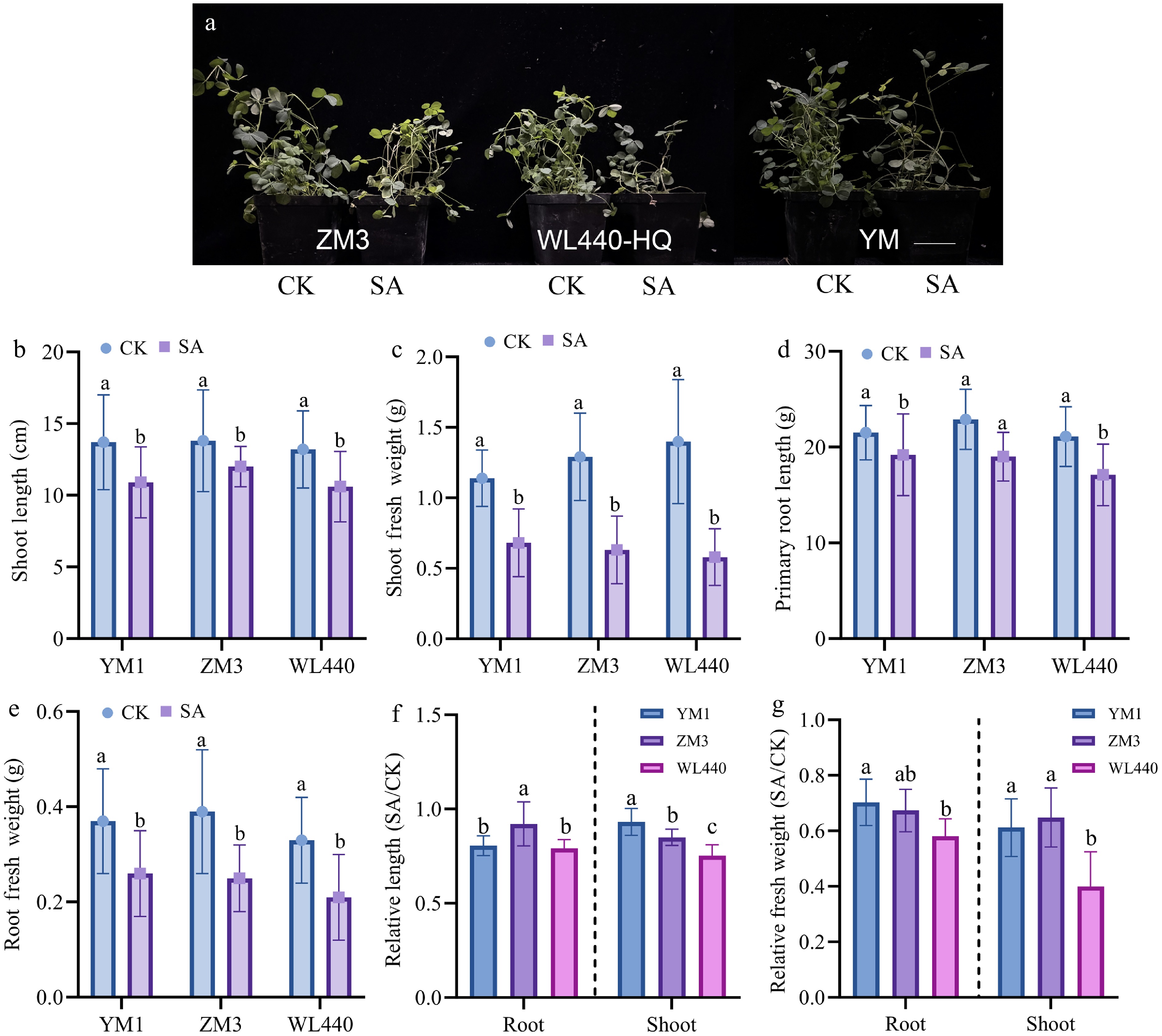
Figure 1.
Growth indices of different alfalfa varieties under saline-alkali stress. (a) Phenotypes of 4-week-old alfalfa seedlings under control (CK) and saline-alkali (SA, 100 mmol/L NaCl + 100 mmol/L NaHCO3) stress for 2 weeks. Scale bar = 5 cm. (b) Shoot length; (c) shoot fresh weight; (d) primary root length; (e) root fresh weight; (f) relative primary root length and shoot length (SA/CK) of three alfalfa varieties under saline-alkali stress; (g) relative root fresh weight and shoot fresh weight (SA/CK) of three alfalfa varieties under saline-alkali stress. CK, control treatment; SA, saline-alkali stress treatment. Data are presented as mean ± standard deviation (n = 10). Different lowercase letters indicate significant differences between treatments within the same variety for (b)–(e) and within the same tissue for (f)–(g) (p < 0.05).
Saline-alkali stress inhibits early seedling growth
-
Considering that hydroponic seedlings have uniform growth status and less interference from the soil matrix, we further adopted saline-alkali stress (75 mmol/L NaCl + 10 mmol/L NaHCO3) for transcriptome sequencing of alfalfa seedlings to obtain cleaner transcriptomic data and mine early stress response genes. Saline-alkali stress significantly inhibited seed germination and early seedling growth (Fig. 2a−d). Under saline-alkali stress, although seed germination rate remained unchanged compared with the control (CK), the longitudinal growth of seedlings was markedly suppressed (Fig. 2b, c). Seedling length was significantly reduced under SA stress (p < 0.001) (Fig. 2c), whereas individual fresh weight was notably increased (p < 0.001) (Fig. 2d).
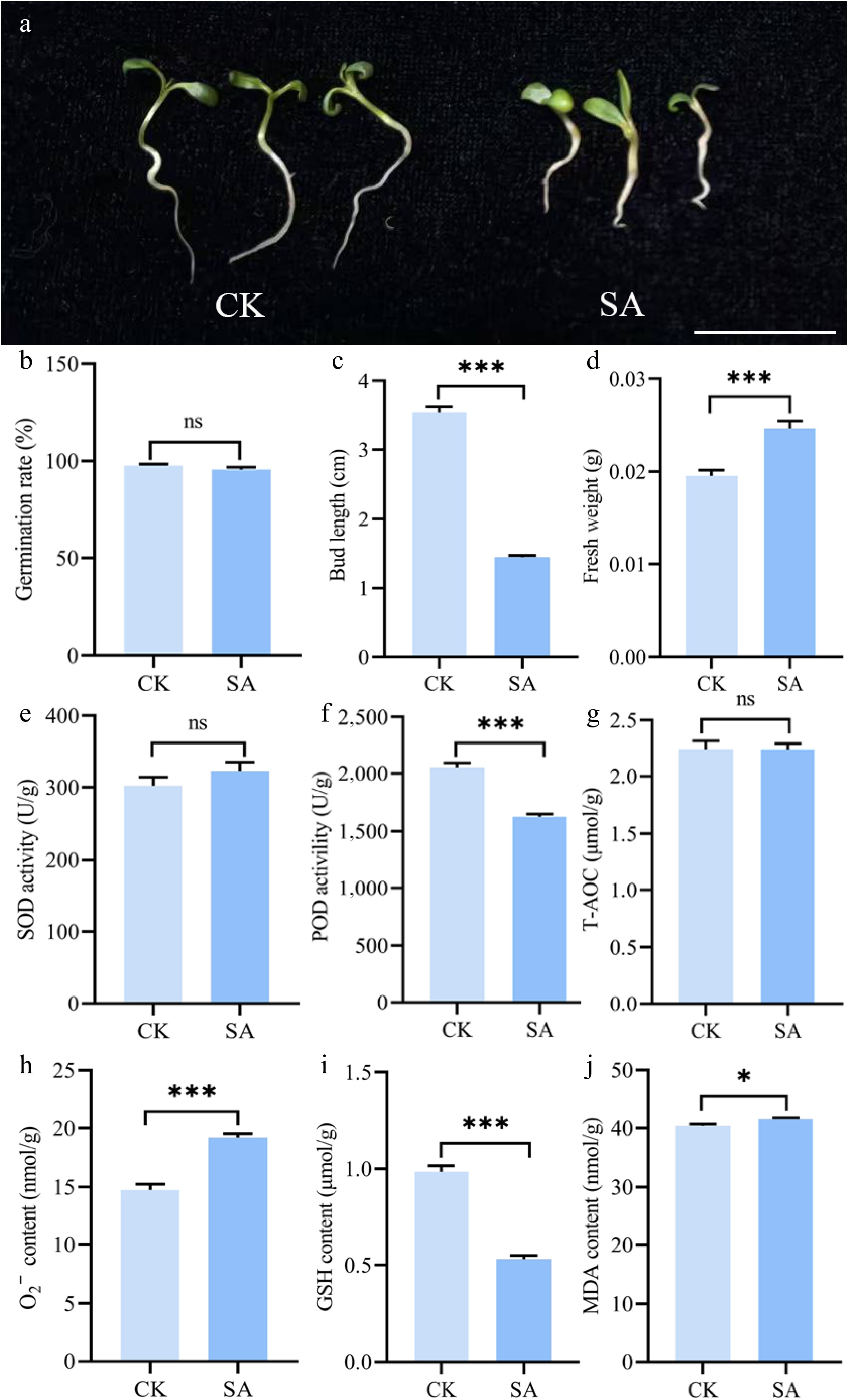
Figure 2.
Physiological and biochemical responses of alfalfa (Medicago sativa L.) to saline-alkali stress at the germination and early seedling stage. (a) The germination phenotype of alfalfa seedlings under control (CK) and saline-alkali stress (75 mmol/L NaCl + 10 mmol/L NaHCO3 treatments). Scale bar = 2 cm; (b) germination rate; (c) bud length; (d) fresh weight; (e) superoxide dismutase (SOD) activity; (f) peroxidase (POD) activity; (g) total antioxidant capacity (T-AOC); (h) superoxide anion content; (i) glutathione (GSH) content; (j) malondialdehyde (MDA) content. Data are presented as mean ± standard deviation. Asterisks denote significant differences between groups: * p < 0.05, *** p < 0.001.
To evaluate the physiological responses to saline-alkali-induced oxidative stress, we measured antioxidant enzyme activities and oxidative stress markers (Fig. 2e−j). For antioxidant systems, no obvious differences in SOD activity and total antioxidant capacity (T-AOC) were detected between CK and SA groups. Nevertheless, POD activity decreased significantly after SA exposure (p < 0.001). SA stress triggered massive accumulation of superoxide anion (O2−) (p < 0.001) and a sharp decline in GSH content (p < 0.001). Meanwhile, MDA content, an indicator of membrane lipid peroxidation, was significantly elevated in SA-treated seedlings (p < 0.05). Collectively, SA stress does not restrain seed germination, but impairs seedling elongation, disrupts the antioxidant system, aggravates reactive oxygen species burst, and causes membrane oxidative damage.
Identification of saline-alkali-responsive genes in alfalfa seedlings
-
To identify genes and regulatory pathways contributing to strong saline-alkali tolerance, transcriptomic profiling was performed on the saline-alkali-tolerant ZM3 seedlings subjected to deionized water (control) and 75 mmol/L NaCl + 10 mmol/L NaHCO3 (saline-alkali stress). Principal component analysis (PCA) was performed to evaluate the repeatability and transcriptional divergence of transcriptome samples. PC1 and PC2 explained 51.63% and 15.80% of total gene expression variance, respectively, with a cumulative explanatory rate of 67.43% (Fig. 3a). Biological replicates within each treatment clustered tightly, while CK and SA samples were clearly separated along the PC1 axis, revealing a dramatic transcriptional reprogramming triggered by compound saline-alkali stress and validating the reliability of sequencing data.
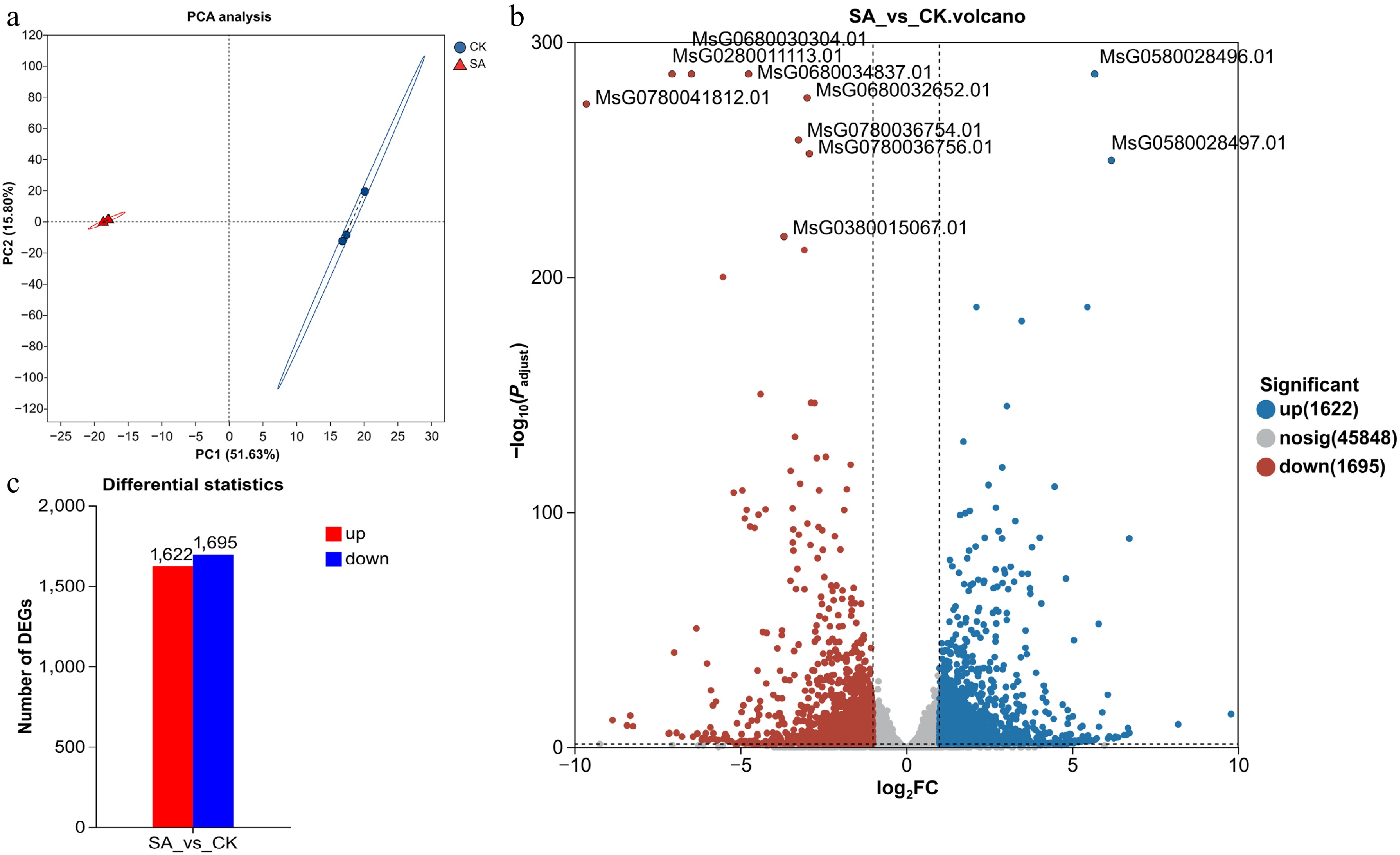
Figure 3.
Principal component analysis and identification of differentially expressed genes (DEGs) between compound saline-alkali stress (SA) and control (CK) groups based on transcriptome data. (a) Principal component analysis (PCA) of all transcriptome samples. The explained variance of PC1 and PC2 is labeled on the axes. Blue circles represent CK control samples; red triangles represent SA compound saline-alkali stress samples. (b) Volcano plot of DEGs in SA vs CK comparison. The x-axis indicates log2 (fold change), and the y-axis represents −log10 (adjusted p-value). Blue dots: significantly upregulated genes; red dots: significantly downregulated genes; gray dots: genes with no significant expression difference. IDs of several highly significant DEGs are annotated in the plot. (c) Bar chart showing the number of DEGs in SA vs CK. Red bars denote upregulated DEGs; blue bars denote downregulated DEGs.
DEGs were screened using the criteria (|log2FC| > 1) and (padjust < 0.05). In total, 3,317 DEGs were identified between SA and CK groups, including 1,622 significantly upregulated genes and 1,695 significantly downregulated genes (Fig. 3b, c). The volcano plot visualized the global expression pattern of all transcripts, where most downregulated genes were distributed on the left side (log2FC < 0) and upregulated genes concentrated on the right side (log2FC > 0). A subset of genes (e.g., MsG0780041812.01, MsG0580028496.01) exhibited extremely high fold changes and statistical significance, which could serve as core candidate genes responding to combined saline-alkali stress. Collectively, compound saline-alkali stress extensively reshapes the transcriptomic landscape of seedlings, and transcriptional repression accounts for a slightly larger proportion of stress-responsive transcriptional alterations.
Functional annotation and enrichment analysis of DEGs
-
Functional classification and enrichment analyses, including GO and KEGG, were performed to dissect the biological functions of DEGs responsive to compound saline-alkali stress. Gene Ontology (GO) annotation classified the identified DEGs into three principal categories: molecular function (MF), cellular component (CC), and biological process (BP) (Fig. 4a). For biological processes, cellular process and response to stimulus contained the largest number of annotated genes. In the cellular component ontology, cellular anatomical entity and protein-containing complex were the dominant subcategories. Within molecular function, catalytic activity and binding occupied the top two positions, followed by transporter activity, transcription regulator activity, and antioxidant activity, implying extensive reprogramming of catalytic reactions, molecular interactions, and substance transport under saline-alkali stress. GO enrichment revealed that terms related to oxidoreductase activity, phenylpropanoid metabolism, secondary metabolite biosynthesis, transmembrane transport, and abiotic stimulus response were significantly enriched, with oxidoreductase activity showing the highest statistical significance (Fig. 4b).
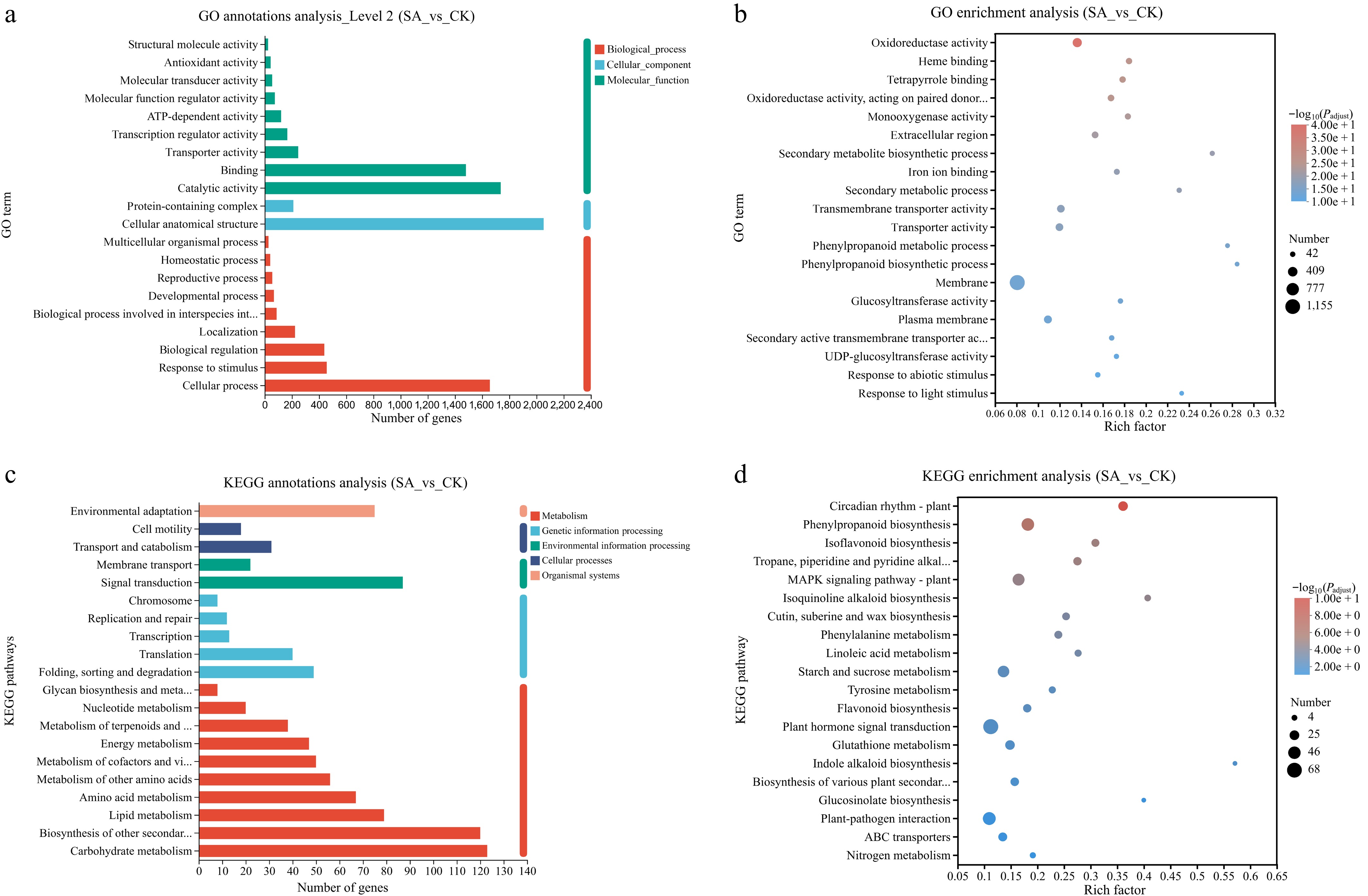
Figure 4.
GO and KEGG functional annotation and enrichment analysis of differentially expressed genes (DEGs) under compound saline-alkali stress (SA) compared with control (CK). (a) Bar chart of GO level 2 classification annotation. The x-axis represents the number of annotated DEGs. Red: biological process (BP); light blue: cellular component (CC); dark green: molecular function (MF). (b) Bubble plot of GO functional enrichment. The x-axis indicates Rich factor, the size of each bubble corresponds to the number of DEGs enriched in the term, and the color gradient represents −log10 (padjust), reflecting enrichment significance. (c) Bar chart of KEGG pathway level 2 classification annotation. The x-axis shows the number of annotated DEGs, and distinct colors represent five primary KEGG pathway categories. (d) Bubble plot of KEGG pathway enrichment. The x-axis denotes Rich factor, bubble size stands for the count of DEGs within each pathway, and color gradient corresponds to −log10 (padjust).
KEGG classification demonstrated that metabolic pathways harbored the most annotated DEGs, among which carbohydrate metabolism, biosynthesis of other secondary metabolites, and lipid metabolism were predominant. Signal transduction, a subcategory of environmental information processing, also contained abundant DEGs, indicating dramatic changes in intracellular signaling upon stress exposure (Fig. 4c). KEGG enrichment further identified a series of vital stress-responsive pathways, including phenylpropanoid biosynthesis, flavonoid and alkaloid biosynthesis, plant MAPK signaling pathway, plant hormone signal transduction, glutathione metabolism, linoleic acid metabolism, and ABC transporters (Fig. 4d). Collectively, compound saline-alkali stress extensively remodels secondary metabolism, antioxidant metabolism, hormone and MAPK signaling cascades, as well as transmembrane transport networks to coordinate plant adaptation to combined saline-alkali environments.
Gene co-expression network analysis
-
WGCNA was conducted to dissect the gene regulatory network underlying seedling responses to compound saline-alkali stress. All DEGs were grouped into nine distinct co-expression modules via hierarchical clustering, among which MEturquoise (7,523 genes), MEblue (4,583 genes), and MEbrown (3,798 genes) contained the largest gene populations, while MEgrey served as the unassigned background gene set (Fig. 5a, b). Correlation analysis between module eigengenes and physiological traits revealed that MEblue and MEturquoise exhibited the strongest correlations with saline-alkali responsive phenotypes. Both modules showed extremely significant negative correlations with seedling height, T-AOC, SOD, and GSH/POD activities, and prominent positive correlations with O2− and MDA contents, indicating their central roles in regulating growth suppression and oxidative homeostasis under combined saline-alkali stress (Fig. 5b). Other minor modules displayed weak or non-significant trait correlations. The co-expression interaction network of MEblue and MEturquoise was constructed to screen hub genes. Multiple high-connectivity hub genes (e.g., MsG0280006443.01, MsG0580028007.01) were identified within densely interconnected gene clusters, which were regarded as master regulators of saline-alkali adaptation. Furthermore, six key hub genes were identified in the blue module (Fig. 5c): MSTRG.6930 (ethylene-responsive transcription factor ERF017), MsG0180003907.01 (auxin-induced protein 22D, AUX22D), MsG0380014538.01 (nuclear transcription factor Y subunit B-3), MsG0380016987.01 (transcription factor bHLH137), MsG0480021254.01 (transcription factor bHLH63), MsG0580029256.01 (dehydration-responsive element-binding protein 2A, DRE2A). Meanwhile, MsG0180003858.01 (transcription factor bHLH155) and MsG0580058560.01 (WRKY transcription factor 33, WRKY33) were identified in the turquoise module (Fig. 5c). Additionally, several key genes implicated in salt response and ROS scavenging were also identified, including MsG0580028947.01 (calcium-dependent protein kinase 20, CDPKK), MsG0880047531.01 (trehalose-phosphate synthase), MsG0480023517.01 (phytosulfokine 3, PSK3), MsG0180004277.01 (ion channel POLLUX-like 2), MsG0280006442.01 (high affinity sulfate transporter 2), MsG0280009291.01 (flavonol 3-O-glucosyltransferase UGT89B1), MsG0380012002.01 (ABC transporter C family member 2, ABCC2), MsG0480021551.01 and MsG0480021549.01 (cytochrome P450 71D9, CYP71D9), MsG0480022308.01 (2-hydroxyisoflavanone synthase, CYP93C), MsG0480022686.01 (zinc finger protein zfs1), MsG0580024260.01 (chalcone synthase 4, CHS4), MsG0580028007.01 (ABC transporter G family member 31, ABCG31), MsG0780040592.01 (peroxidase A2, PERA2), MsG0880042986.01 (auxin response factor 9), MsG0880045645.01 (naringenin, 2-oxoglutarate 3-dioxygenase, F3H), MsG0880046698.01 (Myb family transcription factor EFM), and MSTRG.34001 and MsG0880046713.01 (potassium channel AKT1), collectively constituting a core regulatory network for saline-alkali stress adaptation.
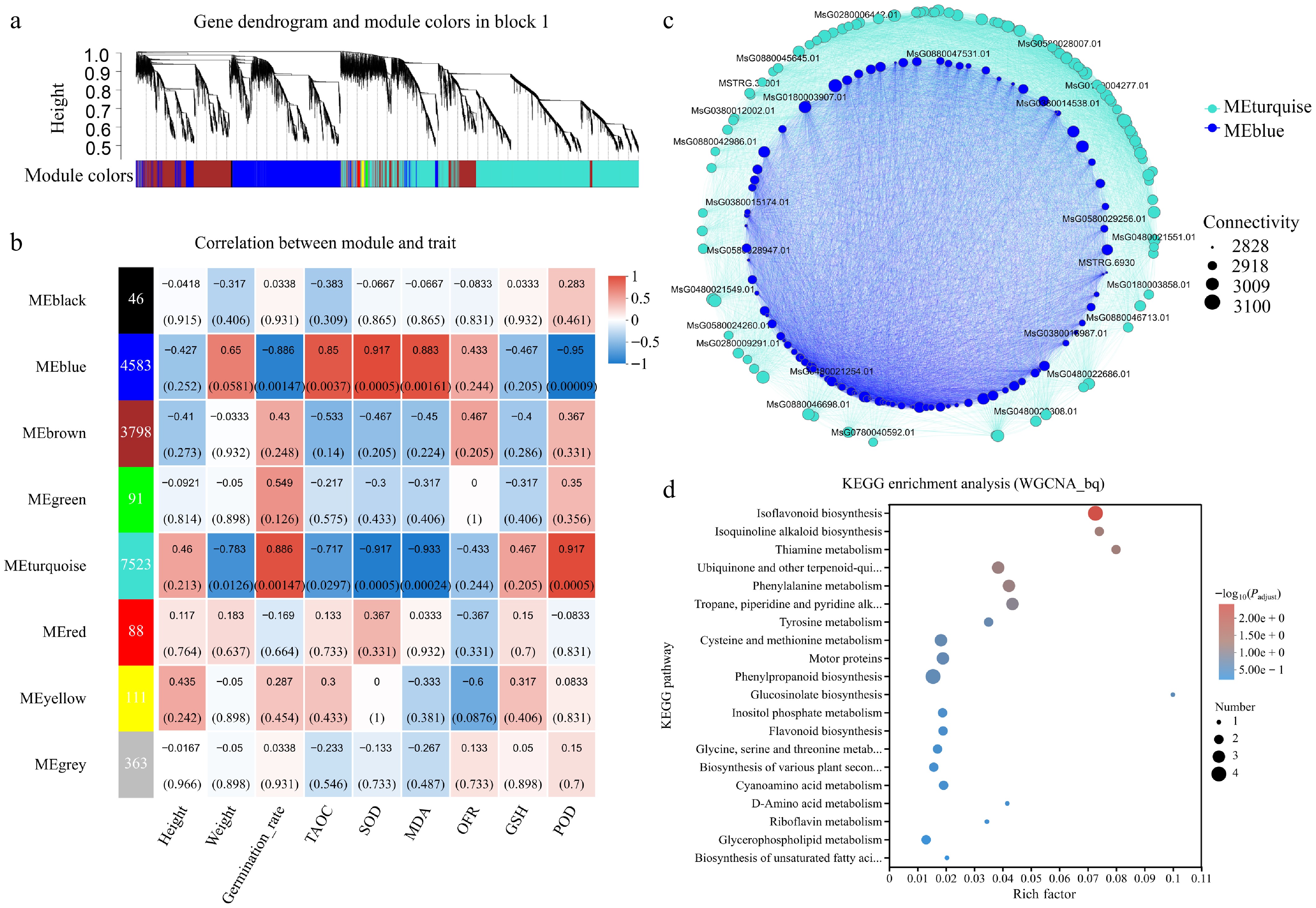
Figure 5.
WGCNA of differentially expressed genes under compound saline-alkali stress. (a) Gene hierarchical clustering dendrogram and corresponding module color assignment. The y-axis represents clustering height, and the color bar underneath distinguishes distinct co-expression modules. (b) Heatmap illustrating Pearson correlations between module eigengenes and seedling physiological traits. The left column lists each module name and its total gene number. Physiological traits along the x-axis include seedling height, fresh weight, germination rate, T-AOC, SOD activity, superoxide anion (O2−), reduced glutathione (GSH), malondialdehyde (MDA), and POD activity. Color intensity denotes the correlation coefficient, and values in parentheses indicate the significance p-value of the correlation. (c) Co-expression interaction network of two core modules, MEblue (blue nodes) and MEturquoise (turquoise nodes). Node size corresponds to gene connectivity, reflecting hub gene status in the network. (d) Bubble plot of KEGG pathway enrichment for genes within core stress-responsive modules. The x-axis represents the Rich factor, bubble size indicates the number of enriched genes in each pathway, and color gradient corresponds to the adjusted p-value (padjust).
KEGG enrichment of core module genes highlighted significantly enriched pathways predominantly related to secondary metabolism and antioxidant systems, including isoflavonoid biosynthesis, isoquinoline alkaloid biosynthesis, phenylpropanoid biosynthesis, tyrosine metabolism, glutathione metabolism, and flavonoid biosynthesis (Fig. 5d). Collectively, the MEblue and MEturquoise modules coordinate plant tolerance to compound saline-alkali stress by reprogramming secondary metabolite biosynthesis and glutathione-mediated antioxidant pathways to alleviate reactive oxygen species damage.
Overexpression of MsPSK3 confers enhanced saline-alkali tolerance in Arabidopsis and Pichia pastoris
-
As a member of the phytosulfokine (PSK) peptide hormone family, PSK3 participates in plant growth and development through phytosulfokine receptor (PSKR)-mediated signaling pathways, while also playing critical roles in defense responses, particularly in conferring tolerance to drought and salt stress[24−26]. Previous research indicated that most key genes characterized in single stress function importantly in combined saline-alkali stress[27]. Notably, WGCNA in this study identified MsPSK3 as a key hub gene within salt stress-responsive modules, underscoring its potential functional significance in saline-alkali tolerance. To investigate the functional role of MsPSK3 in saline-alkali stress tolerance, we generated MsPSK3-OE A. thaliana plants and evaluated their performance under saline-alkali stress. Under normal growth conditions (CK), both wild-type (Col-0) and MsPSK3-OE plants exhibited similar growth phenotypes (Fig. 6a). However, upon exposure to saline-alkali (SA) stress, Col-0 plants showed severe growth inhibition, leaf chlorosis, and wilting, while MsPSK3-OE plants maintained relatively healthier growth with less visible damage (Fig. 6a).
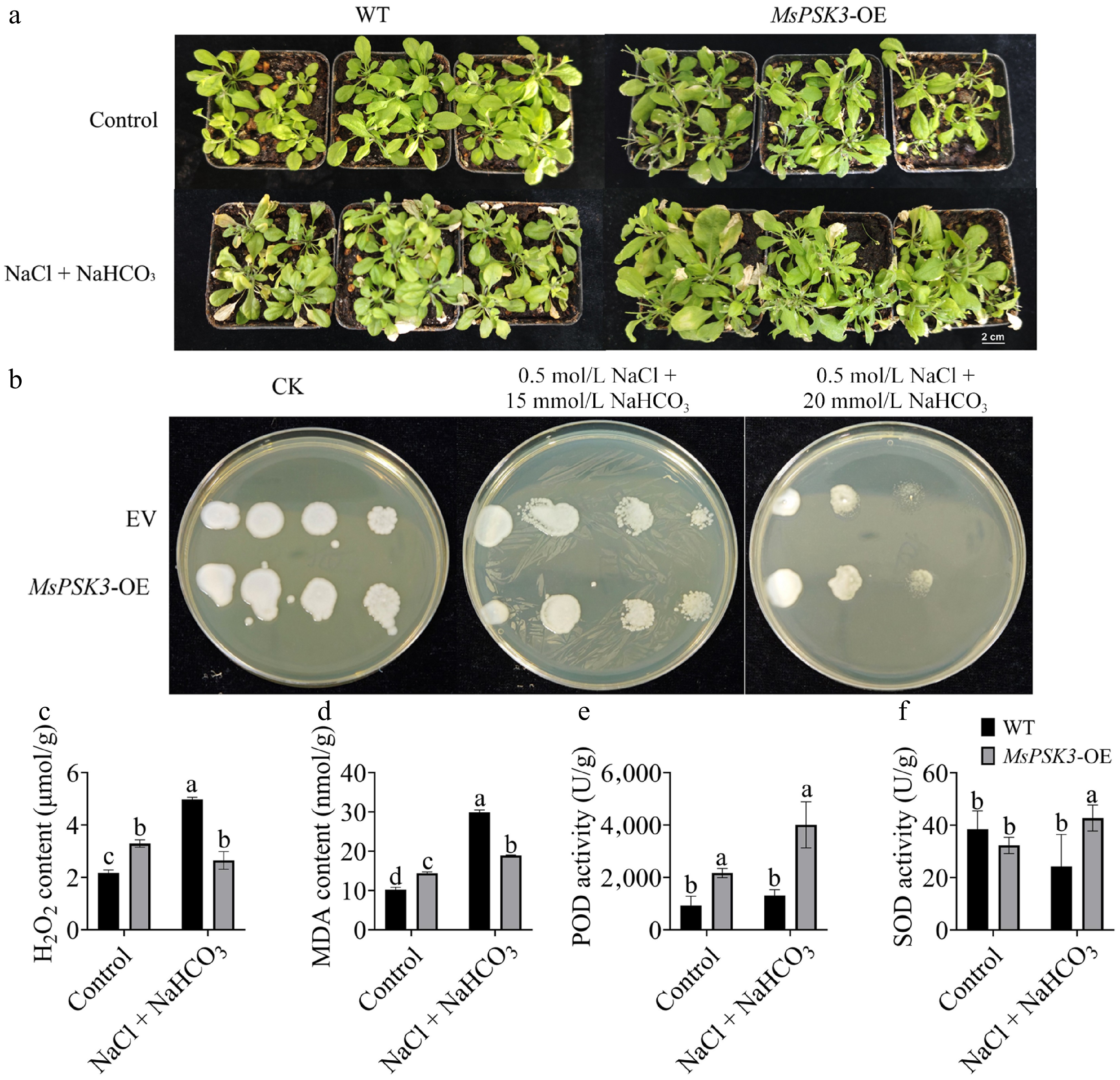
Figure 6.
Overexpression of MsPSK3 enhances saline-alkali stress tolerance in A. thaliana and P. pastoris. (a) Phenotypic comparison of wild-type (Col-0) and MsPSK3-overexpressing (MsPSK3-OE) Arabidopsis plants under control (CK) and saline-alkali (SA, 50 mmol/L NaCl + 50 mmol/L NaHCO3) treatments. Scale bar = 2 cm; (b) growth of empty vector (EV)-transformed and MsPSK3-overexpressing (PSK3-OE) P. pastoris on LB medium supplemented with 0.5 mol/L NaCl plus 0, 15, or 20 mmol/L NaHCO3. Scale bar = 2 cm; (c) hydrogen peroxide (H2O2) content; (d) malondialdehyde (MDA) content; (e) peroxidase (POD) activity; (f) superoxide dismutase (SOD) activity. Values are presented as mean ± standard error (SE, n = 3). Different lowercase letters indicate significant differences (p < 0.05) between groups.
To further verify the protective role of MsPSK3 against saline-alkali stress, we performed a bacterial heterologous expression assay. Under control conditions, both empty vector (EV)-transformed and MsPSK3-OE Pichia pastoris showed robust growth (Fig. 6b). In contrast, when exposed to media supplemented with 0.5 M NaCl plus increasing concentrations of NaHCO3 (15 mmol/L and 20 mmol/L), EV-transformed cells displayed drastically reduced or completely inhibited growth, whereas MsPSK3-OE P. pastoris retained significantly better growth capacity (Fig. 6b).
To further assess the physiological basis of enhanced tolerance, we measured oxidative stress markers and antioxidant enzyme activities in A. thaliana. Under saline-alkali stress, wild-type plants accumulated significantly higher levels of H2O2 (5.0 μmol/g) and MDA (30 nmol/g) compared to control conditions (H2O2: 2.1 μmol/g; MDA: 10 nmol/g; p < 0.05) (Fig. 6c, d). In contrast, MsPSK3-OE plants exhibited substantially lower H2O2 (2.6 μmol/g) and MDA (19 nmol/g) contents under saline-alkali stress, indicating reduced oxidative damage (p < 0.05) (Fig. 6c, d). Concurrently, both POD and SOD activities were significantly higher in MsPSK3-OE plants than in wild-type plants under saline-alkali stress (Fig. 6e, f). Specifically, POD activity increased to 4,000 U/g in MsPSK3-OE plants compared to 1,200 U/g in wild-type plants (p < 0.05), and SOD activity reached 42 U/g in MsPSK3-OE plants vs 24 U/g in wild-type plants (p < 0.05). These data suggested that MsPSK3 overexpression alleviates saline-alkali-induced oxidative stress by enhancing antioxidant enzyme activities, thereby reducing reactive oxygen species (ROS) accumulation and lipid peroxidation.
Collectively, these results demonstrated that MsPSK3 overexpression confers enhanced saline-alkali tolerance in both Arabidopsis and P. pastoris, likely through the activation of antioxidant defense systems to mitigate oxidative damage.
MYC2 directly binds to and activates the promoter of MsPSK3
-
Through systematic analysis of online transcription factor-binding site databases and in-depth mining of our transcriptomic datasets, we identified MsMYC2 as a potential upstream transcription factor targeting MsPSK3. Previous studies have established that MYC2, a basic helix-loop-helix (bHLH) transcription factor, enhances salt resistance in A. thaliana and Salvia miltiorrhiza hairy roots[28]. The expression of MYC2 is bidirectionally regulated by the mitogen-activated protein kinase (MAPK) cascade pathway. This gene integrates diverse intracellular and extracellular signals to participate in salt stress regulatory networks, and the MYC2-mediated modulation of proline biosynthesis represents a critical node for plants to maintain normal physiological metabolism under salt stress conditions[29].
To investigate the transcriptional regulatory mechanism of MsPSK3, we first performed a dual-luciferase reporter assay in tobacco leaves. Co-expression of the MYC2 effector with the proMsPSK3: LUC reporter resulted in significantly enhanced luminescence intensity compared to the control (Fig. 7a). Consistent with the imaging results, quantitative analysis showed that the LUC/REN ratio was significantly higher in the MYC2 co-infiltrated group than in the control (p < 0.05, Fig. 7b). These data indicated that MYC2 activates the transcription of MsPSK3 in plants.
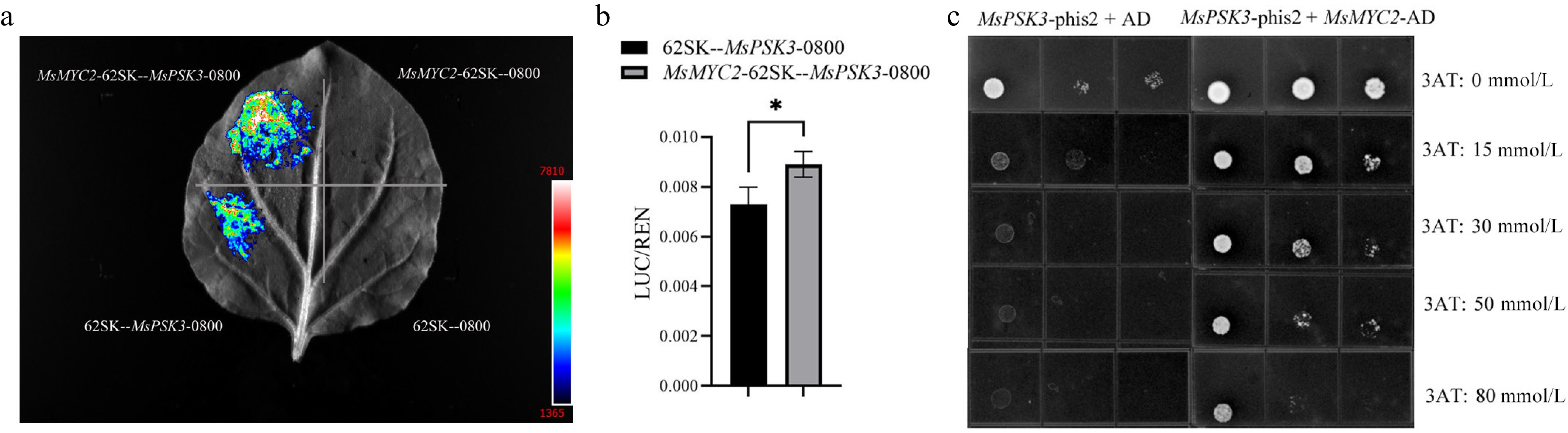
Figure 7.
Transcriptional activation and protein interaction analysis of MsPSK3 with transcription factor MYC2. (a) In vivo luminescence imaging of firefly luciferase (LUC) activity in tobacco leaves co-infiltrated with the proMsPSK3: LUC reporter and 35S: MYC2 effector plasmids. Luminescence intensity is represented by a color gradient ranging from blue (low luminescence) to red (high luminescence). 62-SK refers to the empty pGreen II 62-SK vector, and 0800 corresponds to the empty pGreen II 0800-LUC vector. (b) Quantitative determination of the LUC/REN ratio via dual-luciferase reporter assays. Data are presented as mean ± SE (n = 3); asterisks denote significant differences at p < 0.05 according to Student's t-test. (c) Yeast one-hybrid (Y1H) analysis confirming the physical interaction between MYC2 and the MsPSK3 promoter. Transformed yeast strains were cultured on selective SD/-Leu/-His medium supplemented with a concentration gradient of 3-amino-1,2,4-triazole (3AT; 0−80 mmol/L). The combination of PSK3-phis2 + AD was set as the negative control, whereas PSK3-phis2 + MYC2-AD was the experimental group. phis2 and AD indicate the phis2 and pGADT7 vectors, respectively. From left to right, yeast suspensions in each spot were serially diluted at 10-, 100-, and 1,000-fold.
To further validate the direct interaction between MYC2 and the MsPSK3 promoter, a Y1H assay was conducted. Under non-selective conditions (0 mmol/L 3AT), both the negative control (PSK3-phis2 + AD) and the experimental group (PSK3-phis2 + MYC2-AD) showed normal growth on SD/-Leu/-His medium (Fig. 7c). However, with increasing concentrations of 3AT (15−80 mmol/L), the negative control yeast cells failed to grow, while the cells co-expressing MYC2-AD and the MsPSK3 promoter maintained robust growth, even at the highest 3AT concentration (80 mmol/L, Fig. 7c). These results confirmed that MYC2 directly binds to the promoter of MsPSK3.
-
Soil salinity impairs plant growth by causing osmotic stress, ion toxicity, and nutrient imbalance[30]. Under saline-alkali stress, significant declines in shoot length, primary root elongation, and fresh biomass were observed across three alfalfa genotypes, consistent with previous reports[31]. Especially, pronounced genotypic divergence in stress adaptability was observed: ZM3 maintained milder growth retardation, whereas WL440-HQ suffered severe developmental arrest, indicating ZM3 may act as a tolerant genotype. Oxidative burst represents a core physiological signature of SA injury, driven by excessive superoxide anion (O2−) overproduction that triggers membrane lipid peroxidation quantified by malondialdehyde (MDA) concentration[32]. Plants mitigate the damage caused by stress by increasing the content of osmoregulatory substances and the activity of antioxidant enzymes[33]. Under moderate composite SA stress, both leaf and root tissues of WL440-HQ accumulated substantially higher MDA and O2− relative to ZM3 and YM1, reflecting aggravated plasma membrane impairment in the sensitive cultivar. To eliminate the excessive reactive oxygen species generated, SOD and GSH were significantly induced under SA stress, and ZM3 possessed markedly higher relative root SOD activity than WL440-HQ, showing stronger rapid root antioxidant induction upon stress exposure, while WL440-HQ accumulated significantly higher relative MDA in roots and shoots, indicating severe membrane lipid peroxidation damage. Additionally, ZM3 exhibited the highest shoot GSH concentration under SA to alleviate aerial oxidative injury, whereas WL440-HQ had distinctly lower shoot GSH levels, which may partially explain the weaker saline-alkali tolerance of WL440-HQ at the physiological level. In summary, ZM3 displayed a stronger upregulation of antioxidant components, which further confirmed ZM3 as a tolerant reference material for subsequent hydroponic transcriptome profiling. Notably, hydroponic germination-stage assays with a milder SA regimen (75 mmol/L NaCl + 10 mmol/L NaHCO3) revealed drastically divergent physiological responses compared to 4-week-old soil-grown seedlings. Seed germination percentage remained unaffected by SA exposure, while seedling axial elongation was severely inhibited and single-plant fresh weight unexpectedly increased. This phenomenon is attributed to stress-induced cell vacuolation and suppressed cell division rather than lethal embryonic damage, as reported in early alfalfa seedling stress trials[34]. Antioxidant balance was profoundly disrupted at the germination stage: total antioxidant capacity (T-AOC) and SOD activity failed to compensate for ROS accumulation, peroxidase (POD) activity dropped sharply, GSH pools were depleted, and both O2− and MDA accumulated drastically. Such developmental-stage-specific antioxidant differentiation highlights that mature seedlings establish stable long-term ROS buffering systems, while germinating tissues lack sufficient preformed antioxidant reserves to withstand alkaline salt toxicity[35]. The contrasting physiological readouts between soil and hydroponic systems further suggest that substrate matrix and stress intensity jointly reshape alfalfa's physiological acclimation strategy, which necessitated transcriptome sequencing on uniform hydroponic seedlings to eliminate soil interference and capture early stress-responsive genes.
Global transcriptional reprogramming remodels antioxidant, secondary metabolic, and hormone signaling networks
-
Soil salinity imposes complex transcriptional reprogramming in plants, and the systematic identification of DEGs constitutes a fundamental step toward elucidating stress adaptation mechanisms[6]. In this study, 3,317 DEGs were identified under SA stress, comprising 1,622 upregulated and 1,695 downregulated transcripts. GO enrichment pinpointed oxidoreductase activity as the most statistically significant term, which directly corroborated our physiological measurements of altered SOD, POD, GSH, MDA, and O2− levels[36]. Oxidoreductase enzymes mediate ROS neutralization and redox equilibrium reconstruction under ionic and alkaline stress, bridging transcriptional regulation and phenotypic antioxidant performance. Additional significantly enriched GO terms encompassed phenylpropanoid secondary metabolism, secondary metabolite biosynthesis, and transmembrane ion transport, which coordinate auxiliary detoxification and ion homeostasis maintenance under SA stress. KEGG pathway annotation illustrated that metabolic pathways harbored the largest number of DEGs, dominated by carbohydrate metabolism, secondary metabolite biosynthesis, and lipid metabolism. Signal transduction subpathways also contained abundant DEGs, confirming dramatic remodeling of intracellular signal perception upon stress exposure. KEGG enrichment identified a suite of indispensable stress-responsive cascades: phenylpropanoid, flavonoid, and alkaloid biosynthesis, plant MAPK signaling, plant hormone signal transduction, glutathione metabolism, linoleic acid metabolism, and ABC transporter pathways. Furthermore, glutathione metabolism acts as the central non-enzymatic antioxidant circuit, modulating GSH redox pools to eliminate excess O2− and H2O2, consistent with depleted GSH concentrations observed in hydroponic SA-treated seedlings[37]. In the current study, 10 genes encoding glutathione S-transferase (MsG0580024232.01, MsG0380015192.01, MsG0880044131.01, MsG0280009765.01, MsG0380015231.01, MsG0280009756.01, MsG0580025997.01, MsG0580025998.01, MsG0580025971.01, MsG0480020814.01) were identified as being upregulated under SA stress. Meanwhile, a key gene encoding L-ascorbate peroxidase T (MsG0380016362.01) was also upregulated under SA stress. Linoleic acid metabolism mediates membrane lipid remodeling to mitigate MDA-mediated peroxidation damage, matching elevated MDA levels in stressed alfalfa tissues[38]. Phenylpropanoid, flavonoid, and isoflavonoid biosynthesis pathways produce phenolic antioxidants that directly scavenge free radicals, stabilize lipid bilayers, and reduce membrane oxidative injury in legumes[39]. Multiple flavonoid biosynthetic hub genes (CHS4, F3H, UGT89B1, CYP93C) were identified in core co-expression modules, linking secondary metabolite transcription to physiological ROS clearance capacity. MAPK cascades and plant hormone signaling serve as upstream signal hubs to perceive extracellular Na+ and HCO3− signals and relay stimuli to downstream TFs and functional effector genes[40,41]. ABC transporters, potassium channels (AKT1, POLLUX-like), and sulfate transporters facilitate vacuolar compartmentalization of toxic ions and nutrient uptake, coordinating osmotic and pH homeostasis alongside antioxidant metabolism[42]. Collectively, transcriptomic evidence proves that alfalfa synchronizes antioxidant redox circuits, secondary metabolite synthesis, hormone signaling, and ion transport networks to cope with dual salt-alkali toxicity.
WGCNA reveals core co-expression modules linking transcriptional shifts to oxidative and growth phenotypes
-
When plants face abiotic stress, the selective permeability of the cell membrane is disrupted, altering the dynamic balance of ions and the extravasation of soluble substances. To maintain internal homeostasis, a large number of DEGs were significantly enriched under SA stress in the salt-alkali-tolerant alfalfa cultivar ZM3. Nevertheless, due to the lack of transcriptomic data for the salt-alkali-sensitive genotype WL440-HQ, we mainly investigated the saline-alkali stress responses and limited the direct identification of genotype-specific DEGs. Accordingly, WGCNA was applied to screen hub genes. In this study, WGCNA revealed extremely significant negative correlations between MEblue/MEturquoise eigengenes and growth indicators (seedling height), antioxidant enzyme activities (SOD, POD, T-AOC), and GSH concentration; conversely, both modules exhibited strong positive correlations with oxidative damage markers (O2−, MDA). This correlation pattern establishes a direct mechanistic link between module-level transcriptional reprogramming and the physiological trade-off between growth suppression and oxidative injury under SA stress, confirming MEblue and MEturquoise as central regulatory networks governing alfalfa saline-alkali acclimation. Network visualization of hub genes within MEblue and MEturquoise captured two major functional groups: TFs and stress effector proteins. Key TF hub genes covered multiple abiotic stress regulatory families: ERF017 (ethylene signal integration), AUX22D (auxin response), DRE2A (osmotic stress), bHLH137/bHLH63/bHLH155 (jasmonate-salt crosstalk), and WRKY33 (ROS homeostasis)[43,44]. Functional effector hub genes included calcium-dependent protein kinase CDPK20 (Ca2+ signal transduction), trehalose phosphate synthase (osmoprotectant synthesis), ion transporters, cytochrome P450s, flavonoid biosynthetic enzymes, peroxidase PERA2, and the peptide hormone gene MsPSK3. KEGG enrichment of core module genes further validated the centrality of phenylpropanoid, flavonoid, isoflavonoid, and glutathione metabolic pathways in mitigating ROS damage under composite SA stress. Additionally, a key gene encoding N-acetylserotonin O-methyltransferase (ASMT), namely MsG0480020072.01, exhibited significant upregulation under saline-alkali stress. ASMT functions as the rate-limiting enzyme catalyzing the terminal step of melatonin biosynthesis, converting N-acetylserotonin to melatonin[45]. Melatonin, an indoleamine molecule initially identified in animal systems, has been increasingly recognized as a pivotal regulator of plant abiotic stress tolerance, including responses to salt stress owing to its multifaceted roles in antioxidant defense, osmotic adjustment, membrane stabilization, and modulation of stress-related gene expression[46,47]. Although direct functional characterization of MsASMT genes in alfalfa remains limited, studies conducted in closely related legumes and model plant species provide compelling mechanistic insights: overexpression of ASMT homologs in N. benthamiana and A. thaliana resulted in elevated endogenous melatonin levels, enhanced salt tolerance, and improved ion homeostasis through transcriptional upregulation of Na+/H+ antiporter genes such as NHX1 and SOS1[48,49]. The pronounced upregulation of MsASMT genes observed in our study under saline-alkali stress further indicates that alfalfa actively promotes endogenous melatonin biosynthesis via the tryptophan metabolic pathway under saline-alkali stress conditions.
Regulatory role of the WRKY33-centered signaling network in salt tolerance
-
The mitogen-activated protein kinase (MAPK) signaling pathway represents an evolutionarily conserved phosphorylation cascade in plants that transduces abiotic stress signals from the plasma membrane to the nucleus, thereby regulating downstream stress-responsive gene expression programs. WRKY33, a well-characterized substrate of MAPK kinases (e.g., MPK3 and MPK6), is frequently activated via phosphorylation in response to diverse abiotic stresses, including salt, drought, and oxidative stress. In this study, three MsWRKY33 homologs (MsG0380014920.01, MsG0580028560.01, and MsG0480018500.01) were identified within the MAPK signaling pathway and exhibited significant transcriptional upregulation under salt stress conditions. This observation aligns with extensive experimental evidence demonstrating the pivotal role of WRKY33 in mediating plant salt tolerance across diverse species. For instance, in Arabidopsis, wrky33-knockout mutants exhibit markedly increased salt sensitivity, characterized by elevated reactive oxygen species (ROS) accumulation and impaired ionic homeostasis, whereas WRKY33 overexpression lines display enhanced salt tolerance[12]. At the molecular level, WRKY33 acts as a transcription factor to transcriptionally activate a cytochrome P450 gene, subsequently accelerating suberin deposition in root endodermal cells and ultimately improving the salt resistance capacity of Arabidopsis[50]. In the specific context of alfalfa, a recent study by Ma et al.[11] confirmed that MsWRKY33 enhances salt stress tolerance by modulating ROS scavenging capacity through direct transcriptional activation of MsERF5, which is consistent with our observation of MsWRKY33 upregulation and the significant enrichment of ROS-related metabolic pathways in our transcriptomic dataset.
Notably, our transcriptomic profiling also revealed significant upregulation of two key genes (MsG0380016393.01 and MsG0380016097.01) encoding 1-aminocyclopropane-1-carboxylate oxidase (ACCO) and a gene (MsG0880043113.01) encoding 1-aminocyclopropane-1-carboxylate synthase 1, rate-limiting enzyme catalyzing ethylene biosynthesis, along with four ETHYLENE RESPONSE FACTOR 1 (ERF1) genes (MsG0180003836.01, MsG0780040733.01, MsG0180004079.01, and MsG0180003834.01). Ethylene functions as a key phytohormone intricately involved in mediating plant responses to salt stress, orchestrating diverse physiological processes including stomatal closure, root growth modulation, and activation of antioxidant defense systems[51]. The observed upregulation of ACCO expression suggests enhanced ethylene biosynthesis under salt stress conditions, which may serve as a critical signaling molecule to activate downstream ERF1 transcription. ERF1 belongs to the AP2/ERF transcription factor superfamily, whose members function as direct downstream effectors of ethylene signaling cascades. Observed WRKY target genes encompassed ethylene biosynthetic enzyme genes ACS2, ACS6, and ACS8, as well as MKK9, a kinase proven to operate upstream of MPK3/MPK6 to trigger the activation of ACS2 and ACS6 via phosphorylation and WRKY33 binding[52]. Intriguingly, WRKY33 and ERF family TFs frequently form synergistic regulatory cascades in orchestrating stress responses. WRKY33 directly binds to GCC-box or W-box cis-regulatory elements within the promoters of ERF genes (e.g., ERF-1, ERF5) to enhance their transcriptional activity, thereby amplifying stress-responsive gene expression programs[53].
The coordinated upregulation of MsWRKY33, ACCO, and MsERF1 genes in our study strongly suggests the existence of a potential MAPK-WRKY33-ethylene-ERF regulatory axis mediating alfalfa salt tolerance: saline-alkali stress activates the upstream MAPK signaling cascade, which phosphorylates and activates MsWRKY33; activated MsWRKY33 may dually promote ethylene biosynthesis (via transcriptional regulation of ACCO expression) and directly induce ERF1 gene transcription; ethylene further amplifies ERF1 expression through hormone-mediated signaling, and collectively, these TFs synergistically regulate downstream genes encoding ROS-scavenging enzymes (e.g., SOD, POD, CAT), ion transporters maintaining ionic homeostasis (e.g., Na+/H+ antiporters such as NHX and SOS1), and osmolyte biosynthetic enzymes (e.g., proline synthases, P5CS) (Supplementary Fig. S2). This proposed regulatory hypothesis is substantiated by Ma et al.[11] who experimentally demonstrated that MsWRKY33 directly activates MsERF5 to enhance ROS scavenging capacity in alfalfa, and by Hdira et al.[54], who reported that ethylene-induced ERF1 overexpression improves salt tolerance in Medicago truncatula by transcriptionally upregulating antioxidant enzyme genes.
In our study, the concurrent transcriptional upregulation of MsWRKY33, MsASMT, and genes encoding ROS-scavenging enzymes strongly suggests the existence of a functionally analogous feedback mechanism operating in alfalfa: MsWRKY33 may promote melatonin biosynthesis by transcriptionally activating MsASMT expression, and the accumulated melatonin may further reinforce MsWRKY33-mediated transcriptional activation of ERF1 genes and antioxidant enzyme genes, thereby forming a multi-layered, self-amplifying regulatory network that robustly enhances salt stress tolerance. This intricate regulatory network, integrating signal transduction (MAPK cascade), TFs (WRKY33, ERF1), phytohormones (ethylene), and antioxidant metabolites (melatonin), represents a sophisticated molecular strategy evolved by alfalfa to cope with salt-induced osmotic, ionic, and oxidative stresses.
The MYC2–MsPSK3 module positively regulates saline-alkali tolerance
-
Notably, MsPSK3 emerged as a high-connectivity hub gene within the core stress-responsive modules. PSK peptides are secreted extracellular signaling molecules that modulate cell elongation, antioxidant defense, and abiotic stress tolerance via PSKR receptor kinase signaling[55,56]. The functional validation of the MYC2–MsPSK3 regulatory module in mediating saline-alkali tolerance provides critical mechanistic insights into how leguminous plants integrate hormone signaling and peptide-mediated stress responses to combat environmental adversity. Overexpression of MsPSK3 in both A. thaliana and P. pastoris significantly enhanced tolerance to saline-alkali, as evidenced by healthier plant phenotypes, improved bacterial growth, reduced accumulation of reactive oxygen species (H2O2) and lipid peroxidation (MDA), and elevated activities of antioxidant enzymes (POD and SOD), demonstrating that MsPSK3 acts as a positive regulator of saline-alkali tolerance by reinforcing cellular antioxidant defense and mitigating oxidative damage, consistent with the established roles of phytosulfokines (PSKs) in promoting abiotic stress resilience through the modulation of redox homeostasis and stress signaling pathways[24,56,57]. Dual-luciferase reporter assays and Y1H experiments further confirmed that the transcription factor MYC2 directly binds to the promoter of MsPSK3 and activates its transcription, revealing a key regulatory link between jasmonic acid (JA) signaling and PSK-mediated stress responses, where MYC2, as a core component of the JA signaling cascade[58], transduces stress signals to upregulate MsPSK3, thereby triggering downstream antioxidant defense mechanisms to counteract saline-alkali-induced oxidative stress. Meanwhile, two key genes encoding Jasmonoyl—L-amino acid synthetase JAR6, namely MsG0880043041.01 and MsG0880043046.01, were upregulated under saline-alkali stress, which can catalyze the conversion of jasmonic acid (JA) to form jasmonic acid-soleucine (JA-Ile), an active form of jasmonic acid, and activate the JA signal pathway[59]. Notably, JA positively modulates photosynthetic efficiency through a regulatory module, including MYC2, which is MYC2–RacA, under combined drought and salt stress[60]. Overexpression of MYC2 induced flavonoid biosynthesis, thereby enhancing antioxidant enzyme activities and improving salt stress tolerance[28]. Interestingly, MYC2 also directly activates N-acetylserotonin methyltransferase (ASMT), resulting in increased melatonin accumulation and abiotic tolerance[61]. Conversely, melatonin signaling acts upstream to transcriptionally activate the JA core transcription factor MYC2, and activated MsMYC2 directly binds the promoter of the phytosulfokine gene MsPSK3 to sharply upregulate its expression in alfalfa under saline-alkali stress, forming a positive melatonin-MYC2–PSK3 regulatory cascade that coordinates hormone signal transduction and cell wall stress responses[62]. Although the MYC2–MsPSK3 regulatory module was experimentally validated in this study, the chromatin accessibility dynamics and cis-regulatory landscape governing this pathway under saline-alkali stress remain unclear. Recent advances in plant single-cell chromatin accessibility and cis-regulatory element analyses provide valuable resources for identifying transcription factor binding sites and reconstructing stress-responsive regulatory networks, offering promising directions for future investigation of the MYC2–MsPSK3 module.[63] Collectively, these results suggested a conserved and functionally conserved regulatory module in which MYC2-mediated activation of MsPSK3 enhances saline-alkali tolerance by orchestrating the antioxidant system to alleviate oxidative damage, providing novel molecular targets for breeding stress-tolerant forage crops and expanding our understanding of the crosstalk between hormone signaling and peptide-mediated stress responses in plants.
-
This study integrated phenotypic physiology, comparative cultivar stress screening, transcriptome sequencing, WGCNA co-expression network analysis, and heterologous transgenic functional verification to systematically dissect the morphological, physiological, and molecular mechanisms underlying alfalfa tolerance to combined saline-alkali stress. Further weighted gene co-expression network analysis (WGCNA) indicated that several core candidate genes, including MsWRKY33, MsMYC2, and MsASMT, were potentially involved in alfalfa salt stress responses. Especially, the MsWRKY33-centered regulatory network, intricately interacting with ethylene signaling and melatonin metabolism, orchestrates a multi-layered molecular framework that coordinates ROS detoxification, ionic homeostasis, and osmotic adjustment mechanisms. Meanwhile, we established a key regulatory module, MsMYC2–MsPSK3, and functional validation in A. thaliana and P. pastoris indicated that MsMYC2–MsPSK3 might play pivotal roles in mediating saline-alkali tolerance. Further exploration of the MYC2–MsPSK3 and MAPK–WRKY33–ethylene–ERF module and associated phenylpropanoid and glutathione antioxidant pathways will facilitate genetic engineering and molecular breeding to improve alfalfa productivity on global saline-alkali marginal lands.
-
The authors confirm their contributions to the paper as follows: conceptualized the idea and methodology: Yu R, Zhang Y, Liu D, Wang C, Shi Y, Zhu X, Li D, Cui Y, and Sun H; developed theplant material: Sun H; participated ingrowth characterization: Yu R, Zhang Y, Liu D, Cui Y, and Sun H; expressed the datacollection, analysis, and writing the original draft manuscript: Yu R and Zhang Y; acquired funding for the study and supervision duringthe experiments: Cui Y and Sun H. All authors have read and agreed to the published version of the manuscript.
-
The datasets generated and/or analyzed in the current study are available from the corresponding author upon reasonable request. The raw transcriptomic data has been deposited in the NCBI GenBank under the accession number PRJNA1493827.
-
The authors declare that they have no conflict of interest.
-
accompanies this paper online at: https://doi.org/10.48130/grares-0026-0024.
-
# Authors contributed equally: Ran Yu, Yaohui Zhang
- Supplementary Fig. S1 Physiological indices of different alfalfa cultivars were determined under saline-alkali stress.
- Supplementary Fig. S2 Regulatory pathway of alfalfa in response to salt stress.
- Copyright: © 2026 by the author(s). Published by Maximum Academic Press, Fayetteville, GA. This article is an open access article distributed under Creative Commons Attribution License (CC BY 4.0), visit https://creativecommons.org/licenses/by/4.0/.
-
About this article
Cite this article
Yu R, Zhang Y, Liu D, Li D, Zhu X, et al. 2026. Transcriptomic analysis uncovers the MYC2–MsPSK3 module mediating saline-alkali tolerance in alfalfa. Grass Research 6: e030 doi: 10.48130/grares-0026-0024 

Transcriptomic analysis uncovers the MYC2–MsPSK3 module mediating saline-alkali tolerance in alfalfa
- Received: 24 June 2026
- Revised: 14 July 2026
- Accepted: 30 July 2026
- Published online: 12 October 2026
Abstract: Composite saline-alkali stress severely limits alfalfa (Medicago sativa L.) productivity, but cultivar-specific responses and regulatory mechanisms remain unclear. Three cultivars, Zhongmu No.3 (ZM3), Yumu No.1 (YM1), and WL440-HQ, were evaluated under moderate composite saline-alkali stress (100 mmol/L NaCl + 100 mmol/L NaHCO3). ZM3 and YM1 exhibited greater tolerance to saline-alkali stress than WL440-HQ. Transcriptome analysis of ZM3 seedlings treated with 75 mmol/L NaCl and 10 mmol/L NaHCO3 identified 3,317 differentially expressed genes, including 1,622 upregulated and 1,695 downregulated genes. These genes were mainly enriched in oxidoreductase activity, phenylpropanoid and flavonoid biosynthesis, glutathione metabolism, MAPK signaling, and plant hormone signal transduction. Weighted Gene Co-expression Network Analysis identified nine co-expression modules, of which MEblue and MEturquoise were closely associated with growth and oxidative damage traits. Several hub transcription factors, including MsWRKY33, MsMYC2, MsERF1, bHLH family members, and the MsPSK3 gene, were identified. Heterologous overexpression assays showed that MsPSK3 enhanced saline-alkali tolerance by increasing superoxide dismutase and peroxidase activities and reducing reactive oxygen species and malondialdehyde accumulation. Yeast one-hybrid and dual-luciferase assays confirmed that MsMYC2 directly binds to the MsPSK3 promoter and activates its expression. In addition, an MsWRKY33-centered regulatory pathway involving ethylene signaling and melatonin biosynthesis was proposed to coordinate ROS scavenging, ion homeostasis, and osmotic adjustment. These results demonstrate that the MsMYC2–MsPSK3 and MsWRKY33-centered regulatory network could be potential key regulatory modules in ZM3, providing candidate genes for the genetic improvement of alfalfa.
-
Key words:
- Alfalfa /
- Saline-alkali stress /
- Transcriptomics /
- PSK3