













-
Polynoidae Kinberg, 1856[1] is one of the most diverse families of scale worms within Aphroditiformia, with species occurring from shallow coastal habitats to the deep sea and showing remarkable variation in prostomial appendages, parapodial structure, chaetal morphology and elytral arrangement[2−6]. As in many annelid groups, polynoid taxonomy has long relied primarily on external morphology, especially the number and arrangement of elytra, the insertion pattern of antennae, the structure of parapodia, and the morphology of notochaetae and neurochaetae[7,8]. Although this framework has been fundamental for species discovery and generic diagnosis, the taxonomy of deep-sea polynoids remains challenging because specimens are often rare, incomplete, or represented by single individuals[9−12], and some diagnostic characters may be more variable than previously assumed[13].
Among deep-sea polynoids, Eulagiscinae Pettibone, 1997 is a morphologically distinctive subfamily whose generic boundaries and internal phylogenetic relationships remain incompletely resolved. Pettibone[10] established the subfamily during her revision of Eulagisca McIntosh, 1885, and originally included Eulagisca and the newly erected Pareulagisca Pettibone, 1997. In Pettibone's concept, eulagiscins are characterized mainly by lateral antennae inserted terminally or subterminally on anterior prostomial extensions without distinct ceratophores, and by well-developed noto- and neuropodia with projecting acicular lobes, a combination that distinguishes them from other superficially similar polynoid groups. Subsequent studies broadened the concept of the subfamily through the inclusion of Bathymoorea Pettibone, 1967, the erection of Kristianides Salazar-Silva, 2020, and the description of Pollentia Capa, Pons & Jaume, 2022. Eulagiscinae therefore currently comprises five genera: Eulagisca, Pareulagisca, Bathymoorea, Kristianides and Pollentia[14].
Despite this expanded framework, generic boundaries within Eulagiscinae remain incompletely resolved. The currently recognized genera differ substantially in elytral number, presence or absence of a nuchal fold, degree of eye development, morphology of the tentacular segment, and chaetal complement. In addition, most genera are still represented by very limited material, and molecular sequence data remain uneven across the group. Accordingly, the primary taxonomic challenge for subfamily Eulagiscinae presently centers on the delimitation of generic boundaries and the elucidation of phylogenetic relationships among the recognized genera.
During the Kexue 1405 cruise to Yap Seamount in the tropical western Pacific, we collected a eulagiscin specimen associated with a hexactinellid sponge. Morphological examination showed that this specimen belongs to Eulagiscinae based on the insertion of the lateral antennae on anterior prostomial extensions and the presence of well-developed parapodia with projecting acicular lobes, but its generic placement was not immediately clear. In morphology, it is most similar to Bathymoorea, yet differs from that genus in several important characters, including eye number, elytral number, and neurochaetal tip morphology. These features suggest that the specimen may not be accommodated satisfactorily within any currently recognized genus.
Here we establish a new genus and species, Yaplagisca bidentata gen. et sp. nov. We provide its detailed morphological description, compare it with all currently recognized genera of Eulagiscinae, and discuss its generic placement and the provisional limits of the subfamily in light of both morphological and molecular evidence. We also consider the ecological significance of its probable association with the hexactinellid sponge Poliopogon distortus Gong & Li, 2018, in light of other recently reported sponge-associated eulagiscins. Together, these data contribute to a clearer understanding of generic limits, phylogenetic uncertainty, and ecological diversification in Eulagiscinae.
-
The holotype of the new species was collected during the Kexue 1405 seamount cruise from Yap Seamount in the tropical western Pacific. The specimen was recovered on 15 December 2014 by the ROV Faxian during Dive 16, at 8.86242° N, 137.74027° E, from a depth of 932 m. During the dive, the ROV manipulator collected a specimen of the hexactinellid sponge Poliopogon distortus Gong & Li, 2018. After the sponge had been brought on deck, the polynoid specimen was found on its surface. The specimen was preserved in 80% ethanol and deposited in the Marine Biological Museum of the Chinese Academy of Sciences (MBMCAS), affiliated to the Institute of Oceanology, Chinese Academy of Sciences (IOCAS).
The complete specimen was photographed using a Sony Alpha 7R IV digital camera. Morphological observations of the prostomium, body segments, parapodia, and chaetae were made under a Zeiss Discovery V12 stereomicroscope, and images were captured with the same Sony Alpha 7R IV camera mounted on the microscope. Methyl green staining was applied to better show the selected structures, including the prostomium, dorsal tubercles, elytrophores, and parapodia, to enhance the contrast of diagnostic features. Images from different focal planes were stacked using Helicon Focus 7.
For detailed examination of chaetal morphology, selected parapodia were removed from the specimen, dehydrated through a graded ethanol series, rinsed in absolute ethanol, critical-point dried with liquid CO2, sputter-coated with gold, and examined using a Zeiss Gemini SEM 500 scanning electron microscope. Terminology used in the descriptions follows Pettibone[9,10], Bonifácio & Menot[15], Salazar-Silva[11], and Capa et al.[16], except where otherwise noted. The sponge specimen was identified as Poliopogon distortus Gong & Li, 2018 by comparison with the original description and type material reported by Gong and Li[17].
Data procurement and quality control
-
Tissue samples, specifically one or two parapodia, were dissected and sent to Berry Genomics Co., Ltd. for high-throughput sequencing on the DNBSEQ-T7 platform with a paired-end read length of 150 bp. A paired-end sequencing library with an insert size of ≤ 400 bp was constructed. Initial quality control and removal of low-quality raw reads (N > 3, > 20% bases with quality scores < 5, or adapter sequence > 8 bp) were conducted using the DataFilterQC tool of Berry Genomics Co., Ltd. Low-quality bases, adapter sequences and excessively short reads were further removed using Trimmomatic v0.39[18] with the default settings (LEADING:3 TRAILING:3 SLIDINGWINDOW:4:15 MINLEN:36), generating high-quality clean reads for subsequent assembly.
De novo assembly and annotation of mitochondrial genome
-
The mitochondrial genome and nuclear ribosomal sequences (18S rRNA and 28S rRNA) of the new species were obtained through a genome-skimming sequencing approach. For taxa with mitogenome accessions, individual mitochondrial markers, including COX1, 16S rRNA, and 12S rRNA, were extracted from the mitogenome when required. For taxa represented by SRA or WGS accessions, mitochondrial and other target sequences were assembled or extracted from raw reads when possible. The mitochondrial genome was assembled using GetOrganelle v1.7.7.1[19]. The 18S rRNA and 28S rRNA sequences were assembled with NOVOPlasty v4.3.1[20]. The mitochondrial genome was annotated using the online annotation tool MITOS2 to determine gene order and generate visualization, and manual checking was finally conducted in Geneious Prime software (Geneious Prime 2023.0.1;
www.geneious.com ) to ensure the accuracy of start and stop positions of the protein-coding genes (PCGs).Phylogenetic analyses
-
Phylogenetic analyses were performed using a concatenated dataset comprising 13 mitochondrial protein-coding genes and four ribosomal genes (12S rRNA, 16S rRNA, 18S rRNA and 28S rRNA). The final matrix included 60 terminals, of which 40 were represented by complete mitochondrial genomes and 20 by partial molecular datasets. All eulagiscin taxa with suitable publicly available sequence data were included, together with representative species from other polynoid subfamilies and from the aphroditiform families Eulepethidae Chamberlin, 1919[21], Aphroditidae Malmgren, 1867[22], Iphionidae Kinberg, 1856, Acoetidae Kinberg, 1856 and Sigalionidae Kinberg, 1856. Perinereis wilsoni Glasby & Hsieh, 2006[23] was designated as the outgroup for tree rooting (Supplementary Table S1). Missing genes were treated as missing data in the concatenated matrix and did not preclude inclusion in the analyses. Detailed taxon sampling, sequence completeness, and accession numbers are provided in Supplementary Table S1.
Sequence alignment was performed separately for the 17 genes using MAFFT v7.505[24] with the FFT-NS-2 (default) strategy and normal alignment mode, followed by concatenation of the aligned genes. The best partitioning schemes and evolutionary models for 17 pre-defined partitions were selected using PartitionFinder2 v2.1.1[25], with the greedy algorithm and AIC criterion for maximum-likelihood analyses and BIC for Bayesian inference. The selected models are listed in Supplementary Table S2. Maximum-likelihood (ML) phylogenetic trees were constructed using IQ-TREE v3.0.1[26], with 10,000 ultrafast bootstrap replicates and Shimodaira-Hasegawa-like (SH-like) approximate likelihood-ratio test (aLRT) for branch support. Bayesian inference (BI) phylogenetic analysis was performed using MrBayes v3.2.7a[27]. Four Markov chains (one cold chain and three heated chains) were used with two independent runs. The analysis was run for 2,000,000 generations, with sampling every 1,000 generations. The initial 25% of samples were discarded as burn-in, and the remaining samples were used to generate the consensus tree and calculate posterior probabilities for node support assessment. Convergence between the two independent runs was assessed using the average standard deviation of split frequencies and the potential scale reduction factor. The two runs converged, with the final average standard deviation of split frequencies below 0.01 and all potential scale reduction factor values close to 1.0. The phylogenetic tree was visualized and edited using the ChiPlot online tool[28].
-
The phylogenetic analyses based on the concatenated dataset of 13 mitochondrial PCGs and four ribosomal genes recovered the new taxon Yaplagisca bidentata gen. et sp. nov. within a broader polynoid clade that also included Eulagisca gigantea Monro, 1939, Bathymoorea lucasi Bonifácio & Menot, 2018, and Bathymoorea aff. lucasi (Fig. 1). Within this assemblage, Y. bidentata was recovered in close association with Bathymoorea, rather than being placed with any other sampled polynoid lineage. Bathymoorea lucasi and Bathymoorea aff. lucasi formed a clade with strong ML support and moderate BI support (ML/BI: 95/0.86). This clade was recovered as sister to Y. bidentata (ML/BI: 50/0.93), and together they were recovered as sister to Eulagisca gigantea, forming a moderately to strongly supported clade (ML/BI: 88/0.98).
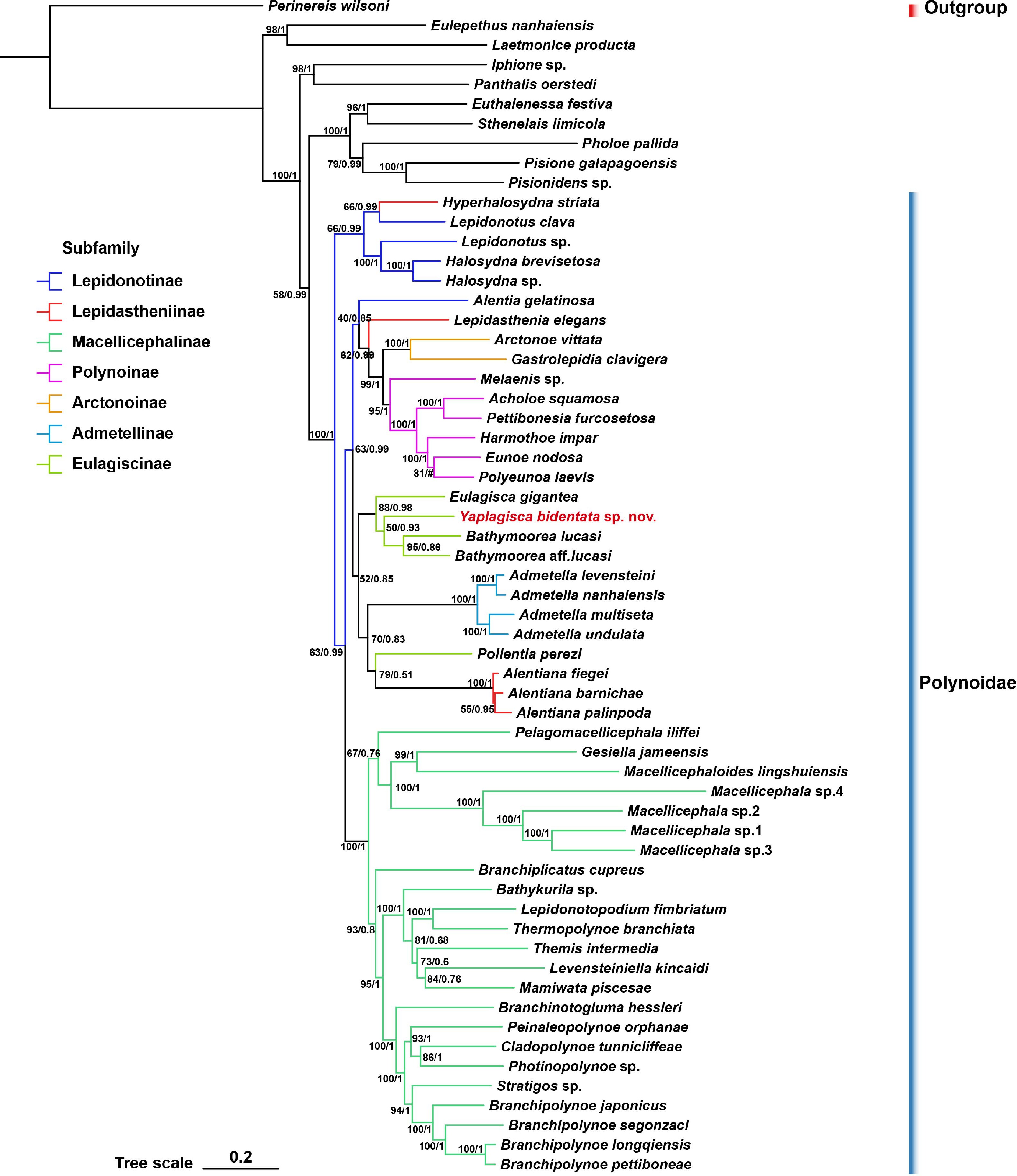
Figure 1.
Phylogenetic relationships inferred from the concatenated 17-gene matrix. The topology shown is the maximum-likelihood (ML) tree. Node values indicate ML ultrafast bootstrap support (left) and Bayesian posterior probability (BI; right). Different branch colors denote different subfamilies of Polynoidae. The hash sign marks the node at which the ML and BI topologies were incongruent.
The analyses did not, however, recover Eulagiscinae as a consistently well-supported monophyletic group as currently circumscribed. In particular, Pollentia perezi was not grouped with the Eulagisca–Bathymoorea–Yaplagisca assemblage but instead occurred in a separate position in the tree, leaving the monophyly of Eulagiscinae unresolved in the present analysis.
Overall, the molecular results are compatible with the morphological evidence in indicating that the new taxon belongs to Eulagiscinae and is closely associated with Bathymoorea. At the same time, the relationships among these genera and the position of Pollentia remain insufficiently resolved and are therefore treated with caution in the following discussion.
Systematics
-
Class Polychaeta Grube, 1850
Order Phyllodocida Dales, 1962
Family Polynoidae Kinberg, 1856
Eulagiscinae Pettibone, 1997
-
Emended diagnosis. Body elongate, dorsoventrally flattened, with up to 41 segments. Prostomium bilobed. Median and lateral antennae present; median antenna inserted in anterior prostomial notch; lateral antennae inserted terminally or subterminally on anterior prostomial extensions, with or without distinct ceratophores. Eyes present or absent. Facial tubercle present or absent. Tentacular segment with one tentaculophore on each side of prostomium, each bearing dorsal and ventral tentacular cirri; acicular lobe, chaetae and aciculum present or absent. Nuchal fold present or absent. Pharynx with two pairs of jaws. Dorsal tubercles present, conspicuous or inconspicuous. Elytrophores bulbous, 13–16 pairs, arranged on segments 2, 4, 5, 7, 9, 11, 13, 15, 17, 19, 21, 23, 26, 29, 32 and, when present, 33. Parapodia biramous or subbiramous; notopodia shorter than neuropodia; noto- and neuropodia with projecting acicular lobes; tips of noto- and neuroaciculae generally not penetrating epidermis. Ventral lamellae present or absent. Notochaetae numerous, with spinous rows, represented by one or two types; neurochaetae numerous, represented by one or two types, with distal tips entire, bidentate, tridentate or otherwise modified.
Remarks. This diagnosis is emended from Pettibone[10], Bonifácio & Menot[15], and Capa et al.[16] to accommodate the morphological variation currently recognized among the included genera and the addition of Yaplagisca gen. nov. In particular, lateral antennal ceratophores are here treated as indistinct or distinct, whereas eye condition, nuchal fold, tentacular chaetae, ventral lamellae, elytral number and chaetal morphology are variable among genera. The terminal or subterminal insertion of the lateral antennae on anterior prostomial extensions, together with well-developed parapodia bearing projecting acicular lobes, remains the principal morphological basis for recognizing Eulagiscinae.
Yaplagisca gen. nov.
-
Type species. Yaplagisca bidentata gen. et sp. nov., by present designation.
Diagnosis. Body elongate, dorsoventrally flattened. Prostomium bilobed, with two pairs of eyes; median antenna inserted in anterior notch of prostomium; lateral antennae inserted subterminally on anterior prostomial extensions, with distinct ceratophores. Facial tubercle distinct. First or tentacular segment with one tentaculophore on each side of prostomium, each bearing dorsal and ventral tentacular cirri, several chaetae, a projecting acicular lobe and one aciculum. Nuchal fold absent. Elytra 15 pairs. Dorsal tubercles conspicuous, bulbous or nodular on anterior and median segments, becoming lamelliform posteriorly. Parapodia biramous; notopodia shorter than neuropodia; both rami with distinct projecting acicular lobes. Notochaetae of a single type. Neurochaetae of a single type, distally bidentate. Ventral lamellae absent.
Etymology. Generic name derived from Yap Seamount, the type locality of the genus, and the suffix -lagisca, referring to its affinity with other eulagiscin genera. Gender feminine.
Remarks. Yaplagisca gen. nov. agrees with Eulagiscinae in having lateral antennae inserted on anterior prostomial extensions and well-developed notopodia and neuropodia with projecting acicular lobes. It differs from Eulagisca in lacking a nuchal fold and in having only one type of neurochaetae; from Pareulagisca in having 15 rather than 16 pairs of elytra and a distinct facial tubercle; from Bathymoorea in having two pairs of eyes, 15 rather than 13–14 pairs of elytra, and bidentate rather than entire neurochaetal tips; from Kristianides in lacking ventral lamellae and in having a distinct facial tubercle; and from Pollentia in having 15 rather than 13 pairs of elytra and only one type of neurochaetae. Comparisons (Table 1) are based on the diagnoses and descriptions of Pettibone[10], Bonifácio & Menot[15], Salazar-Silva[11], Capa et al.[16], and the sponge-associated Bathymoorea aff. lucasi reported by Periasamy et al.[29].
Table 1. Comparative morphological characters of the six genera of Eulagiscinae.
Character Eulagisca Pareulagisca Bathymoorea Kristianides Pollentia Yaplagisca gen. nov. Number of segments up to 41 up to 37 up to 33 38 26–27 36 Number of elytral pairs 15 16 13–14 15 13 15 Eyes two pairs two pairs one pair of ocular areas or absent/reduced two pairs absent two pairs Facial tubercle distinct weak distinct absent absent distinct Chaetae on tentacular segment present present, single chaeta absent or present (emended concept) absent present present Acicular lobe on tentacular segment present absent absent or present (emended concept) present present present Nuchal fold present present absent absent absent absent Dorsal tubercles bulbous or nodular slightly bulbous conspicuous, inflated to lamelliform inconspicuous inconspicuous conspicuous; bulbous/nodular anteriorly and medially, lamelliform posteriorly Elytral ornamentation variable, often with papillae/tubercles/vesicles smooth without tubercles or papillae poorly known in intact material; genus diagnosed mainly from body and parapodia marginal papillae, microtubercles and macrotubercles on surface smooth or with microtubercles
along external edgeall elytra detached in holotype Ventral lamellae absent absent absent present absent absent Types of notochaetae one type two types one type two types one type one type Types of neurochaetae one type one type one type two types two types one type Neurochaetal distal tip pointed, entire or weakly hooked, depending on species pointed, with or without minute secondary tooth pointed, entire not bidentate superior tridentate; inferior lanceolate/pectinate bidentate Dorsal pigmentation variable poorly known weak or poorly known poorly known absent except
minute specklesconspicuous reddish to orange-brown median band Notes: (1) Characters of Bathymoorea summarized from Pettibone[9], Bonifácio & Menot[15], and Periasamy et al.[29]; (2) Pollentia treated here as a valid genus of Eulagiscinae following current usage; (3) Condition of elytral surface in Yaplagisca bidentata gen. et sp. nov. remains unknown because all elytra were detached from the holotype. Yaplagisca bidentata gen. et sp. nov. (Figs 2−4)
-
Material examined. Holotype. MBM287247, collected during the Kexue 1405 seamount cruise, tropical western Pacific, Yap Seamount, 15 December 2014, R/V Kexue, ROV Faxian, dive 16, 8.86242° N, 137.74027° E, 932 m water depth. Owing to apparent stress-induced shedding during ROV recovery, all elytra, all dorsal cirral styles, most prostomial appendages, and several parapodia had already been lost before the specimen was photographed alive (Fig. 2a). No paratypes.
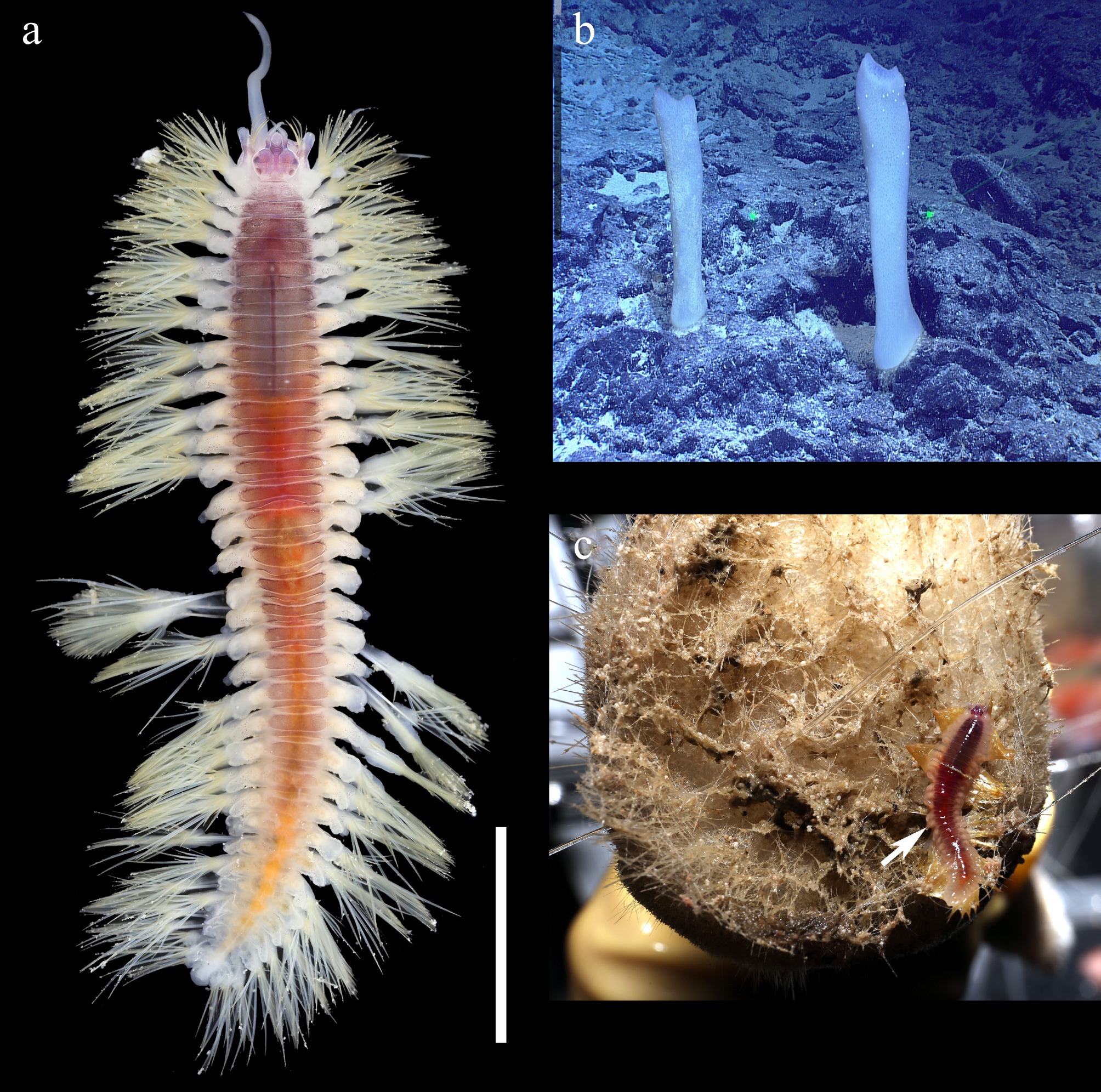
Figure 2.
Yaplagisca bidentata gen. et sp. nov. (a) Dorsal view of living holotype. (b) In situ image of putative host sponge Poliopogon distortus Gong & Li, 2018. (c) Holotype found on the surface of P. distortus after ROV recovery. The distance between the paired laser beams in the in situ image (b) is 33 cm. Scale bar: (a) 5 mm.
Diagnosis. Body with 36 segments; elytra 15 pairs; lateral antennae inserted on anterior prostomial extensions, with distinct ceratophores; eyes two pairs; nuchal fold absent; facial tubercle distinct; dorsal tubercles conspicuous, bulbous to nodular anteriorly and medially, lamelliform posteriorly; tentacular segment with acicular lobe, aciculum and chaetae; single type of both notochaetae and neurochaetae; neurochaetae with bidentate distal tips; dorsum with conspicuous reddish to orange-brown longitudinal pigmentation band formed by transverse pigment patches of successive segments.
Description. Holotype complete, elongate, dorsoventrally flattened, widest in anterior to mid-body region, gradually tapering posteriorly; parapodia long, nearly as long as body diameter, with well-developed chaetal fascicles (Fig. 2a). Elytra missing; elytrophores indicating 15 pairs of elytra. Body with 36 segments; length 21.9 mm, width 9.88 mm including chaetae, 6.56 mm excluding chaetae.
Dorsum of live specimen with a conspicuous longitudinal reddish to orange-brown median band extending almost throughout body, formed by a series of transversely aligned pigmented areas on successive segments; pigmentation strongest on anterior and middle segments, becoming paler posteriorly (Fig. 2a). Lateral and ventral surfaces whitish to translucent (Fig. 3d). Eyes pinkish to dark in preserved specimen (Fig. 3a).
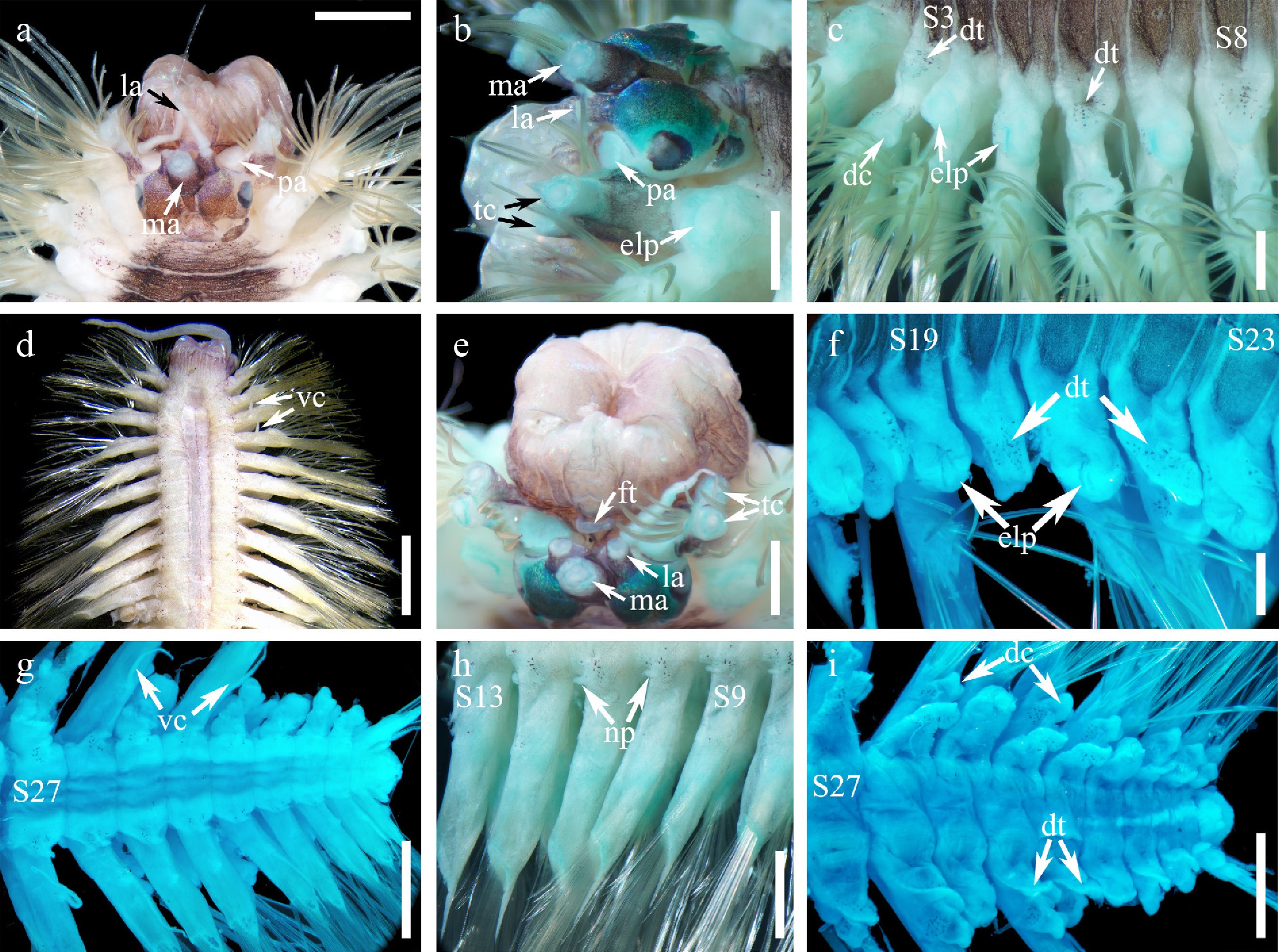
Figure 3.
Yaplagisca bidentata gen. et sp. nov., details of the anterior, median and posterior body regions. (a) Dorsal view of prostomium and anterior segments. (b) Left dorsolateral view of prostomium and anterior segments. (c) Left dorsolateral view of segments 2 to 8, showing dorsal tubercles and elytrophores. (d) Ventral view of anterior body region. (e) Oblique anterodorsal view of prostomium, showing facial tubercle below ceratophore of median antenna. (f) Left dorsolateral view of segments 17–23, showing dorsal tubercles, dorsal cirrophores and elytrophores. (g) Ventral view of posterior body region. (h) Left ventrolateral view of segments 8 to 13, showing nephridial papillae. (i) Dorsal view of posterior body region. dc: dorsal cirrophore; dt: dorsal tubercles; elp: elytrophores; ft: facial tubercle; la: lateral antenna or ceratophore of lateral antenna; ma: ceratophore of median antenna; np: nephridial papillae; pa: palpophore; S3: segment 3; tc: tentacular cirrophore; vc: ventral cirrus. Scale bars: (d) 2 mm, (a, g–i) 1 mm, and (b, c, e, f) 0.5 mm.
Prostomium bilobed, wider than long (Fig. 3a). Two pairs of round eyes arranged in an inverted trapezoid; anterior pair larger than posterior pair, situated laterally at widest part of prostomium; posterior pair smaller, near posterior margin of prostomium (Fig. 3a, b). Median antenna with a distinct cylindrical ceratophore, inserted in anterior notch of prostomium; style missing. Lateral antennae inserted subterminally on anterior prostomial extensions, each with a slender cylindrical ceratophore distinctly smaller than that of median antenna; styles slender, tapering distally (Fig. 3a, b). Palps robust, much thicker than antennae, smooth, tapering distally; right palp missing (Fig. 3d). Facial tubercle subconical, situated below ceratophore of median antenna, clearly visible in oblique anterodorsal view (Fig. 3e). Cephalic peaks absent. Pharynx slightly everted, not dissected.
First or tentacular segment not visible dorsally, with one tentaculophore on each side of prostomium. Each tentaculophore bearing dorsal and ventral tentacular cirri, five stout chaetae, a projecting acicular lobe and one aciculum; dorsal and ventral tentacular cirrophores cylindrical and subequal in size, styles detached in holotype (Fig. 3b, e). Aciculum slightly protruding through epidermis (Fig. 3b; Supplementary Fig. S1). Segment 2 without a nuchal fold; with first pair of elytrophores, parapodia and ventral cirri.
All elytra detached and not recovered. Elytrophores: 15 pairs, distinct, bulbous, on segments 2, 4, 5, 7, 9, 11, 13, 15, 17, 19, 21, 23, 26, 29, and 32. Segments 33–35 with distinct insertion scars of dorsal cirri; segment 36 weakly developed, with oval-shaped parapodia. Dorsal cirrophores distinct and cylindrical on cirrigerous segments; all dorsal cirral styles detached and missing in the holotype (Fig. 3c, f, i). Dorsal tubercles conspicuous, bulbous to nodular on anterior and middle segments (Fig. 3c, f), becoming lamelliform on posterior segments and nearly as long as dorsal cirrophores (Fig. 3f, i). Buccal cirri on segment 2 stout, tapering, inserted basally on neuropodia. Ventral cirri from segment 3 onwards smaller, tapering, inserted medially on neuropodia (Fig. 3d; Supplementary Fig. S2). Nephridial papillae minute, papilliform, beginning from segment 4 and continuing to posterior end, situated at junction between neuropodia and body wall (Fig. 3g, h; Supplementary Fig. S3). Pygidium small, rounded; anus terminal; pygidial cirri detached in holotype.
Parapodia biramous. Notopodia well developed, shorter than neuropodia; both rami with distinct projecting acicular lobes. Anterior, median and posterior parapodia similar in general organization, differing only slightly in proportions of acicular lobes and chaetal fascicles (Fig. 4a–c).
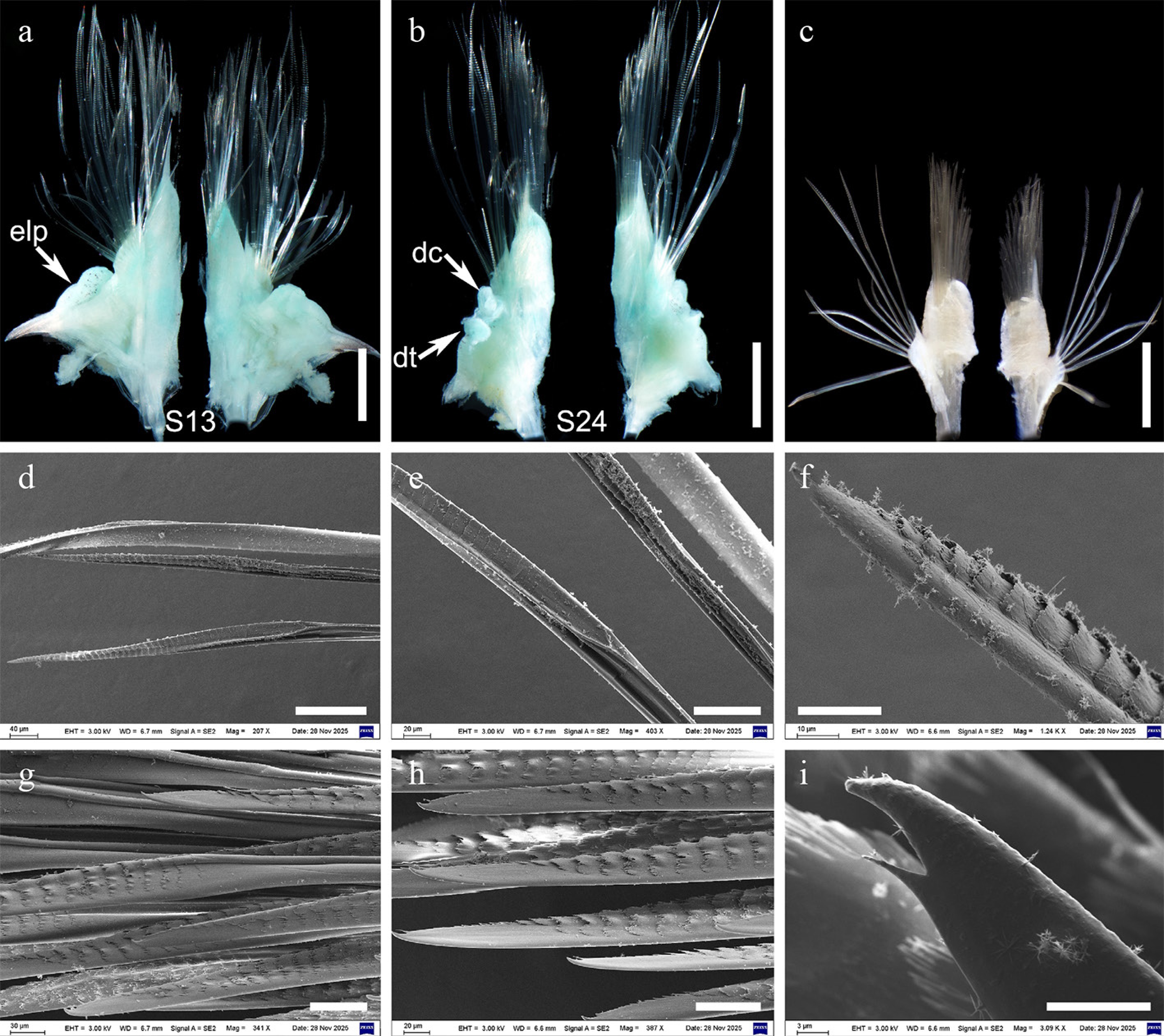
Figure 4.
Yaplagisca bidentata gen. et sp. nov., parapodia and chaetae. (a) Left parapodium from segment 13, anterior view (left) and posterior view (right). (b) Right parapodium from segment 24, posterior view (left) and anterior view (right). (c) Left posterior parapodium, unstained, anterior view (left) and posterior view (right). (d) General view of notochaetae. (e) Detail of notochaeta, showing basal part of spinous region. (f) Detail of notochaeta, showing transverse rows of spines and a pointed tip. (g) Neurochaetae from the middle part of the neurochaetal fascicle. (h) Neurochaetae from the lower part of the neurochaetal fascicle. (i) Distal tip of neurochaeta, showing bidentate apex. dc: dorsal cirrophore; dt: dorsal tubercles; elp: elytrophores; S13: segment 13; S24: segment 24. Scale bars: (a–c) 1 mm, (d) 100 μm, (e, g, h) 50 μm, (f) 20 μm, and (i) 10 μm.
Notochaetae numerous, arranged in radiating fascicles, all of a single type, stouter than neurochaetae. Shafts with a flattened, slightly curved, blade-like spinous region; rows of short spines arranged transversely on convex side of expanded distal region; tips entire, tapering to a pointed end (Fig. 4d–f).
Neurochaetae arranged in fan-shaped fascicles, all of a single type, differing only slightly in length and robustness. Distal spinous region weakly flattened and expanded, blade-like, with rows of spines; tips bidentate, secondary tooth markedly smaller than main distal tooth (Fig. 4g–i).
Etymology. Specific epithet bidentata refers to the bidentate distal tips of the neurochaetae.
Ecology. Holotype found on the surface of the hexactinellid sponge Poliopogon distortus Gong & Li, 2018 after recovery of the sponge by the ROV (Fig. 2b, c). Because no in situ image documented the worm on the sponge before collection, the association is regarded here as probable but unconfirmed.
Remarks. Yaplagisca bidentata gen. et sp. nov. is most similar to Bathymoorea. Both share a similar overall morphology, absence of a nuchal fold, a distinct facial tubercle, and conspicuous dorsal tubercles. The new species differs from Bathymoorea, however, in having two pairs of eyes rather than one pair of ocular areas or strongly reduced ocular structures, 15 rather than 13–14 pairs of elytra, and neurochaetae with bidentate rather than entire pointed tips. Additional differences from the other eulagiscin genera are summarized in Table 1 and under the generic remarks above.
-
The new species is assignable to Eulagiscinae. It shares the principal characters currently used to define the subfamily, most notably lateral antennae inserted on anterior prostomial extensions and well-developed noto- and neuropodia, both with projecting acicular lobes. In overall cephalic and parapodial organization, it is evidently eulagiscin rather than referable to any other polynoid subfamily. This interpretation is also consistent with the broadened concept of Eulagiscinae resulting from the inclusion of Bathymoorea, Kristianides and Pollentia.
Within Eulagiscinae, the new species is morphologically most similar to Bathymoorea (Table 1). Both share a similar overall morphology, absence of a nuchal fold, presence of a distinct facial tubercle, and conspicuous dorsal tubercles. The critical taxonomic question, therefore, is not whether the species belongs to Eulagiscinae, but whether it should be included in Bathymoorea or recognized as a distinct genus.
We consider inclusion in Bathymoorea to be less satisfactory taxonomically. Although the new species is Bathymoorea-like in general morphology, it differs from the two currently valid species of that genus in several independent morphological characters (Table 1), including eye development, elytral number, and neurochaetal tip morphology. These differences do not represent variation in a single structure, but involve three separate morphological systems and together define a coherent combination of characters that distinguishes the new species from the current concept of Bathymoorea.
This point is especially important because Bathymoorea has already been broadened beyond its original concept. Pettibone[9] established the genus for B. renotubulata, whereas Bonifácio & Menot[15] emended the diagnosis to include B. lucasi, considerably expanding the morphological concept of the genus. Incorporating the present species in Bathymoorea would require the diagnosis to be broadened further to include additional variation in eye development, elytral number and neurochaetal morphology. Such a treatment would substantially reduce the morphological diagnosability of Bathymoorea, leaving it defined largely by general eulagiscin features rather than by a distinctive combination of generic characters. Recognition of a new genus, by contrast, preserves a clearer and more informative generic diagnosis while better reflecting the morphological differentiation currently recognized within Eulagiscinae. The recognition of Yaplagisca is also consistent with an emerging pattern of increasing generic diversity within Eulagiscinae. Additional undescribed eulagiscin genera are currently under study (S. I. Salazar-Vallejo, pers. comm., 2026), suggesting that the morphological diversity of the subfamily is greater than previously recognized.
The available phylogenetic evidence does not contradict this interpretation, but neither does it resolve the generic limits of the Bathymoorea–Yaplagisca relationship on its own. In our analyses, the new species is recovered in close association with Bathymoorea, but it is not clearly nested within Bathymoorea or any other previously described genus (Fig. 1). The molecular results are therefore best regarded as broadly consistent with, rather than independently decisive for, the morphological conclusion that the new species should be recognized as a distinct genus. Recognition of Yaplagisca gen. nov. thus rests primarily on morphological diagnosability, while the molecular evidence remains compatible with that taxonomic interpretation.
Putative sponge association and ecological implications
-
The holotype of Yaplagisca bidentata gen. et sp. nov. was found on the surface of the hexactinellid sponge Poliopogon distortus after recovery of the sponge by the ROV. Because the worm was not documented in situ before collection, this observation cannot be taken as conclusive evidence of symbiosis. The most cautious interpretation is therefore that the species shows a probable, but as yet unconfirmed, association with the sponge. This distinction is important, as post-recovery coincidence cannot be entirely excluded in deep-sea samples.
Even so, the association is unlikely to be trivial. The specimen was recovered directly from the sponge surface rather than from unsorted residual material, and a comparable case has already been reported in a closely related lineage. Periasamy et al.[29] documented Bathymoorea aff. lucasi associated with a hexactinellid sponge of the genus Dictyaulus from the Southwest Indian Ridge and interpreted that occurrence as indicating possible sponge commensalism. That record is particularly relevant here because it involves a taxon morphologically and phylogenetically close to the lineage represented by Yaplagisca gen. nov.
Taken together, these observations suggest that sponge association may occur more broadly in the Bathymoorea–Yaplagisca lineage, and perhaps in part of Eulagiscinae more generally. Such a relationship is biologically plausible: hexactinellid sponges provide a structurally complex habitat that may offer shelter, attachment surfaces, and localized food resources. Polynoid–sponge associations are already known elsewhere in the family[30−34], and the present case fits that broader ecological pattern. At the same time, the available evidence remains too limited to infer host specificity or obligate dependence. Additional in situ observations and repeated collections will be needed to determine whether Y. bidentata is consistently associated with Poliopogon distortus or uses this sponge only opportunistically. For now, the new species is best regarded as a probable sponge-associated eulagiscin, with the ecological significance of this relationship remaining an important question for future study.
Phylogenetic relationships of Yaplagisca gen. nov. and the provisional limits of Eulagiscinae
-
The phylogenetic position of Yaplagisca bidentata gen. et sp. nov. is informative at two levels. First, it bears on the relationship of the new genus to the Bathymoorea–Eulagisca complex; second, it highlights the still unresolved limits of Eulagiscinae as a whole. In our analyses, Yaplagisca is recovered in the same broad lineage as Bathymoorea and Eulagisca, which is consistent with the morphological evidence that these taxa are closely related. At the same time, the present topology does not by itself resolve whether the new species should be interpreted as a distinct genus or as part of an expanded concept of Bathymoorea. Accordingly, recognition of Yaplagisca gen. nov. rests primarily on morphological diagnosability, whereas the molecular results should be regarded as compatible with, rather than independently decisive for, that interpretation.
The broader phylogenetic interpretation of Eulagiscinae is less straightforward because the position of Pollentia perezi remains unstable. Capa et al.[16] assigned Pollentia to Eulagiscinae primarily on morphological grounds. In their remarks and amended diagnosis, they emphasized that Pollentia shares with other eulagiscins the terminal or subterminal insertion of the lateral antennae on anterior prostomial extensions and subbiramous parapodia with notopodia shorter than neuropodia, while differing in several derived features, notably its reduced number of elytral pairs and distinctive neurochaetae. They therefore interpreted Pollentia as a morphologically unusual but still eulagiscin lineage and modified the diagnosis of the subfamily accordingly.
However, the molecular evidence available for Pollentia has never provided strong support for a stable phylogenetic placement within Eulagiscinae. Capa et al.[16] explicitly noted that, in their reduced four-gene dataset, Eulagiscinae was not consistently recovered as monophyletic and that the position of Pollentia perezi was only weakly resolved. Our analyses likewise do not place Pollentia consistently together with Eulagisca, Bathymoorea and Yaplagisca in a strongly supported grouping. In the present tree, Pollentia is separated from the assemblage formed by Eulagisca, Bathymoorea and Yaplagisca, whereas some deeper relationships within that assemblage are themselves only moderately to weakly supported. An additional Bayesian analysis based on the four-marker dataset used by Capa et al.[16] recovered the same overall relationships among the sampled eulagiscins, including the separation of Pollentia from the Eulagisca–Bathymoorea–Yaplagisca assemblage, although support for several deeper nodes was lower and parts of the topology were unstable (analysis not shown).
At present, this conflict between morphology and molecules is best interpreted as a consequence of insufficient and uneven taxon and gene sampling rather than as decisive evidence against the placement of Pollentia in Eulagiscinae. Molecular data remain highly incomplete across the subfamily: Pollentia perezi is represented only by the standard four markers (COI, 16S rRNA, 18S rRNA and 28S rRNA), Bathymoorea is also incompletely sampled, and Pareulagisca and Kristianides still lack molecular data altogether. Under these circumstances, the failure to recover a consistently monophyletic Eulagiscinae should be regarded as an unresolved phylogenetic signal rather than a firm basis for excluding Pollentia from the subfamily.
For the time being, we therefore prefer to retain Pollentia provisionally in Eulagiscinae on morphological grounds. Under this interpretation, Eulagiscinae is best treated as a morphologically coherent but phylogenetically incompletely resolved group, pending denser taxon sampling and more balanced molecular coverage across all included genera. Accordingly, the placement of Yaplagisca near the Bathymoorea–Eulagisca assemblage is compatible with the evidence currently available, whereas the inclusion of Pollentia remains provisional and the monophyly of Eulagiscinae as presently circumscribed should be regarded as unresolved.
We sincerely thank the crew of R/V Kexue and the ROV Faxian for their valuable assistance in sample collection. We are especially grateful to Dr. Sergio I. Salazar-Vallejo for generously providing the first author, Xuwen Wu, with extensive literature and unpublished materials relevant to this study, and for his valuable discussions and taxonomic advice during the revision of the manuscript. We are grateful to Dr. Lin Gong for identifying the deep-sea hexactinellid glass sponge associated with the examined material.
-
This study involved no human participants or vertebrate animals. The taxonomic and molecular analyses were conducted using a preserved marine invertebrate specimen collected during a scientific research cruise. No specific ethical approval was required for this study.
-
The authors confirm contribution to the paper as follows: study conception and design, sample collection, methodology, morphological investigation, draft manuscript preparation: Wu X; molecular phylogenetic analysis, data curation, sequence submission: Ma M; writing – review and editing: Wu X, Zhang Y, Xu K. All authors reviewed the results and approved the final version of the manuscript.
-
The holotype described in this study is available at the Marine Biological Museum of the Chinese Academy of Sciences (MBMCAS), Institute of Oceanology, Qingdao, China, under voucher number MBM287247. The whole-genome sequencing (WGS) reads are available in the NCBI Sequence Read Archive (SRA) under accession number SRR39264811. The mitochondrial genome, nuclear ribosomal sequence containing 18S rRNA and 28S rRNA, and the H3 sequence are available in GenBank under accession numbers PZ789386, PZ769330, and PZ768667, respectively (Supplementary Table S1). The H3 sequence was generated and deposited but was not included in the phylogenetic analyses presented here. ZooBank LSIDs are as follows: Yaplagisca gen. nov., urn:lsid:zoobank.org:act:A0F2EF6A-37CF-4B7D-8C69-4900507919E2; Yaplagisca bidentata gen. et sp. nov., urn:lsid:zoobank.org:act:4F73F403-D176-4F5F-859A-9967919FF3FD, and this publication, urn:lsid:zoobank.org:pub:620C8C25-9CB4-499D-B1E2-A7C4956CEA0C.
-
The authors declare no conflicts of interest.
-
accompany this paper online at: https://doi.org/10.48130/jzser-0026-0011.
- Supplementary Table S1 Taxon sampling, voucher information, accession numbers and references for sequences used in the 17-gene phylogenetic analyses.
- Supplementary Table S2 Partitioning schemes and substitution models selected by PartitionFinder2 for maximum-likelihood and Bayesian analyses of the 17-gene matrix.
- Supplementary Fig. S1 Yaplagisca bidentata gen. et sp. nov., dorsal view of the right appendages of the tentacular segment and segment 2. Scale bar: 0.5 mm.
- Supplementary Fig. S2 Yaplagisca bidentata gen. et sp. nov., ventral view of the left parapodia from segments 4–8. Scale bar: 0.5 mm.
- Supplementary Fig. S3 Yaplagisca bidentata gen. et sp. nov., ventral view of the body wall from segments 7–13, showing the nephridial papillae. Scale bar: 1 mm.
- Copyright © 2026 by the author(s). Journal of Zoological Systematics and Evolutionary Research published by Maximum Academic Press on behalf of John Wiley & Sons Ltd. This is an open access article under the terms of the Creative Commons Attribution License, which permits use, distribution and reproduction in any medium, provided the original work is properly cited.
-
About this article
Cite this article
Wu X, Ma M, Zhang Y, Xu K. 2026. A new genus and species of Eulagiscinae Pettibone, 1997 (Annelida, Polynoidae) from a western Pacific seamount, with remarks on generic placement and putative sponge association. Journal of Zoological Systematics and Evolutionary Research 2026: e010 doi: 10.48130/jzser-0026-0011 

A new genus and species of Eulagiscinae Pettibone, 1997 (Annelida, Polynoidae) from a western Pacific seamount, with remarks on generic placement and putative sponge association
- Received: 23 June 2026
- Revised: 07 August 2026
- Accepted: 11 August 2026
- Published online: 11 September 2026
Journal of Zoological Systematics and Evolutionary Research
2026,
Article number: e010 (2026)
|
Cite this article
Abstract: A new genus and species of Polynoidae, Yaplagisca bidentata gen. et sp. nov., is described from Yap Seamount in the tropical western Pacific. The new taxon is assigned to Eulagiscinae Pettibone, 1997, based on its cephalic and parapodial organization, including lateral antennae inserted subterminally on prostomial extensions and well-developed noto- and neuropodia with projecting acicular lobes. Yaplagisca gen. nov. is distinguished from the other genera of Eulagiscinae by a combination of characters, including 15 pairs of elytra, lateral antennae with distinct ceratophores, absence of a nuchal fold, a distinct facial tubercle, conspicuous dorsal tubercles, and a single type of neurochaetae with bidentate tips. Morphologically, the new species is most similar to Bathymoorea but differs from that genus in having two rather than one pair of eyes, 15 rather than 13–14 pairs of elytra, and bidentate rather than entire neurochaetal tips. Phylogenetic analyses based on 13 mitochondrial protein-coding genes and four ribosomal genes recover Yaplagisca in close association with Bathymoorea, and place both genera with Eulagisca in a broader eulagiscin assemblage. The analyses do not recover Eulagiscinae as a consistently well-supported monophyletic group as currently circumscribed, because Pollentia perezi is not placed with Eulagisca, Bathymoorea and Yaplagisca. We nevertheless retain Pollentia provisionally in Eulagiscinae on morphological grounds and regard the monophyly of the subfamily as unresolved. The holotype was found on the surface of the hexactinellid sponge Poliopogon distortus after ROV recovery, suggesting a probable but unconfirmed sponge association. This study refines the taxonomy of Eulagiscinae and provides new evidence on its morphological diversity, phylogenetic uncertainty, and ecological diversification.
-
Key words:
- New genus /
- Eulagiscinae /
- Molecular phylogeny /
- Seamount /
- Sponge association