












-
In real-world applications, the provenance of data can be very diverse and include non-trustworthy sources. Thus, databases are often inconsistent in practice when the data do not conform to the imposed integrity constraints (ICs). A rich theory has been developed to deal with inconsistent databases.
Formally, ICs describe fundamental structural properties of data that should be satisfied for a database to be considered consistent. ICs are often formulated in some logic, most notably in fragments of first-order logic. Two of the most fundamental classes of ICs are key constraints (indicating that the value of a given collection of attributes uniquely determines the whole record in the database table) and inclusion dependencies (which express that all values for a given attribute occur as values of another given attribute). Together, key constraints and inclusion dependencies (IDs) can express foreign key constraints. The literature for database dependencies considers a whole hierarchy of dependencies in increasing generality (see, e.g., Abiteboul[1]). Within this hierarchy, key constraints are special cases of functional dependencies (FDs), which are special cases of equality-generating dependencies, which again generalize to denial constraints (DCs). Likewise, IDs generalize to local-as-view tuple-generating dependencies (LTGDs), which are special cases of tuple-generating dependencies (TGDs). All the aforementioned dependencies can be defined as particular syntactic fragments of first-order logic (see the section "Preliminaries" for formal definitions). In this paper, we examine expressive ICs, specifically DCs and LTGDs, alongside their less expressive counterparts, FDs and IDs.
One of the main approaches for handling inconsistency is database repairing. The goal is to identify and repair inconsistencies in data to obtain a consistent database that satisfies the imposed constraints. In the usual approaches, one would search for a database that satisfies the given constraints and differs minimally from the original database; the obtained database is called a repair of the original. Some of the most prominent notions of repairs are set-based repairs[2,3], attribute-based repairs[4], and cardinality-based repairs[5].
Dung's abstract argumentation framework (AF)[6] has been specifically designed to model conflicts and support relationships among arguments. An abstract AF represents arguments and their conflicts through directed graphs and allows for a convenient exploration of the conflicts at an abstract level. Furthermore, it is often necessary to consider conflicts not only between individual arguments but also between sets of arguments. This necessity has given rise to the so-called set-based AFs (SETAFs)[7], which allow modeling of collective attacks.
AFs have been explored extensively for representing and reasoning with inconsistent knowledge bases (KBs), covering Datalog± and description logics (see, e.g., studies[8−13] and Arieli[14] for an overview). The common goal in each of these works is to formally establish a connection between inconsistent KBs and AFs such that the argumentation machinery then outputs extensions equivalent to the set of repairs of the KB. Nevertheless, in the setting of relational databases and ICs, there is still a gap with respect to how or whether a connection between inconsistent databases and AFs can be established. To the best of our knowledge, only FDs (or their generalization, denial constraints) have been investigated in the context of AFs (resp., SETAFs) in Bienvenu & Bourgaux[13]. We expand this area of research by establishing further connections between repairs and abstract argumentation frameworks when further ICs are allowed.
In this paper, we focus on subset repairs of relational databases when the ICs are DCs and LTGDs. The first problem of interest to us is establishing a connection between repairs for the inconsistent databases (DBs) and extensions in SETAFs. We show how subset-maximal repairs under a set of DCs and LTGDs can be obtained by computing the naive, preferred, or stable extensions (see the section "Preliminaries" for definitions) in the related SETAFs. Repairs under DCs correspond to the naive extensions, which also coincide with the preferred and stable extensions in the resulting SETAFs. For LTGDs, the correspondence requires preferred semantics. However, a polynomial-time pre-processing on the resulting SETAFs results in its unique extension that is also stable and naive. Allowing both types of ICs breaks this relationship between extensions, and only preferred semantics captures the repairs. Our second contribution highlights that when one restricts DCs to FDs and LTGDs to IDs, respectively, a similar connection as for the expressive ICs holds; however, now the resulting SETAFs are in fact AFs (with attacks only between arguments, rather than collective attacks). We are also interested in the computational problems of deciding the existence of a repair and of determining whether a given fact belongs to some (or every) repair and consider their complexity. See Table 1 for the complexity results.
Table 1. Overview of our main contributions.
Equivalence between DBs with expressive ICs and SETAFs, along with data complexity results. ICs SETAF-equivalent semantics for repairs Complexity results $ {\rm{REP}}_{{\rm{B}}} $ $ \exists {\text{-}}{\rm{REP}}_{{\rm{B}}} $ $ \forall {\text{-}}{\rm{REP}}_{{\rm{B}}} $ DCs $ \sigma \in \{\text{naive},\text{pref},\text{stab}\}^\star $ (trivial) (trivial) $ \in{\bf{P}} $ LTGDs $ \text{pref} $ (Thm. 3.9) $ \in{\bf{P}} $[15] $ \in{\bf{P}} $[15] $ \in{\bf{P}} $[15] DCs+LTGDs $ \text{pref} $ (Thm. 3.13) $ {\bf{NP}} $ (Thm. 3.14) $ {\bf{NP}} $ (Thm. 3.14) $ {\boldsymbol{\Pi}}_2^{{\bf{P}}} $ (Thm. 3.15) Equivalence between DBs with less expressive ICs and AFs, along with combined complexity results. ICs AF-equivalent semantics for repairs Complexity Results $ {\rm{REP}} $ $ \exists {\text{-}}{\rm{REP}} $ $ \forall {\text{-}}{\rm{REP}} $ FDs $ \sigma \in \{\text{naive},\text{pref},\text{stab}\}^\star $ (trivial) (trivial) $ \in{\bf{P}} $ IDs $ \text{pref} $ (Cor. 4.7) $ \in{\bf{P}} $[15] $ \in{\bf{P}} $[15] $ \in{\bf{P}} $[15] FDs+IDs $ \text{pref} $ (Cor. 4.12) $ {\bf{NP}} $ (Thm. 4.13) $ {\bf{NP}} $ (Thm. 4.13) $ {\boldsymbol{\Pi}}_2^{{\bf{P}}} $ (Thm. 4.16) The table at the top indicates results for expressive ICs involving a fixed set $ B $ of DCs and LTGDs, whereas the table at the bottom depicts results for less expressive ICs including FDs and IDs. The lower bounds for less expressive ICs also hold for data complexity since the involved reductions use fixed sets of constraints. The second column in each table indicates the (SET)AF-semantics corresponding to repairs for ICs in the first column, and the last three columns present the complexity of each problem. The P-results are already known in the literature, whereas the remaining results are new. Finally, the results marked by * follow from the earlier work in studies[13,17]. By employing Dung's AFs (and their generalizations, SETAFs) to model repairs of a relational database, one can effectively abstract away from the detailed content of individual entries in the database and focus solely on their relationships with other entries. This approach provides a clearer understanding of why specific records either appear or do not appear in a repair, as well as the reasons certain values may be absent from query answers. Furthermore, this modeling approach allows for the incorporation of additional information about records, such as priorities among them, directly at an abstract level.
Related work The problem of computing subset-maximal repairs and its complexity has been explored extensively in the database setting[15−20] (see studies[21,22] for an overview). The notions of conflict graphs and hypergraphs have been introduced before for certain families of ICs[23−25]. In particular, a correspondence between repairs and subset-maximal independent sets of the conflict graphs for FDs[16] and DCs[17] has been established. Moreover, a recent work defines conflict (hyper)graphs for a richer setting of universal constraints considering symmetric difference repairs[26]. Notice that the connection between repairs and independent sets also yields a correspondence between repairs and the naive extensions when the conflict graph is seen as an AF. Nevertheless, to the best of our knowledge, no work has considered a similar graph representation when LTGDs (or even IDs) are taken into account. Hannula and Wijsen[18] addressed the problem of consistent query answering with respect to primary and foreign keys. Their setting allows the insertion of new tuples to fulfill foreign key constraints rather than only deleting.
The case of unirelational databases is also connected to the team-semantics literature[27]. Team semantics is a logical framework where formulae are evaluated over unirelational databases (teams in their terminology). In this setting, the complexity of finding maximal satisfying subteams has been studied by Hannula & Hella[28] for inclusion logic formulas and by Mahmood[29] for propositional dependence logic. In the team-semantics literature, FDs are known as dependence atoms and IDs as inclusion atoms, denoted, respectively, as
$ \text{dep}({\boldsymbol{x}} ; {\boldsymbol{y}}) $ $ {\boldsymbol{x}} \subseteq {\boldsymbol{y}} $ $ \text{dep}({\boldsymbol{x}} ; {\boldsymbol{y}}) $ $ {\boldsymbol{x}} \subseteq {\boldsymbol{y}} $ Our work differs from the previous work, since it combines denial constraints (a subclass of universal constraints) and LTGDs (a subclass of tuple-generating dependencies). Moreover, one of our main contributions lies in connecting repairs under DCs (resp., FDs) and LTGDs (IDs) to the extensions of set-based (plain) AFs in Dung's setting[6]. A similar connection between (SET)AFs and preferred repairs has been explored in the context of prioritized description logic[13] and Datalog± KBs[30−33]. Employing abstract argumentation, we utilize facts in a database as arguments, aligning with the approach presented in Bienvenu & Bourgaux[13]. In fact, the results for DCs and FDs regarding preferred and stable semantics follow as a corollary from the work by Bienvenu & Bourgaux[13] since repairs in the prioritized setting generalize subset repairs. In contrast, Croitoru et al.[31,32] take an orthogonal approach in the datalog setting, employing structured argumentation to construct arguments from a given KB.
Regarding the expressivity comparison between various formalisms, König el al.[34] provided several translations between different argumentation formalisms, namely assumption-based argumentation (ABA)[35], claim-augmented frameworks (CAF)[36], and argumentation frameworks with collective attacks (SETAF)[7]. This puts our work in a broader context by presenting novel translations from databases with expressive ICs to SETAFs. Furthermore, recently, Mahmood et al.[37] presented translations from AFs to inconsistent databases, which is the converse direction to what we aimed to achieve in this paper. Their main findings indicate that one can translate argument interaction in an AF via FDs and IDs alone.
Prior work A preliminary version of this work was published in FoIKS 2024[38]. The current paper expands the earlier work to more expressive ICs. To be precise, we utilize SETAFs to simulate denial constraints and LTGDs using the same ideas as for FDs and IDs. The conference version focused on FDs and IDs in connection to plain AFs. The results for DCs follow from the work by Bienvenu & Bourgaux[13]; thus, the task is to extend them to LTGDs. The results of the conference version can now be derived as special cases from the more general results of this paper, when the involved ICs are FDs and IDs.
-
We assume that the reader is familiar with basics of complexity theory and first-order logic. In particular, we will encounter (1) the complexity classes
$ {\bf{P}}, {\bf{NP}} $ $ {\boldsymbol{\Pi}}_2^{{\bf{P}}} $ $ \forall.\exists. $ Databases A (relational) schema
$ \tau $ $ T\in\tau $ $ T $ $ C $ $ C $ $ t_1,\dots,t_k $ $ T\in\tau $ $ k $ $ T(t_1,\dots,t_k) $ $ \tau $ $ {\cal{T}} $ $ \tau $ $ \tau $ $ {\cal{T}} $ $ \text{dom}({\cal{T}}) $ $ C $ $ {\cal{T}} $ A fact can also be seen as a database tuple. In this notation, the fact
$ T(a_1,\dots,a_k) $ $ (a_1,\dots,a_k) $ $ T $ $ k $ $ T $ $ \tau $ $ T $ $ T $ $ k $ $ \{1,\dots,k\} $ $ T $ $ \text{att}(T) $ $ T $ $ \text{dom}(T) $ $ T $ $ T $ $ x $ $ y $ $ {\boldsymbol{x}}, {\boldsymbol{y}} $ $ x\in\text{att}(T) $ $ s\in T $ $ s(x) $ $ s $ $ x $ $ {\boldsymbol{x}} =(x_1,\ldots,x_k) $ $ s({\boldsymbol{x}}) $ $ (s(x_1),\ldots, s(x_k)) $ $ \tau = \{T_1,\ldots, T_m \} $ $ {\cal{T}}=(T_1,\dots, T_m) $ $ \tau $ $ \text{dom}({\cal{T}}) $ $ {\cal{T}} $ $ T\in{\cal{T}} $ We next present an example database.
Example 2.1 Consider the schema
$ \{E,D\} $ $ E $ $ e_1 $ $ e_1 $ ◁ Table 2. A database with two tables over the schema {E,D}.
E Emp_ID Dept_ID Location D Dept_ID Dept_NAME Location e1 E1 D1 Paderborn d1 D1 Sales Paderborn e2 E2 D2 Sheffield d2 D2 Marketing Sheffield e3 E3 D2 Hanover d3 D3 HR Hanover The first column indicates identifier for each fact/tuple. Integrity constraints. ICs are closed first-order formulas, i.e., all the variables are bound to quantification. In the following, we first specify different types of ICs.
Let
$ \tau $ $ T\in\tau $ $ \varphi $ $ \psi_i $ $ \beta $ $ \forall {\boldsymbol{x}} (\varphi({\boldsymbol{x}})\land \beta({\boldsymbol{x}})\rightarrow \bigvee\limits_{i=1}^n \exists {\boldsymbol{y}}_i \psi_i({\boldsymbol{x}}, {\boldsymbol{y}}_i)) $ a generic first-order IC (FO). All other types of constraint languages arise from restrictions on the generic ICs, as we illustrate next. A generic IC is called full or a universal constraint (UC) if it contains no existential quantifiers. A DC has the form
$ \forall {\boldsymbol{x}} \neg (\varphi({\boldsymbol{x}})\land \beta ({\boldsymbol{x}})) $ $ \forall {\boldsymbol{x}} (\varphi({\boldsymbol{x}})\rightarrow x_i=x_j) $ $ \beta $ $ T $ $ n $ $ I,J\subseteq \{1,\dots,n\} $ $ x_1,\dots,x_n,y_1,\dots,y_n $ $ T $ $ \forall {\boldsymbol{x}} \forall {\boldsymbol{y}} (T({\boldsymbol{x}}) \land T({\boldsymbol{y}}) \land \bigwedge_{i\in I}x_i =y_i \rightarrow \bigwedge_{j\in J}x_j=y_j) $ $ I\cup J = \{1,\dots,n\} $ A disjunctive tuple-generating dependency (
$ \vee $ $ \beta $ $ n=1 $ $ \varphi $ $ \psi_i $ 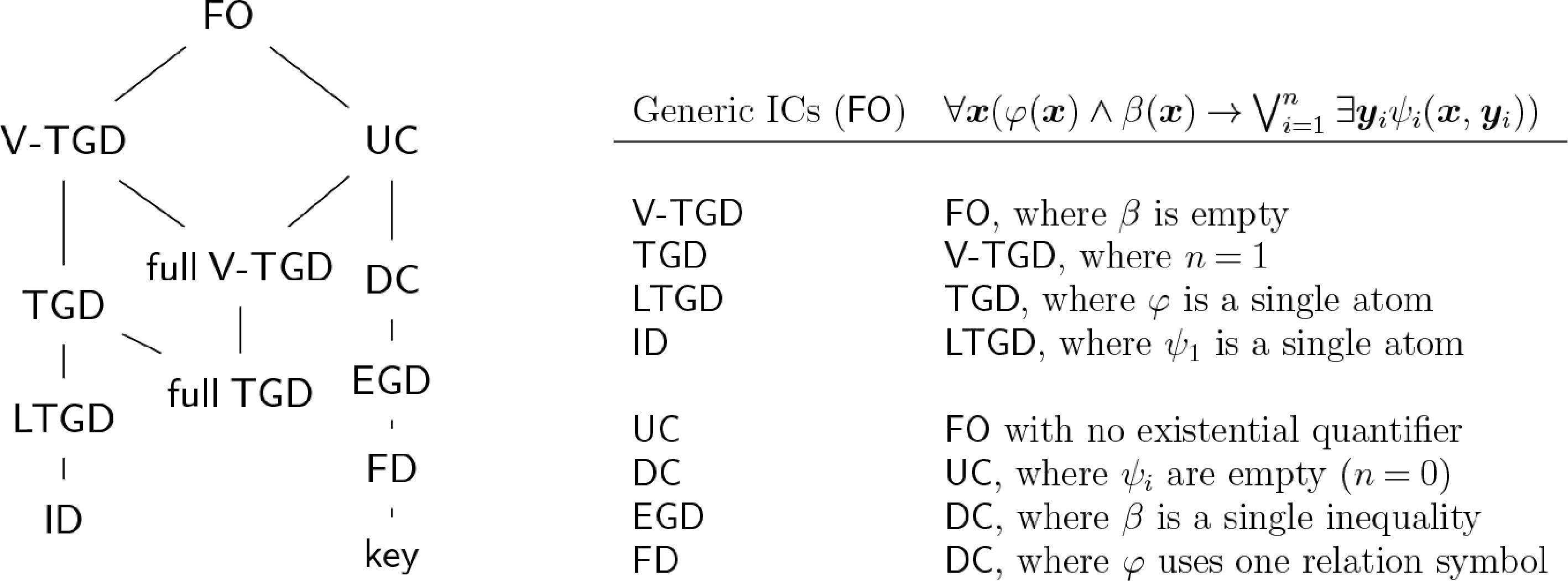
Figure 1.
Hierarchy of ICs and syntactic form for the most commonly studied constraints[39].
The semantics for ICs is defined similarly to first-order (FO) formulas. A database
$ {\cal{T}} $ $ \tau $ $ \mathcal A $ $ \tau $ $ \mathcal A $ $ \text{dom}({\cal{T}}) $ $ {\cal{T}} $ $ T\in \tau $ $ T $ $ {\cal{T}} $ $ (a_1,\dots,a_k) $ $ \text{dom}({\cal{T}}) $ $ T(a_1,\dots,a_k)\in {\cal{T}} $ $ \alpha $ $ {\cal{T}}\models \alpha $ $ \mathcal A\models \alpha $ $ T $ $ n $ $ I,J\subseteq \{1,\dots,n\} $ $ x_1,\dots,x_n,y_1,\dots,y_n $ $ {\boldsymbol{X}} = (x_i \mid i\in I) $ $ {\boldsymbol{Y}} = (y_j \mid j\in J) $ $ \forall {\boldsymbol{x}} \forall {\boldsymbol{y}} (T({\boldsymbol{x}}) \land T({\boldsymbol{y}}) \land \bigwedge_{i\in I}x_i =y_i \rightarrow \bigwedge_{j\in J}x_j=y_j) $ $ \text{dep}({\boldsymbol{X}} ; {\boldsymbol{Y}}) $ $ {\boldsymbol{X}} \rightarrow {\boldsymbol{Y}} $ $ T_i $ $ T_j $ $ {\boldsymbol{x}}_1, {\boldsymbol{x}}_2, {\boldsymbol{x}}_3 $ $ \forall {\boldsymbol{x}}_1 \forall {\boldsymbol{x}}_2 (T_i({\boldsymbol{x}}_1,{\boldsymbol{x}}_2) \rightarrow \exists {\boldsymbol{x}}_3 T_j({\boldsymbol{x}}_2,{\boldsymbol{x}}_3)) $ $ T_i[{\boldsymbol{Y}}] \subseteq T_j[{\boldsymbol{X}}] $ $ {\boldsymbol{X}} $ $ {\boldsymbol{Y}} $ $ T_j $ $ T_i $ $ {\boldsymbol{x}}_2 $ $ {\boldsymbol{Y}}\subseteq {\boldsymbol{X}} $ $ T[{\boldsymbol{Y}}]\subseteq T[{\boldsymbol{X}}] $ $ T $ The following example depicts ICs over the database from Example 2.1.
Example 2.2 Consider a DC
$ {\rm{dc}} $ $ {\rm{lav}} $ $ {\rm{dc}} := \forall x_1, x_2, x_3, x_4, x_5 \neg (E(x_1, x_2, x_3) \land D(x_2, x_4, x_5) \land x_3 \neq x_5) $ $ {\rm{lav}} := \forall x_1, x_2, x_3 (D(x_1, x_2, x_3) \to \exists y_1, y_2 E(y_1, x_1, y_2)) $ The DC
$ {\rm{dc}} $ $ {\rm{lav}} $ $ {\rm{dc}} $ $ {\rm{lav}} $ ◁ Let
$ {\cal{T}} $ $ B $ $ {\cal{T}} $ $ B $ $ {\cal{T}}\models B $ $ {\cal{T}}\models b $ $ b\in B $ $ {\cal{T}} $ $ B $ $ b\in B $ $ {\cal{T}}\not \models b $ $ {\cal{T}} $ $ B $ $ {\cal{P}}\subseteq {\cal{T}} $ $ B $ $ {\cal{P}}' $ $ B $ $ {\cal{P}} \subset {\cal{P}}' \subseteq T $ $ {\cal{T}} = (T_1,\dots,T_m) $ $ {\cal{P}} = (P_1,\dots,P_m) $ $ P_i\subseteq T_i $ $ i\leq m $ $ {\cal{T}} $ $ B $ $ B $ $ {\cal{T}} $ $ {\cal{D}} = \langle {\cal{T}}, B \rangle $ $ {\cal{D}} $ $ \text{repairs}({\cal{D}}) $ $ {\cal{D}} $ The first problem we are interested in (
$ {\rm{REP}} $ $ {\cal{D}} $ $ \emptyset $ Problem: REP Input: a constrained database $ {\cal{D}}=\langle {\cal{T}}, B\rangle $ Question: is there a repair $ \mathcal R\in \text{repairs}({\cal{D}}) $ $ \mathcal R\neq \emptyset $ Two further problems of interest are brave and cautious reasoning for a given fact
$ s\in {\cal{T}} $ $ s $ $ {\cal{D}} $ Problem: $ \exists {\text{-}}{\rm{REP}} $ Input: a constrained database $ {\cal{D}}=\langle {\cal{T}}, B\rangle $ $ s\in {\cal{T}} $ Question: does $ s $ $ {\cal{D}} $ Problem: $ \forall {\text{-}}{\rm{REP}} $ Input: a constrained database $ {\cal{D}}=\langle {\cal{T}}, B\rangle $ $ s\in {\cal{T}} $ Question: does $ s $ $ {\cal{D}} $ We also consider the case when the set
$ B $ $ {\cal{T}} $ $ s $ $ {\rm{REP}}_{{\rm{B}}} $ $ \exists {\text{-}}{\rm{REP}}_{{\rm{B}}} $ $ \forall {\text{-}}{\rm{REP}}_{{\rm{B}}} $ $ B $ $ {\rm{REP}} $ $ \exists {\text{-}}{\rm{REP}} $ $ \forall {\text{-}}{\rm{REP}} $ $ {\cal{C}} $ $ {\rm{REP}} $ $ {\cal{C}} $ $ {\rm{REP}}_{{\rm{B}}} $ $ {\cal{C}} $ $ B $ $ {\cal{C}} $ $ {\rm{REP}}_{{\rm{B}}} $ $ {\cal{C}} $ $ B $ $ {\rm{REP}} $ $ \exists {\text{-}}{\rm{REP}} $ $ \forall {\text{-}}{\rm{REP}} $ Observe that our focus in this work lies on inconsistent databases, i.e., we assume that
$ {\cal{T}} $ $ B $ $ {\cal{D}}=\langle {\cal{T}}, B\rangle $ The following example presents a repair for the database from Example 2.1 with respect to the ICs from Example 2.2.
Example 2.3 Reconsider the database from Example 2.1, which is inconsistent with the ICs from Example 2.2. Here, the fact
$ d_3 $ $ {\rm{lav}} $ $ d_3 $ $ \{e_3, d_2\} $ $ {\rm{dc}} $ $ \{e_1, e_2, d_1, d_2\} $ $ \{e_1, e_2, e_3, d_1\} $ ◁ Abstract argumentation We use Dung's argumentation framework[6] and consider only non-empty and finite sets of arguments
$ A $ $ {\cal{F}}=(A, R) $ $ A $ $ R \subseteq A\times A $ $ S\subseteq A $ $ s \in A $ $ S $ $ {\cal{F}} $ $ (s', s) \in R $ $ s''\in S $ $ (s'',s')\in R $ In abstract argumentation, one is interested in computing the so-called extensions, which are subsets
$ S \subseteq A $ $ S $ $ {\cal{F}} $ $ (S\times S) \cap R = \emptyset $ $ S $ $ S $ 1. naive in
$ {\cal{F}} $ $ S' \supset S $ $ {\cal{F}} $ 2. admissible in
$ {\cal{F}} $ $ s \in S $ $ S $ $ {\cal{F}} $ Further, let
$ S $ $ S $ 3. preferred in
$ {\cal{F}} $ $ S' \supset S $ $ {\cal{F}} $ 4. stable in
$ {\cal{F}} $ $ s \in A \setminus S $ $ s' \in S $ We denote each of the mentioned semantics by abbreviations:
$ \text{conf},\text{ naive},\ \mathrm{adm},\ \mathrm{pref} $ $ \text{stab} $ $ \sigma \in \{\text{conf}, \text{naive}, \text{adm}, \text{pref}, \text{stab}\} $ $ \sigma({\cal{F}}) $ $ \sigma $ $ {\cal{F}} $ $ \sigma $ Problem: $ {\rm{Ext}}\sigma $ Input: an argumentation framework $ {\cal{F}} $ Question: is it true that $ \sigma({\cal{F}})\neq\emptyset $ Finally, for an AF
$ {\cal{F}}{=}(A,R) $ $ a\in A $ $ {\rm{Cred}}_{\sigma} $ $ {\rm{Skep}}_{\sigma} $ $ a $ $ \sigma $ $ {\cal{F}} $ $ \sigma $ $ {\cal{F}} $ Problem: $ {\rm{Cred}}_\sigma $ Input: an AF $ {\cal{F}} = (A, R) $ $ a \in A $ Question: is it true that $ a \in E $ $ E \in \sigma({\cal{F}}) $ Problem: $ {\rm{Skep}}_\sigma $ Input: an AF $ {\cal{F}} = (A, R) $ $ a \in A $ Question: is it true that $ a \in E $ $ E \in \sigma({\cal{F}}) $ Example 2.4 Consider the argumentation framework
$ \mathcal{AF} = \{a,b,c,d\} $ $ {\cal{F}} $ ◁ 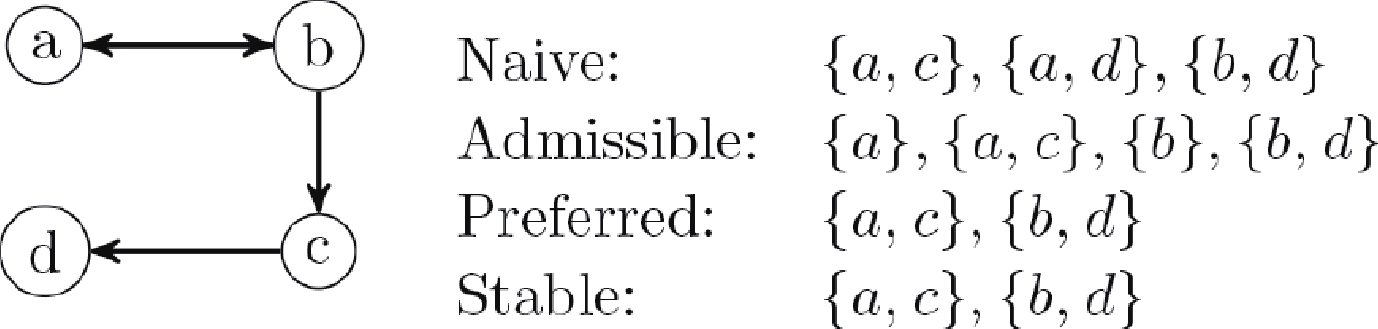
Figure 2.
Framework $ {\cal{F}} $ from Example 2.4 (left) and extensions for given semantics (right).
The complexity of reasoning in argumentation is well understood, see Table 1 in Dvorák & Dunne[40] for an overview. In particular,
$ {\rm{Cred}}_{\text{naive}} $ $ {\rm{Skep}}_{\text{naive}} $ $ {\rm{Cred}}_{\text{pref}} $ $ {\rm{Skep}}_{\text{pref}} $ $ {\bf{NP}} $ $ {\boldsymbol{\Pi}}_2^{{\bf{P}}} $ $ \text{naive} $ $ {\bf{NP}} $ $ \text{pref} $ $ \text{naive} $ $ \text{pref} $ Set-based argumentation. Dung's AFs can be generalized by allowing attacks not only from single arguments, but from collections of arguments[7]. A B-hypergraph (backwards hypergraph) is a directed hypergraph
$ (V, E) $ $ E \subseteq 2^V \times V $ $ {\cal{F}} = (A, R) $ $ A $ $ R \subseteq 2^A \times A $ $ S \subseteq A $ $ (2^S \times S) \cap R = \emptyset $ $ S $ $ s \in A $ $ (S', s) \in R $ $ S" \subseteq S $ $ (S'',s')\in R $ $ s' \in S' $ $ S=\{s\} $ $ (\{s\},s') $ $ (s, s') $ Problem: $ {\rm{Ext}}\sigma^{SET} $ Input: a SETAF $ {\cal{F}} $ Question: is it true that $ \sigma({\cal{F}}) \neq \emptyset $ For a SETAF
$ {\cal{F}} $ $ a\in A $ $ {\rm{Cred}}_{\sigma} $ $ {\rm{Skep}}_{\sigma} $ $ a $ $ \sigma $ $ {\cal{F}} $ $ \sigma $ $ {\cal{F}} $ Example 2.5 Consider the SETAF
$ {\cal{S}} = (A, R) $ $ A = \{a, b, c, d, e\} $ $ R = \{(\{a, b\}, d), (\{b, c\}, e), (\{e\}, a)\} $ $ {\cal{S}} $ $ \{a, b, c\} $ $ \{b, c\} $ $ a $ $ \{e\} $ ◁ 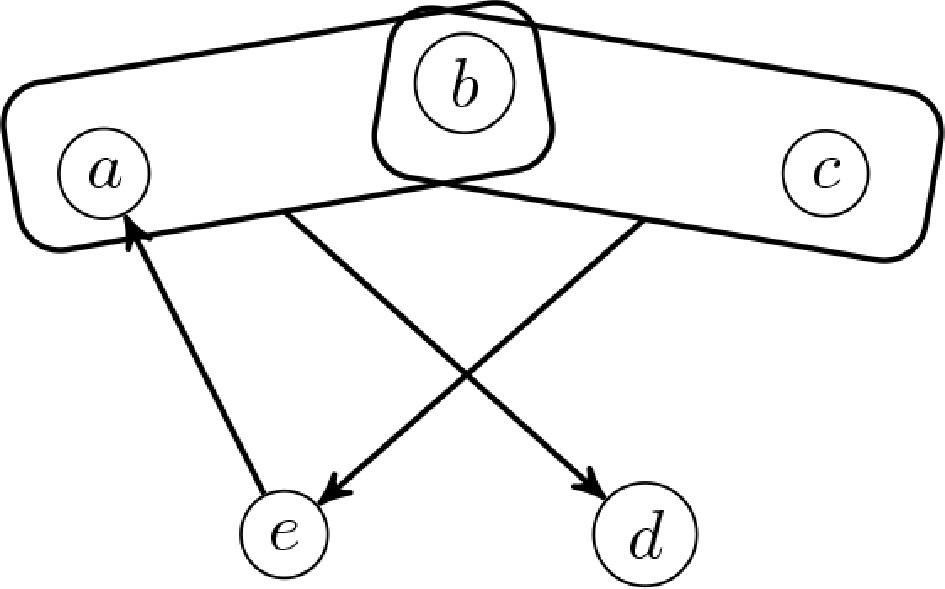
Figure 3.
The SETAF $ {\cal{S}} $ from Example 2.5.
The corresponding decision problem for the extensions existence is defined as follows.
-
In this section, we prove that repairs under expressive families of ICs (involving DCs and LTGDs) can be equivalently seen as extensions in SETAFs. In the first two subsections, we consider instances containing only one type of ICs to SETAFs and the third subsection combines both constraints (DCs and LTGDs). Given an instance
$ {\cal{D}} = \langle {\cal{T}},B\rangle $ $ {\cal{T}} $ $ B $ $ {\cal{D}} $ $ \sigma $ $ {\cal{S}}_{\cal{D}} $ $ \sigma $ In the section "Simulating DCs via SETAFs", we encode a constrained database
$ {\cal{D}} = \langle {\cal{T}},D \rangle $ $ {\cal{T}} $ $ D $ $ {\cal{S}}_{\cal{D}} $ $ s\in {\cal{T}} $ $ d \in D $ $ {\cal{D}} $ In the section "Simulating LTGDs via SETAFs", we simulate a constrained database
$ {\cal{D}}= \langle {\cal{T}}, L\rangle $ $ L $ $ \ell \in L $ $ {\cal{D}} $ $ {\cal{D}} $ $ {\cal{D}} $ Having established that both DCs and LTGDs can be modeled in SETAFs via attacks, the section "Simulating DCs and LTGDs via SETAFs" generalizes this approach by allowing both types of constraints. We observe that no prior work has handled the case of tuple-generating dependencies (to our knowledge).
We first formalize the notion of conflicts for a DB with respect to a set of DCs. Intuitively, a conflict in a constrained database
$ {\cal{D}} $ $ {\cal{T}} $ $ {\cal{D}} $ Definition 3.1 Let
$ {\cal{D}}=\langle{\cal{T}}, D \rangle $ $ D $ $ C\subseteq {\cal{T}} $ $ {\cal{D}} $ $ d\in D $ $ C\not\models d $ $ C'\models d $ $ C'\subsetneq C $ Given
$ {\cal{D}} $ $ {\rm{Conf}}({\cal{D}}) $ $ {\cal{D}} $ $ {\rm{Conf}}({\cal{D}}) $ $ {\cal{D}} $ $ {\cal{T}} $ $ {\cal{D}} = \langle {\cal{T}}, D\rangle $ $ {\cal{T}} $ $ D $ $ {\cal{S}}_{\cal{D}} $ Definition 3.2 (Bienvenu & Bourgaux[13]) Let
$ {\cal{D}} = \langle {\cal{T}}, D\rangle $ $ {\cal{T}} $ $ D $ $ {\cal{S}}_{\cal{D}} $ ●
$ A := {\cal{T}} $ $ s\in {\cal{T}} $ ●
$ R := \{(C\setminus\{t\}, t) \mid C\in{\rm{Conf}}({\cal{D}}), t\in C\} $ We call
$ {\cal{S}}_{\cal{D}} $ $ {\cal{D}} $ It is worth highlighting that given a set
$ D $ $ {\cal{T}}' $ $ {\cal{T}} $ $ D $ $ {\bf{DP}} $ $ {\cal{T}} $ $ {\cal{T}}' $ $ D $ $ {\cal{D}} $ $ {\cal{G}}_{\cal{D}} $ $ {\cal{D}} $ $ {\cal{S}}_{\cal{D}} $ $ {\cal{G}}_{\cal{D}} $ Example 3.3 Consider the following database tables
$ C $ $ O $ ${ \begin{array}{c|cc} C & \mathit { Cus\_ID } & \mathit { Location } \\ \hline s_1 & \mathit { C1 } & \mathit { Paderborn } \\ s_2 & \mathit { C2 } & \mathit { Sheffield } \\ s_3 & \mathit { C3 } & \mathit { Hanover } \end{array}\ \ \ \ \ \ \ \ \begin{array}{c|cccc} \mathit { O } & \mathit { Ord\_ID } & \mathit { Cus\_ID } & \mathit { Prod\_ID } & \mathit { Ship\_ID } \\ \hline t_1 & \mathit { O1 } & \mathit { C1 } & \mathit { P1 } & \mathit { S1 } \\ t_2 & \mathit { O2 } & \mathit { C2 } & \mathit { P2 } & \mathit { S2 } \\ t_3 & \mathit { O3 } & \mathit { C2 } & \mathit { P1 } & \mathit { S1 } \\ t_4 & \mathit { O5 } & \mathit { C1 } & \mathit { P1 } & \mathit { S4 } \end{array}} $ Here, Cus_ID, Ord_ID, Prod_ID and Ship_ID are the IDs of individual customers, orders, products and shipments, respectively. Let
$ D = \{{\rm{dc}}_1, {\rm{dc}}_2\} $ $ {\rm{dc}}_1 := \forall x_1, \dots , x_6 \neg (O(x_1, x_2, x_3, x_4) \land O(x_5, x_2, x_3, x_6) \land x_1 \neq x_5) $ and
$ \begin{split}{\rm{dc}}_2 :=& \forall x_1, \dots, x_9 \neg (O(x_1, x_2, x_3, x_4) \land O(x_5, x_6, x_7, x_4) \\&\land C(x_2, x_8) \land C(x_6, x_9) \land x_8 \neq x_9). \end{split}$ The DC
$ {\rm{dc}}_1 $ $ {\rm{dc}}_2 $ Both constraints are violated in the tables
$ C $ $ D $ $ \{t_1,t_4\},\{t_1,t_3,s_1,s_2\} $ $ {\cal{S}}_{\langle \{C, O\}, D \rangle} $ ◁ 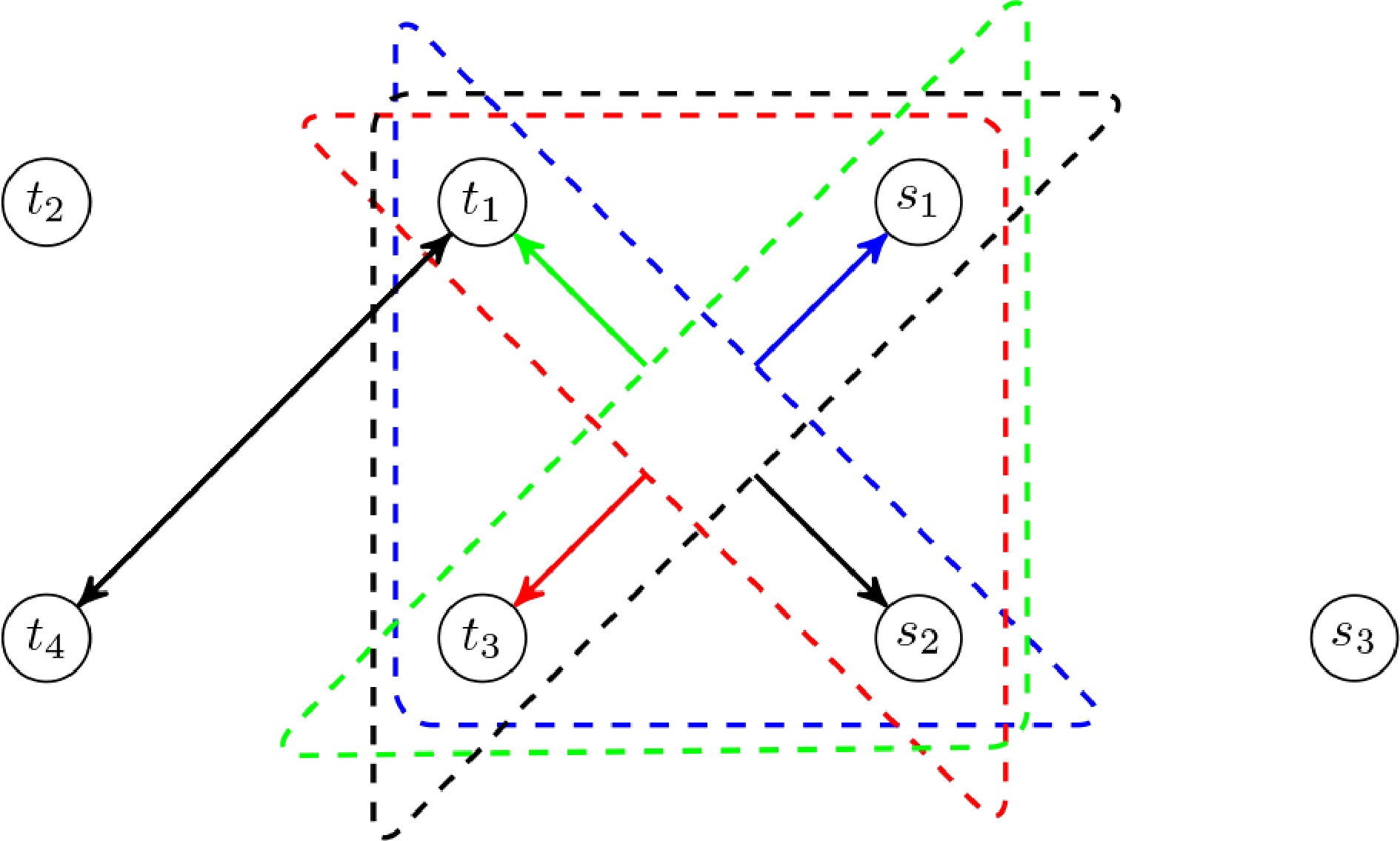
Figure 4.
SETAF $ {\cal{S}}_{\langle \{C, O\}, D \rangle} $ for Example 3.3. The attacker in each set-attack is depicted as a triangle of different color (for better presentation) and the attack is presented in the same color. For example, the red triangle and the arrow depict the attack $ (\{t_1,s_1,s_2\},t_3) $.
It is known that the repairs for
$ {\cal{D}} $ $ {\cal{G}}_{\cal{D}} $ $ {\cal{G}}_{\cal{D}} $ $ {\cal{S}}_{\cal{D}} $ Theorem 3.4. Let
$ {\cal{D}} = \langle {\cal{T}}, D \rangle $ $ D $ $ {\cal{S}}_{\cal{D}} $ $ {\cal{D}} $ $ {\cal{P}}\subseteq {\cal{T}} $ $ {\cal{P}} \in \text{repairs}({\cal{D}}) $ $ {\cal{P}}\in \sigma({\cal{S}}_{\cal{D}}) $ $ \sigma \in \{\text{naive}, \text{stab}, \text{pref}\} $ Proof Given a repair
$ {\cal{P}}\subseteq {\cal{T}} $ $ {\cal{P}}\models d $ $ d\in D $ $ C\in{\rm{Conf}}({\cal{D}}) $ $ C\subseteq {\cal{P}} $ $ {\cal{P}} $ $ R $ $ (E\setminus\{t\},t) $ $ E\cup \{t\} \in {\rm{Conf}}({\cal{D}}) $ The converse holds similarly. A naive extension
$ P\subseteq A $ $ (E,t) $ $ C\in {\rm{Conf}}({\cal{D}}) $ $ C=E\cup\{t\} $ $ C\not\subseteq P $ $ P $ $ {\cal{T}} $ $ {\cal{D}} $ □ It is worth remarking that the presence of DCs with a single database atom yields singleton conflicts which results in self-contradictory facts (or self-attacking arguments in the translation). However, such self-contradictory facts do not occur in any repair and can be removed using existing reasoning algorithms, as highlighted by Bienvenu & Bourgaux[13]. Therefore, a usual assumption is that every DC contains at least two database atoms. This has the effect that each conflict contains at least two arguments. Consequently, in the presence of DCs, every fact in a conflict belongs to at least one repair and no fact in any conflict belongs to every repair. This holds because for each conflict
$ C\in{\rm{Conf}}({\cal{D}}) $ $ C\setminus \{t\} $ $ t $ $ {\cal{D}} $ $ s \in {\cal{T}} $ Remark 3.5 Let
$ D $ $ \tau $ $ {\cal{D}} = \langle {\cal{T}},D \rangle $ $ {\cal{T}} $ $ \tau $ $ \exists {\text{-}}{\rm{REP}} $ $ s\in{\cal{T}} $ $ \forall {\text{-}}{\rm{REP}} $ $ s\not\in C $ $ C\in {\rm{Conf}}({{\cal{D}}}) $ 3.2. Simulating LTGDs via SETAFs
-
Let
$ {\cal{D}} =\langle {\cal{T}}, L\rangle $ $ {\cal{T}} $ $ L $ $ V $ $ V $ $ {\cal{T}} $ $ h\colon V\rightarrow \text{dom}({\cal{T}}) $ $ T({\boldsymbol{t}}) $ $ {\boldsymbol{t}}=(t_1,\dots,t_k) $ $ h(T({\boldsymbol{t}})) $ $ t_i $ $ T({\boldsymbol{t}}) $ $ h(t_i) $ $ h(t_i)=t_i $ $ t_i $ $ T({\boldsymbol{t}}) $ $ h(T({\boldsymbol{t}})) $ $ {\cal{T}} $ $ \phi({\boldsymbol{x}}) :=\bigwedge_{1\leq i\leq n} T_i({\boldsymbol{x}}_i) $ $ {\boldsymbol{x}}_i\subseteq {\boldsymbol{x}} $ $ T_i\in \tau $ $ h\colon {\boldsymbol{x}}\rightarrow \text{dom}({\cal{T}}) $ $ h(\phi({\boldsymbol{x}}))=\{h(T_i({\boldsymbol{x}}_i))\mid 1\leq i\leq n\} $ $ \ell\in L $ $ \forall {\boldsymbol{x}} (T({\boldsymbol{x}}) \rightarrow \exists {\boldsymbol{y}} \psi({\boldsymbol{x}},{\boldsymbol{y}})) $ $ \psi := \bigwedge_{1\leq i\leq n_\ell}\psi_i({\boldsymbol{z}}_i) $ $ {\boldsymbol{z}}_i \subseteq {\boldsymbol{x}}\cup{\boldsymbol{y}} $ $ \psi_i\in\tau $ $ {\cal{T}}\models \ell $ $ h $ $ h(T({\boldsymbol{x}}))\in {\cal{T}} $ $ h'\colon {\boldsymbol{x}}\cup\mathbf y\rightarrow \text{dom}({\cal{T}}) $ $ h'\upharpoonright_{{\boldsymbol{x}}}=h\upharpoonright_{{\boldsymbol{x}}} $ $ h'(\psi({\boldsymbol{x}}, {\boldsymbol{y}})) \subseteq {\cal{T}} $ $ h\upharpoonright_{{\boldsymbol{x}}} $ $ h $ $ {\boldsymbol{x}} $ $ h(T({\boldsymbol{x}}))\in {\cal{T}} $ $ h' $ $ h'(\psi({\boldsymbol{x}}, {\boldsymbol{y}})) $ $ h(T({\boldsymbol{x}})) $ $ \ell $ $ \ell $ $ T $ $ \ell $ $ \text{source}(\ell) $ $ \text{source}(\ell) $ $ s $ $ {\boldsymbol{S}}_{\ell}({s}) $ $ s $ $ \ell $ $ {\cal{D}}=\langle{\cal{T}},L\rangle $ $ \ell\in L $ $ {\cal{D}}\models \ell $ $ {\boldsymbol{S}}_{\ell}({s})\neq\emptyset $ $ \text{source}(\ell) $ $ s $ Interestingly, we can encode the sets supporting a fact by using SETAFs, as formalized next.
Definition 3.6 Let
$ {\cal{D}} =\langle {\cal{T}},L \rangle $ $ {\cal{T}} $ $ L $ $ {\cal{S}}_{\cal{D}} $ ●
$ A := \{s \mid s\in {\cal{T}} \} \cup \{s_\ell \mid s{{\ is\ a }}\ \text{source}(\ell)-{\rm{fact\ for }}\ \ell\in L\} $ ●
$ R := \{(s_\ell,s), (s_\ell,s_\ell) \mid s{{\ is\ a }}\ \text{source}(\ell)-{\rm{fact\ for }}\ \ell\in L \}\cup \{(S,s_\ell)\mid S\in {\boldsymbol{S}}_{\ell}({s}), \ell\in L\} $ Intuitively, for each
$ \ell\in L $ $ \text{source}(\ell) $ $ s $ $ (s_\ell,s) $ $ \ell\in L $ $ s $ $ (s_\ell,s_\ell) $ $ S\in {\boldsymbol{S}}_{\ell}({s}) $ $ s_\ell $ $ s $ $ s_\ell $ $ \ell \in L $ $ \forall {\boldsymbol{x}} (T({\boldsymbol{x}}) \rightarrow \exists {\boldsymbol{y}} \bigwedge_{1\leq i\leq n_\ell}\psi_i({\boldsymbol{z}}_i)) $ $ {\boldsymbol{z}}_i \subseteq {\boldsymbol{x}}\cup{\boldsymbol{y}} $ $ T $ $ s $ $ \mathcal P $ $ {\cal{D}} $ $ \psi_i $ $ t_i $ $ 1\leq i\leq n_\ell $ $ \{t_1,\dots,t_{n_\ell}\}\in {\boldsymbol{S}}_{\ell}({s}) $ $ S=\{t_1,\dots,t_{n_\ell}\} $ $ s_\ell $ $ {\cal{S}}_{\cal{D}} $ $ s\in A $ $ s_\ell $ $ {\cal{S}}_{\cal{D}} $ Example 3.7. The database tables
$ E $ $ D $ $ P $ $\begin{split}& \begin{array}{c|cc} E & \mathit { Emp\_ID } & \mathit { Dept\_ID } \\ \hline {s_1} & \mathit{E 1} & \mathit{D 1} \\ s_2 & \mathit{E 2} & \mathit{D 2} \\ s_3 & \mathit{E 3} & \mathit{D 3} \end{array}\ \ \ \ \ \ \ \ \begin{array}{c|cc} D & \mathit { Dept\_ID } & \mathit { Dept\_Name } \\ \hline t_1 & \mathit { D1 } & \mathit { Accounting } \\ t_2 & \mathit { D3 } & \mathit { Sales } \end{array}\\& \begin{array}{c|cc} P & \mathit { Prod\_ID } & \mathit { Dept\_ID } \\ \hline u_1 & \mathit { P1 } & \mathit { D1 } \\ u_2 & \mathit { P2 } & \mathit { D3 } \end{array}\end{split} $ Here, Emp_ID, Dept_ID and Prod_ID are the IDs of individual employees, departments and products, respectively. Let
$ L = \{{\rm{lav}}_1, {\rm{lav}}_2\} $ $ {\rm{lav}}_1 := \forall x_1, x_2 (E(x_1, x_2) \to \exists y, z (D(x_2, y) \land P(z, x_2))) $ and
$ {\rm{lav}}_2 := \forall x_1, x_2 (D(x_1, x_2) \to \exists y, z (E(y, x_1) \land P(z, x_1))). $ The constraint
$ {\rm{lav}}_1 $ $ {\rm{lav}}_2 $ In the tables
$ E $ $ D $ $ P $ $ {\rm{lav}}_1 $ $ {\rm{lav}}_2 $ $ \ell $ $ \text{source}(\ell) $ $ s $ ●
$ \text{source}({\rm{lav}}_1) = E, $ ●
$ \text{source}({\rm{lav}}_2) = D, $ ●
$ \{t_1,u_1\} $ $ s_1 $ $ {\rm{lav}}_1 $ ●
$ s_2 $ $ {\rm{lav}}_1 $ ●
$ \{t_2,u_2\} $ $ s_3 $ $ {\rm{lav}}_1 $ ●
$ \{s_1, u_1\} $ $ t_1 $ $ {\rm{lav}}_2 $ ●
$ \{s_3, u_2\} $ $ t_2 $ $ {\rm{lav}}_2 $ The respective SETAF
$ {\cal{S}}_{\langle \{E, D, P\}, L \rangle} $ ◁ 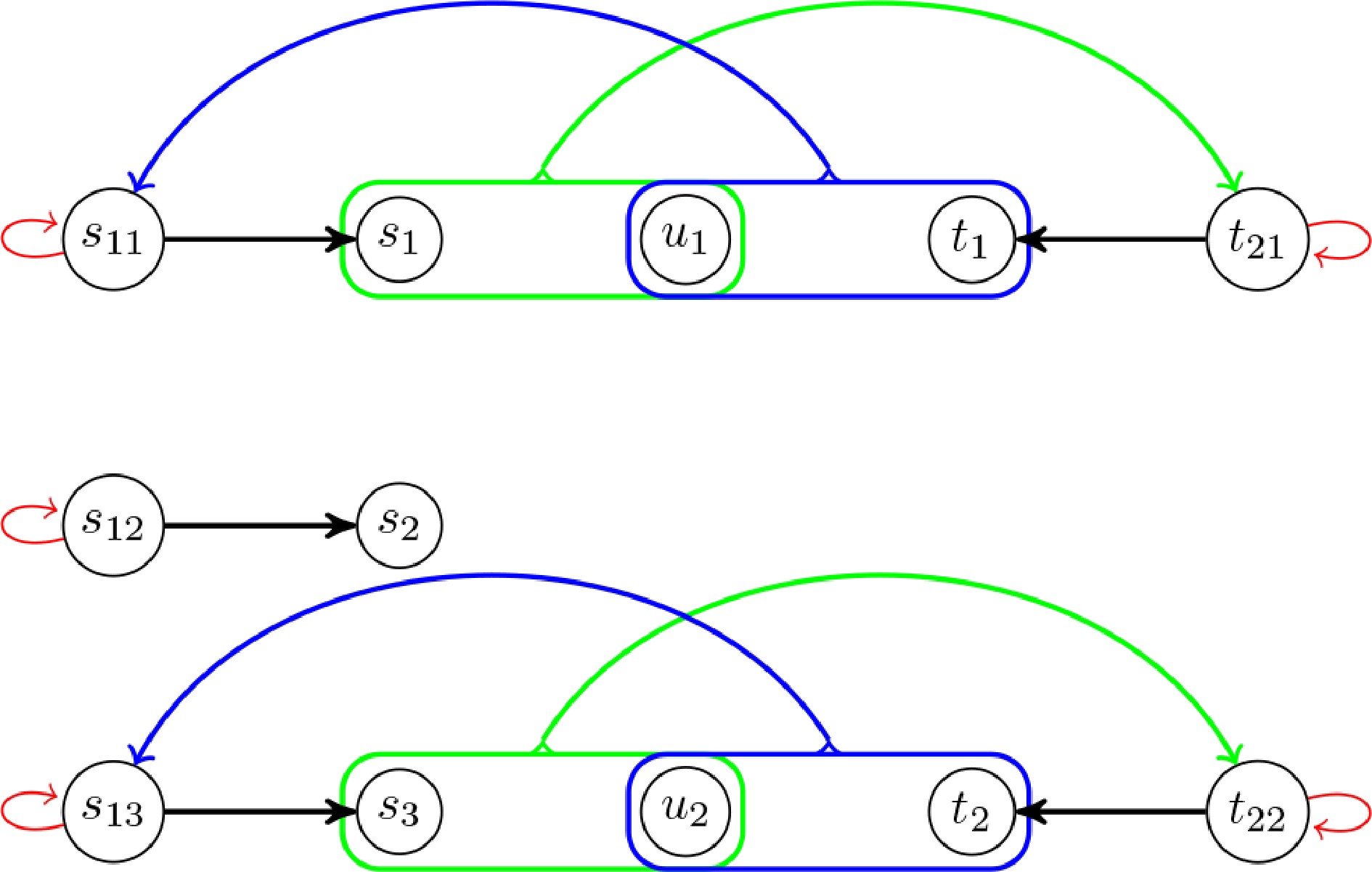
Figure 5.
SETAF $ {\cal{S}}_{\langle \{E, D, P\}, L \rangle} $ for Example 3.7. For brevity, we rename the LTGDs $ \{{\rm{lav}}_1,{\rm{lav}}_2\} $ to be $ \{1,2\} $. Moreover, the auxiliary arguments for $ \text{source}(1) $-facts $ s_i $ are renamed to $ s_{1i} $ and those for $ \text{source}(2) $-facts $ t_j $ to $ t_{2j} $.
Similar to the case of DCs, the repair checking problem under LTGDs is
$ {\bf{DP}} $ $ L $ $ L $ $ {\cal{D}}=\langle{\cal{T}},L \rangle $ $ {\cal{S}}_{\cal{D}} $ $ \ell\in L $ $ \text{source}(\ell) $ $ s $ $ {\boldsymbol{S}}_{\ell}({s}) $ $ L $ For a set
$ L $ $ \ell\in L $ $ \text{source}(\ell) $ $ s $ $ {\boldsymbol{S}}_{\ell}({s})=\emptyset $ $ s $ $ \emptyset $ $ \emptyset $ $ {\cal{D}} $ Remark 3.8 A constrained database
$ {\cal{D}} = \langle {\cal{T}}, L \rangle $ $ L $ Now we prove that the repair of an instance
$ {\cal{D}} $ $ {\cal{S}}_{\cal{D}} $ Theorem 3.9. Let
$ {\cal{D}} = \langle {\cal{T}}, L \rangle $ $ L $ $ {\cal{S}}_{\cal{D}} $ $ {\cal{D}} $ $ {\cal{P}}\subseteq {\cal{T}} $ $ {\cal{P}} \in \text{repairs}({\cal{D}}) $ $ {\cal{P}}\in \text{pref}({\cal{S}}_{\cal{D}}) $ $ {\cal{S}}_{\cal{D}} $ Proof We first prove the reverse direction. Let
$ P\subseteq A $ $ {\cal{S}}_{\cal{D}} $ $ P $ $ s_\ell $ $ \ell\in L $ $ P $ $ P\subseteq {\cal{T}} $ $ P $ $ s\in P $ $ s_\ell\in A $ Conversely, let
$ {\cal{P}}\subseteq {\cal{T}} $ $ {\cal{D}} = \langle {\cal{T}}, L \rangle $ $ {\cal{P}} $ $ {\cal{S}}_{\cal{D}} $ $ R $ $ s_\ell $ $ {\cal{P}} $ $ {\cal{P}}\subseteq {\cal{T}} $ $ s\in {\cal{P}} $ $ \ell\in L $ $ t_1,\dots,t_{n_\ell}\in {\cal{P}} $ $ \{s, t_1,\dots, t_{n_\ell}\}\models \ell $ $ s\in {\cal{P}} $ $ s_\ell\in A $ $ (\{t_1,\dots,t_{n_\ell}\}, s_\ell)\in R $ $ {\cal{P}} $ $ {\cal{P}} $ $ {\cal{S}}_{\cal{D}} $ $ {\cal{P}}'\supset {\cal{P}} $ $ {\cal{S}}_{\cal{D}} $ $ {\cal{P}}' $ $ {\cal{P}} $ $ {\cal{P}}'\subseteq {\cal{T}} $ $ {\cal{P}}' $ $ {\cal{P}}' $ $ {\cal{D}} $ $ {\cal{P}} $ $ {\cal{D}} $ $ {\cal{P}} $ $ {\cal{S}}_{\cal{D}} $ This proves the correctness of the theorem. The uniqueness of the extension follows due to Remark 3.8.
□ Notice that a framework
$ {\cal{S}}_{\cal{D}} $ $ {\cal{D}} $ $ {\cal{T}} $ $ L $ $ {\boldsymbol{S}}_{\ell}({s})=\emptyset $ $ \text{source}(\ell) $ $ s $ $ \ell\in L $ $ A $ $ {\cal{D}} $ $ s\in{\cal{T}} $ A pre-processing algorithm for
$ {\cal{S}}_{\cal{D}} $ $ {\cal{S}}=(A,R) $ $ {\cal{S}} $ $ {\cal{S}}_{\cal{D}} $ $ s\in {\cal{T}} $ $ \ell\in L $ $ s $ $ \text{source}(\ell) $ $ {\boldsymbol{S}}_{\ell}({s})=\emptyset $ $ \text{PRE}({\cal{S}}_{\cal{D}}) $ $ * $ $ s_\ell\in A $ $ s_\ell $ $ S\subseteq A\setminus \{s_\ell\} $ $ s $ $ s_j $ $ j\in L $ $ s $ $ s_j $ We repeat this procedure until convergence. Once a fixed point has been reached, the remaining arguments in
$ A $ $ {\cal{D}} $ $ \text{PRE}({\cal{S}}_{\cal{D}}) $ $ {\cal{S}}_{\cal{D}} $ $ \text{PRE} $ Lemma 3.10. Let
$ L $ $ {\cal{D}}=\langle{\cal{T}}, L\rangle $ $ {\cal{S}}_{\cal{D}} $ $ {\cal{D}} $ $ \text{PRE}({\cal{S}}_{\cal{D}}) $ $ {\cal{S}}_{\cal{D}} $ $ \text{PRE}({\cal{S}}_{\cal{D}}) $ Proof The procedure
$ \text{PRE}({\cal{S}}_{\cal{D}}) $ $ s $ $ {\boldsymbol{S}}_{\ell}({s})=\emptyset $ $ \ell\in L $ $ s $ $ \text{source}(\ell) $ $ {\boldsymbol{S}}_{\ell}({s}) $ $ \ell\in L $ $ \text{source}(\ell) $ $ s $ $ L $ $ \text{PRE} $ $ s $ $ {\boldsymbol{S}}_{\ell}({s})=\emptyset $ $ s $ $ \text{PRE} $ $ A $ $ {\boldsymbol{S}}_{\ell}({t}) $ $ t\in A $ $ A $ $ \text{PRE} $ $ {\cal{S}}_{\cal{D}} $ Let
$ \text{PRE}({\cal{S}}_{\cal{D}}) = (A',R') $ $ S $ $ A' $ $ S $ $ A'\setminus S $ $ S $ $ {\boldsymbol{S}}_{\ell}({s})\neq \emptyset $ $ s\in S $ $ \text{source}(\ell) $ $ s $ $ A'\setminus S $ $ S $ $ S $ $ S $ $ S $ $ \text{PRE}({\cal{S}}_{\cal{D}}) $ $ A'\setminus S $ This establishes the correctness of the lemma together with Theorem 3.9.
□ As a consequence of Lemma 3.10, we can also determine
$ \exists {\text{-}}{\rm{REP}} $ $ \forall {\text{-}}{\rm{REP}} $ $ s\in {\cal{T}} $ $ \text{PRE}({\cal{S}}_{\cal{D}}) $ Remark 3.11 Let
$ {\cal{D}}=\langle{\cal{T}},L\rangle $ $ L $ $ {\cal{S}}_{\cal{D}} $ $ {\cal{D}} $ $ \exists {\text{-}}{\rm{REP}} $ $ \forall {\text{-}}{\rm{REP}} $ $ s\in {\cal{T}} $ $ s\in \text{PRE}({\cal{S}}_{\cal{D}}) $ 3.3. Simulating DCs and LTGDs via SETAFs
-
Consider an instance
$ {\cal{D}}= \langle {\cal{T}},B \rangle $ $ {\cal{T}} $ $ B= D\cup L $ $ D $ $ L $ $ {\cal{T}} $ $ \exists {\text{-}}{\rm{REP}} $ $ \forall {\text{-}}{\rm{REP}} $ $ s\in{\cal{T}} $ $ {\cal{T}} $ In the following, we do not apply pre-processing and instead consider all the arguments for facts in the database. The framework
$ {\cal{S}}_{\cal{D}} := (A,R_{{\rm{D}}}\cup R_{{\rm{L}}}) $ $ {\cal{D}} $ Definition 3.12 Let
$ {\cal{D}} = \langle {\cal{T}}, B\rangle $ $ {\cal{T}} $ $ B=D\cup L $ $ D $ $ L $ $ {\cal{S}}_{\cal{D}} = (A,R_D\cup R_L) $ ●
$ A := \{s \mid s\in {\cal{T}} \} \cup \{s_\ell \mid s{{\ is\ a }}\ \text{source}(\ell)-{\rm{fact\ for }}\ \ell\in L\} $ ●
$ R_D := \{(C\setminus\{t\}, t) \mid C\in{\rm{Conf}}({\cal{D}}), t\in C\} $ ●
$ R_L := \{(s_\ell,s), (s_\ell,s_\ell) \mid s{{\ is\ a }}\ \text{source}(\ell)-{\rm{fact\ for }}\ \ell\in L \}\cup \{(S,s_\ell) \mid S \in {\boldsymbol{S}}_{\ell}({s}) \ {\rm{for }}\ \ell\in L\} $ As before, we call
$ {\cal{S}}_{\cal{D}} $ $ {\cal{D}} $ A consequence of allowing both types of ICs (DCs and LTGDs) is that the preferred and naive extensions do not coincide in general. Moreover, both
$ \exists {\text{-}}{\rm{REP}} $ $ \forall {\text{-}}{\rm{REP}} $ Theorem 3.13. Let
$ {\cal{D}} = \langle {\cal{T}}, B \rangle $ $ B $ $ {\cal{S}}_{\cal{D}} $ $ {\cal{D}} $ $ {\cal{P}}\subseteq {\cal{T}} $ $ {\cal{P}} \in \text{repairs}({\cal{D}}) $ $ {\cal{P}} \in \text{pref}({\cal{S}}_{\cal{D}}) $ Proof The correctness follows from the proofs of Theorems 3.4 and 3.9. The conflict-freeness and admissibility of
$ {\cal{P}} $ $ B $ $ {\cal{P}} $ $ {\cal{D}} $ $ {\cal{S}}_{\cal{D}} $ □ Next, we establish that allowing DCs and LTGDs renders the data complexity for repair existence (
$ {\rm{REP}} $ $ \exists {\text{-}}{\rm{REP}} $ $ \forall {\text{-}}{\rm{REP}} $ Theorem 3.14. The problems
$ {\rm{REP}} $ $ \exists {\text{-}}{\rm{REP}} $ Proof We prove that
$ {\rm{REP}}_{{\rm{B}}} $ $ \exists {\text{-}}{\rm{REP}}_{{\rm{B}}} $ $ {\bf{NP}} $ $ B $ $ {\cal{D}} = \langle {\cal{T}}, B \rangle $ $ {\cal{T}} $ $ {\cal{D}} $ $ s $ $ B $ $ {\cal{T}} $ $ B $ $ s $ $ {\cal{D}} $ $ s $ Hardness follows from the case of FDs and IDs proved in Theorem 4.13. To be precise, we construct a fixed set
$ B $ $ B' $ $ {\rm{REP}}_{{\rm{B}}} $ $ \exists {\text{-}}{\rm{REP}}_{{{\rm{B}}}'} $ $ {\bf{NP}} $ □ Theorem 3.15. The data complexity of
$ \forall {\text{-}}{\rm{REP}} $ $ {\boldsymbol{\Pi}}_2^{{\bf{P}}} $ Proof For membership, we prove that
$ \forall {\text{-}}{\rm{REP}}_{{\rm{B}}} $ $ {\boldsymbol{\Pi}}_2^{{\bf{P}}} $ $ B $ $ {\boldsymbol{\Sigma}}_2^{\rm{P}} $ $ \forall {\text{-}}{\rm{REP}}_{{\rm{B}}} $ $ {\cal{D}} = \langle {\cal{T}}, B \rangle $ $ {\cal{T}} $ $ {\cal{P}} $ $ {\cal{T}} $ $ B $ $ s $ $ s\not\in {\cal{P}} $ $ {\cal{P}} $ $ {\cal{D}} $ $ B $ $ {\cal{P}} $ $ \forall {\text{-}}{\rm{REP}} $ $ s $ $ {\cal{P}}\subseteq {\cal{T}} $ $ {\cal{P}} $ $ B $ $ s\not\in {\cal{P}} $ $ {\cal{P}} $ $ {\boldsymbol{\Pi}}_2^{{\bf{P}}} $ For hardness, we prove that there exists a set
$ B $ $ \forall {\text{-}}{\rm{REP}}_{{\rm{B}}} $ $ {\boldsymbol{\Pi}}_2^{{\bf{P}}} $ □ We conclude this section by noting that the combined complexity of
$ {\rm{REP}} $ $ \exists {\text{-}}{\rm{REP}} $ $ \forall {\text{-}}{\rm{REP}} $ -
In this section, we consider FDs and IDs, which are restricted classes of ICs inside DCs and LTGDs, respectively. The two sub-cases are interesting due to the fact that one only requires binary conflicts/supports. As a result, the classical Dung's AFs with binary attacks suffice for encoding repairs into extensions.
Following the same theme as in the section "Simulating DCs and LTGDs via SETAFs", the first two subsections translate instances containing only one type of ICs to AFs. Then, we combine both FDs and IDs in the third subsection. As before, we adopt the construction for FDs from Bienvenu & Bourgaux[13], but without fact priorities, thus resulting in the need for a weaker AF-semantics to capture repairs.
Having established that both FDs and IDs can be modeled in AFs via binary attacks, the section "The role of self-attacking arguments" generalizes this approach by allowing both types of dependencies. The primary result of this section is noteworthy: it demonstrates that the integrity constraints can be restricted from (1) DCs to FDs and (2) LTGDs to IDs, while the corresponding encoding into argumentation frameworks preserves the exact semantics, modulo the transition from SETAFs to AFs.
4.1. Simulating FDs via AFs
-
We transform an instance
$ {\cal{D}} = \langle {\cal{T}},D \rangle $ $ {\cal{T}} $ $ D $ $ {\cal{F}}_{\cal{D}} $ $ d\in D $ $ T $ $ {\cal{D}} $ Definition 4.1 Let
$ {\cal{D}} =\langle {\cal{T}}, D\rangle $ $ {\cal{T}} $ $ D $ $ {\cal{F}}_{{\cal{D}}} $ ●
$ A := {\cal{T}} $ $ s\in {\cal{T}} $ ●
$ R := \{(s,t),(t,s) \mid s,t \in {\cal{T}} \ {\rm{and }}\ \{s,t\}\not\models d {{\ for\ some}}\ d \in D\} $ We call
$ {\cal{F}}_{\cal{D}} $ $ {\cal{D}} $ $ R $ $ {\cal{D}} $ Note that, for a given constrained database
$ {\cal{D}} $ $ {\cal{F}}_{\cal{D}} $ $ R $ $ d\in D $ $ T $ $ {\cal{D}} $ $ s,t $ $ T $ $ \{s,t\}\models d $ $ D $ Example 4.2 Consider
$ {\cal{D}} = \langle T,D \rangle $ $ T=\{s,t,u,v\} $ $ \{\text{dep}({{Emp\_ID}}; {{Dept}}) $ $ \text{dep}({{Sup\_ID}}; {{Building}})\} $ $ T $ $ \{s,t\}\not\models \text{dep}({{Emp\_ID}}; {{Dept}}) $ $ \{u,v\}\not\models \text{dep}({{Emp\_ID}}; {{Dept}}) $ $ \{t,v\}\not\models \text{dep}({{Sup\_ID}}; {{Building}}) $ $ {\cal{F}}_{\cal{D}} $ $ {\cal{F}}_{\cal{D}} $ $ \{s,v\}, \{t,u\} $ $ \{s,u\} $ $ {\cal{D}} $ ◁ 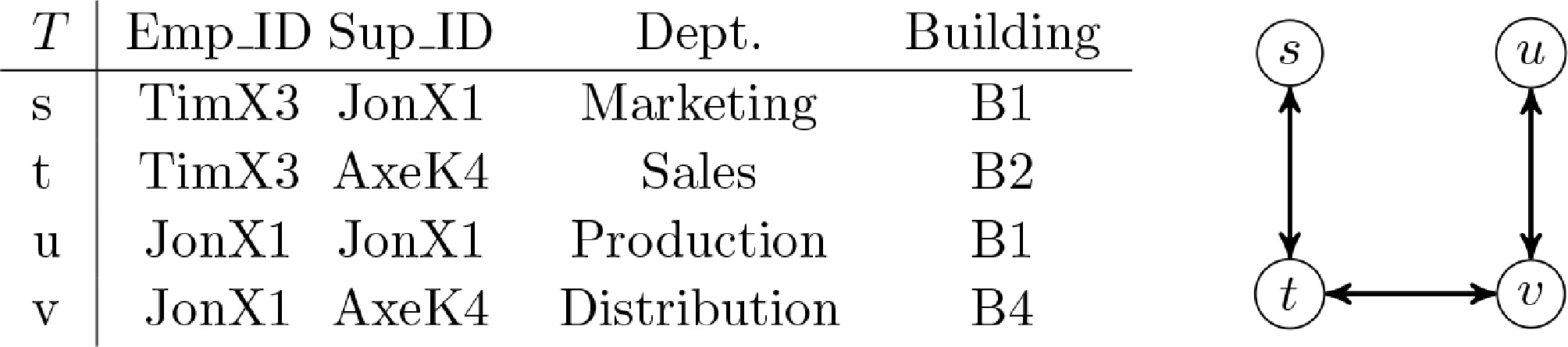
Figure 6.
Argumentation framework for modeling the FDs in Example 4.2.
It is easy to observe that any subset
$ {\cal{P}} \subseteq {\cal{T}} $ $ d \in D $ $ {\cal{T}} $ $ {\cal{F}}_{\cal{D}} $ $ {\cal{F}}_{\cal{D}} $ $ (s,t)\in R $ $ (t,s) \in R $ Observe that every FD is also a DC and hence the AF
$ {\cal{F}}_{\cal{D}} $ $ {\cal{S}}_{\cal{F}} $ $ {\cal{D}} $ $ C $ Corollary 4.3. Let
$ {\cal{D}} = \langle {\cal{T}}, D \rangle $ $ D $ $ {\cal{F}}_{\cal{D}} $ $ {\cal{D}} $ $ {\cal{P}}\subseteq {\cal{T}} $ $ {\cal{P}} \in \text{repairs}({\cal{D}}) $ $ {\cal{P}}\in \sigma({\cal{F}}_{\cal{D}}) $ $ \sigma \in \{\text{naive}, \text{stab}, \text{pref}\} $ Corollary 4.3 reproves that a subset-repair for
$ {\cal{D}} $ $ s\in {\cal{T}} $ $ \exists {\text{-}}{\rm{REP}} $ $ s\in {\cal{T}} $ $ \forall {\text{-}}{\rm{REP}} $ $ s\in {\cal{T}} $ $ \{s,t\} \models d $ $ t\in {\cal{T}} $ $ d\in D $ $ {\cal{D}} $ $ D $ We conclude this section by observing that adding a size restriction on repairs renders the
$ {\rm{REP}} $ $ {\bf{NP}} $ $ T $ $ \text{dom}(T)=\{0,1\} $ Proposition 4.4. Mahmood[29], Theorem 3.32. There is a constrained database
$ {\cal{D}} $ $ T $ $ D $ $ k\in \mathbb N $ $ P\subseteq T $ $ {\cal{D}} $ $ |P|\geq k $ $ {\bf{NP}} $ 4.2. Simulating IDs via AFs
-
Let
$ {\cal{D}} = \langle {\cal{T}},I\rangle $ $ {\cal{T}} $ $ I $ $ i\in I $ $ i := T[{\boldsymbol{x}}]\subseteq T'[{\boldsymbol{y}}] $ $ T $ $ i $ $ T' $ $ i $ $ i \in I $ $ \text{source}(i) $ $ s $ $ t $ $ \text{target}(i) $ $ \{s,t\}\models i $ $ t $ $ s $ $ i\in I $ $ {\boldsymbol{S}}_{i}({s}) $ $ s $ $ i $ $ i\in I $ $ \text{source}(i) $ $ s $ $ {\boldsymbol{S}}_{i}({s})\subseteq \text{target}(i) $ $ {\boldsymbol{S}}_{i}({s}) $ $ {\cal{D}}\models i $ $ {\boldsymbol{S}}_{i}({s})\neq\emptyset $ $ \text{source}(i) $ $ s $ $ s_i $ $ \text{source}(i) $ $ s $ $ \text{target}(i) $ $ {\boldsymbol{S}}_{i}({s}) $ Definition 4.5 Let
$ {\cal{D}} =\langle {\cal{T}},I \rangle $ $ {\cal{T}} $ $ I $ $ {\cal{F}}_{\cal{D}} $ ●
$ A := {\cal{T}} \cup \{s_i \mid s {{\ is\ a }}\ \text{source}(i)-{\rm{fact\ for }}\ i\in I\} $ ●
$ R := \{(s_i,s), (s_i,s_i) \mid s {{\ is\ a }}\ \text{source}(i)-{\rm{fact\ for }}\ i\in I \} \cup \{(t,s_i)\mid t\in {\boldsymbol{S}}_{i}({s}) \ {\rm{for }}\ i\in I\} $ The intuition behind our encoding remains the same as for the case of LTGDs. That is, the attack
$ (s_i,s) $ $ i\in I $ $ \text{source}(i) $ $ s $ $ (s_i,s_i) $ $ {\boldsymbol{S}}_{i}({s})\subseteq \text{target}(i) $ $ i\in I $ $ \text{source}(i) $ $ s $ Example 4.6 Consider
$ {\cal{D}} = \langle T,I \rangle $ $ T=\{s,t,u,v\} $ $ I := \{{{Sup\_ID}\subseteq {Emp\_ID}}, {{Covers\_For}\subseteq {Dept}}\} $ $ I= \{1,2\} $ $ {\boldsymbol{S}}{i}{w} $ $ i\in I, w\in T $ $ s({Sup\_ID})=t({Emp\_ID}) $ $ s({Covers\_For})=t({Dept})= u({Dept}) $ $ {\boldsymbol{S}}_{1}({s})=\{t\} $ $ {\boldsymbol{S}}_{2}({s})=\{t,u\} $ $ {\cal{F}}_{\cal{D}} $ $ {\cal{F}}_{\cal{D}} $ $ \{s,t\} $ $ {\cal{D}} $ ◁ 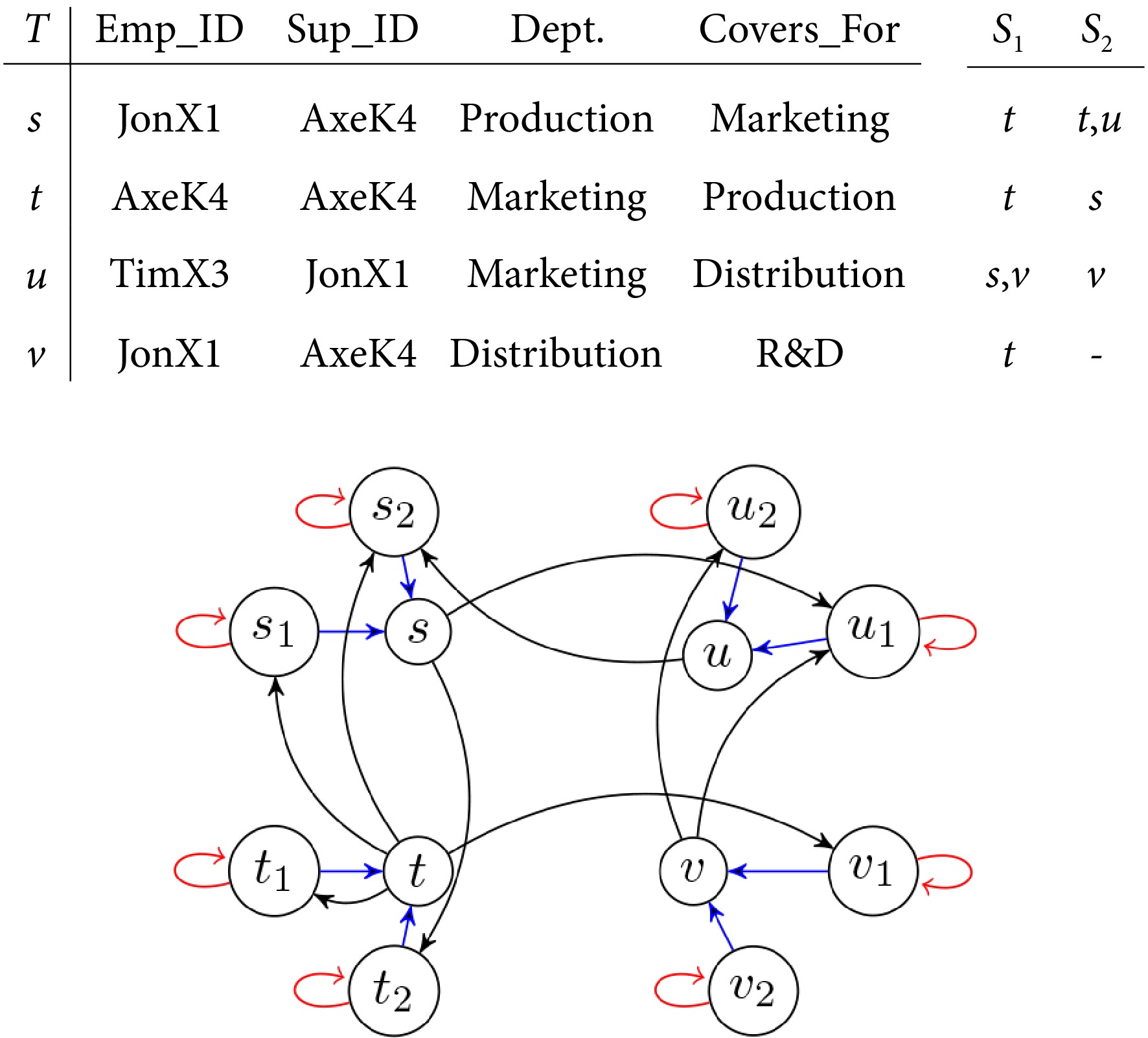
Figure 7.
The AF $ {\cal{F}}_{\cal{I}} $ modelling $ {\cal{I}} $ in Example 4.6: the red self-loops together with blue arcs depict the attacks for each fact $ w\in T $ due to IDs $ i\in I $ and the black arcs model the attacks due to the support set $ {\boldsymbol{S}}_i(w) $.
It is worth mentioning that
$ \{s,t,u,v\} $ $ {\cal{F}}_{\cal{D}} $ $ {\cal{D}} $ $ {\cal{F}}_{\cal{D}} $ Similar to the case of FDs, we observe that every ID is also an LTGD and hence the AF
$ {\cal{F}}_{\cal{D}} $ $ {\cal{S}}_{\cal{D}} $ $ {\cal{D}} $ Corollary 4.7. Let
$ {\cal{D}} = \langle {\cal{T}}, I \rangle $ $ I $ $ {\cal{F}}_{\cal{D}} $ $ {\cal{D}} $ $ {\cal{P}}\subseteq {\cal{T}} $ $ {\cal{P}} \in \text{repairs}({\cal{D}}) $ $ {\cal{P}}\in \text{pref}({\cal{F}}_{\cal{D}}) $ $ {\cal{F}}_{\cal{D}} $ The observation for LTGDs that some frameworks may not have any stable extension also applies to the special case of IDs and their corresponding AFs. As before, this holds because some arguments can neither be accepted in an extension nor attacked by arguments in an extension. The argument corresponding to the fact
$ v $ $ I $ $ \exists {\text{-}}{\rm{REP}} $ $ \forall {\text{-}}{\rm{REP}} $ $ s\in {\cal{T}} $ $ s\in \text{PRE}({\cal{F}}_{\cal{D}}) $ Example 4.8 (Continued) Reconsider the constrained database
$ {\cal{D}}= \langle T, I\rangle $ $ v $ $ v_2 $ $ \{v,v_1,v_2\} $ $ v $ $ u $ $ \{u,u_1,u_2\} $ $ u $ $ \{s,t\} $ $ {\cal{D}} $ $ \sigma $ $ \sigma\in\{\text{naive},\text{stab},\text{pref}\} $ ◁ Our construction of AFs for IDs relies on self-attacking arguments. However, these self-attacks are restricted to only auxiliary arguments and allow us to avoid taking these arguments in any extension. This results in obtaining a precise connection between repairs of a DB and extensions of the resulting AF. Without self-attacking arguments, one gets extensions that may contain auxiliary arguments, and thus, a precise connection between repairs and extensions might be lost. This is further highlighted in the following example.
Example 4.9 Consider a single binary relation
$ T(x,y) $ $ {\cal{D}} = \langle T, I\rangle $ $ T=\{s, t, u, v\} $ $ T[x] \subseteq T[y] $ $ {\cal{F}}_{\cal{D}} $ $ {\cal{F}}_{\cal{D}} $ $ \{\{s,t, u_1, v\}, \{s,t, u_1, v_1\}, \{s_1,t_1, u_1, v\}, \{s_1,t_1, u_1, v_1\}\} $ $ {\cal{D}} $ $ \{s, t, v\} $ 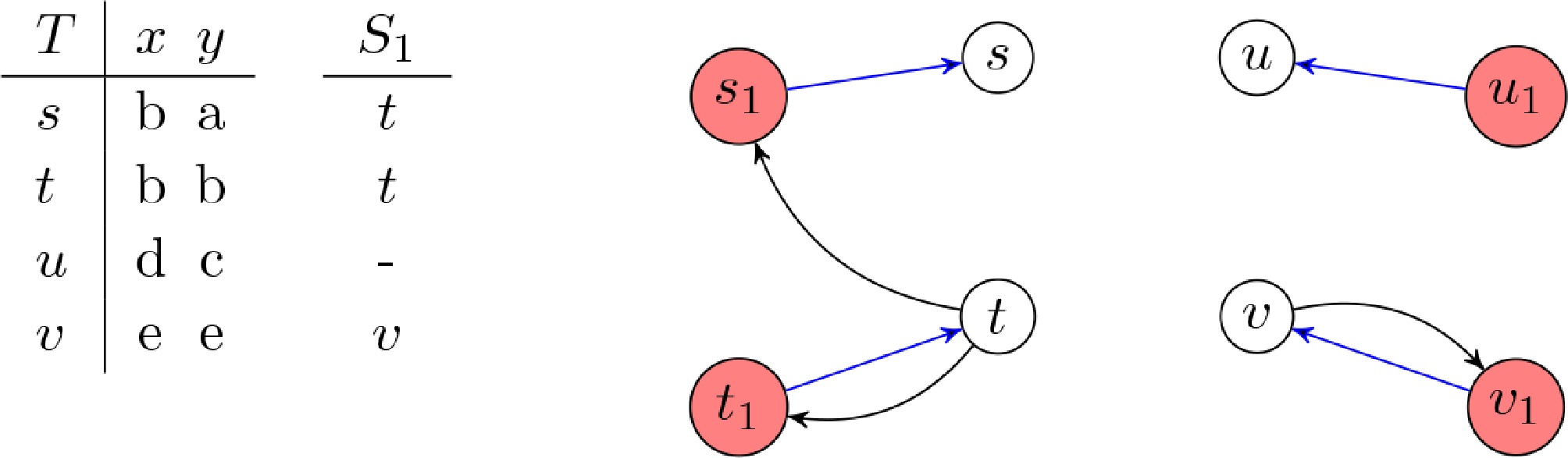
Figure 8.
Argumentation framework without self-attacks for modelling IDs in Example 4.9. The auxiliary arguments are highlighted in red for convenience.
Toward the end of our paper, in the next section, we will discuss how and whether we can model IDs via another translation that avoids self-attacking arguments.
4.3. Simulating FDs and IDs via AFs
-
Consider an instance
$ {\cal{D}} = \langle {\cal{T}}, B\rangle $ $ {\cal{T}} $ $ B = D\cup I $ $ D $ $ I $ $ {\cal{F}}_{\cal{D}}=(A,R_{\rm{D}}\cup R_{\rm{I}}) $ ●
$ A := \{s \mid s\in {\cal{T}} \} \cup \{s_i \mid s {\rm{\ is\ a }}\ \text{source}(i)-{\rm{fact\ for }}\ i\in I\} $ ●
$ R_{\rm{D}} := \{(s,t),(t,s) \mid s,t \in {\cal{T}} \ {\rm{and }}\ \{s,t\}\not\models d {\rm{\ for\ some}}\ d \in D\} $ ●
$ R_{{\rm{I}}} := \{(s_i,s), (s_i,s_i) \mid s {\rm{\ is\ a }}\ \text{source}(i)-{\rm{fact\ for }}\ i\in I \}\cup \{(t,s_i)\mid t\in {\boldsymbol{S}}_{i}({s}) \ {\rm{for }}\ i\in I\} $ As before, one may apply the pre-processing as a first step, thereby removing those facts from
$ {\cal{T}} $ $ i\in I $ Example 4.10 Consider
$ {\cal{D}} = \langle T,B \rangle $ $ T=\{s,t,u\} $ $ B= D\cup I $ $ D= \{\text{dep}({{S up\_ID}}; {{Building}})\} $ $ I=\{{{Covers\_For}\subseteq {{Dept}}}\} $ $ T $ $ {\boldsymbol{S}}_{{{Covers\_For}}\subseteq{{{Dept}}}}({w}) $ $ w\in T $ $ \{s,t\}\not\models \text{dep}({{S up\_ID}}; {{Building}}) $ $ \{t,u\}\not\models \text{dep}({{S up\_ID}}; $ $ {{Building}})$ $ {\cal{F}}_{\cal{D}} $ $ {\cal{F}}_{\cal{D}} $ $ \{t\} $ $ {\cal{D}} $ $ \{t\} $ $ \{s,u\} $ $ {\cal{F}}_{{\cal{D}}^{\prime}} $ $ {\cal{D}}' =\langle T,D\rangle $ $ \{s,t, u\} $ $ {\cal{F}}_{{\cal{D}}^{"}} $ $ {\cal{D}}" =\langle T,I\rangle $ $ {\cal{F}}_{\cal{D}} $ ◁ 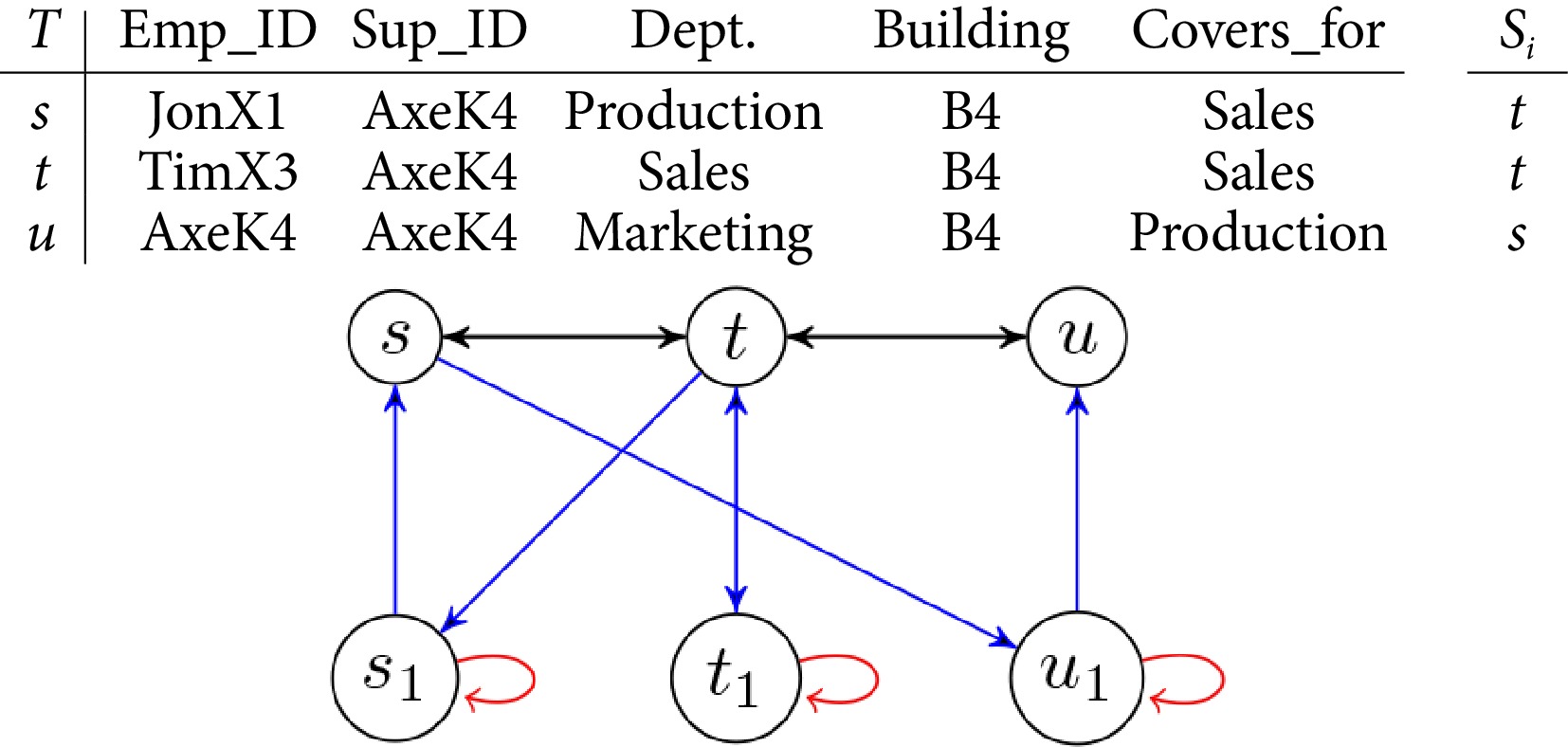
Figure 9.
Argumentation framework for modelling dependencies in Example 4.10. Black arcs depict conflicts due to functional, and blue ones due to inclusion dependency.
Similar to their expressive counterparts, allowing both types of ICs (FDs and IDs) has the effect that the preferred and naive extensions do not coincide in general. Moreover, the repairs correspond to preferred semantics for AFs.
Example 4.11 (Cont.) Reconsider the constrained database
$ {\cal{D}} $ $ \{s,u\} $ $ {\cal{F}}_{\cal{D}} $ $ t $ $ \exists {\text{-}}{\rm{REP}} $ $ \forall {\text{-}}{\rm{REP}} $ ◁ Corollary 4.12. Let
$ {\cal{D}} = \langle {\cal{T}}, B \rangle $ $ B $ $ {\cal{F}}_{\cal{D}} $ $ {\cal{D}} $ $ {\cal{P}}\subseteq {\cal{T}} $ $ {\cal{P}} \in \text{repairs}({\cal{D}}) $ $ {\cal{P}} \in \text{pref}({\cal{F}}_{\cal{D}}) $ Next, we establish the data and combined complexity results for
$ {\rm{REP}}, \exists {\text{-}}{\rm{REP}} $ $ \forall {\text{-}}{\rm{REP}} $ Theorem 4.13. The problems
$ {\rm{REP}} $ $ \exists {\text{-}}{\rm{REP}} $ $ {\bf{NP}} $ $ B $ $ {\rm{REP}}_{{\rm{B}}} $ $ \exists {\text{-}}{\rm{REP}}_{{\rm{B}}} $ Proof The membership follows analogous to the proof of Theorem 3.14 in both cases. Let
$ {\cal{D}} = \langle {\cal{T}}, B \rangle $ $ B $ $ s\in {\cal{T}} $ $ B $ $ {\cal{D}} $ $ {\bf{NP}} $ $ {\rm{REP}} $ $ \exists {\text{-}}{\rm{REP}} $ For hardness, we reduce from
$ {\rm{SAT}} $ $ \exists {\text{-}}{\rm{REP}}_{{\rm{B}}} $ $ {\rm{REP}}_{{\rm{B}}} $ $ B $ $ \varphi := \{c_i\mid {i\leq m}\} $ $ X= \{p_1,\ldots, p_n\} $ $ 4 $ $ F(t_0,u_0,t_1,u_1) $ $ C(t_2,u_2) $ $ F $ $ \varphi $ $ F(x,v,c_i,{\rm{sat}}) $ $ x $ $ c_i $ $ v=1 $ $ v=0 $ $ C $ $ C $ $ C $ $ {\cal{T}} $ $ F $ Formally, we will define
$ F $ $ G $ $ \text{dom}(F)\subseteq\{c_i \mid i\leq m\}\cup\{p_1,\ldots, p_n\}\cup\{0,1,{\rm{sat}}\} $ $ \text{dom}(C)=\{c_i \mid i\leq m\}\cup\{{\rm{sat}}\} $ $ \begin{aligned} {\cal{T}} = \quad & \{F(x,1,c_i,{\rm{sat}}) \mid x \in c_i, c_i\in\varphi\}\cup \{F(x,0,c_i,{\rm{sat}}) \mid \neg x \in c_i, c_i\in\varphi\} \\ & \cup \{F({\rm{sat}}, {\rm{sat}}, {\rm{sat}}, {\rm{sat}})\} \cup \{C({\rm{sat}}, c_1), C(c_m, {\rm{sat}})\} \\ & \cup \{C(c_i, c_{i+1}) \mid 1\leq i \lt m\}. \end{aligned} $ As ICs, we consider a collection
$ B $ $ \{F,C\} $ $ V := \{t_j,u_j \mid 0\leq j \leq 2\} $ $ F(t_0,u_0,t_1,u_1) $ $ C(t_2,u_2) $ $ B= \{\text{dep}({t_0};{u_0})\} \cup \{F[u_1]\subseteq C[u_2], C[u_2]\subseteq C[t_2], C[t_2]\subseteq F[t_1], F[u_1]\subseteq F[t_1]\}. $ The FD
$ \text{dep}({t_0};{u_0}) $ $ F $ $ \{0,1\} $ $ B $ $ c_i\in\varphi $ $ F[u_1]\subseteq C[u_2] $ $ F({\rm{sat}}, {\rm{sat}}, {\rm{sat}}, {\rm{sat}}) $ $ s_d $ $ {\cal{T}} $ $ s_d $ $ C $ $ C[u_2]\subseteq C[t_2] $ $ C $ $ \emptyset $ $ C $ $ C[t_2]\subseteq F[t_1] $ $ C $ $ F[u_1]\subseteq F[t_1] $ $ {\rm{REP}}_{{\rm{B}}} $ $ s_d $ $ B $ $ \varphi $ We next highlight some observations before delving into the correctness proof. Clearly,
$ {\cal{D}} $ $ F(x,1,c_i,{\rm{sat}}), F(x,0,c_j,{\rm{sat}}) $ $ \text{dep}({t_0};{u_0}) $ $ x $ $ c_i $ $ c_j $ $ \varphi $ $ P_X $ $ F $ $ \text{dep}({t_0};{u_0}) $ $ x\in X $ $ P_X $ $ F(x,1,*,{\rm{sat}}) $ $ F(x,0,*,{\rm{sat}}) $ $ * $ $ P_X $ $ F $ $ F(x,*,*,*) $ $ x\in X $ $ P_c $ $ C $ $ C[u_2]\subseteq C[t_2] $ $ P_c=\emptyset $ $ P_c $ $ C $ $ P_X $ $ F $ $ s_d $ $ {\cal{P}}= P_X \cup P_c $ $ {\cal{P}}\models F[u_1]\subseteq C[u_2] $ $ P_c\neq \emptyset $ $ P_c $ $ C $ $ {\cal{P}}\models C[t_2]\subseteq F[t_1] $ $ c_i\in\varphi $ $ P_X $ $ F(x,v,c_i,{\rm{sat}}) $ $ v=1 $ $ x\in c_i $ $ v=0 $ $ \neg x\in c_i $ $ {\cal{P}} $ $ C(*, c ) $ $ c\in\varphi $ $ F $ $ {\cal{P}} $ $ F(*,*,c,*) $ $ c\in \varphi $ Claim 4.14.
$ \varphi $ $ \exists {\text{-}}{\rm{REP}} $ $ s_d $ Proof of claim "
$ \Longrightarrow $ $ \varphi $ $ \theta $ $ {\cal{P}} := \{F(x,1,c_i,{\rm{sat}}) \mid \theta(x)=1, \ {\rm{for }}\ x\in X \ {\rm{and }}\ i\leq m\} \cup \{F(x,0,c_i,{\rm{sat}}) \mid \theta(x)=0, \ {\rm{for }}\ x\in X \ {\rm{and }}\ i\leq m\} \cup \{s_d\} \cup P_c $ $ P_c $ $ C $ $ {\cal{T}} $ $ {\cal{P}}\models \text{dep}({t_0};{u_0}) $ $ x\in X $ $ {\cal{P}} $ $ F(x,1,*,*) $ $ F(x,0,*,*) $ $ \theta $ $ X $ $ {\cal{P}}\models F[u_1]\subseteq C[u_2] $ $ P_c \neq \emptyset $ $ {\cal{P}}\models C[u_2]\subseteq C[t_2] $ $ {\cal{P}} $ $ C $ $ {\cal{P}} $ $ F(*,*,c,*) $ $ c\in \varphi $ $ \theta(\ell)=1 $ $ \ell\in c $ $ c\in \varphi $ $ c\in \varphi $ $ {\cal{P}} $ $ F(x,v, c, {\rm{sat}}) $ $ x $ $ c $ $ v $ $ \theta $ $ c $ $ v=1 $ $ \theta(x)=1 $ $ c $ $ v=0 $ $ \theta(x)=0 $ $ {\cal{P}}\models C[t_2]\subseteq F[t_1] $ $ {\cal{P}}\models F[u_1]\subseteq F[t_1] $ $ s_d\in {\cal{P}} $ $ {\cal{P}} $ $ {\cal{P}} $ $ F(x,v,c,{\rm{sat}}) $ $ v\in\{0,1\} $ $ c\in\varphi $ $ F(x,1-v,c,{\rm{sat}})\in {\cal{P}} $ $ {\cal{P}} $ $ {\cal{P}} $ $ s_d \in {\cal{P}} $ "
$ \Longleftarrow $ $ {\cal{P}} $ $ s_d \in {\cal{P}} $ $ {\cal{P}}\models F[u_1]\subseteq C[u_2] $ $ {\cal{P}} $ $ C $ $ s_d\in{\cal{P}} $ $ {\cal{P}}\models F[u_1]\subseteq C[u_2] $ $ {\cal{P}} $ $ C $ $ \theta $ $ X $ $ \theta(x)= 1 $ $ {\cal{P}} $ $ F(x,1,*,*) $ $ \theta(x)= 0 $ $ F(x,0,*,*) $ $ {\cal{P}}\models \text{dep}({t_0};{u_0}) $ $ \theta $ $ x\in X $ $ \theta(x)=1 $ $ \theta(x)=0 $ $ \theta $ $ X $ $ {\cal{P}} $ $ F(x,0,*,*) $ $ F(x,1,*,*) $ $ x\in X $ $ \theta\models\varphi $ $ c\in\varphi $ $ {\cal{P}}\models C[t_2]\subseteq F[t_1] $ $ {\cal{P}} $ $ F(x,v,c,{\rm{sat}}) $ $ x $ $ v\in\{0,1\} $ $ v=1 $ $ x\in c $ $ v=0 $ $ \neg x\in c $ $ F $ $ \theta(x)=1 $ $ v=1 $ $ x\in c $ $ \theta(x)=0 $ $ v=0 $ $ \neg x\in c $ $ \theta\models c $ $ c\in\varphi $ $ \theta\models \varphi $ ■ To reduce
$ {\rm{SAT}} $ $ {\rm{REP}}_{{\rm{B}}} $ $ {\cal{P}}\models F[u_1]\subseteq F[t_1] $ $ {\cal{P}} $ $ F $ $ s_d $ $ {\cal{D}} $ $ F $ $ C $ $ C[t_2]\subseteq F[t_1] $ $ {\cal{D}} $ $ s_d $ $ {\cal{P}} $ $ {\cal{D}} $ $ s_d $ $ {\cal{D}} $ $ \varphi $ This completes the proof for both cases.
□ We provide an example for a better understanding of the reductions from the proof of Theorem 4.13.
Example 4.15 (Example with fixed ICs) Let
$ \varphi := \{x \lor y, \neg x \lor \neg y, \neg x \lor y\} $ $ \exists {\text{-}}{\rm{REP}} $ $ {\cal{T}} $ $ F $ $ C $ $ B := \{\text{dep}({t_0};{u_0})\}\cup \{F[u_1]\subseteq C[u_2], C[u_2]\subseteq C[t_2], C[t_2]\subseteq F[t_1]\} $ Observe that the only satisfying assignment for
$ \varphi $ $ \{x\mapsto 0, y\mapsto 1\} $ $ \{S, \bar{x}_2, \bar{x}_3, y_1, y_3\}\cup \{s_c,s_1,s_2,s_3\} $ $ {\cal{D}} $ $ S $ $ \exists {\text{-}}{\rm{REP}} $ $ s_d $ ◁ Next, we prove that
$ \forall {\text{-}}{\rm{REP}} $ $ {\boldsymbol{\Pi}}_2^{{\bf{P}}} $ Table 3. The database corresponding to the formula $ \varphi $ from Example 4.15.
$ F $ $ t_0 $ $ u_0 $ $ t_1 $ $ u_1 $ $ \begin{array}{c|cc}C & t_2 & u_2 \\\hline s_c & \text { sat } & c_1 \\s_1 & c_1 & c_2 \\s_2 & c_2 & c_3 \\s_3 & c_3 & \text { sat }\end{array} $ $ s_d $ sat sat sat sat $ x_1 $ $ x $ 1 $ c_1 $ sat $ {\bar{x}_2} $ $ x $ 0 $ c_2 $ sat $ {\bar{x}_3} $ $ x $ 0 $ c_3 $ sat $ y_1 $ $ y $ 1 $ c_1 $ sat $ {\bar{y}_2} $ $ y $ 0 $ c_2 $ sat $ y_3 $ $ y $ 1 $ c_3 $ sat Theorem 4.16. The problem
$ \forall {\text{-}}{\rm{REP}} $ $ {\boldsymbol{\Pi}}_2^{{\bf{P}}} $ $ B $ $ \forall {\text{-}}{\rm{REP}}_{{\rm{B}}} $ $ {\boldsymbol{\Pi}}_2^{{\bf{P}}} $ Proof The membership follows analogously to the proof of Theorem 3.15. The only difference here is that one can check in polynomial time whether a set of facts satisfies each IC in the input. As a result, the membership holds for
$ \forall {\text{-}}{\rm{REP}} $ For hardness, we build on the same idea as in the proof of Theorem 4.13. Here, we reduce from an instance
$ \Phi $ $ {\boldsymbol{\Pi}}_2^{{\bf{P}}} $ $ {\rm { 2QBF }} $ $ {\rm { 2QBF }} $ $ \Phi = \forall Y \exists Z \varphi(Y,Z) $ $ \varphi := \{c_i \mid 1\leq i\leq m\} $ $ \Phi $ $ Y $ $ Z $ $ \varphi $ $ X=Y\cup Z $ $ {\cal{D}} $ $ 4 $ $ F(t_0,u_0,t_1,t_\exists) $ $ S(u_1,u_\exists) $ $ C(t_2,u_2) $ $ B $ $ {\cal{T}} $ $ V := \{t_j,u_j \mid 0\leq j\leq 2 \}\cup \{t_\exists,u_\exists\} $ $ B $ $ \text{dep}({t_0};{u_0}) $ $ \{S[u_1]\subseteq C[u_2], C[u_2]\subseteq C[t_2], C[t_2]\subseteq F[t_1]\} $ $ c_i\in \varphi $ $ F[t_{\exists}]\subseteq S[u_{\exists}] $ $ Z $ $ B= \{\text{dep}({t_0};{u_0})\} \cup \{ S[u_1]\subseteq C[u_2], C[u_2]\subseteq C[t_2], C[t_2]\subseteq F[t_1], F[t_{\exists}]\subseteq S[u_{\exists}]\} $ For the database relations, we let
$ \text{dom}(F)\subseteq\{c_i \mid i\leq m\}\cup X\cup \{0,1, {\rm{exists}}, d\} $ $ \text{dom}(C)=\{c_i \mid i\leq m\}\cup\{d\} $ $ \text{dom}(S)=\{c_1, {\rm{exists}}, d\} $ 1. We include an
$ S $ $ C $ $ S(c_1, {\rm{exists}}) $ $ C(c_{m}, c_1) $ $ C({\rm{sat}},c_1) $ $ C $ $ \{C(c_i, c_{i+1})\mid i< m\} $ 2. We use
$ s^d := S(d,d), y^d := F(d,d,d,d) $ $ c^d := C(d,d) $ $ Y $ $ {\cal{T}} $ $ \forall $ $ Y $ 3. If a literal
$ \ell \in {\rm {Lit}}(Y) $ $ F $ $ \ell $ $ F(y, 1, d, d) $ $ \ell =y $ $ F(y, 0, d, d) $ $ \ell = \neg y $ $ d $ $ \ell $ $ Y $ $ \ell \in c_0 $ $ Y $ 4. The attributes
$ \{t_{\exists}, u_{\exists}\} $ $ S $ $ s_{{\rm{sat}}} := S(c_1,{\rm{exists}}) $ $ z\in Z $ $ F[t_{\exists}] \subseteq S[u_{\exists}] $ $ F(z,*,*,{\rm{exists}}) $ $ z \in Z $ $ s_{{\rm{sat}}} $ $ y\in Y $ $ F(y,*,*,d) $ $ d $ Observe that the construction in (3) and (4) requires us to distinguish facts based on variables in
$ Y $ $ Z $ $ \begin{aligned} {\cal{T}} = \quad & \{F(y,1,c_i,d) \mid y \in Y \cap c_i, c_i\in\varphi\}\cup \{F(y,0,c_i,d) \mid y\in Y, \neg y \in c_i, c_i\in\varphi\} \\ & \cup \{F(y,1,d,d) \mid \text{ no clause in } \varphi \text{ contains the literal } y\in Y\} \\ & \cup \{F(y,0,d,d) \mid \text{ no clause in } \varphi \text{ contains the literal } \neg y \ {\rm{for }}\ y\in Y\} \\ &\cup \{F(z,1,c_i,{\rm{exists}}) \mid z \in Z\cap c_i, c_i\in\varphi\}\cup \{F(z,0,c_i,{\rm{exists}}) \mid \\&z\in Z, \neg z \in c_i, c_i\in\varphi\} \\ & \cup \{F(d,d,d,d)\} \cup \{S(c_1,{\rm{exists}}), S(d,d))\} \\ & \cup \{C(c_i, c_{i+1}) \mid 1\leq i \lt m\} \cup \{C(c_m, c_1), C(d,d)\}. \end{aligned} $ For correctness, notice that every assignment
$ I_Y $ $ Y $ $ Y $ $ P_Y =\{ F(y,1,c_i, d) \mid y\in I_Y \ {\rm{and }}\ y\in c_i \ {\rm{for }}\ 0\leq i\leq m \} \cup \{F(y,0,c_i, d) \mid y \not \in I_Y \ {\rm{and }}\ \neg y\in c_i \ {\rm{for }}\ 0\leq i\leq m\} $ $ F $ $ {\cal{T}} $ $ P_Y\models \text{dep}({t_0};{u_0}) $ $ I_Y $ $ Y $ $ i\neq j\leq m $ $ P_Y $ $ F(y,1,c_i, d) $ $ F(y,0,c_j, d) $ $ y\in Y $ $ c_i, c_j $ $ P_D = \{y^d, s^d, c^d\} $ $ P_Y\cup P_D $ $ S[u_1]\subseteq C[u_2] $ $ C[u_2]\subseteq C[t_2] $ $ {\cal{P}}_Y = P_Y\cup P_D $ $ s_{{\rm{sat}}} \not \in {\cal{P}}_Y $ $ {\cal{P}}_Y $ $ F(z,1,c_i, {\rm{exists}}) $ $ F(z,0,c_i, {\rm{exists}}) $ $ z\in Z $ $ i\leq m $ $ s_{{\rm{sat}}} $ $ F[t_{\exists}]\subseteq S[{u_{\exists}}] $ $ s_{{\rm{sat}}} $ $ I_Y $ $ I_Z $ $ \varphi $ $ C[t_2]\subseteq F[t_1] $ $ I_Y $ $ Y $ $ I_Z $ $ Z $ $ I_Y \cup I_Z \models \varphi $ $ {\cal{P}}_Y $ $ {\cal{D}} $ $ P_Z =\{ F(z,1,c_i, d) \mid z\in I_Z \ {\rm{and }}\ z\in c_i \ {\rm{for }}\ 0\leq i\leq m \} \cup \{F(z,0,c_i, d) \mid z \not \in I_Z \ {\rm{and }}\ \neg z\in c_i \ {\rm{for }}\ 0\leq i\leq m\} $ $ I_Z $ $ {\cal{D}} $ $ s_{{\rm{sat}}} $ $ \Phi $ $ \Phi $ $ {\cal{D}} $ $ s_{{\rm{sat}}} $ $ \forall {\text{-}}{\rm{REP}} $ $ s_{{\rm{sat}}} $ □ We provide an example for a better understanding of the reduction from the proof of Theorem 4.16.
Example 4.17 Let
$ \Phi = \forall x\forall y \exists z\exists w((x \lor y \lor z) \land (y \lor \neg z \lor \neg w) \land (y \lor z \lor w)) $ $ {\rm { 2QBF }} $ $ {\cal{T}} $ $ B := \{\text{dep}({t_0};{u_0})\}\cup \{ S[u_1]\subseteq C[u_2], C[u_2]\subseteq C[t_2], C[t_2]\subseteq F[t_1], F[t_{\exists}]\subseteq S[u_{\exists}]\} $ $ \Phi $ $ s_{\rm{sat}} $ $ \forall {\text{-}}{\rm{REP}} $ $ \{x\mapsto0, y\mapsto 0\} $ $ I_Y=\emptyset $ $ P_Y= \{\bar{x}_0, \bar{y}_0\} $ $ P_Y\cup\{y^d, s^d, c^d\} $ $ B $ $ \{z_1,z_3, \bar{w}_2\}\cup \{S,s_1,s_2,s_3\} $ ◁ Table 4. The database corresponding to the $ {\rm { 2QBF }} $ instance $ \Phi $ from Example 4.17.
$\begin{array}{l|c|c} S & u_1 & u_{\exists} \\\hline s_{{\rm{sat}}} & c_1 & \text { exists } \\ s^d & d & d \end{array} $ $\begin{array}{l|cc|c|c} F & t_0 & u_0 & t_1 & t_{\exists} \\\hline y^d & d & d & d & d \\\hline x_1 & x & 1 & c_1 & d \\\bar{x}_0 & x & 0 & d & d \\\hline y_1 & y & 1 & c_1 & d \\ y_2 & y & 1 & c_2 & d \\ y_3 & y & 1 & c_3 & d \\\bar{y}_0 & y & 0 & d & d \\\hline z_1 & z & 1 & c_1 & \text { exists } \\\bar{z}_2 & z & 0 & c_2 & \text { exists } \\ z_3 & z & 1 & c_3 & \text { exists } \\\hline \bar{w}_2 & w & 0 & c_2 & \text { exists } \\ w_3 & w & 1 & c_3 & \text { exists }\end{array} $ $\begin{array}{c|c|c} C & t_2 & u_2 \\\hline s_1 & c_1 & c_2 \\ s_2 & c_2 & c_3 \\ s_3 & c_3 & c_1 \\ c^d & d & d \end{array} $ -
Overview. We simulated the problem of finding repairs of an inconsistent database under various families of ICs by Dung's (set-based) argumentation frameworks. Our main results (see Table 1) indicate that subset-maximal repairs correspond to naive extensions when only one type of dependency is allowed, whereas only preferred extensions yield all the repairs when both types are allowed. Note that the case of LTGDs (or IDs) requires a polynomial-time pre-processing to eliminate all the non-accepted arguments from the resulting (SET)AFs. The result of this yields a unique preferred extension that is also stable and naive.
Moreover, the following interesting facts can be derived: "FDs can be modeled via AFs" in a similar way in which "DCs can be modeled via SETAFs". Analogous results hold when we replace FDs and DCs by (1) IDs and LTGDs, respectively, or (2) FDs + IDs and DCs + LTGDs, respectively. Furthermore, for the problem to determine whether a tuple is in some (resp., every) repair, we establish the same complexity bounds as the complexity of credulous (skeptical) reasoning for preferred semantics in AFs. Interestingly, the combined complexity with FDs+IDs remains the same as the data complexity with DCs+LTGDs for the considered problems.
5.1. The role of self-attacking arguments
-
Observe that our construction of (SET)AFs for LTGDs and IDs relies on self-attacking auxiliary arguments. Our motivation lies in avoiding those arguments in any extension of the resulting (SET)AF and connecting repairs to extensions directly. In the absence of self-attacking arguments, extensions may contain auxiliary arguments and therefore a precise connection between repairs and extensions cannot be established (see Example 4.9).
We find it worth highlighting that considerable thought has been given to how LTGDs/IDs can be modeled in an argumentation framework. Intuitively, the semantics of inclusion dependencies closely resemble the notion of "necessary support" in the argumentation literature[42,43,37]. If a DB instance contains only one inclusion dependency (
$ i $ $ {\boldsymbol{S}}_{i}({s}) $ $ s $ $ {\cal{D}} $ $ s $ $ {\boldsymbol{S}}_{i}({s}) $ $ {\boldsymbol{S}}_{j}({s}) $ $ i\neq j $ 5.2. Discussion and future work
-
We would like to point out that, although a correspondence between subset-maximal repairs in the presence of functional dependencies (resp., denial constraints) and extensions for (SET)AFs is known[13], the main contributions of our work establish the correspondence when inclusion dependencies or LTGDs are also allowed. This novel contribution opens up several directions for future work. First and foremost, the authors believe that the connection between repairs in the setting of inconsistent databases and extensions in AFs is stronger than what is established here. Intuitively, one can model the attack relationship via functional dependencies and defense/support via inclusion dependencies. A transformation based on this intuition was recently presented in ref.[37], showing that AFs can be simulated via inconsistent databases considering FDs and IDs.
Further future work may consider whether the connection between inconsistent databases and argumentation can be generalized to other well-known types of expressive ICs. This is particularly interesting, keeping in mind that the current paper extends an earlier work for FDs and IDs[38] to certain expressive ICs toward both sides of Fig. 1. Currently, the authors believe that to model arbitrary (or full) tuple-generating dependencies, one needs the so-called hyper argumentation frameworks[44], allowing attacks between two sets of arguments. Furthermore, one can also target the richer setting of universal constraints and the symmetric difference repairs[26]. Another interesting question is to explore whether the lower bounds for complexity also apply to the sub-classes of FDs and IDs, namely keys and foreign keys, as well as the particular case of acyclic dependencies. Moreover, we would like to explore whether consistent query answering (CQA) under inconsistency-tolerant semantics can also be tackled via the argumentation approach. Finally, one can consider incorporating information about priorities among tuples into the resulting AFs, that is, extending the translations presented in this work to the setting of prioritized repairing and consistent query answering[23,24,45]. Here, ref.[13] has already considered FDs and DCs, thus the question remains open only for the case of IDs and LTGDs.
Another promising direction to consider next is the exploration of an explainability dimension, similar to that in the setting of ontological KBs[8,10,46]. Given an instance
$ {\cal{D}} $ $ {\cal{T}} $ $ B $ $ {\cal{F}}_{\cal{D}} $ $ B $ $ {\cal{F}}_{\cal{D}} $ $ s $ $ \exists {\text{-}}{\rm{REP}} $ $ \forall {\text{-}}{\rm{REP}} $ -
All authors contributed to the discussions. The first three authors contributed significantly to the technical writing phase of the paper.
-
Data sharing not applicable as the paper does not include an experimental evaluation.
-
We thank all anonymous reviewers for their valuable feedback. The manuscript has undergone substantial revision in response to their detailed comments, which have significantly improved the quality of the work. Research was funded by the German Research Foundation (DFG), grants TRR 318/3 2026–438445824 and VI 1045-1/1–432788559, the Ministry of Culture and Science of North Rhine-Westphalia (MKW NRW) within the project WHALE (LFN 1-04) funded under the Lamarr Fellow Network programme and project SAIL, grant NW21-059D, and by the German Federal Ministry of Research, Technology and Space (BMFTR) within the project KI-Akademie OWL under grant 16IS24057B.
-
The authors declare that they have no conflict of interest.
- Copyright: © 2026 by the author(s). Published by Maximum Academic Press, Fayetteville, GA. This article is an open access article distributed under Creative Commons Attribution License (CC BY 4.0), visit https://creativecommons.org/licenses/by/4.0/.
-
About this article
Cite this article
Mahmood Y, Virtema J, Barlag T, Ngomo ACN. 2026. Inconsistent databases and argumentation frameworks with collective attacks. The Knowledge Engineering Review 41: e005 doi: 10.48130/ker-0026-0006 

Inconsistent databases and argumentation frameworks with collective attacks
- Received: 12 December 2025
- Revised: 12 December 2025
- Accepted: 10 March 2026
- Published online: 29 June 2026
Abstract: The connection between subset-maximal repairs for inconsistent databases involving various integrity constraints (ICs) and acceptable sets of arguments within argumentation frameworks (AFs) has recently drawn growing interest. In this paper, we contribute to this domain by establishing a new connection when ICs include denial constraints and local-as-view tuple-generating dependencies. It turns out that set-based AFs (SETAFs), an extension of Dung's AFs allowing collective attacks, is needed. It is known that subset-maximal repairs under denial constraints correspond to the naive extensions, which also coincide with the preferred and stable extensions in the resulting SETAFs. Our main findings establish that repairs under the considered fragment of tuple-generating dependencies correspond to the preferred extensions. Moreover, for these dependencies, an additional pre-processing allows us to compute a unique extension that is stable and naive. Allowing both types of constraints breaks this relationship, and even the pre-processing does not help, as only preferred semantics captures these repairs. Finally, while it is known that functional dependencies do not require set-based attacks, we prove the same regarding inclusion dependencies. Thus, one can translate inconsistent databases under these restricted classes of ICs to plain AFs with attacks only between arguments.