











-
The application of drones in civilian, commercial, and other fields is becoming increasingly widespread. Especially in monitoring tasks, drones can provide flexible, efficient, and low-cost solutions. However, with the increasing complexity of tasks, traditional task allocation methods are no longer able to meet practical needs. The complexity of unmanned aerial vehicle (UAV) group monitoring tasks increases exponentially with the increase in task size and environmental complexity, including an increase in the number of tasks, diversification of task types, and changes in task priorities, all of which make task allocation more complex. Monitoring tasks are typically performed in complex and ever-changing environments, such as urban environments, natural terrains, etc. The dynamic factors in these environments, such as weather changes, traffic flow, and crowd activity, can have a real-time impact on task allocation, increasing the difficulty and time required for task allocation. Especially in large-scale drone swarms, the reliability and efficiency of communication have become an important issue. How to optimize resource allocation to improve utilization in situations where resources are limited is a complex problem. Reasonable task allocation can avoid resource waste, such as reducing overlapping monitoring between drones[1], optimizing energy consumption[2], extending drone working time, and achieving optimal resource utilization[3,4]. Optimizing the flight path and task execution strategy of drones, reducing energy consumption and improving task completion rate, while ensuring monitoring quality, is of great significance for task allocation in large-scale drone swarm monitoring. Improving the adaptability of the task allocation system to environmental changes and task requirements is essential for ensuring effective execution of monitoring tasks in various situations and enhancing system adaptability[5,6]. The safe operation of drones during task allocation has also attracted attention, as collisions with other aircraft or obstacles must be avoided to ensure the safe execution of monitoring tasks[7,8]. In addition, artificial intelligence and machine learning technologies have been employed to achieve intelligent management of drone swarms and to improve the autonomy and intelligence level of task allocation[9].
To this end, relevant scholars have conducted research on the problem of drone task allocation and made some progress. The specific content is as follows: Peng et al. proposed a multi-drone task allocation method based on improved multidimensional particle swarm optimization (PSO)[10−12], with minimizing task completion time and maximizing task coverage as the objectives of multi drone task allocation, resource constraints as constraints, particle swarm optimization as the basic algorithm, and PSO extended to multidimensional space to adapt to the complexity of multiple drones and tasks. Design a fitness function using multidimensional particle swarm optimization method, evaluate the performance of each particle (i.e. task allocation scheme), introduce adaptive weights as an improvement strategy, solve the fitness function, conduct parameter optimization and performance optimization through experiments, and obtain the optimal allocation scheme for multiple unmanned aerial vehicle tasks. In multi-dimensional PSO, information sharing and collaboration among drones (or particles) is the key to solving the optimal task assignment scheme. However, in practical applications, the communication between UAVs may be affected by factors such as the instability of the communication link, interference, or obstruction, resulting in the interruption of collaboration. Zhang et al. proposed a heterogeneous, multi-drone task allocation method based on multi strategy GWO algorithm in uncertain environments[13−15], which clarifies the attributes of each task (such as position, priority, and time window), considers uncertain factors such as task demand changes, resource availability fluctuations, and environmental interference as constraints, designs a multi-drone task allocation objective function. They considered the influence of uncertain factors through probability models and selected Grey Wolf Optimization (GWO) to construct a multi-drone task allocation model. This improved model used dynamic weight allocation, representing a task allocation scheme for each particle, which updates the position of Grey Wolf using a multi-strategy GWO algorithm, dynamically adjusting the task allocation scheme based on monitoring information, and obtaining the optimal solution. Since the algorithm itself depends on the perception and adaptation of the environment, when the environment changes or unexpected situations occur, the algorithm may need to be readjusted and optimized. However, the algorithm may not be able to adapt quickly to the new environment, resulting in a decline in the performance of the task allocation scheme. Yu et al. proposed a drone task allocation method based on the fireworks algorithm under uncertain conditions[16−18], which obtains the position, priority, time window, flight speed, and payload capacity of the drone, taking into account uncertain factors such as changes in task requirements, environmental interference, and drone failures, including determining the number, location, and explosion radius of fireworks (i.e., solutions). A fitness function is defined that can comprehensively consider factors such as task completion time, resource utilization, and task priority, and can reflect the influence of uncertain factors. New solutions are generated near the current optimal solution to explore the solution space. A mutation mechanism is introduced to increase the diversity of solutions through random perturbations to avoid the algorithm falling into local optima. Newly generated solutions are evaluated based on the fitness function, and some excellent solutions are selected to enter the next generation. Elimination mechanisms to remove solutions with lower fitness can be implemented in order to maintain population diversity and competitiveness. Real-time monitoring of tasks and drone status, as well as changes in the environment, dynamically adjusts the parameters of the fireworks algorithm based on monitoring information, such as explosion radius, mutation rate, etc., to obtain a drone task allocation plan. The application of the fireworks algorithm in UAV task assignment depends on the communication and cooperation between UAVs. However, in practical applications, the communication capabilities and collaboration needs between different UAVs may be affected by a variety of factors, such as communication distance, signal interference, communication protocols, and so on. These factors lead to interruptions or delays in communication and collaboration between drones, which affects the efficiency and accuracy of task assignment. Zhao et al. proposed an improved particle swarm optimization algorithm for UV collaborative multi-drone task allocation[19] which determines the task set and drone set, considers the characteristics of UV communication, such as communication distance, anti-interference ability, concealment, etc., and incorporates these factors into the model. The traditional PSO algorithm is improved by introducing adaptive parameter adjustment, local search mechanisms, and a diversity preservation strategy to enhance the algorithm's search capability and global optimization performance[20,21]. A fitness function comprehensively considers factors such as task completion time, resource utilization, task priority, and communication efficiency. A set of particles is generated, each representing a task allocation scheme, with the position and velocity of the particles corresponding to the task allocation and adjustment strategy, respectively. In each iteration, the performance of particles is evaluated based on their fitness function, and their velocity and position are updated. An ultraviolet light collaboration mechanism is introduced to achieve information exchange and collaborative decision-making between UAVs through ultraviolet light communication. During the particle update process, local searches and global exploration are explored to avoid premature convergence or getting stuck in local optima. Parameters, such as the upper limit of particle velocity and inertia weight, are dynamically adjusted in the algorithm to find the optimal solution. However, distance limitations, weather conditions, and equipment requirements of ultraviolet communication may affect the efficiency of collaboration between drones.
In response to the above issues, the paper considers dynamically adjusting resources to allocate large-scale UAV group monitoring tasks in order to obtain the optimal allocation scheme for UAV group monitoring tasks. The main contributions of this paper are summarized as follows:
(1) A constrained optimization model for UAV swarm monitoring task allocation is constructed that jointly considers navigation distance, task completion time, time-window deviation, and monitoring reward, formalizing the task allocation problem under dynamic resource allocation.
(2) An improved auction algorithm based on greedy thinking (IAA-GI) is proposed, which constructs candidate bidder sets via greedy heuristics, forms cooperative subgroups with value-sharing, and thereby resolves the 'no qualified bidder' failure of traditional auctions while reducing dependence on communication bandwidth.
(3) Experimental results demonstrate that the proposed method achieves a resource utilization rate of 99.8% and an allocation time of only 3.9 s at a task volume of 6000, significantly outperforming the compared methods.
-
Due to the exponential growth in the complexity of drone swarm monitoring tasks, communication between drones and ground control centers is constrained by factors such as distance, interference, and bandwidth limitations. Traditional static task allocation methods often result in low resource utilization and long task allocation times. By introducing an objective function, the task allocation of drones can be dynamically adjusted according to real-time environmental changes, reducing the risk of task failure caused by factors such as long distances, tight time constraints, and task window deviation, while maximizing monitoring benefits. This dynamic deployment strategy can improve the adaptability and flexibility of drone swarms, ensuring efficient completion of monitoring tasks in changing environments.
Problem description
-
The object of the entire problem mainly consists of three parts: UAVs, target objects, and tasks. The drone set is
$ U=\left\{ U_i \mid i=1,2,\ldots,N_u \right\} $ $ N_u $ $ T=\left\{T_q\mid q=1,2,\ldots,N_t \right\} $ $ N_t $ $ Nu_j $ $ T_s=\left\{T_j\in T\mid Nu_j=1\right\} $ $ T_m=\left\{T_j\in T\mid Nu_j>1\right\} $ $ Nu_j $ $ M=\left\{M_q\mid q=1,2,\ldots,N_m \right\} $ $ N_m=\sum N_{\psi j},T_j\in T $ $ x_{pq}^i $ $ x_{pq}^i=\left\{ 0,1 \right\} ,\;i=1,2,\ldots,N_u,p,q=0,1,2,\ldots,N_j $ (1) Among them,
$ x_{pq}^i $ $ s $ $ a $ $ 0/1 $ $ i $ $ U_i $ $ T_p\quad p $ $ q $ $ T_j=\left\{ID_T,L_T,R_T,[t_S^T,t_E^T ],CT_T,N_u \right\} $ $ ID_T $ $ L_T $ $ R_T $ $ [t_S^T,t_E^T ] $ $ CT_T $ $ N_{uT} $ $ U_i=\left\{ID_U,B_U,p_U,M_U^{max},v_U \right\} $ $ ID_U $ $ B_U $ $ p_U $ $ M_U^{max} $ $ v_U $ $ \Delta_i= \langle T_1^i,T_2^i,\ldots,T_{mi}^i \rangle $ $ U_i $ $ M_i^{max} $ $ U_i $ $ B_i $ $ T_p^i $ $ \Delta_i $ $ TW_i $ $ G_i^{T_i^z } $ $ E_i^{TV} $ $ U_i $ $ {G_{i}^{T_{i}^{j}} } = \begin{cases} \dfrac{w\left( B_i,L_{ T_{1}^{i}} \right)}{v_i},&p=1\\ E_{i}^{T_{ p-1 }^{i} }+CT_{T_{ p-1 }^{i}}+\dfrac{w\left( L_{\left( T_{ p-1}^{i} \right)},L_{ T_{p}^{i} } \right)}{v_i},&p\in \left\{ 2,3,\ldots,m_i\right\} \end{cases} $ (2) Among them,
$ w(T_p,T_q ) $ $ T_p $ $ T_q $ $ U_i $ $ \prod(T_j )=\left\{U_s\in U\mid T_j\in \Delta_s \right\} $ $ T_p^i $ $ {E_i^{T_p^i} } = \begin{cases} G_i^{T_p^i}, & T_p^i \in T_s \\ \max\limits_{v_s \in \Pi_p^{(T_p^i)}} \left\{ G_s^{T_s^s} \right\}, & T_p^i \in T_m, \, p \in \{2, 3, \ldots, m_i\} \end{cases} $ (3) For each target, there is a monitoring time window
$ [t_S^{T_D^i },t_E^{T_p^i } ] $ $ TW_i=\sum\limits_{p=1}^{m_i}\left[b_1\max\left(t_s^{T_p^i}-G_i^{T_p^i},0\right)+b_2\max\left(G_i^{T_p^i}-t_E^{T_p^i},0\right)\right] $ (4) Among them,
$ b_1 $ $ b_2 $ $ t_i $ $ U_i $ $ t_i = E_i^{T_{im}^i} + C T_{T_{mi}^i} + \dfrac{w(T_{mi}^i, B_i)}{v_i} $ (5) Distance cost
$ D_i $ $ D_i=\sum\limits_{p=0}^{NT}\sum\limits_{q=0}^{NT}x_{pq}^iw(L_p,L_q) $ (6) Among them,
$ w(L_p,L_q ) $ $ L_p $ $ L_q $ $ L_0 $ $ U_i $ $ I_i = \sum\limits_{q=0}^{N_t} P_{iq} \cdot x_{pq}^i \cdot R_i $ (7) Among
$ I_i $ $ T_q $ $ P_{iq} $ $ U_i $ $ \min J = a_1 \sum\limits_{i=1}^{N_u} D_i + a_2 \max_{i=1,2,\ldots,N_u} t_i + a_3 \sum\limits_{i=1}^{N_u} TW_i - a_4 \sum\limits_{i=1}^{N_u} l_i $ (8) $ \sum\limits_{i=1}^{N_u} \sum\limits_{p=0}^{N_t} x_{pq}^i = 1, \quad \forall T_q \in T_s $ (9) $ \sum\limits_{i=1}^{N_u} \sum\limits_{p=0}^{N_t} x_{pq}^i = N_u q, \quad \forall T_q \in T_m $ (10) $ \sum\limits_{q=1}^{N_i} x_{0q}^i = \sum\limits_{p=0}^{N_i} x_{p0}^i = 1, \quad \forall T_p, T_q \in T $ (11) $ \sum\limits_{i=1}^{N_u} \sum\limits_{p=0}^{N_t} x_{pq}^i - \sum\limits_{i=1}^{N_u} \sum\limits_{k=0}^{N_t} x_{qk}^i = 0, \quad \forall T_p, T_q, T_k \in T_m $ (12) $ 1 \leq \sum\limits_{p=0}^{N_i} \sum\limits_{q=1}^{N_i} x_{pq}^i \leq M_i^{\max}, \quad \forall T_p, T_q \in T $ (13) Among them, Eq. (8) is the objective function, and its value is the fitness value, an important indicator for evaluating the quality of the solution.
$ a_1,a_2,a_3,a_4 $ $ U_i $ $ M_i^{max} $ Solving the problem of task allocation for UAV group monitoring
-
Due to the fact that UAV group monitoring tasks are usually carried out in complex and ever-changing environments, it is difficult to make quick decisions and adapt to the exponential growth of task complexity[30]. Therefore, for scenarios where UAV groups undertake dynamic monitoring tasks, dynamic resource allocation is considered to allocate monitoring tasks for multiple UAV groups[31−33]. Due to the typical nonlinear optimization problem of monitoring task allocation, this paper adopts the auction algorithm to solve it. However, in the study of task allocation for large-scale drone swarm monitoring, auction algorithms may encounter the problem of all bidders not meeting the criteria, as auction algorithms rely on the bids of bidders (i.e., drones) to determine task allocation[34−36]. If all bidders are unable to meet specific requirements of the task, such as time windows, energy limitations, technical capabilities, etc., or if the bidder's bid is below the minimum acceptance threshold of the task, then there will be no bidders who meet the conditions[37−39]. To solve the problem of all bidders not meeting the criteria in auction algorithms, an improved auction algorithm based on greedy ideas (IAA-GI) is proposed. The greedy algorithm, with its simple and efficient characteristics, can adopt the optimal choice in the current state at each step of the selection process, gradually constructing the global optimal solution[40,41]. Although greedy strategies are efficient, they are often prone to local optimality due to their short-sighted decision-making nature. To mitigate this issue, the proposed IAA-GI algorithm integrates greedy selection within an auction-based iterative framework[42−44]. Specifically, while the greedy strategy is used to construct candidate bidder sets and subgroups, the final task allocation is determined through multiple rounds of bidding, where UAVs compete based on global profit evaluation[45]. In addition, the subgroup formation mechanism enables cooperative allocation among multiple UAVs, which expands the solution space beyond individual greedy choices. This combination of local heuristic selection and global auction competition effectively alleviates the short-sightedness problem and improves the overall optimization performance[46,47]. Optimizing overall task allocation through local optimal selection reduces resource waste and allocation delay caused by communication limitations such as distance, interference, and bandwidth limitations, enhancing the responsiveness and task execution efficiency of drone swarms in dynamic environments[48−50]. This chapter studies the system model and problem definition of dynamic task allocation, and then elaborates on the design details of a multi-drone group monitoring task allocation algorithm for drone members, and provides pseudocode for the corresponding algorithm. Due to factors such as distance, interference, and bandwidth limitations in communication, drone swarms need to be able to quickly adapt to environmental changes. During the movement of the drone swarm towards the target location, members of the swarm will initially receive several known task requests, and during the execution of the initial task by the drone, some members will also continuously receive subsequent task requests. The type and difficulty of task requests will be randomly generated, and the logical relationships between tasks will be independent of each other. The traditional auction algorithm uses the set constructed by all drones in the group as the bidders in the auction algorithm[51−53]. The total number N of heterogeneous drones can be obtained through the drone type set
$ Ty=\left\{Ty_1,Ty_2,\ldots,Ty_y \right\} $ $ Nm=\left\{Nm_1,Nm_2,\ldots,Nm_n \right\} $ $ \sum\limits_{i=1}^kPow_i\ge Task_{pow}+\xi_{pow} $ (14) Among them,
$ k $ $ \xi_{pow} $ $ Task_{pow} $ $ Task_{pow} =10 $ $ Task_1 =8 $ $ Task_2 =6 $ $ Task_3 =5 $ $ \xi_{pow} =1.2 $ $ Task_{pow}+\xi_{pow}=11.2 $ $ Rward(S_i ) $ $ Rward(S_i ) $ $ Rward(m_i) = Rward(S_i) \dfrac{Pow_i}{\sum\nolimits_{i=1}^{n} Pow_i} $ (15) Among them, n refers to the number of members that make up the UAV subgroup,
$ Rward(S_i) $ $ Rward(m_i) $ $ i_{th} $ $ Cost(S_i) $ $ p_j $ $ \xi<1/N $ $ P_{j\_old} \lt P_{j\_new} \lt P_{j\_old} + \pi + \xi $ (16) Among them,
$ \pi=Value_i-P_j $ $ Value_i $ $ i $ $ \pi=Value_i-P_j-( Value_k-P_k ) $ The implementation process of the algorithm is shown in Fig. 1. The tasks will first be automatically generated and added to the monitoring task queue. The algorithm will retrieve the tasks in the order they are in the monitoring task queue and select the drones that meet the requirements from the drone queue according to the needs of the monitoring tasks. If no single drone meets the requirements, a subgroup of bidders will be constructed to meet the task requirements. All eligible drones or drone subgroups are added to the bidder queue; the bidders are determined according to the above auction algorithm process, and the bidders execute the task. This section designs a mathematical model for an improved auction algorithm based on greedy thinking. The algorithm makes greedy decisions to select and combine task queues and UAVs that form subgroups due to insufficient capabilities to meet task requirements. Based on the principles of cooperation and greed in the market, a subgroup of UAVs is constructed as bidders to participate in the task competition. Finally, the price update process in the auction algorithm is presented, and the uniqueness constraint of the drone in task executor allocation is given. As introduced in the previous subsection, the improved algorithm can be combined with cost-benefit analysis to ensure that task allocation not only considers execution efficiency but also the balance between costs and benefits, especially finding a suitable balance point between task rewards and execution costs. By combining pseudocode to describe the algorithm steps of IAA-GI, the effectiveness and practicality of the algorithm in practical applications can be ensured, helping drone groups to perform monitoring tasks more effectively in dynamic environments and better cope with the challenges of large-scale drone group monitoring task allocation. Therefore, this section elaborates on the algorithm steps of IAA-GI in conjunction with pseudocode. After receiving information about monitoring tasks that need to be executed, the drone cluster will construct a monitoring task queue based on the urgency of the monitoring tasks and the order in which they are generated. Bidders will match the monitoring tasks in the task queue and add a judgment of whether the drone is already executing the task when screening the queue of bidders who meet the criteria. During the comparison process, if no drones are found to meet the task requirements, the drones are combined into subgroups and the subgroup numbers are added to the bidder queue. Then the auction process begins until the drone or subgroup that performs the task is selected, and the algorithm ends. The specific implementation process of the improved auction algorithm based on greedy thinking is shown in Algorithm 1.
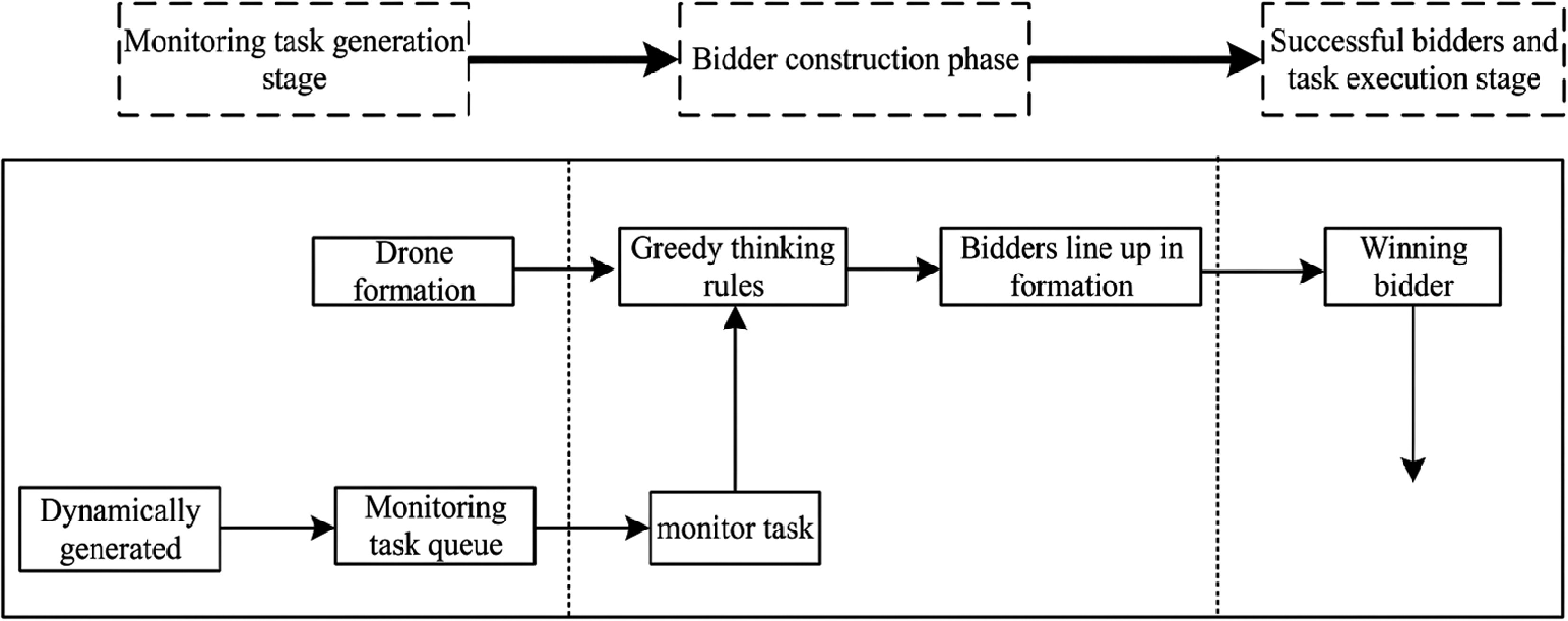
Figure 1.
Schematic diagram of the process of improving the auction algorithm based on greedy thinking.
Table 1. IAA-GI.
Input: $ S $ (drone information set), $ P $ (bidder set), $ T $ (auction item set), $ k $ (total number of tasks) Output: $ L $ (Collection of task allocation results) $ Flag \gets True $ while $ Flag $ do Random(Task) Add tasks to $ T $ and sort them by task urgency and task generation order for $ j = 0 $ to $ \text{len}(T) $ do if the bidder meets the bidding requirements and the corresponding task number is the original value then Add bidders to $ P $ end if end for for $ i = 0 $ to $ \text{len}(P) $ do if there are no bidders in $ P $ then Combine multiple bidders to meet the conditions and join $ P $ if the conditions are met end if end for while $ T $ is not empty do Start quoting for competitor products Calculate the optimal return for this round Calculate the suboptimal earnings for this round Calculate the next round of quotation if there is a unique highest price then The task assignment has been completed, and the bidder information will be added to $ L $ Remove bidder information from the bidder collection Mark Task as in execution status end if end while if $ \text{len}(T) \gt k $ then $ Flag \gets false $ end if end while return $ L $ Before carrying out the task, the current time
$ t_0 $ $ T(n)=N $ -
The drone monitoring task allocation algorithm mentioned in this chapter is executed on a PC (Intel I7-12700U CPU, 16GB memory, Windows 11 Home Edition, Python 3.6) platform. This article established five sets of comparative experiments with different numbers of individuals within the drone swarm. Each experiment was repeated for 10 rounds to statistically reduce the impact of model size randomness on the results. All experimental results are reported as the mean ± standard deviation (SD) over the 10 repeated runs. The average of the 10 rounds of experimental results was taken as the endpoint values in the simulation graph. The parameter settings in the simulation experiment are shown in Table 1. To better interpret the reported resource utilization, we define the Task-to-UAV Capacity Ratio (TCR) as the ratio between the total task demand and the overall resource capacity of the UAV swarm. In the experimental setup, each task requires a certain number of UAVs (based on capability requirements), and the total task demand is computed as the sum of required UAVs across all tasks. In our simulation, the TCR is maintained within a moderately saturated range (approximately 0.85–0.95), meaning that the overall task demand is close to but does not exceed the total UAV capacity. Under this setting, the proposed IAA-GI algorithm can effectively utilize available resources without causing excessive competition or idle UAVs.
Table 1. Simulation parameters of the city defender.
Parameter Price Simulation area 1,000 * 1,000 (m) Number of drones 10/20/30/40/50 (frames) Initial speed of drone 3 m/s End position (600,600,600) The maximum number of times a task is executed 50 Average velocity 100 km/h Agent model size 1/2/3/4/5/6 (m) Opportunity loss factor 0.5 Delayed penalty factor 0.2 The experimental simulation environment is selected in an open airspace, without considering the influence of tall buildings or trees, with a range of 1,000 m × 1,000 m. Set in a vast and complex geographical area (large urban areas), it is necessary to monitor and respond quickly to various potential threats in real time, such as illegal intrusion and environmental pollution. To simulate these threats, two types of tasks are designed: fixed monitoring tasks and dynamic burst tasks. The details are as follows: (1) Initial task generation: to accomplish this task efficiently, a large-scale drone cluster consisting of multiple UAVs was deployed for monitoring. Initially, 50 monitoring points are set up, and each point needs to be inspected by the drone at least once every 15 min. According to the task pre-assignment algorithm, taking into account the flight speed, endurance, load capacity, and other factors of the UAV, the UAV cluster is divided into five groups, which are respectively responsible for monitoring tasks in different areas. In the simulation experiment, several known monitoring tasks are first generated, and the capability requirements of these tasks are described as a three-dimensional capability set of three capabilities: namely, computing capability, detection capability, and carrying capability. For example, some tasks may require high computing power to process complex image data (such as images captured by high-definition cameras), high detection capabilities (such as infrared sensors that need to accurately detect targets), and certain load-carrying capabilities (such as carrying gas detection equipment). (2) Dynamic task generation: during the whole experiment, in addition to the initial task, several monitoring tasks are dynamically generated. These dynamic tasks are randomly generated, and each task is independent and irrelevant. Therefore, in the process of task execution, the system detects an emergency (such as the sudden occurrence of illegal activity hotspots or changes in environmental pollution sources), and the UAV cluster control center immediately starts a dynamic task reassignment mechanism to deploy drones from other regions to the accident area for key monitoring. (3) Distribution of task difficulties: the difficulty of the task is not evenly distributed in the set simulation area. Tasks close to the boundaries of the simulation area or near complex terrain are more difficult. This is because drones in these areas may face problems such as unstable signal transmission (near the border and far from the control center) and more environmental interference factors (such as the border being near other areas that are not fully monitored). The simulation diagram of drone deployment is shown in Fig. 2.
Figure 2.
Simulation diagram of drone deployment.
Throughout the simulation experiment, the distribution of drones within the drone swarm was ignored, and all drones had the same starting point and target endpoint. The positions of tasks are randomly distributed in each round of the experiment, and dynamic tasks are randomly generated during the motion process. The auction algorithm improved based on greedy thinking was used for 20 random monitoring task assignments, and multiple rounds of simulation experiments were conducted. The experimental results were taken as the average of multiple rounds of experimental results. At the beginning of task allocation, only the overall position of the cluster is considered, rather than being specific to each drone. It should be noted that in the preliminary testing of this article, it was found that under the scenarios and simulation settings involved in this section, the model trained through reinforcement learning took slightly longer, and the trained model did not fit well when facing the subgroup reconstruction process in dynamic scenarios. After multiple rounds of experiments, the model needed to be retrained for task matching, so reinforcement learning-based algorithms were not used as comparative experiments. In the simulation experiment, several known monitoring tasks will be generated first, and the ability requirements to solve the tasks will be described as a three-dimensional set of three abilities, namely computing ability, detection ability, and carrying capacity. In the future, several monitoring tasks will be dynamically generated, and each task will be independent and unrelated.
To ensure a fair comparison, all compared methods were run under exactly the same experimental conditions as the proposed method, including the same hardware configuration (Intel i7-12700U CPU, 16 GB memory, Windows 11 Home Edition, Python 3.6), the same task sets and task generation rules (identical initial tasks, dynamic task generation rules, and task difficulty distribution), the same UAV swarm size and initial speed, the same simulation area and random seed settings, and the same evaluation metric computation (both resource utilization and task allocation time are averaged over 10 repeated runs). Each compared method was implemented according to the parameter configuration and algorithmic procedure reported in its original publication, without additional tuning for our scenario, so that the performance differences arise solely from the algorithms themselves rather than from differences in experimental conditions.
Monitoring the distribution of task locations
-
The discrete degree of task distribution can also reflect some characteristics of the algorithm. If the degree of dispersion is large, it means that the algorithm pays more attention to the local optimal solution when assigning tasks, resulting in a scattered distribution of tasks over a wide range. If the degree of dispersion is small, the representation algorithm considers the overall layout to a certain extent, making the task distribution relatively concentrated. The tasks are dynamically generated, and the positions of the tasks generated in each experiment will be different. After all tasks are executed, the distribution of dynamic task positions is shown in Fig. 3, where Fig. 3a is an auction algorithm improved based on greedy thinking, and Fig. 3b is an auction algorithm based on time sequence (both algorithm result graphs in this section are placed in this order). Figure 3 shows the starting and ending positions of the drone cluster, and even under different rounds of testing, the starting and target endpoints of the drones remain unchanged. However, the distribution of positions of dynamic tasks may vary in different rounds of experiments. Since each task is independent and randomly distributed, there may be a situation where the task locations overlap. However, it cannot be considered the same task. Its essence is different tasks generated at the same position at different times. It can be observed from Fig. 3a that the task location distribution under the improved auction algorithm based on greedy thinking presents certain regularity and aggregation. The distribution of tasks is dense in some areas and sparse in others. In the process of task allocation, the auction algorithm improved by greedy thinking will make the tasks spatially distributed in some directions conducive to the realization of the greedy strategy. For example, there will be more task distribution near the start or end point of the UAV cluster. The task location distribution under the sequential auction algorithm shown in Fig. 3b is significantly different from that in Fig. 3a. Since it is a time-sequence-based algorithm, the task location distribution is affected by time factors. In the early days, the tasks generated were concentrated in a specific area, and over time, the task distribution gradually expanded to other areas. The task distribution under this algorithm is not as obviously clustered as the auction algorithm based on greedy ideas. The dynamic task requirement capability is described as different capability dimensions. Each task is dynamically generated using a randomly generated numerical quantification capability dimension to represent the minimum capability requirements provided by the drone or drone swarm executing the task. The capabilities of each drone in a multi-model heterogeneous drone swarm are represented by the same capability dimension values, which allows for matching, comparison, and calculation of the capability utilization rate after task algorithm allocation with dynamic tasks. In addition to uniformly distributed tasks, we also consider scenarios with highly clustered task distributions. In such cases, task demand becomes spatially concentrated, increasing competition among UAVs. The proposed IAA-GI algorithm can adapt to this situation through subgroup formation and auction-based redistribution, enabling multiple UAVs to collaboratively handle dense task regions.
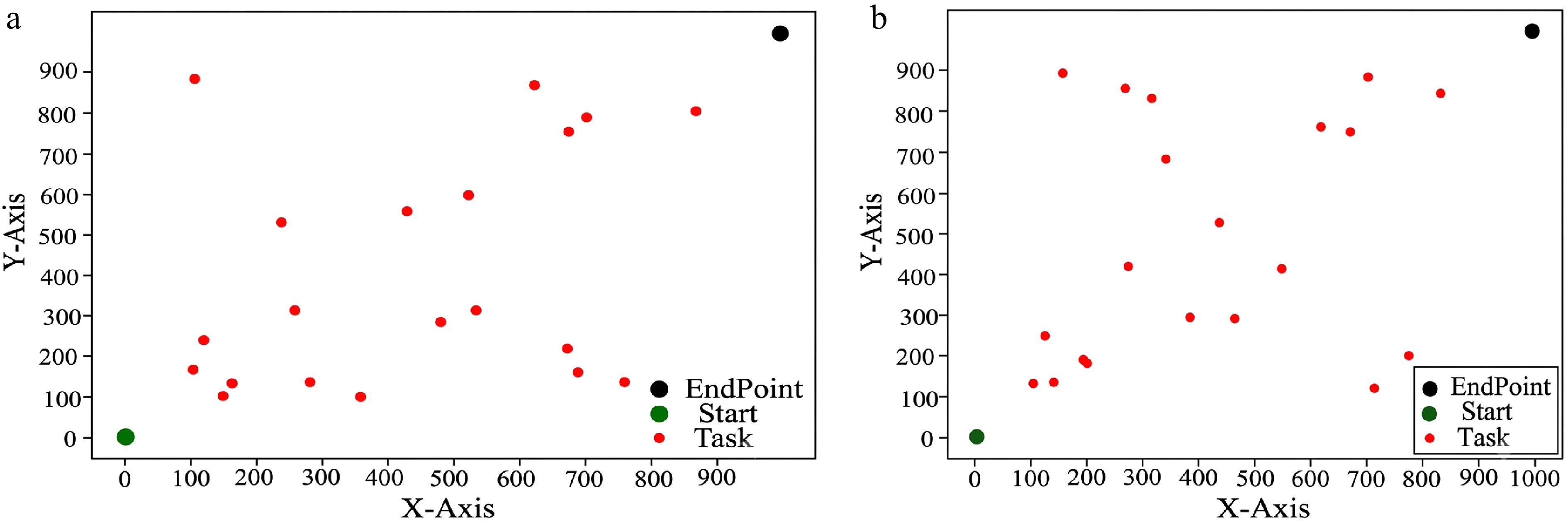
Figure 3.
Schematic diagram of task location. (a) An improved auction algorithm based on greedy thought. (b) Auction algorithm based on time series.
-
At the beginning of its design, this algorithm fully considers the problem that a single drone cannot meet the task requirements and cannot perform task matching. Therefore, it combines the greedy idea of combining drones in the drone queue, allowing multiple drones to work together as subgroups to complete the same task. The algorithm allows multiple drones to be combined into subgroups for collaborative task execution. The number of drones participating in completing the task is counted, and the statistical results are shown in Fig. 4. The vertical axis represents the number of drones required to solve the same task in a random task simulation, and the horizontal axis represents the task number. By observing the overall distribution of task numbers and the number of UAVs required in Fig. 4, it can be found that the complexity of tasks is not randomly distributed. There are some task intervals that generally require more UAVs to complete, indicating that the tasks in these task intervals have some common characteristics. When two UAVs cooperate to complete the task, the time to complete the task is longer, or the resource consumption is larger, which means that there is still room for improvement in the UAV cooperation algorithm. We can further study how to optimize the communication, task assignment, and action coordination among UAVs to improve the cooperative working efficiency of multi-UAVs.
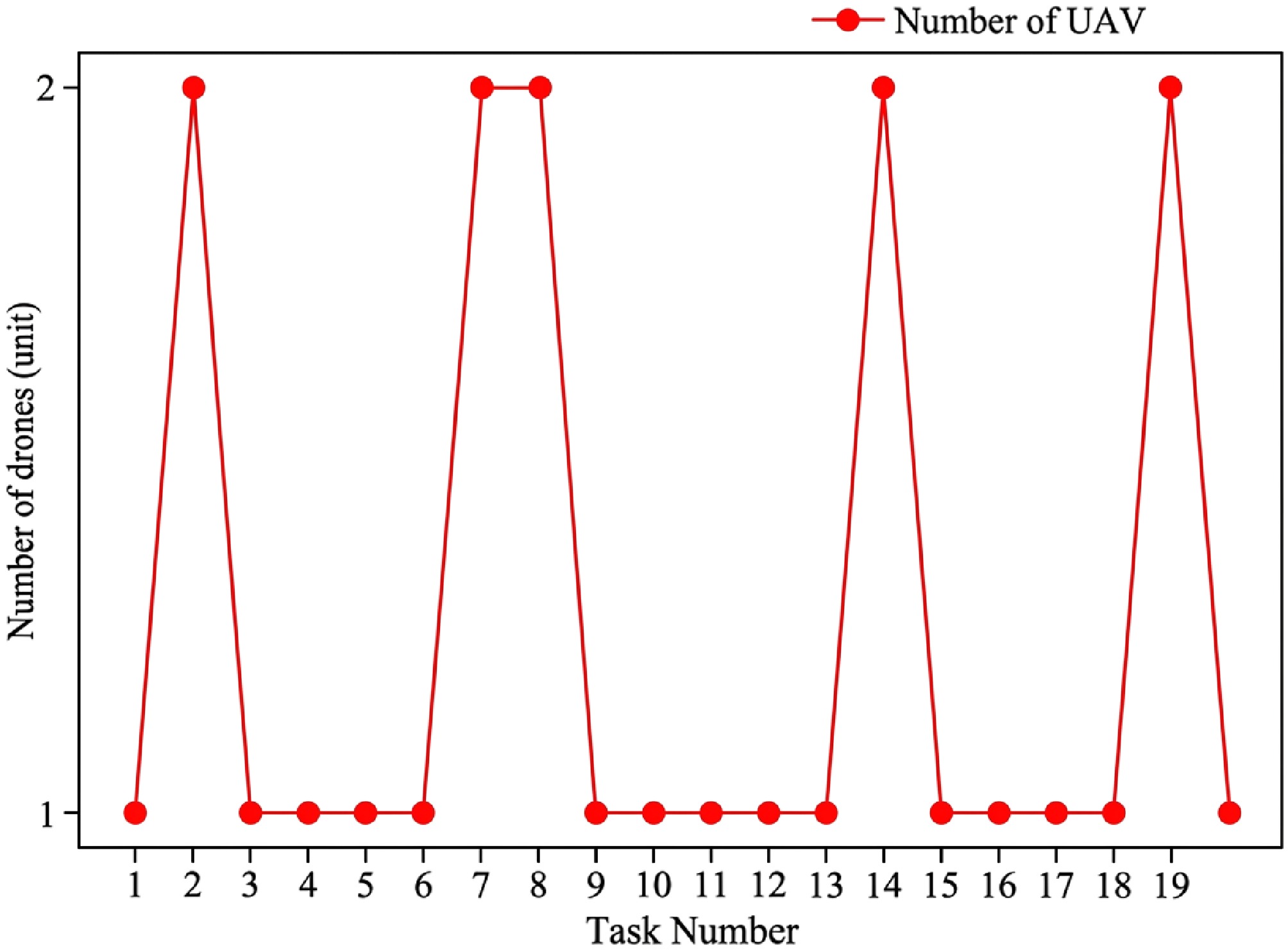
Figure 4.
Number of UAVs performing monitoring tasks.
For large-scale monitoring tasks, task coverage is one of the key indicators to measure the quality of the algorithm. By counting the number of UAVs participating in the task under different algorithms, the ability of the algorithm to cover the task area can be evaluated. The number of UAVs required by each task in a certain round of dynamic tasks is counted, and the total number of UAVs required by the two algorithms is counted, as shown in Fig. 5.
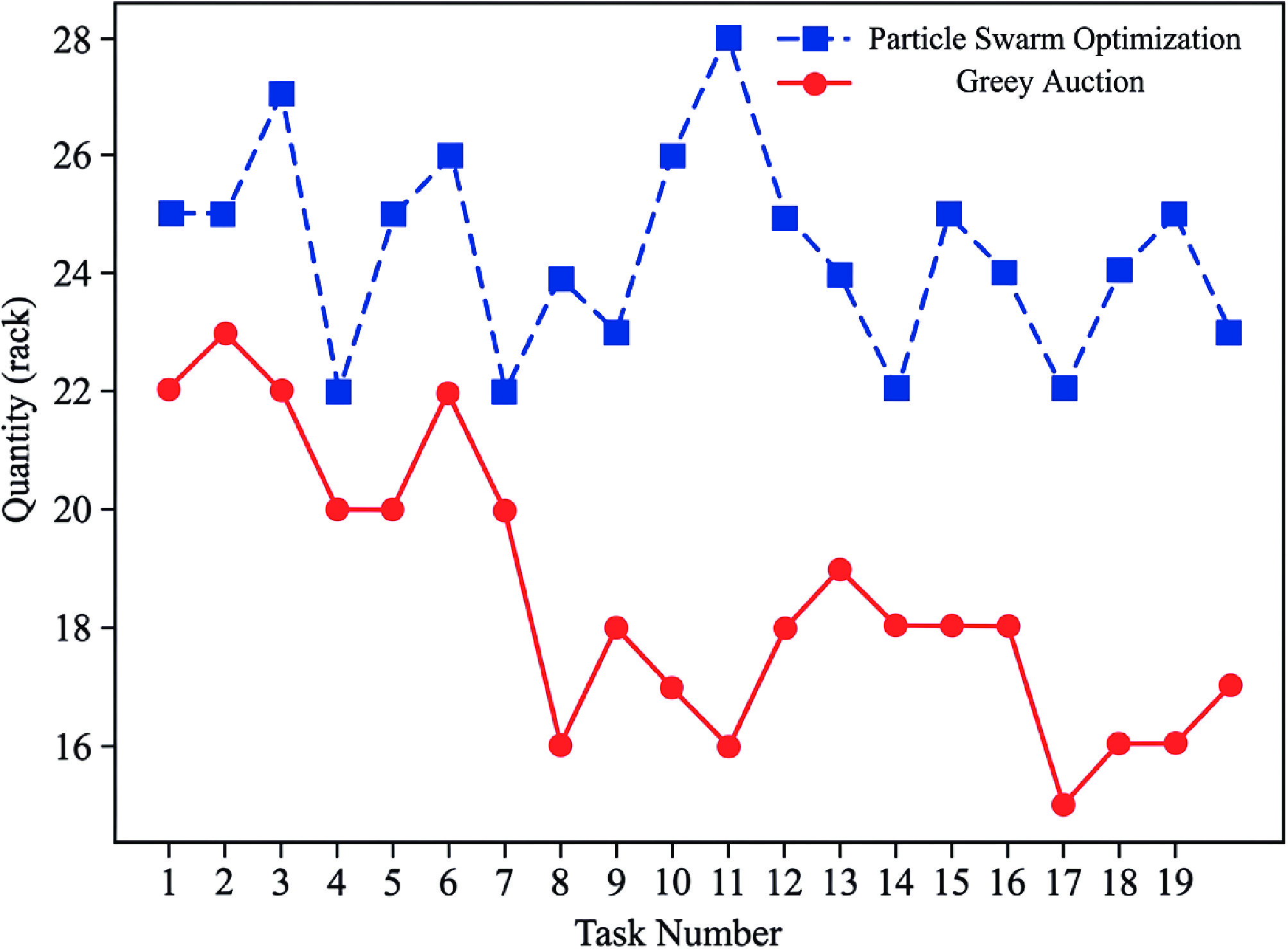
Figure 5.
Number of drones used.
The upper curve in the graph represents the number of drones required for the greedy auction algorithm. Due to the different capabilities required for each dynamic monitoring task, the requirements for drone capabilities are not fixed for each task, which may result in drones having to be combined into subgroups to meet the monitoring task requirements. Therefore, the number of drones will be greater than or equal to 20, as each monitoring task requires at least one drone to perform it. The red curve at the bottom of the figure represents the auction process that allows the drone to continue participating in the next monitoring task after completing the current monitoring task, with the addition of a time sequence. This will result in some UAVs executing monitoring tasks multiple times without conflicting time constraints, thereby reducing the number of drones used. For example, in the 11th experiment, if using the traditional particle swarm algorithm, the required number of drones was 28, while the greedy auction algorithm would reduce the number of drones used to 16, reducing the use of 12 drones. Due to the limited number of UAVs in the swarm and the difficulty in supplementing them during monitoring tasks, this algorithm can effectively reduce the demand for UAVs and increase their utilization rate, which is of great significance to the overall UAV cluster.
Resource utilization
-
In large-scale drone group monitoring missions, each drone has its own performance limits, such as flight time, load capacity, etc. Choosing resource utilization rate as an evaluation index can directly reflect the integration effect of the algorithm on UAV resources when assigning tasks. If an algorithm can make full use of the flight time and load capacity of each drone through reasonable task allocation without increasing the number of drones, then the algorithm is efficient in resource integration. On the contrary, if the algorithm causes the UAV resources to be idle or overused, it will cause a waste of resources or a failure of the mission. To verify the effectiveness of drone resource utilization, the multi-drone task allocation method based on improved multidimensional PSO from Peng et al.[11], the heterogeneous multi-drone task allocation method based on the multi-strategy GWO algorithm in uncertain environments from Zhang et al.[13], the drone task allocation method based on the fireworks algorithm in uncertain conditions from Yu et al.[17], and the method proposed in this paper were used for drone resource utilization verification. The higher the resource utilization rate, the better the task allocation effect of the method. The results are shown in Table 2.
Table 2. Comparison of resource utilization results.
Number of tasks Improved multidimensional PSO[11] Multi-strategy GWO[13] Fireworks algorithm[17] Proposed method 1,000 56.6 ± 3.2 56.1 ± 2.3 52.8 ± 1.5 88.2 ± 1.4 2,000 58.9 ± 2.6 58.8 ± 1.7 55.0 ± 4.0 89.0 ± 2.3 3,000 62.1 ± 3.0 61.0 ± 2.4 59.6 ± 3.2 92.1 ± 2.8 4,000 65.8 ± 1.8 63.6 ± 3.4 60.2 ± 2.1 94.6 ± 3.9 5,000 66.9 ± 4.1 67.9 ± 3.1 62.5 ± 2.5 96.2 ± 1.2 6,000 69.2 ± 2.8 68.4 ± 4.5 65.1 ± 3.6 99.8 ± 1.9 All values are presented as mean ± SD over 10 repeated runs. According to Table 2 analysis, when the monitoring task volume is 1,000, the drone resource utilization rate in method[11] can reach 56.6%, the drone resource utilization rate in method[13] can reach 56.1%, the drone resource utilization rate in method[17] can reach 52.8%, and the drone resource utilization rate of the method in this paper can reach 88.2%. When the monitoring task volume is 6,000, the drone resource utilization rate in method[11] can reach 69.2%, the drone resource utilization rate in method[13] can reach 68.4%, the drone resource utilization rate in method[17] can reach 65.1%, and the drone resource utilization rate of the method in this paper can reach 99.8%. This method can effectively improve the utilization rate of drone resources, avoid waste of drone resources, and effectively enhance the efficiency of drone group monitoring task allocation.
In large-scale UAV group monitoring tasks, the task environment is often dynamic. For example, targets in the monitoring area may suddenly increase or decrease, or a new emergency situation may arise that requires the drone to immediately adjust its mission. Choosing task assignment time as an evaluation index can measure whether the algorithm can adapt to this dynamic change quickly. If the task assignment takes too long, the UAV may not be able to adjust the task in time when encountering an emergency, thus affecting the monitoring effect. In order to verify the efficiency of task allocation for UAV group monitoring, the methods included in previous studies[11,13,17] and our method were used to verify the task allocation time. It should be noted that the reported task allocation time mainly reflects the computational time of the proposed IAA-GI algorithm, including bidder matching, subgroup construction, and iterative auction updates. In the current simulation, communication delays between UAVs during multiple rounds of bidding are assumed to be negligible and are therefore not explicitly modeled. The results are shown in Table 3.
Table 3. Comparison of task allocation time results.
Number of tasks Improved multidimensional PSO[11] Multi-strategy GWO[13] Fireworks algorithm[17] Proposed method 1,000 12.6 ± 0.3 16.2 ± 0.9 19.1 ± 0.2 0.1 ± 0.5 2,000 28.5 ± 0.5 28.5 ± 0.7 36.9 ± 0.3 0.6 ± 0.3 3,000 38.1 ± 0.4 39.0 ± 0.5 58.2 ± 0.5 1.2 ± 0.6 4,000 56.9 ± 0.3 48.1 ± 0.7 86.2 ± 0.3 2.5 ± 0.5 5,000 69.8 ± 0.2 82.2 ± 0.6 153.8 ± 0.6 3.2 ± 0.4 6,000 98.3 ± 0.4 126.9 ± 0.4 186.0 ± 0.5 3.9 ± 0.3 All values are presented as mean ± SD over 10 repeated runs. According to Table 3, when the task volume of UAV group monitoring is 1,000, the task allocation time in method[11] is 12.6 s, the task allocation time in method[13] is 16.2 s, the task allocation time in method[17] is 19.1 s, and the task allocation time of the method in this paper is 0.1 s. When the task volume of UAV group monitoring is 3,000, the value are 38.1s, 39.0s, 58.2s, and 1.2s, respectively. When the task volume is 6,000, the the value are 98.3s, 126.9s, 186.0s, and 3.9s. Under the proposed method, the task allocation time for UAV group monitoring is consistently low, indicating that this method can effectively improve the efficiency of task allocation. Although subgroup formation improves allocation feasibility, it may introduce additional coordination costs such as communication and synchronization overhead. In this work, such costs are assumed to be relatively small and are not explicitly modeled. This is because subgroup formation is only triggered when necessary, and the subgroup size is typically limited. Therefore, the additional overhead has a negligible impact on overall performance.
Dynamic allocation stability analysis
-
To further evaluate the dynamic behavior of the proposed IAA-GI algorithm, we analyze its allocation stability under dynamically generated tasks. When new tasks arrive, or environmental conditions change, the algorithm prioritizes local adjustments by reassigning only a subset of UAVs involved in the affected tasks, rather than performing a complete global reallocation. This local refinement mechanism reduces unnecessary task switching and improves system stability. Experimental observations show that most UAVs maintain their original task assignments unless significant conflicts arise, indicating that the algorithm achieves a balance between adaptability and stability. In terms of energy overhead, dynamic reassignment may introduce additional flight distance due to task switching. However, since the algorithm limits the scope of reallocation, the additional energy consumption remains within an acceptable range compared to full global reallocation strategies. This demonstrates the effectiveness of the proposed method in handling dynamic task environments.
-
Compared with existing studies, the proposed IAA-GI algorithm exhibits clear advantages in task allocation efficiency and resource utilization. Most existing UAV swarm task allocation studies adopt swarm intelligence optimization algorithms, such as improved multidimensional particle swarm optimization[11], the multi-strategy GWO algorithm[13], and the Tent-Levy fireworks algorithm[17]. These methods can obtain satisfactory allocation schemes in small- and medium-scale task scenarios; however, as the task scale increases, the computational cost of their iterative search grows significantly, and they rely heavily on a complete communication topology. The experimental results in this paper show that at a task volume of 6000, the allocation times of the above methods reach 98.3 s, 126.9 s, and 186.0 s, respectively, whereas IAA-GI requires only 3.9 s, and the resource utilization increases from 65.1%–69.2% to 99.8% (Table 4). The fundamental reason for this difference is that swarm intelligence algorithms require extensive iterative evaluation over the solution space, whereas IAA-GI compresses the search space to the feasible bidder set through greedy candidate construction and subgroup formation, thereby substantially reducing the computational burden while maintaining allocation quality. In terms of communication efficiency, the clustering-based consensus bundle algorithm (Clustering-CBBA) groups UAVs via k-means++ to reduce communication redundancy[37], which shares a similar rationale with the subgroup formation mechanism of this paper at the level of 'grouping to reduce complexity'. However, Clustering-CBBA still relies on multiple rounds of intra-cluster and inter-cluster consensus negotiation, and the number of negotiation rounds may increase when dynamic tasks arrive frequently. In contrast, IAA-GI decouples subgroup formation from the auction process, triggering formation only when a single UAV is insufficient, and allocates rewards within a subgroup in proportion to capability, thereby reducing negotiation overhead while ensuring cooperative feasibility. Moreover, the greedy selection mechanism completes capability matching and screening at the candidate bidder construction stage, preventing unqualified bidders from entering the auction, which is consistent with the 'communication-efficient' objective emphasized in the literature but is achieved through a more lightweight implementation.In terms of dynamic adaptability, distributed methods based on auction and consensus (such as CBBA and its variants) typically require multiple rounds of message passing to converge[37], whereas the local adjustment mechanism of IAA-GI allows the algorithm to reassign only a subset of UAVs involved in the affected tasks rather than performing a complete global reallocation. This design is practically meaningful in dynamic task scenarios, since global reallocation not only increases computation time but may also cause many UAVs to deviate from their original tasks and incur additional flight energy consumption.Admittedly, the proposed method has limitations. Greedy selection is myopic when constructing candidate sets; although the global competition in the auction phase alleviates this issue to some extent, the suboptimality of subgroup combinations may still affect the final allocation quality in highly heterogeneous task scenarios. In addition, the current experiments do not explicitly model the impact of communication delay and packet loss on the auction process, whereas in practical deployment these factors may alter bidders’ information states and decision timing. Future work will evaluate the robustness of IAA-GI under more realistic communication constraints and consider integrating it with clustering-based grouping strategies[37] to further improve communication efficiency in large-scale scenarios.
Table 4. Ablation results of the components of IAA-Gl (task volume = 6,000).
Method Resource utilization (%) Task allocation time (s) IAA-GI (full) 99.8 ± 1.9 3.9 ± 0.3 IAA-GI w/o Greedy 91.3 ± 2.6 5.6 ± 0.4 IAA-GI w/o Subgroup 74.5 ± 3.1 4.2 ± 0.3 IAA-GI w/o Value-Sharing 95.2 ± 2.4 4.1 ± 0.4 -
The paper proposes a large-scale UAV group monitoring task allocation algorithm under dynamic resource allocation. This paper combines an auction algorithm with a mathematical model to solve the multi-task allocation problem using an auction algorithm. Through research, the following conclusions have been drawn: (1) The task allocation problem of drone group monitoring considers the constraints of monitoring navigation distance, overall completion time of monitoring tasks, monitoring task efficiency, and target time window. By matching the value of drone bidders with the bidding items in the task, the drone group monitoring tasks are allocated, effectively improving the utilization rate of drone resources. The highest utilization rate of drone resources can reach 99.8%, effectively improving the utilization rate, avoiding waste, and enhancing the efficiency of drone group monitoring task allocation. (2) Building a task allocation model for UAV swarm monitoring under dynamic resource allocation improves the auction algorithm through greedy thinking, optimizes the qualifications of bidders, and combines some UAVs that meet certain conditions into one bidder, forming a subgroup. All members of the subgroup share their acquired value and assume corresponding responsibilities, achieving large-scale UAV swarm monitoring task allocation, effectively improving task allocation time by 3.9 s, and effectively improving the efficiency of UAV swarm monitoring task allocation.
The authors would like to thank the anonymous reviewers for their valuable comments and suggestions, which helped improve the quality of this manuscript.
-
The authors confirm their contributions to the paper as follows: study conception and design: Liu G, Jiang J; data collection: Zou G, Qi C; analysis and interpretation of results: Liu G, Jiang J, Zou G, Qi C, Feng D; draft manuscript preparation: Liu G, Feng D. All authors reviewed the results and approved the final version of the manuscript.
-
The datasets generated during and/or analyzed during the current study are not publicly available due to the proprietary nature of the simulation models and the confidentiality of the specific task scenarios used to evaluate the UAV swarm performance, but are available from the corresponding author upon reasonable request.
-
The authors declare that they have no conflict of interest.
- Copyright: © 2026 by the author(s). Published by Maximum Academic Press, Fayetteville, GA. This article is an open access article distributed under Creative Commons Attribution License (CC BY 4.0), visit https://creativecommons.org/licenses/by/4.0/.
-
About this article
Cite this article
Liu G, Jiang J, Zou G, Qi C, Feng D. 2026. Task allocation algorithm for large-scale unmanned aerial vehicle group monitoring under dynamic resource allocation. International Journal of Micro Air Vehicles 18: e023 doi: 10.48130/mav-0026-0020 

Task allocation algorithm for large-scale unmanned aerial vehicle group monitoring under dynamic resource allocation
- Received: 28 February 2026
- Revised: 02 April 2026
- Accepted: 09 August 2026
- Published online: 02 November 2026
Abstract: The rapid expansion of UAV cluster monitoring in complex and dynamic environments intensifies communication challenges, as distance, interference, and bandwidth limitations lead to reduced resource utilization and increased task allocation latency. To address these issues, the task assignment process is formulated as a constrained optimization problem incorporating navigation distance, task efficiency, overall completion time, and time-window requirements. An improved auction-based mechanism is introduced, integrating greedy heuristics, subgroup formation, and value-sharing strategies to enhance computational efficiency and mitigate communication bottlenecks in large-scale dynamic resource settings. By matching bidder values with task requirements and organizing qualified UAVs into cooperative subgroups, the method enables scalable and robust task allocation while reducing dependence on communication bandwidth. Experimental evaluations demonstrate that the approach achieves a resource utilization rate of 99.8% and completes allocation in only 3.9 s, significantly improving the operational efficiency of large-scale UAV clusters.