










-
Genetic research on edible mushrooms should ultimately serve practical production needs. In 2022, the major scientific questions identified by the edible mushroom research and production communities in China centered on strain degeneration and the stability of strain-specific characteristics, fruiting body development, the genetic basis of agronomic traits, environmental responses, substrate degradation and nutritional metabolism, and the precise evaluation of germplasm resources[1]. These questions are interconnected and often involve multiple genes, developmental stages, and environmental conditions. Omics technologies have provided new approaches for investigating these complex processes in greater depth.
Since high-throughput sequencing began to be applied to edible mushroom research around 2009, the scope of observation has expanded markedly. Reference genomes placed mating type, lignocellulose degradation, and fruiting body development within a genome-wide context[2−4]. Transcriptomics, proteomics, and metabolomics began to track system-wide changes during development and environmental responses[5−7]. Genetic maps, quantitative trait loci (QTLs), genome-wide association studies (GWASs), and pangenomes connected agronomic traits with chromosomal intervals and population variation[8−11]. Edible mushroom genetics thus progressed from studies of individual genes and limited numbers of markers to a new stage in which genomic data, dynamic omics data, and population-level variation accumulated in parallel.
These advances have substantially broadened the scope for examining genetic variation and physiological processes in edible mushrooms but they have not automatically resolved questions concerning the analytical unit and causal validation. Many studies still treat a dikaryotic strain as a single genetic and expression unit, and its genomic, transcriptomic, proteomic, and metabolomic signals are generally not further resolved by constituent nucleus or internuclear interactions. Such data can describe what occurs in a strain as a whole but they often cannot determine which constituent nucleus a change originates from or distinguish genetic effects attributable to individual constituent nuclei, nuclear combination effects, and the effects of the shared cytoplasm.
This problem is particularly apparent in typical basidiomycete edible mushrooms such as Lentinula edodes, Flammulina filiformis, Pleurotus ostreatus, Hypsizygus marmoreus, and Ganoderma lucidum, in which the mycelia used in production and the fruiting bodies generally contain two haploid nuclei with different genetic backgrounds. Recent direct evidence shows that the transcriptional contributions of the two nuclear types in Agaricus bisporus vary among genes, tissues, and developmental stages[12]. The two constituent nuclei of L. edodes show extensive sequence and structural differences and exhibit internuclear allele-specific expression (in-ASE)[13,14]. Proteomic comparisons between dikaryons and their constituent monokaryons further indicate that a nuclear combination can generate an integrated state that cannot be explained by simply adding the states of the two monokaryons[15].
Diploid genetic models can describe some aspects of a dikaryotic strain but they do not capture all consequences of maintaining distinct nuclear genomes within a shared cytoplasm. Analysis of its phenotype must consider the genetic effect of each constituent nucleus, nuclear combination effects and internuclear interactions, nuclear ratios, and the combined influences of mitochondria, the shared cytoplasm, developmental stage, and environmental conditions. The significance of dikaryon biology lies in decomposing the basic analytical unit of edible mushroom omics from a dikaryotic strain treated as a whole into its two constituent nuclei and their combination within the shared cytoplasm. This approach brings omics data back into alignment with the actual lifecycle and the biological units used in production and breeding.
This review organizes dikaryons' establishment, the joint functioning of the two constituent nuclei, fruiting body development, the formation of agronomic traits, and environmental and metabolic responses into a continuous chain of questions. It distinguishes the evidentiary boundaries among three types of research: comparisons between constituent monokaryons, dikaryon–monokaryon comparisons, and analyses of nucleus-of-origin expression within a dikaryon. On this basis, it discusses research directions including nuclear phasing and nucleus-resolved omics, the functional genetics of dikaryons, nuclear combination breeding, and the digital dikaryon (Fig. 1).
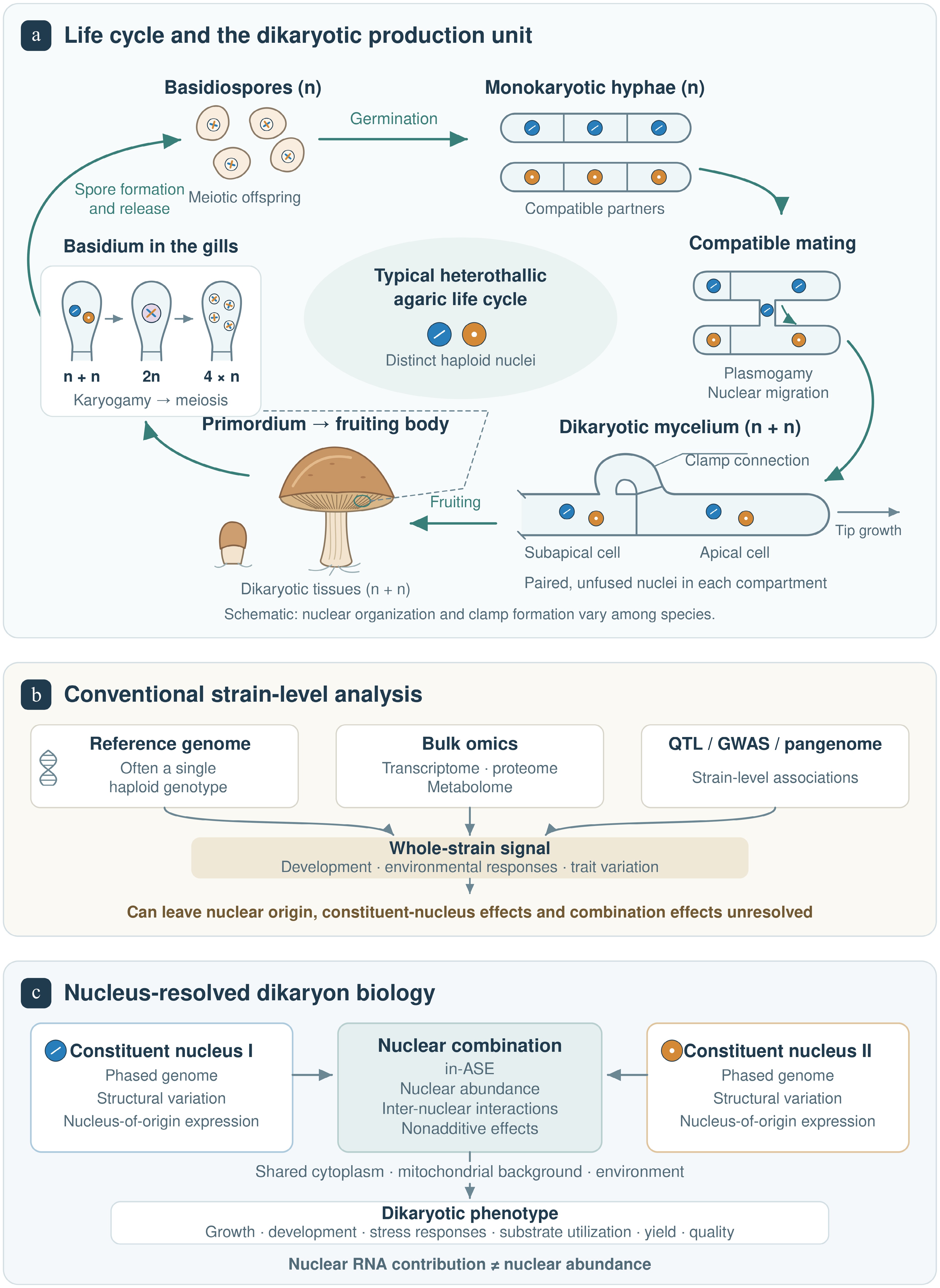
Figure 1.
From omics to dikaryon biology: a shift in the analytical unit of edible mushroom genetics. (a) A closed, schematic heterothallic agaric lifecycle. Compatible monokaryotic hyphae fuse by plasmogamy to establish a dikaryon; distinct haploid nuclei remain separate during vegetative growth. A clamp develops from the apical cell and bends back to fuse with the subapical compartment, helping restore nuclear pairing after mitosis. The mature connection and direction of tip growth are shown. Karyogamy occurs in the basidium, followed by meiosis and basidiospore formation. Blue and orange distinguish constituent nuclei within a combination; meiotic offspring can carry segregated and recombined haplotypes. Nuclear organization and clamp formation vary among species. (b) Conventional genome resources, bulk omics, and association analyses can leave the contributions of individual nuclei and their combinations unresolved. (c) Phased nuclear genomes and nucleus-of-origin expression connect constituent nuclei to combination effects and dikaryotic phenotypes in a shared cytoplasmic and mitochondrial context. Nuclear RNA's contribution is distinct from nuclear abundance. Arrows in B and C organize the analytical framework rather than imply demonstrated causality. QTL, quantitative trait locus; GWAS, genome-wide association study; in-ASE, internuclear allele-specific expression.
-
This is a narrative review, not a systematic review. Literature was identified through targeted searches of PubMed-indexed records and publisher websites, supplemented by reference-list searches, with the update completed on 1 October 2026. Species names were combined with terms including dikaryon, heterokaryon, mating type, haplotype phasing, allele-specific expression, nuclear ratio, single nucleus, monokaryotization, mitochondrial inheritance, and substrate response. Primary studies were prioritized for their relevance to nuclear organization, development, environmental responses, and breeding, with particular attention to work published in 2024–2026. Classical studies and selected reviews were retained where they established essential concepts or historical context.
-
Before the advent of high-throughput sequencing, classical genetics had already established a relatively well-defined evidentiary framework for edible mushroom research. Mating tests and the isolation of monokaryotic materials were used to analyze mating compatibility and generate hybrid combinations. For example, Castle et al.[16] obtained hybrid strains by pairing homokaryons of A. bisporus. Single-basidiospore progeny and tetrad analyses were used to examine genetic segregation and recombination; Miyazaki et al.[8], for instance, constructed a genetic map using 92 monokaryotic strains derived from basidiospores of L. edodes. Mutants provided a means of linking specific phenotypes to genetic changes. Challen and Elliott[17] used fungicide-resistant mutants to investigate the inheritance of resistance in A. bisporus. With the development of molecular markers, isozymes, random amplified polymorphic DNA (RAPD), amplified fragment length polymorphism (AFLP), and simple sequence repeats (SSRs) were progressively applied to the identification of genetic types, discrimination among commercial strains, and constructing genetic maps[18−21]. Sequence-characterized amplified region (SCAR) markers tightly linked to mating-type loci also began to be used to determine the A and B mating-type factors in L. edodes[22].
Despite their limited scope, these methods could directly link genotypic changes to phenotypes through genetic segregation, recombination, and mutation, thereby providing advantages for causal analysis that later association-based approaches could not readily replace. Between 2010 and 2014, the scale of analysis in edible mushroom genetics rapidly expanded from individual loci to reference genomes. Genome sequences were published in succession for Schizophyllum commune[2], Coprinopsis cinerea[3], G. lucidum[23], A. bisporus[24], Volvariella volvacea[25], and F. filiformis[4]. Research on mating type, lignocellulose degradation, fruiting bodies' development, and secondary metabolism consequently expanded from individual genes to genome-wide analyses[26]. Research during this period first addressed which genes were present in edible mushrooms, but early functional interpretations relied largely on homology-based annotation. The presence of genes and the expansion of gene families could indicate genetic potential, but were insufficient to establish that the relevant genes played defined roles under specific conditions.
From gene catalogs to dynamic omics and population variation
-
Reference genomes provided a framework for analysis, and research questions subsequently shifted toward when, where, and under what conditions genes are expressed. Muraguchi et al.[5] used strand-specific ribonucleic acid sequencing (RNA-seq) to trace the developmental progression of C. cinerea. Krizsán et al.[27] used multispecies developmental transcriptomic atlases to identify relatively conserved functional modules involved in complex multicellular development. Transcriptomics, proteomics, and metabolomics were subsequently applied extensively to investigate temperature stress[6,28,29], substrate degradation[30,31], the accumulation of bioactive compounds[7], and postharvest senescence[32], making the system-wide changes during development and environmental responses observable. Dynamic omics primarily reveals patterns of covariation among genes, proteins, and metabolites as conditions change. Establishing functional causality still requires validation using mutants, gene editing, biochemical analyses, and fruiting trials.
The scope of research also expanded from individual species and strains to germplasm populations. Research on edible mushroom traits progressed from association mapping in L. edodes based on a limited set of markers[33] to an analytical framework integrating a reference genome, population resequencing, and a GWAS of cadmium accumulation[10]. A pangenome was subsequently constructed from 199 enoki mushroom germplasm accessions, and single-nucleotide polymorphism-based GWAS (SNP-GWAS) and presence–absence variation-based GWAS (PAV-GWAS) were combined to analyze domestication-related traits[11]. These studies associated agronomic traits with single nucleotide polymorphisms (SNPs), structural variants, gene presence–absence variants, and candidate haplotypes, although the resulting associations still require validation in independent populations and through functional experiments.
From whole-strain analysis to nucleus-resolved omics
-
As omics research advanced, limitations associated with the choice of analytical unit in edible mushroom genetics became increasingly apparent. Many reference genomes were generated from monokaryotic cultures and therefore represented a single haploid genome. A verified protoplast-derived isolate can represent a constituent nuclear genotype of the source dikaryon, whereas a monokaryotic single-basidiospore isolate is a meiotic product and may carry a recombinant genome. In contrast, dikaryotic genomes that are not adequately phased could contain mixed sequences derived from the two constituent nuclei. Transcriptomic, proteomic, and metabolomic analyses generally use intact dikaryotic mycelia or fruiting bodies and therefore capture the combined output of the two constituent nuclei and their shared cytoplasm. Analyzing a dikaryotic sample against a monokaryotic reference genome may conflate information from the two nuclei or omit information from the other nucleus. Similarly, population genetic studies that record only the heterozygous genotype of a dikaryotic strain may obscure how different alleles are combined between two physically separate nuclei.
Nucleus-resolved studies have begun to change this situation. Gehrmann et al.[12] systematically traced nucleus-of-origin expression in A. bisporus and found that the expression contributions of the two constituent nuclei were not fixed at a 1:1 ratio for all alleles. Gao et al.[13] and Shen et al.[14] generated chromosome-level to nearly gapless genomes of the constituent nuclei of L. edodes, revealing SNPs, structural variants, nucleus-specific genes, and in-ASE. Yoshitake et al.[34] also attempted to obtain two nearly telomere-to-telomere haplotype assemblies directly from dikaryotic material of L. edodes. Omics research has thus begun to move from describing what occurs in a strain as a whole toward determining what each nucleus carries, what each nucleus expresses, and what arises from their combination. Following the historical progression from individual genes to reference genomes and whole strains, the basic analytical unit of edible mushroom genetics is now being extended to nuclear haplotypes and nuclear combinations.
-
Mating-type loci lie at the beginning of the chain of questions addressed by dikaryon biology in the lifecycle of mushroom-forming basidiomycetes. They determine whether, following hyphal fusion, the two monokaryotic nuclei can initiate nuclear migration, nuclear pairing, synchronous division, and dikaryon maintenance, thereby establishing the nuclear state required for subsequent vegetative growth and fruiting body development[35,36].
From classical mating genetics to a molecular framework for dikaryon formation
-
Classical genetic studies of model basidiomycetes, including S. commune and C. cinerea, showed that mating compatibility is controlled by two independent genetic systems, A and B[37−39]. In a typical tetrapolar mating system, two monokaryons must differ at both the A and B mating-type factors to initiate a complete compatible mating reaction and form a typical, stable dikaryon. If they differ at only one factor, only part of the mating response is activated, resulting in a common-A or common-B heterokaryon[40].
Beginning in the 1990s, molecular cloning studies gradually revealed the molecular basis of the A and B mating-type factors. Studies in S. commune and C. cinerea showed that the A factor encodes two classes of transcriptional regulatory proteins containing distinct homeodomains (HDs), subsequently designated HD1 and HD2[41,42]. The B factor consists of lipopeptide pheromones and their seven-transmembrane G protein-coupled receptors, forming what is now generally termed the pheromone/receptor (P/R) locus[43,44]. Further studies showed that HD1 and HD2 proteins from different mating types can form an active heterodimer and initiate the developmental program controlled by the A factor[45,46]. In the B-factor system, pheromones from a nonself mating type can be recognized by and activate compatible receptors, thereby initiating downstream signaling and the mating response controlled by the B factor[43,44]. The A and B mating-type factors defined by classical genetics were thus resolved into two molecular recognition and signaling systems.
Genome technologies reveal the complete structure of mating-type loci
-
Whole-genome sequencing has enabled the HD and P/R regions to be located within their chromosomal contexts and compared in terms of their gene composition, synteny, recombination boundaries, and haplotype variation. The unit of mating-type analysis has consequently expanded from individual functional genes to chromosomal regions containing multiple functional modules and exhibiting characteristic patterns of recombination[47]. In enoki mushrooms, both the HD and P/R loci can be divided into widely separated subloci, with intralocus recombination between the subloci generating new mating-type haplotypes[48,49]. The B locus of L. edodes contains multiple STE3-like receptor genes and pheromone genes, but only a subset has been identified as components of the functional modules involved in mating-type-specific recognition[50].
The detection of HD genes, STE3-like receptors, or pheromone genes in a genome therefore establishes only the presence of the relevant sequences. Determining whether a gene or sublocus actually participates in nonself recognition requires comparisons across multiple haplotypes, genetic segregation analysis, functional analysis of the relevant genes, and assessment of mating phenotypes. Genome sequencing has broadened the scope of mating-type research while also raising the evidentiary standards required for functional assignment.
Molecular mechanisms underlying mating-type diversity
-
The diversity of basidiomycete mating types reflects variation at two main levels. Individual functional genes occur as numerous highly differentiated allelic types, whereas HD or P/R functional units may be duplicated to form multiple subloci. Different combinations of allelic types and subloci further increase the number of mating types and the probability that monokaryons encountering one another in natural populations will form compatible combinations[36].
Mating-type diversity ultimately depends on specific recognition between proteins. Studies in C. cinerea showed that the variable N-terminal regions of HD proteins are involved in selecting compatible heterodimerization partners[45]. In S. commune, a single amino acid substitution in a pheromone or changes in only a few amino acids of a receptor can alter the pheromone–receptor recognition spectrum[51,52]. These studies have established causal links between sequence changes and altered compatibility for some combinations. However, how different HD1/HD2 and pheromone/receptor combinations distinguish self from nonself through their tertiary structures and binding interfaces still lacks a systematic explanation.
In F. filiformis, introduction of a compatible bHD1 allele or a chimeric HD construct into a monokaryon induced pseudoclamps and increased clp1 expression, providing experimental support for activation of the MAT-A pathway[53].
Breeding applications and limitations of molecular mating-type information
-
Molecular mating-type information is currently used mainly to classify monokaryons, screen compatible parents, identify constituent nuclei, and assist in verifying hybrids' authenticity. Polymorphisms at the A and B subloci of L. edodes have been used to develop polymerase chain reaction (PCR) markers. Wang et al.[54] established molecular fingerprints using whole-genome sequences of the constituent monokaryons, indicating that such identification is moving from a small number of mating-type markers toward combined multilocus genotyping.
Mating-type composition can also assist in reconstructing the routes through which cultivars were developed. In the absence of nuclear replacement, contamination, or mating-type mutation, cultivars generated through asexual propagation, crosses between monokaryons, selfing, or backcrossing may retain information about their mating-type origins. However, identical mating types do not demonstrate that two strains have the same genetic background, and different mating types alone are insufficient to establish their parentage. Lineage analysis still requires nucleus-specific markers or whole-genome data[48]. Mating-type markers primarily indicate whether monokaryons are compatible and identify the haplotypic origins of the relevant loci. They can assist in verifying cultivars' identity, studies of trait-linked markers, and the evaluation of combining ability.
Mating type may also be associated with growth or agronomic traits through genetic linkage or the biological functions of the mating-type genes themselves. The mating-type (MAT) region of A. bisporus exhibits suppressed recombination, whereas recombination between subloci within mating-type loci has been documented in enoki mushrooms, indicating that the recombination properties of these regions differ among species[48,55]. Park et al.[56] found an association between mycelial growth rate and the A mating type in single-basidiospore populations of L. edodes. Gong et al.[57] narrowed a growth-related QTL to an approximately 1.176-Mb region containing the mating-type gene LeHD1 and demonstrated, through overexpression and RNA interference (RNAi), that LeHD1 positively regulates mycelial growth.
Associations between mating type and traits may therefore arise either from genetic linkage with neighboring genes or from the biological functions of the mating-type genes themselves. Distinguishing between these possibilities requires fine mapping and functional validation.
From identification of mating types to nuclear combination design
-
From the perspective of dikaryon biology, mating type should be incorporated into an integrated system for managing nuclear identity and nuclear combinations. In addition to the HD and P/R subloci, the records for each monokaryotic resource should include its nuclear haplotype identifier, dikaryotic source strain, mitochondrial origin, genetic background, general combining ability, and range of suitable pairing partners. Such an information system would provide a basis for the long-term preservation and repeated use of monokaryotic resources.
The introduction of mating-type genes also provides an experimental route for activating sexual development pathways without crossing two genetically distinct monokaryons. After compatible HD and pheromone-related genes were introduced into a monokaryon of P. eryngii, the mating-type signaling pathway was activated, and the transformants formed clamp connections and produced primordia and fruiting bodies with pilei, stipes, and lamellae, but no basidiospores[58]. Such material is derived from a single monokaryotic genotype and lacks the two different parental haplotypes of a conventional cross. Its nuclear organization and the effects of transgene insertion should nevertheless be verified.
This single-genotype-derived material provides a relatively simple system for studying gene function. A target gene could first be edited in a monokaryon with a single genetic background, after which activation of the mating-type pathway could enable clamp formation and fruiting body development. This strategy could allow the effects of the target gene on mycelial growth, fruiting body development, and agronomic traits to be evaluated. Its potential breeding value lies in the possibility of first pyramiding favorable alleles within a single monokaryotic genome and then activating the mating-type pathway to obtain fruiting material. The effects of this approach on yield, adaptability, fertility, and trait stability require validation in additional species and through multienvironment fruiting trials.
Genome technologies have advanced mating-type research to analyses of locus structure, haplotype evolution, and molecular recognition, providing a relatively clear answer to which nuclei are compatible. Dikaryon biology must continue to ask whether compatible nuclei can efficiently establish and stably maintain a dikaryon, and which nuclear combinations can produce superior and stable production traits.
-
Once a dikaryon has been established between compatible monokaryons, two haploid nuclei with different genetic backgrounds coexist for prolonged periods within the same cytoplasm and jointly support mycelial growth, environmental responses, and fruiting body development. Most previous omics studies analyzed intact dikaryotic mycelia or fruiting bodies and interpreted the molecular changes detected as phenotypes of the strain as a whole. Conventional bulk omics therefore makes it difficult to determine which constituent nucleus a particular molecule originated from.
The two constituent nuclei have different genetic foundations
-
The two constituent nuclear genomes of a dikaryon can differ substantially in their sequence, structure, and gene content. Gao et al.[13] isolated the constituent monokaryons SP3 and SP30 from the same commercial cultivar of L. edodes. Their genomes were 50.93 and 49.80 Mb, respectively; approximately 30% of the sequences were nucleus-specific or located in nonsyntenic regions. The two genomes contained 333 and 366 nucleus-specific genes, accounting for 2.91% and 3.25% of their predicted genes, respectively. Shen et al.[14] generated nearly gapless assemblies of the two constituent nuclei of the L. edodes strain WX1 and likewise identified numerous inversions, translocations, and duplications, indicating that substantial internuclear structural variation is not unique to a single cultivar.
Different degrees of internuclear differentiation have also been observed in other edible mushrooms. In one dikaryon of Agrocybe chaxingu, approximately 30% of homologous chromosomal sequences were not collinear, and nucleus-specific genes accounted for 4.26% and 3.40% of the genes in the two constituent nuclei, respectively[59]. The corresponding proportions were lower in the two constituent nuclei of Tremella fuciformis, at 1.18% and 1.56%, although chromosomal rearrangements and differences in their accessory chromosomes were still present[60]. The genomes of the two constituent nuclei of the Auricularia heimuer strain Hei29 showed 90.81% collinearity, indicating that the degree of internuclear differentiation varies among species and nuclear combinations[61]. The genomes of the two constituent nuclei of Phlebopus portentosus were 30.87 and 32.04 Mb, respectively, and 175,663 SNPs were detected between them. Their difference in genome size was mainly associated with the expansion of transposable elements, including long terminal repeat elements[62].
These findings show that genetic differences between constituent nuclei are directly observable in several dikaryotic edible mushrooms. Such differences include SNPs and insertions/deletions (indels), as well as genes' presence–absence variation, chromosomal rearrangements, and the expansion of transposable elements. The distinct genetic information carried by the two constituent nuclei provides the genomic basis for studying nucleus-of-origin expression and nuclear combination effects.
The expression contributions of the two nuclei are not fixed at 1:1
-
Gehrmann et al.[12] systematically distinguished the transcriptional contributions of the two nuclear types in A. bisporus. They found that the proportions of messenger RNA (mRNA) produced by the two nuclear types varied among genes, tissues, and developmental stages. One nuclear type contributed more to overall transcript output, whereas the other showed higher expression of some metabolic genes and genes encoding carbohydrate-active enzymes. Using the two nearly complete nuclear genomes of L. edodes, Shen et al.[14] analyzed in-ASE in vegetative mycelia, primordia, and mature fruiting bodies. They found that in-ASE showed clear dependence on the gene and developmental stage, with each constituent nucleus preferentially expressing genes with different functions. These studies indicate that the contributions of the two constituent nuclei to dikaryotic transcript output are dynamic and cannot be assumed to remain fixed at 1:1.
The proportion of mRNA originating from a particular nucleus cannot be equated directly with the proportion of that nuclear type in the sample. A greater abundance of transcripts from one nuclear type may result either from an increase in the number of nuclei of that type or from greater RNA abundance per nucleus, reflecting both transcription and RNA turnover. In dikaryotic hyphae with typical clamp connections and a stable nuclear state, most hyphal cells generally retain one nucleus from each parent. This arrangement provides a more clearly defined nuclear stoichiometric background for studying in-ASE than is available in multinucleate heterokaryons. However, this intracellular nuclear organization does not ensure that the overall proportions of the two nuclear types remain equal among tissues or throughout a bulk sample, and the same assumption cannot be extrapolated directly to all tissues of primordia and fruiting bodies. Analyses of nucleus-of-origin expression should therefore, whenever possible, be combined with measurements of nuclear number, spatial distribution, and the tissue composition of the samples.
The independent capacity of a monokaryon does not equal its contribution within a dikaryon
-
Separating the two constituent nuclei of a dikaryon and culturing them as monokaryons allows the independent growth and environmental response capacities of the two nuclear genotypes to be compared. Guo et al.[63] compared the responses of the L. edodes monokaryons SP3 and SP30 to high temperature and found that both their degree of inhibition and their regulatory responses differed. These findings show that the two nuclear genotypes have different capacities to respond independently, but they do not directly establish a functional division between them within the original dikaryon.
When a monokaryon becomes part of a dikaryon, its cellular environment changes. Each nucleus is influenced by the other constituent nucleus and by transcription factors, signaling molecules, proteins, and metabolites within the shared cytoplasm. Its expression state and physiological role may change accordingly. Greater heat tolerance, growth capacity, or metabolic activity in a monokaryon therefore does not mean that the corresponding constituent nucleus primarily performs that function within the dikaryon. The actual contribution of a constituent nucleus must be assessed directly while the two nuclei coexist, using nucleus-of-origin expression, nucleus-specific genetic manipulation, and comparisons among nuclear combinations.
Protoplast regeneration can recover the two constituent nuclear types at unequal frequencies[64]. These frequencies therefore need not reflect their proportions or functional contributions in the original dikaryon.
A nuclear combination can generate a new integrated state
-
Direct comparison of a dikaryon with its two constituent monokaryons can reveal the integrated effects produced by a nuclear combination. Liu et al.[65] compared the transcriptome of a reconstituted dikaryon of P. ostreatus with those of its two parental monokaryons. The dikaryon exhibited additive expression close to the mean of the two parents, as well as parent-biased expression and nonadditive expression outside the parental range. Yu et al.[15] compared the dikaryotic mycelia of G. lucidum with their constituent monokaryons and found that the dikaryon showed greater growth and biomass than the monokaryons. Protein synthesis, cellular structure, and several biosynthetic processes also changed markedly. These findings indicate that when two nuclei enter the same cytoplasm, they can generate expression and physiological states that cannot be explained by simply averaging or adding the states of the two monokaryons.
The phenotype of a dikaryon is shaped at several levels. Genetic variation carried by each constituent nucleus provides the underlying basis, and nucleus-of-origin expression determines the output of these variants at particular stages. Coexistence of the two nuclei may also produce compensatory, enhancing, or other nonadditive effects, whereas the nuclear ratios, mitochondria, shared cytoplasm, and environmental conditions exert additional influences. Current evidence is insufficient to characterize the relationship between the two nuclei in terms of 'dominant' and 'recessive' nuclei. An expression advantage of one nucleus for particular genes or under particular conditions does not mean that it remains dominant across all tissues, developmental stages, and agronomic traits.
Relatively direct evidence is currently available for genomic differences between the two constituent nuclei, developmental variation in nucleus-of-origin expression, and integrated changes arising after nuclear combination. By contrast, causal relationships linking nuclear ratios, cis-regulatory effects, epigenetic regulation, and internuclear compensation to agronomic traits remain insufficiently studied. Addressing these gaps requires causal tests that distinguish individual-nucleus effects from nuclear-combination effects.
Cytoplasmic inheritance and mitonuclear effects
-
The shared cytoplasm contains mitochondrial genomes as well as the products of nuclear gene expression. During mating, reciprocal nuclear migration can establish the same nuclear pair in different parental mitochondrial backgrounds. In P. pulmonarius, mitochondrial inheritance was uniparental and associated with the position from which dikaryotic hyphae were isolated; inheritance in the contact zone also depended on the parental nuclear and mitochondrial genomes[66].
This inherited background can influence traits attributed to a nuclear combination. Kim et al.[67] compared L. edodes dikaryons isolated from opposite sides of mating cultures, using mating-type markers and mitochondrial markers to identify corresponding nuclear pairs in different mitochondrial backgrounds. In the B2 × E13 and B5 × E13 combinations, isolates carrying E13 mitochondria grew faster and produced a greater total fruiting body weight than their reciprocal counterparts. Differences in mitochondrial gene expression accompanied these physiological differences.
In P. ostreatus, Garde et al.[68] found that reciprocal hybrids differed in their growth, reactive oxygen species (ROS) accumulation, and expression of selected respiratory and antioxidant genes. Growth responses also depended on the nuclear combination, temperature, and carbon source, indicating that mitochondrial background can modify hybrids' performance. These studies extend nuclear combination analysis to mitonuclear interactions. Reciprocal reconstructions, once their nuclear identity and mitochondrial genotype have been verified, provide a practical way to assess their contributions to mushroom traits.
-
Fruiting body development is a continuous morphogenetic process through which edible mushrooms transition from vegetative growth to sexual reproduction. Mature mycelia perceive and integrate environmental signals such as temperature, light, carbon dioxide (CO2), humidity, and damage. Following hyphal aggregation and primordium formation, the pileus, stipe, and spore-producing tissues differentiate, after which karyogamy, meiosis, and basidiospore formation occur in the basidia[5,69,70]. In most heterothallic edible mushrooms, these processes occur within a dikaryon composed of two genetically distinct nuclei.
Developmental frameworks and spatiotemporal atlases established in model species
-
Early classical genetic studies of C. cinerea and S. commune divided fruiting body formation into observable and genetically tractable stages, including developmental initiation, primordium formation, tissue differentiation, and maturation. Studies in S. commune showed that even after a dikaryon has formed, entry into fruiting body development remains dependent on the genetic background and environmental conditions and can be blocked by specific morphogenetic mutations[71−73]. Developmental mutants of C. cinerea showed that successive steps of fruiting body morphogenesis are under distinguishable genetic control. A cfs1 mutant formed primary hyphal knots but failed to progress to secondary hyphal knots and primordia[74], whereas an ich1 mutant formed a primordial shaft but failed to differentiate a pileus[75]. Activation of the mating-type pathways provides the basis for sexual development and dikaryotic growth, but the formation of a complete fruiting body also requires subsequent developmental regulatory programs and environmental signals[69,74].
Omics studies connected morphological stages with changes in gene expression. Ohm et al.[2,76] compared monokaryotic vegetative mycelia, postmating hyphal aggregates, primordia, and mature fruiting bodies of S. commune. They found marked developmental changes in the expression of genes involved in energy metabolism and the formation of cell walls, as well as genes encoding hydrophobins and several classes of transcription factors. Functional analyses indicated that fst4 participates in fruiting body formation, whereas fst3 affects fruiting body number and size. These studies placed monokaryotic vegetative growth, dikaryon establishment, and fruiting body development within a continuous developmental sequence. However, both the nuclear state and tissue organization change between these stages, making it difficult to distinguish changes in expression associated with dikaryon formation from those associated with the fruiting body's development itself.
Self-compatible materials such as the C. cinerea AmutBmut strain provide another experimental approach. In these materials, mutations cause self-activation of the A and B mating-type pathways, allowing clamp connections to form and fruiting body development to proceed without mating between two genetically distinct monokaryons. Using this material, Muraguchi et al.[5] constructed a transcriptomic atlas spanning successive developmental stages and tissue compartments and characterized processes including hyphal knot formation, pileus and stipe differentiation, karyogamy, meiosis, and spore formation. Krizsán et al.[27] subsequently compared developmental transcriptomes across six mushroom-forming fungi and found that ancient gene families involved in cell adhesion, cell wall remodeling, protein degradation, and signal transduction were redeployed during fruiting body development in different species. These studies revealed the spatiotemporal dynamics of mushrooms' morphogenesis and some conserved mechanisms. However, self-compatible materials lack two genetically distinct constituent nuclei and therefore cannot show how each nucleus participates in the development of a natural dikaryon.
Major advances in fruiting body development research in edible mushrooms
-
A relatively consistent finding from developmental omics studies of edible mushrooms is that gene expression patterns and functional emphasis shift markedly as vegetative mycelia begin developing primordia and fruiting bodies. Park et al.[4] compared mycelia, primordia, and the pilei and stipes of mature fruiting bodies in F. filiformis. Genes associated with lignocellulose degradation were prominently expressed in vegetative mycelia, whereas many genes showed stage- and tissue-specific expression in the primordia and fruiting bodies. Liu et al.[77] found that the transition from mycelium to primordium was the stage with the most pronounced changes in expression and identified multiple classes of genes associated with morphogenesis, reproductive development, and spore formation. Marked expression shifts were also observed among mycelia, primordia, and mature fruiting bodies of Stropharia rugosoannulata, and changes in temperature and CO2 during cultivation accompanied primordium formation[78]. Treatment experiments in L. edodes showed that blue light promoted pileus development, whereas darkness was more favorable for stipe elongation[79].
These findings indicate that genes described as primordium-related or pileus-related are generally defined by their relatively high or differential expression during a particular developmental stage or in a particular tissue. Such genes are often also expressed at other stages or in other tissues. The terms 'primordium-related' and 'pileus-related' therefore primarily indicate a strong association between gene expression and the corresponding developmental process. They do not mean that a gene is expressed exclusively in the primordium or pileus, nor can transcriptomic data alone establish that its function is confined to that stage or tissue[5,27]. Cross-species comparisons also showed that mushroom-forming fungi share some functional modules associated with cell wall remodeling, signal transduction, and tissue formation during fruiting body development, although the specific genes recruited and their expression patterns are not identical among species[27]. A gene identified as primordium-related or pileus-related in one species therefore cannot be regarded, without validation, as a functional gene for the corresponding developmental stage in another species.
Some studies have progressed from expression associations to functional validation. Qi et al.[80] manipulated the expression of Pofst3 in dikaryotic P. ostreatus. The silenced strains formed more primordia but smaller fruiting bodies, demonstrating that this transcription factor participates in regulating the number of primordia and their subsequent development. However, direct transformation of a dikaryotic strain does not reveal which constituent nucleus the exogenous construct was introduced into. In F. filiformis, reduced expression of FvCPC2 blocked fruiting body formation, whereas overexpression increased yield and shortened the cultivation cycle, showing that genetic manipulation can provide direct functional evidence for candidate developmental genes[81].
Genetic mapping has also connected fruiting body phenotypes with specific genomic regions. Gong et al.[9] mapped seven fruiting-body-related traits to 62 QTLs in two segregating populations of L. edodes, with most of the QTLs concentrated in several hotspots. Wu et al.[82] combined hybrid segregation analysis, bulked segregant analysis, and developmental transcriptomics using tiger-skin Lentinus tigrinus materials with umbrella-shaped and closed fruiting body morphologies. They narrowed the candidate genes associated with the difference between these morphologies to an approximately 1.5-Mb region, although the specific causal gene has not yet been identified. Transcriptomics is therefore suitable for identifying candidate developmental genes, whereas QTL and population analyses can narrow the relevant genetic intervals. The final confirmation of causality still requires functional validation of the candidate genes.
A gap remains between differential expression and developmental mechanisms
-
A large number of stage- and tissue-specific transcriptomes have been generated for fruiting body development in edible mushrooms, but most of the evidence remains at the levels of differential expression and coexpression. Only a limited number of developmental regulators have been validated through gene knockout, complementation, and direct target validation. Culture conditions, developmental staging, and sampling criteria also differ among studies, and samples described by the same term, such as primordia or young fruiting bodies, may represent different morphological stages. Fruiting bodies also contain substantial cellular heterogeneity. The pileus trama, gill trama, and stipe contain hyphal cells with different morphologies; moreover, the hymenium includes differentiated cell types such as basidia, cystidia, and paraphyses[69,83]. Expression changes detected in tissue transcriptomes may therefore reflect either transcriptional regulation within individual cells or changes in the relative proportions of different cell types.
Existing omics studies have provided a relatively systematic description of the spatiotemporal changes in gene expression and functional modules during the formation of fruiting bodies and have identified numerous candidate genes. However, a substantial gap remains between these correlations and a causal regulatory network linking environmental sensing, primordium initiation, tissue differentiation, and morphogenesis. Standardized developmental staging, resolution at the tissue and cell-type levels, genetic perturbation, and direct validation of the target genes are important steps toward closing this gap.
From whole-dikaryon development to nucleus-of-origin developmental regulation
-
Most existing developmental omics studies use intact dikaryotic mycelia or fruiting bodies and therefore detect integrated signals jointly produced by the two constituent nuclei, the shared cytoplasm, and different cell types. Differential expression in the pileus or stipe generally cannot be assigned to a particular constituent nucleus, nor can changes in nucleus-of-origin expression be readily distinguished from changes in tissue composition. Few studies have resolved fruiting body development at the nucleus-of-origin level. The available direct evidence comes mainly from studies of in-ASE in A. bisporus and L. edodes[12,14].
Further research should be based on high-quality phased genomes of the two constituent nuclei and should combine continuous developmental sampling and tissue partitioning with analyses of nucleus-of-origin expression, alongside measuring the relative abundance of the two nuclei in parallel. Editing the constituent nuclei separately and reconstructing different nuclear combinations would then make it possible to determine whether the effect of a developmental gene arises from the genetic effect of one nucleus, compensation by the other nucleus, or a nonadditive effect generated by a particular nuclear combination. This approach would recast the broad question of what occurs in a dikaryotic strain during development as a more specific analysis of what each constituent nucleus contributes in different tissues and developmental stages, and how these contributions jointly form a complete fruiting body.
-
With the development of reference genomes, high-throughput resequencing, and high-density genetic maps, the types of genetic variation and scales of analysis available for studying traits in edible mushrooms have continued to expand. Early studies relied mainly on a limited number of molecular markers, such as SSRs and indels, for association mapping[33]. Subsequent approaches included QTL mapping based on high-density genetic maps[9,84,85], association analyses based on genome-wide SNPs[10,86], and haplotype analysis[87]. Contiguous blocks of genomic variation and structural variants have also been incorporated into genetic mapping and trait analyses[88,89]. Pangenomes have further enabled genes' presence–absence variation to be incorporated into PAV-GWAS, allowing variable genes absent from a single reference genome to be analyzed as sources of trait variation[11].
These technologies have substantially increased the capacity to identify trait-associated variants, but most findings remain at the levels of associated markers, QTL intervals, or candidate genes. Molecular markers can distinguish strains or track chromosomal segments but they can be used for marker-assisted selection only when they are stably linked to the target trait. Candidate genes within an associated interval must also undergo fine mapping, genetic transformation, gene editing, knockout, or complementation before they can be confirmed as functional genes. Research on pileus color in P. cornucopiae progressed from QTL mapping in a population constructed with a common tester nucleus to fine mapping and genetic manipulation of PcTYR, providing one of the more complete evidence chains currently available for agronomic trait research in edible mushrooms[84,90].
Progress and interpretive limits of association analyses in dikaryotic strains
-
Cultivated germplasm of edible mushrooms can be used for association analysis, although its suitability depends on the genetic composition of the population. Long-term domestication and repeated use of a small number of parents often result in reduced genetic diversity and high levels of linkage disequilibrium (LD) among commercial cultivars. Li et al.[33] observed a narrow genetic base and high LD when conducting association mapping with 89 cultivated L. edodes strains from China. Subsequent GWASs in L. edodes, F. filiformis, and P. pulmonarius gradually incorporated both wild resources and cultivated germplasm into the association panels to expand the available genetic variation. Such mixed panels also require more rigorous control of the population structure and relatedness[10,11,86].
GWASs in edible mushrooms have progressed from association mapping with limited markers to analyses of genome-wide SNPs, haplotypes, and structural variants. Yu et al.[10] used 99 L. edodes accessions to identify three significant loci associated with cadmium accumulation. Li et al.[86] conducted an exploratory GWAS of agronomic traits, including pileus, stipe, and yield traits, in 47 P. pulmonarius accessions. Liu et al.[11] analyzed pileus color and stipe length in 199 F. filiformis accessions by combining SNP-GWAS and PAV-GWAS and functionally validated some of the candidate genes. Sun et al.[87] evaluated agronomic traits in 140 A. cornea accessions over two consecutive years and selected core SNPs and candidate haplotypes from associations that recurred across years. A recent L. edodes study combined GWAS and transcriptomics to identify LePC4 as a candidate for crude protein content, showing that RNAi increased crude protein content in transformed mycelia under the tested conditions[91]. These studies show that GWASs in edible mushrooms are moving toward larger germplasm populations, multiyear phenotyping, and analyses of multiple types of genomic variation. However, sample size, phenotypic repeatability, and validation in independent populations remain the principal constraints on the stability of association results.
Association results from dikaryotic edible mushrooms have an additional interpretive boundary. The two allelic sequences detected as heterozygous during sequencing are located in two physically separate haploid nuclei. Conventional genotype analysis can record the allelic composition of a locus but generally cannot reconstruct the complete haplotype configurations of multiple loci across the two constituent nuclei. A GWAS of dikaryotic strains therefore initially establishes a statistical association between the genotype of the nuclear combination as a whole and the phenotype. Association results alone cannot determine which constituent nucleus contributes the effect or whether the same nuclear haplotype would retain its original effect after being paired with a different nucleus. Associated loci and candidate haplotypes can be used to identify candidate regions and favorable germplasm. Further estimation of the genetic effect and breeding value of an individual nucleus requires nuclear haplotype phasing and genetic validation using a common tester nucleus or different nuclear combinations.
Common tester nucleus designs extend trait analysis to nuclear effects
-
Single-basidiospore segregating populations provide haploid materials that have undergone meiosis and recombination for quantitative genetic analysis. These single-basidiospore progeny are not simply separated versions of the two constituent nuclei of the original dikaryotic parent, and their monokaryotic mycelial phenotypes cannot directly represent fruiting body traits. A recoverable monokaryon contains a single nuclear genotype and can often be cultured, preserved, and repeatedly propagated independently. The same monokaryon can also be paired repeatedly with different tester nuclei. The genotype of the tested nucleus can therefore be held constant while its partner nucleus is changed, allowing its performance to be evaluated across different nuclear combinations.
The 'segregating monokaryon plus tester nucleus' approach is therefore particularly valuable in quantitative genetics of edible mushrooms. Gong et al.[9] paired the same set of 146 recombinant L. edodes monokaryons separately with two tester monokaryons to construct parallel dikaryotic populations and mapped QTLs for fruiting body traits such as pileus and stipe characteristics. The tester nucleus had significant effects on most traits, and the QTLs detected under the two nuclear backgrounds were not identical. Subsequent analyses of earliness, fruiting body number, and yield produced similar results[9,92]. In A. bisporus, pairing the same set of monokaryotic progeny with different tester nuclei likewise revealed the tester nuclei's effects on bruising sensitivity and several agronomic traits, although some QTLs changed with the nuclear background[93,94]. Fixing the tester nucleus allows phenotypic differences between dikaryons to be traced more readily to the tested monokaryon, but the resulting estimate still represents the genetic effect of the tested nucleus × specific tester nucleus combination.
The ability of a monokaryon to enter different nuclear combinations repeatedly also gives general combining ability and specific combining ability well-defined genetic and breeding meanings. General combining ability reflects the relatively stable average performance of a monokaryon when paired with multiple different nuclei, whereas specific combining ability reflects the extent to which a particular nuclear combination deviates from the general performance of its two parents. A diallel cross among 19 monokaryotic parents of A. bisporus was used to estimate general and specific combining abilities for bruising sensitivity[95]. A diallel cross in P. pulmonarius was likewise used to identify monokaryotic parents with favorable general combining ability and specific combinations with outstanding performance[96]. Monokaryons can therefore serve as reusable genetic units that can be repeatedly evaluated, rather than as one-time crossing materials. Establishing a monokaryotic resource collection that records nuclear genotype, mating type, general combining ability, and the range of suitable pairing partners would help identify core parents that stably transmit favorable traits across multiple nuclear backgrounds, as well as nuclear pairings that perform well only in specific combinations.
From trait mapping to nuclear combination breeding
-
The agronomic traits of a dikaryon depend both on the alleles carried by its two constituent nuclei and on how their nuclear haplotypes are combined. In tiger-skin L. tigrinus, Wu et al.[82] found that the agaricoid (Aga)/Aga and agaricoid (Aga)/secotioid (Sec) nuclear combinations produced umbrella-shaped fruiting bodies, whereas the Sec/Sec combination produced closed fruiting bodies. The closed morphology was not observed when a Sec nucleus was paired with an Aga nucleus, indicating that the phenotypic effect of the same nuclear haplotype changes with its partner nucleus. The traits of a dikaryon therefore cannot be inferred directly from the genetic type of a single nucleus. The umbrella-shaped phenotype of Aga/Sec is consistent with dominance, even though the alternative alleles reside in physically separate haploid nuclei. This genetic description does not by itself explain how gene products and regulatory interactions within the shared cytoplasm generate the phenotype, which remains a question for nucleus-resolved functional analysis.
Trait mapping can identify candidate regions containing favorable genetic variants, but breeding also requires a determianation of whether nuclei carrying these variants can express their effects consistently across different pairing backgrounds. General combining ability is used to evaluate the average breeding value of a monokaryon across multiple nuclear backgrounds, whereas specific combining ability is used to identify additional advantages generated by a particular nuclear combination. Nuclear combination breeding must therefore address two questions: which nuclei can stably transmit favorable traits, and which nuclei produce favorable cultivation phenotypes only when paired with particular partners? Nuclear haplotype phasing, designs using a common tester nucleus, diallel crosses, and multienvironment evaluation can progressively connect associated loci, favorable monokaryons, and high-yielding, high-quality nuclear combinations, thereby moving agronomic trait research from the mapping of candidate variants toward the evaluation of nuclear effects and the design of nuclear combinations.
-
The growth and fruiting of edible mushrooms take place under specific environmental and substrate conditions. Mycelia must perceive external changes in temperature, light, gas composition, and moisture while decomposing the cultivation substrate, absorbing nutrients, and adjusting their metabolism. Together, these processes affect mycelial growth, fruiting body development, yield, and quality. Omics studies have revealed many of the processes involved, but the evidence comes from different species, developmental stages, and treatment conditions. A mechanistic framework linking environmental sensing, nutrient acquisition, metabolic regulation, and production phenotypes along a continuous chain is still lacking. Many production-related questions, including differences among temperature types, substrate substitution, and biological efficiency, also remain largely at the levels of physiological phenomena and candidate pathways[1].
Perception of and responses to environmental conditions
-
The cultivation environment of edible mushrooms includes temperature, light, CO2 and oxygen (O2) concentrations, moisture and atmospheric humidity, pH, and osmotic and oxidative conditions. Physiological and omics evidence has accumulated for temperature, light, and CO2, whereas relatively few studies have examined how moisture, humidity, pH, and related conditions are perceived and connected to specific signaling pathways.
Temperature is one of the more extensively studied environmental factors. High-temperature responses are not limited to the upregulation of heat shock proteins (HSPs) but also involve processes such as protein folding and degradation and oxidative phosphorylation[6]. HSP family members show different induction patterns at high temperature among L. edodes strains[97]. L. edodes strains belonging to different temperature types also exhibit differences in their membrane-associated gene expression and in their purine, pyrimidine, sulfur-containing amino acid, and glycerophospholipid metabolism following treatment at 37 °C[28]. These findings indicate that the high-temperature responses in L. edodes involve multiple molecular and metabolic processes and that strains with different genetic backgrounds may use different combinations of responses. Such responses are therefore difficult to attribute to a single heat-tolerance gene or pathway. The effects of low temperature depend strongly on the species and developmental stage. Low-temperature treatment alters carbohydrate metabolism and antioxidant systems in S. rugosoannulata[98]. During the growth of enoki mushrooms, low temperature constitutes an environmental stress but is also an important condition for inducing the formation of primordia. Changes in expression at different stages therefore cannot all be interpreted as cold-tolerance responses[29].
Light and atmosphere conditions play prominent roles in regulating fruiting bodies' development. Light can induce or modify fruiting bodies' formation and morphological development in several edible mushrooms. For example, light can induce fruiting body formation in P. ostreatus[99], whereas blue light promotes pileus development and alters the relative growth of the pileus and stipe in L. edodes[79]. In L. edodes, integrated transcriptomic and metabolomic analyses associated light-dependent fruiting body phenotypes with developmental changes in amino acid and lipid metabolism[100]. High CO2 significantly inhibits early pileus expansion in enoki mushrooms and is accompanied by the downregulation of genes related to cell division and the cell cycle[101]. Existing studies indicate that calcium ions (Ca2+) participate in high-temperature responses in edible mushrooms[102], ROS are also involved in regulating high-temperature stress responses[103], and proteins associated with the mitogen-activated protein kinase (MAPK) pathway change markedly during high-temperature treatment[6]. However, complete evidence chains tracing an external stimulus through intracellular signal transduction to direct target genes and final phenotypes remain rare. G. lucidum is one of the more extensively studied examples. Phosphatidylinositol metabolism has been shown to participate in regulating cytosolic Ca2+ levels under high-temperature conditions, providing relatively direct experimental evidence of how environmental signals enter intracellular regulatory networks[104].
Substrate degradation, nutrient acquisition, and mycelial growth
-
The cultivation substrate provides carbon, nitrogen, and mineral nutrients required for mycelial growth and also serves as the immediate external environment of the mycelium[105,106]. Lignin, cellulose, hemicellulose, and nitrogen-containing compounds are the principal utilizable resources. Physicochemical properties such as substrate particle size and pore structure, moisture content, and pH also affect gas exchange, mycelial expansion, and extracellular enzyme activity[106]. Genomic studies have further revealed the potential enzyme systems through which different edible mushrooms use these resources. The genome of G. lucidum contains numerous glycoside hydrolase genes, and 16 laccase and 7 peroxidase genes have also been identified[23]. Numerous genes encoding carbohydrate-active enzymes (CAZymes) and auxiliary activity enzymes associated with lignin degradation have been identified in the genome of F. filiformis[4]. The genome of P. eryngii is similarly rich in genes encoding CAZymes and lignin-degrading oxidoreductases[107]. These findings provide a gene-level basis for understanding the lignocellulose-degrading potential of edible mushrooms. Comparative genomic studies also indicate that basidiomycetes degrade plant cell walls using different combinations of oxidative and hydrolytic enzymes and that no single mode of wood degradation applies to all species[108].
The number of enzyme-related genes in a genome primarily reflects the potential degradative capacity. Actual substrate utilization also depends on whether these genes are expressed under specific conditions, whether the corresponding enzymes are secreted and active, and whether the degradation products enter subsequent transport and metabolic processes. A. bisporus exhibits markedly different expression patterns of lignocellulose-degrading genes and secreted protein profiles at different cultivation stages[30]. In L. edodes, cultivation on fresh and composted sawdust substrates resulted in differences in the expression of CAZyme genes and proteins and in metabolic processes involving sugars and amino acids. However, the measured activities of lignocellulose-degrading enzymes did not differ significantly between the two substrates[31]. Evaluating the substrate utilization capacity of a strain therefore requires the integration of gene composition, transcript expression, protein secretion, enzyme activity, substrate degradation, and mycelial growth. Comparing CAZyme numbers alone is insufficient to infer actual substrate utilization efficiency or production performance directly.
Metabolic remodeling driven by environment and nutrition
-
After sugars, amino acids, and other small molecules generated through substrate degradation are absorbed by the mycelium, they enter the central carbon metabolism, amino acid and lipid metabolism, and respiratory energy production pathways[109−111]. The metabolic state thus forms an important intermediate layer between environmental and nutritional inputs and the final phenotypes[109,112]. Existing multi-omics studies indicate that environmental changes and developmental progression are often accompanied by shifts in central carbon metabolism, amino acid metabolism, lipid metabolism, and secondary metabolism[32,112,113]. For example, pigment formation in A. cornea is associated with metabolic changes in glycolysis, the tricarboxylic acid (TCA) cycle, and the shikimate pathway[113], whereas postharvest senescence in V. volvacea involves changes across multiple metabolic systems, including energy, amino acid, and lipid metabolism[32].
Many currently proposed metabolic networks are derived mainly from correlation analyses among transcriptomic, proteomic, and metabolite data. These results can identify pathways that change in parallel with a particular phenotype but they cannot directly determine the actual origin, fate, or conversion rate of metabolites. In the absence of genetic perturbation, enzymatic validation, isotope tracing, and metabolic flux analysis, the evidence supporting mechanistic inferences from differential metabolites remains limited.
How shared environmental signals generate responses in the two nuclei
-
Most of the studies described above measured dikaryotic strains as a whole and therefore captured responses jointly generated by the two constituent nuclei, the shared cytoplasm, and different cell types. A dikaryon provides the two constituent nuclei with a shared plasma membrane and cytoplasmic environment, and external signals such as temperature, light, and nutrients may first enter a common cytoplasmic signaling network. Because the two constituent nuclei have different alleles, promoters, and regulatory backgrounds, the same upstream signal may still produce different levels of transcriptional output after reaching the two nuclei.
Existing in-ASE studies indicate that the transcriptional contributions of the two constituent nuclei vary among genes, tissues, and developmental stages[12,14]. Direct tests of how environmental changes alter nucleus-of-origin expression in cultivated edible mushrooms remain limited. How a single shared environmental input generates distinct or coordinated expression responses in the two nuclei remains a key unresolved question in studies of environmental adaptation in dikaryons.
Future studies should examine the same nuclear combination while strictly controlling the developmental stage and sampled tissue. Environmental changes, nuclear number, nuclear spatial distribution, and nucleus-of-origin expression should be measured simultaneously and linked with protein and metabolite profiles, enzyme activities, and production phenotypes. Studies of this kind are needed to determine whether temperature tolerance, substrate utilization efficiency, and metabolite accumulation arise from the genetic effect of one constituent nucleus, cooperation or compensation between the two nuclei, or integration of their outputs by the shared cytoplasm.
-
Long-read sequencing has made it possible to phase the two constituent nuclei of a dikaryon directly. Nearly complete nuclear haplotype assemblies have recently been obtained for edible mushrooms such as L. edodes. In other dikaryotic fungi, phased nuclear genomes have also begun to be integrated with long-read transcriptomics, epigenetic analyses, and allele-specific expression analyses[34,114]. These technologies have created the technical basis for edible mushroom genetics to move beyond a single mixed dikaryotic dataset and resolve the two constituent nuclei and their combination.
A digital dikaryon is a framework for organizing data and conducting research around an actual dikaryotic strain. Its foundation is the verified identity and nuclear haplotype of each constituent nucleus. Mating type, SNPs, structural variants, nucleus-specific genes, and nucleus-of-origin expression can then be recorded and linked with the nuclear number and spatial distribution, the mitochondrial background, the shared proteome and metabolome, and phenotypes at different developmental stages and under different environmental conditions. No edible mushroom currently has all these types of data. Near-term work should therefore prioritize high-quality nuclear phasing, verification of nuclear identity, analysis of nucleus-of-origin expression, and accumulation of standardized phenotypic data before progressively extending to the epigenetic, proteomic, and metabolic levels.
This data system must distinguish the biological origin and level of each data type. Genomic sequences, mating types, epigenetic modifications, and some transcriptional information can be assigned to a specific constituent nucleus. Proteomic, secretomic, and metabolomic data more often represent integrated outputs within the shared cytoplasm. Mycelial growth, yield, quality, temperature tolerance, and substrate utilization efficiency are phenotypes of the entire nuclear combination under a particular environment. Distinguishing these levels is necessary to prevent the two constituent nuclei from being compressed once again into a strain-level average when integrated databases are constructed.
Nucleus-resolved expression can be examined by assigning RNA reads to informative variants in phased nuclear genomes, including in multinucleate heterokaryons[12,14]. Matched DNA measurements provide a baseline for interpreting RNA's allelic ratios. Calibrated multilocus estimates of genomic representation have been demonstrated in Heterobasidion parviporum[115]; validated digital PCR assays or sequencing-based estimates could extend this approach to edible mushrooms, with controls for copy-number variation and detection bias. Microscopy remains necessary to establish nuclear number and spatial organization. Single-nucleus RNA sequencing offers complementary resolution: a recent Erysiphe necator study recovered expression profiles from more than 3,000 fungal nuclei[116]. Application to edible mushroom heterokaryons will require reliable nuclear isolation and haplotype assignment, with checks for differential recovery of nuclear types. DNA abundance, RNA contribution, and the frequency of isolated nuclei should therefore be measured and interpreted separately.
From validation of nuclear effects to prediction and application of nuclear combinations
-
The framework must ultimately address two related questions: what genetic and breeding value is attributable to an individual constituent nucleus, and what phenotypes arise when it is combined with different nuclei? Functional studies can take advantage of the relative ease of genetically manipulating monokaryons. Target genes can be edited in individual monokaryons, after which different nuclear combinations can be constructed to test the genetic effect of an individual nucleus, compensation by the other constituent nucleus, and nonadditive effects generated by the nuclear combination. The same monokaryon can also be paired repeatedly with multiple tester nuclei, allowing the gradual accumulation of data on its general combining ability, specific combining ability, and performance across multiple environments.
This work requires monokaryotic resource collections that can be preserved and reused over the long term. Preservation methods need to accommodate variation in growth and recovery among monokaryons; successful 12-year cryopreservation of P. ostreatus isolates, including monokaryons, has demonstrated the value of suitable protocols[117]. Retaining the corresponding dikaryon may provide a complementary reserve of its constituent nuclear genotypes, with their identity verified after recovery. Nuclear haplotypes, mating types, mitochondrial origins, records of genetic manipulation, and combining abilities should be linked with the nuclear combinations formed by each monokaryon and the agronomic phenotypes of those combinations. Only when the number of nuclear combinations and multienvironment phenotypes increases will it become possible to use quantitative genetic models and machine learning to predict combinations' performance. At present, however, the scale of available data, phenotypic quality, and degree of standardization are insufficient to support reliable predictions of nuclear combinations' performance. In the near term, such models are better used as auxiliary tools for screening parents and combinations, though crossing, fruiting trials, and multienvironment evaluation remain necessary for confirming production value.
In the near term, this framework can be applied to identifying the constituent nuclei of cultivars, monitoring nuclear stability during strain propagation and preservation, selecting favorable monokaryons, and redesigning nuclear combinations. Its longer-term significance lies in establishing a continuous chain of evidence from nuclear haplotypes, nucleus-of-origin expression, and nuclear combination effects to dikaryotic phenotypes. Such a framework would allow data generated by different studies to be connected and reused and would provide an updatable data foundation for nuclear combination breeding.
-
Since 2009, reference genomes, dynamic omics, genetic maps, GWASs, pangenomes, and studies of structural variation have substantially expanded what can be observed in edible mushroom genetics, enabling the identification of numerous genes, variants, expression changes, and candidate regulatory pathways. The increased data volume, however, has not automatically resolved the question of the appropriate analytical level. In most typical basidiomycete edible mushrooms, the mycelia used in production and the fruiting bodies contain two haploid nuclei with different genetic backgrounds. Treating the entire dikaryotic strain as a single analytical unit can describe what occurs in the strain as a whole but often cannot determine which constituent nucleus a change originates from or distinguish the genetic effects attributable to individual constituent nuclei, nuclear combination effects, and the integration of nuclear outputs within the shared cytoplasm.
Recent studies of phased nuclear genomes, nucleus-of-origin expression, and dikaryon–monokaryon comparisons have provided direct evidence that the two constituent nuclei of the same dikaryon can show clear differences in their sequence and structure; that their transcriptional contributions vary among genes, tissues, and developmental stages; and that their combination can produce an integrated state that cannot be explained by simply adding the states of the constituent monokaryons. Current evidence remains insufficient to establish a general model of functional division between the two nuclei. It nevertheless indicates that the basic analytical unit of edible mushroom genetics needs to extend beyond the dikaryotic strain to its two constituent nuclei and their combination. A dikaryon can be understood as a genetic and physiological system in which two constituent nuclei with independent nuclear haplotypes operate together within a shared cytoplasm, in association with mitochondria and under a particular environment. Mating type determines whether two nuclei can establish a dikaryon, whereas nuclear haplotypes, nucleus-of-origin expression, and internuclear interactions jointly influence dikaryotic growth, development, environmental adaptation, and agronomic traits.
The framework draws mainly on systems with a stable dikaryotic nuclear organization. Assumptions about nuclear pairing, abundance, and behavior should be tested before specific conclusions are extended to multinucleate heterokaryons such as A. bisporus, bipolar species, or tetrapolar species with atypical nuclear behavior. Polarity in the mating system alone does not determine nuclear organization. Distinguishing constituent nuclear genotypes from their combinations nevertheless provides a useful starting point for comparative studies of these species.
The next stage of research should connect high-quality phased genomes of pairs of constituent nuclei, the nuclear number and spatial distribution, and nucleus-of-origin transcription and epigenetic regulation with proteins, metabolism, and reproducible agronomic trait evaluations. Editing the constituent nuclei separately and reconstructing different nuclear combinations should then be used to establish causal relationships. As monokaryotic resources, nuclear combinations, and multienvironment phenotypes continue to accumulate, the breeding contribution values of individual nuclei, combination prediction, and the digital dikaryon may gradually move from research concepts toward practical application. Nuclear phasing and nucleus-of-origin omics cannot currently replace fruiting trials or multienvironment evaluations. Their value lies in tracing production phenotypes to a level that more closely reflects the actual genetic structure of edible mushrooms. After more than a decade of omics research, the technical capacity now exists to examine the internal organization of the dikaryon. Dikaryon biology can bring these data into closer alignment with the lifecycle, production units, and breeding practices of edible mushrooms and provide a more accurate analytical starting point for the next stage of genetic research.
-
Not applicable.
-
The author confirms sole responsibility for all aspects of this review and has approved the final version of the manuscript.
-
Data sharing is not applicable to this review, as no datasets were generated or analyzed during the current study. All data reported in this manuscript were from published literature.
-
The author declares no conflict of interest.
- Copyright: © 2026 by the author(s). Published by Maximum Academic Press on behalf of Jilin Agricultural University. This article is an open access article distributed under Creative Commons Attribution License (CC BY 4.0), visit https://creativecommons.org/licenses/by/4.0/.
-
About this article
Cite this article
Bao D. 2026. From omics to dikaryon biology: reframing the research paradigm in edible mushroom genetics. Panfungi 1: e013 doi: 10.48130/panfungi-0026-0008 

From omics to dikaryon biology: reframing the research paradigm in edible mushroom genetics
- Received: 28 August 2026
- Revised: 07 October 2026
- Accepted: 08 October 2026
- Published online: 27 October 2026
Abstract: Since high-throughput sequencing entered edible mushroom research around 2009, reference genomes, dynamic omics, genetic maps, genome-wide association studies, and pangenomes have greatly expanded investigations of genetic variation, development, environmental responses, and agronomic traits. However, the production mycelia and fruiting bodies of most cultivated basidiomycetes contain two genetically distinct haploid nuclei. Treating a dikaryotic strain as a unified genetic and expression unit obscures constituent nucleus effects, nucleus-of-origin expression, and nuclear combination effects. This review traces the transition from classical genetics and genome-scale analysis to nucleus-resolved research, examining mating type and dikaryon formation, genetic and transcriptional differences between constituent nuclei, fruiting body development, environmental and substrate responses, agronomic trait dissection, and nuclear combination breeding. Phased nuclear genomes and nucleus-of-origin expression analyses show extensive differences among constituent nuclei in their sequence, structure, and gene content, with transcriptional contributions varying among genes, tissues, and developmental stages. The dikaryon's growth and physiology also cannot be explained by simply summing the independent performance of its constituent monokaryons. Although evidence remains insufficient to support a general model of fixed functional division between nuclei, it indicates that the basic analytical unit should extend from the dikaryotic strain to its constituent nuclei and their combination. Future research should integrate phased nuclear genomes, nuclear ratios, nucleus-of-origin expression, shared cytoplasmic outputs, and multienvironment phenotypes, alongside testing causality through nucleus-specific manipulation and defined nuclear combinations. Reusable monokaryon and nuclear combination resources could support nuclear combination breeding and digital dikaryon development, aligning omics data more closely with the biological units of mushroom production and breeding.