












-
Soybean (Glycine max [L.] Merr.) is one of the world’s most important oil crops and a major source of plant protein. It accounts for approximately 28% of the global vegetable oil production[1] and supplies over a quarter of the total protein used in food and animal feed worldwide[2]. Seed oil content is a key agronomic trait that directly determines its economic value, nutritional quality, and end-use applications. Given the growing demand for edible oils and renewable biodiesel feedstocks, enhancing seed oil content and yield has become a central objective of soybean breeding programs worldwide[3].
Soybean seeds contain 18%–22% oil by dry weight, predominantly stored as triacylglycerol (TAG), with the final oil content shaped by an intricate network of metabolic flux, transcriptional regulation, and developmental programs during seed maturation[4]. Genetic dissection of oil biosynthesis has largely centered on the Kennedy pathway, in which diacylglycerol acyltransferase (DGAT) catalyzes the final and rate-limiting step in converting diacylglycerol to TAG[5−7]. Consequently, DGAT genes have become a central focus of metabolic engineering strategies aimed at enhancing seed oil content in oil crops, including soybean.
The DGAT gene family has been classified into four major types in plants (DGAT1, DGAT2, DGAT3, and WSI/DGAT4) with distinct biochemical properties, subcellular localizations, and substrate preferences[8−11]. In soybean, functional studies have established the pivotal roles of multiple DGAT members. For example, GmDGAT1A and GmDGAT1B drive TAG biosynthesis in heterologous systems[12,13], and GmDGAT3-2 preferentially incorporates oleic acid into TAG and significantly increases seed oil content when expressed in transgenic tobacco (Nicotiana benthamiana)[14]. Seed-specific overexpression of DGAT2A or a variant DGAT1b enhances oil and linoleic acid contents in soybean. Moreover, transgenic soybean overexpressing GmDGAT1-2 exhibits broad proteomic and lipidomic remodeling[15], while similar engineering strategies using phosphatidate phosphohydrolases[16], or heterologous DGAT1 from Chlorella ellipsoidea[17] also increase oil content and modulate fatty acid profiles.
Nevertheless, seed oil content is not governed solely by the structural enzymes of the Kennedy pathway; transcription factors acting upstream of lipid biosynthesis also exert strong effects[18]. Therefore, these regulatory genes and DGAT together represent key targets for improving soybean's oil content, and the potential regulatory interplay between DGAT and its upstream transcription factors is of central importance for oil enhancement in soybean.
Seeds accumulate oil rapidly during the filling stage, a process accompanied by a dramatic increase in seed size. Brassinosteroid (BR) signaling, mediated by the cell-surface receptor BRI1 and transduced through the nuclear transcription factors BES1, BZR1, and their BEH1–BEH4 homologs, has emerged as a key coordinator of seed development, size, and oil deposition[19−23]. In Arabidopsis thaliana and cereal crops (e.g., rice [Oryza sativa] and wheat [Triticum aestivum]), BES1/BZR1 family genes regulate BR-responsive growth and yield-related traits. In soybean, functional studies have implicated BR signaling in nodulation[24], heat tolerance[25], and drought stress response[26]. Notably, a recent comparative transcriptome analysis of developing soybean seeds identified multiple BES1/BZR1 family members (e.g., GmBZR1 and GmBEH4) within oil accumulation-associated regulatory modules, alongside known oil regulators such as LEC1a and WRI1a/1b[27−29], suggesting a direct molecular link between BR signaling and the lipid synthesis and development of seeds.
Taken together, these advancements highlight the close connections among DGAT-mediated TAG biosynthesis, the BR signaling pathway, seed development, and oil synthesis. However, the molecular links among these genes remain largely unresolved. A deeper understanding of these interactions is crucial for designing integrated breeding or engineering strategies aimed at simultaneously enhancing soybean's oil content, seed size, and overall yield.
Building on our prior characterization of soybean nitrogen associated NAP (SNAP)1/2/3/4 as hub NAM, ATAF1,2, and CUC2 (NAC) transcription factors in soybean[30] and the observation that snap1/2/3/4 mutants display increased seed size and oil content[31], we hypothesized that SNAP family members directly regulate seed oil and development genes, which motivated the present integrative RNA sequencing (RNA-seq) and chromatin immunoprecipitation sequencing (ChIP-seq) investigation. In this study, we characterized a novel molecular function of SNAP: Coordinately regulating seed size and oil synthesis by directly targeting DGATs in the oil synthesis pathway and the key transcription factor BEH4-1, a BES1/BZR1 homolog, in the BR pathway.
-
We selected snap1/2/3/4-1 from two phenotype-identical snap1/2/3/4 mutant lines (snap1/2/3/4-1 and snap1/2/3/4-2) for RNA-seq. For brevity, snap1/2/3/4 lines are used to represent the mutant in the Results section. Seeds at the S1 (R6, full seed) and S2 (R7, beginning of seed maturity) stages were collected from snap1/2/3/4-1 mutant and wild-type (WT) plants. All seed samples were harvested simultaneously at the indicated developmental stages from plants of the same batch grown in Guangzhou. Total RNA was extracted, and strand-specific mRNA libraries were constructed, followed by paired-end sequencing on an Illumina platform. Raw reads were quality-trimmed to remove adapters and low-quality bases, then aligned to the G. max reference genome (cultivar 'Williams 82', assembly Wm82.a4.v1) using HISAT2 v2.1.0. The number of reads mapping to each gene and normalized expression value (fragments per kilobase per million mapped reads, FPKM) were calculated by StringTie v1.3.6. Differential expression analysis was performed in R using DESeq2 v1.34. Genes were called differentially expressed (DEGs) according to the following standards: |log2fold change (FC)| > 1 and false discovery rate (FDR) < 0.05. Gene Ontology (GO) and Kyoto Encyclopedia of Genes and Genomes (KEGG) enrichment analyses were performed using the SoyMD online platform (
https://yanglab.hzau.edu.cn/SoyMD/# )[32]. Enriched GO terms and KEGG pathways were identified at an adjusted p < 0.05 (Benjamini–Hochberg).Hairy root transformation of soybean
-
Hairy root transformation of soybean (G. max cv. 'Williams 82') was performed using the Agrobacterium rhizogenes strain K599 as previously described, with minor modifications[30]. Briefly, the coding sequence of SNAP1 was cloned into the pTransE4 vector with the 3 × FLAG tag to generate overexpression constructs. The recombinant plasmids were introduced into A. tumefaciens via the freeze–thaw method. Soybean seeds were surface-sterilized and germinated on vermiculite for 5 days. The hypocotyls, approximately 1 cm below the cotyledons, were wounded with a sterile scalpel and inoculated with the Agrobacterium suspension (optical density at 600 nm [OD600] = 0.6) for 60 min. Subsequently, the explants were co-cultivated in the dark at 25 °C for 2 h and then transferred to standard growth conditions (a 16-h light/8-h dark photoperiod at 25 °C). Emerging transgenic hairy roots were verified by red fluorescent protein (RFP) fluorescence observation and harvested for subsequent experimental analyses.
Formaldehyde fixation and extraction of nuclei
-
To prepare chromatin for ChIP and quantitative polymerase chain reaction (qPCR) assays, fresh transgenic hairy roots (~1 g) were harvested and immersed in a crosslinking buffer containing 1% formaldehyde, pH 7.4. Vacuum infiltration was applied for 15 min at room temperature to ensure adequate penetration. The crosslinking reaction was quenched by adding glycine to a final concentration of 0.125 M, followed by an additional 3 min of vacuum infiltration. The fixed tissues were washed three times with cold distilled water, then blotted dry, flash-frozen in liquid nitrogen, and stored at –80 °C.
To extract the nuclei, the frozen tissues were ground into a fine powder in liquid nitrogen and resuspended in 30 mL of ice-cold nucleus extraction Buffer I (1× phosphate-buffered saline [PBS] at pH 7.4, 0.4 M sucrose, 1% Triton X-100, and 1 mM phenylmethylsulfonyl fluoride [PMSF]). The homogenate was filtered through two layers of 150-μm nylon mesh to remove cell debris. The filtrate was centrifuged at 3,000 × g for 10 min at 4 °C. The pelleted nuclei were gently washed four times with nucleus extraction Buffer II (1× PBS at pH 7.4, 0.25 M sucrose, 1% Triton X-100, and 1 mM PMSF) and kept on ice for subsequent sonication.
Chromatin immunoprecipitation and qPCR
-
The isolated nuclei were resuspended in a nuclear lysis buffer (10 mM Tris-HCl, pH 8.0, 1 mM ethylenediaminetetraacetic acid [EDTA], 0.2% sodium dodecyl sulfate [SDS], and 1× protease inhibitor) and subjected to sonication using a Diagenode Bioruptor® Plus (Cat. No. B01020001) to shear the chromatin into fragments ranging from 200 to 300 bp. The sonicated chromatin was centrifuged at 12,000 × g for 10 min at 4 °C to remove insoluble debris. A small aliquot of the supernatant was retained as the "Input" control.
For immunoprecipitation, the remaining chromatin was incubated with 25 µL of Protein G magnetic beads and 2.5–3 µg of the specific primary antibody FLAG (Sigma-Aldrich, Cat. No. F1804) or normal mouse Immunoglobulin G (IgG) (negative control) overnight at 4 °C with gentle rotation. The bead–antibody–chromatin complexes were sequentially washed with low-salt, high-salt, LiCl, and Tris-EDTA (TE) buffers. The immunoprecipitated DNA and Input DNA were eluted and reverse-crosslinked at 65 °C overnight in the presence of Proteinase K. After purification using a polymerase chain reaction (PCR) purification kit (Zymo, Cat. No. D4003), the enrichment of target DNA fragments was quantified by qPCR using ChamQ Universal SYBR qPCR Master Mix (Vazyme, Cat. No. Q711) on a qTOWER3 Real-Time PCR System (Analytik Jena). The relative enrichment was calculated as the fold change relative to the IgG control. All primers used for ChIP-qPCR are listed in Supplementary Table S1.
Dual-luciferase reporter assay in N. benthamiana
-
To validate the transcriptional regulatory relationships in vivo, dual-luciferase (dual-LUC) reporter assays were performed in N. benthamiana leaves. The promoter sequences of the target genes (DGAT1 and BEH4-1), each comprising an ~2,500-bp genomic fragment upstream of the transcription start site, were cloned into the pGreenII 0800-LUC vector, containing the firefly luciferase (LUC) reporter and the Renilla luciferase (REN) gene driven by the cauliflower mosaic virus (CaMV) 35S promoter as an internal control, to generate the reporter constructs. The coding sequences of effector proteins were cloned into the pTF101 vector.
The recombinant reporter and effector plasmids were co-transformed into A. tumefaciens strain GV3101 carrying the pSOUP and P19 helper plasmids. Agrobacterium cultures were resuspended in an infiltration buffer (10 mM 2-morpholinoethanesulfonic acid [MES] at pH 5.6, 10 mM MgCl2, and 150 µM acetosyringone) to a final OD600 of 0.6–0.8 for each construct. The effector and reporter Agrobacterium suspensions were mixed at a 1:1 ratio, incubated at room temperature for 1 h, and co-infiltrated into the abaxial side of fully expanded leaves of 4-week-old N. benthamiana plants using a needleless syringe. Plants were maintained in a growth chamber under a 16-h light/8-h dark cycle at 22 °C.
After 48 h of infiltration, the leaves were harvested, and LUC activity was visualized using D-luciferin sodium salt (Sangon Biotech). LUC and REN activities were measured using a dual-LUC reporter assay system (Promega, Cat. No. E1910) according to the manufacturer's instructions. The transcriptional activation or repression activity was expressed as the LUC/REN ratio. The data were normalized, and each experiment was performed with at least three biological replicates.
Electrophoretic mobility shift assay
-
Single-stranded DNA probes (5′-biotin-labeled; sequences listed in Supplementary Table S1) were synthesized by TSINGKE Biotech (Beijing, China). For each probe, equimolar amounts of the two complementary single-stranded oligonucleotides were denatured at 95 °C for 5 min and then annealed by cooling from 95 °C to 25 °C at a rate of 0.1 °C s−1 in a standard PCR thermal cycler. An electrophoretic mobility shift assay (EMSA) was performed using a Chemiluminescent EMSA Kit (Beyotime Biotechnology, China). Biotin-labeled double-stranded probes were individually incubated with the target protein at 25 °C for 30 min. The binding reactions were then separated on 6% nondenaturing polyacrylamide gels in an ice-cold 0.5× Tris-borate-EDTA buffer at 100 V. Finally, the protein–DNA complexes were transferred onto a nylon membrane (Beyotime Biotechnology, China) and detected using the Beyotime Chemiluminescent EMSA Kit (GS009).
Statistical analysis
-
Statistical analyses were performed using GraphPad Prism (version 10.2.0; Dotmatics, Boston, MA, USA). For the dual-LUC reporter and ChIP-qPCR experiments, differences between two groups were evaluated by a two-tailed Student's t-test. For seed length and width, which were compared across multiple genotypes, one-way analysis of variance (ANOVA) followed by Dunnett's multiple comparison test was applied. Here, p ≤ 0.05 was considered to indicate statistical significance. All quantitative data are presented as the mean ± standard deviation (SD) derived from at least three independent biological replicates.
-
The previously characterized snap1/2/3/4 mutants, which exhibit altered regulation of nitrogen repression and leaf senescence, display significantly enhanced seed oil accumulation and increased seed size[31]. In the previous study by Wang et al., compared with the WT, the snap1/2/3/4 mutant seeds showed a significant increase of 1.2–1.7 percentage points in oil content, and the 100-seed weight increased by approximately 10%[31]. To further characterize the seed morphology of the snap1/2/3/4 mutants reported previously[31], we measured seed length and width. Seed size was visibly enlarged (Fig. 1a), with seed length extended by about 1 mm and seed width expanded by approximately 0.5 mm compared with the WT (Fig. 1b, c). These results demonstrate that the SNAP1/2/3/4 mutants not only influence the nitrogen response and senescence but also coordinately promote oil biosynthesis and seed development in soybean.
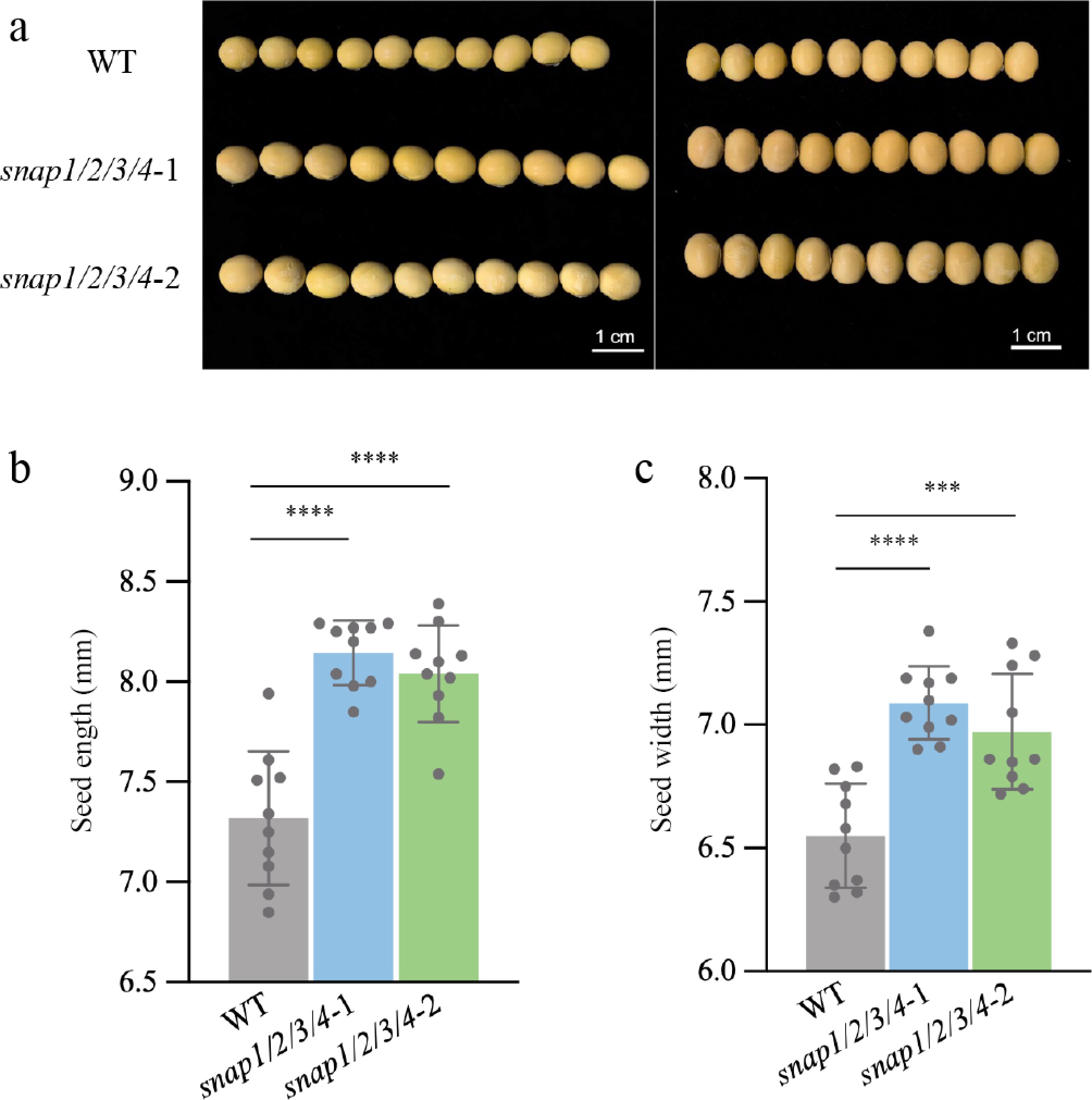
Figure 1.
Phenotypic characterization of snap1/2/3/4 mutant seeds in Sanya. (a) Representative images of mature seeds from WT and two independent snap1/2/3/4 mutant lines (snap1/2/3/4-1 and snap1/2/3/4-2). Scale bars = 1 cm. (b, c) Quantitative analysis of seed length (b) and seed width (c). Data are presented as the mean ± SD, and the error bars represent the SD. Statistical significance was determined by one-way ANOVA with Dunnett's post hoc test (n = 10); asterisks indicate significant differences compared with the WT (*** p < 0.001, **** p < 0.0001).
Transcriptional differences observed in seeds of the snap1/2/3/4 mutants
-
To elucidate the transcriptional landscape underlying the phenotypic alterations in seeds, we performed high-throughput RNA-seq using seeds harvested at two critical developmental stages: The full seed stage (R6) and the beginning of maturity (R7). We selected these stages because they encompass the period with the most active TAG accumulation and the peak of DGAT expression in soybean seeds, and the seed-filling transcriptome (R4–R7) has been comprehensively profiled[33,34]. These stages were designated S1 and S2, respectively, to capture the dynamic changes in gene expression during the transition from seed filling to maturation (Fig. 2a). Comparative transcriptome analysis between the snap1/2/3/4 mutants and the WT control revealed substantial transcriptional reprogramming during seed development (Supplementary Figs S1 and S2). At the S1 stage, 13,919 DEGs were identified between the mutants and WT, with 7,873 genes upregulated and 6,046 genes downregulated in the mutant (|log2FC| > 1, FDR < 0.05) (Fig. 2b and Supplementary Table S2). As development progressed to the S2 stage, the number of DEGs increased markedly to 19,747, comprising 12,631 upregulated and 7,116 downregulated genes using the same statistical thresholds (Fig. 2b and Supplementary Table S3). These results demonstrate that the snap1/2/3/4 mutants induce significant and stage-specific transcriptional alterations during soybean's seed development. In WT plants, the transition from S1 to S2 was also accompanied by extensive transcriptional reprogramming. In total, 11,810 DEGs were identified, with 3,652 genes significantly upregulated and 8,158 genes downregulated in the S2 stage compared with S1 (Fig. 2c and Supplementary Table S4). This extensive downregulation suggests a broad suppression of metabolic activities associated with active cell division and expansion as the seeds enter the maturation phase. In sharp contrast, the snap1/2/3/4 mutants exhibited a significantly attenuated transcriptional response during the same developmental transition. Only 1,831 DEGs were detected between S2 and S1 in the mutant background, comprising 1,133 upregulated and 698 downregulated genes (Fig. 2c and Supplementary Table S5). The pronounced divergence in gene expression profiles between the mutant and WT, particularly the growing number of DEGs from S1 to S2, suggests that the regulatory influence of the snap1/2/3/4 mutants becomes more prominent as the seeds approach maturity, potentially contributing to the observed phenotypic changes in oil accumulation and seed size.
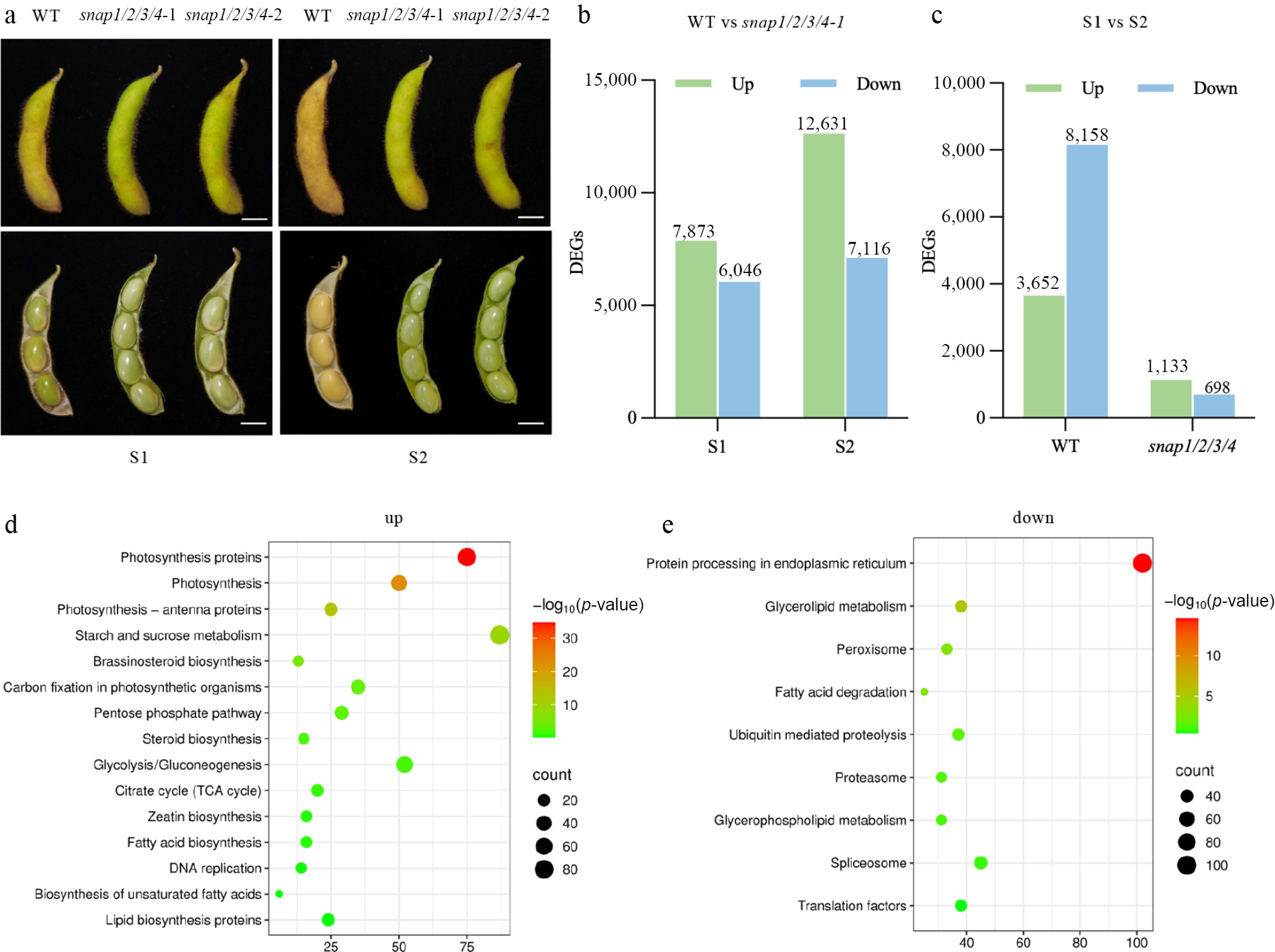
Figure 2.
Transcriptomic profiling of the snap1/2/3/4 mutants compared with WT soybean. (a) Phenotypes of the WT and snap1/2/3/4-1 and snap1/2/3/4-2 mutant pods at two developmental stages (Guangzhou), S1 (R6, full seed stage) and S2 (R7, beginning of maturity). Scale bars = 1 cm. (b) The number of DEGs between the WT and snap1/2/3/4 mutants at Stages S1 and S2. (c) Comparison of DEGs between Stages S1 and S2 within the WT and the snap1/2/3/4 mutants. (d) KEGG pathways for upregulated DEGs of Stage S1 in snap1/2/3/4 mutants and the WT. (e) KEGG pathways for downregulated DEGs of Stage S1 in snap1/2/3/4 mutants and the WT. The size of the bubble represents the gene count, and the color gradient indicates the statistical significance.
KEGG pathway enrichment analysis of DEGs of Stage S1 indicate that the enlarged seed size and elevated oil content in the mutant result from synergistic enhancement of carbon assimilation, hormonal regulation, and lipid biosynthesis, coupled with suppression of catabolic processes (Fig. 2d, e; Supplementary Tables S6 and S7). The significant upregulation of photosynthesis, carbon fixation, and glycolysis/gluconeogenesis pathways suggest a robust carbon flux from source to sink, providing abundant carbon precursors (acetyl-CoA) and energy for biosynthetic activities. Crucially, the enrichment of BR biosynthesis points to a hormonal driver for cell expansion; elevated BR levels likely promote cell elongation and division, directly contributing to the increased seed size. This growth promotion is further supported by the upregulation of DNA replication, indicating sustained proliferative activity during seed development. Regarding oil accumulation, the snap1/2/3/4 mutants exhibit coordinated activation of the TAG assembly line. The upregulation of fatty acid biosynthesis, biosynthesis of unsaturated fatty acids, and lipid biosynthesis proteins confirm an enhanced de novo synthesis capacity (Fig. 2d). Simultaneously, the downregulation of fatty acid degradation, peroxisomal metabolism, and glycerolipid metabolic pathways indicates weakened lipid catabolism and turnover, thereby reducing oil consumption (Fig. 2e). In summary, the snap1/2/3/4 mutants trigger metabolic reprogramming characterized by BR-mediated growth promotion and a shift in carbon partitioning toward lipid storage, resulting in larger, oil-rich seeds.
SNAPs regulate the expression of BR pathway and lipid biosynthesis genes
-
To elucidate the molecular mechanism underlying the phenotypic alterations in seed size and oil content observed in the snap1/2/3/4 mutants, we analyzed the expression levels of representative genes associated with BR signaling, sugar transport, and fatty acid biosynthesis. The transcript levels of BZR1 and its homologs, as well as those of pivotal genes involved in sugar transport and lipid biosynthesis, were significantly elevated in the snap1/2/3/4 mutants compared with the WT (Supplementary Fig. S3). Moreover, SNAP proteins were shown to directly bind the promoter regions of these genes (Supplementary Fig. S4). This suggests that the loss of SNAP function activates the BR signaling cascade, potentially promoting cell expansion and contributing to the increased seed size phenotype. Specifically, the transcript levels of BZR1 homologs (Glyma.04G033800, Glyma.06G034600) and BEH4 homologs (Glyma.13G266600, Glyma.13G266500, Glyma.12G231500) were significantly upregulated in the snap1/2/3/4 mutants (Fig. 3a). Furthermore, the expression of the sucrose transporter (SWEETIE homolog) and WRI1, a major transcriptional regulator of lipid biosynthesis, was significantly elevated in the mutants, whereas GmRWOS1 (regulator of weight and oil of seed 1), a negative regulator of lipid synthesis, was significantly reduced in the mutant[35] (Fig. 3b). Consistent with this, a broad range of structural genes encoding enzymes critical for fatty acid elongation and TAG assembly showed significant upregulation in the snap1/2/3/4 mutants (Fig. 3c). Genes encoding β-ketoacyl-ACP synthases (KAS1, KAS2), ketoacyl-CoA synthases (KCS), acyl-CoA synthetases (ACS), and DGAT (DGATs) exhibited substantially higher transcript abundance relative to the WT. Collectively, these results demonstrate that SNAP genes act as negative regulators of both BR signaling and the lipogenic program. Derepression of BZR1/BEH4 likely drives cell growth. Concurrently, activation of WRI1 and fatty acid/TAG biosynthetic genes, together with the repression of RWOS1, enhanced carbon flux into oil storage, thereby explaining the dual phenotype of enlarged, oil-rich seeds in the snap1/2/3/4 mutants.
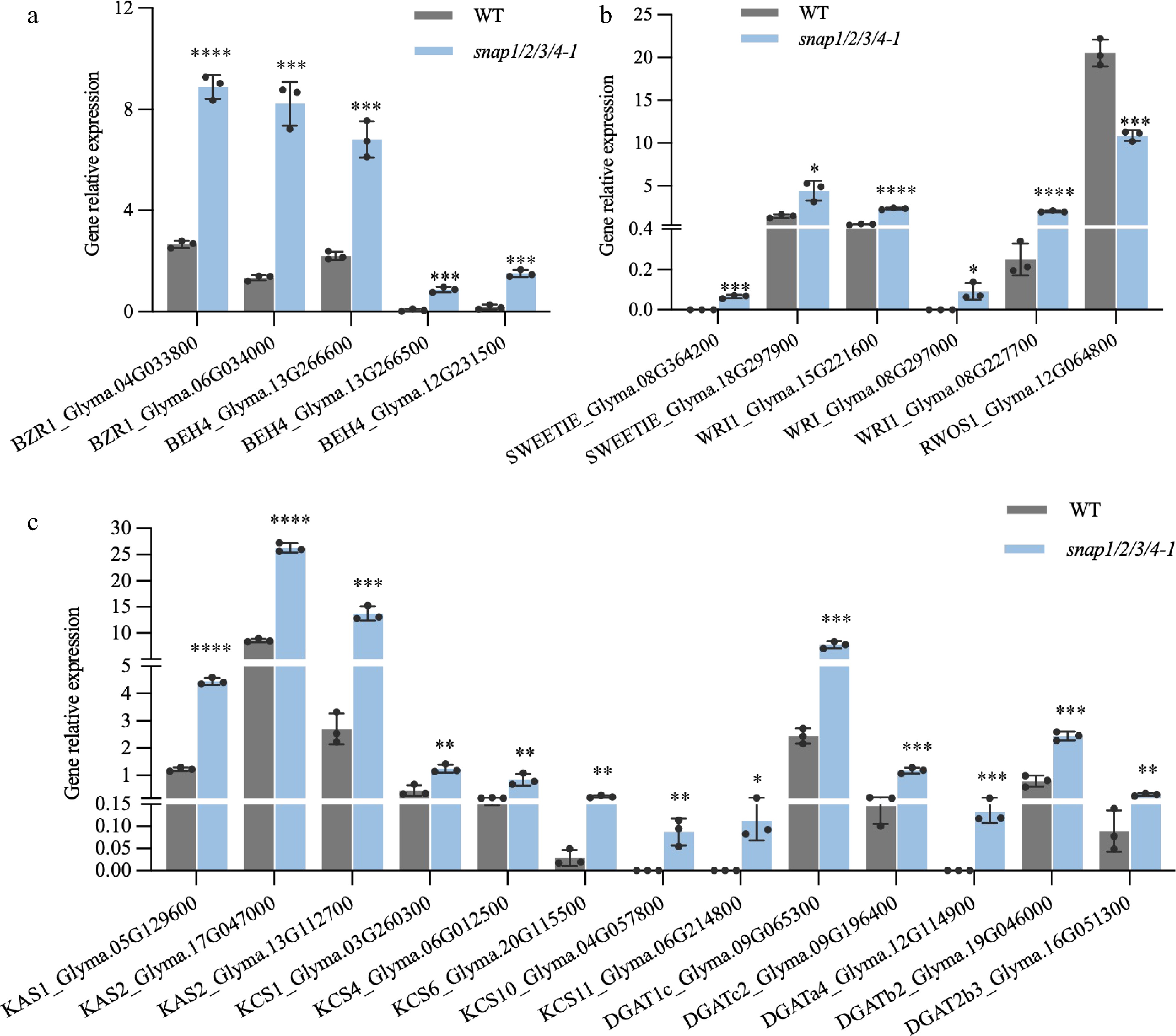
Figure 3.
Expression profiles of key genes involved in BR signaling, sugar transport, and fatty acid biosynthesis in the WT and snap1/2/3/4 mutants. (a) Relative expression levels of genes associated with BR signaling, including BZR1, BEH4, and their homologs. (b) Expression profiles of genes related to lipid synthesis (SWEET, WRIs, RWOS1). (c) Expression profile of key enzyme genes in the lipid synthesis pathway. Data are presented as the mean ± SD (n = 3). * p < 0.05, ** p < 0.01, *** p < 0.001, **** p < 0.0001; Student’s t-test. Asterisks indicate significant differences compared with the WT.
SNAPs repress the expression of genes related to BR signaling and the Kennedy pathway to regulate seed development and oil content
-
To elucidate the molecular mechanisms underlying the snap1/2/3/4 mutant phenotype, we performed an integrative analysis of SNAP binding sites and transcriptomic data. Intersection analysis of ChIP-seq and RNA-seq data at Stages S1 and S2 revealed significant overlaps between SNAP binding genes and DEGs. Specifically, 816 repressed genes and 913 activated genes at S1 (Fig. 4a), as well as 1,358 repressed and 912 activated genes at S2 (Fig. 4b), were identified as direct targets of SNAP. The GO and KEGG enrichment analyses of all the suppressed target genes in S1 and S2 demonstrated that they are significantly enriched in biological processes related to BR signaling (e.g., "response to brassinosteroid" and "brassinosteroid-mediated signaling pathway") and lipid metabolism (e.g., "fatty acid elongation" and "fatty acid biosynthesis"), suggesting that SNAPs regulate seed development by directly modulating these pathways (Fig. 4c and Supplementary Tables S8 and S9). Moreover, GmDGAT1, GmDGATc2, and GmBEH4-1 exhibited significant and sustained upregulation in the snap1/2/3/4 mutants compared with the WT throughout Stages S1 and S2 (Fig. 4d), underscoring their pivotal roles in determining seed size and oil content. ChIP-seq data confirmed that SNAP1 directly binds to the promoters of DGAT1 (Glyma.09G065300) and BEH4-1 (Glyma.13G266600), establishing them as direct downstream targets (Fig. 4e). These results collectively suggest that SNAPs act as transcriptional regulators that directly target the genes involved in BR signaling and fatty acid biosynthesis to control seed size and development.
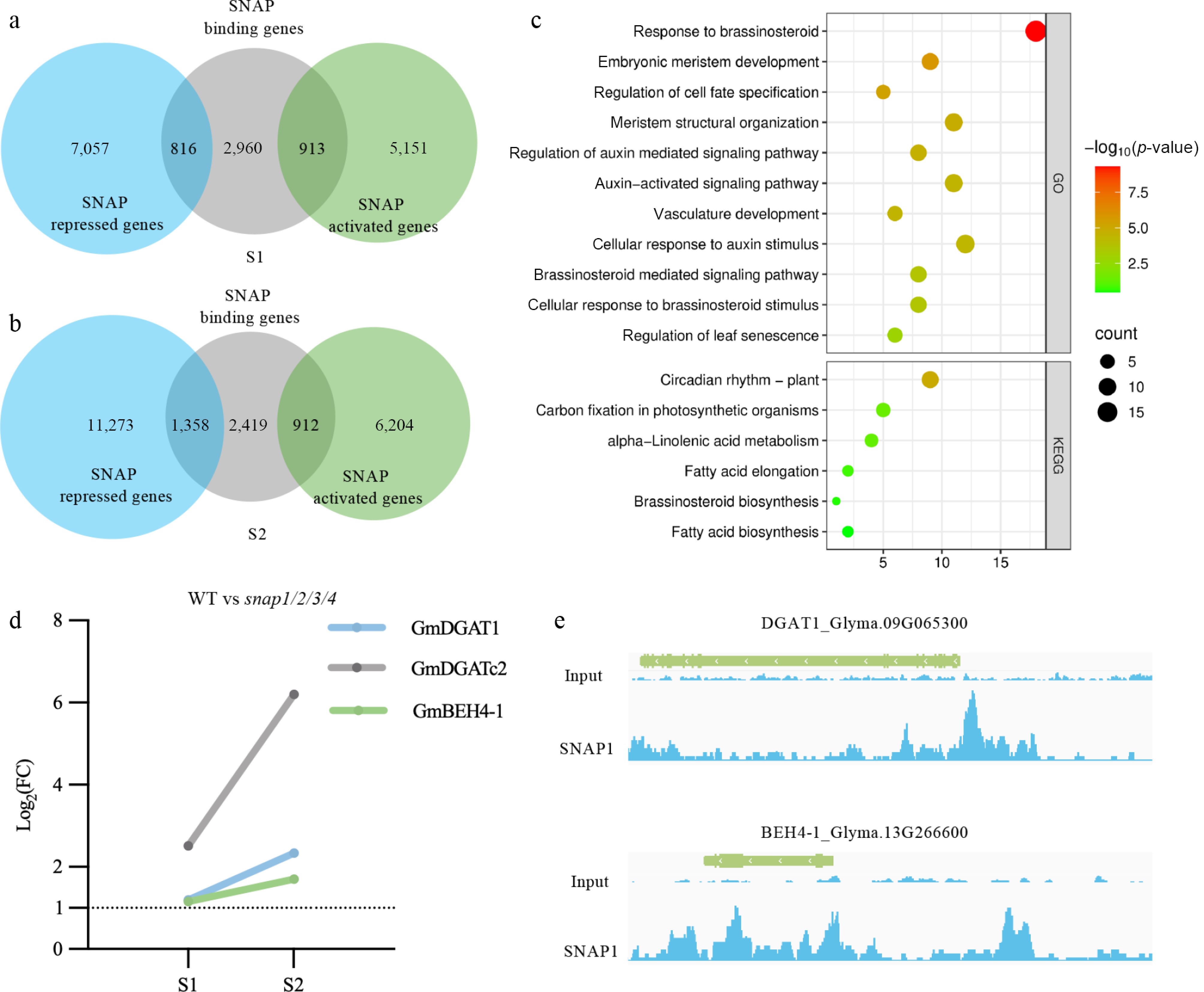
Figure 4.
Integrative analysis of SNAP binding targets and transcriptomic data. (a), (b) Venn diagrams illustrating the overlap between SNAP binding genes (ChIP-seq peaks) and differentially expressed genes (DEGs) at developmental stages (a) S1 and (b) S2. (c) GO and KEGG pathway enrichment analyses for the target genes directly inhibited at both S1 and S2 simultaneously. (d) The expression changes of representative candidate genes between the WT and snap1/2/3/4 mutants across Stages S1 and S2. (e) Genome browser tracks visualizing the ChIP-seq signal intensity of SNAP1 at the genomic loci of DGAT1 and BEH4-1.
SNAP1 represses seed oil accumulation and seed size by directly binding to the DGAT1 and BEH4-1 promoters
-
ChIP-qPCR confirmed the physical interaction between SNAP1 and the promoters of DGAT1 and BEH4-1 in vivo. Significant enrichment of SNAP1-FLAG was observed at the P1 region of the BEH4-1 promoter and DGAT1 promoter relative to the IgG control (Fig. 5a–c). To further verify whether SNAP1 regulates the transcription of these genes, we conducted dual-LUC reporter assays in tobacco leaves (Fig. 5d). The transient expression of SNAP1 significantly repressed the luciferase activity driven by the DGAT1 and BEH4-1 promoters compared with the empty vector control (Fig. 5e–h), suggesting that SNAP1 acts as a transcriptional repressor of DGAT1 and BEH4-1. Collectively, these results demonstrate that SNAP1 directly binds to the promoters of key BR signaling and lipid biosynthesis genes, such as BEH4-1 and DGAT1, to suppress their transcription, thereby showing SNAP-mediated regulation determines seed size and oil content.
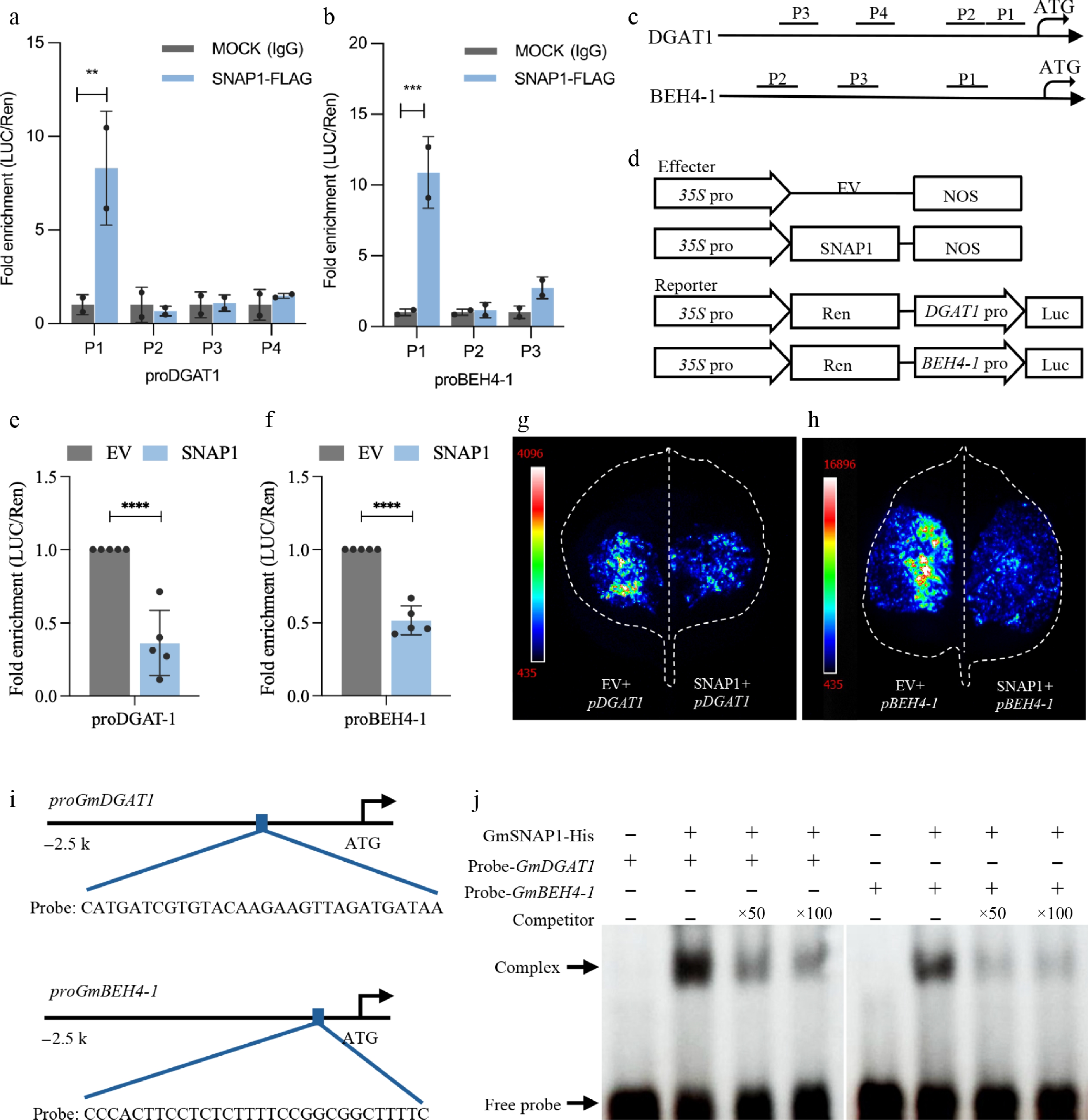
Figure 5.
SNAP1 directly binds to and represses the transcription of target genes. (a)–(c) ChIP-qPCR analysis showing the enrichment of SNAP1-FLAG at specific promoter regions relative to the mock (IgG) control. Data are presented as the mean ± SD. ** p < 0.01, *** p < 0.001; Student’s t-test. (d) Schematic diagram of the effector and reporter constructs used in the dual-LUC assay. The effector constructs contain either an empty vector (EV) or SNAP1 driven by the CaMV 35S promoter. The reporter constructs contain the firefly luciferase (LUC) gene driven by the BEH4-1 or DGAT1 promoters, with Renilla luciferase (REN) as an internal control. (e), (f) Relative fold change in relative promoter activity (LUC/REN). Data are presented as the mean ± SD, *** p < 0.001, Student’s t-test. (g), (h) Representative images of LUC activity in N. benthamiana leaves co-infiltrated with the indicated effector and reporter constructs. The color scale indicates the intensity of luminescence. (i) Location of biotin-labeled DNA probes within the 2.5-kb upstream region of the ATG start codon for GmDGAT1 and GmBEH4-1. The probe sequences are shown below each schematic. (j) EMSA results showing protein–DNA complex formation. Recombinant GmSNAP1-His protein was incubated with labeled probes in the presence or absence of unlabeled competitor DNA (×50 or ×100). "Complex" indicates shifted bands representing specific protein–probe interactions; "Free probe" denotes unbound oligonucleotides. Competitor specificity confirms that binding is sequence-specific. Probe labeling, binding buffer composition, and electrophoresis conditions followed the standard protocols as described earlier.
To provide direct biochemical evidence for the sequence-specific interaction between SNAP1 and its target promoters, we performed an EMSA using purified recombinant GmSNAP1-His protein and biotin-labeled DNA probes corresponding to the ChIP-seq peak regions of DGAT1 and BEH4-1 (Fig. 5i). Incubation of GmSNAP1-His with the WT DGAT1 probe, which harbors a canonical NAC recognition core (CACG), resulting in the formation of a distinct retarded protein–DNA complex (Fig. 5j). Similarly, GmSNAP1-His produced a clear mobility shift when incubated with the WT BEH4-1 P1-region probe (Fig. 5j), despite the absence of a classical NAC consensus motif within this region, consistent with the in vivo ChIP-qPCR enrichment observed at the same locus. In both cases, the shifted bands were effectively competed away by the addition of unlabeled WT competitor DNA at 50-fold or 100-fold molar excess, confirming that the binding was sequence-specific and saturable. No shifted complex was detected when the labeled probes were incubated with the buffer alone, ruling out nonspecific interactions. Together, these EMSA results establish that SNAP1 directly and specifically binds to the promoter regions of both DGAT1 and BEH4-1 in vitro, providing orthogonal biochemical validation that complements the in vivo ChIP-qPCR and functional reporter assays.
-
Early transcriptomic and co-expression network analyses have identified homologs of BR receptors and signaling kinases as central hubs in the early seed coat's regulatory network, closely associated with large seed traits; however, their upstream repressors have remained elusive[36]. In rice, OsNAC129 acts as a negative regulator of BR signaling and grain development, providing a cross-species precedent for a repressive NAC–BR module[37]. In soybean, oil accumulation has been predominantly attributed to positive transcriptional regulators—including LEC1/LEC2, WRI1, NF-Y, DREB, and zinc finger (ZF) families—that promote fatty acid biosynthesis and TAG assembly[27,38−41]. Terminal acyltransferases such as DGAT and Phospholipid:Diacylglycerol Acyltransferase (PDAT) are established positive determinants of both seed size and oil content[14,15,42,43], yet their upstream repressive regulators have remained unidentified. Although NAC family members have been correlated with variations in oil content and seed size variation in plants[44−46], most evidence is limited to co-expression networks. The direct repression of BRs and GmDGAT1 by SNAP provides a precise molecular target for the strategy of knocking out negative regulators to achieve simultaneous gains in seed size and oil, echoing previous findings on repressive MYB89-like factors[47,48]. By integrating ChIP-seq with stage-specific transcriptomics in soybean, our work establishes a definitive causal chain linking SNAP1 to its direct targets and the resulting phenotype. Our study positions SNAPs unequivocally upstream of BR signaling components (BEH factors) and lipid synthesis, filling a critical gap in understanding how BR activity is terminated to restrict seed growth in soybean and how genes directly regulating oil synthesis in soybean are identified and explored. We examined the ChIP-seq browser trajectories of SNAP1/2/3/4 at the promoter regions of lipid biosynthesis and BR signaling genes in our seed dataset (Supplementary Fig. S4). SNAP1 targets five downstream genes in these pathways, whereas SNAP2 and SNAP4 each target three, with substantial overlap among the three paralogs. This convergent targeting profile confirms that SNAP1–4 function redundantly in transcriptional regulation during seed development; accordingly, we used SNAP1 throughout as the representative member of the subfamily, acknowledging that individual homologs may retain distinct contributions beyond the shared targets examined here.
Mechanistically, SNAP1 protein functions as a dual repressor that directly targets GmBEH4-1 and GmDGAT1, initiating coordinated suppression of BR signaling and lipid biosynthesis as early as Stage S1, with markedly enhanced repression at S2. This temporal dynamic suggests that SNAP sets a metabolic threshold for growth versus storage carbon allocation at the onset of seed filling, rather than passively responding to carbon substrates' availability later in development. Such stage-specific regulation likely intersects with dynamic BR sensitivity during seed maturation, consistent with the established role of BR in plant growth and development[49,50]. Contrary to the conventional view that BR-mediated cell expansion and WRI1/LEC1-driven lipid accumulation operate as parallel pathways, our identification of SNAP as a shared upstream node reveals a coordinated repression mechanism. This contrasts with the OsBZR1/OsWRI1 positive cascade in rice[51,52], highlighting a parallel, repression-centric regulatory mechanism. Functioning as a molecular switch, SNAP fine-tunes carbon partitioning toward storing lipids by modulating the expression of enzymes involved in fatty acid elongation and TAG synthesis. The EMSA provided direct in vitro evidence that SNAP1 is a sequence-specific DNA-binding repressor of its target promoters, as purified SNAP1-His formed retarded complexes with both DGAT1 and BEH4-1 probes that were competed away by excess unlabeled DNA. The canonical CACG motif underlies DGAT1 binding, whereas BEH4-1 may be engaged through a noncanonical interaction. Together, these data complete the occupancy–binding–function chain and validate the representative member strategy for the redundant SNAP1–4 family.
The frequent trade-off between seed size and oil content in crop breeding arises from competition for carbon skeletons between structural growth and storage reserves. The snap1/2/3/4 mutants break this trade-off: Loss of SNAP function simultaneously derepresses cell expansion (via BR) and TAG assembly (via DGAT), redirecting the carbon flux toward oil storage without compromising growth. Furthermore, the significant downregulation of RWOS1 (a negative regulator of lipid synthesis and a downstream WRI-responsive gene) at S1 suggests an indirect amplification within the lipogenic network. No SNAP1 binding peak was detected at the RWOS1 promoter in our ChIP-seq dataset; RWOS1 is therefore not classified as a direct SNAP1 target, and the associated positive feedback loop is proposed as a hypothetical model distinct from the directly validated repression of DGAT1 and BEH4-1, consistent with the SPF1/SPF2-WRI1 bistable switch recently described in soybean[53]. Future studies should prioritize elucidating the upstream signals governing SNAP activity, the epigenetic mechanisms underlying its temporal specificity, and natural allelic variation across soybean germplasm[28]. Additionally, determining whether SNAP physically interacts with established lipid regulators such as WRI1 or LEC2 will be essential for constructing a comprehensive regulatory network of seed oil biosynthesis, ultimately facilitating the translation from mechanistic insight to precision trait design.
-
In conclusion, we show that the soybean NAC transcription factor SNAP, a member of the SNAC-B/NAP subfamily, acts as a direct transcriptional repressor of DGAT1 and BEH4-1, thereby constraining TAG biosynthesis and BR-mediated seed developmental progression. Integrative RNA-seq and ChIP-seq analyses further place SNAP at the apex of a broad regulatory network covering oil biosynthesis genes, sugar transporters, and seed development programs. Whereas SNAP was previously known solely for its role in the nodule nitrogen response and senescence, this work reveals its pleiotropic role in seed oil accumulation, linking NAC-mediated transcriptional control to BR signaling crosstalk and providing actionable genetic targets for breeding high-oil soybean.
-
The authors confirm their contributions to the paper as follows: coordinated and designed the project: Wang X, Guan Y; performed experiments and data analysis: Wang N, Li Y, Zhou Y; participated in the experiments: Kong D, Zhou Z, Peng Y; wrote the manuscript: Wang X, Guan Y, Wang N. All authors reviewed the results and approved the final version of the manuscript.
-
All data supporting this study are available in the article, Supplementary Information, and Source Data files. The RNA-seq data are deposited at the China National Center for Bioinformation under accession PRJCA068036, whereas the ChIP-seq data are available from NCBI (PRJNA907509), as generated in our previous study[30]. Additional datasets are available from the corresponding author upon reasonable request.
-
The authors declare that they have no conflict of interest.
-
accompanies this paper online at: https://doi.org/10.48130/seedbio-0026-0024.
-
# Authors contributed equally: Nan Wang, Yingqi Li, Yanhui Zhou
- Copyright: © 2026 by the author(s). Published by Maximum Academic Press on behalf of Hainan Yazhou Bay Seed Laboratory. This article is an open access article distributed under Creative Commons Attribution License (CC BY 4.0), visit https://creativecommons.org/licenses/by/4.0/.
-
About this article
Cite this article
Wang N, Li Y, Zhou Y, Kong D, Zhou Z, et al. 2026. The NAC transcription factor SNAP represses DGAT1 and BEH4-1 to limit soybean seed development and oil accumulation. Seed Biology 5: e028 doi: 10.48130/seedbio-0026-0024 

The NAC transcription factor SNAP represses DGAT1 and BEH4-1 to limit soybean seed development and oil accumulation
- Received: 03 July 2026
- Revised: 24 August 2026
- Accepted: 29 September 2026
- Published online: 03 November 2026
Abstract: Triacylglycerol (TAG) serves as the primary storage lipid in plants and is essential for seed germination and early seedling development. Diacylglycerol acyltransferase 1 (DGAT1) catalyzes the final step of TAG biosynthesis and is a key determinant of seed oil content and composition. Brassinosteroid (BR) signaling plays a pivotal role in coordinating seed development, oil biosynthesis, and filling duration. Here, we uncover a previously unrecognized function of the soybean (Glycine max) NAM, ATAF1,2, and CUC2 (NAC) transcription factor soybean nitrogen associated NAP (SNAP), a member of the SNAC-B/NAC-like, activated by AP3/PI (NAP) subfamily, in seed development, showing that SNAP directly represses DGAT1 and BR signaling's core component BES1/BZR1 homolog 4-1 (BEH4-1), thereby constraining oil accumulation and developmental progression. Integrative RNA sequencing and chromatin immunoprecipitation sequencing analyses demonstrate that SNAP orchestrates a broad transcriptional program encompassing oil biosynthesis genes (e.g., GmWRI1, GmKAS), sugar transporters (GmSWEET), and seed development networks, while also acting as a direct transcriptional repressor of DGAT1 and BEH4-1 by binding to their promoters. Notably, the SNAP family has previously been characterized exclusively as a regulator of the nodule nitrogen response and senescence. Our findings reveal a conserved yet distinct function of SNAP in mediating seed development and crosstalk with BR signaling, uncovering its pleiotropic roles beyond nodulation and providing key genetic targets for molecular breeding of high-yield, high-oil soybean materials.
-
Key words:
- Soybean;
- NAC transcription factor;
- BEH4-1;
- Brassinosteroid;
- DGAT;
- Seed oil