












-
Synthetic apomixis, which enables the clonal propagation of hybrids through seeds, offers a promising approach to fix heterosis[1]. In rice (Oryza sativa), synthetic apomixis has been achieved by combining MiMe (mitosis instead of meiosis) with ectopic expression of parthenogenesis genes. Among the reported systems, the OsBBM1-based approach achieves the highest clonal efficiency, with rates of 95%–100%[2,3]. However, this high efficiency is often accompanied by reduced fertility. Other parthenogenesis triggers, including OsBBM4, OsWUS, and OsBEL, can maintain normal seed set but they generally produce lower clonal efficiencies[4−6]. An exception has been claimed for a newly reported trigger, HUAXU, which is reported to achieve both high clonal efficiency and normal seed set[7]. Although substantial progress has been made, the currently known parthenogenesis triggers of rice remain confined to a limited set of transcription factor families. Thus, identifying the functional triggers from additional transcription factor families would expand the molecular toolkit for synthetic apomixis.
To identify candidate parthenogenesis regulators beyond these known families, we re-analyzed zygote transcriptome data covering the egg-to-zygote transition in rice[8]. This analysis identified 181 genes that were continuously upregulated at 2.5, 5, and 9 h after fertilization. Among these, 14 encoded transcription factors, including members of the BBM family, whose founding member, BBM1, has been validated as a parthenogenesis trigger[2]. The recovery of BBM family genes from this dataset supports the biological relevance of our candidate selection strategy (Fig. 1a, Supplementary Fig. S1). We then prioritized five transcription factors from previously untested families for functional evaluation in the MiMe background. Through this screen, we identified LOC_Os02g38470, which encodes a B3-domain transcription factor, as a functional parthenogenesis trigger capable of inducing clonal seed production when combined with MiMe. We therefore named this gene OsBPF (B3-domain parthenogenesis factor). These findings identify OsBPF as a previously unrecognized parthenogenesis trigger and demonstrate that it can support high-fertility synthetic apomixis in rice.
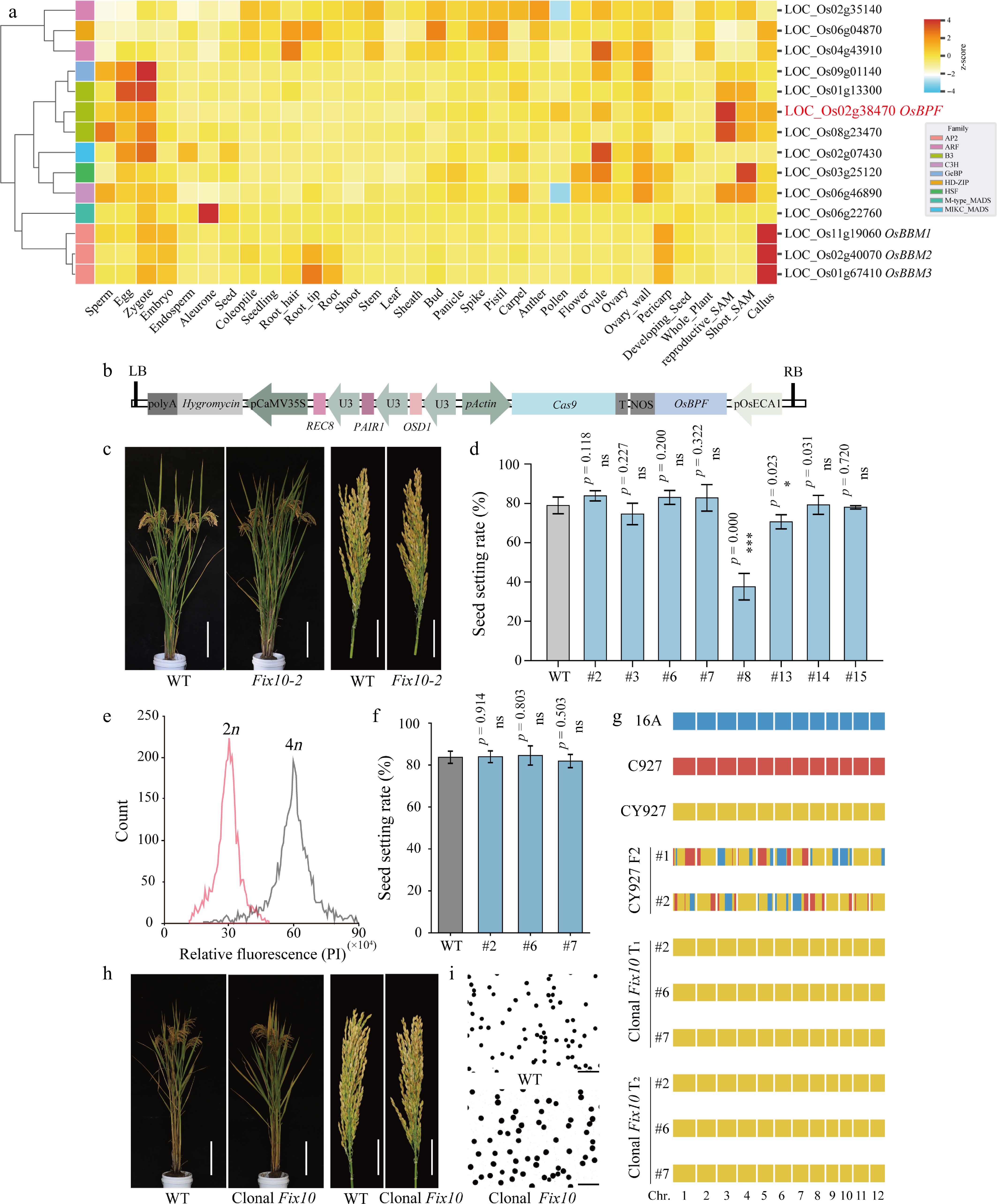
Figure 1.
OsBPF enables high-fertility synthetic apomixis in hybrid rice. (a) Heatmap of 14 zygote-enriched transcription factors across various rice tissues. The Z-score indicates the relative expression level; "Family" indicates the transcription factor family. (b) Diagram of the vector design integrating MiMe with the ectopic expression of OsBPF. (c) Plant morphology and panicles of wild-type (WT) and Fix10. Scale bars, 20 cm for plants, 5 cm for panicles. (d) Seed-setting rate of Fix10 plants (T0). Each bar represents an individual plant; three panicles per plant were measured as technical replicates, and the mean value is shown. Bars show the mean ± standard deviation (SD) (n = 3). For T0 events, independent two-sample Student's t-tests are used only as exploratory event-level comparisons to identify well-performing lines, not as formal population-level inference. * p < 0.05; *** p < 0.001; ns, not significant. (e) Flow cytometry analysis of ploidy levels in the offspring of Fix10. Red peaks: 2C diploid (WT and clonal progeny); black peaks: 4C tetraploid (nonclonal progeny). PI, propidium iodide. (f) Seed-setting rate of Fix10 plants (T1). Each bar represents an individual T1 plant; three panicles per plant were measured as technical replicates, and the mean value is shown. Bars show the mean ± SD (n = 3). For T1 events, independent two-sample Student's t-tests were used; ns, not significant. (g) Whole-genome sequencing of hybrid rice CY927, its parents 16A and C927, F2 progeny, and clonal Fix10 plants (T1 and T2 generations). Blue, 16A alleles; red, C927 alleles; yellow, heterozygous alleles across the 12 chromosomes. (h) Comparison of the plant morphology and panicles of WT and clonal Fix10 plants. Scale bars, 20 cm for plants and 5 cm for panicle. (i) Comparison of pollen viability between WT and Fix10 revealed via iodine staining. Scale bars, 200 µm.
-
To identify candidate genes upregulated during the egg-to-zygote transition, we re-analyzed the RNA sequencing (RNA-seq) dataset from manually isolated rice egg cells and zygotes generated by Anderson et al. Differential expression analysis was performed between egg cells and zygotes at 2.5, 5, and 9 h after fertilization. From Supplementary Table S1A of Anderson et al.[8], which contains cluster assignments and differential expression calls for 7,704 genes labeled as differentially expressed in at least one contrast in the time series, we extracted genes that were consistently upregulated at all three post-fertilization time points relative to the egg cell. This yielded 181 continuously upregulated genes, of which 14 were transcription factors. We excluded the three BBM family members already validated as parthenogenesis triggers, as well as three additional genes (qSE4, OsHsfB4d, and OsGeBP11) previously characterized in other contexts with no reported link to parthenogenesis. The remaining eight genes fell into six distinct transcription factor families. For functional evaluation, we selected one representative gene from each of the five families whose members had not been previously implicated in parthenogenesis, according to the availability of full-length coding sequences and conserved functional domains. The C3H family was not represented in our selection because no member of this family has been reported to be associated with parthenogenesis or embryogenic initiation in plants. The complete list of 181 continuously upregulated genes, with all 14 transcription factors highlighted, is provided in Supplementary Table S1. The transcriptome data used for the heatmap in Fig. 1a were downloaded from the rice RNA-seq database (
https://plantrnadb.com/ricerna ; Zhailab, SUSTech). Fragments per kilobase of transcript per million mapped reads (FPKM) values were converted to transcripts per million (TPM), and expression levels for each tissue type were averaged across multiple libraries.Plasmid construction
-
The coding sequences of LOC_Os02g07430, LOC_Os02g35140, LOC_Os02g38470 (OsBPF), LOC_Os06g04870, and LOC_Os06g22760 were amplified from cDNA of the rice variety "Nipponbare" by polymerase chain reaction (PCR). Each coding sequence was placed under the control of the egg-cell-specific OsECA1 promoter (2,078 bp upstream of the ATG start codon of LOC_Os03g18530), whose strict egg cell expression specificity has been previously validated via reporter gene assays and cell-type transcriptomic profiling in rice[3]. The expression cassettes were constructed via Gibson assembly (NEB, USA) and cloned into the pC1300 binary vector backbone. A clustered regularly interspaced short palindromic repeat (CRISPR)/CRISPR-associated protein 9 (Cas9) multiplex guide RNA cassette targeting the three core MiMe genes (OsPAIR1, OsREC8, and OsOSD1) was assembled into the same T-DNA region, following the multiplex genome editing strategy described by Wang et al.[9]. The resulting construct, designated OsBPF-MiMe, was verified by Sanger sequencing prior to transformation. The primers used for vector construction are listed in Supplementary Table S2.
Rice transformation and growth conditions
-
The binary vector was introduced into Agrobacterium tumefaciens strain EHA105 by electroporation. Embryogenic calli derived from mature seeds of the indica–japonica hybrid rice variety CY927 were used for Agrobacterium-mediated transformation, which was carried out by EDGENE BIOT Co., Ltd (Wuhan, China). CY927 is an elite inter-subspecific hybrid derived from the sterile japonica line 16A and the indica–japonica restorer line C927; it exhibits strong heterosis in yield, stress tolerance, and plant architecture and is a standard test material for research into synthetic apomixis in rice by our group. Regenerated plants were selected on a medium containing 50 mg/L hygromycin B. During the summer growing season, transgenic plants were grown in the genetically modified rice field at the China National Rice Research Institute (CNRRI) in Hangzhou, Zhejiang, China (30.08° N, 119.94° E). In the winter, plants were cultivated in Sanya, Hainan, China (18.27° N, 109.20° E), under standard paddy field management.
Genotyping of transgenic plants
-
Genomic DNA was extracted from approximately 100 mg of fresh leaf tissue using the cetyltrimethylammonium bromide (CTAB) method. The presence of each transgene and the hygromycin resistance marker was confirmed by PCR using 2× Rapid Taq Master Mix (Vazyme, P222-01). To identify plants carrying homozygous or biallelic mutations in all three MiMe target loci, the genomic regions surrounding each CRISPR target site were PCR-amplified and subjected to the Hi-TOM 2.0 platform[10]. All primers used for genotyping are provided in Supplementary Table S2.
Flow cytometry analysis
-
The ploidy level of progeny plants was determined by measuring the nuclear DNA content using flow cytometry. Fresh leaf tissue (approximately 50 mg) was finely chopped with a razor blade in 1 mL of Galbraith buffer (45 mM MgCl2, 30 mM sodium citrate, 20 mM 3-(N-morpholino)propanesulfonic acid (MOPS), pH 7.0, 0.1% Triton X-100) containing 50 µg/mL of propidium iodide and 50 µg/mL of RNase A. The suspension was filtered through a 40-µm nylon mesh and incubated on ice for 15 min. Samples were analyzed with a CyFlow Space flow cytometer (Partec, Germany). A minimum of 5,000 nuclei were recorded per sample. Wild-type (WT) CY927 leaf tissue (diploid) served as an internal reference standard in each measurement.
Whole-genome resequencing and clonal identity verification
-
Genomic DNA from diploid progeny confirmed by flow cytometry, the WT CY927, its parents 16A and C927, and its F2 progeny, was subjected to whole-genome resequencing. Paired-end libraries (150-bp reads) were prepared and sequenced on the Illumina HiSeq 2500 platform at a minimum depth of 10× coverage per sample. Library preparation and sequencing were performed by Beijing Genomics Institute (Shenzhen, China). Raw reads were aligned to the Nipponbare reference genome (IRGSP-1.0) using BWA-MEM (v0.7.17). Single-nucleotide polymorphisms (SNPs) were identified using the GATK HaplotypeCaller pipeline (v4.1). For clonal identity analysis, 2,131,467 high-quality heterozygous SNP loci were retained, and genotypes at these loci were compared with CY927. Genetic identity between putative clonal offspring and the WT CY927 parent was evaluated by comparing genome-wide SNP profiles. All six whole-genome sequencing (WGS)-validated clonal progeny retained at least 87.8% of SNP alleles shared with CY927 and were classified as genuine clonal individuals. Detailed sequencing statistics for each sample, including clean reads, mapped reads, mapped ratio, and coverage depth, are summarized in Supplementary Table S3. The number of total SNPs and heterozygous SNPs retained for clonal identity analysis is provided in Supplementary Table S4.
Assessment of seed setting rate and clonal efficiency
-
Seed setting rates were determined from three primary tiller panicles per plant, with the three panicles measured as technical replicates. The seed setting rate was calculated as the percentage of filled grains relative to the total number of spikelets per panicle. Statistical comparisons were performed using two-sample Student's t-tests (equal variance assumed after Levene's test), with * p < 0.05 and *** p < 0.001; "ns" indicates not significant (p ≥ 0.05). For T0 plants, t-test comparisons with the WT are provided as a reference to facilitate the identification of well-performing events, rather than as formal population-level statistical inference.
Clonal seed induction efficiency was calculated as the percentage of clonal progeny among the total number of germinated seeds. Clonal efficiencies were recorded across the T1 and T2 generations to assess transgenerational stability.
-
To validate the apomixis-inducing ability of OsBPF, we engineered the OsBPF–MiMe construct and transformed it into the indica–japonica hybrid rice variety CY927 (Fig. 1b). Among 15 independent transgenic T0 plants, eight carried homozygous or biallelic mutations in all three MiMe genes (Supplementary Figs. S2, S3 and Supplementary Table S5). These lines were designated Fix10 (Fixation of hybrids 10). Notably, six of the eight Fix10 lines exhibited seed setting rates similar to that of the WT CY927, and the T0 plants were phenotypically indistinguishable from the WT (Fig. 1c, d). However, Line #8 was a clear exception, showing markedly reduced seed setting (37.60%). This reduction is likely attributable to T-DNA insertion position effects or elevated transgene expression rather than to the OsBPF–MiMe combination, as the other lines maintained WT-like fertility.
To evaluate clonal seed production of Fix10 plants, we performed flow cytometry to determine the progeny's ploidy in the T1 generation. One diploid plant was identified in each of Lines #2, #6, and #7, from screening populations of 119, 117, and 120 plants, respectively (Fig. 1e, Supplementary Table S6). All diploid progeny identified by flow cytometry (one per line in #2, #6, and #7; Supplementary Table S6) were subjected to whole-genome resequencing (sequencing statistics provided in Supplementary Table S3). SNP profile analysis confirmed that these plants retained genome-wide heterozygosity similar to that of the WT CY927 parent (Supplementary Table S4), validating them as genuine clonal offspring (Fig. 1g). The corresponding clonal induction efficiencies were 1/119, 1/117, and 1/120 (Supplementary Table S6). Importantly, these clonal plants maintained WT-like seed setting rates, plant architecture, and grain phenotype (Fig. 1f, h and Supplementary Fig. S4), and showed no obvious reduction in pollen viability, as determined by iodine staining (Fig. 1i).
To test transgenerational stability, we examined the next generation using flow cytometry and whole-genome resequencing. In the T2 generation, the clonal efficiencies were 1/105, 1/120, and 1/117 for Lines #2, #6, and #7, respectively (Supplementary Table S6). These frequencies remained similar to those observed in the T1 generation, confirming heritable maintenance of the apomictic trait. Given the limited number of positive events per line, the observed clonal frequencies should be interpreted as approximate estimates; larger screening populations would be required to establish the precise range of clonal efficiency.
The remaining four transcription factors, although similarly upregulated during zygotic activation, did not induce detectable clonal seed formation when combined with MiMe (Supplementary Figs. S5, S6 and Supplementary Table S7). Although we cannot exclude the possibility that inadequate transgene expression, position effects, or silencing contributed to these negative outcomes, the results suggest that transcriptional upregulation alone may not be sufficient for parthenogenetic activity, and that specific molecular features beyond shared expression patterns are required to trigger autonomous egg cell development. Together with the identification of OsBPF, these negative results highlight the value of systematic functional screening over expression-based prediction alone.
-
In this study, we identified OsBPF as a novel parthenogenesis trigger that, when combined with MiMe, enables synthetic apomixis in hybrid rice with normal fertility. OsBPF joins OsBBM4 (Fix2), OsWUS (Fix3), and OsBEL (Fix6) as a high-fertility synthetic apomixis trigger in rice[4−6]. However, the systems differ markedly in their clonal output: Fix2 and Fix6 achieve approximately 3%–6%, Fix3 reaches up to 21.7%, whereas Fix10 produces one clonal plant per screened population (1/119, 1/117, and 1/120 in T1; 1/105, 1/120, and 1/117 in T2), and all maintain normal seed setting. At the opposite end of the spectrum, the original OsBBM1-based system achieves high clonal efficiency (95%–100%) but exacts a substantial fertility penalty[2,3]. This inverse relationship suggests a model in which trigger strength dictates a trade-off between embryogenic induction and reproductive fitness. The recently reported HUAXU trigger further broadens the repertoire of parthenogenesis factors and suggests that distinct triggers may achieve different combinations of clonal efficiency and fertility through divergent molecular mechanisms[7].
Critically, OsBPF is the first parthenogenesis trigger from the B3-domain family, expanding the molecular repertoire beyond the previously represented AP2/ERF (BBM), WOX (WUS), and homeobox (BEL) lineages. Notably, at least four distinct transcription factor families can each initiate parthenogenesis in the MiMe background, implying that the egg cell's developmental arrest is maintained by a repressive state[2−6]. This state can be disrupted through multiple molecular entry points, possibly converging on common downstream targets such as cell cycle reactivation or auxin biosynthesis. It should be noted, however, that although the OsBPF recovery of diploid clonal progeny in the MiMe background is consistent with parthenogenetic embryo development, direct evidence of embryo initiation in the complete absence of fertilization remains to be established.
Admittedly, the clonal efficiency of Fix10 is modest. The relatively low clonal efficiency of Fix10 compared with OsBBM1-based systems may reflect intrinsic differences in transcriptional activation potency between B3-domain and AP2/ERF transcription factors, or divergence in their downstream target repertoires involved in embryogenic initiation. Alternatively, OsBPF may require a higher expression threshold to overcome egg cell arrest than other triggers. Future optimization strategies could include replacing the promoter with a more robust egg-cell-specific or fusion promoter, or combining OsBPF with other parthenogenesis genes for additive effects. Of the remaining six transcription factors from the original screen that were not tested here, three (qSE4, OsHsfB4d, and OsGeBP11) have been characterized in other contexts, but none has been linked to parthenogenesis[11−13]. The other three remain functionally uncharacterized.
Beyond rice, B3-domain parthenogenesis factors may have potential application in cereal crops. Homologs of OsBPF with a conserved B3-domain structure and embryonic expression patterns are widely present in major cereals, including maize (Zea mays), wheat (Triticum aestivum), and sorghum (Sorghum bicolor)[14]. In addition, the core regulatory pathways of early embryogenesis are largely conserved among grass species, including zygotic genome activation, cell fate specification, and auxin-mediated patterning[15]. OsBPF orthologs may therefore have potential utility as parthenogenesis triggers in other crops, although this remains to be experimentally tested. Although the clonal rate of the current Fix10 system is too low for practical application in any crop, including vegetatively propagated species such as sugarcane (Saccharum officinarum), forage grasses, or potato (Solanum tuberosum), the identification of OsBPF as a B3-domain parthenogenesis trigger provides a new molecular entry point for future optimization. Heterosis is well documented in these crops, yet hybrid seed production is often limited by polyploidy, high heterozygosity, or reliance on vegetative propagation[16]. If the clonal efficiency of OsBPF-based systems could be substantially improved through promoter engineering, gene dosage optimization, or combination with other parthenogenesis factors, B3-domain triggers might eventually offer a route to apomixis in such species. At present, however, the primary contribution of this work is the expansion of the molecular toolkit for engineering apomixis rather than immediate practical deployment.
-
This study identified OsBPF as a novel parthenogenesis trigger from the B3-domain family. When combined with MiMe, it enables synthetic apomixis in hybrid rice with normal fertility, albeit at modest clonal efficiency. This work expands the molecular toolkit for engineering apomixis, highlights the value of functional screening over expression-based prediction, and provides a new entry point for future optimization of clonal efficiency and fertility in synthetic apomixis systems.
-
The authors confirm their contributions to the paper as follows: developed and led the project: Wang K; performed the experiments: Xiong J, Yuan W, Wang D; analyzed the data: Lu H; wrote the manuscript: Xiong J, Wang K. All authors reviewed the results and approved the final version of the manuscript.
-
The whole-genome resequencing data have been deposited in the Genome Sequence Archive under accession number CRA049421 (https://ngdc.cncb.ac.cn/gsa).
-
The authors declare that they have no conflict of interest.
-
accompanies this paper online at: https://doi.org/10.48130/seedbio-0026-0026.
-
# Authors contributed equally: Jie Xiong, Weilong Yuan
- Supplementary Table S1 List of 181 genes continuously upregulated during the rice egg-to-zygote transition.
- Supplementary Table S2 Primers used in this study.
- Supplementary Table S3 Summary of whole genome sequencing data for each sample.
- Supplementary Table S4 Summary of SNP-based clonal identity validation for Fix10 plants.
- Supplementary Table S5 Summary of mutation types at the three MiMe target loci in Fix10 lines.
- Supplementary Table S6 Seed setting rates and clonal seed offspring of Fix10 T0 and T1 generations.
- Supplementary Table S7 Seed setting rates and clonal seed offspring of the other four apomixis constructs.
- Supplementary Fig. S1 Expression dynamics of 14 candidate transcription factors during the egg-to-zygote transition.
- Supplementary Fig. S2 Transgenic positive detection of transformed lines.
- Supplementary Fig. S3 Mutation detection of three MiMe genes of Fix10 lines.
- Supplementary Fig. S4 Comparison of grain phenotype of WT and clonal Fix10 plants.
- Supplementary Fig. S5 Plant morphology and panicles of WT and the other four apomixis constructs.
- Supplementary Fig. S6 Mutation detection of three MiMe genes of the other four apomixis constructs.
- Copyright: © 2026 by the author(s). Published by Maximum Academic Press on behalf of Hainan Yazhou Bay Seed Laboratory. This article is an open access article distributed under Creative Commons Attribution License (CC BY 4.0), visit https://creativecommons.org/licenses/by/4.0/.
-
About this article
Cite this article
Xiong J, Yuan W, Wang D, Lu H, Wang K. 2026. OsBPF, a novel zygote-expressed B3-domain transcription factor, enables high-fertility synthetic apomixis in rice. Seed Biology 5: e029 doi: 10.48130/seedbio-0026-0026 

OsBPF, a novel zygote-expressed B3-domain transcription factor, enables high-fertility synthetic apomixis in rice
- Received: 15 July 2026
- Revised: 07 September 2026
- Accepted: 07 October 2026
- Published online: 04 November 2026
Abstract: Triggers of parthenogenesis for synthetic apomixis remain confined to a few transcription factor families, limiting apomixis deployment in diverse crop contexts. Through re-analysis of zygotic transcriptome data of the egg-to-zygote transition in rice (Oryza sativa), we identified OsBPF (B3-domain parthenogenesis factor), a previously uncharacterized B3-domain transcription factor. When combined with MiMe (mitosis instead of meiosis), OsBPF induces clonal seed formation in the indica–japonica hybrid rice CY927. The lines producing clonal seed (#2, #6, and #7) maintain seed setting, plant architecture, and pollen viability that are similar to those of the wild-type. Flow cytometry and whole-genome resequencing confirmed clonal progeny at observed frequencies of 1/119, 1/117, and 1/120 in the T1 generation and 1/105, 1/120, and 1/117 in the T2 generation. OsBPF represents the first parthenogenesis trigger from the B3-domain family, expanding the known repertoire beyond the BBM, WUS, and BEL families. By contrast, four other transcription factors identified from the same screen, all of which were upregulated during zygotic activation, did not induce detectable clonal seed formation under the tested conditions when combined with MiMe. Although inadequate transgene expression or position effects cannot be excluded, transcriptional upregulation alone may not be sufficient for activating egg cells. The conservation of OsBPF homologs across the major cereals suggests that B3-domain factors could provide a broadly applicable route to apomixis in crops where hybrid seed production remains a bottleneck.
-
Key words:
- Synthetic apomixis /
- Parthenogenesis /
- Hybrid rice /
- B3-domain transcription factor /
- Clonal seed