











-
The heart has long been regarded as resistant to tumor development, as reflected by the rarity of primary tumors, and limited growth of cardiac metastases. This resistance is largely attributed to its low proliferative capacity and its unique metabolic, hemodynamic, and biomechanical environment[1,2]. A recent study published in Science, revealed that sustained mechanical load in the heart suppresses tumor growth[3]. To confirm its causal role, the researchers removed left ventricular mechanical stress via heterotopic heart transplantation, while maintaining normal blood perfusion. The results showed that reduced mechanical load rendered the heart susceptible to tumor growth. This finding was further supported by engineered heart tissue models and long-term static culture systems.
Spatial transcriptomics revealed that cardiac metastases from different origins shared common transcriptional patterns. The most notable changes included increased expression of lysine demethylases, reduced H3K9me3 levels, and concomitant alterations in chromatin state. Single-nucleus ATAC-seq and ChIP-seq data further demonstrated that mechanical load increased chromatin accessibility in cancer cells. These open chromatin regions are highly enriched in pathways associated with cell-cycle arrest and mechanosensing. Functional screening of the linker of nucleoskeleton and cytoskeleton (LINC) complex components identified Nesprin-2 as a key mediator of mechanically induced tumor growth suppression. Knockdown of Nesprin-2 abolished the anti-proliferative effect of mechanical force across multiple cancer cell types and was accompanied by restored H3K9me3 levels and chromatin re-condensation.
-
Nesprin-2, encoded by SYNE2, is a giant scaffold protein localized to the outer nuclear membrane and a central component of the LINC complex[4]. Its C-terminal KASH domain spans the nuclear envelope and interacts with SUN proteins, while its N-terminal region anchors to the actin cytoskeleton. This unique architecture establishes a stable physical coupling between the cytoskeleton and the nuclear scaffold, allowing cytoskeletal forces to be transmitted to the nucleus. Inside the nucleus, Lamin A/C couples the LINC complex to chromatin, allowing mechanical inputs to directly regulate chromatin accessibility and epigenetic landscapes[4]. As one of the few proteins with structurally validated force-transmission capacity, Nesprin-2 plays a key role in cellular responses to mechanical cues and in regulating nuclear structure and function. This role is particularly evident in mechanically active tissues such as the heart and skeletal muscle, where Nesprin-2 helps maintain nuclear tension, limits epigenetic plasticity, and thereby restrains abnormal cell proliferation. In tumors, Nesprin-2 is often dysregulated or functionally impaired in a context-dependent manner[5,6]. Distinct from conventional tumor suppressors, Nesprin-2 may function as a mechanosensor to inhibit tumor growth, particularly under high mechanical stress. Consequently, therapeutic strategies may benefit from targeting downstream nuclear and epigenetic effectors or enhancing its intrinsic mechanotransductive capacity (Fig. 1).
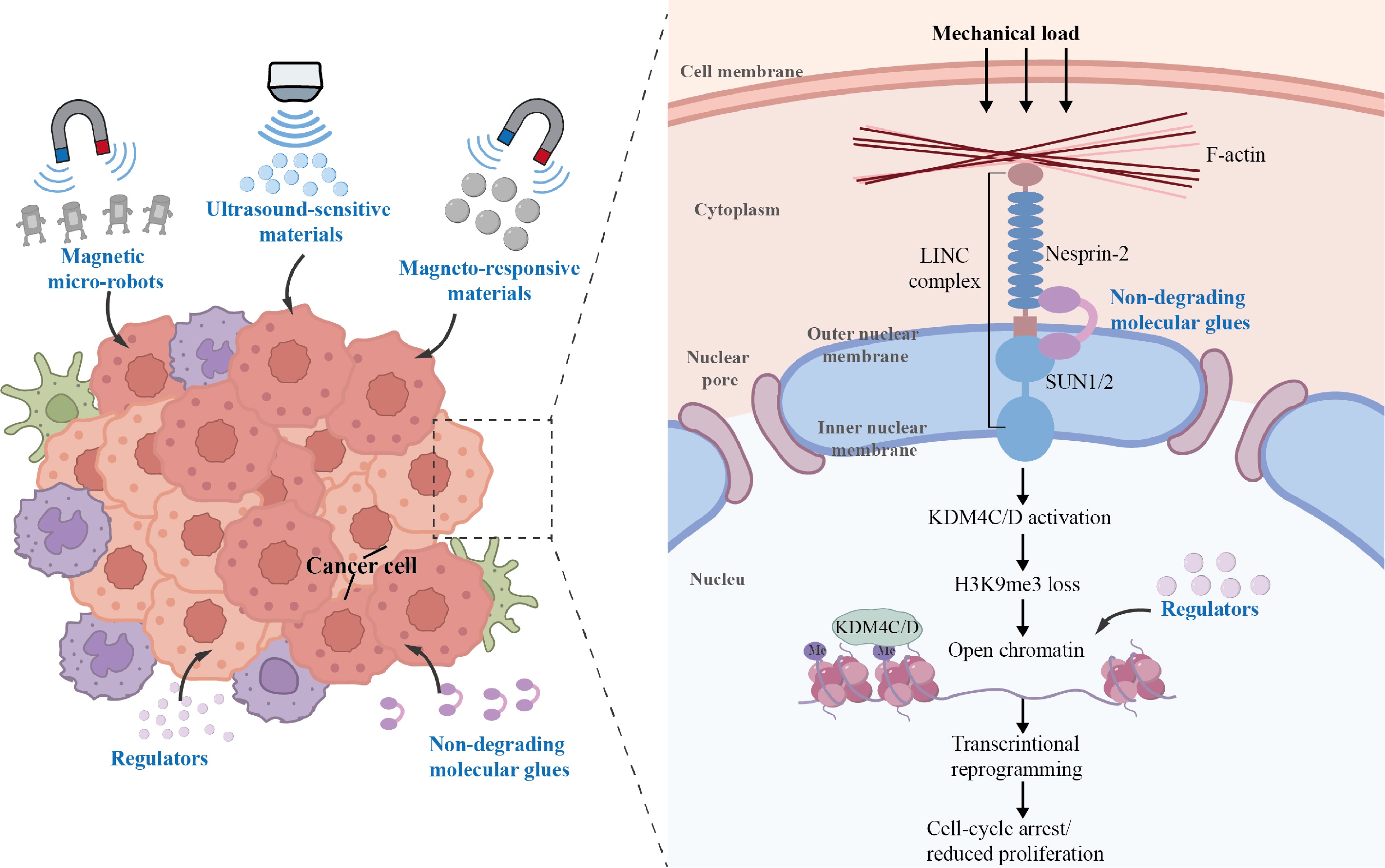
Figure 1.
Schematic illustration of the mechanism underlying mechanical load-induced inhibition of cancer cell proliferation and potential therapeutic strategies. The right panel illustrates the mechanotransduction pathway, in which external mechanical load is transmitted through F-actin to the LINC complex (Nesprin-2 and SUN1/2). This mechanical signal promotes nuclear activation of KDM4C/D, leading to epigenetic alterations, particularly loss of H3K9me3 and subsequent chromatin remodeling. These alterations result in transcriptional reprogramming, ultimately causing cell cycle arrest and reduced tumor cell proliferation. The left panel depicts potential therapeutic approaches, including magnetic microrobots, ultrasound-sensitive materials, magneto-responsive materials, regulators and non-degrading molecular glues used for targeting cancer cells. Therapeutic strategies are highlighted in blue.
-
The Science study suggests that when cancer cells encounter sustained mechanical loading from the beating heart, compression may activate KDM4C/D through a Nesprin-2-dependent nuclear mechanotransduction pathway, resulting in a marked loss of H3K9me3. This process appears to disrupt the intrinsic epigenetic equilibrium of cancer cells and initiates transcriptional reprogramming associated with suppressed proliferation. However, KDM4 proteins, especially KDM4C and KDM4D, have been regarded as canonical oncogenic factors[7−9]. In many solid tumors, including lung, breast, and prostate cancers, abnormally elevated KDM4 activity erases the repressive H3K9me3 mark, thereby promoting oncogene expression and driving tumor progression[10−12]. Accordingly, most current therapeutic strategies targeting H3K9me3 have focused on inhibiting these demethylases. This apparent contradiction highlights a context-dependent 'KDM4 paradox', in which the same enzymatic activity may exert either tumor-promoting or tumor-suppressive effects, depending on the mechanical and epigenetic landscape. The Science discovery therefore challenges the conventional view of KDM4 as a universal driver of tumor growth, suggesting that therapeutic strategies may need to shift from broad inhibition toward rebuilding context-specific epigenetic architectures.
-
In addition, non-degrading molecular glues, which can stabilize protein–protein interactions without inducing degradation, may offer a conceptual means to modulate the LINC complex[13]. For example, the mechanically robust, rapamycin-induced FKBP-FRB system can modulate integrin-talin pathways, demonstrating that reinforcing protein interactions directly enhances force propagation without higher external mechanical input[14]. By analogy, non-degrading molecular glues could potentially stabilize and strengthen the interaction between Nesprin-2 and SUN, without directly activating Nesprin-2 itself. In tissues with low mechanical load, such stabilization is expected to enhance LINC-mediated nucleus-cytoskeleton coupling and improve the efficiency and persistence of force transmission, thereby lowering the threshold for mechanical activation. As a result, the nucleus may adopt a functional state similar to that induced by high mechanical load, thereby promoting mechanically driven epigenetic reprogramming. Implementing this concept will require in-depth structural and biophysical characterization of the SUN-KASH interface, particularly its force-dependent conformational dynamics. Although this strategy carries inherent experimental challenges, it also presents significant translational potential. By lowering the activation threshold of LINC-mediated mechanotransduction, this strategy may allow low-mechanical tissues to generate nuclear responses that are typically observed only under high-load conditions. In this way, mechanically driven tumor-suppressive programs may be recapitulated without increasing extracellular force.
-
Aside from molecular intervention, physical and material-based approaches provide an alternative strategy. Researchers can deliver localized and controllable mechanical stimulation within solid tumors[15,16]. Common tools include magnetic micro-robots, magneto-responsive, and ultrasound-sensitive materials[17−19]. These systems can simulate cyclic mechanical stress similar to that found in cardiac tissue and directly activate the endogenous Nesprin-2/LINC nuclear mechanotransduction pathway. This strategy avoids direct protein manipulation and instead uses external mechanical input to drive the nucleus-cytoskeleton system into a high-stress state, allowing researchers to evaluate how nuclear mechanics regulate tumor suppression. However, this approach still faces clear translational limitations. It relies on implanted or localized devices, external energy sources, and precise spatiotemporal control, making long-term, systemic, and standardized applications challenging.
Overall, mechanical signals have the possible to reshape the epigenetic landscape and growth fate of cancer cells. In this context, Nesprin-2 and the nuclear mechanotransduction axis it mediates emerge as non-canonical, mechanism-driven anticancer targets with broad therapeutic potential. Importantly, this pathway rewires the function of the H3K9me3 demethylase KDM4C/D, demonstrating that the same demethylation machinery can support tumor suppression when engaged by mechanical load rather than oncogenic signaling. Stabilizing the Nesprin-2-SUN interaction using non-degrading molecular glues, or mimicking cardiac-like mechanical forces through physical and material-based approaches, may represent promising directions for future research.
This work was supported by the Science and Technology Development Fund, Macau SAR (File No. 0001-2025-AKP, 0002/2025/NRP and 0008/2025/EQP), the University of Macau (File No. MYRG-GRG2025-00101-ICMS) and the Ministry of Education Frontiers Science Center for Precision Oncology, University of Macau (SP2026-00002-FSCPO).
-
Not applicable.
-
The authors confirm their contributions to the commentary as follows: draft manuscript preparation and revision: Liu F; conceptualization, study conception, manuscript revision and supervision: Lu J. Both authors approved the final version of the manuscript.
-
Data sharing is not applicable to this commentary as no datasets were generated or analyzed.
-
The authors declare that they have no conflict of interest.
- Copyright: © 2026 by the author(s). Published by Maximum Academic Press on behalf of China Pharmaceutical University. This article is an open access article distributed under Creative Commons Attribution License (CC BY 4.0), visit https://creativecommons.org/licenses/by/4.0/.
-
About this article
Cite this article
Liu F, Lu J. 2026. Nesprin-2-mediated epigenetic remodeling under mechanical load: anti-tumor mechanisms and strategies. Targetome 2(4): e033 doi: 10.48130/targetome-0026-0032 

Nesprin-2-mediated epigenetic remodeling under mechanical load: anti-tumor mechanisms and strategies
- Received: 18 May 2026
- Revised: 15 June 2026
- Accepted: 02 July 2026
- Published online: 22 July 2026
Abstract: Primary tumors of the heart are rare, and metastatic growth within the heart is typically limited. In this study previously published in Science, the authors used genetically engineered cancer models, heterotopic heart transplantation, and engineered heart tissue systems to demonstrate that mechanical load directly contributes to the suppression of malignancy. Remarkably, removal of this mechanical load alone was sufficient to permit tumor growth in the heart. At the molecular level, cardiac mechanical load induced a shared epigenetic landscape in metastatic cells, characterized by loss of H3K9me3, increased chromatin accessibility, and activation of growth-suppressive transcriptional programs. Functional screening identified Nesprin-2, a core component of the linker of nucleoskeleton and cytoskeleton (LINC) complex, as a critical mediator of this process. Given that Nesprin-2 itself is unlikely to be directly druggable, targeting downstream epigenetic pathways or therapeutically mimicking mechanical load may represent promising anticancer strategies.
-
Key words:
- Nesprin-2 /
- Mechanical load /
- Epigenetic remodeling /
- Strategies