











-
Rice (Oryza sativa) is a fundamental staple food for more than 65% of China's population[1]. Its production affects not only national food security but also the socioeconomic wellbeing of a large proportion of the population[2]. Hunan Province is the largest rice-producing region in China, accounting for approximately 14% of the national planting area and 13% of total rice production (National Bureau of Statistics of China,
https://data.stats.gov.cn ). In recent years, however, rice production in Hunan has been severely challenged by excessive cadmium (Cd) accumulation in rice grains. This problem is largely attributed to the expansion of Cd-contaminated soils resulting from intensified nonferrous mining and smelting activities[3,4]. Excessive Cd accumulation in rice grains has long been recognized as a global issue in many rice-producing regions. A well-documented example is the outbreak of itai-itai disease in Japan during the 1950s, which was caused by long-term consumption of Cd-contaminated rice[5].To mitigate excessive Cd accumulation in grains, substantial efforts have been made in China to develop Cd-reduction technologies, with the development of low-Cd rice varieties widely regarded as the most economical and sustainable solution[6]. Encouragingly, several low-Cd rice varieties have recently been developed in Hunan by targeting OsNRAMP5[7], a key transporter responsible for Cd uptake in rice that exhibits high affinity for Cd across a wide range of external concentrations[8,9]. Grain Cd concentrations in these varieties have been validated to remain below China's national maximum residue limit of 0.20 mg kg–1 when grown on Cd- contaminated soils considered potentially safe for use, with total Cd concentrations of 0.3−1.5 mg kg–1[7]. However, comprehensive field-based evaluations of their agronomic performance remain limited.
High grain yield is one of the most important objectives in rice research[10]. Grain yield can be analyzed using several conceptual frameworks. First, it can be expressed in terms of yield components, including panicles per unit of area, spikelets per panicle, spikelet filling percentage, and grain weight; alternatively, it can be described using spikelets per unit of area (panicles per unit of area × spikelets per panicle), spikelet filling percentage, and grain weight; or further simplified into sink capacity (spikelets per unit of area × grain weight) and spikelet filling percentage[11,12]. Second, grain yield can be considered to be a function of total biomass production and harvest index[13]. Third, it can be described as the product of total nitrogen (N) uptake and internal N use efficiency[14]. Moreover, strong interrelationships among these yield attributes have been widely reported. For instance, spikelet filling percentage is positively correlated with harvest index[15], a higher harvest index is associated with greater sink capacity[16], and higher internal N use efficiency is linked to a higher harvest index[17]. In principle, grain yield can be improved by enhancing one or more of these yield attributes.
In this study, the grain yield and yield attributes of four newly developed low-Cd rice varieties were evaluated in comparison with a widely grown non-low-Cd variety via 2-year field experiments. The objective was to elucidate yield performance and the key yield attributes contributing to higher yield in low-Cd rice varieties.
-
Field experiments were conducted at Hengyang (26°53' N, 112°28' E), Hunan Province, China, in 2024 and 2025. The experimental site has a subtropical monsoon climate. The average daily mean temperature during the rice-growing season (from transplanting to maturity) and the cumulative solar radiation were 26.6 °C and 1504 MJ m–2 in 2024, and 28.0 °C and 1411 MJ m–2 in 2025, respectively (Fig. 1). The experimental field has a purple sandy soil, with the chemical properties of the top 20 cm presented in Table 1. In particular, the soil exhibited mild Cd contamination, with a total Cd concentration of 0.366 mg kg–1, which is close to the lower limit of Cd-contaminated soils considered potentially safe for use (0.3−1.5 mg kg–1).
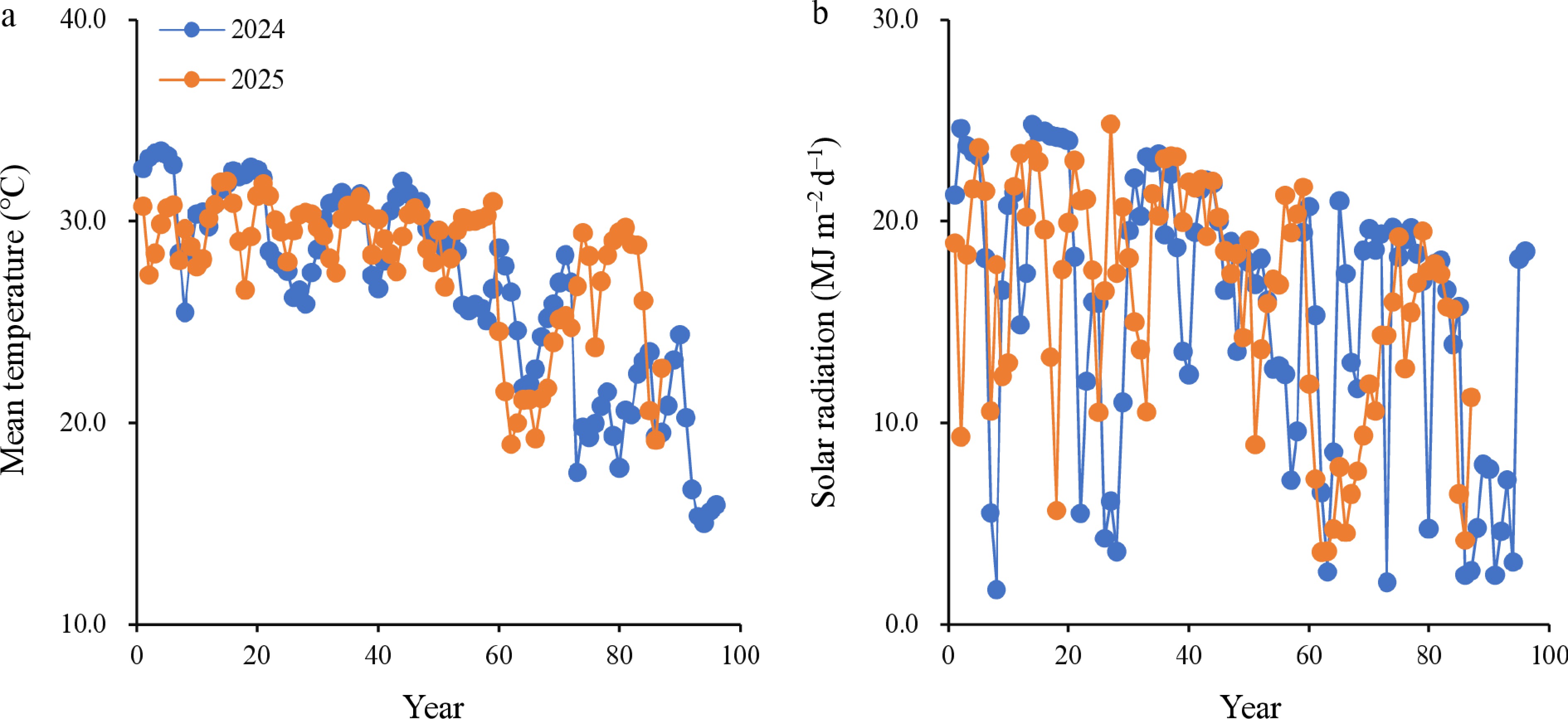
Figure 1.
Daily mean temperature (a) and solar radiation (b) during the rice-growing season (from transplanting to maturity) in 2024 and 2025.
Table 1. Soil chemical properties of the top 20 cm of the experimental field.
Soil chemical property Value pH 6.61 Organic matter (g kg–1) 28.7 Total N (g kg–1) 2.19 Available N
(mg kg–1)171 Total P (g kg–1) 0.500 Available P (mg kg–1) 9.28 Total K (g kg–1) 17.2 Available K (mg kg–1) 103 Total Cd (mg kg–1) 0.366 Available Cd (mg kg–1) 0.255 N, P, K, and Cd are nitrogen, phosphorus, potassium, and cadmium, respectively. Five late-season rice varieties were used, including four newly developed low-Cd varieties, namely Anliangyou 2 (ALY2), Qingliansimiao (QLSM), Qinglianxiangzhan (QLXZ), and Xizi 3 (XZ3), and a non-low-Cd variety, Nongxiang 42 (NX42). NX42 was selected because it is a major promoted variety in Hunan and has been widely grown by local farmers because of its good performance in both grain yield and grain quality. Additional information on these varieties is provided in Table 2.
Table 2. Information on the four newly developed low-cadmium (Cd) rice varieties and the widely grown non-low-Cd rice variety used in this study.
Varietya Type Grain Cd content (mg kg−1)b Parentc Release year Female Male ALY2 Low-Cd 0.000−0.159 An 1S Dige 2 2024 QLSM Low-Cd 0.000−0.130 Huazhan/Guangchaosimiao Dige 1 2024 QLXZ Low-Cd 0.000−0.150 Dige 1 Xiangzhan 2024 XZ3 Low-Cd 0.000−0.098 Huanghuazhan Luohong 4A/IR28 2023 NX42 Non-low-Cd Not available Xiangwanxian 17 Gumei 4 2020 a ALY2, QLSM, QLXZ, XZ3, and NX42 refer to the rice varieties Anliangyou 2, Qingliansimiao, Qinglianxiangzhan, Xizi 3, and Nongxiang 42, respectively. b Data on grain Cd content were sourced from the China Rice Data Center ( www.ricedata.cn/variety ). For ALY2, QLSM, and QLXZ, the data were derived from analyses of brown rice samples obtained through regional trials, production trials, and pond cultivation identification experiments conducted in Hunan Province. In the pond cultivation identification experiments, soil pH ranged from 5.0 to 6.0, and two soil Cd contents were applied: 0.7 ± 0.1 and 1.5 ± 0.1 mg kg−1. For XZ3, the data were obtained from analyses of brown rice samples collected in regional trials carried out in the middle and lower reaches of the Yangtze River. In China, the permissible limit for grain Cd content in rice is 0.2 mg kg−1. c Dige 1, Dige 2, and Luohong 4A are low-Cd rice germplasms carrying OsNRAMP5 mutations.Experimental design and crop management
-
In each year, the five rice varieties were grown under five N application rates: 0, 90, 120, 150, and 180 kg ha–1. The experiment was arranged in a split-plot design with three replicates. N application rates were assigned as the main plots, and varieties were arranged as subplots. Each subplot measured 12 m2 and was maintained consistently across both years.
Seeds were coated with a commercial seed coating agent and soaked in tap water at room temperature for about 24 h before sowing. Soaked seeds were sown on 26 June, and 25-day-old seedlings were transplanted at a hill spacing of 20 cm × 20 cm, with three seedlings per hill. In addition to N fertilizer, phosphorus (P) and potassium (K) fertilizers were applied to all subplots at rates of 75 kg P2O5 ha–1 and 150 kg K2O ha–1, respectively. N fertilizer was applied in three splits, specifically basal (1 day before transplanting), early tillering (7 days after transplanting), and panicle initiation, at a ratio of 5:3:2. P fertilizer was applied entirely at the basal stage, whereas K fertilizer was split equally between the basal and panicle initiation stages. Water depth was maintained at 5–10 cm from transplanting until 7 days before maturity, when the field was drained for harvest. Diseases, pests, and weeds were managed following the local standard practices. Crop residues were removed from each subplot after harvest.
Sampling and measurements
-
At maturity, 10 hills were sampled from each subplot. Panicle number was recorded before manual threshing. Filled and unfilled grains were separated by flotation in tap water. Three 5-g subsamples of filled spikelets and all unfilled spikelets were used for counting. Filled spikelets were quantified using a SLYC digital automatic seed counter (Zhejiang Top Cloud-Agri Technology Co., Ltd., Hangzhou, China), whereas unfilled spikelets were counted manually. All plant organs were oven-dried at 70 °C to a constant weight.
Yield components including panicles per m2, spikelets per panicle, spikelets per m2 (panicles per m2 × spikelets per panicle), spikelet filling percentage, grain weight (adjusted to a standard moisture content of 0.135 g g–1), and sink capacity (spikelets per m2 × grain weight), as well as total biomass production and harvest index, were calculated following standard protocols. The source–sink ratio was calculated as total biomass production divided by sink capacity.
Oven-dried plant organs were ground, and N concentration was determined using a segmented flow analyzer (Skalar SAN Plus, Skalar Inc., Breda, The Netherlands) according to standard procedures. Total N uptake was calculated as the sum of N content in each organ (biomass × N concentration).
Rice grains were harvested from a 5-m2 area in each subplot and sun-dried for 2 days. A 50-g subsample was oven-dried at 70 °C to a constant weight to determine the moisture content, and grain yield was adjusted to a standard moisture content of 0.135 g g–1. Internal N use efficiency was calculated as grain yield divided by total N uptake.
Statistical analysis
-
All data for each year were subjected to analysis of variance to determine the significance of the interaction between the variety and the N application rate. This analysis guided whether varietal comparisons could be combined across N application rates (if the interaction was not significant at the 0.05 probability level) or needed to be examined separately (if significant). As the interaction between variety and N application rate was either nonsignificant or inconsistent across years for all measured variables, except spikelet filling percentage (Table 3), varietal means were compared across N application rates using the least significant difference (LSD) test at the 0.05 probability level. In addition, to evaluate N responses, the means of N application rates were compared across varieties for grain yield using the LSD test at the 0.05 probability level. All statistical analyses were performed using Statistix 8.0 (Analytical Software Co., Tallahassee, FL, USA).
Table 3. Analysis of variance of the interactive effects of variety and nitrogen application rate on yield formation characteristics in rice in 2024 and 2025.
Variable F-value 2024 2025 Grain yield 1.40NS 0.77NS Panicles m−2 0.82NS 0.66NS Spikelets panicle−1 1.74NS 0.59NS Spikelets m−2 0.79NS 0.74NS Spikelet filling percentage 2.76** 3.06** Grain weight 0.92NS 1.21NS Total biomass production 1.83NS 0.35NS Harvest index 5.07** 1.52NS Sink capacity 0.81NS 0.54NS Source–sink ratio 6.50** 1.39NS Total N uptake 1.04NS 0.43NS Internal N use efficiency 0.80NS 1.47NS ** indicates significance at the 0.01 probability level, and NS indicates nonsignificance at the 0.05 probability level. -
ALY2 produced the highest grain yield in both 2024 and 2025, which was 22% and 16% higher than that of NX42, respectively (Table 4). QLSM also yielded significantly more than NX42 in both years, with increases of 10% in 2024 and 12% in 2025. The grain yield of QLXZ did not differ significantly from NX42 in either year. XZ3 had a similar grain yield to NX42 in 2024, but produced 11% more in 2025. In both 2024 and 2025, grain yield increased significantly as N application rates increased from 0 to 150 kg ha−1, and then remained unchanged from 150 to 180 kg ha−1.
Table 4. Grain yield of five rice varieties grown under five nitrogen (N) application rates in 2024 and 2025.
Experimental factor Grain yield (t ha−1) 2024 2025 Varietya ALY2 7.79 ± 0.37a 8.01 ± 0.25a QLSM 7.02 ± 0.25b 7.72 ± 0.35a QLXZ 6.62 ± 0.25c 6.49 ± 0.26b XZ3 6.52 ± 0.32c 7.67 ± 0.33a NX42 6.36 ± 0.21c 6.89 ± 0.27b N application rate (kg ha−1) 0 5.32 ± 0.12d 5.94 ± 0.17c 90 6.18 ± 0.16c 7.08 ± 0.24b 120 7.27 ± 0.22b 7.48 ± 0.29b 150 7.82 ± 0.19a 8.16 ± 0.35a 180 7.72 ± 0.21a 8.12 ± 0.15a Data for each variety are presented as the mean ± standard error across five N application rates, with three replicates per N application rate (n = 15), and for each N application rate as mean ± standard error across five varieties, with three replicates per variety (n = 15). Within a column for each experimental factor (variety or N application rate), means sharing the same letters are not significantly different at the 0.05 probability level. a ALY2, QLSM, QLXZ, XZ3, and NX42 refer to the newly developed low-cadmium (Cd) rice varieties Anliangyou 2, Qingliansimiao, Qinglianxiangzhan, and Xizi 3 and the widely grown non-low-Cd variety Nongxiang 42, respectively. Some consistent significant differences in the yield components were observed between the four low-Cd varieties and the widely grown non-low-Cd variety NX42 in both 2024 and 2025 (Table 5). Specifically, ALY2 had 25% and 14% more spikelets m−2, 19% and 12% greater sink capacity, but 4% and 2% lower grain weight than NX42 in 2024 and 2025, respectively. QLSM had 10% and 4% higher spikelet filling percentage, but 6% and 4% lower grain weight than NX42 in 2024 and 2025, respectively. QLXZ had 6% and 4% lower spikelet filling percentage than NX42 in 2024 and 2025, respectively. XZ3 had 30% and 13% more panicles m−2 and 34% and 24% more spikelets m−2, but 18% and 15% lower grain weight than NX42 in 2024 and 2025, respectively.
Table 5. Yield components of five rice varieties in 2024 and 2025.
Varietya Panicles m−2 Spikelets panicle−1 Spikelets m−2 (×103) Spikelet filling (%) Grain weight (mg) Sink capacity (g m−2) 2024 ALY2 252 ± 10b 176 ± 4a 44.4 ± 1.9a 76.4 ± 0.7b 23.3 ± 0.1b 1,033 ± 45a QLSM 223 ± 10cd 162 ± 4c 36.1 ± 1.7c 85.5 ± 0.8a 23.0 ± 0.1b 831 ± 37d QLXZ 239 ± 8bc 165 ± 4bc 39.4 ± 1.6b 73.4 ± 0.7c 24.3 ± 0.2a 958 ± 42b XZ3 274 ± 11a 173 ± 4ab 47.4 ± 1.8a 70.6 ± 1.6d 20.0 ± 0.2c 948 ± 34bc NX42 211 ± 4d 168 ± 4abc 35.4 ± 1.3c 78.0 ± 0.9b 24.5 ± 0.1a 868 ± 35cd 2025 ALY2 274 ± 11b 152 ± 2a 41.6 ± 2.1b 75.9 ± 0.9bc 25.4 ± 0.1c 1,058 ± 55a QLSM 276 ± 13b 133 ± 2c 36.7 ± 1.7c 81.4 ± 1.2a 25.0 ± 0.1d 918 ± 43c QLXZ 264 ± 10b 127 ± 3c 33.5 ± 1.3d 74.6 ± 1.6c 26.8 ± 0.2a 899 ± 37c XZ3 295 ± 13a 153 ± 1a 45.1 ± 2.1a 75.4 ± 1.1bc 22.0 ± 0.1e 993 ± 48b NX42 260 ± 12b 140 ± 3b 36.4 ± 1.8c 78.1 ± 2.0b 26.0 ± 0.2b 946 ± 48bc Data are presented as the mean ± standard error across five nitrogen (N) application rates, with three replicates per N application rate (n = 15). Within a column for each year, means sharing the same letters are not significantly different at the 0.05 probability level. aALY2, QLSM, QLXZ, XZ3, and NX42 refer to the newly developed low-cadmium (Cd) rice varieties Anliangyou 2, Qingliansimiao, Qinglianxiangzhan, and Xizi 3 and the widely grown non-low-Cd variety Nongxiang 42, respectively. Total biomass production, source–sink ratio, and harvest index
-
ALY2 exhibited 11% higher total biomass production than NX42 in 2024, whereas the difference was not significant in 2025 (Fig. 2a). QLSM and XZ3 showed no significant differences in total biomass production compared with NX42 in either 2024 or 2025. Total biomass production did not differ significantly between QLXZ and NX42 in 2024 but was 14% lower in QLXZ than in NX42 in 2025.
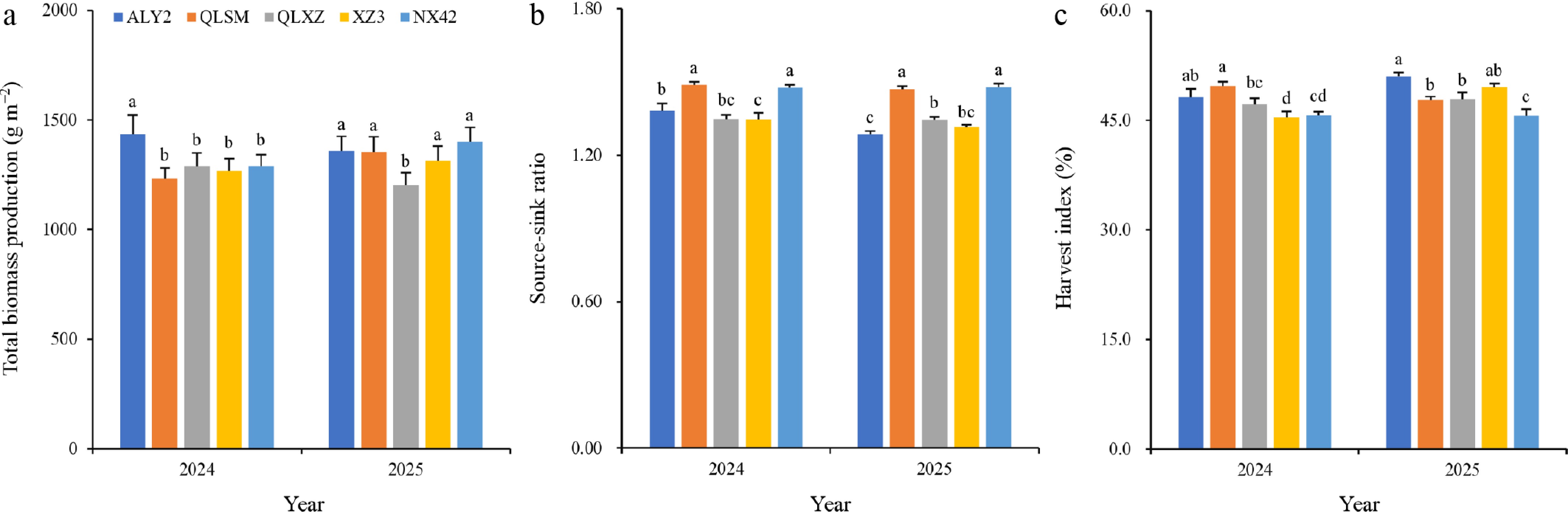
Figure 2.
(a) Total biomass production, (b) source–sink ratio, and (c) harvest index of five rice varieties in 2024 and 2025. Columns and error bars represent the means and standard errors, respectively, across five nitrogen (N) application rates, with three replicates per N application rate (n = 15). Within each year, means sharing the same letters are not significantly different at the 0.05 probability level. ALY2, QLSM, QLXZ, XZ3, and NX42 refer to the newly developed low-cadmium (Cd) rice varieties Anliangyou 2, Qingliansimiao, Qinglianxiangzhan, and Xizi 3 and the widely grown non-low-Cd variety Nongxiang 42, respectively.
The source–sink ratio was 7%–9% lower in ALY2, QLXZ, and XZ3 than in NX42 in 2024 and 9%–13% lower in 2025 (Fig. 2b). No significant difference in the source–sink ratio was observed between QLSM and NX42 in either 2024 or 2025.
The harvest index was 5%–9% higher in ALY2 and QLSM than in NX42 in 2024 and 5%–12% higher in 2025 (Fig. 2c). QLXZ and XZ3 did not differ significantly from NX42 in harvest index in 2024 but exhibited 5%–9% higher harvest indices than NX42 in 2025.
Total N uptake and internal N use efficiency
-
ALY2 and QLXZ exhibited 13%–16% higher total N uptake than NX42 in 2024, whereas no significant differences were observed in 2025 (Fig. 3a). QLSM and XZ3 showed no significant differences in total N uptake compared with NX42 in either 2024 or 2025. Internal N use efficiency did not differ significantly between the four low-Cd varieties and NX42 in either year (Fig. 3b).
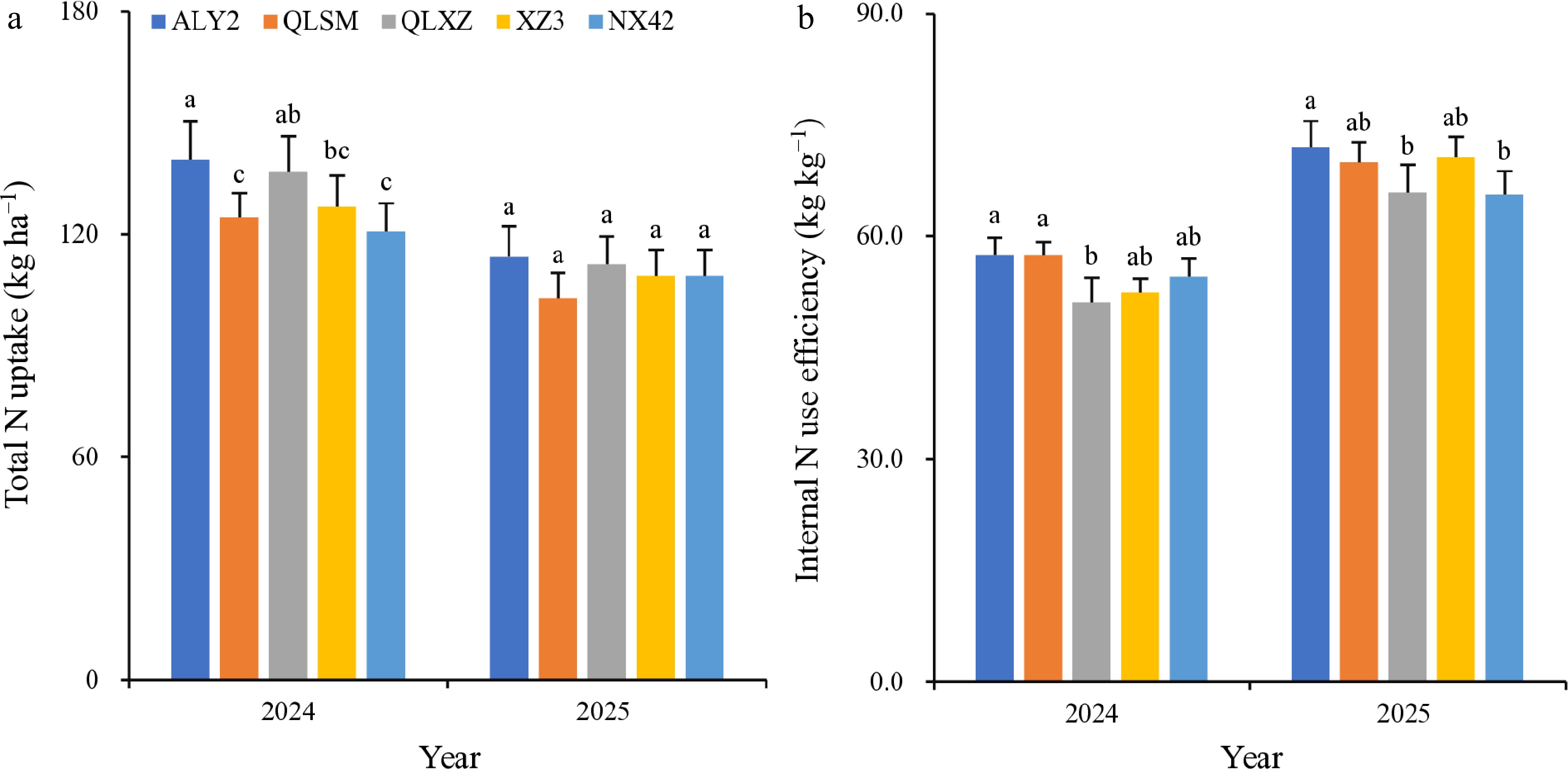
Figure 3.
(a) Total nitrogen (N) uptake and (b) internal N use efficiency of five rice varieties in 2024 and 2025. Columns and error bars represent the means and standard errors, respectively, across five N application rates, with three replicates per N application rate (n = 15). Within each year, means sharing the same letters are not significantly different at the 0.05 probability level. ALY2, QLSM, QLXZ, XZ3, and NX42 refer to the newly developed low-cadmium (Cd) rice varieties Anliangyou 2, Qingliansimiao, Qinglianxiangzhan, and Xizi 3 and the widely grown non-low-Cd variety Nongxiang 42, respectively.
-
This study indicated that, among the four newly developed low-Cd rice varieties, ALY2 and QLSM outyielded the widely grown non-low-Cd variety NX42. In addition, the average grain yield of these two low-Cd varieties across the 2 years ranged from 7.37 to 7.90 t ha–1, representing a 15%–23% increase over the recent 5-year average for the same rice type in Hunan (6.40 t ha–1; National Bureau of Statistics of China,
https://data.stats.gov.cn ). These findings suggest that ALY2 and QLSM are promising alternatives for cultivation on Cd-contaminated soils considered potentially safe for use, offering the added benefit of higher yield.The key yield attributes contributing to the higher yield performance of ALY2 and QLSM were not entirely consistent. ALY2 had more spikelets per m2 than NX42 in both years. Since spikelets per m2 is the product of panicles per m2 and spikelets per panicle, it can be increased by either component or by both. However, strong compensation between panicles per m2 and spikelets per panicle is well documented, and typically, more spikelets per m2 is achieved by increasing only one of these two components[18]. For example, Zhang et al.[19] reported that the increased number of spikelets per m2 in super hybrid rice varieties were attributable to increased spikelets per panicle, whereas Huang et al.[20] found that the higher number of spikelets per m2 in hybrid rice varieties grown at a high-yielding site were mainly caused by a greater number of panicles per m2. Consistently, in this study, the higher number of spikelets per m2 in ALY2 compared with NX42 was driven by more panicles per m2 in 2024 and by more spikelets per panicle in 2025. This finding also indicates that ALY2 has a strong regulatory capacity to balance panicles per m2 and spikelets per panicle under different environmental conditions.
Furthermore, ALY2 had a greater sink capacity than NX42 in both years. This greater sink capacity in ALY2 was primarily driven by its higher number of spikelets per m2, because its grain weight was lower compared with NX42. Beyond being a direct component of grain yield[12], sink capacity also influences other yield attributes, particularly harvest index, which is positively associated with sink capacity[16,21]. In this study, the greater sink capacity in ALY2 was accompanied by a higher harvest index than in NX42, collectively contributing to its superior yield performance.
For QLSM, the spikelet filling percentage was higher than that of NX42 in both years. Previous studies have reported a positive relationship between spikelet filling percentage and the harvest index in rice[15]. In agreement with this, the higher spikelet filling percentage in QLSM was accompanied by a higher harvest index than in NX42. More interestingly, the underlying mechanism for the higher harvest index in QLSM differed from that in ALY2, as QLSM did not exhibit a significantly higher sink capacity than NX42. Harvest index can also be influenced by spikelet filling percentage, which is linked to source–sink relationships and spikelet fertility; a higher source–sink ratio and/or higher spikelet fertility are conducive to achieving a higher spikelet filling percentage[12]. In this study, no significant difference in the source–sink ratio was observed between QLSM and NX42, suggesting that higher spikelet fertility, rather than an increased source–sink ratio, might have contributed to the higher spikelet filling percentage and harvest index in QLSM. Nevertheless, further investigations are required to confirm this hypothesis.
In addition, this study showed that, compared with NX42, QLXZ exhibited comparable grain yield in both 2024 and 2025, whereas XZ3 produced a similar grain yield in 2024 but a higher grain yield in 2025. These results suggest that QLXZ and XZ3 also have potential as alternative varieties for cultivation on Cd-contaminated soils considered potentially safe for use, but they do not offer the additional benefit of higher yield. Therefore, for practical cultivation focused on maximizing yield, we recommend the other two low-Cd varieties, ALY2 and QLSM.
The year-to-year variation in the yield performance of XZ3 relative to NX42 was partly attributable to the lower temperatures during the ripening period in 2024 compared with 2025 (Fig. 1a). The lower temperature caused the spikelet filling percentage of XZ3 to shift from being not significantly different from that of NX42 in 2025 to being significantly lower in 2024 (Table 3), and the harvest index changed from being significantly higher than that of NX42 in 2025 to showing no significant difference in 2024 (Fig. 2c). These observations are consistent with those reported from actual production, where XZ3 suffered substantial yield losses in many regions and even complete crop failure in some fields in 2024, mainly because of low temperatures during the heading stage[7]. These findings indicate that XZ3 may be sensitive to environmental fluctuations. Such varietal instability poses a challenge to its adoption, particularly under climate change, which has increased the frequency of extreme weather events[22]. This further highlights the importance of thoroughly evaluating the agronomic performance of newly developed low-Cd rice varieties.
Unexpectedly, no consistent differences in total N uptake or internal N use efficiency were observed between the four low-Cd rice varieties and the non-low-Cd variety NX42 across the 2 years, suggesting that N utilization characteristics in rice are strongly influenced by environmental conditions. Further analysis of the relationships between grain yield and these two N utilization traits revealed only limited associations in ALY2; the higher grain yield of ALY2 relative to NX42 could be attributed to higher total N uptake in 2024 and to higher internal N use efficiency in 2025 (Table 3; Fig. 3a, b). However, owing to these limited and inconsistent year-to-year results, it remains difficult to fully elucidate the relationships between yield formation and N utilization in the four low-Cd rice varieties. These findings highlight the need for further investigations across a wider range of environmental conditions to better understand N utilization characteristics and their roles in yield formation in newly developed low-Cd rice varieties.
No effect of the interaction between variety and N application rate on grain yield was observed in this study, indicating that the effect of the N application rate on grain yield was independent of the variety. In addition, grain yield increased with the N application rate up to 150 kg ha–1, indicating that this rate was optimal for the five rice varieties in this study. However, further investigations are needed to validate these finding and other results of this study across a wider range of soil types and climatic conditions, and such investigations should also include measurements of the grain Cd concentration, which was not assessed here and therefore represents an important limitation.
-
Among the four newly developed low-Cd rice varieties evaluated in this study, ALY2 and QLSM outyielded the widely grown non-low-Cd variety NX42. This higher yield was primarily associated with more spikelets m–2, a larger sink capacity, and a higher harvest index in ALY2, and mainly attributed to improved spikelet filling percentage and higher harvest index in QLSM. These two low-Cd rice varieties are promising alternatives for cultivation on Cd-contaminated soils considered potentially safe for use in terms of yield performance.
-
The authors confirm their contributions to the paper as follows. Study conception and design: Huang M, Fu Z, Liao C; data collection: Liao C, Wang M, Zhang R, Cao F; analysis and interpretation of results: Liao C, Chen J, Wang W, Zheng H; draft manuscript preparation: Liao C, Huang M. All authors reviewed the results and approved the final version of the manuscript.
-
The data generated and analyzed during the current study are available from the corresponding author upon reasonable request.
-
This study was supported by the National Key R&D Program of China (2023YFD2301303) and the Earmarked Fund for China Agriculture Research System (CARS-01-33).
-
The authors declare that they have no conflict of interest.
- Copyright: © 2026 by the author(s). Published by Maximum Academic Press, Fayetteville, GA. This article is an open access article distributed under Creative Commons Attribution License (CC BY 4.0), visit https://creativecommons.org/licenses/by/4.0/.
-
About this article
Cite this article
Liao C, Wang M, Zhang R, Cao F, Chen J, et al. 2026. Grain yield and yield attributes of newly developed low-cadmium rice varieties. Technology in Agronomy 6: e009 doi: 10.48130/tia-0026-0007 

Grain yield and yield attributes of newly developed low-cadmium rice varieties
- Received: 27 March 2026
- Revised: 28 April 2026
- Accepted: 10 May 2026
- Published online: 30 July 2026
Abstract: Excessive grain cadmium (Cd) accumulation poses a major challenge for rice (Oryza sativa) production in Hunan Province, China, and in many other rice-growing regions worldwide. To address this issue, several low-Cd rice varieties have recently been developed in Hunan. These varieties have been validated to maintain grain Cd concentrations below China's national maximum residue limit when grown on Cd-contaminated soils considered potentially safe for use. However, information on their agronomic performance remains limited. Field experiments were conducted in 2024 and 2025 to compare grain yield and the yield attributes of four newly developed low-Cd rice varieties, namely Anliangyou 2 (ALY2), Qingliansimiao (QLSM), Qinglianxiangzhan (QLXZ), and Xizi 3 (XZ3), with a widely grown non-low-Cd variety, Nongxiang 42 (NX42), under five nitrogen (N) application rates. The results showed that compared with NX42 across the five N application rates (with no interaction between variety and N application rate), ALY2 and QLSM produced higher grain yields in both years, with increases of 10%–22%; QLXZ exhibited comparable grain yield across both years; and XZ3 showed similar grain yield in 2024 but 11% higher yield in 2025. Regarding the yield attributes associated with the superior yield performance of ALY2 and QLSM, the former had 5%–25% greater spikelets m–2, sink capacity, and harvest index, whereas the latter had 4%–12% higher spikelet filling percentage and harvest index. These results suggest that ALY2 and QLSM are promising alternative varieties for cultivation on Cd-contaminated soils considered potentially safe for use, offering the added benefit of higher grain yield through improvements in different yield attributes.
-
Key words:
- Cadmium /
- Grain yield /
- Harvest index /
- Rice /
- Sink capacity /
- Spikelet filling