










-
Sunlight is the engine of photosynthesis, and for tropical fruit crops it is also a chronic source of abiotic stress. When solar irradiance and radiant surface heating combine to push fruit tissue temperatures beyond a species-specific threshold, a suite of physiological disorders appears on the exposed epidermis that devalues or destroys marketable produce[1,2]. These disorders, collectively grouped under the umbrella term sunburn, are not trivial. Fischer et al.[3] identified three distinct sunburn types in tropical and subtropical fruit systems: photooxidative sunburn, caused primarily by excess photosynthetically active and ultraviolet radiation; sunburn browning, driven by a combination of radiant heat and high-irradiance conditions; and epidermal necrosis, resulting from extreme tissue temperatures. Each type is associated with different induction thresholds, causal pathways, and economic outcomes, yet all share one consequence: loss of consumer acceptability and reduction in postharvest shelf life.
The global significance of these disorders is amplified in tropical zones, where a convergence of near-equatorial solar angles, high ambient temperatures, low relative humidity during dry-season fruit development, and rapid climate change creates conditions that maximise exposure risk[4]. This risk is not evenly distributed geographically: Southern Hemisphere tropical fruit-growing regions (e.g., southern Africa, Brazil, and northern Australia) and Northern Hemisphere tropical regions (e.g., West Africa, South and Southeast Asia, and Central America) experience opposite seasonal solar angle and day-length cycles, which shift the calendar window of peak sunburn risk relative to the fruit development period in each hemisphere. Sub-Saharan Africa, home to the majority of the world's smallholder banana, plantain, and mango growers, already sustains postharvest losses of 30% to 50% of fruit and vegetable production, with the economic burden amounting to over US
$\$1 $ These findings are consistent with global climate model projections, which indicate a measurable upward trend in surface solar radiation and clear-sky UV exposure across tropical latitudes over the coming decades as cloud cover patterns shift and clear-sky days become more frequent, reinforcing the urgency of the mitigation evidence reviewed here[7].
Research on sunburn physiology has historically concentrated on temperate species, particularly apple (Malus domestica) and pear (Pyrus communis), where the literature is well developed[8,9]. The mechanisms elucidated in those systems provide an essential conceptual scaffold. Yet the tropical context differs profoundly: fruit development occurs year-round rather than in a discrete summer window; canopy architecture, variety portfolios, and smallholder management practices diverge entirely from commercial temperate orchards; and the interaction between high solar radiation and the already elevated ambient temperatures of the tropics creates compound stress conditions with no temperate equivalent. Fischer et al.[3] and Munné-Bosch & Vincent[10] have both called for dedicated research programmes targeting tropical fruits, a call that has only partially been answered.
The aim of this review is to critically analyse solar radiation-induced senescence and spotting in major tropical fruit crops such as banana, plantain, mango, papaya, pineapple, citrus, avocado, dragon fruit, and guava. The specific objectives are: (1) to characterise the sunburn injury types and their biochemical induction pathways; (2) to document the endogenous defence and photoprotection systems that fruit deploy against radiation and thermal stress; (3) to analyse the manifestation and documented severity of sunburn across the selected tropical crops; (4) to critically evaluate the strategies put in place to mitigate these injuries and their efficacy, practicability, and cost in tropical production contexts; and (5) to identify knowledge gaps and research priorities that could drive genuine reductions in solar-related postharvest losses in the tropics.
The scope of this review covers both preharvest field exposure and the downstream postharvest consequences of sunburn. This scope is paramount because injury sustained in the orchard frequently manifests or worsens during storage and marketing, and sometimes it leads to delayed expressions of browning known as sunscald[8,9]. This continuity between field and store is critically important for tropical supply chains, where cold storage infrastructure is often limited or absent[11,12], and where sunburn that went undetected at harvest can collapse an entire consignment during transport to market. Unlike previous reviews that focused on temperate pome fruits or broad tropical classifications, this synthesis explicitly integrates postharvest consequences with preharvest solar stress, prioritizes smallholder constraints in sub-Saharan Africa and Southeast Asia, and identifies epigenetic regulators as emerging intervention targets.
-
This critical review was conducted by searching Semantic Scholar, PubMed, Scopus, and arXiv for relevant reputable publications between 14 January and 12 February 2026. Search queries were formulated to cover eight thematic areas of the topic being investigated (Table 1). The same eight query strings (Table 1) were applied identically across all four databases, without database-specific syntax modification. For each query, publications were retained only when published in peer-reviewed journals and carrying a verifiable digital object identifier (DOI) and written in English. Screening was based on relevance and peer-review eligibility rather than formal risk-of-bias appraisal: each record was assessed by one reviewer during full-text screening for topical relevance to the review scope and for peer-reviewed status with a verifiable DOI. No formal quality-appraisal instrument was applied. To preserve transparency about evidence strength, the discussion distinguishes claims supported by direct field solar-injury studies from those based on controlled radiation or heat experiments and those extrapolated from other abiotic or postharvest stresses. Table 1 further documents the complete search strategy; the number of records returned after every search and the number of papers retained per query. All references cited in this review originate directly from these searches; no citation has been inferred, guessed, or generated independently of retrieved source records.
Table 1. Literature search queries, records returned, records retained, and key sources identified.
S/N Search string Returned Retained Ref. 1 Solar radiation sunburn browning tropical fruits postharvest 152 30 [3,10] 2 Banana plantain postharvest senescence peel browning mechanisms 89 18 [13,14] 3 Mango sunburn UV radiation peel discolouration pigment degradation 74 16 [15,16] 4 Papaya postharvest solar heat stress quality deterioration tropics 61 11 [17,18] 5 ROS oxidative stress fruit senescence polyphenol oxidase phenylpropanoid pathway 95 12 [19,20] 6 Fruit bagging shading nets kaolin clay sunburn protection tropical orchard 83 14 [21,22] 7 1-MCP ethylene salicylic acid ascorbic acid antioxidant postharvest browning treatment 77 12 [23,24] 8 Postharvest fruit loss Africa sub-Saharan tropics food security economic impact 69 12 [5,25] Figure 1 displays the source selection flow, following a transparent search strategy adapted from the PRISMA framework for the critical review design. A total of 125 publications were retained across the eight thematic queries after the search was concluded (Table 1). After removing 25 duplicate articles across the eight thematic queries, 100 unique records were obtained and assessed for eligibility against the earlier-stated eligibility criteria of peer review and direct relevance to the review topic. From the 100 records, 20 publications were grey literature without digital object identifiers, whereas 17 studies did not directly fall within the scope of the review. These 37 studies were thus excluded, leaving a total of 63 sources that met all inclusion criteria and are cited in the review body.
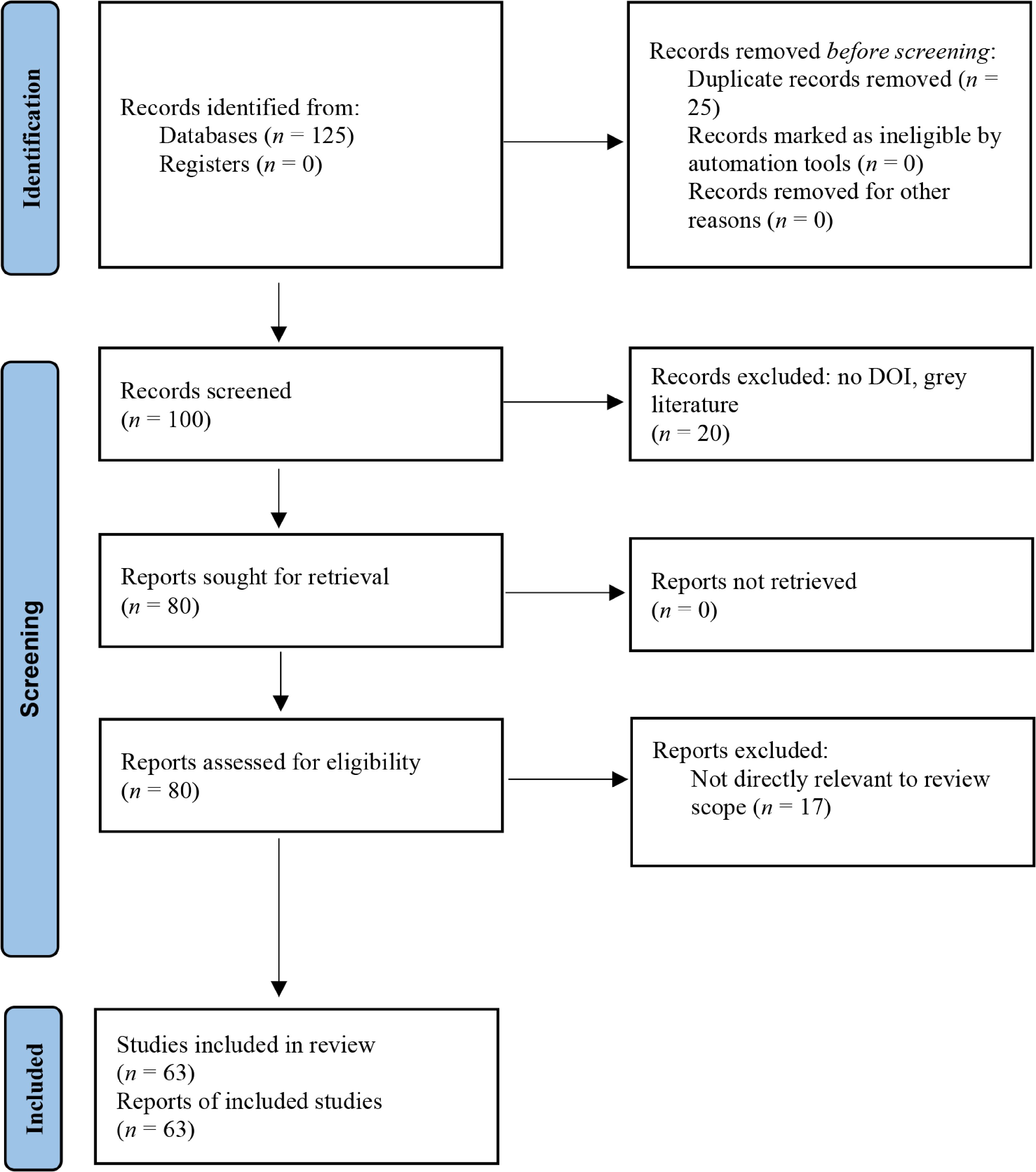
Figure 1.
Source identification, screening, and inclusion flow for this review, adapted from the PRISMA framework.
-
The fruit epidermis is an optically active surface. In clear-sky tropical conditions, total solar irradiance reaching the fruit surface can exceed 1,200 W/m2. These irradiations include ultraviolet B (UV-B, 280 to 315 nm), ultraviolet A (UV-A, 315 to 400 nm), photosynthetically active radiation (PAR, 400 to 700 nm), and near-infrared wavelengths. Each spectral fraction interacts differently with fruit tissue. UV-B is absorbed by aromatic amino acids, nucleic acids, and photosensitising pigments, and this generates singlet oxygen and other reactive species directly. PAR is absorbed by chlorophyll and carotenoids in the peel, where it drives photochemical reactions that can generate reactive oxygen species (ROS) when the absorbed photon flux exceeds the capacity for productive use or dissipation. Near-infrared radiation is largely absorbed as heat and raises surface temperature independent of photochemical effects[10].
The compound consequence of these three spectral effects is that fruit surface temperature under direct tropical sun can substantially exceed ambient air temperature. Sun-exposed mango fruit of the cultivars Keitt and Reynal have been recorded to reach surface temperatures of up to 47 °C when ambient air temperature was below 37 °C[26]. Mandarin rind damage was confirmed at temperatures above 47 °C in laboratory heat tolerance tests, consistent with thermal denaturation of membrane-associated proteins[27]. Sunburn browning in apple was associated with temperatures above 45 to 46 °C, a threshold frequently reached by fruit surfaces under tropical midday sun even when air temperature is nominally moderate[4,8]. Low relative humidity exacerbates the problem by reducing evaporative cooling from the fruit surface, and at higher altitudes within the tropics, increased UV-B flux further amplifies damage frequency[3,28].
Three distinct sunburn injury types and their mechanistic signatures
-
Table 2 presents the three sunburn injury types documented by Fischer et al.[3], Munné-Bosch & Vincent[10], and Racskó & Schrader[8], with their respective triggers, thermal thresholds, biochemical mechanisms, visible symptoms, and typical field contexts for tropical production systems. Photooxidative sunburn presents a distinct epidemiological challenge because it can occur at relatively low ambient temperatures when light suddenly reaches fruit that have been shaded, a scenario particularly common in banana plantations after wind damage, pest defoliation, or aggressive pruning[3]. Sunburn browning is the most economically consequential type in tropical contexts because the brown discolouration it produces is immediately associated with decay by consumers. Epidermal necrosis, though the most severe in tissue-level damage, is less common in humid tropical lowlands but becomes a significant concern in drier high-altitude tropical zones where the combination of intense UV-B and radiant heat can be extreme[3].
Table 2. Classification of solar radiation-induced fruit injury types: triggers, thresholds, mechanisms, and symptoms.
Injury type Primary trigger Induction threshold Key biochemical mechanism Visual symptom Photooxidative sunburn High irradiance alone; no heat required Below 30 °C possible Chlorophyll photodestruction; singlet oxygen generation; PSII photoinhibition Yellow-white bleaching; no necrosis Sunburn browning High temperature + high irradiance combined 45−52 °C surface (species-dependent) ROS overaccumulation; membrane lipid peroxidation; Polyphenol oxidase (PPO) mediated browning Brown-tan discolouration; no necrosis Epidermal necrosis Extreme radiant heat; light secondary > 52 °C surface temperature Protein denaturation; cell membrane collapse; irreversible damage Sharply delimited dead tissue; fungal entry points Sources: Fischer et al.[3]; Munné-Bosch & Vincent[10]; Racskó & Schrader[8]; Kim et al.[27]; Lal & Sahu[28]. Table 2 records epidermal necrosis as creating fungal entry points, but this review's search did not return studies that directly quantify the interaction between preharvest sunburn and postharvest disease development, which is one of the main drivers of tropical fruit supply-chain loss. Postharvest pathogens known to exploit fruit-surface microdamage, such as Colletotrichum spp. (anthracnose), for example on papaya[17], are plausible candidates for exploiting solar-damaged tissue, and likewise, the effect of sunburn on downstream internal quality parameters such as soluble solids, acidity, aroma volatiles, and nutritional bioactives is not resolved by the studies reviewed here. This sunburn-postharvest pathogen synergy is flagged as an explicit evidence gap in Table 3 (Gap 7), which requires further investigations.
Table 3. Priority knowledge gaps, rationale, and recommended research approaches.
S/N Knowledge gap Rationale Recommended research approach Priority 1 Species-specific surface temperature thresholds for sunburn induction in banana, plantain, and papaya under tropical field conditions Mechanistic modelling of climate change impacts requires quantitative thermal thresholds; currently only citrus (47 °C) and apple are well characterised Controlled heating experiments with surface thermocouple arrays across cultivar panels; multi-site tropical field studies High 2 Preharvest molecular characterisation of solar stress response in papaya Papaya is the third most economically important tropical fruit in Africa yet has zero dedicated preharvest solar omics data Multi-omics (transcriptomics, metabolomics) field experiments analogous to Chen et al.[29] for wampee High 3 Multi-season, multi-site efficacy trials of kaolin and shade nets for smallholder producers in sub-Saharan Africa Virtually all mitigation data originate from commercial-scale operations in Egypt, Chile, and southern Europe; smallholder African context is completely absent On-farm participatory trials across West Africa, East Africa, and Southeast Asia; at least three seasons Critical 4 Solar radiation-induced lignification in banana peel Chilling-induced lignification is well characterised[30], but solar-equivalent has not been studied; understanding is needed for texture quality prediction Controlled solar exposure experiments with peel histology and lignin pathway gene expression analysis Moderate 5 Gender dimensions of solar-related postharvest loss Kikulwe et al.[31] found female-headed households suffer higher banana postharvest losses; no intervention study has disaggregated data by gender Gender-responsive PHL surveys and intervention trials in sub-Saharan Africa with sex-disaggregated outcome reporting Moderate 6 Preharvest efficacy of melatonin, 1-MCP, and salicylic acid under field solar stress conditions All biochemical intervention studies are postharvest; preharvest solar context involves continuous exposure, plant hormonal crosstalk, and developmental stage complexity not captured in postharvest experiments Controlled field applications at flowering and fruit development stages with concurrent solar monitoring High 7 sunburn-postharvest pathogen synergy Epidermal necrosis is noted to create fungal entry points, but no study in this review directly quantifies how sunburn severity affects postharvest pathogen incidence, latent infection activation, or internal quality decline Controlled inoculation trials on fruit with graded, quantified sunburn severity, tracking pathogen incidence, and internal quality parameters through storage High Biochemical mechanisms of solar-induced senescence and spotting
-
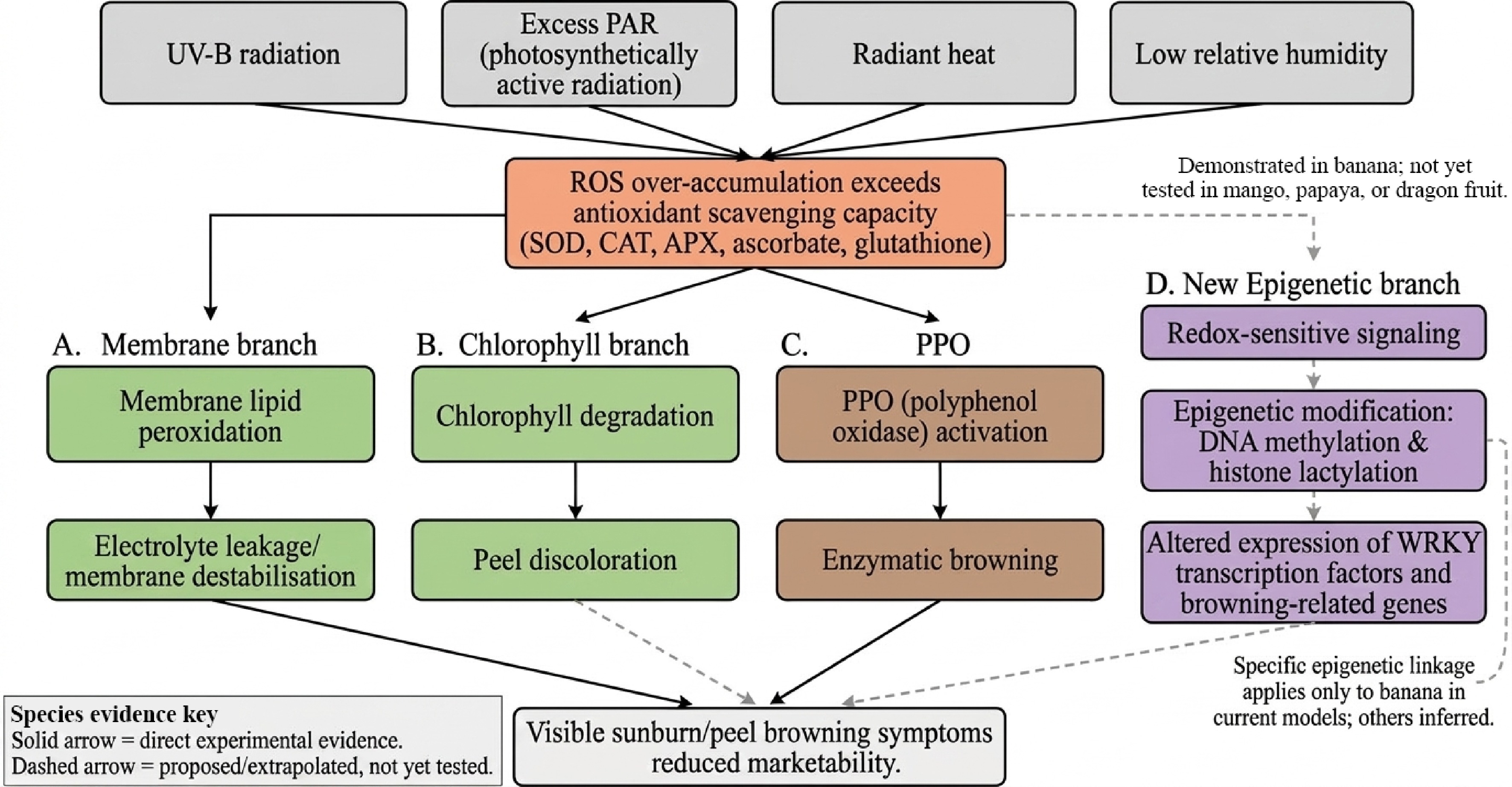
Figure 2 presents the integrated mechanistic cascade from solar radiation inputs to visible injury outcomes, synthesising evidence from across the tropical fruit literature. The four primary physical drivers, UV-B, PAR excess, radiant heat, and low relative humidity, converge on a single biochemical bottleneck: ROS overaccumulation that exceeds the capacity of superoxide dismutase (SOD), catalase (CAT), ascorbate peroxidase (APX), and non-enzymatic antioxidants to maintain redox homeostasis. The downstream consequences branch into three parallel damage pathways, namely membrane lipid peroxidation, chlorophyll degradation, and PPO activation, all producing the visible symptoms that reduce marketability.
Reactive oxygen species overaccumulation
-
Figure 2 presents an integrated mechanism of sun-induced senescence spotting in tropical fruit. Under normal irradiance, superoxide anion (O2·−), hydrogen peroxide (H2O2), and singlet oxygen are generated as byproducts of photosynthetic electron transport, but are efficiently scavenged by SOD, CAT, and APX, as well as by non-enzymatic antioxidants including ascorbic acid, glutathione, tocopherols, and carotenoids[19,20]. When irradiance and temperature exceed a threshold that varies by species, developmental stage, and prior acclimatisation history, ROS production outpaces scavenging capacity. This imbalance constitutes the initiating event in sunburn[10].
As further shown in Fig. 2, in banana peel, the ROS cascade is well characterised. Xiao et al.[30] demonstrated that abiotic stress conditions increase O2·− and H2O2 content, promote membrane lipid peroxidation, and accelerate senescence. Tian et al.[33] confirmed that banana peel browning was associated with elevated ROS, membrane lipid peroxidation as measured by malondialdehyde (MDA) content, and increased electrolyte leakage, all indices of membrane destabilisation. Zhang et al.[32] identified insufficient antioxidant capacity and ROS burst as the common mechanistic currency across multiple fruit species regardless of the primary stressor. The molecular signatures of this stress include coordinated upregulation of WRKY transcription factors, particularly WRKY28, bHLH30, and HSFC1, which regulate expression of key phenylpropanoid biosynthesis genes including PAL and 4CL[14,29].
Polyphenol oxidase and enzymatic browning
-
The visible brown discolouration that characterises sunburn in banana, mango, papaya, and other tropical fruit results directly from PPO activity. PPO is a copper-containing oxidoreductase that, under normal cellular compartmentation, is physically separated from its phenolic substrates. When membrane integrity is compromised by ROS-mediated lipid peroxidation or thermal protein denaturation, this compartmentation breaks down: PPO contacts its phenolic substrates and catalyses their oxidation to quinones, which undergo non-enzymatic polymerisation to produce brown melanin-like pigments[32].
At sub-injurious radiation doses, the phenylpropanoid pathway is upregulated adaptively, producing photoprotective flavonoids, anthocyanins, and hydroxycinnamic acid derivatives that absorb UV and quench ROS[19]. A separate, non-solar route converges on the same pigment endpoint: exogenous ethylene treatment has been shown to accelerate chlorophyll degradation and drive anthocyanin synthesis in postharvest mango peel[34], indicating that solar and hormonal signals act on overlapping biochemical pathways. In addition, light substantially upregulates the enzymes PAL, CHI, DFR, and UFGT, driving anthocyanin synthesis in the peel[15,35]. Shui et al.[16] documented the kinetics of the adaptive-to-injurious transition in Tainong 1 mango: before 60 d after flowering, enhanced UV-B increased flavonoid synthesis and net protection; after 60 d, accumulated ROS exceeded scavenging capacity and pulp oxidative damage was documented. DNA methylation as an epigenetic regulator of PPO gene expression represents a genuinely new mechanistic insight: 5-azacytidine treatment suppressed PPO activity and programmed cell death to retard peel browning in post-ripening banana, linking redox status to chromatin state[1]. Wang et al.[36] extended this insight by demonstrating that exogenous ascorbic acid reduces H3K18 lactylation at WRKY gene promoters, silencing the WRKY-AAO1 oxidative cascade and thereby halting the browning process through a previously unknown epigenetic mechanism.
Chlorophyll degradation and stomatal cell death
-
Pongprasert et al.[13] established that dark spot formation on Khai banana peel originates specifically from stomatal cell death, not from surface contamination or pathogen infection, and that chlorophyllase, chlorophyll-degrading peroxidase, and pheophytinase all reach maximum activity at the moment of most rapid chlorophyll decline. This precision finding redefines the target for any intervention strategy: effective prevention must preserve stomatal cell integrity, not merely suppress enzyme activity after the fact. Mandarin fruit showed a graded reduction in peel chlorophyll with increasing sunburn severity, while carotenoids initially increased as chloroplasts converted to chromoplasts, an adaptive transition that collapses under extreme conditions[27]. At the transcriptional level, heat stress can accelerate chlorophyll breakdown through dedicated regulatory modules; Liu et al.[37] showed that the transcription factor ABI5 promotes heat stress-induced chlorophyll degradation by stabilising MYB44, illustrating a signalling route by which thermal load could couple directly to pigment loss in solar-exposed peel. The xanthophyll cycle provides a key photoprotective buffer in fruit through reversible interconversion of violaxanthin, antheraxanthin, and zeaxanthin, but its capacity is finite, and its saturation represents a critical transition point beyond which ROS accumulation becomes uncontrollable[8,10]. Heat shock proteins of the sHSP17 class also provide thermal protection by preventing protein denaturation, and their induction by preharvest solar exposure has been documented in mango fruit[26], revealing an acclimatisation effect with practical implications for canopy management timing.
Sunburn in key tropical fruit species
-
Figure 3 provides a comparative vulnerability profile across the nine species reviewed, integrating UV-B sensitivity, thermal threshold, PPO activity level, natural canopy protection, postharvest risk, and quality of current evidence. The figure reveals that banana, mango, papaya, and dragon fruit share high vulnerability profiles but differ strikingly in the quality and depth of the mechanistic evidence available for each.

Figure 3.
Comparative sunburn vulnerability profile across key tropical fruit species. (Transcribed ratings; H = high, M = medium, L = low, Mod = moderate evidence quality, Hi = high evidence quality, Lo = low evidence quality).
The high/medium/low ratings shown in Fig. 3 reflect a qualitative synthesis by the review authors of the relative UV-B sensitivity, thermal threshold, PPO activity, natural canopy protection, postharvest disease risk, and depth/quality of primary evidence reported across the species-specific studies, rather than scores derived from a standardised quantitative instrument applied uniformly across species. They should therefore be read as a relative ranking to orient the reader, not as directly comparable absolute measurements.
Banana and plantain (
Musa spp.) -
Fischer et al.[3] reviewed the state of banana sunburn research and noted that banana plants lose their photoprotective effect on the fruit bunch when leaf area is reduced by wind damage, pest defoliation, or aggressive pruning. The dark spotting documented in Khai banana by Pongprasert et al.[13] provides one of the few direct mechanistic studies of tropical banana solar senescence: spot development coincided with stomatal cell death, chlorophyll loss, and DNA degradation, progressing over 6 d at 25 °C. Several chemical regulators of banana peel browning have direct relevance to solar stress. Ge et al.[38] showed that H2S treatment antagonised ethylene-mediated ripening acceleration in banana, delaying peel yellowing by suppressing superoxide and H2O2 accumulation while enhancing total antioxidant capacity. Combined 1-MCP and salicylic acid treatment inhibited ethylene production, delayed colour change, enhanced SOD and CAT activities, and reduced MDA accumulation compared to either treatment alone[23]. Gum arabic coating at 10% reduced peel browning index while maintaining membrane stability index and higher free radical scavenging capacity[39]. DNA methylation inhibition[1] and histone lactylation by ascorbic acid[36] represent the emerging molecular layer of browning regulation that has not yet been translated into practical on-plant intervention.
Mango (
Mangifera indica ) -
Fischer et al.[3] identified mango as particularly vulnerable to solar browning injury in low-canopy cultivars such as Keitt. At sub-injurious radiation doses, mango peel employs a photoadaptive programme driven by MYB, ERF, WRKY, and bZIP transcription factors to upregulate anthocyanin, flavonol, and phenolic acid biosynthesis[15,35,40]. Kagy et al.[26] showed that sun-exposed mango fruit contain higher Hsp17.4 concentrations (two to six times higher than shaded fruit), elevated total polyphenols and anthocyanins, and improved tolerance to subsequent postharvest heat treatment, revealing a preharvest acclimatisation benefit. Kaolin applications at 6% significantly reduced sunburned fruit numbers while improving photosynthetic pigments and yield[41], and liquid kaolin reduced sunburn probability by 68% and delayed onset by 47 d[22].
The evidence synthesised throughout this section is drawn overwhelmingly from studies conducted at the species level. Where cultivar-specific data exist, such as the heightened vulnerability of low-canopy mango cultivars like Keitt relative to other mango cultivars, they are noted individually, but a systematic cultivar-by-cultivar comparison of thermal thresholds and biochemical responses was not possible given the current evidence base; this remains an important gap for future primary research. A related and currently unaddressed question is the relationship between peel pigmentation and heat load: darker, less reflective peel surfaces generally absorb more incident solar radiation and can reach higher surface temperatures than lighter, more reflective peel phenotypes, which has direct implications for cultivar and rootstock selection in high-radiation environments. However, this physical relationship interacts with the photoprotective flavonoid and anthocyanin pathway discussed elsewhere in this review, since some of the same pigments that increase radiative heat absorption are simultaneously protective at the biochemical level, creating a possible trade-off between physical heat load and biochemical photoprotection that has not yet been resolved in the tropical fruit literature reviewed here.
Papaya (
Carica papaya ) -
Mitra[18] identified high temperature during flowering and fruit development as a key driver of physiological disorders in papaya and confirmed its acute sensitivity to climate change-driven temperature increases. Raju et al.[7] reiterated that papaya is among the most vulnerable tropical fruit to elevated temperatures throughout development, a sensitivity that extends directly to solar thermal stress on exposed fruit. Postharvest evidence confirms that the enzymatic and oxidative pathways governing solar senescence are active and responsive in this species: Fan et al.[17] demonstrated that melatonin suppressed O2·−, H2O2, and MDA accumulation while elevating CAT, APX, SOD, and POD activities in postharvest papaya. Priyaxee et al.[42] found that 1.5 mM melatonin as a combined pre- and postharvest treatment extended shelf life to 9 d at 32 °C ambient, a result with direct practical relevance to tropical markets. The preharvest field characterisation of papaya sunburn at the molecular level remains entirely absent from the literature, representing the single largest species-specific evidence gap identified in this review. On the postharvest side, the toolkit is comparatively well developed: Vinod et al.[43] reviewed physical treatments for papaya quality retention, and Prasad et al.[44] showed that a hydrocolloid coating enriched with papaya leaf extract improved quality and extended shelf life under ambient storage, both offering ready-made platforms that could be redirected toward mitigating the downstream consequences of preharvest solar injury.
Pineapple (
Ananas comosus ) -
Pineapple develops at the apex of the plant with limited natural foliage shading, making it intrinsically exposed to overhead solar radiation. Santos et al.[2] documented that without protection under high-irradiance Brazilian field conditions, 70% of pineapple cv. Pérola fruits reached damage level 4 (suitable for industry only), and 13% were disposed of entirely. TNT fabric protection provided complete protection, while cassava intercropping at 0.80 to 1.20 m row spacing substantially reduced damage without chemical inputs. Scheduling fruit development to avoid peak-irradiance periods through controlled floral induction is potentially the most upstream and cost-effective intervention. Léchaudel et al.[45] confirmed that pineapple antioxidant and PPO transcripts are responsive to the radiation environment during development, and that cultivar genotype significantly influences this response.
Citrus, dragon fruit, and other tropical species
-
Kim et al.[27] characterised sunburn-induced anatomical and physiological changes in Satsuma mandarin across five severity grades, documenting the compensatory flavonoid upregulation at grade III that is overcome at grade IV, the same adaptive-to-catastrophic transition identified in mango by Shui et al.[16]. El-Zawily et al.[21] established that white shade nets at 50% shading eliminated sunburn entirely in Balady mandarin. Karunakaran et al.[46] showed that neem soap combined with a microbial consortium reduced canopy temperature by 4.2 to 5.1 °C and MDA by 32% to 38% in dragon fruit, and that the red genotype exhibited 12% lower MDA and 18% higher SOD activity than the white genotype, demonstrating the potential of variety selection for solar stress tolerance in this species. Fischer et al.[3] also identified avocado and pitaya as affected by sunburn in the tropics. Chen et al.[47] reviewed guava postharvest physiology, confirming its thin-skin susceptibility to surface damage and the effectiveness of composite edible coatings in maintaining antioxidant integrity under ambient tropical storage.
Climate change and the escalating threat in the tropics
-
Solar radiation-induced fruit damage is not a static problem. It is intensifying. The increase in solar radiation and high-temperature events associated with anthropogenic climate change directly raises the frequency and severity of sunburn injury in tropical fruit production zones[3,48]. Raju et al.[7] identified elevated temperature and altered rainfall patterns as the primary stressors for tropical fruit crops including mango, banana, passionfruit, and papaya under modelled climate scenarios. Sharma et al.[49] established that rising temperatures upregulate ethylene biosynthesis genes (ACS, ACO), accelerating ripening and softening and compounding the marketability damage caused by surface browning.
The interaction between temperature and radiation stress in the field is synergistic rather than simply additive. Li et al.[50] documented that high temperature disrupts cellular homeostasis and normal physiological and metabolic processes in fruit trees, reducing fruit quality across multiple dimensions simultaneously. Effective postharvest management is itself a recognised lever against poverty and hidden hunger in the region[51], yet in sub-Saharan Africa, the lack of cold chain infrastructure[11] means that sunburn sustained in the orchard propagates unmitigated through the entire value chain. Kikulwe et al.[31] found that 14.9% of cooking banana production in Uganda deteriorated along the value chain, with female-headed households experiencing disproportionately higher losses, a gender disparity that intersects with differential access to mitigation technologies.
Affognon et al.[5] established through meta-analysis that sub-Saharan African postharvest losses are frequently economic rather than physical, meaning that the visible quality defect of solar browning inflates percentage loss calculations beyond what internal quality deterioration alone would produce. Stathers et al.[25,52] identified in two systematic scoping reviews that fruit postharvest loss reduction interventions in SSA are dominated by storage technology studies focused on maize and cereals, with tropical fruit interventions representing only 20.8% of studies and being concentrated in India rather than Africa. This geographic mismatch between where the research is done and where the losses occur is a systemic failure that the field must urgently address.
Mitigation strategies: evidence and critique
-
Table 4 provides a structured comparative synthesis of the major mitigation categories, with documented efficacy, practical limitations, and key references. Figure 4 illustrates the reported sunburn incidence reduction achieved by the principal mitigation approaches, compiled across six independent studies. Together, these synthesised outputs allow a direct comparison that the narrative alone cannot convey with the same clarity. Two comparability caveats apply to both Table 4 and Fig. 4. First, the studies compiled here measure efficacy using inconsistent outcome metrics: some report percentage incidence (share of affected fruit), some report percentage severity (share of peel area affected), some use a subjective four- or five-point damage scale, and others rely on biochemical markers such as malondialdehyde or electrolyte leakage; because these metrics are not on a common scale, the apparent ranking of strategies partly reflects differences in what was measured rather than differences in true treatment performance. Second, the percentage reductions plotted in Fig. 4 are drawn from six different studies with different crops, control incidence levels, treatment concentrations, exposure durations, and evaluation methods, so the values illustrate relative reported outcomes rather than directly comparable, standardised effect sizes under uniform conditions.
Table 4. Comparative synthesis of mitigation strategies for solar radiation-induced fruit injury in tropical production systems.
Strategy Mode of action Target species Reported efficacy Practical limitations Ref. White shade net (50%) Physical; microclimate Citrus, mango, apple ~100% reduction High capital; reusable; labour for installation. Fixed netting can delay red-blush colour development in bicolour cultivars; no disease incidence effect reported in the studies reviewed [21,53] Fruit bagging (paper/TNT) Physical; barrier Pineapple, mango, citrus ~100% reduction Very high labour; not scalable at low value. Can reduce red-blush colour development in bagged fruit, but the physical barrier may also lower incidence of some postharvest fungal infections by limiting pathogen contact [2,54] Kaolin clay film (4%−6%) Reflective mineral coating Mango, citrus, dragon fruit 58%–68% reduction Moderate cost; reapplication needed after rain. Leaves a visible white mineral residue that must be washed off before marketing, though the cited field trials report no adverse effect on underlying fruit colouration itself; disease-incidence effects not evaluated [41,22] Calcium carbonate (3%) Reflective mineral coating Citrus, tangor ~58% reduction Low cost; easily sourced; frequent reapplication. Also leaves a visible white residue requiring removal before sale; disease-incidence effects not evaluated in the cited studies [21,54] Intercropping for shade Agronomic; canopy Pineapple; broad applicability ~45% reduction Low cost; food security co-benefit; management skill needed. No direct effect on fruit surface colour reported; any disease-incidence effect would be indirect, via reduced microclimate heat and humidity stress rather than a documented antimicrobial action [2,3] 1-MCP + salicylic acid Biochemical; ethylene inhibition Banana; broad climacterics Delays senescence; reduces MDA Requires equipment; postharvest only (to date). By design, delays ripening-associated colour change, which can affect marketing timing; disease-incidence effects not evaluated in the cited studies [23,24] Melatonin
(1.5 mM)Biochemical; antioxidant Papaya; guava Extends shelf life 6−9 d ambient storage Cost; preharvest field data still limited. No adverse colour effect reported; documented to reduce anthracnose incidence in papaya, a secondary disease-suppression benefit beyond sunburn protection [17,42] Edible coatings (gum arabic, chitosan) Physical barrier + antioxidant carrier Banana, mango, guava Reduces browning index; extends shelf life Low-cost materials available locally in Africa. Coatings can alter surface gloss/appearance; chitosan-based composites have documented antimicrobial activity that may lower postharvest disease incidence, though this was not systematically evaluated across the studies reviewed here [39,55] 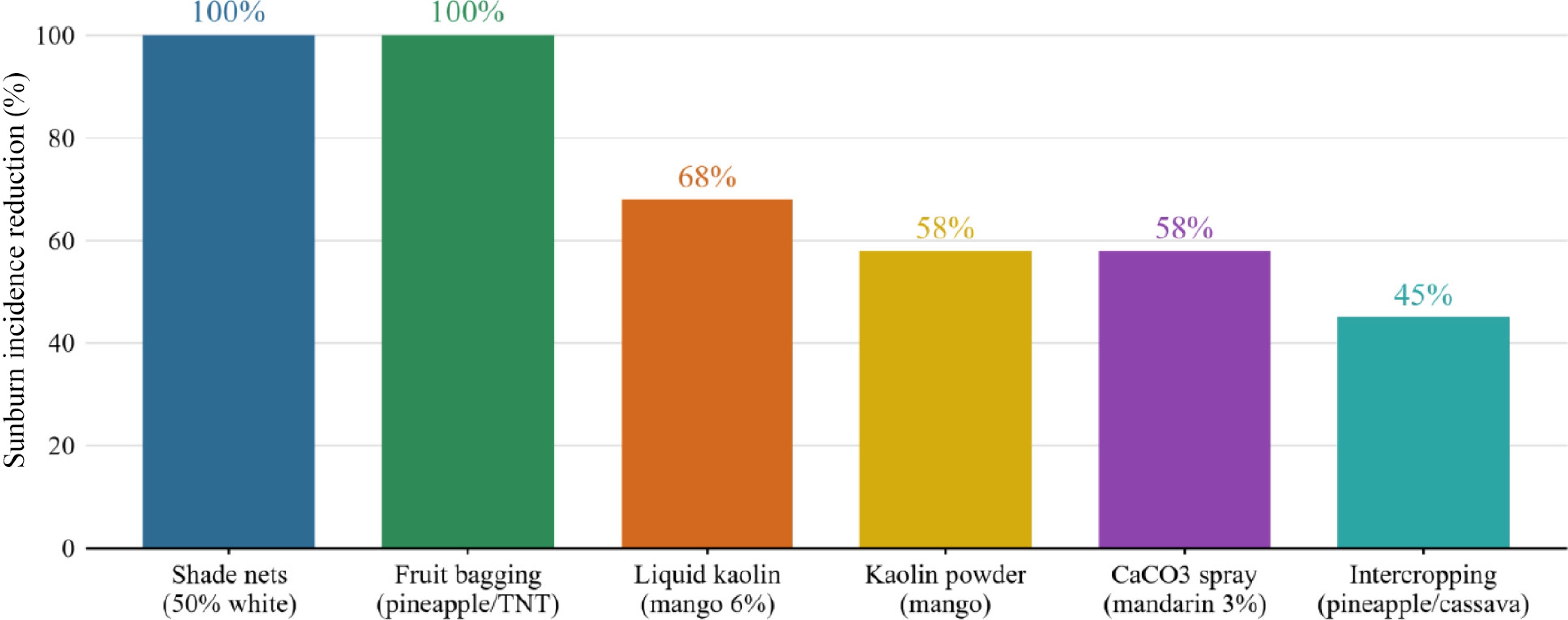
To reduce this heterogeneity in future work, this review proposes a composite Tropical Fruit Sunburn Severity Index (TF-SSI) that future studies could adopt a 0−3 scale combining: (1) incidence (proportion of affected fruit, weighted 0 = < 10%, 1 = 10%−30%, 2 = 30%−60%, 3 = > 60%); (2) severity (mean proportion of peel area affected per fruit, on the same 0−3 banding); and (3) a biochemical confirmation flag (0 = not measured, 1 = confirmed via MDA or electrolyte leakage above species-specific baseline), reported alongside the raw incidence and severity data rather than in place of them. Reporting all three components separately, in addition to any composite score, would allow future meta-analyses to re-derive comparable effect sizes regardless of which single metric an individual study originally emphasised.
Agronomic and canopy management (preharvest)
-
The most upstream mitigation is to reduce the amount of solar radiation reaching the fruit surface in the first place. Fischer et al.[3] identified pruning and training practices that retain sufficient foliage above developing fruit, intercropping for shade provision, and variety selection for natural canopy density as the principal agronomic tools available to growers. In banana and plantain, maintaining bunch leaf coverage is both an agronomically standard practice and critical for sunburn prevention. Santos et al.[2] confirmed that intercropping pineapple with cassava at 0.80 to 1.20 m row spacings reduced sunburn while providing an additional food crop, a dual benefit with significant livelihood value in African and Latin American smallholder contexts. Rootstock selection as a longer-term agronomic tool has been demonstrated in apple[4], suggesting that rootstock-mediated water supply capacity may be a relevant breeding target for tropical species where hydraulic conductance limits evaporative cooling under high transpirational demand.
Physical and microclimate interventions (preharvest)
-
Shade nets represent the most extensively evaluated physical mitigation technology. El-Zawily et al.[21] demonstrated that all shade net colours and densities tested for mandarin completely eliminated sunburn, compared to 8.74% incidence in unprotected controls.
White shade nets at 50% density provided the optimal balance of sunburn elimination and fruit quality preservation. Severino et al.[53] established that Black-Net-50% treatment kept fruit surface temperatures below 46 °C in neotropical climates. Fruit bagging provides near-complete protection but at a labour cost that limits scalability in commodity production. Willsea et al.[56] showed that retractable netting allowed colour development before harvest without increased sunburn risk, a valuable refinement for red-peel mango cultivars. Xu et al.[57] demonstrated that a hydrogel coating achieved a 15.3 °C surface temperature reduction through combined radiative and evaporative cooling, pointing toward materials-based field solutions with tropical application potential. In a complementary direction, Gang et al.[58] developed a biodegradable active composite hydrogel packaging for climacteric bananas, indicating that the same hydrogel chemistries used for radiative cooling can be engineered into low-cost postharvest formats suited to tropical supply chains.
Reflective particle films and mineral protectants (preharvest)
-
Kaolin clay particle film is the most extensively evaluated chemical sunburn protectant for tropical and subtropical fruit. Its mode of action is passive: white kaolin particles reflect a portion of incident solar radiation before it can be absorbed, thereby reducing surface temperature. Hamdy et al.[41] found that 6% kaolin significantly reduced sunburned fruit numbers while improving yield and fruit quality in Keitt mango. Bellitti et al.[22] confirmed that liquid kaolin reduced sunburn probability by 68% and delayed onset by 47 d, with no adverse effect on sugar content, acidity, or colouration. Karunakaran et al.[46] showed that kaolin combined with shade nets provided the highest chlorophyll retention in dragon fruit. Calcium carbonate at 3% reduced mandarin sunburn to 7.32%, and its calcium component may provide an additional membrane-stabilising benefit[21].
Biochemical and chemical protectants, and edible coatings (predominantly postharvest)
-
Ascorbic acid addresses the correct mechanistic target by directly scavenging ROS and, at the epigenetic level, suppressing WRKY-regulated oxidative gene expression via H3K18 lactylation[36]. Salicylic acid functions as an endogenous plant defence hormone that enhances antioxidant enzyme activities and reduces lipid peroxidation; its combination with 1-MCP in banana produced superior outcomes to either agent alone[23]. Melatonin at 1.5 mM in papaya extended shelf life to 9 d under ambient tropical storage conditions and reduced all ROS markers[17,42]. These biochemical strategies address the correct mechanistic targets, but their preharvest efficacy under continuous field solar exposure conditions has not been directly tested in tropical contexts, which represents a significant and correctable evidence gap.
A related limitation cuts across both the kaolin and melatonin evidence discussed in this section: kaolin is reported here predominantly at a single concentration (6% w/v), and melatonin predominantly at a single concentration (1.5 mM), each drawn from a small number of studies. Neither the dose–response relationship above or below these concentrations, nor the optimal application timing relative to fruit phenological stage (young fruit vs rapid expansion vs pre-ripening), is established by the current evidence base. Because incorrect dosing or mistimed application risks reduced efficacy or phytotoxicity, dose-gradient and timing trials are needed before these concentrations can be generalised as recommended field rates.
Edible coatings provide a dual function as passive barriers and antioxidant carriers. Gum arabic at 10%, a Sahel-derived material broadly accessible in sub-Saharan Africa, reduces the peel browning index and maintains membrane stability in bananas[39]. Chitosan-gum arabic composites extended guava shelf life to 12 d under ambient conditions[55]. Tavassoli-Kafrani et al.[59] reviewed the state of edible coating technology for mango, identifying the incorporation of plant extract antioxidants as a direction that substantially enhances anti-browning performance. Moradinezhad et al.[60] confirmed that nanotechnology-enhanced coatings represent the next generation of barrier technology, with improved gas exchange control and controlled antioxidant release relevant to both postharvest and potentially preharvest solar protection contexts. A recurring theme across this literature is the enrichment of coatings with plant-derived antioxidants: Bajaj et al.[61] reviewed how plant-extract-enriched edible coatings preserve postharvest fruit quality, and Kohli et al.[62] demonstrated that composite edible coatings extend shelf life and maintain postharvest quality in guava under natural storage. The choice of base material also matters for smallholder feasibility: Osae et al.[63] showed that locally available shea butter, beeswax, and cassava starch coatings inactivated oxidative enzymes and retained antioxidant quality in stored fruit, underscoring that effective anti-browning barriers need not depend on imported inputs.
-
The evidence surveyed in this review establishes a coherent mechanistic picture of solar radiation-induced senescence and spotting in tropical fruits, as visualised in Fig. 2. The initiating event is ROS overaccumulation triggered by the combination of photochemical excitation, thermal protein stress, and membrane lipid peroxidation. The cascade involves PPO-mediated enzymatic browning of phenylpropanoid substrates, chlorophyll degradation through the pheophytinase–PAO pathway, and structural collapse of the peel epidermis. This mechanism appears broadly conserved among the tropical fruit species examined in this review, although direct confirmatory evidence remains concentrated in a small number of species (chiefly banana, mango, and mandarin), so conservation across all tropical fruit species should be read as plausible rather than established; the specific biochemical signatures, induction thresholds, and downstream trajectories vary substantially by species, cultivar, developmental stage, and environmental context.
The field has advanced considerably in its molecular characterisation of browning pathways. WRKY transcription factors have emerged as central regulators in both banana and wampee solar stress responses[14,29], and their conservation across tropical species suggests they may be broadly relevant targets for genetic improvement. It should be noted that reference[63] was itself a low-temperature/chilling-injury study of banana peel browning rather than a direct solar-exposure study, so its WRKY evidence is being extrapolated to the solar-stress context here rather than demonstrating it directly. DNA methylation and histone lactylation as epigenetic regulators of PPO gene expression represent genuinely new mechanistic insights with potentially major implications for breeding strategies[1,36]. As with the WRKY evidence above, reference[54] examined chilling-induced peel browning rather than solar-induced browning, and all of the epigenetic evidence assembled in this review to date comes exclusively from banana; equivalent epigenetic data for mango, papaya, and dragon fruit are simply not yet available in the literature searched, so the regulatory framework proposed here should be read as a banana-derived hypothesis awaiting cross-species validation rather than an established conserved mechanism. The convergence of thermal and radiation stress pathways on the same WRKY–antioxidant–PPO axis raises the possibility that insights gained from chilling-injury studies in banana are mechanistically relevant to solar heat stress contexts, but this transferability is a testable hypothesis, not an established finding, and should not be assumed until it is verified directly under solar-exposure conditions.
Critical appraisal of mitigation evidence
-
The mitigation literature is mature for physical interventions, particularly shading nets and kaolin, in citrus and mango production in Mediterranean and neotropical environments. The critical weakness, visualised starkly in Fig. 4, is that the impressive efficacy numbers are drawn almost entirely from commercial-scale operations in Egypt, Chile, Brazil, and Southern Europe, with experimental designs, infrastructure, climate profiles, and variety portfolios that may not translate to the West African or East African smallholder reality. Affognon et al.[5] and Stathers et al.[25,52] have repeatedly identified this geographic concentration of postharvest research as a fundamental barrier to evidence-based investment in the regions where postharvest losses are most severe.
The biochemical mitigation strategies are evaluated almost entirely in postharvest contexts. The physiological context of a fruit on the tree under solar radiation differs substantially from that of harvested fruit in a controlled environment: water stress, hormonal crosstalk with the parent plant, fruit developmental stage, and the continuous nature of solar exposure on the plant are all absent from postharvest studies. This gap is not a reason to dismiss biochemical strategies, but it is a reason to treat their preharvest efficacy as a hypothesis requiring direct testing rather than assumed proof.
Knowledge gaps, research priorities, and future directions
-
Table 3 presents the seven priority knowledge gaps identified in this review, with their rationale, recommended research approach, and priority level. The gaps are not merely academic: each represents a specific barrier to translating available mechanistic knowledge into reduced solar-related postharvest losses for tropical smallholder producers.
Three recommendations emerge from deductions made through this study. First, multi-omics approaches of the kind applied to wampee[29] must be extended to the commercially dominant tropical species, particularly banana, mango, and papaya, to identify variety-specific molecular markers of solar stress tolerance exploitable in breeding programmes.
Additionally, the postharvest-to-preharvest translational gap in biochemical intervention research must be addressed through controlled field experiments that test melatonin, salicylic acid, and ascorbic acid under continuous solar exposure conditions across the full fruit development period. Also, participatory research designs that place smallholder producers in sub-Saharan Africa and Southeast Asia at the centre of mitigation efficacy trials, rather than as recipients of technologies developed for different contexts, are essential for any intervention to achieve meaningful adoption and impact.
-
Solar radiation-induced senescence and surface spotting in tropical fruits constitute a significant and growing challenge to tropical fruit production systems, one whose economic and food security consequences fall disproportionately on smallholder producers in sub-Saharan Africa and Southeast Asia. The core mechanism, ROS overaccumulation triggering PPO-mediated enzymatic browning, chlorophyll degradation, and cellular necrosis, is mechanistically coherent and increasingly well characterised at the molecular level in model tropical species. WRKY transcription factors, the phenylpropanoid pathway, PPO-substrate compartmentation, and epigenetic regulators of gene expression emerge as the most promising mechanistic targets for both agronomic and genetic improvement strategies.
Among mitigation strategies, the evidence is strongest for shade nets and kaolin particle films in tropical citrus and mango contexts. Fruit bagging provides near-complete protection but at labour costs that limit scalability. Intercropping as both a shading and food security strategy has demonstrated practical promise for pineapple and offers a directly translatable model for banana and papaya in smallholder systems. Biochemical strategies including melatonin, ascorbic acid, salicylic acid, and 1-MCP address the correct mechanistic targets, but their preharvest efficacy under field tropical conditions remains unverified for most species. The gap between the quality of mechanistic knowledge and the quality of actionable, context-specific mitigation evidence is the defining limitation of the current literature. Closing the seven priority gaps identified in this study is not merely a scientific priority. It is a practical imperative for the food security of hundreds of millions of people who depend on tropical fruits as a primary source of nutrition and income.
The authors thank the National Horticultural Research Institute for institutional support during the preparation of this review. This research did not receive any specific grant from funding agencies in the public, commercial, or not-for-profit sectors.
-
During the preparation of this work, the authors used Grammarly for language refinement and assistance. The authors also used Canva Pro to draw Figs. 2 and 3 for high-quality and analytical visualization. The authors reviewed and edited all content produced with the assistance of this tool, verified its accuracy, and take full responsibility for the integrity and originality of the final manuscript. This work represents the authors' own intellectual contribution, and no AI tool is credited as an author.
-
The authors confirm their contributions to the paper as follows: study conception and design: Fasuan TM, Olatunji OA; literature search and data collection: Olagunju YO, Adesokan SO; analysis and interpretation of retrieved literature: Fasuan TM, Olatunji OA, Olagunju YO; draft manuscript preparation: Fasuan TM, Adesokan SO. All authors reviewed the results and approved the final version of the manuscript.
-
Data sharing is not applicable to this article as no datasets were generated or analyzed during the study.
-
The authors declare that they have no conflict of interest.
- Copyright: © 2026 by the author(s). Published by Maximum Academic Press, Fayetteville, GA. This article is an open access article distributed under Creative Commons Attribution License (CC BY 4.0), visit https://creativecommons.org/licenses/by/4.0/.
-
About this article
Cite this article
Fasuan TM, Olagunju YO, Olatunji OA, Adesokan SO. 2026. Mechanisms and consequences of solar radiation-induced senescence, peel browning, and surface spotting in tropical fruits and their mitigation strategies. Technology in Horticulture 6: e023 doi: 10.48130/tihort-0026-0015 

Mechanisms and consequences of solar radiation-induced senescence, peel browning, and surface spotting in tropical fruits and their mitigation strategies
- Received: 01 June 2026
- Revised: 09 September 2026
- Accepted: 20 September 2026
- Published online: 22 October 2026
Abstract: The objective of this review is to synthesise and critically evaluate the mechanistic evidence for solar radiation-induced senescence and surface spotting in tropical fruits and to appraise the evidence base for their mitigation strategies. This review synthesises evidence on sun-induced senescence and mitigation across nine tropical fruits, spanning three distinct injury types: photooxidative sunburn, sunburn browning, and epidermal necrosis, each with a distinct phenotype and induction threshold. Of these, sunburn browning is the most frequently reported as economically consequential across the literature reviewed, given its high prevalence in commercial cultivars and its direct, visible link to marketability loss, whereas photooxidative sunburn and epidermal necrosis are comparatively less pervasive but can cause more severe, unmarketable damage where they occur. The shared mechanism is excess reactive oxygen species generation that overwhelms antioxidant defences, leading to membrane destabilisation once thresholds are crossed. Mitigation strategies span three tiers: agronomic and canopy management; physical and microclimate interventions such as shading nets, fruit bagging, and evaporative cooling; and biochemical and chemical approaches including kaolin clay, calcium carbonate, ascorbic and salicylic acid, 1-methylcyclopropene, and edible coatings. Four figures and four tables consolidate the mechanistic and mitigation literature reviewed here. Key gaps include the absence of species-specific thermal thresholds for most tropical fruits, sparse multi-season smallholder efficacy data across Africa and Southeast Asia, and limited understanding of how rising temperature and elevated UV radiation interact with bioactive compound accumulation. Future work should adopt integrative multi-omics approaches and climate-adaptive management calibrated to the real constraints of tropical production systems.
-
Key words:
- Sunburn /
- Tropical fruits /
- Peel browning /
- Climate change /
- Phenylpropanoid pathway