












-
Epiphytic plants are a significant component of global plant diversity, with orchids being particularly notable. Orchids account for 67.6% of all epiphytic species[1]. Within the Orchidaceae, Dendrobium is the largest genus, encompassing species of both high ornamental and medicinal value. In addition to their striking floral diversity and unique growth forms, Dendrobium species are rich in bioactive metabolites, including phenols, flavonoids, alkaloids, bibenzyls, phenanthrenes, and polysaccharides[2−6]. Their distribution is closely linked to climatic conditions, as they thrive in warm, humid environments; under stresses such as drought, pseudobulb production is markedly reduced, and mortality rates increase[7−9]. In recent decades, anthropogenic disturbance and environmental changes have rendered numerous Dendrobium species threatened with extinction[10]. Therefore, a systematic evaluation of their growth patterns and phytochemical variation across different habitats is crucial for resource conservation and sustainable utilization.
Dendrobium sinense Tang & F. T. Wang is a perennial epiphytic orchid species endemic to Hainan, China[11]. It is found in mountainous areas above 1,000 m, in regions such as Changjiang, Lingshui, and Ledong[12]. As an important traditional Li medicine in Hainan, its pseudobulbs are decocted to relieve cough[13]. Phytochemical studies have revealed that D. sinense is rich in alkaloids, benzyl derivatives, flavonoids, and polysaccharides. The extract of D. sinense has been shown to possess excellent antioxidant activity, antibacterial properties, and acetylcholinesterase inhibitory activity[14−19]. Pseudobulbs not only contain a large amount of medicinal components, but their structure and function also affect the individual development of the plant. More and more researchers are paying attention to the significance of pseudobulbs in the phenological process of orchid growth, flowering, and fruiting[20]. The growth and reproduction of D. sinense are closely linked to local climatic conditions[21,22]. Pseudobulbs activate phenotypic growth and the accumulation of secondary metabolites in response to abiotic stress. Appropriate temperature is beneficial for the morphological growth of Dendrobium, while extreme temperatures will promote the accumulation of secondary metabolites[23−25]. The morphology of pseudobulbs is typically associated with water storage. Long pseudobulbs increase the distance for water transportation, while short and wide ducts generally have higher water conductivity and transportation rates[26]. Additionally, water and metabolite contents vary across pseudobulb ages and developmental stages[25]. This reflects their dynamic role in plant growth, reproduction, and seasonal adaptation[27]. The metabolism and accumulation of active components in pseudobulbs result from various ecological factors that influence the development and growth of medicinal orchids[28]. For Dendrobium species, temperature, humidity, and sunlight duration are significantly correlated with the content of bioactive components[29]. Different active components contribute distinct antioxidant capabilities[30]. Given the potential impact of geographical variations on chemical composition and growth in Orchidaceae[31], it is crucial to understand how local environmental conditions affect the growth and metabolic characteristics of D. sinense pseudobulbs. This knowledge is vital for the conservation and habitat restoration of this endangered species and for enhancing the sustainable utilization of its medicinal resources[31]. However, little is known about how environmental gradients regulate the growth and metabolic traits of D. sinense. Understanding these relationships is essential not only for understanding its adaptive strategies but also for addressing the ecological and physiological mechanisms underlying its endangered status.
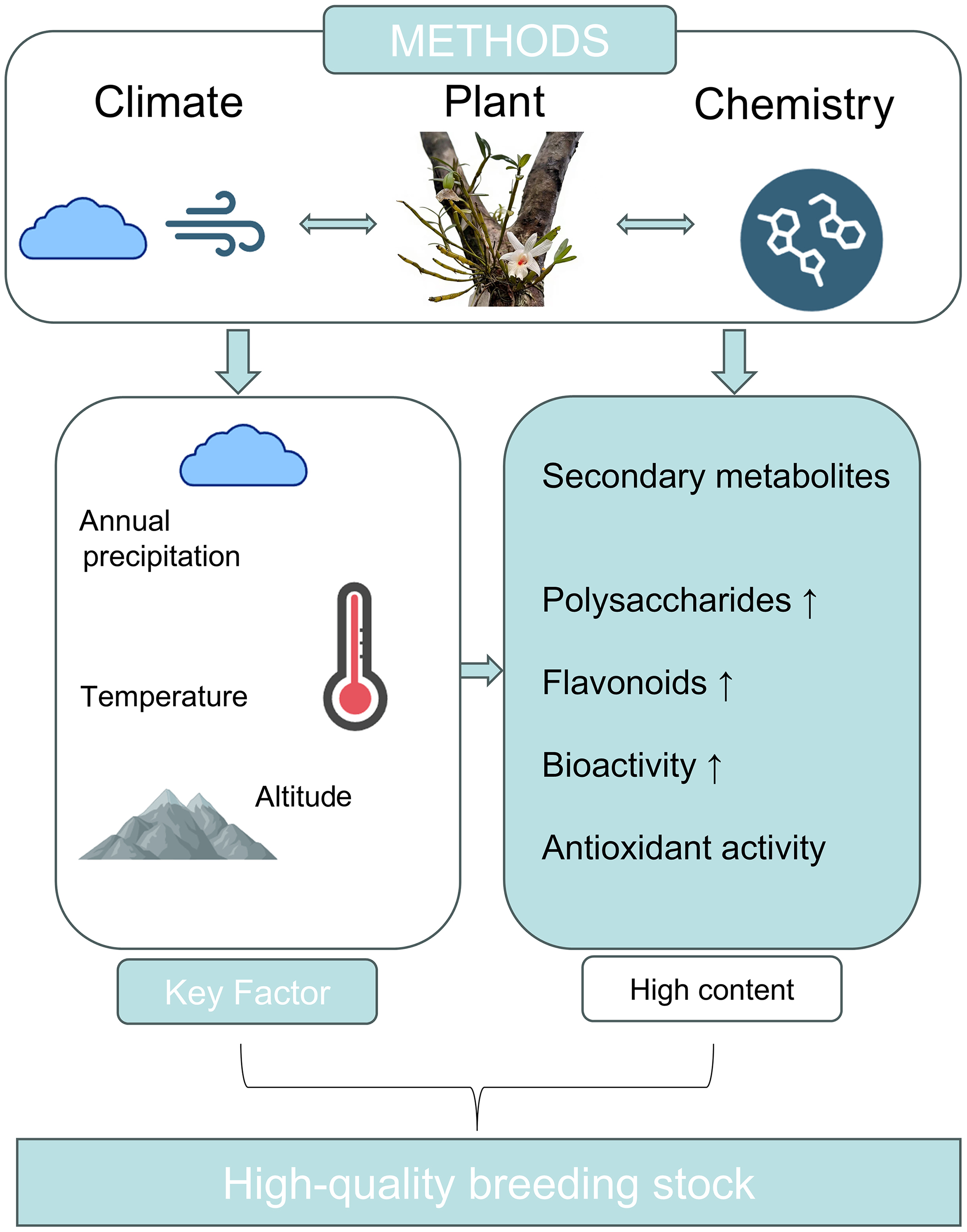
Previous studies have investigated the physiological characteristics and chemical composition of D. sinense in specific areas. However, their research primarily focused on individual active compounds or single environmental factors. There is still a lack of a clear understanding of how regional conditions regulate the overall metabolic profile and physiological landscape at different growth stages. This has led to gaps in understanding the quality formation of D. sinense. The present study investigated pseudobulbs of D. sinense collected from seven provenances within the National Park of Hainan Tropical Rainforest. Pseudobulb number, length, bioactive components, and antioxidant activities were compared across different development stages. The study aims to explore the relationship between the growth quantity of pseudobulbs in different varieties/populations of D. sinense, their active components, antioxidant properties, and ecological factors. The goal is to clarify the adaptation rules of D. sinense growth at different stages and identify the main environmental factors influencing it. Additionally, regional physiological differences and potential mechanisms of endangerment were investigated to provide theoretical guidance for the conservation, artificial cultivation, and sustainable utilization of D. sinense.
-
This research area was located in the natural reserves of Hainan Province: Bawangling, Yinggeling, Jinfengling, Limu Mountains (Sanxinglinling and Limu Peak), Wuzhi Mountains, and Diaoluo Mountains (Supplementary Table S1). The regional altitude ranged from 1,000 to 1,700 m (Fig. 1; Supplementary Table S1). Hainan Island had a tropical monsoon maritime climate, with an average annual temperature of 22.5−25.6 °C and an annual precipitation of 1,500−2,500 mm. The average annual relative humidity was 87%, featuring a tropical rainforest ecosystem. At that time, the main vegetation types included seagrass beds, mangroves, semi-mangroves, freshwater wetland grasslands, coastal (island, riverbank) sandy forests, tropical monsoon forests, tropical rainforests, highland cloud forests, and mountain shrublands, etc.[32,33].
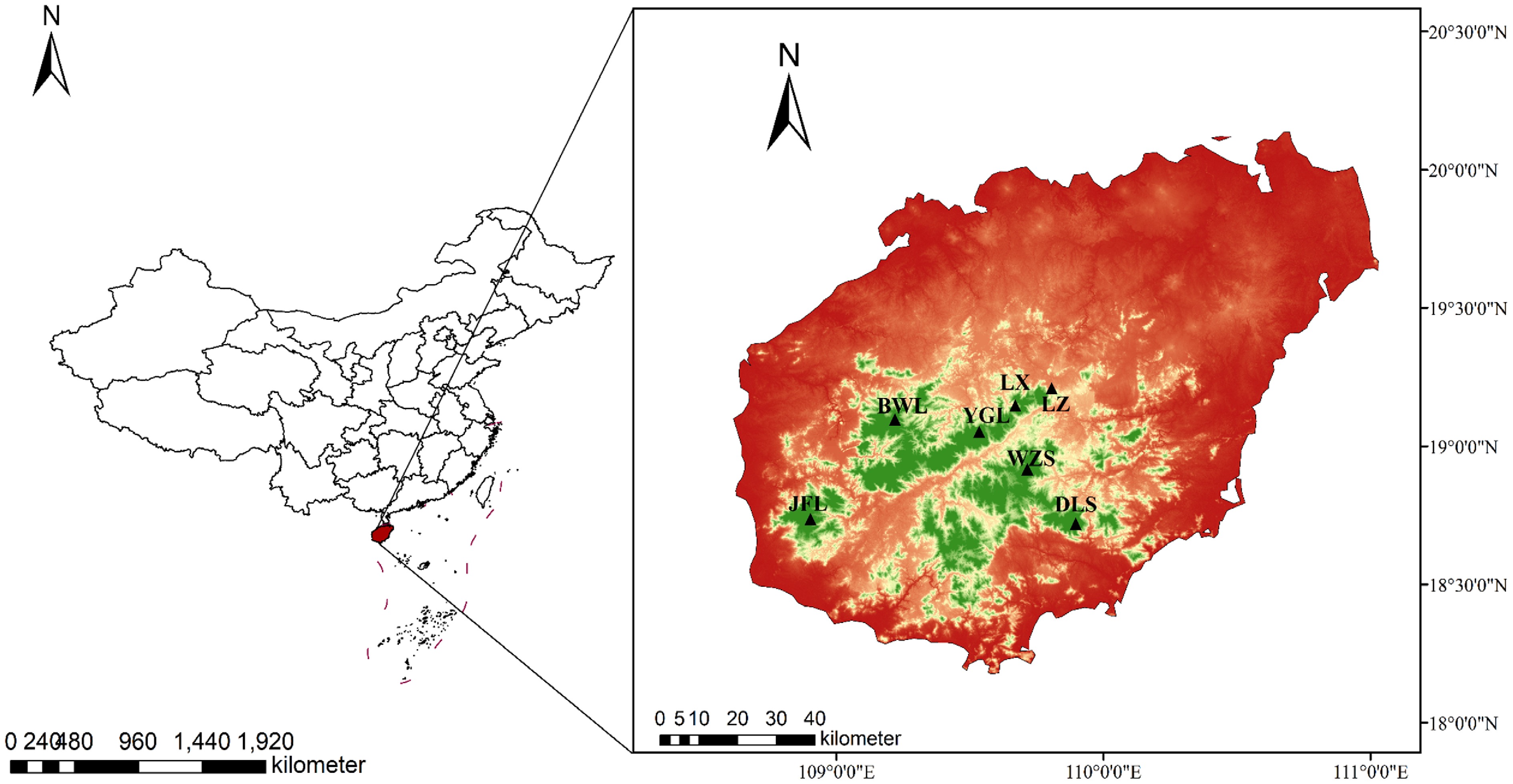
Figure 1.
Location map of D. sinense from different populations. Map source is the National Geographic Information Public Service Platform (
www.tianditu.gov.cn ). Drawing Review Number: GS (2024) 0650. BWL: Bawangling, YGL: Yinggeling, JFL: Jinfengling, LX: Limu Mountains - Sanxinglinling, LZ: Limu Peak, WZS: Wuzhi Mountains, DLS: Diaoluo Mountains.Sample plot establishment and survey
-
In the seven protected areas of Hainan Province, 5 m × 5 m strip sample plots were set up centered around the D. sinense epiphytic tree species. Each 5 m × 5 m plot was established around a single, independent host tree (phorophyte) bearing D. sinense, and no host tree was sampled more than once.
The companion tree species with a diameter at breast height (DBH) of 5 cm or more within the sample plots were investigated. The names and diameters of the associated tree species were recorded, and the length, quantity, and attachment angle of the pseudobulbs of D. sinense in each cluster were also recorded.
Annual average solar radiation, average temperature, and annual precipitation were extracted from WorldClim v2.1 (1 km2 resolution), while relative humidity was measured in situ at each plot using a portable hygrometer. Altitude, longitude, and latitude were recorded on site using a GPS device.
Sample collection
-
The wild D. sinense was identified by researcher Zhang et al.[34]. All the plants were immediately collected and stored in the −20 °C freezer section of the laboratory of the Tropical Agricultural and Forestry College of Hainan University, China. A total of seven regions were used in this study, with 30 plots set up in each region. At each growth stage (such as the seedling stage, flowering stage, etc.), 48 independent biological replicates were collected from Bawangling, 19 from Yinggeling, 19 from Jinfengling, 18 from Limu Mountains (Sanxinglinling), nine from Limu Peak, 21 from Wuzhi Mountains, and 23 from Diaoluo Mountains in each region, respectively. The total sample size obtained was 157 plants.
The pseudobulb parts collected from each region were washed with water and dried at 60 °C. After drying, the materials were ground and sieved. The ultrasonic-assisted extraction method was used to extract the ground pseudostem samples from each region, following the method described by Dong et al.[35]. The extraction was carried out using an ultrasonic processor (SB25-12D, Ningbo Xinzhi Biotechnology Co., Ltd, Zhejiang Province, China), with a frequency of 40 kHz and an ultrasonic power of 600 W. The solvent was a 70% (volume/volume) mixture of ethanol and water, with a sample-to-solvent ratio of 1 g: 40 mL. The extraction temperature was 30 °C, and it was carried out twice for 30 min. Then, rotary evaporation was used to bring the solution up to 50 mL, obtaining the ethanol extract of D. sinense. This extract was used for the subsequent biological activity assays.
Based on the previous descriptions of the life history stages of the Dendrobium species and combined with the field observations of D. sinense, four phenological stages were defined through clear morphological characteristics[34]. Representative photos of each stage can be found in the content of Fig. 2.
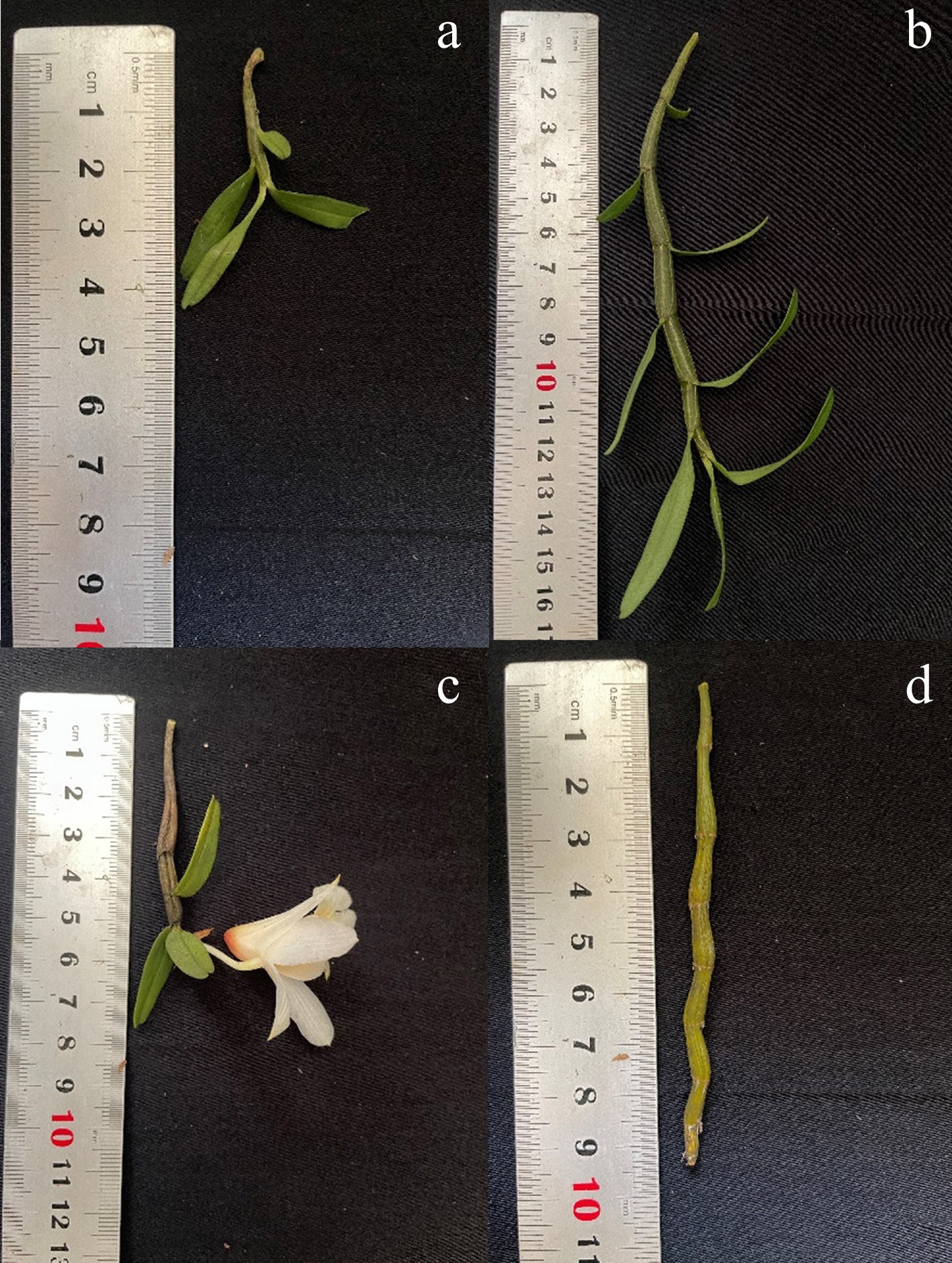
Figure 2.
D. sinense population at each stage of life history. (a) Seedling stage (YMQ). (b) Vegetative growth stage (YYSZQ). (c) Flowering stage (FZQ). (d) Senescence stage (SLQ).
(1) YMQ (Seedling stage): the plant has only three pseudobulbs with a length not exceeding 1 cm, accompanied by new young leaves.
(2) YYSZQ (Vegetative growth stage): unfertile plants, with at least one elongated pseudobulb (length over 1 cm), without flower clusters or signs of flowering, and capable of actively growing new leaves.
(3) FZQ (Flowering stage): refers to plants with a clearly visible flower cluster or open flowers on at least one pseudobulb.
(4) SLQ (Senescence stage): refers to pseudobulbs that are yellowish-brown and without leaf growth.
Calculation of epiphytic tree species diversity
-
The Shannon diversity index (SHDI) and Simpson diversity index (SIDI) were used to estimate the diversity of associated tree species of D. sinense in different regions.
The Simpson diversity index was calculated as follows[36]:
$ \text{SIDI}=1-\sum\limits_{i=1}^{S}P_{\text{i}}^{2} $ (1) where, Pi represents the proportion of samples belonging to the species. As biodiversity increases, the Simpson index also increases.
The Shannon diversity index was calculated as follows[37]:
$ \text{SHDI}=-\sum\limits_{i=1}^S(P\mathrm{_i}\ln_{ }P\mathrm{_i}) $ (2) Determination of main components
Determination of total flavonoid content (TFC)
-
Following the method of Zhishen et al.[38] with slight modifications, 10 mg of rutin standard was dissolved in an appropriate amount of anhydrous ethanol and diluted to 50 mL to prepare a 0.2 mg/mL stock solution. Aliquots of 1 mL from standard solutions with concentrations of 0.02, 0.04, 0.06, 0.08, 0.1, and 0.2 mg/mL were separately transferred into 10 mL volumetric flasks. Subsequently, 1.5 mL of NaNO3 solution (5%) was added to each flask, followed by high-frequency vortex mixing and reaction for 6 min. After thorough reaction, 1.5 mL of Al(NO3)3 solution (10%) was added, and the mixture was allowed to react for another 6 min. Finally, 4 mL of NaOH solution (4%) was added, and the volume was adjusted to the mark with ethanol. The mixture was left to stand for 30 min.
A blank sample containing 0 mL of rutin standard solution was used as a reference. The absorbance (A) of each concentration gradient was measured at 510 nm, and a standard curve was plotted. The concentration (C) of the standard solution was plotted against the absorbance (A) to obtain the standard curve equation: y = 0.8969x + 0.0334 (R2 = 0.9929).
$ \text{Extraction rate }(\text{%})=\dfrac{m}{M}\times100\text{%}=\dfrac{C\times v\times N}{M}\times100\text{%} $ (3) where, C represents the concentration of flavonoids, mg/mL; v represents the volume of the extract or the volume after dilution, mL; N represents the dilution factor; M represents the mass of the sample dry powder, mg.
Determination of total phenol content (TPC)
-
In this experiment, the total phenolic content in D. sinense extracts was determined using the Folin–Ciocalteu method[39]. Briefly, 5 mg of gallic acid monohydrate was accurately weighed and dissolved in a 50 mL volumetric flask to prepare a 0.1 mg/mL stock solution, which was stirred thoroughly to ensure complete dissolution. Aliquots of 0, 1.0, 2.0, 3.0, 4.0, and 5.0 mL were pipetted from the stock solution into separate 10 mL volumetric flasks and diluted to the mark, yielding gallic acid standard solutions with concentrations of 0, 0.01, 0.02, 0.03, 0.04, and 0.05 mg/mL, respectively.
For the assay, 1 mL of each gallic acid standard solution was transferred to a 10 mL volumetric flask, followed by the addition of 1 mL of distilled water and 0.2 mL of 1 mol/L Folin–Ciocalteu reagent. After vigorous vortexing, the mixture was allowed to stand for 4 min. Subsequently, 4 mL of 7.5% Na2CO3 solution was added, and the reaction mixture was mixed well and incubated at room temperature in the dark for 60 min. A reagent blank was prepared simultaneously. The absorbance of each sample was measured at 760 nm. A linear regression equation was established between gallic acid concentration (x) and absorbance (y).
Polysaccharide content determination
-
The content of polysaccharides was determined by the phenol-sulfuric acid method[40], and the reagent kit was purchased from Suzhou Grace Biotechnology Co., Ltd.
Bioactivity analysis
Acetylcholinesterase inhibitory activity
-
The acetylcholinesterase (AChE) inhibitory activity of D. sinense compounds was determined following the method according to Ellman et al.[41]. The test samples were dissolved in 70% ethanol to prepare 2 mg/mL sample solutions. The following reagents were sequentially pipetted into centrifuge tubes: 675 μL of phosphate buffer saline (PBS, pH 8.0), 45 μL of test sample solution, and 90 μL of acetylcholinesterase solution (0.2 U/mL). Then, 180 μL of the mixture was transferred to a 96-well plate and incubated at 37 °C for 15 min. Subsequently, 20 μL of an equal-volume mixture of 5,5'-dithiobis-(2-nitrobenzoic acid) (DTNB, 1 mmol/L) and acetylthiocholine iodide (ATch, 5 mmol/L) was added, followed by incubation at 37 °C for 30 min. The optical density (OD) was measured at 405 nm.
$ \text{Inhibition ratio }({\text{%}})=\dfrac{{OD}_{Ethanol}-{OD}_{Sample}}{{OD}_{Ethanol}-{OD}_{PBS}}\times 100{\text{%}} $ (4) DPPH radical scavenging activity
-
The DPPH radical scavenging activity was determined using a modified method from Brand-Williams et al.[42]. Briefly, 2 mL of D. sinense ethanol extract (concentrations of 0, 0.025, 0.05, 0.1, 0.2, and 0.4 mg/mL) was mixed with 2 mL of DPPH solution (0.1 mmol/mL in anhydrous ethanol). The mixture was vortexed vigorously and allowed to react in the dark for 30 min. The absorbance was measured at 517 nm using a UV-visible spectrophotometer, with 2 mL of anhydrous ethanol solution serving as the blank control. Ascorbic acid was used as the positive control. The vitamin C equivalent antioxidant capacity (VCEAC) of D. sinense ethanol extracts from different regions was calculated using a vitamin C standard curve[43], with results expressed as vitamin C equivalents, mmol/mL.
ABTS radical scavenging activity
-
The ABTS radical scavenging activity was determined using a modified method from Re et al.[44]. The ABTS stock solution was prepared by mixing equal volumes of 2.45 mmol/L K2S2O8 solution and 7 mmol/L ABTS solution, followed by incubation at room temperature in the dark for 12−16 h. The working solution was obtained by diluting the ABTS stock solution with PBS buffer (pH = 7.4) at a volume ratio of 49:1 to achieve an absorbance of 0.7 ± 0.02 at 734 nm.
For the assay, 1 mL of the total flavonoid extract from D. sinense was mixed with 3 mL of ABTS working solution. The mixture was vortexed vigorously and allowed to react in the dark for 6 min. The absorbance was then measured at 734 nm. Anhydrous ethanol served as the blank control, while L-ascorbic acid (VC) was used as the positive control.
Principal component analysis
-
Comprehensive evaluation of D. sinense across different regions based on environmental factors and growth characteristics. The calculation formula was as follows:
$ \begin{gathered}{\text{Factor eigenvector coefficient}}=\\ \dfrac{\text{Principal component load}}{\sqrt{\text{The eigenvalues corresponding to the principal components}}}\end{gathered} $ (5) The comprehensive quality score for D. sinense from different regions was calculated using the following formula, where T1, T2, T3, T4, T5, and T6 were the eigenvalues of the 1 to 6 principal components:
$ \begin{split}Y=\sum_{i=1}^6\dfrac{T_i}{\sum_{j=1}^6T_j}\times Y_i\end{split} $ (6) Statistical analysis
-
The mean values and standard deviations (SD) were calculated using Microsoft Excel 2017. IBM SPSS Statistics 27.0 was employed to perform one-way analysis of variance (ANOVA) on all pseudobulb traits (quantity and length) and biochemical characteristics, with Duncan's multiple range test used for mean comparisons at a 0.05 significance level. PAST v4.17 was utilized to analyze the diversity of companion tree species across different D. sinense habitats using Simpson and Shannon diversity indices.
Column charts were generated using Origin 2024, along with cluster analysis based on cosine distance and correlation analysis visualized through heatmaps. Principal component analysis (PCA) of 18 indicators of Dendrobium sinense was conducted using SPSS, with a cumulative variance contribution rate of 77.2%. The first six principal components with eigenvalues greater than 1 were extracted.
The relationship between the physiological and ecological indicators of D. sinense and environmental factors was explored using R (v4.4.2). The analysis was completed using the vegan package, with the RDA1 explanatory variance being 42.49% and the RDA2 explanatory variance being 29.47%. Using the ggplot2 package in R, a principal component analysis plot and a redundancy analysis plot were generated to illustrate the relationships between environmental factors and pseudostem length, number, and active substance content of D. sinense.
-
In different regions of D. sinense, the number of pseudobulbs at the seedling stage (YMQSL) in YGL, LZ, LS, WZS, and DLS was significantly higher than that in BWL and JFL (F = 11.018, p < 0.05). The average number was 3−4 per plant. YGL had an average of two seedling-stage pseudobulbs, while BWL had almost none. Except for DLS, all regions showed senescence-stage number (SLQSL) > vegetative growth-stage number (YYSZQSL) > seedling-stage number (YMQSL). Among them, the reproductive-stage number (FZQSL) of YGL was significantly higher than that of the other regions, with an average of five pseudobulbs (F = 17.180, p < 0.05) (Fig. 3a).
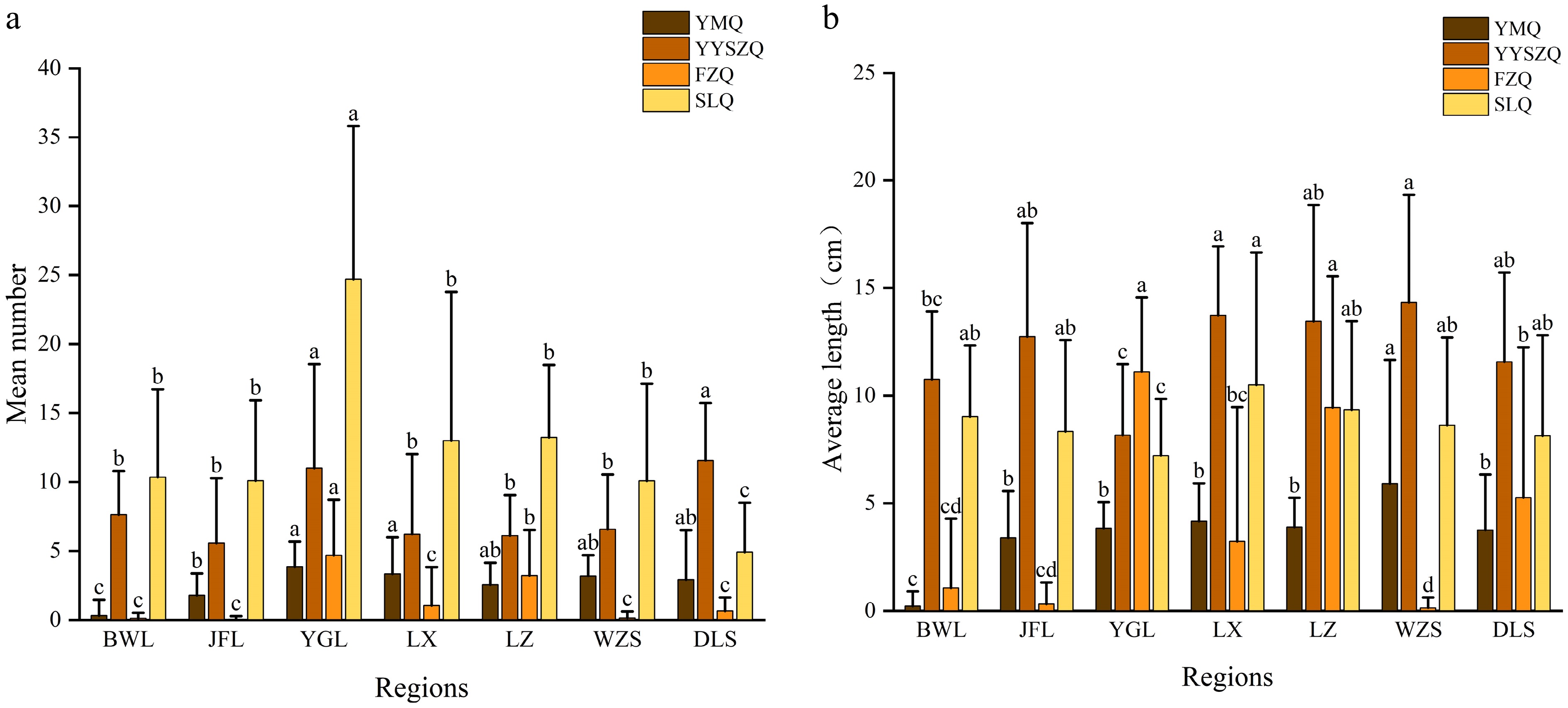
Figure 3.
D. sinense pseudobulb growth differences from different regions. (a) Differences in the number of pseudobulbs of D. sinense. (b) Differences in the pseudobulb length of D. sinense. YMQ: seedling stage, YYSZQ: vegetative growth stage, FZQ: reproductive stage, SLQ: senescence stage, CD: length, SL: number. BWL: Bawangling, YGL: Yinggeling, JFL: Jinfengling, LX: Limu Mountains - Sanxinglinling, LZ: Limu Peak, WZS: Wuzhi Mountains, DLS: Diaoluo Mountains. The lowercase letters above the columns indicate significant differences in mean number and average length among different groups.
Among the pseudobulb lengths at different growth stages of D. sinense, the seedling-stage length (YMQ) in WZS was significantly greater than that in the other regions, approximately 5.9 cm (F = 15.037, p < 0.05). The vegetative growth-stage length (YYSZQ) in YGL was significantly lower than that in the other regions, approximately 8.16 cm (F = 5.584, p < 0.05) (Fig. 3b).
Diversity index of associated tree species
-
The Simpson diversity index (SIDI) values of the associated tree species of D. sinense are as follows: BWL (0.96), JFL (0.93), YGL (0.95), LX (0.97), LZ (0.97), WZS (0.95), and DLS (0.96) (Table 1). The Shannon diversity index (SHDI) values are: BWL (3.46), JFL (2.97), YGL (3.18), LX (3.63), LZ (3.13), WZS (3.37), and DLS (3.66) (Table 1). The highest species diversity is found in DLS, followed by LMS.
Table 1. D. sinense diversity Index in different regions.
Region SIDI SHDI BWL 0.96 3.46 JFL 0.93 2.97 YGL 0.95 3.18 LX 0.97 3.63 LZ 0.97 3.13 WZS 0.95 3.37 DLS 0.96 3.66 Note: SHDI: Shannon diversity index. SIDI: Simpson diversity index. BWL: Bawangling, YGL: Yinggeling, JFL: Jinfengling, LX: Limu Mountains - Sanxinglinling, LZ: Limu Peak, WZS: Wuzhi Mountains, DLS: Diaoluo Mountains. Principal component analysis of
D. sinense from different regions -
Principal component analysis (PCA) of 18 indicators from seven D. sinense germplasm resources yielded six principal components with eigenvalues greater than 1, collectively accounting for 77.20% of the total variance (Fig. 4a). The loading matrix indicated that Principal Component 1 (PC1) was primarily influenced by longitude, annual precipitation, and solar radiation, showing the highest positive loadings for longitude and annual precipitation but the strongest negative loading for mean annual solar radiation (Supplementary Table S2). This component reflected geographic influences on D. sinense distribution, demonstrating that greater longitude values were associated with increased precipitation but decreased solar radiation. PC2 was mainly determined by altitude, SLQSL, and FZQSL.
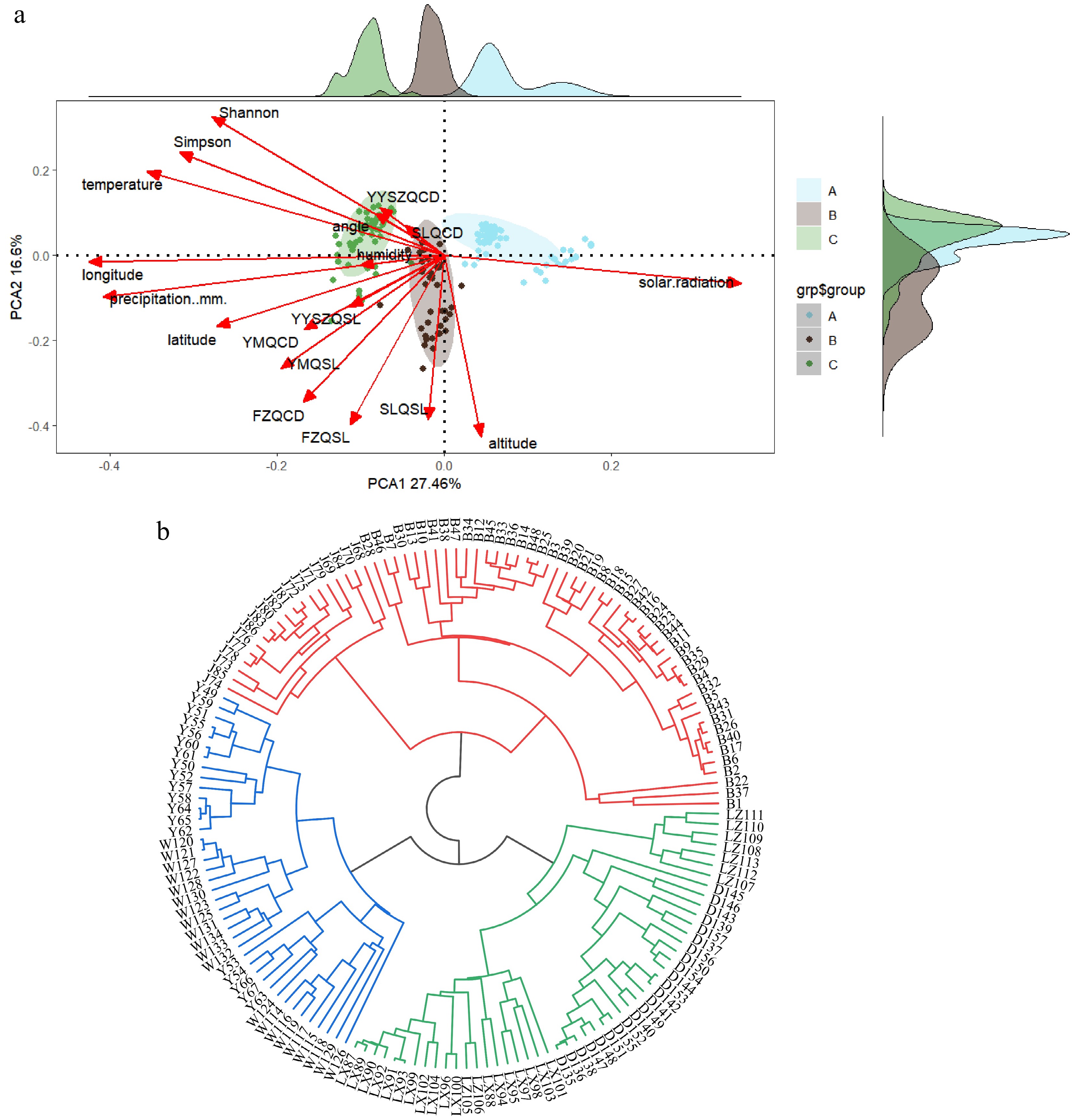
Figure 4.
(a) Principal component analysis diagram. (b) Cluster map of D. sinense in different regions.
A comprehensive quality evaluation was conducted for seven D. sinense regions. After calculating the eigenvector coefficients for each principal component, the scoring functions for Principal Components 1 through 6 were constructed as follows:
y1 = −0.04X6 − 0.36X2 + 0.10X3 + 0.36X4 + 0.41X5 + 0.08X6 + 0.32X7 + 0.28X8 + 0.43X9 + 0.27X10 + 0.20X11 + 0.11X12 + 0.02X13 + 0.11X14 + 0.17X15 + 0.08X16 + 0.05X17 + 0.17X18
y2 = 0.43X1 + 0.07X2 + 0.02X3 − 0.20X4 + 0.10X5 − 0.10X6 − 0.24X7 − 0.33X8 + 0.02X9 + 0.17X10 + 0.27X11 + 0.12X12 + 0.39X13 + 0.40X14 + 0.17X15 − 0.11X16 − 0.07X17 + 0.35X18
y3 = −0.27X1 − 0.07X2 + 0.45X3 + 0.03X4 − 0.09X5 − 0.23X6 − 0.21X7 − 0.19X8 − 0.08X9 − 0.12X10 + 0.29X11 + 0.12X12 + 0.03X13 − 0.13X14 + 0.35X15 + 0.46X16 + 0.31X17 − 0.09X18
y4 = −0.16X1 + 0.35X2 + 0.05X3 + 0.14X4 − 0.12X5 − 0.12X6 + 0.29X7 + 0.03X8 − 0.16X9 + 0.33X10 − 0.20X11 + 0.08X12 + 0.32X13 + 0.19X14 − 0.38X15 + 0.18X16 + 0.42X17 + 0.19X18
y5 = 0.23X1 − 0.06X2 − 0.48X3 − 0.26X4 + 0.05X5 + 0.29X6 − 0.04X7 + 0.13X8 + 0.06X9 − 0.10X10 − 0.04X11 + 0.50X12 + 0.12X13 − 0.18X14 + 0.06X15 + 0.32X16 + 0.34X17 − 0.11X18
y6 = 0.30X1 + 0.17X2 − 0.09X3 − 0.16X4 + 0.18X5 − 0.14X6 + 0.17X7 − 0.06X8 + 0.04X9 + 0.41X10 + 0.07X11 − 0.51X12 + 0.03X13 − 0.22X14 + 0.23X15 + 0.08X16 + 0.20X17 − 0.42X18
The scoring functions incorporated the following parameters: y1–y6 represented the eigenvector weights of principal components 1–6, while X1–X18 denoted the normalized values of 18 quality indicators across D. sinense regions (Supplementary Table S3), including elevation, solar radiation, humidity, temperature, annual precipitation, epiphytic angle, Simpson diversity index, Shannon diversity index, longitude, latitude, and pseudobulb characteristics (quantity and length across the seedling, vegetative growth, senescence, and reproductive stages) (Supplementary Table S4). The comprehensive quality score (Y) was calculated as Y = 0.36y1 + 0.21y2 + 0.13y3 + 0.12y4 + 0.10y5 + 0.08y6, with provenance rankings from highest to lowest being YGL > LZ > LX > DLS > WZS > BWL > JFL (Table 2).
Table 2. Scoring and ranking of principal component factors of germplasm resource quality.
Region 1 2 3 4 5 6 Synthesis score Sort YGL 0.22 1.17 1.41 −0.21 0.30 0.29 0.55 1 LZ 2.35 −0.05 0.77 0.30 0.39 0.36 1.03 2 LX 2.87 −0.61 −0.90 0.88 −0.19 0.12 0.86 3 DLS 2.46 −1.46 −0.47 −0.87 −0.54 0.00 0.34 4 WZS 0.59 −0.41 0.13 0.92 0.73 0.21 0.33 5 BWL −1.50 −0.05 −0.15 −0.13 −0.47 −0.20 −0.64 6 JFL −3.91 1.78 −0.12 −0.40 0.71 −0.31 −1.02 7 Note: BWL: Bawangling, YGL: Yinggeling, JFL: Jinfengling, LX: Limu Mountains - Sanxinglinling, LZ: Limu Peak, WZS: Wuzhi Mountains, DLS: Diaoluo Mountains. A cluster analysis was conducted on 18 quality indicators from seven accessions of D. sinense, including altitude, solar radiation, humidity, temperature, annual precipitation, epiphytic angle, Simpson diversity index, Shannon diversity index, longitude, latitude, and pseudobulb quantity and length at the seedling, vegetative growth, senescence, and reproductive stages.
The seven accessions of D. sinense were classified into three major groups (Fig. 4b). The first group included LX, LZ, and DLS, ranking second to fourth overall, with relatively high annual precipitation averaging 1,662 mm and an altitude of 1,100–1,200 m. The second group included YGL and WZS, ranking first and fifth overall, with relatively higher altitudes ranging from 1,500 to 1,700 m and an average annual precipitation of 1,645 mm. The third group included BWL and JFL, ranking sixth and seventh overall, characterized by lower YMQSL values and an altitude of 1,200–1,300 m.
Analysis of bioactive compounds
Contents of total phenolics, flavonoids, and polysaccharides
-
The total flavonoid content of the alcohol extract from different sources of D. sinense ranged from 11 to 24.99 mg/g. The total flavonoid contents of LX, BWL, and LZ were significantly higher than those of the other regions, being 24.91, 24.76, and 24.61 mg/g, respectively (F = 74.988, p < 0.05). The total flavonoid content of JFL and DLS was 21.49 and 20.37 mg/g, respectively. The total flavonoid content in YGL and WZS was the lowest, at 11.23 and 11.01 mg/g, respectively.
The total phenolic content of the extract from different sources of D. sinense ranged from 3.76 to 4.24 mg/g. The total phenolic contents of the other regions were 4.01 (DLS), 3.99 (LX), 3.93 (LZ), 3.87 (YGL), 3.81 (BWL), and 3.76 mg/g (JFL) (Fig. 5a).
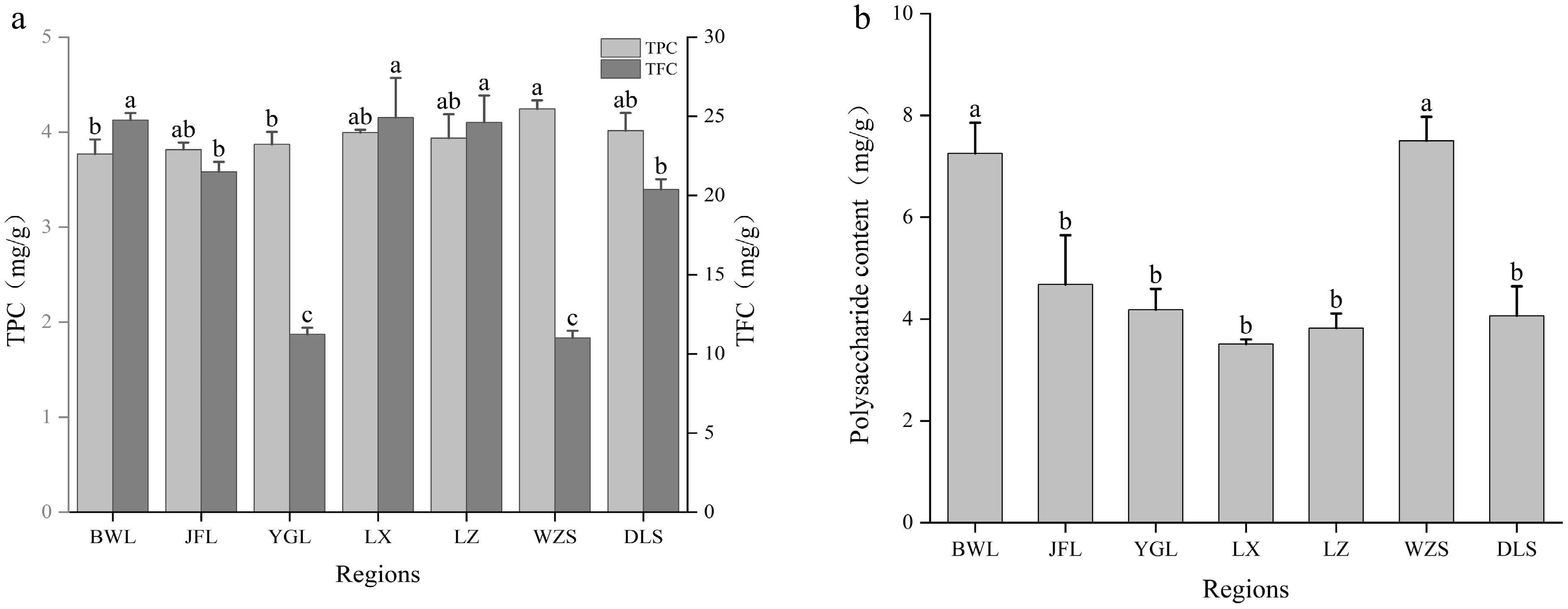
Figure 5.
Content of active ingredients of D. sinense from different regions. (a) TFC: determination of total flavonoid content; TPC: determination of total phenol content. (b) The content of polysaccharides in different regions. BWL: Bawangling, YGL: Yinggeling, JFL: Jinfengling, LX: Limu Mountains - Sanxinglinling, LZ: Limu Peak, WZS: Wuzhi Mountains, DLS: Diaoluo Mountains. The lowercase letters above the columns indicate significant differences in TPC, TFC and polysaccharides content among different groups.
The polysaccharide content of the extracts from different sources of D. sinense ranged from 3.51 to 7.50 mg/g. Among them, the polysaccharide contents of WZS and BWL were significantly higher than those of the other regions, being 7.50 and 7.25 mg/g, respectively (F = 9.153, p < 0.05). The polysaccharide contents of the other regions were 4.68 (JFL), 4.18 (YGL), 4.07 (DLS), 3.82 (LZ), and 3.51 mg/g (LX), respectively (Fig. 5b).
Antioxidant activity
-
In D. sinense, the DPPH antioxidant vitamin C equivalent antioxidant capacity (VCEAC) among different populations was evaluated. The VCEAC values of LZ, LX, and DLS were significantly higher than those of the other regions, being 0.071, 0.070, and 0.069 mmol/L, respectively (F = 40.830, p < 0.01). The VCEAC values in the other regions were 0.056 (JFL), 0.055 (WZS), 0.054 (BWL), and 0.042 mmol/L (YGL). Similarly, the ABTS antioxidant VCEAC values of LZ, LX, and DLS were significantly higher than those of the other regions, being 0.051, 0.049, and 0.048 mmol/L, respectively (F = 16.519, p < 0.01). The ABTS antioxidant VCEAC values in the other regions were 0.034 (BWL) and 0.033 mmol/L (JFL, WZS, and YGL) (Fig. 6a).
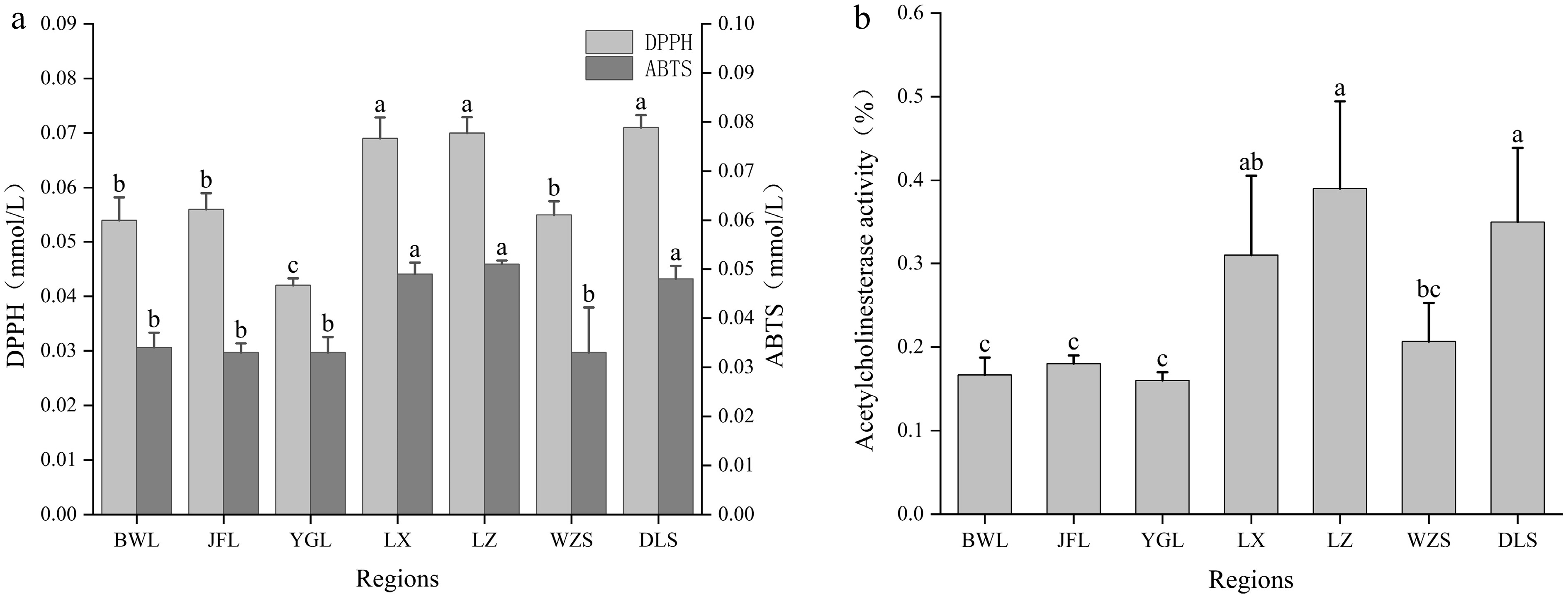
Figure 6.
(a) Antioxidant activity (in terms of Vc equivalent) of different populations of D. sinense. (b) Inhibitory ability of acetylcholinesterase activity. BWL: Bawangling, YGL: Yinggeling, JFL: Jinfengling, LX: Limu Mountains - Sanxinglinling, LZ: Limu Peak, WZS: Wuzhi Mountains, DLS: Diaoluo Mountains. The lowercase letters above the columns indicate significant differences in antioxidant capacity and acetylcholinesterase content among different groups.
The inhibitory activity of D. sinense pseudobulb extracts against acetylcholinesterase showed that LZ, LX, and DLS exhibited significantly stronger inhibitory effects than the other regions (F = 6.277, p < 0.01), with inhibition rates of 39.15%, 30.91%, and 34.98%, respectively. The inhibition rates in the other regions were 20.71% (WZS), 18.07% (BWL), 16.00% (JFL), and 16.81% (YGL) (Fig. 6b).
Cluster analysis (CA)
-
The clustering results of the active components of D. sinense in different regions were consistent with those of the environmental factors. The seven regions were grouped into three clusters. The first group included DLS, LZ, and LX, which were characterized by high antioxidant activity and enzyme inhibitory activity. The annual precipitation was relatively high, averaging around 1,662 mm, and the altitude ranged between 1,100 and 1,200 m. The second group consisted of BWL and JFL, which were characterized by relatively weak antioxidant activity and lower annual precipitation, with altitudes ranging from 1,200 to 1,300 m. The third group consisted of WZS and YGL, which were characterized by weak antioxidant activity and relatively high altitudes, ranging from 1,500 to 1,700 m, with an average annual precipitation of 1,645 mm (Fig. 7).
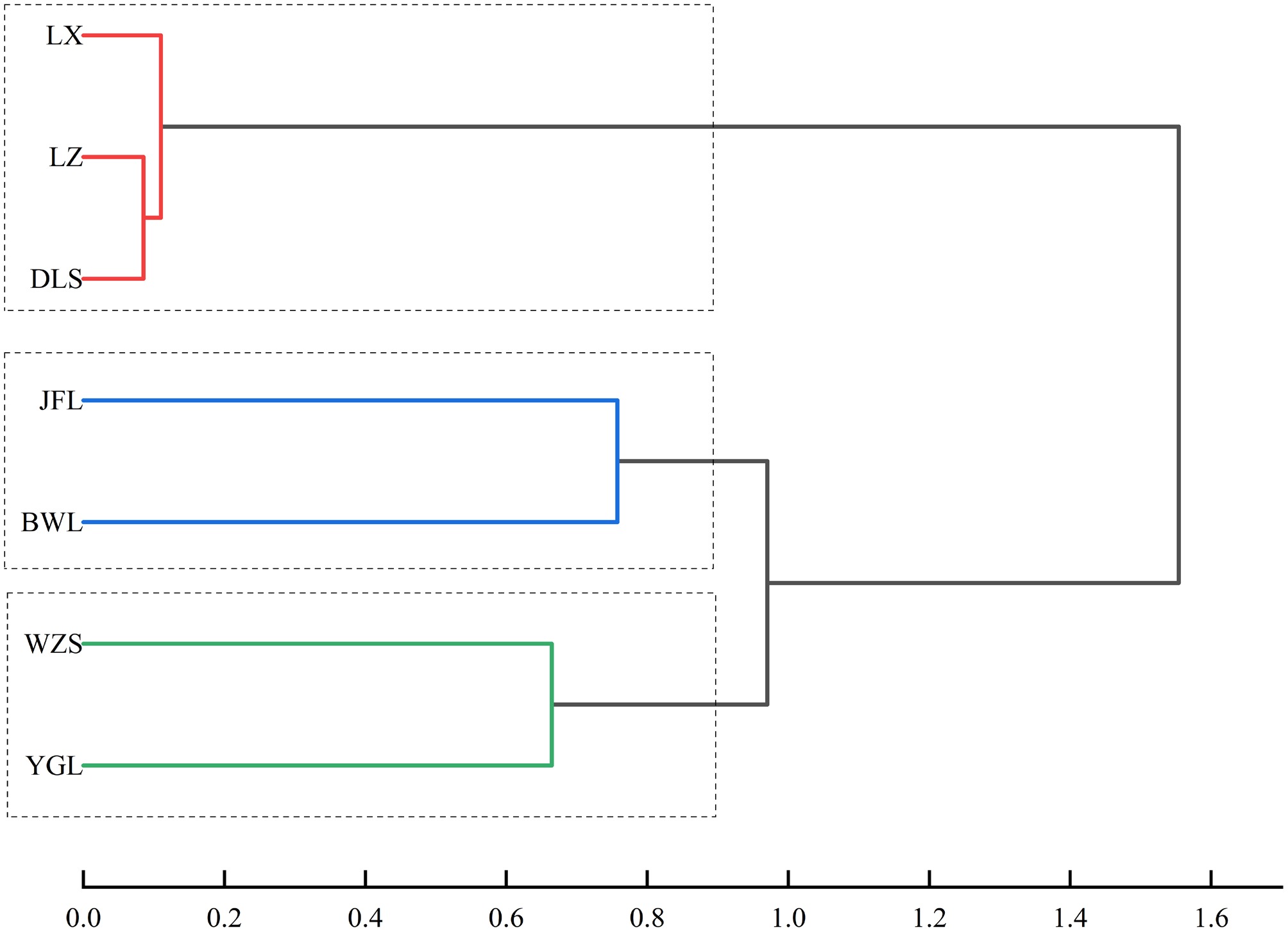
Figure 7.
Hierarchical clustering analysis of D. sinense germplasm based on active ingredients and their antioxidant capacity. BWL: Bawangling, YGL: Yinggeling, JFL: Jinfengling, LX: Limu Mountains - Sanxinglinling, LZ: Limu Peak, WZS: Wuzhi Mountains, DLS: Diaoluo Mountains.
Membership function evaluation method
-
The integrated assessment of D. sinense quality, incorporating six key indicators of bioactive compounds and antioxidant capacity, reveals significant regional variations. LZ ranks first in the comprehensive evaluation, demonstrating consistently higher levels of active components and superior antioxidant activity compared to other regions. In contrast, YGL shows the lowest membership function value, indicating relatively poor performance in both compound content and antioxidant capacity. The overall ranking by average membership function values follows the order: LZ > DLS > LX > WZS > BWL > JFL > YGL (Table 3).
Table 3. Analysis of membership functions of D. sinense from different regions.
Region Polysaccharide TFC TPC VCEAC (DPPH) VCEAC (ABTS) ACHE Score Sort LZ 0.08 0.98 0.36 0.97 1.00 1.00 0.73 1 DLS 0.14 0.67 0.52 1.00 0.86 0.82 0.67 2 LX 0.00 1.00 0.48 0.93 0.90 0.65 0.66 3 JFL 0.29 0.75 0.10 0.48 0.14 0.00 0.30 6 BWL 0.94 0.99 0.00 0.41 0.00 0.09 0.41 5 WZS 1.00 0.00 1.00 0.45 0.19 0.20 0.47 4 YGL 0.17 0.02 0.22 0.00 0.05 0.03 0.08 7 Note: BWL: Bawangling, YGL: Yinggeling, JFL: Jinfengling, LX: Limu Mountains - Sanxinglinling, LZ: Limu Peak, WZS: Wuzhi Mountains, DLS: Diaoluo Mountains. TFC: determination of total flavonoid content, TPC: determination of total phenol content, ACHE: acetylcholinesterase inhibitory activity. VCEAC: the vitamin C equivalent antioxidant capacity. Correlation analysis
-
Based on the correlation analysis, it was inferred that the growth conditions of the pseudobulbs of D. sinense were mainly related to altitude (Fig. 8b). However, the specific influence of individual environmental factors was not clearly distinguished. Therefore, redundancy analysis (RDA) was conducted. The RDA results for the phenotypic traits and active components of D. sinense in relation to environmental factors indicated that the RDA1 axis explained 42.49% of the variation, while the RDA2 axis explained 29.47%. Together, they accounted for 71.96% of the variation in phenotypic traits and active components explained by environmental variables.
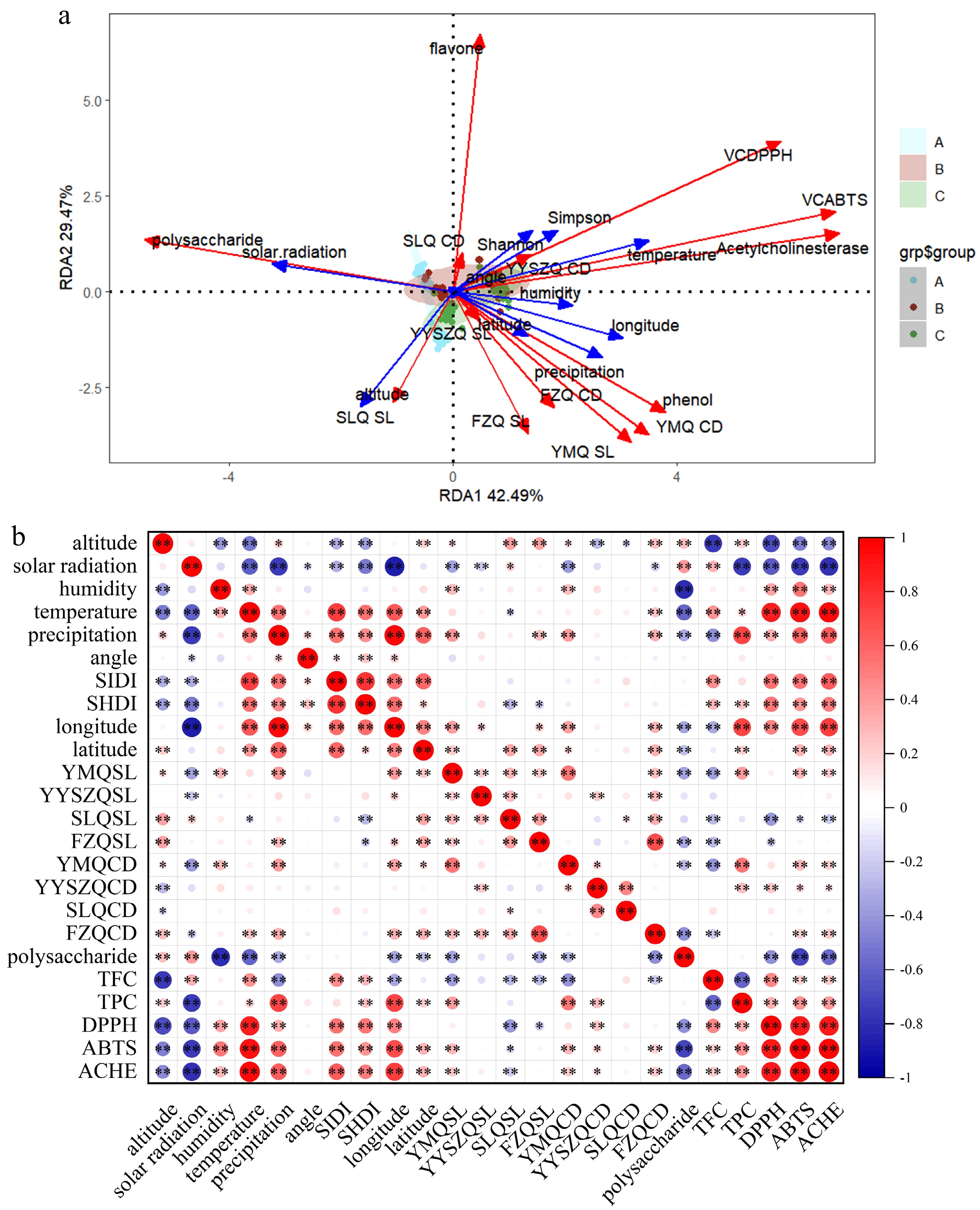
Figure 8.
(a) Redundancy analysis of D. sinense. (b) Correlation heat map. * Correlation is significant at the 0.05 level. ** Correlation is significant at the 0.01 level. Red indicates a positive correlation, blue indicates a negative correlation. The larger the circle, the stronger the correlation; the smaller the circle, the weaker the correlation.
The contribution of the environmental factor temperature to RDA1 was significant, indicating that temperature was the main environmental factor affecting D. sinense (Fig. 8a, Supplementary Table S5). FZQCD was highly significantly positively correlated with temperature, whereas SLQSL was significantly negatively correlated with temperature. The contribution of altitude to RDA2 was also significant, with altitude simultaneously affecting the distribution of D. sinense (Fig. 8a, Supplementary Table S5). SLQSL, FZQSL, and CD were extremely significantly positively correlated with altitude, while YYSZQCD was extremely significantly negatively correlated with altitude (Fig. 8a).
In the analysis of active components and antioxidant properties of D. sinense, polysaccharide content showed a highly significant positive correlation with temperature. In contrast, DPPH and ABTS antioxidant capacities, acetylcholinesterase (ACHE) inhibitory activity, and TPC exhibited highly significant negative correlations with temperature. Polysaccharides and TPC were highly significantly positively correlated with altitude, whereas DPPH and ABTS antioxidant capacities, ACHE inhibitory activity, and TFC were highly significantly negatively correlated with altitude (Fig. 8a).
-
D. sinense is a dense-type clonal plant. There are few D. sinense pseudobulbs with a high mortality rate, and the pseudobulbs play an important role in the growth and development of D. sinense[45]. In this study, through the combination of principal component analysis and cluster analysis, there were significant differences in the size and quantity of D. sinense pseudobulbs among different regions (p < 0.05). As an epiphytic plant, the pseudobulbs serve as a reserve pool for storing nutrients and water. The old pseudobulbs can affect the flowering of the plant but do not affect its nutritional growth[46]. The number of pseudobulbs is crucial during the growth and development process. In this study, the clustering results of environmental factors and active ingredients showed a high degree of consistency, dividing the seven regions of D. sinense into three categories. The high-altitude regions WZS and YGL were classified as one category, with an altitude of 1,500−1,700 m. Their characteristics were weak antioxidant activity and low TFC. The mid-high altitude regions BWL and JFL were classified as another category, with an altitude of 1,200−1,300 m. Their features were relatively weak antioxidant activity and low YMQSL. The low-altitude regions DLS, LZ, and LX were classified as the third category, with an altitude of 1,100−1,200 m and a relatively high annual precipitation (average 1,662 mm). Their characteristics were high antioxidant activity and enzyme inhibition activity. The high-altitude regions had lower TFC and biological activity, which might be related to a more suitable growth environment (lower abiotic stress), and plants did not need to invest a large amount of resources in synthesizing defensive metabolites. The pseudobulb length and quantity of YGL were higher than those of other regions, ranking first in the comprehensive score of principal component analysis. High-altitude regions are usually accompanied by lower human disturbance and lower pH values of host tree bark, which are considered to be conducive to the germination of epiphytic plant seeds and enhance the reproductive capacity of the population[47]. However, as the altitude increases, epiphytic plants can adapt to these conditions by adjusting their functional traits, and they can utilize a variety of microhabitats on the tree canopy and trunks, which may to some extent counteract the environmental pressure brought by the altitudinal gradient[48]. This might explain the relatively high levels of TPC and polysaccharides in the WZS region. Environmental factors are closely related to the growth changes of medicinal plants and the changes in the quantity and quality of their active components (such as total flavonoids, glycosides, and steroids)[49]. In high-altitude areas, the biological activity is low, and YMQSL is also scarce. Orchid plants form endophytic mycorrhizae with fungi. Only when the seeds establish a symbiotic relationship with the mycorrhizae can the seedlings grow properly[50]. The absence of an appropriate fungal environment may lead to poor growth of Dendrobium plants[51]. Studies have shown that during the rainy season, D. sinense collects a greater number of fungi, and the richness of fungi is also influenced by the corresponding environment[52]. High biological activity was detected in low-altitude areas. Higher antioxidant activity usually indicates a higher level of oxidative stress within the plants, which may be a stress response to environmental pressures such as higher temperatures, stronger light, or water fluctuations. The high accumulation of these secondary metabolites may reflect a defense strategy adopted by the plants in the face of environmental stress, at the cost of potentially consuming energy and resources that should have been used for growth.
The growth of different varieties of D. sinense is closely related to environmental factors. By combining principal component and redundancy analysis, altitude, annual precipitation, and temperature are the environmental factors with a relatively high correlation to the variation of D. sinense. Epiphytic plants rely on a humid environment and the substrate of the tree canopy, so they are more sensitive to forest disturbances (such as changes in precipitation). Reduced precipitation or seasonal drought may affect the germination rate of Dendrobium seeds[53−55]. The differences in rainfall amounts across different regions are associated with the varying increases in the young pseudobulbs of D. sinense, and this may also be accompanied by adjustments in the metabolic pathways of D. sinense. D. sinense also faced months with water shortages. It is speculated that it might follow this pattern to cope with the extreme environmental challenges.
Sun et al.[56] compared the metabolites of Luoshan fog tea from different geographical regions. In high-altitude areas, diffuse light promotes nitrogen metabolism and increases the content of organic acids and flavonoids, while the total phenolic content decreases[56]. In this study, the total phenolic content was generally low and showed no significant difference among different geographical regions of D. sinense distribution altitude. This suggests that the survival strategies of epiphytic plants and understory plants may differ in response to the external environment. Among different D. sinense varieties, from the correlation analysis, it can be seen that temperature is significantly positively correlated with total phenols and total flavonoids, and negatively correlated with polysaccharides. Generally speaking, an increase in temperature is often accompanied by an increase in the concentration of secondary metabolites in plant species, which is usually explained as a defense response of plants to high-temperature stress[57]. Similarly, under drought stress, plants accumulate higher concentrations of secondary metabolites to alleviate oxidative damage[57]. The drought alleviation of ketone compounds and flavonoid derivatives has also been confirmed in Arabidopsis thaliana. The results of environmental factors and effective component clustering in this study are consistent, once again confirming the close association between environmental pressure and the accumulation of plant defensive metabolites. In different geographical environments, Dendrobium responds to environmental changes by undergoing morphological changes and phenotypic trait differentiation and adjusting the synthesis of secondary metabolites.
In summary, this study reveals significant correlations between environmental factors (temperature, annual precipitation, and altitude) and the pseudobulb morphology, active ingredient accumulation, and bioactivity of D. sinense. The heightened bioactivity observed at lower altitudes may represent a stress-induced signal in response to local environmental pressures, identifying these regions as 'metabolic hotspots' for active ingredient accumulation. Consequently, these areas should be prioritized for monitoring when formulating conservation strategies.
While temperature and annual precipitation are most closely associated with pseudobulb metabolic activity and secondary metabolite accumulation, altitude likely functions as an indirect proxy for a complex environmental gradient. Given the physiological plasticity exhibited by this species, future population restoration programs should focus on the ecological compatibility between donor materials and target habitats-specifically regarding altitude, climate, and epiphytic microenvironments. Such alignment is critical for enhancing reintroduction success rates while maintaining genetic integrity.
It should be noted that as this study is based on field surveys and correlation analyses, the results primarily highlight associations rather than inherent causal mechanisms. Although we draw upon extensive literature regarding environmental stress-induced defense responses in plants, the specific regulatory pathways by which factors such as temperature and precipitation govern pseudobulb development and secondary metabolism in D. sinense remain to be elucidated. These causal links require further validation through controlled experiments, such as artificial cultivation across temperature and humidity gradients, or long-term site-specific monitoring.
-
To explore the relationship between the growth and development of D. sinense and the accumulation of its active components in different regions, D. sinense from seven regions was divided into three groups based on altitude and the content of active components. Among them, the biological activity and TFC of D. sinense in high-altitude regions were lower; the biological activity and YMQSL in mid-high-altitude regions were less; in low-altitude regions (such as LZ, LX, DLS), due to higher precipitation and temperature, the secondary metabolic activities of pseudostems were promoted, making the content of effective components (such as total phenols and total flavonoids) higher and the antioxidant capacity stronger. The number and length of YGL pseudobulbs were greater than those observed in other regions, which can be attributed to the favorable temperature conditions and reduced human disturbance in the area. In BWL and JFL regions, YMQSL was less, possibly affected by the epiphytic microenvironment. It is suggested that when analyzing the internal influencing factors of pseudostems, samples of D. sinense from different regions can be collected to analyze the differences between epiphytic fungi and pseudostem growth.
Principal component analysis combined with redundancy analysis indicated that environmental factors such as altitude, precipitation, and temperature significantly affected the distribution and metabolic patterns of D. sinense. In conclusion, D. sinense adapts to different environments through morphological and metabolic adjustments. Future research can further explore its ecological adaptation mechanism and effective component regulation strategies, and developing breeding plans may be a sustainable choice to counter the further loss of the population. Based on the above analysis, this study proposes that before obtaining sufficient genetic and phenotypic data, the sustainable management of the wild D. sinense population should primarily aim at systematically collecting and utilizing D. sinense plant materials for population rejuvenation. This strategy aims to maximize the maintenance of the local adaptability and genetic integrity of the D. sinense population, laying the foundation for subsequent selection of specific traits (such as high yield and rapid growth) for management decisions.
-
The authors confirm their contribution to the paper as follows: research conception and design: Feng X, Liang L; supervision: Song X; resources: Liu S, Wang Y; data collection: Feng X, Liang L, Zhang W, HuY; results, analysis, and interpretation: Liang L; initial draft and writing of the manuscript: Liang L. All authors reviewed the results and approved the final version of the manuscript.
-
The datasets generated during or analyzed during the current study are available from the corresponding author on reasonable request.
-
The authors declare no conflict of interest.
-
accompanies this paper online at: https://doi.org/10.48130/tp-0026-0030.
-
Received 5 January 2026; Accepted 6 May 2026; Published online 31 August 2026
- Supplementary Table S1 The geographical location and coordinates of D. sinense.
- Supplementary Table S2 Principal component eigenvalues and contribution rates.
- Supplementary Table S3 D. sinense principal component loading matrix for the quality of seven germplasm resources.
- Supplementary Table S4 Redundancy analysis of D. sinense in different regions.
- Supplementary Table S5 Supplementary data of D. sinense environmental factors in different regions.
- Supplementary Table S6 Supplementary data of D. sinense epiphytic tree species.
- Copyright: © 2026 by the author(s). Published by Maximum Academic Press on behalf of Hainan University. This article is an open access article distributed under Creative Commons Attribution License (CC BY 4.0), visit https://creativecommons.org/licenses/by/4.0/.
-
About this article
Cite this article
Liang L, Zhang W, Hu Y, Liu S, Wang Y, et al. 2026. Responses to environmental factors at growth stages of Dendrobium sinense (Orchidaceae) from different regions in Hainan tropical rainforest. Tropical Plants 5: e031 doi: 10.48130/tp-0026-0030 

Responses to environmental factors at growth stages of Dendrobium sinense (Orchidaceae) from different regions in Hainan tropical rainforest
- Received: 05 January 2026
- Revised: 24 April 2026
- Accepted: 06 May 2026
- Published online: 31 August 2026
Abstract: Dendrobium sinense Tang & F. T., an orchid species endemic to Hainan, is traditionally used by the Li people for its medicinal value but is increasingly threatened by environmental pressures. This study compared the response patterns between the physiological and ecological indicators of D. sinense and environmental factors to clarify its ecological adaptation and bioactive diversity. Pseudobulbs from seven regions were evaluated for morphology and phytochemical profiles. Principal component analysis (PCA) and cluster analysis (CA) grouped the seven populations into low-altitude (DLS, LZ, LX), mid-high-altitude (BWL, JFL), and high-altitude (WZS, YGL). Low-altitude populations showed stronger antioxidant capacity and acetylcholinesterase inhibition (DPPH VCEAC: 0.070 mmol/L; ABTS VCEAC: 0.049 mmol/L; inhibition rate: 35.01%), associated with higher precipitation (1,662 mm). In contrast, the seedling stage exhibited poor growth and low antioxidant activity. High-altitude populations had generally reduced flavonoid content and antioxidant activity. However, Yinggeling displayed the largest pseudobulbs (11 per plant), while Wuzhi Mountains contained higher total phenolics (TPC: 4.24 mg/mL). The Limu Mountains (Sanxinglinling and Limu Peak) and Bawangling yielded the highest TPC values (24.9, 24.61, and 24.8 mg/g, respectively), and both Bawangling and Wuzhi Mountains were rich in polysaccharides (7.25 and 7.50 mg/g, respectively). PCA combined with membership function analysis indicated that Limu Peak supports optimal growth and bioactivity. Furthermore, redundancy analysis and correlation analysis identified altitude, precipitation, and temperature as key factors influencing pseudobulb traits and metabolite accumulation. These results enhance understanding of the ecological adaptation of D. sinense and provide a theoretical basis for its conservation and sustainable utilization.
-
Key words:
- D. sinense /
- Bioactive compounds /
- Diversity analysis /
- Conservation strategies