











-
The rubber tree (Hevea brasiliensis [Willd. ex A. Juss.] Müll. Arg.), commonly known as the Brazilian rubber tree or Para rubber tree, is a tropical economic crop belonging to the genus Hevea within the Euphorbiaceae family. It is notably recognized for its capacity to produce milky latex containing ~30% (by volume) natural rubber (NR). As a primary global source of NR, the rubber tree plays a crucial role in industry, agriculture, and daily life[1]. Rubber tree is a tall evergreen species that thrives in Southeast Asia, capable of growing to heights of up to 30 m. The tree is monoecious and its leaves are palmate trifoliate compound. The ovary is primarily trilocular, containing a single ovule in each locule. The fruit is an ellipsoid capsule, and the seeds are ovoid, pale gray-brown with distinctive stripe patterns. The juvenile phase of the rubber tree endures for seven to eight years, after which latex tapping can commence, offering an economic lifespan of 25 to 30 years. In flat terrain, the standard planting density is typically arranged at a spacing of 3 m × 7 m, equating to approximately 495 trees per hectare. For mountainous cultivation, a configuration of 2 m × 8 m is more commonly adopted, allowing for a planting density exceeding 600 trees per hectare.
Within the genus Hevea, there are ten additional species, namely: H. nitida, H. pauciflora, H. spruceana, H. benthamiana, H. camporum, H. microphylla, H. rigidifolia, H. guianensis, H. camargoana, and H. paludose[2]. Among these, H. brasiliensis stands out due to its significantly higher rubber yield, making it the only species cultivated on a large commercial scale. The rubber tree serves as an important biological synthesis factory, with its laticifer cells producing NR through the cis-polymerization of isopentenyl pyrophosphate units (C5H8). NR possesses unique properties, including excellent elasticity and impact resistance, wear resistance, heat dissipation, and low-temperature flexibility[3]. These attributes make it a core material for specialized polymer products, such as aircraft and heavy vehicle tires, which require 100% NR content[4]. Currently, approximately 75% of global NR production is used in tire manufacturing, while the remaining 25% is widely applied in medical devices (e.g., latex gloves and infusion tubes), engineering components (e.g., seals and vibration dampers), and daily supplies. Furthermore, the rubber tree is an important economic timber species. Rubberwood, as a typical fast-growing plantation timber, exhibits characteristics such as a small shrinkage coefficient, moderate density, and ease of mechanical processing. After anti-corrosion treatment, it can be processed into various products, including furniture, medium-density fiberboard, molds, and other applications[5].
The breeding of rubber trees primarily focuses on the selection of high-yielding and disease-resistant clones, followed by their propagation via bud grafting to obtain populations suitable for field production. Subsequently, superior clonal lines are crossbred to produce high-yielding recombinant individuals, contributing to the continuous improvement of rubber tree varieties. Over approximately 150 years of breeding efforts, NR yields have increased nearly tenfold. In recent years, the techniques of tissue culture and genetic transformation in rubber trees have been continuously refined, leading to the development of multiple new transgenic rubber tree germplasms[6]. Additionally, the release of genomic and transcriptomic datasets from various rubber tree germplasms has facilitated the identification and characterization of candidate genes linked to important agronomic traits. These genes, which are associated with high yield and disease resistance, have become a valuable resource for targeted transgenic breeding. Such advancements provide essential conditions for further improving the yield and enhancing the resistance of rubber trees, thereby ensuring the global supply of this vital resource.
-
Over 3,000 years ago, the Aztecs and Maya civilizations crafted rubber balls from plant latex, using them in games for more than a century[7]. The advancement of rubber science owes a pivotal breakthrough to 18th-century French researchers François Fresneau and Charles Marie de La Condamine. Fresneau reported on rubber science and conducted original experiments, including tapping rubber from H. brasiliensis. Condamine collected documents on rubber from Fresneau and delivered a lecture at the academy about the expedition and rubber. However, the extensive application of NR was significantly constrained by its poor processability after coagulation. This technological barrier persisted until 1768, when French chemist Pierre-Joseph Macquer invented a solvent capable of softening rubber, thereby enabling its medical and industrial utilization. Subsequently, in 1770, British chemist Joseph Priestley discovered that NR could erase pencil marks through friction, leading to its nomenclature as 'rubber' [8,9].
The field of material science underwent a significant change in 1819 when Scottish chemist Charles Macintosh discovered that NR could be dissolved in coal tar. This breakthrough led to the innovative creation of waterproof fabric, which revolutionized raincoat manufacturing. The most transformative innovation emerged in 1839 when American inventor Charles Goodyear devised the vulcanization process, which permanently resolved the temperature-dependent brittleness and plasticity of rubber products[10]. Another revolutionary industrial breakthrough emerged in 1888 when John Boyd Dunlop patented pneumatic tire manufacturing techniques, fundamentally redefining transportation systems[11]. The launch of vehicle industrialization in 1985 led to an 800% increase in rubber demand within two decades and propelled innovations in latex processing technologies.
Collection and preservation of rubber tree germplasms
-
In 1876, British botanist Henry Wickham collected approximately 70,000 rubber tree seeds near the Tapajos River in the Amazon Basin and transported them to the Royal Botanic Gardens (Kew Gardens), in London, UK. Successfully, 2,397 seedlings were cultivated. Subsequently, about 1,900 of these seedlings were shipped to Ceylon (present-day Sri Lanka), some were sent to Malaya (present-day Malaysia), and two were transported to the botanical garden in Bogor, West Java (part of Indonesia) for planting. Ultimately, only 46 of these seedlings survived. These surviving seedlings became the primary source of the current cultivated rubber tree varieties. Due to the limited quantity and narrow genetic origin of these germplasm resources, their genetic basis is relatively narrowed. In 1981, the International Rubber Research and Development Board (IRRDB) organized member countries, including Malaysia, Indonesia, Thailand, China, France, Nigeria, and Brazil, to revisit the Amazon Basin for the collection of wild rubber tree germplasm (Fig. 1). During this expedition, a total of 64,256 rubber tree seeds were collected, and 17,900 seedlings were successfully cultivated. Additionally, budwood harvested from 294 selected elite rubber trees was grafted, resulting in 162 surviving grafts[12]. These wild germplasms (also referred to as Amazon germplasm or IRRDB 1981 germplasm) were distributed to three dedicated international rubber germplasm centers in Brazil, Malaysia, and Côte d'Ivoire for conservation[13].
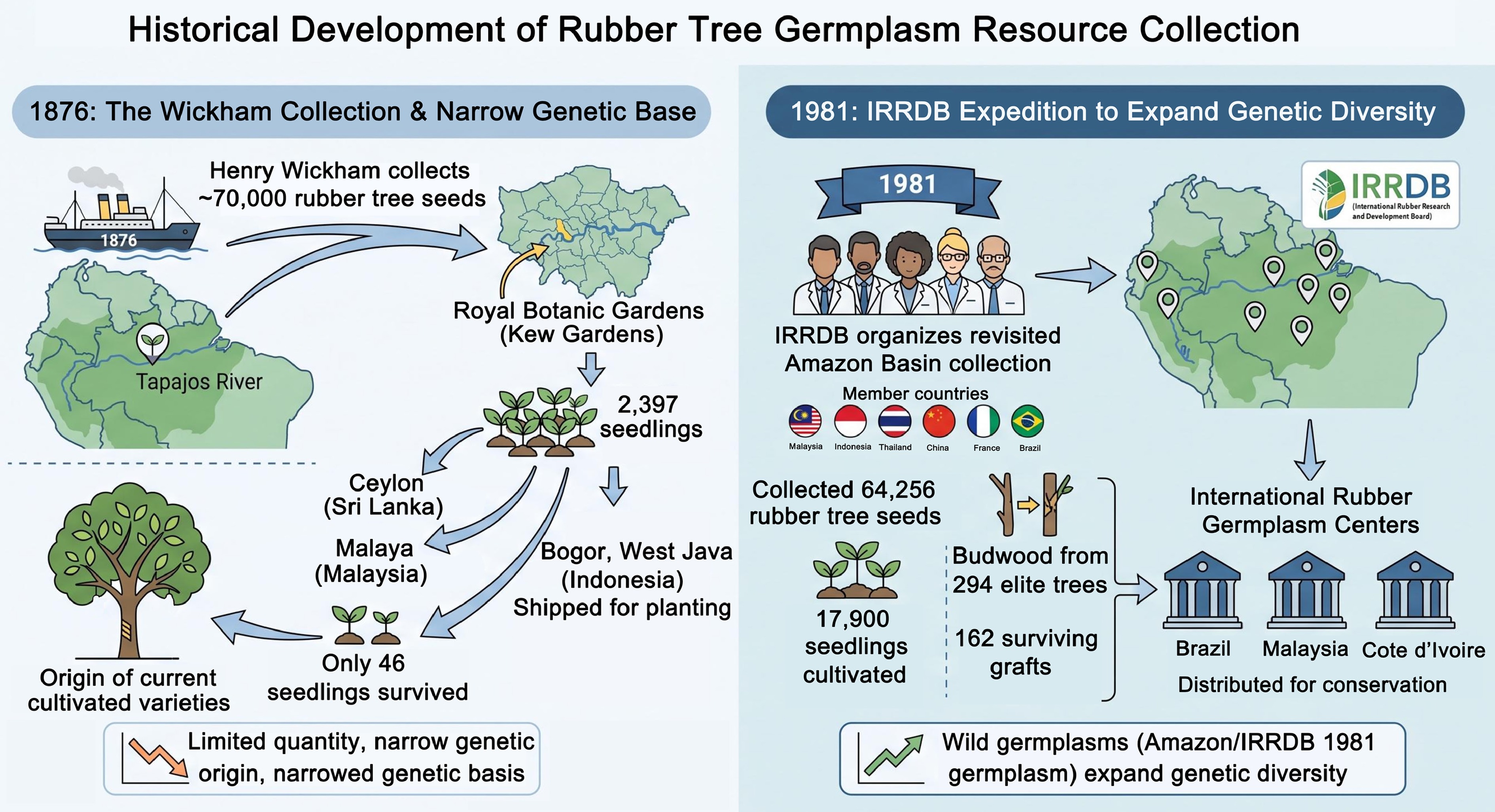
Figure 1.
Genetic origins of cultivated and wild rubber tree germplasm. The Wickham collection introduced in 1876 consisted of a limited number of accessions with a narrow genetic background, yet it became the major source of most modern cultivated rubber tree varieties (left panel). In contrast, the IRRDB collection established in 1981 included a much larger number of predominantly wild accessions, substantially expanding the genetic diversity available for rubber tree research and breeding (right panel).
In the global research and conservation of rubber germplasms, international collaboration among countries and research institutions has intensified, facilitating the mutual exchange of these materials. From 1951 to 1954, Malaysia collected germplasms from six Hevea species in South America and exchanged South American Leaf Blight-resistant lines with Brazil. Subsequently, Southeast Asian countries enriched their national rubber tree germplasm resources through varietal exchanges. Between 1974 and 1976, France and Brazil jointly collected 40 rubber tree germplasms from the Amazonian states of Acre and Rondônia, while 18 MDF (Madre de Dios) germplasms were gathered from Peru's Madre de Dios Basin. In 1987, under the funding of the European STD1, France's CIRAD introduced 24 CNSAM lines via bilateral exchanges with Brazil. Later, Professor RE Schultes introduced 341 rubber tree lines from Colombia's Calima and Palmira regions. In 1995, the Malaysian Rubber Board acquired germplasms of eight Hevea species from Brazil, obtaining a total of 50,231 seedlings.
-
Rubber trees (H. brasiliensis) can be propagated through both sexual and asexual methods. Sexual reproduction relies on cross-pollination to produce seedlings from seeds, while asexual propagation involves bud-grafting (budded clones) and somatic embryogenesis using explants such as shoot segments with buds, anthers, and inner integuments to regenerate own-root juvenile clones. In 1915, Van Helten pioneered bud-grafting techniques for rubber trees. This innovation successfully addressed the challenge of preserving the superior traits of clones, facilitated the propagation of elite clones, and laid the foundation for rubber tree breeding. Bud-grafting has since become the predominant propagation method in most rubber plantations[14]. Early 20th-century breeding efforts focused on selecting primary clones. Researchers in Indonesia, Malaysia, and Sri Lanka identified early primary clones such as Tjir 1, PR107, and GT1, many of which exhibited a 150% yield increase over unselected populations. The Indonesian Rubber Research Institute (IRRI) has conducted continuous selection and comparative studies of IRR series clones since 1917. These efforts reduced the juvenile phase from six to seven years to four years and increased annual latex yield from 500 to 2,500 kg/ha[15,16]. Notable achievements include high-yielding clones (e.g., IRR104, IRR200) and dual-purpose clones optimized for latex and timber production (e.g., IRR5, IRR39, IRR107). The elite RRIV-series clones were developed by the Vietnam Rubber Research Institute, with five RRIV clones (RRIV 205, 206, 207, 208, and 209) demonstrated exceptional early tapping performance in traditional cultivation areas. In China, selective breeding of superior trees began in the 1950s. The first-generation clone Haiken1 achieved an annual dry rubber yield of 945 kg/ha, nearly double the yield of unselected seedlings.
Later, it was recognized that the yield of primary clones had reached a plateau through clonal selection. Therefore, the focus gradually shifted from the selection of primary clones to recombinants derived from controlled pollination. Based on specific regional conditions, rubber-growing countries have developed a variety of excellent cultivars to meet their own needs through superior hybrid combinations. Examples include the RRIM series in Malaysia, the PR series in Indonesia, the RRII series in India, the RRIT series in Thailand, the RRIV series in Vietnam, and the Reyan and Yunyan series in China. Using primary clone hybridization breeding, the RRIM developed outstanding varieties represented by RRIM600, which greatly promoted the development of the rubber tree plantation industry[17].
Somatic embryogenesis and genetic transformation of rubber trees
-
Conventional rubber tree breeding is constrained by its prolonged juvenile phase, high heterozygosity, narrow cultivated genetic base, and the difficulty of rapidly propagating and evaluating improved genotypes. Somatic embryogenesis enables the regeneration and clonal propagation of selected genotypes and, critically, provides the plant-regeneration platform required for genetic transformation and genome editing. Wang et al.[18] pioneered somatic embryogenesis in rubber trees by inducing somatic embryos from anthers of clones Haiken1, Haiken2, and Reyan 88−13, achieving regenerated plants. Subsequently, CIRAD researchers established an efficient somatic embryo regeneration system using inner integuments of ovules as explants[19]. Rubber tree ovules, embedded in lignified seeds, serve as naturally sterile materials with maternal ploidy. Inner integuments dissected eight to ten weeks post-pollination readily dedifferentiate into callus, enabling somatic embryo regeneration (Fig. 2). The somatic embryogenesis process comprises three stages: embryogenic cell initiation, somatic embryo formation, and maturation. During embryogenic cell induction, callus is transferred to low-auxin/cytokinin media to trigger embryogenic competence[19]. Etienne et al.[20] demonstrated that reducing auxin/cytokinin concentrations while supplementing abscisic acid (ABA) enhances endogenous auxin and ABA accumulation, essential for somatic embryogenesis. CIRAD's protocol for inducing friable embryogenic callus (FEC) in clone PB260 uses 1.34 μM 3,4-dichlorophenoxy-acetic acid (3,4-D) and N6-benzyladenine (6-BA), whereas somatic embryo induction requires lowering 3,4-D/6-BA to 0.44 μM with 0.5 μM ABA[21]. During embryo formation, individual embryogenic cells or clusters develop into pale yellow proembryos, which transition to white globular embryos, followed by pear-shaped embryos with apical meristems, and ultimately cotyledonary embryos. Somatic embryos can also dedifferentiate into secondary embryos[22]. In addition to advances in somatic embryo morphogenesis and induction system optimization in rubber trees, recent transcriptomic studies have identified genes specifically expressed in mature embryos, as well as differentially expressed genes between rubber tree varieties with high and low embryogenic capacity[23,24].
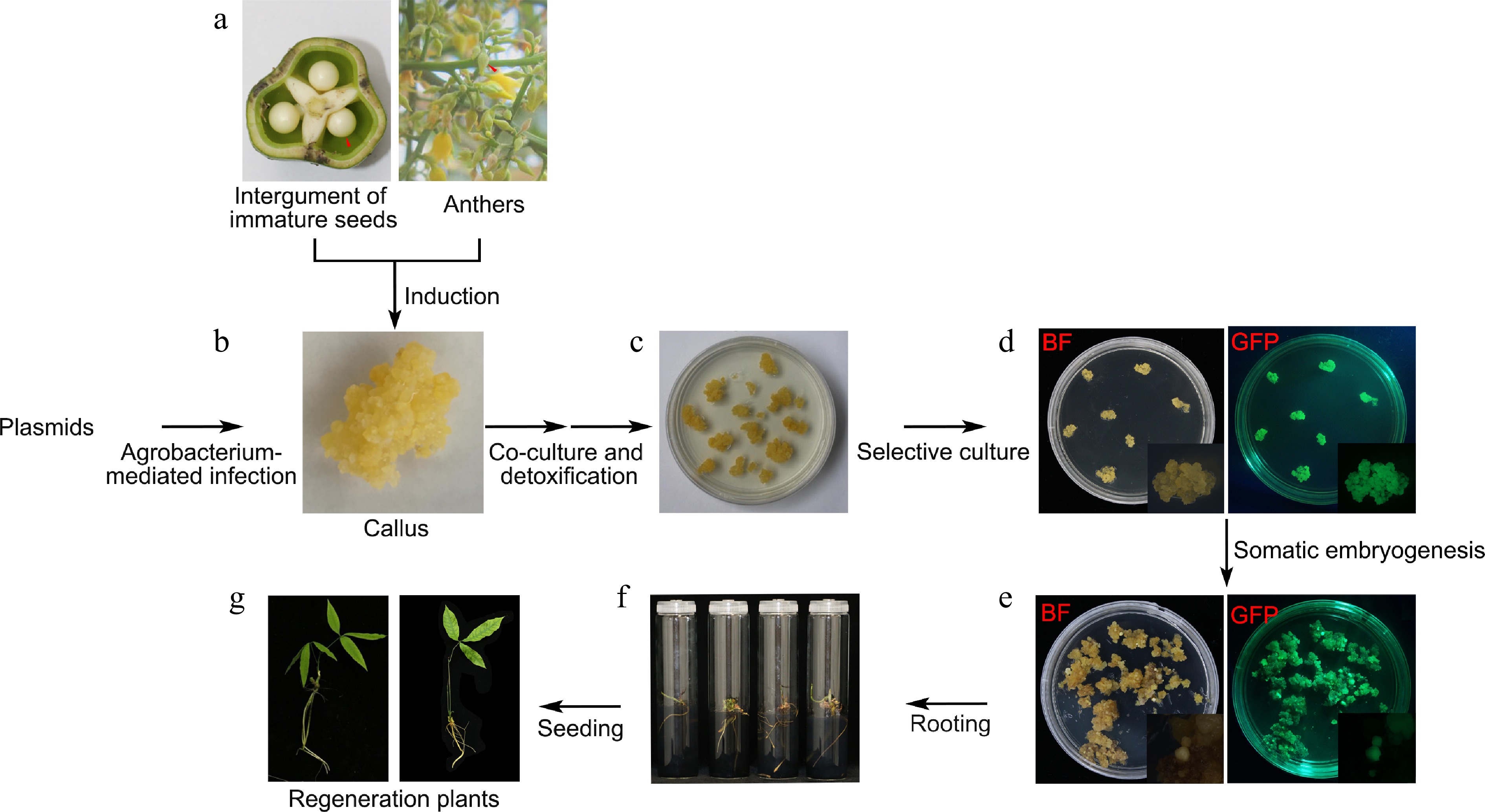
Figure 2.
Agrobacterium mediated transgenic processes in rubber tree. Inner integuments or anthers of rubber tree were used as explants to induce friable callus, which was then co-cultivated with (a)–(c) Agrobacterium. Transgenic homozygous positive calli were subsequently selected by monitoring (d) GFP signal and paromomycin resistance, and these selected calli were further subjected to (e)–(g) somatic embryogenesis, rooting, and seedling development, ultimately yielding transgenic plants.
In the 1990s, Arokiaraj et al.[25] generated the first transgenic rubber tree (clone GL-1) via biolistic delivery of β-glucuronidase (GUS) into anther-derived callus. Wang et al.[26] optimized biolistic parameters using Haiken2 anther callus, producing transgenic plants expressing the dwarfing gene GAI. However, the high cost, unstable integration, and multicopy insertions associated with biolistics limit its utility in rubber tree transformation. As a natural host for Agrobacterium, rubber tree transformation was advanced by Arokiaraj[27], who infected GL-1 anther callus with Agrobacterium to produce GUS-expressing plants. However, low somatic embryogenesis efficiency yielded only three transgenic trees from 35 transformed callus lines. CIRAD researchers isolated highly embryogenic FEC from PB260 inner integuments, maintained via cryopreservation[22,28,29]. Subsequent optimizations of calcium concentration, co-culture temperature, and culture container, alongside GFP reporter substitution for GUS, improved transformation efficiency[21,30,31]. This system facilitated functional studies of laticifer-specific HEV2.1[32], oxidative stress-responsive HbCuZnSOD/EcGSH1, and laticifer differentiation regulator HbERF-IXc5[33−35]. Research on Agrobacterium-mediated transformation in China started later has generally exhibited lower efficiency. Zhao et al.[36] induced GUS-positive embryoids from Reyan73397 anther callus but failed to regenerate plants. Huang et al.[37] optimized strain selection, co-culture conditions, and acetosyringone concentration, yielding 11 transgenic plants from 22,000 transformed calli (0.05% efficiency). Bi et al.[38] obtained four transgenic trees from 1,539 embryoids of Reyan879. These studies underscore somatic embryogenesis capacity as the critical bottleneck in transformation efficiency.
Genomics sequencing and mapping of agronomic traits in rubber trees
-
The rapid development of H. brasiliensis genomics has laid the foundation for functional genomics and genomic selection breeding. Compared to other crops, rubber tree genomic research began relatively late but has progressed rapidly in recent years, reaching international forefront levels (Table 1). In 2013, a draft genome of the rubber tree clone RRIM600 was assembled using shotgun sequencing, yielding a 2.15 Gb genome with 68,955 predicted genes. This study preliminarily identified genes associated with natural rubber biosynthesis, wood formation, disease resistance, and allergenicity[39]. In 2016, the genome of the cultivated variety Reyan73397 was sequenced by integrating next-generation sequencing with BAC library data, assembling a 1.47 Gb genome with 43,792 predicted protein-coding genes[40]. In the same year, a hybrid approach combining next-generation and PacBio third-generation sequencing further refined the RRIM600 genome to 1.55 Gb, identifying 84,440 high-confidence protein-coding genes[41]. Both studies revealed that the expansion of rubber biosynthesis-related genes and their specific high expression in latex are critical for rubber production. In 2017, the genome of clone BPM24 was assembled (1.26 Gb) using second- and third-generation sequencing combined with Chicago technology, while only 363 Mb of the genome could be anchored to 18 linkage groups using SNP-based genetic maps[42]. By 2020, a chromosome-level assembly of the GT1 genome (1.47 Gb, 44,187 protein-coding genes) was accomplished through single-molecule real-time (SMRT) sequencing and Hi-C scaffolding, enabling the identification of domestication-related candidate genes between cultivated and wild varieties[43]. In 2023, a high-quality, chromosome-level genome of the wild rubber tree accession MT/VB/25A 57/8 (1.72 Gb, 35,318 proteins) was assembled using SMRT, BioNano optical mapping, and Hi-C sequencing[44]. Simultaneously, the genome of the high-yielding cultivar CATAS8-79 (1.58 Gb, 1.55 Gb anchored to 18 chromosomes) was completed via PacBio, BioNano, and Hi-C integration, significantly improving genome contiguity[45]. In 2024, chromosome-level genomes were sequenced for three cultivated varieties, two wild accessions, and three Hevea-related species (H. benthamiana, H. nitida, H. pauciflora). Pan-genome and phylogenetic analyses further clarified species delineation and the evolution of rubber-related traits[46]. Additionally, T2T haplotype-resolved genome of Reyan73397 (1.56 Gb per haplotype, ~38,600 protein-coding genes each) was assembled using HiFi, Hi-C, and ultra-long ONT sequencing[47]. These advancements in genome assembly quality have strengthened the basis for genomic selection breeding and cloning of agronomically important genes.
Table 1. Comparison of genome assembly quality of different rubber trees.
Variety/line Genome size (Gb) Gene number Length of N50 (Mb) Ref. RRIM600 2.15 68,955 0.00297 [39] Reyan73397 1.47 43,792 1.28 [40] RRIM600 1.55 84,440 0.06724 [41] BPM24 1.26 43,868 0.0968 [42] GT1 1.47 44,187 0.1527 [43] MT/VB/25A57/8 1.72 35,318 3.51 [44] CATAS8-79 1.58 38,595 11.21 [45] Reyan73397 1.49 42,897 2.24 [46] CATAS8-79 1.52 42,386 1.33 [46] RRIM600 1.54 43,594 2.54 [46] XJA868 1.56 43,994 2.59 [46] XJA968 1.54 43,565 2.02 [46] Hbe 1.57 46,095 2.72 [46] Hp 1.58 43,481 2.26 [46] Hn 1.57 44,138 2.13 [46] Reyan73397 1.56 38,635 93.6 [47] Hbe: H. benthamiana; Hn: H. nitida; Hp: H. pauciflora; XJ: wild accession of rubber tree. Agronomical traits in rubber tree include latex yield, stem circumference, plant height, and latex physiological parameters. Identifying major-effect QTLs and candidate genes for these traits is pivotal for molecular marker-assisted breeding. Early QTL mapping efforts in rubber trees were limited. Rattanawong et al.[48] constructed an F1 population (RRIM600 × PB217) and identified two major QTLs for latex yield and stem circumference using SSR and AFLP markers. Souza et al.[49] detected 18 QTLs for stem circumference and plant height under seasonal variations in a PB217 × PR255 F1 population with SSR/EST-SSR markers. Xia et al.[50] developed a high-density linkage map using amplified fragment sequencing (AFSM) in a Yunyan277-5 × IAN873 F1 population, locating 17 latex yield QTLs, including two major loci explaining >30% phenotypic variance. Subsequent studies using integrated SSR/SNP maps[51], SLAF-seq[52], whole-genome resequencing[53,54] further expanded QTL discoveries for growth and yield traits. Despite the progress made, challenges such as long breeding cycles and geographic constraints necessitate continued exploration of novel QTLs. Beyond biparental QTL mapping, GWAS has emerged as a complementary approach. Chanroj et al.[55] identified three SNPs associated with latex yield and stem circumference in 170 Amazonian wild accessions. Genotyping-by-sequencing (GBS)-based GWAS revealed stem circumference-related loci[56,57], while resequencing-based studies pinpointed 155 latex yield QTLs (326 candidate genes) and a laticifer differentiation gene (HbPSK5), respectively[44,45]. Recent work further identified 93 growth/yield-associated loci and 37 SNPs linked to latex inorganic phosphate/sucrose content in diverse germplasm[5,58]. These discoveries provide critical targets for molecular and genetic engineering strategies to enhance rubber tree breeding efficiency.
-
Despite significant progress in Agrobacterium-mediated transformation and somatic embryogenesis in rubber trees, several technical bottlenecks have limited the widespread application of transgenic breeding. The most critical constraint remains the low efficiency of plant regeneration from transformed cells, which is intrinsically linked to genotype-dependent embryogenic capacity. Future research should prioritize overcoming this barrier through two complementary strategies. First, the identification and manipulation of key developmental regulators—such as WUSCHEL (WUS), BABY BOOM (BBM), and LEAFY COTYLEDON1 (LEC1)—under the control of inducible promoters could dramatically improve somatic embryo induction and conversion rates in recalcitrant clones. Second, advances in genome editing technologies, particularly CRISPR/Cas9, offer unprecedented opportunities for precise trait modification without the integration of foreign selectable markers, thereby addressing public and regulatory concerns regarding genetically modified organisms. To date, no CRISPR/Cas9-based gene editing plants has been reported in H. brasiliensis. Therefore, establishing an efficient editing platform should be a top priority.
Another major direction is the functional validation of candidate genes identified through QTL mapping and GWAS. Genes such as HbPSK5 (involved in laticifer differentiation), HbERF-IXc5 (regulating laticifer differentiation), and numerous oxidoreductase and hormone-related genes await detailed characterization. Overexpression or knockout of these genes will not only elucidate their precise roles in rubber biosynthesis, stress tolerance, and growth regulation but also generate elite transgenic germplasms with enhanced yield and resilience. Furthermore, the development of tissue-specific promoters (e.g., the HEV2.1 promoter) will enable targeted gene expression, while minimizing potential pleiotropic effects on vegetative growth. The use of cryopreserved embryogenic callus as a universal recipient material would allow researchers to maintain a standardized, highly competent cell line across multiple transformation experiments, thereby reducing experimental variability and improving reproducibility. With these advances, transgenic and gene-edited rubber trees are poised to enter commercial breeding pipelines within the next decade, dramatically shortening the current breeding cycle.
Multi-omics integration and genomic selection breeding in rubber tree
-
The rapid progress in rubber tree genomics—from early draft assemblies to T2T haplotype-resolved genomes—has laid a solid foundation for implementing genomic selection (GS) and multi-omics-driven breeding. However, translating these genomic resources into practical genetic gain requires addressing several key challenges. The first priority is the construction of large, diverse training populations with high-density genotypic and accurate phenotypic data. Current QTL and GWAS studies have been limited by small population sizes, narrow genetic bases, and environmental variations across years and locations. International consortia should establish shared reference panels comprising hundreds of accessions—including wild Amazonian germplasms (IRRDB 1981 collection), primary clones, and modern elite cultivars—genotyped by whole-genome resequencing. Phenotypic evaluations for latex yield (dry rubber content, tapping panel dryness), growth (stem circumference, plant height), wood properties, and disease resistance (especially SALB) need to be standardized across multiple environments using automated field phenotyping platforms. With such training populations, genomic prediction models (GBLUP, BayesR, and machine learning algorithms) can be developed to estimate breeding values for juvenile seedlings without waiting seven to eight years for first tapping[59]. This would reduce the breeding cycle from 25–30 years to perhaps ten to 15 years, analogous to the transformation seen in maize and rice breeding. The accuracy of prediction will depend on the density of markers, the heritability of target traits, and the size of the training population. Initial studies in rubber have identified hundreds of SNPs associated with NR yield, but few have been validated across independent populations. Therefore, cross-validation and multi-population validation should be mandatory before deploying GS in routine breeding.
The integration of transcriptomics, proteomics, and metabolomics will further refine genomic predictions. For example, transcriptomic data from latex can serve as intermediate phenotypes linking genotypes to final phenotypes. Genes differentially expressed between high- and low-yielding varieties could be incorporated as weighted features in prediction models. Similarly, latex metabolomic profiles—such as inorganic phosphate, sucrose, and thiol content—have been associated with yield QTLs and could act as predictive biomarkers for early screening. The development of multi-omics network models will help identify hub genes and metabolic modules that drive rubber biosynthesis and stress adaptation. Another promising avenue is the use of pangenome graphs instead of a single reference genome. With chromosome-level assemblies now available for multiple cultivated varieties and wild relatives, the rubber tree pangenome will capture presence/absence variations (PAVs) and structural variants (SVs) that are invisible to short-read SNP calling. Some SVs may affect gene expression or protein function more drastically than SNPs. For instance, copy number variations of cis-prenyltransferase genes or latex-abundant protein genes could underlie NR yield differences. Incorporating SVs into GS models may substantially boost prediction accuracy for complex traits. Finally, with sustained investment, the goal of releasing custom-designed rubber tree clones with superior yield, disease resistance, and timber quality is attainable within the next two decades.
-
The authors confirm contributions to the paper as follows: figure preparation: Fang Y, Cao J; draft manuscript preparation: Liang C, Li X, Zhou Z; writing—review and editing: Zhang YY, Xiao X, Zhang Y; manuscript revision: Tang C, Liu K. All authors reviewed the results and approved the final version of the manuscript.
-
All data generated or analyzed during this study are included in this published article.
-
The authors declare that they have no conflict of interest.
-
Received 18 April 2026; Accepted 28 August 2026; Published online 22 October 2026
-
# Authors contributed equally: Cuili Liang, Xue Li, Zixing Zhou
- Copyright: © 2026 by the author(s). Published by Maximum Academic Press on behalf of Hainan University. This article is an open access article distributed under Creative Commons Attribution License (CC BY 4.0), visit https://creativecommons.org/licenses/by/4.0/.
-
About this article
Cite this article
Liang C, Li X, Zhou Z, Zhang Y, Fang Y, et al. 2026. Historical overview, recent advances, and future perspectives in rubber tree research. Tropical Plants 5: e037 doi: 10.48130/tp-0026-0036 

Historical overview, recent advances, and future perspectives in rubber tree research
- Received: 18 April 2026
- Revised: 21 July 2026
- Accepted: 28 August 2026
- Published online: 22 October 2026
Abstract: Natural rubber (NR), derived from the latex of the Para rubber tree (Hevea brasiliensis), is an irreplaceable raw material for the tire, medical, and engineering industries. Despite its global economic importance, rubber tree breeding has historically been constrained by a narrow genetic base originating from the 1876 Wickham collection and a prolonged juvenile phase. This review synthesizes historical germplasm conservation efforts—most notably the IRRDB 1981 Amazonian expedition—and over a century of clonal selection that has increased NR yields nearly tenfold. We critically assess recent biotechnological advances, including somatic embryogenesis and Agrobacterium-mediated transformation, highlighting their current bottlenecks and the potential of developmental regulators to overcome recalcitrance. A major focus is the rapid acceleration of genomic resources, tracing the progression from early draft assemblies to recent telomere-to-telomere (T2T) haplotype-resolved genomes and pan-genome analyses. We further summarize quantitative trait loci (QTL) mapping and genome-wide association studies (GWAS) that have identified key genes governing growth traits, latex yield, and laticifer differentiation. Finally, we outline future perspectives emphasizing the integration of CRISPR/Cas9-based gene editing with multi-omics-driven genomic selection to drastically shorten breeding cycles. By consolidating these interdisciplinary advancements, this review underscores the transition of rubber tree improvement from traditional selection toward precision molecular breeding, thereby ensuring the sustainable supply of this strategic industrial resource.