











-
Entering the 21st century, the frequency, combustion intensity, and duration of mega-forest fires globally have shown a significant upward trend[1−3]. The Australian bushfires that erupted from July 2019 to March 2020, historically named 'Black Summer' due to their duration and destructive scope, burned approximately 24.3 million hectares of land[4,5]. These fires released approximately 715 to 830 million tons of carbon dioxide equivalent, caused economic losses exceeding 100 billion AUD, and led to substantial population declines of iconic species such as koalas[5,6], directly prompting their elevation to 'endangered' status. From Australia's 'Black Summer' to the wildfire seasons in California, USA, and heatwave fires in Europe, extreme fire events have not only caused immense casualties and economic losses but have also disrupted existing carbon balances[2,3,7].
In the early 20th century, influenced by European forestry traditions that viewed forests primarily as timber production systems and by the expansion of resource exploitation in North America, fire was widely regarded as a destructive force threatening forest resources and public safety[8]. In particular, the 'Big Burn' of 1910 in the Northern Rocky Mountains of the United States (US), which burned about 1.2 million hectares of forest and caused significant casualties, strongly reinforced the hardline fire-suppression stance represented by the United States Forest Service (USFS)[9]. However, long-term suppression of natural low-intensity fires resulted in the continuous accumulation of biomass fuels in forest ecosystems[10]. Over time, forest structures underwent substantial changes, including excessive stand density and the formation of ladder fuels connecting surface fuels to the canopy layer[11]. Once fires occurred under extreme weather conditions, their intensity often exceeded human suppression capacity, leading to large and destructive wildfires[12]. Since the 1970s, with the emergence and development of fire ecology, the forest fire management paradigm has gradually shifted. Fire began to be recognized as an essential natural disturbance process in many ecosystems, such as coniferous forests, savannas, and Mediterranean shrublands[13]. Consequently, management goals evolved from the traditional strategy of 'eliminating fire' to a more adaptive approach of 'managing fire,' acknowledging the ecological inevitability of fire and attempting to regulate fire behavior within controllable spatial and temporal ranges through human intervention, such as prescribed burning[14]. Through controlled fuel management, prescribed burning can reduce both horizontal and vertical fuel continuity, thereby limiting fire spread and preventing the development of large-scale, high-intensity wildfire disasters[15,16].
Prescribed burning refers to the planned burning of vegetation in a specific area under human-controlled conditions by precisely regulating parameters such as combustion time, spatial extent, and fire intensity. Its core objective is to reduce fuel accumulation and lower the risk of uncontrolled wildfires while simultaneously optimizing ecosystem structure and enhancing ecological functions. As global climate change intensifies, the frequency and intensity of wildfires driven by extreme weather events have increased significantly, posing serious threats to ecological environments, biodiversity, and human life and property safety. In this context, prescribed burning has become an important research focus in global ecological management due to its dual advantages of relatively low cost and high operational efficiency in both wildfire risk reduction and ecosystem regulation.
To ensure transparency, we conducted a systematic literature search and bibliometric screening using two global core databases (Web of Science Core Collection and Scopus). We employed a search string containing terms such as 'prescribed burning' or 'controlled burning' and (forest* or woodland* or savanna*), with the time range set from 2000 to 2025, and downloaded the full records and citing literature (download date: January 15, 2025). Records were de-duplicated based on DOI and title, and bibliometric indicators were calculated using the Bibliometrix package in R. Only peer-reviewed articles and reviews directly related to prescribed burning in forest and grassland ecosystems were included, while irrelevant records (e.g., unrelated combustion studies or non-ecological applications) were excluded[17]. The results showed that research on prescribed burning presented significant phased characteristics, as shown in Fig. 1. Before 2010, the field remained in a relatively stable accumulation stage, whereas a clear turning point and accelerated growth began around 2020. This pattern is consistent with the growing global attention to wildfire risk and fire management under climate change. Therefore, this review focuses particularly on the period from 2020 to 2025 to synthesize the most recent evidence and technological developments in prescribed burning research. Based on the bibliometric analysis of literature indexed in global core databases from 2000 to 2025, the cumulative number of related publications worldwide exceeded 10,000, indicating that the field is currently experiencing rapid expansion driven by both increasing wildfire disasters and advances in fire ecology theory. Three major evolutionary trends can be identified. First, in terms of geographical distribution patterns, although traditional fire-prone regions such as North America (43%), Europe (14.8%), and Australia (11.5%) still dominate academic output, research attention is increasingly shifting toward Asia, particularly China. Regions such as the Greater Khingan Mountains and other forested areas in northern and southern China have begun exploring localized fire management practices, contributing to the accumulation of region-specific knowledge and management experience. Second, regarding research dimensions, the traditional paradigm focusing primarily on fire-prevention effectiveness has gradually expanded toward multidimensional research perspectives. Recent studies increasingly examine ecosystem responses, environmental impacts, and governance mechanisms associated with prescribed burning, including its influence on forest carbon stability, smoke emissions, and public health risks. Finally, at the methodological level, interdisciplinary integration and technological innovation have become major driving forces of research development. Emerging digital technologies—including unmanned aerial vehicles (UAVs), multi-source remote sensing monitoring, and artificial intelligence—are increasingly integrated with ecological and atmospheric research, enabling more precise prediction of fire behavior and smoke dispersion processes[18−23]. Given these developments, this review synthesizes recent advances in prescribed burning research over the past five years, aiming to clarify the scientific development trajectory of this field and provide insights for the precise application of prescribed burning in China and future research directions. To fully understand the potential of prescribed burning as an ecosystem management tool, it is essential to further examine the ecological mechanisms underlying its influence on ecosystem structure and function.
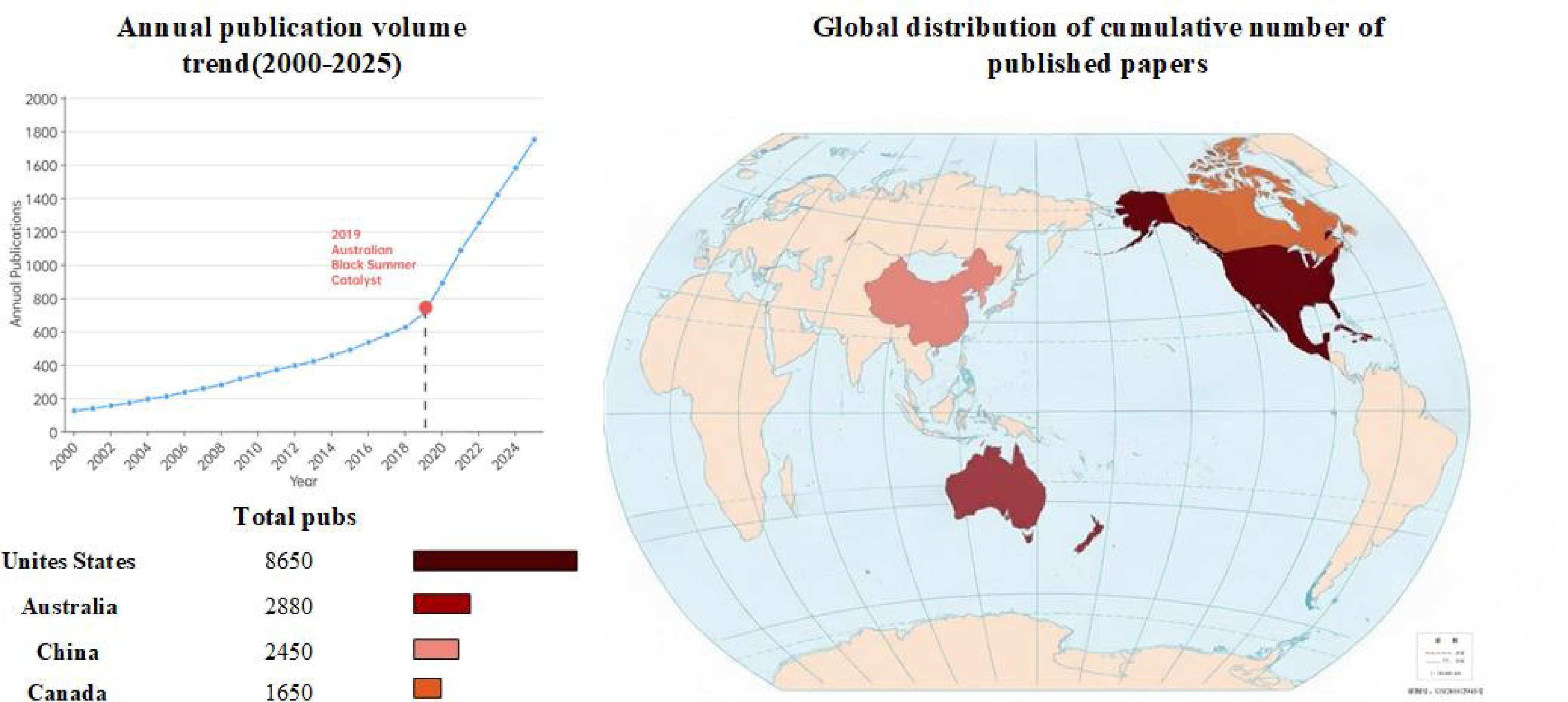
Figure 1.
Trend of global prescribed burning research publications and geographical distribution characteristics, 2000–2025.
These developments indicate that prescribed burning research is no longer limited to a single disciplinary perspective but is instead evolving into an integrated socio-ecological management framework. To better synthesize these emerging research directions and clarify their interrelationships, it is necessary to establish a conceptual structure that links ecological objectives, technological tools, and governance constraints[24].
To better connect the three core themes of this review—ecological goals, technological tools, and management challenges—we therefore propose an integrated conceptual framework. As illustrated in Fig. 2, ecological objectives constitute the starting point of prescribed burning management, defining key ecological targets such as fuel load reduction, biodiversity conservation, carbon stability, and ecosystem resilience. These objectives guide the selection and development of technological tools, including remote sensing and LiDAR for fuel mapping, UAV ignition systems for operational implementation, AI/ML models for fire behavior prediction, and CFD-based simulations for smoke dispersion assessment.
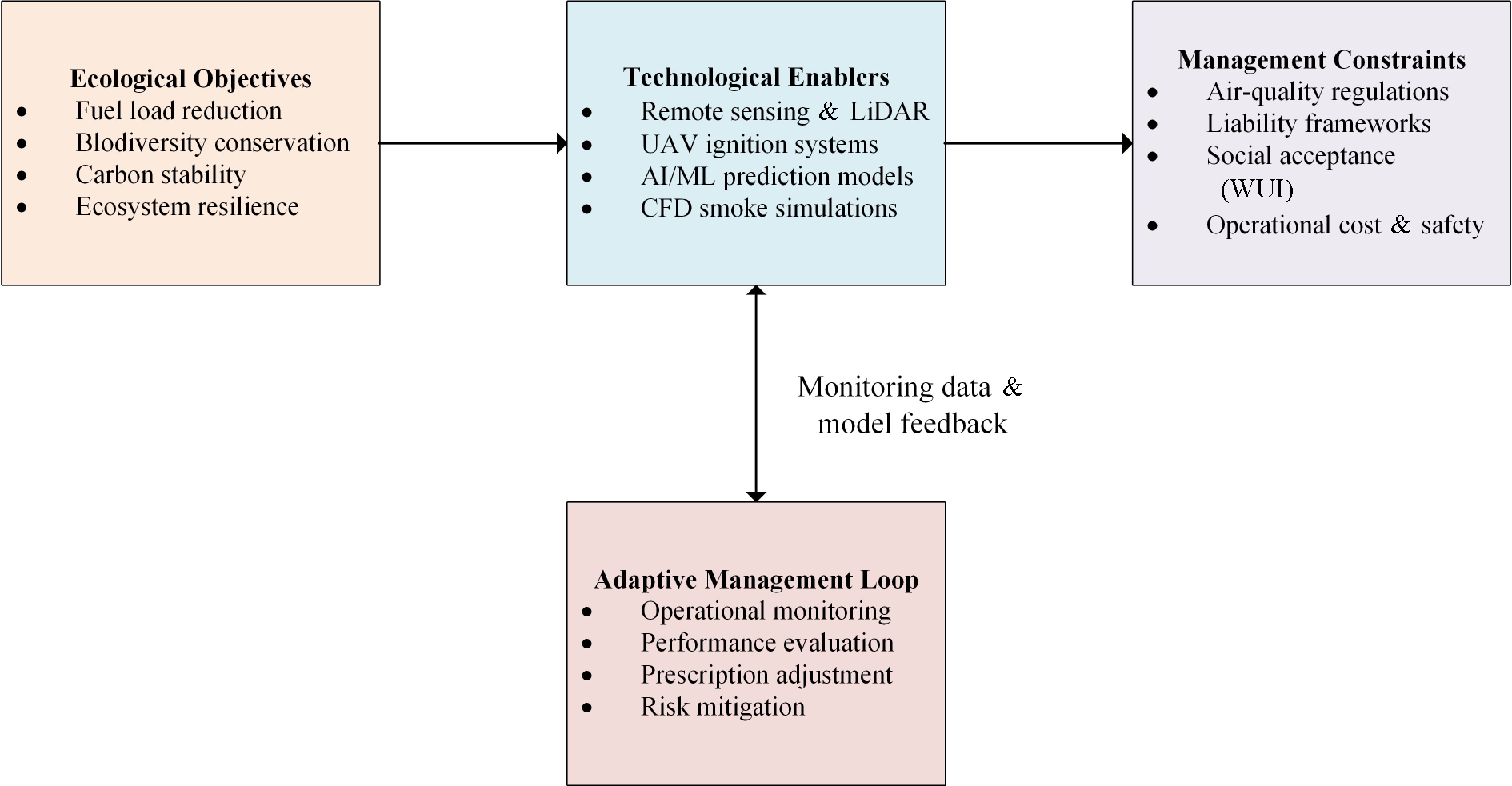
Figure 2.
Conceptual framework of prescribed burning management.
However, the implementation of these technologies is constrained by a series of governance and management challenges, such as air-quality regulations, liability frameworks, public acceptance in wildland–urban interface (WUI) areas, and operational safety considerations. As shown by the directional links in Fig. 2, ecological objectives drive the development of technological solutions, while management constraints shape how these tools can be applied in real-world burning prescriptions.
Importantly, Fig. 2 highlights an adaptive management loop, in which monitoring data and model feedback continuously inform decision-making. Through operational monitoring, performance evaluation, and prescription adjustment, managers can iteratively update disturbance thresholds and optimize prescribed burning strategies. In this way, ecological goals, technological tools, and governance challenges interact dynamically within a data-driven adaptive management system that supports both wildfire risk reduction and long-term ecosystem sustainability.
-
As an active ecosystem management strategy, the core logic of prescribed burning lies in simulating natural fire disturbance processes. By artificially regulating fire intensity and frequency, it redistributes ecosystem energy and matter in time and space. Modern forest fire management theory suggests that prescribed burning is not only an engineering measure to reduce wildfire risk but also a key mechanism for maintaining the health of specific ecosystems, optimizing forest management, and coping with climate change.
Fuel regulation mechanism
-
From the perspective of physical mechanisms, the most direct function of prescribed burning lies in the precise regulation of forest fuel loads and their spatial structure, aiming to destroy the continuity conditions for fire spread. First, regarding vertical structure, prescribed burning uses low-intensity surface fire to precisely consume surface fine fuels (mainly 1 and 10 h lag time litter) and lower-layer shrubs. This process effectively increases the vertical distance between surface fuels and the canopy layer, severing the intermediate vegetation acting as 'ladder fuels', thereby greatly reducing the probability of surface fire climbing to the canopy layer and transforming into a devastating crown fire. Second, regarding horizontal structure, by forming patchy burned areas within the stand, discontinuous interfaces of fuel loads are artificially constructed. Both field measurement data and fire behavior simulation studies indicate that areas treated with prescribed burning show significantly reduced flame length, spread rate, and energy release rate when encountering wildfires. This physical barrier and energy management effect not only mitigates direct thermal damage to tree trunks but also creates safe buffer spaces and tactical anchor points for subsequent suppression operations. The specific mechanism of its impact on forest vertical structure and potential fire behavior is shown in Fig. 3.
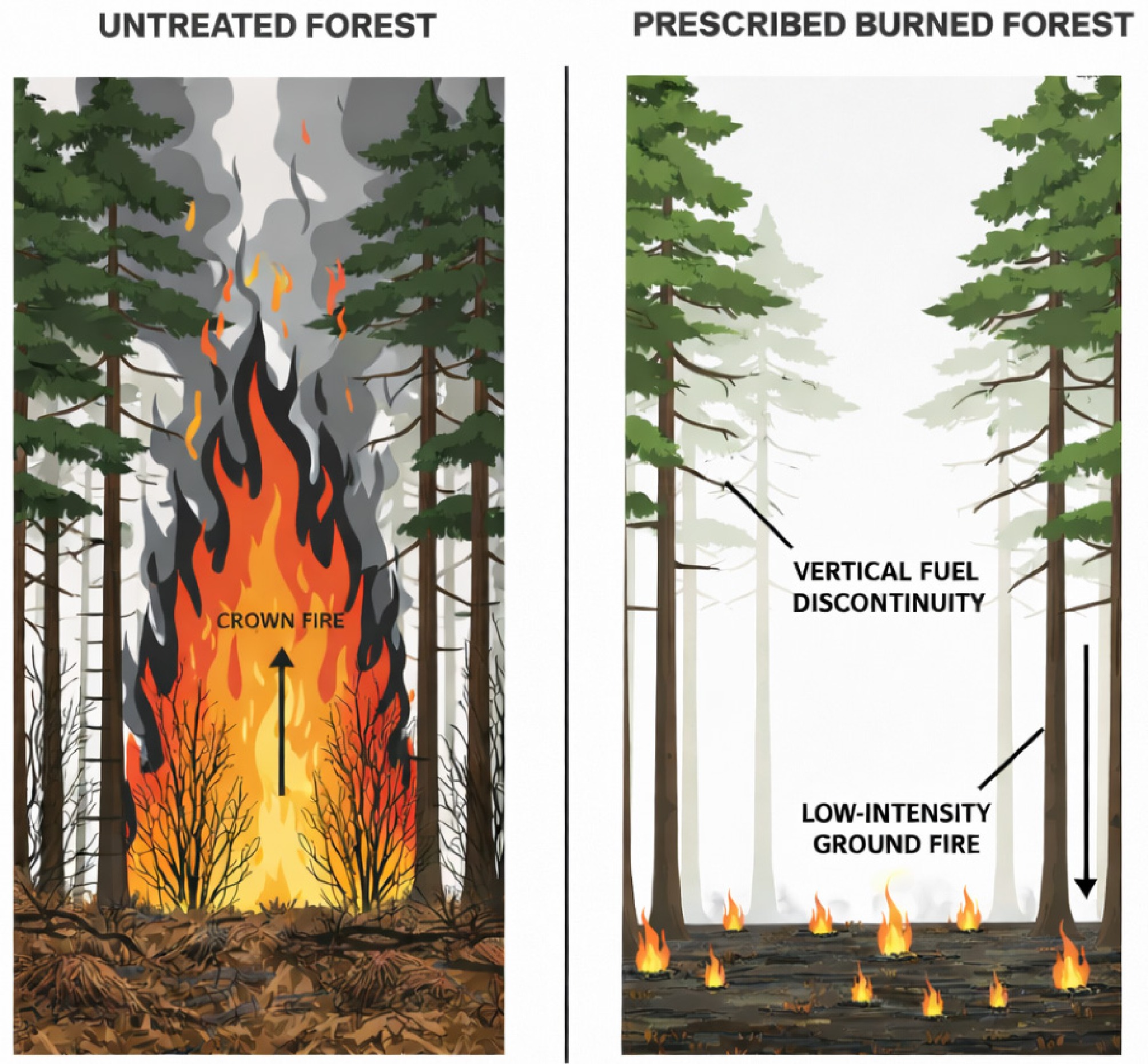
Figure 3.
Mechanism of prescribed burning's impact on forest vertical structure and potential fire behavior.
However, the role of prescribed burning extends far beyond physical fuel remodeling; this thermal disturbance also profoundly drives the biological succession and self-renewal of the ecosystem.
Biological response of ecosystems
-
In addition to structural changes at the physical level, prescribed burning drives the ecological response of vegetation communities and pests through thermal effects and habitat reshaping.
Habitat restoration and biodiversity conservation
-
For ecosystems dependent on fire disturbance, such as North American longleaf pine forests, Mediterranean shrublands, and some savannas, prescribed burning plays a key role in 'successional reset'. It effectively inhibits the invasion of shade-tolerant hardwood species (such as red maple and sweetgum) and maintains the open structure of the stand. This specific habitat structure is crucial for biodiversity. A typical case is the Red-cockaded Woodpecker in the USA. This species relies highly on open stands formed by frequent burning for nesting and breeding; thus, prescribed burning has become a core technical means for the habitat restoration of this endangered species.
Ecological control of forest pests and diseases
-
As a strong physical factor, fire performs dual functions of 'sanitation cutting' and environmental regulation in integrated pest management (IPM), acting through direct killing and indirect control, respectively. Direct killing utilizes high temperatures to destroy pathogen spores and overwintering pests present in the litter layer or on diseased plants. For example, in longleaf pine management, fire can effectively control the spread of brown spot needle blight. Indirect control reduces the breeding vectors for bark beetles (such as Scolytinae) by removing weakened trees within the forest; meanwhile, the enhanced ventilation and light transmission after burning reduce micro-environmental humidity, thereby suppressing the outbreak of various fungal diseases.
Soil improvement and silvicultural auxiliary measures
-
In the efficient management of plantations, prescribed burning is often used as a substitute or supplement for mechanical operations due to its low cost and high efficiency, profoundly affecting soil physicochemical properties and the afforestation process, thereby affecting site productivity and subsequent forest regeneration[25,26].
Promoting nutrient cycling ('fertilization' effect)
-
Prescribed burning accelerates the decomposition process of organic matter sequestered in the form of litter. Through oxidation reactions, key nutrient elements such as nitrogen, phosphorus, potassium, and calcium are rapidly released and returned to the soil as ash, forming a short-term 'nutrient pulse effect,' which significantly improves forest soil fertility and promotes the growth of retained trees or newly planted young forests.
Site preparation and regeneration
-
On cutover lands, prescribed burning can quickly clear large amounts of logging residues (branches, tops) and break the thick litter layer, exposing mineral soil. This not only facilitates the direct establishment and germination of tree seeds but also greatly reduces the difficulty and economic cost of artificial afforestation operations. In addition, moderate burning may contribute to stabilizing soil carbon dynamics over longer temporal scales by preventing large carbon losses associated with severe wildfires[27].
Dual effects on the forest carbon sink
-
Against the backdrop of 'Dual Carbon' goals, the impact of prescribed burning on forest carbon sinks involves a complex dialectical relationship. Although in the short term, the combustion process inevitably releases carbon dioxide and some aerosols into the atmosphere, causing immediate carbon emissions, evaluated from a long-term temporal scale and a full life-cycle perspective, this mechanism embodies the strategic wisdom of 'exchanging small carbon losses for large carbon gains'.
Through regular, low-emission prescribed burning, unstable surface carbon pools are removed, effectively avoiding the risk of high-intensity, catastrophic wildfires occurring under extreme weather in the future[28]. High-intensity wildfires not only instantly release massive carbon emissions but also kill a large number of trees (long-term carbon pools) and destroy soil carbon pool structures. Therefore, moderate prescribed burning protects the tree layer and deep soil—the core carbon sinks—by maintaining the stability of the forest ecosystem, realizing a net gain in forest carbon sink function over a long cycle. Figure 4 displays the simulation comparison results of carbon emissions between prescribed burning and high-intensity wildfires over a full life cycle.
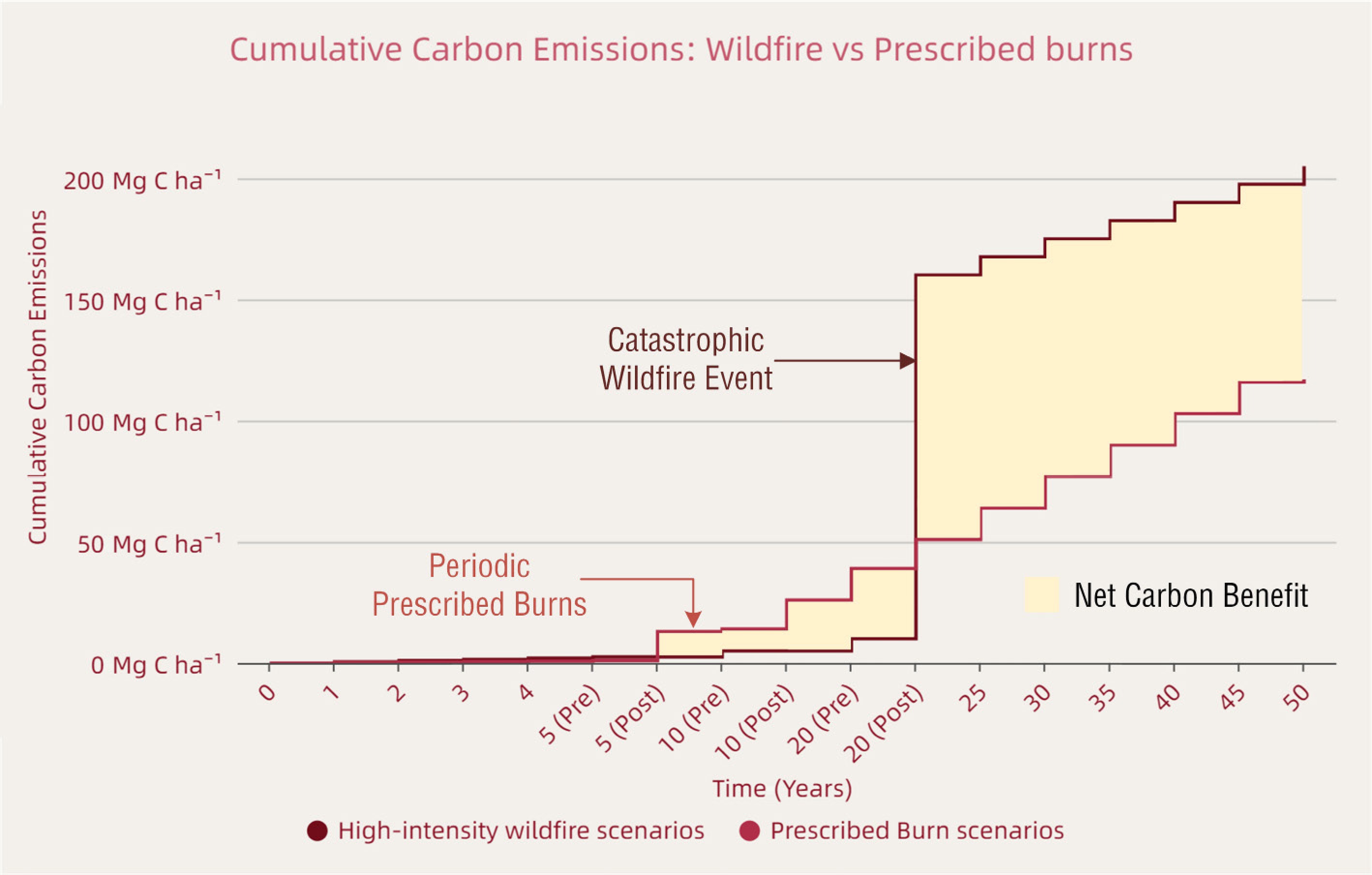
Figure 4.
Full life-cycle carbon emission simulation comparison between prescribed burning and high-intensity wildfires.
Quantitatively, under a simplified life-cycle simulation scenario (assuming a representative temperate forest system, a 50-year evaluation horizon, and typical fuel accumulation and fire-return intervals reported in the literature), the results in Fig. 4 suggest that cumulative carbon emissions under a high-intensity wildfire scenario can reach about 200 Mg C ha−1. In contrast, a periodic prescribed-burning scenario remains around 120 Mg C ha−1, corresponding to an approximate net reduction of ~80 Mg C ha−1 (about 40% lower cumulative emissions).
Despite the significant positive benefits prescribed burning demonstrates in ecology and disaster reduction, as a human-controlled combustion act, its implementation is inevitably accompanied by environmental disturbances and safety hazards, requiring scientific assessment of its potential risks.
-
Although prescribed burning shows significant benefits in ecological restoration and fire prevention, as an anthropogenic disturbance involving complex physicochemical reactions, it is accompanied by non-negligible environmental externalities and implementation risks. Scientifically assessing these negative impacts is not only a prerequisite for formulating reasonable burning prescriptions but also key to weighing ecological benefits against social costs.
Smoke emissions and atmospheric environmental effects
-
The disturbance of combustion products to the atmospheric environment is the negative effect of prescribed burning that is most criticized by the public. Unlike the uncontrolled emissions of wildfires, although the total amount of prescribed burning is controllable, the smoke generated still poses a direct challenge to air quality.
Characteristics of particulate and gas emissions
-
Incomplete combustion of biomass releases large amounts of fine particulate matter (PM2.5), carbon monoxide (CO), volatile organic compounds (VOCs), and nitrogen oxides (NOx). Studies show that PM2.5, due to its small particle size and large specific surface area, easily enriches toxic substances and penetrates deep into human lungs, acting as a major health risk factor[29]. In addition, although prescribed burning aims to reduce long-term carbon emissions, a single burning event still releases a certain amount of greenhouse gases (CO2 and CH4), perturbing the short-term regional carbon budget balance.
Public health exposure in WUI areas
-
With the continuous expansion of the global Wildland-Urban Interface (WUI), prescribed burning zones are often adjacent to densely populated areas. Under meteorological conditions such as temperature inversion layers or sudden wind direction changes, smoke easily accumulates at low altitudes and drifts to residential areas, leading to short-term severe air pollution events[30]. This not only reduces atmospheric visibility, affecting traffic safety, but also poses potential threats to the respiratory health of sensitive populations (such as children, the elderly, and asthma patients). How to find a balance point between reducing fire risk and ensuring air quality has become a thorny problem facing managers.
Soil erosion and water quality risks
-
Fire removes surface vegetation cover and alters the physical structure of the soil surface, thereby increasing the risk of soil erosion and water pollution under rainfall scouring.
Surface exposure and soil erosion
-
Prescribed burning consumes the litter layer, exposing mineral soil directly to raindrop impact and surface runoff scouring. Although low-intensity burning usually does not produce severe soil water repellency layers, in areas with steep slopes or concentrated rainfall, the amount of sediment transport within a short period may still increase significantly. This surface erosion not only causes impoverishment of forest soil but may also lead to siltation in downstream river channels.
Ash transport and water eutrophication
-
The ash produced by combustion is rich in nutrient elements such as nitrogen, phosphorus, and potassium, as well as some heavy metals. Under heavy rain scouring, these ashes enter streams or lakes with surface runoff, potentially leading to increased water turbidity, altered pH values, and sudden spikes in nitrogen and phosphorus loads. In extreme cases, this sudden nutrient input may trigger water eutrophication, threatening the survival environment of aquatic organisms and affecting the safety of drinking water sources.
Escaped fire risk and safety boundaries
-
'Escaped fire', where prescribed burning loses control and evolves into a destructive wildfire, is the greatest safety hazard in the application of this technology and the main cause of the crisis in public trust.
Prescription failure and sudden weather changes
-
Every prescribed burn is based on a specific 'burning prescription', which strictly limits parameter ranges such as temperature, humidity, wind speed, and fuel moisture during operations. However, the unpredictability of local micrometeorology (such as sudden gusts, wind reversals, or sudden drops in humidity) may cause fire behavior to instantly exceed prescription thresholds, allowing the fire to breach preset control lines.
Operational errors and cumulative effects
-
In addition to environmental factors, human operations (such as improper ignition methods and insufficient patrol forces) are also important causes of escaped fires. Furthermore, due to misjudgment of the dryness of forest fuels, residual fires lurking in the humus layer or snags may reignite days after the operation ends, causing secondary disasters. Historical cases like the Cerro Grande Fire in New Mexico, USA, in 2000, which was triggered by a lost prescribed burn and eventually destroyed numerous homes, warn us that while pursuing ecological goals, we must strictly adhere to safety baselines.
It is precisely these environmental externalities and uncertainties in safety boundaries that expose the limitations of traditional experience-based management, urgently calling for the intervention of high-precision, intelligent technological means to achieve precise control over the entire process of prescribed burning.
-
Facing challenges in traditional prescribed burning, such as rough assessment, high operational risk, and lagging prediction, modern technologies characterized by digitalization, networking, and intelligence are reshaping this ancient management practice. The paradigm shift from 'experience-based decision-making' to 'precise data-driven decision-making' has not only significantly improved operational safety and efficiency but also made prescribed burning an indispensable part of the smart forestry system.
Refined pre-burn assessment: remote sensing and GIS technology
-
Precise fuel assessment is the cornerstone of formulating scientific burning prescriptions. Traditional manual plot surveys are time-consuming, labor-intensive, and have poor spatial representation, making it difficult to capture landscape-scale heterogeneity. Modern remote sensing technology has completely changed this status quo by building 'digital twin' models of forests.
3D fuel modeling
-
Airborne LiDAR technology, with its strong penetration of vegetation vertical structures, has become the 'gold standard' for acquiring understory fuel parameters. Through high-density point cloud data, researchers can precisely retrieve canopy base height, canopy bulk density, and surface roughness to build high-precision 3D fuel models. Combined with multi-spectral satellite data (e.g., Sentinel-2, Landsat-8) for the retrieval of vegetation moisture content and phenological characteristics, managers can map fuel loads and flammability with sub-meter resolution.
Intelligent decision support systems
-
Based on Geographic Information Systems (GIS), the aforementioned multi-source heterogeneous data are integrated into fire risk zoning models. By overlaying historical data on terrain, meteorology, and residential locations, intelligent algorithms can automatically identify high-risk areas and calculate the 'burning urgency index' for different plots. This spatial decision support system achieves quantitative ranking of burning priorities, ensuring limited resources are invested in areas with the greatest fire hazards and optimal ecological benefits.
After completing a precise 'pre-burn' assessment and planning, how to safely land these paper prescriptions depends on equipment upgrades and real-time perception capabilities during the operational phase.
Intelligent operation and monitoring during burning
-
In the operational implementation phase, the introduction of UAVs (drones) and Internet of Things (IoT) technologies has realized a leap from 'human wave tactics' to 'human-machine collaboration' modes, greatly expanding operational safety boundaries and control precision.
UAV precision ignition technology
-
Industrial-grade UAVs equipped with Plastic Sphere Dispensers (PSD) are gradually replacing high-risk manual ignition operations. UAVs are not limited by terrain barriers and can penetrate deep into steep slopes or dense stands that are difficult for personnel to reach. More critically, through preset flight routes, UAVs can precisely control the density and spatiotemporal distribution of ignition points, flexibly implementing point, line, or ring ignition patterns. This micron-level control of ignition patterns can finely regulate fire line intensity and convection column height, strictly confining fire behavior within preset safety ranges.
Infrared thermal imaging and situational awareness
-
Monitoring performance depends on sensor modality and deployment configuration. UAV thermal cameras enable hotspot detection under smoke, ground IoT nodes support continuous micro-meteorology and exposure monitoring, and satellite products provide synoptic context with revisit limitations. Table 1 summarizes representative options and their trade-offs.
Table 1. Comparison of monitoring sensors for prescribed burning operations.
Sensor/platform Main outputs Strengths Limitations Best-use cases UAV RGB Perimeter, flame geometry, visual smoke plume High spatial detail; flexible viewpoints Smoke occlusion; daylight dependent Ignition quality control; mapping burn perimeter UAV thermal IR (TIR) Hotspots, temperature proxies Penetrates smoke; night
capableRadiometric calibration; limited flight endurance Spot-fire detection; mop-up; safety monitoring Ground IoT (met, PM sensors) Wind/RH; fuel moisture;
PM2.5 near receptorsContinuous; direct exposure measurement Sparse coverage; maintenance burden Go/no-go thresholding; compliance reporting Satellite (VIIRS/MODIS/Sentinel) Hotspots, burn scars,
aerosols (coarse)Large-area context; historical baselines Revisit/cloud limits; coarse resolution Regional awareness; post-burn severity mapping Handheld IR/crew sensors Local hotspots, intensity proxies Low cost; immediate tactical feedback Labor intensive; limited coverage Fine-scale verification during operations Traditional fire ground monitoring is often interfered with by thick smoke, creating visual blind spots. UAVs equipped with infrared thermal imaging sensors can penetrate smoke to capture the temperature field distribution and spread vectors of the fire line in real time. These data are transmitted back to the command center via IoT in real time, building a dynamic panoramic view of the fire ground. Commanders can thereby detect potential 'spot fire' boundary-crossing risks in real time and dispatch forces for disposal in a timely manner, achieving digital transparency of the fire ground situation. The complete workflow of smart prescribed burning based on digital twins and human-machine collaboration is shown in Fig. 5.
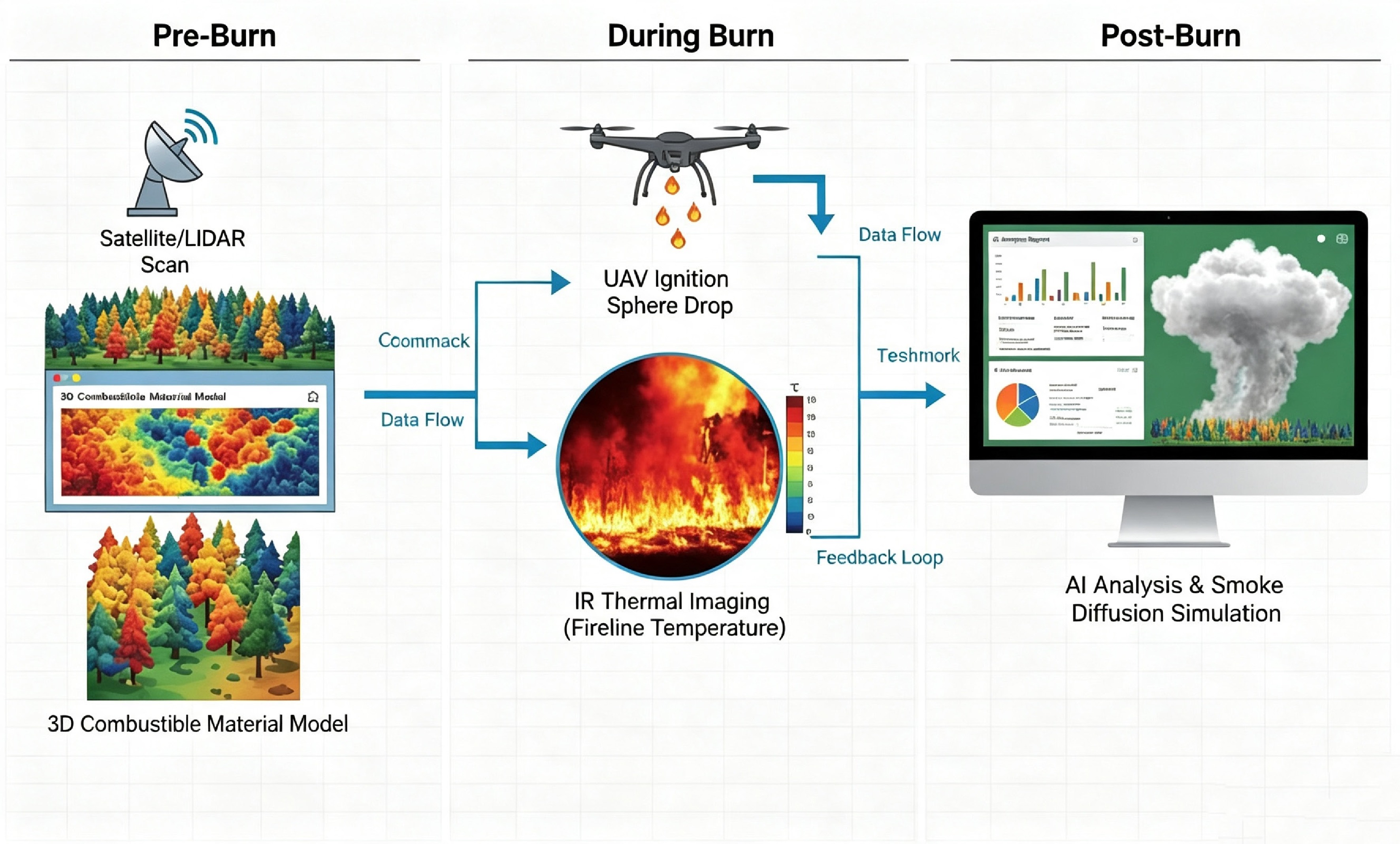
Figure 5.
Smart prescribed burning workflow based on digital twins and human-machine collaboration.
Open datasets and AI-ready benchmarks for UAV/thermal monitoring
-
In recent years, prescribed burning management has rapidly entered a 'data-driven' phase. On the one hand, unmanned aerial vehicles (UAVs) equipped with RGB and thermal infrared (TIR) sensors have enabled high spatiotemporal resolution observations of pre- and post-burn fuel loads, fireline progression, flame morphology, and smoke-plume dispersion. On the other hand, ground-based sensors, meteorological stations, and satellite products (e.g., active fire/thermal anomaly detections and aerosol indicators) provide complementary cross-scale monitoring. Together, these multi-source data streams not only enhance the visualization and traceability of burning operations, but also underpin a closed-loop 'monitor–evaluate–feedback' framework. For example, thermal radiance intensity and flame geometric features can be used to estimate fire intensity and potential emission risks, while the integration of wind fields and topography enables dynamic warning of plume transport and exposure risks for sensitive receptors. Consequently, prescribed burning is gradually moving beyond reliance on practitioner experience or static rules, creating the conditions for semi-automated and intelligent decision-making.
To translate these monitoring advantages into reusable algorithms and operational management capabilities, a key bottleneck is the availability of AI-trainable datasets and standardized evaluation benchmarks. At present, publicly accessible datasets that provide paired RGB–TIR imagery together with pixel-level or instance-level annotations remain relatively scarce, yet they largely determine whether tasks such as flame/smoke detection, fireline segmentation, object tracking, and thermal-radiance inversion can be modeled systematically and compared fairly across methods. Meanwhile, AI/ML approaches (e.g., multimodal fusion, temporal modeling, and semi-/weakly supervised learning) have demonstrated strong potential to improve robustness under occlusion by smoke, background clutter, and scale variation. Beyond this, large language models (LLMs) may play an emerging role in future prescribed-burning planning and decision support—for instance, generating auditable burn-plan drafts from regulations, weather windows, and fuel conditions; synthesizing multi-scenario outputs from smoke-dispersion models, fire-behavior models, and monitoring streams to provide interpretable trade-off recommendations (ecological benefits, emission risks, resource inputs, and safety constraints); and structuring historical operation records and incident reports into searchable 'experience bases' to support training and post-operation review. Against this background, we summarize representative open datasets and AI-ready benchmarks in Table 2 to facilitate further research and real-world implementation.
Table 2. Representative open datasets for AI-enabled fire/flame/smoke monitoring.
Dataset Modalities Scenario and scale Annotations/tasks Ref. FLAME RGB video + thermal heatmaps UAV imagery over a prescribed pile burn (Arizona, US) Frame-level classification; fire segmentation masks Shamsoshoara et al.[31] FLAME 3 RGB + radiometric thermal (TIFF) UAV wildland-fire imagery with radiometric thermal products Detection/segmentation; thermal calibration Hopkins et al.[32] UAV-strawFire RGB + thermal IR + video Controlled residue/straw burning (southern China) Detection, segmentation, tracking baselines Hu et al.[33] Post-burn simulation and prediction
-
To address the risks of smoke dispersion and prescription failure outlined earlier, the integration of artificial intelligence and high-performance computing models delivers robust predictive capabilities for prescribed burning operations.
CFD simulation of smoke dispersion
-
Model choice strongly affects predicted exposure and operational constraints downwind. In practice, managers often combine fast-running screening tools with higher-fidelity CFD or coupled chemistry models for sensitive receptors and complex terrain. Table 3 compares representative smoke and fire atmosphere modeling options.
Table 3. Comparison of commonly used smoke/fire–atmosphere modeling tools for prescribed burning.
Tool Typical scale/use Key inputs Strengths Limitations HYSPLIT Regional transport/screening Meteorology, emission rate, release height Fast; widely used; trajectory/dispersion screening Simplified plume rise; limited near-field complexity CALPUFF Local–regional, complex terrain Meteorology, terrain, emissions Terrain handling; regulatory use
in some settingsParameter sensitive; simplified chemistry; setup effort WRF-chem/
CMAQRegional air-quality planning Emissions inventory, chemistry, meteorology Coupled chemistry; PM2.5/ozone impacts High computational cost; coarse for near-field burns WFDS/FDS Near-field flow/smoke in constrained domains Heat release, geometry, wind High-fidelity flow/heat; near-field scenarios Domain-limited; heavy compute; not regional QUIC-fire Operational CFD fire–
atmosphereFuel, wind, terrain, ignition pattern Fast CFD-style simulation; complex terrain support Needs calibration; emissions/fuels uncertainty To precisely manage the impact of PM2.5 on sensitive downwind areas, Computational Fluid Dynamics (CFD) models (such as QUIC-Fire, WFDS) are widely applied. These physics-based models can couple complex terrain and micrometeorological fields to simulate the plume rise, transport, and dispersion processes generated by combustion in 3D space with high fidelity. By simulating dispersion paths under different meteorological conditions, managers can predict whether smoke will invade towns or highways before ignition, thereby optimizing ignition timing.
Machine learning-based window prediction
-
Finding the optimal ignition window is key to the success of prescribed burning. Traditional look-up table methods are often too conservative or broad. Modern research uses machine learning algorithms (such as Random Forest, Long Short-Term Memory networks [LSTM]) to mine non-linear relationships among massive historical meteorological data, fuel moisture data, and past burning effects. AI models can precisely predict the coupled state of 'weather-fuel' in the coming days, recommending optimal operational time windows that maintain effective combustion intensity while maximizing the reduction of escaped fire risk, greatly improving the scientific nature and success rate of decision-making.
However, although technological innovation provides powerful 'hard tools', transforming them into widespread governance efficacy requires the support of 'soft environments' such as laws, regulations, social participation, and management systems.
-
The implementation of prescribed burning is not only a scientific and technical issue but also a management proposition deeply influenced by social systems, legal frameworks, and geographical environments. By comparing the mature systems of developed countries in forest fire management, such as North America and Australia, and combining them with China's current forestry and social conditions, exploring a localized, precise, and intelligent implementation path is an inevitable requirement for achieving high-quality development in China's forestry.
Standardized management systems in North America and Australia
-
Countries represented by the US and Australia, after half a century of exploration, have established a standardized management system highly integrating 'regulation-technology-society'. Their core experiences are mainly reflected in three dimensions.
Professional certification and legal guarantees
-
To standardize operational procedures, most US states have implemented 'Certified Prescribed Burn Manager' programs. Only professionals who have undergone strict training and certification have the authority to approve burning prescriptions. More critically, the legal system has gradually shifted from 'strict liability' to 'negligence liability' (or gross negligence), meaning that as long as the implementer strictly follows the approved prescription without subjective gross negligence, they can receive legal immunity even if an accidental escape occurs. This institutional design greatly eliminates managers' worries and encourages active fire prevention behaviors.
Full-cycle public communication mechanism
-
Facing potential smoke disturbance to residents, managers have established mature public communication procedures. From the public display of annual plans and community notifications 48 h before burning to real-time smoke trajectory releases on the day of burning, full-process information transparency effectively mitigates the 'NIMBY (Not In My Backyard) effect' and wins community understanding and support.
Cross-departmental collaborative linkage
-
Mechanisms for data sharing and joint decision-making among forestry departments, meteorological bureaus, environmental protection agencies, and emergency management departments have been established, ensuring a precise balance between fire risk windows, air quality compliance periods, and ecological demand periods. To intuitively understand the differences between China and foreign countries, Table 4 details the comparison of management characteristics in terms of driving mechanisms, legal liability, and core technologies.
Table 4. Comparison of prescribed burning management modes and characteristics between China and major western countries.
Dimension North America/Australia (mature system) China (transition phase) Primary driver Dual-drive (ecology and risk)
Views fire as an ecological process; emphasizes fuel reduction and habitat restoration.Safety-dominant (prevention)
Focuses on firebreaks and risk reduction; gradually extending to ecological restoration.Legal liability Negligence liability
Certified practitioners following prescriptions are generally
immune from liability (Safe Harbor principle).Strict liability
Result-oriented accountability; accidental escapes often lead to severe penalties regardless of intent.Decision & personnel Professional certification
Mandatory Certified Burn Manager (CBM) credentialing is administered by state/agency fire and land-management authorities. Training covers fire behavior–weather, fuels and burn prescriptions, ignition operations, smoke/air-quality compliance, risk & safety management; certification typically requires coursework plus mentored burns, competency sign-off, and periodic recertification.Administrative command
Establish a forestry and fire-authority–led Certified Burn Manager framework with tiered roles; standardize curricula; require coursework plus mentored burns with task-book/logbook documentation; competency sign-off; periodic recertification/CPDKey technology Data-driven and aerial
Widespread use of aerial ignition (PSD), fire behavior modeling,
and smoke dispersion simulation.Labor-intensive
Relies on manual drip torches and blowers; UAVs and digital twins are in pilot stages.Major challenges Social acceptance
Public intolerance to smoke (NIMBY effect) and constraints in Wildland-Urban Interface (WUI) areas.Fragmented tenure and terrain
Steep terrain, high population density, and fragmented forest tenure hinder unified operations.Although Western mature systems provide valuable lessons, considering China's unique natural geographical features and social governance structure, China faces more complex realistic constraints in promoting prescribed burning.
Representative prescribed-burning case studies across ecosystems and regions
-
To highlight geographic variability, Table 5 summarizes representative prescribed-burning practices across ecosystems and regions, emphasizing how objectives, regulations, and techniques differ.
Table 5. Representative prescribed-burning practices across ecosystems and regions.
Ecosystem/region Main objectives Regulatory and institutional context Typical techniques and tools Boreal forests (Canada/Alaska) Fuel reduction near communities; protect timber assets Agency-led planning; smoke management permits; burn boss/crew qualifications Spring/fall low–moderate intensity; aerial ignition in remote areas; satellite + ground severity plots Savannas (Northern Australia) Early dry-season mosaic burning; biodiversity and emissions reduction Indigenous ranger programs; carbon-credit methodologies in some regions Frequent low-intensity burns; ignition by drip torch/heli/PSD; monitoring with burn-scar maps and emissions accounting Mediterranean forests (Southern Europe) Maintain fuel breaks; reduce crown-fire potential; WUI protection Highly regulated due to smoke and liability; narrow burn windows Small-block burns; mechanical prep + backing fires; smoke forecasting and rapid mop-up Chaparral/WUI (Western
North America)Hazard reduction; create defensible space; ecosystem restoration Public communication and air-quality coordination are central Targeted burns under dispersion constraints; sensors + handheld IR; post-burn risk scoring Subtropical plantations
(South China, pilots)Fuel reduction; pest/disease control; site preparation Pilot programs with administrative approval; evolving standards Small-area burns; UAV reconnaissance/
thermal imaging; local fuel models under developmentStatus and challenges of prescribed burning in China
-
In recent years, forest fire management in China has been gradually shifting from a purely suppression-oriented strategy toward a more integrated approach that combines fire prevention, suppression, and controlled fuel management. This transition reflects a growing recognition that excessive fire exclusion can lead to fuel accumulation and increased wildfire risk. Some early practices resembling prescribed burning have already emerged, such as firebreak creation in the Greater Khingan Mountains and site-preparation burning in southern collective forest regions. However, compared with countries where prescribed fire has been widely institutionalized, China still faces a series of structural constraints related to natural conditions, land tenure systems, technical infrastructure, and social acceptance.
Dual constraints of terrain and population
-
A key challenge for implementing prescribed burning in China arises from the combined constraints of complex terrain and high population density. Unlike the extensive and sparsely populated forest landscapes of North America, many forest regions in southern China are characterized by mountainous and hilly terrain with fragmented landscapes and highly interwoven wildland–urban interfaces (WUI). These conditions not only limit the deployment of mechanized burning operations but also significantly reduce the environmental capacity for smoke dispersion.
As a result, even low-intensity prescribed fires may generate smoke impacts that affect nearby communities, transportation corridors, and urban settlements. This spatial proximity between forests and human settlements greatly increases the perceived risk associated with controlled burning and often leads to strong administrative caution in approving such operations. Therefore, terrain complexity and population distribution jointly impose strict operational and environmental constraints on the large-scale implementation of prescribed burning in China.
Coordination dilemma under fragmented tenure
-
Institutional arrangements of forest land tenure further complicate the implementation of prescribed burning. Following the reform of collective forest tenure in southern China, forest ownership and management rights became highly fragmented among numerous individual households. While this reform improved local incentives for forest management, it also created significant challenges for coordinated landscape-scale fuel management.
In contrast to large-scale public forest systems in countries such as the United States, where agencies can organize prescribed burns across contiguous forest areas, implementing unified burning operations across numerous small and separately managed forest parcels in China requires extensive negotiation and coordination among landholders. This fragmentation substantially increases transaction costs, complicates decision-making processes, and often results in collective action problems. Consequently, fragmented tenure structures represent an important institutional barrier to the large-scale adoption of prescribed burning practices.
Lack of basic data and localization of models
-
Another critical limitation lies in the insufficient availability of basic fire-management data and localized modeling tools. At present, China still lacks a standardized national fuel database that systematically characterizes fuel loads, vegetation structures, and combustion properties across major forest types. As a result, fire behavior prediction in many cases relies on imported modeling tools developed in other ecological contexts, such as the BehavePlus system from the United States.
However, differences in species composition, forest structure, and climatic regimes between China and North America may significantly affect model performance. Without proper calibration and validation, the direct application of these models may introduce uncertainties in predicting fire spread, fire intensity, and smoke dispersion. Developing localized fuel datasets, fire behavior models, and smoke impact simulations is therefore essential for supporting scientifically based prescribed burning planning in China.
Social acceptance and public perception
-
Beyond environmental and institutional constraints, social acceptance represents another important factor affecting the feasibility of prescribed burning in China. Compared with countries such as the United States and Australia, where prescribed fire has gradually gained broader societal recognition through long-term practice and public communication, the concept remains relatively unfamiliar to many communities in China. Concerns about smoke pollution, potential fire escape, and perceived ecological damage may easily trigger public opposition, particularly in densely populated forest regions.
Emerging empirical studies have begun to examine wildfire risk perception and public participation in China. For instance, survey research has shown that factors such as information transparency, trust in government institutions, and confidence in emergency response capacity significantly influence public perceptions of wildfire risk. Case studies of wildfire governance, such as the 2022 Beibei wildfire in Chongqing, further demonstrate that community networks and volunteer participation can play an important role in wildfire management and response (Wu & Lyu[34]). These findings suggest that effective communication, stakeholder engagement, and public participation mechanisms are essential for improving societal acceptance of fire management policies.
Nevertheless, systematic research on the 'Not In My Backyard' (NIMBY) effect related to prescribed burning remains limited in China. Considering the high population density and complex WUI conditions in many regions, future studies should incorporate public perception surveys, stakeholder analysis, and participatory governance approaches to better understand social constraints and support the gradual institutionalization of prescribed burning.
Implications for China
-
Facing the aforementioned dual challenges from natural geography to social management, China cannot simply replicate the Western model. Instead, it should utilize late-mover advantages to explore a modernization path where technology and institutions are deeply integrated.
Construct a localized precision model system
-
Relying on national forest inventory data, combined with LiDAR and field measurements, accelerates the construction of a standard surface fuel model library covering China's major forest types. Develop fire behavior prediction algorithms adapted to China's complex terrain to replace simple empirical judgments, providing a scientific basis for decision-making.
Promote the deployment of 'unmanned' and 'intelligent' technologies
-
For regions with steep terrain and poor accessibility, unmanned intelligent technologies should be widely promoted. Specifically, UAV ignition and aerial monitoring approaches outlined earlier can greatly boost operational efficiency and safety within mountain forest landscapes. Unlike conventional manual ignition methods, UAV ignition systems support precise control of ignition points, lower personnel exposure to dangerous conditions, and facilitate timely evaluation of fire spread via real-time aerial images.
Recent pilot applications in China have demonstrated the potential of UAV-assisted fire management. For example, UAV-based aerial ignition and monitoring systems have been experimentally applied in forest fuel management and firebreak construction projects in the Greater Khingan Mountains and parts of Sichuan Province, where complex terrain limits ground-based operations. In these cases, UAV platforms were used to deploy ignition devices, conduct thermal monitoring, and transmit real-time fire behavior data to command centers, significantly improving operational efficiency and situational awareness. Similar applications of UAV monitoring in forest fire prevention and emergency response have also been reported in southern collective forest regions, providing technical support for precision fire management and rapid risk assessment.
In addition, artificial intelligence technologies can be integrated to support high-resolution meteorological forecasting and decision-making. By combining localized weather prediction models, fuel moisture monitoring, and remote sensing data, AI-assisted systems can help identify short and safe burning windows in regions with highly variable weather conditions, particularly in southern mountainous areas. The integration of UAV platforms, remote sensing, and AI-driven decision tools, therefore, represents an important technological pathway for the future development of prescribed burning in China.
Perfect laws, regulations, and multi-party coordination mechanisms
-
It is suggested that within the framework of the 'Regulations on Forest Fire Prevention', operational protocols and exemption clauses for prescribed burning should be refined. Explore the establishment of an operational mode of 'government-led, professional team implementation, and farmer cooperation'. Meanwhile, utilize digital platforms to break down data barriers between forestry and ecological environment departments, achieving dynamic synergy between 'fire control' and 'haze control'.
-
With the intensification of global climate change and the frequent occurrence of extreme wildfire events, prescribed burning is no longer just a traditional forestry technique but an indispensable strategic tool in modern ecosystem management. This paper systematically reviews the evolutionary trajectory of prescribed burning from ecological mechanisms to technological applications, drawing the following core conclusions:
(1) Deepened understanding of mechanisms: Prescribed burning plays an irreplaceable role in maintaining forest health, blocking pests and diseases, and optimizing carbon sink stability through physical fuel barriers, biological successional resets, and chemical nutrient pulses. This is a wise strategy of exchanging short-term, controllable micro-disturbances for the long-term steady state and safety of the ecosystem.
(2) Dialectical perspective on risks: We must squarely face the accompanying risks of smoke emissions, soil erosion, and escaped fires. These negative externalities remind managers that the formulation of any burning prescription must seek a refined balance between ecological benefits and social costs, rather than blind implementation.
(3) Innovation of technical paradigms: The comprehensive intervention of modern remote sensing (LiDAR), drones (UAV), Internet of Things (IoT), and artificial intelligence (AI) technologies is driving the transformation of prescribed burning from extensive 'experience-based decision-making' to precise 'data-driven' approaches. This transformation makes it possible to implement safe and efficient burning operations in complex terrain and high-population-density areas, marking the arrival of the 'Smart Prescribed Burning' era.
Standing at the present and looking to the future, to build a fire prevention system where humans and nature coexist harmoniously, subsequent research and practice should further deepen efforts in multi-objective synergy and systematic construction.
Future outlook
Optimal disturbance thresholds for China's major forest types
-
In this review, 'optimal disturbance thresholds' are defined as the upper bounds of fire frequency, intensity, and spatial extent within which prescribed burning can deliver multi-objective benefits—fuel reduction, carbon stability, and biodiversity maintenance—while avoiding irreversible ecosystem degradation and unacceptable safety or smoke impacts. A preliminary indicator set may include the fire return interval and seasonality, proxies of fireline intensity or heat release, burn patch size and total treated area per year, canopy scorch height and soil heating depth as damage proxies, and smoke exposure metrics for adjacent communities (e.g., PM2.5 concentration-hours). For China, initial benchmarks can be stratified by forest type: boreal conifer forests in the Greater Khingan Mountains may require longer intervals, lower-intensity burning, and larger patch mosaics; subtropical pine plantations may favor moderate intervals with low-to-moderate intensity and fine-scale patchiness; southern evergreen broadleaf forests may be best suited to low-intensity burning under strict fuel-moisture constraints; and dry-hot valley forests or savanna-like systems in Southwest China may permit higher-frequency burns in the early dry season. Future research should prioritize calibration and validation of these indicators using long-term monitoring plots, coupled with localized fire-behavior and smoke-impact modeling, to improve robustness under regional heterogeneity and climate-change scenarios.
AI/ML and large language models for planning, simulation, and decision support
-
Beyond conventional statistical and machine-learning approaches, large language models (LLMs) may serve as 'planning copilots' that synthesize heterogeneous inputs—fuel inventories, weather forecasts, regulatory requirements, and historical burn reports—into structured burn plans, operational checklists, and scenario narratives. When integrated with physics-based simulators (e.g., CFD-based smoke models) for verification and sensitivity analysis, such systems could support more transparent, reproducible, and auditable planning workflows. For high-stakes operations, their use should be bounded by human-in-the-loop governance, traceable data provenance, explicit uncertainty communication, and clearly assigned accountability.
Looking forward, to further unleash the potential of prescribed burning and cope with challenges of the new era, the academic community and management departments should focus on the following three directions:
(1) Research on dynamic thresholds for multi-objective synergy: Future research needs to be dedicated to quantifying the trade-off relationships among fire safety, carbon sink gains, and biodiversity conservation. By establishing multi-objective optimization models, we can explore the 'optimal disturbance thresholds' for different forest types under different climate scenarios, providing theoretical support for formulating burning prescriptions that balance both ecological and disaster reduction goals.
(2) Construct a 'Space-Air-Ground' integrated smart decision platform: Accelerate the integration of macro-monitoring by satellite remote sensing, meso-scale operations by UAVs, and micro-perception by ground IoT to build a real-time interconnected smart fire management system. This system will realize full-chain digital management from precise pre-burn fuel assessment and real-time twin simulation of fire behavior to automatic post-burn effect evaluation. Its future system architecture is shown in Fig. 6.
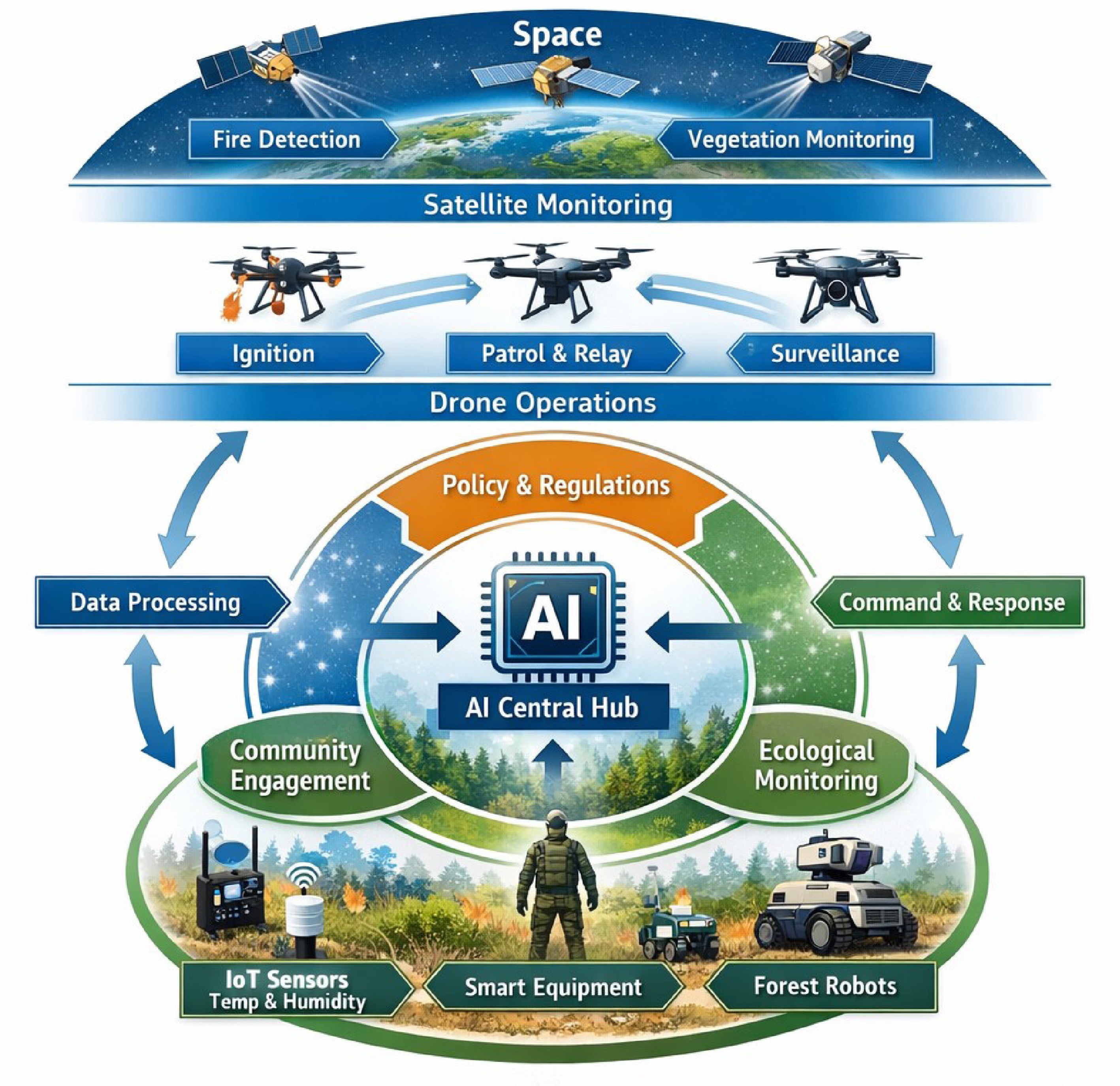
Figure 6.
Architecture of the future 'Space-Air-Ground' integrated smart forest fire management system.
(3) Deep integration of social-ecological systems: Technological progress must be accompanied by innovation in governance models. Future efforts should strengthen cross-disciplinary research between social sciences and natural sciences, exploring how to enhance societal tolerance and acceptance of short-term disturbances like smoke generated by prescribed burning through science education, community co-management, and public participation mechanisms, thereby building a resilient fire prevention system beneficial to the government, the public, and the ecosystem.
-
During the preparation of this work, the authors used ChatGPT(5.2/2025.12.18) for figure enhancement. The authorsreviewed and edited all content produced with the assistance of this tool, verified its accuracy, and take full responsibility for the integrity and originality of the final manuscript. This work represents the authors' own intellectual contribution, and no AI tool is credited as an author.
-
The authors confirm contribution to the paper as follows: study conception and design: Tang L, Li H; data collection: Zhou G, Li Z; analysis and interpretation of results: Tang L, Li H, Lin S, Li L; draft manuscript preparation: Tang L, Li H. All authors reviewed the results and approved the final version of the manuscript.
-
Data sharing is not applicable to this article as no datasets were generated or analyzed during the current study.
-
This work was supported by the Hunan Provincial Natural Science Foundation Project (Grant No. 2025JJ50385).
-
The authors declare that they have no conflict of interest.
- This article is an open access article distributed under Creative Commons Attribution License (CC BY 4.0), visit https://creativecommons.org/licenses/by/4.0/.
-
About this article
Cite this article
Tang L, Li H, Li Z, Lin S, Li L, et al. 2026. Prescribed burning: ecological effects, technological applications, and management challenges: a review and prospects. Smart Forestry 1: e013 doi: 10.48130/smartfor-0026-0010 

Prescribed burning: ecological effects, technological applications, and management challenges: a review and prospects
- Received: 19 December 2025
- Revised: 27 April 2026
- Accepted: 09 May 2026
- Published online: 31 July 2026
Abstract: Prescribed burning, as a critical technical means for forest and grassland ecosystem management, plays multiple roles in fire prevention and control, ecological restoration, and climate change adaptation. This paper systematically reviews research findings in the field of prescribed burning from 2020 to 2025. It synthesizes the current status, key breakthroughs, and geographical distribution characteristics from four core directions: ecosystem impacts, environmental and climatic effects, technological innovation applications, and management decision optimization. The paper focuses on analyzing research characteristics such as interdisciplinary integration and technology-driven innovation, while looking forward to future research trends. Bibliometric analysis results indicate that prescribed burning research has shown explosive growth in the last five years, with over 10,000 cumulative related papers globally. The research geography is rapidly expanding from traditional dominant regions (North America, Europe, Australia) to Asia (primarily China). The technical system is becoming increasingly perfected, and application scenarios are extending from single-objective fire prevention to comprehensive ecosystem management, providing important scientific support for global fire control and ecological sustainable development.