












-
The quest for healthier alternatives to traditional deep-frying is a significant trend in food processing. Although deep-frying imparts a desirable golden hue and crispy texture, it involves submerging food in large quantities of hot oil[1]. This method is linked to high oil absorption and the formation of trans fatty acids, which are associated with an increased risk of obesity, cardiovascular disease, and other chronic health issues[2]. Consequently, air-frying has gained popularity. Although this novel technology uses a controlled stream of high-velocity hot air to create products with significantly lower fat content than their deep-fried counterparts, its application to raw potato strips is fundamentally challenged by the high moisture content and dense cellular structure of potato[3,4]. During direct air-frying, the intense hot air causes rapid dehydration and crust formation on the surface, while the interior remains relatively raw and undercooked, thus creating significant unevenness in heating and texture. Furthermore, upon cooling, moisture migration from the core often leads to a loss of crispness and an undesirable softening of the outer layer[5,6]. Conventionally, blanching in hot water is used as a pretreatment to mitigate these issues. Blanching gelatinizes the surface starch and disrupts the cellular structure, facilitating more even water release during frying, which helps form a crispier shell. However, it is highly problematic from a sustainability standpoint, as it requires large volumes of water, consumes significant energy, and leads to the leaching of water-soluble nutrients, diminishing the product's nutritional value[7]. Therefore, there is a clear need for an alternative pretreatment method that can improve the quality of air-fried potatoes without the environmental and nutritional drawbacks of blanching[7−9]. Pulsed electric field (PEF) processing is a promising non-thermal, green technology that fits this role. PEF processing involves applying short, high-voltage pulses to food placed between two electrodes, which induces electroporation, creating micropores in the cell membranes and increasing their permeability[8,10,11]. This leads to an increase in the rate of water diffusion during processing and a decrease in oil absorption by the product during frying[12]. In addition, PEF treatment reduces the swelling pressure of potato cells, leading to tissue softening, which is beneficial for cutting and processing[13,14]. Moreover, deep-fried potatoes pretreated with PEF have shown better textural properties[15].
Potatoes, because of containing 70%–80% starch, significantly affect postprandial blood glucose. Based on starch digestibility, a key predictor of the glycemic index (GI), starch is categorized in vitro into rapidly digestible starch (RDS), which causes fast glucose spikes; slowly digestible starch (SDS), which provides a more gradual release; and resistant starch (RS), an indigestible fiber fermented in the colon to produce beneficial short-chain fatty acids. Processing methods, particularly heat, are known to alter the proportions of these fractions.
Studies have shown that PEF treatment can not only increase the content of SDS in native potato starch[16] but also enhance the satiety of products like potato strips[17], both of which indicate the immense potential of PEF technology in slowing down starch digestion. However, the synergistic effects of air-frying and PEF pretreatment on starch digestibility remain underexplored.
In the present study, we systematically evaluated the effects of PEF pretreatment on the quality attributes of air-fried French fries. Fresh potato strips were subjected to varied PEF treatments followed by air-frying, with outcomes benchmarked against blanching pretreatment. Comprehensive analyses were done to assess the texture, color, fat content, and in vitro small-intestinal starch digestibility across treatment conditions. Findings from this work provide mechanistic insights and practical guidelines for integrating PEF technology into industrial food production, with specific applications in developing fried food formulations with reduced digestibility.
-
Fresh potatoes (Helan 15, Foshan, China) and peanut oil (Yihai Kerry Arawana Holdings Co., Ltd., Shanghai, China) were purchased from a local market (Foshan, China). The reagents used in the experiment were all analytical grade and sourced from China Pharmaceutical Group Corporation (Beijing, China).
Preparation of potato strips
-
After the initial cleaning and peeling, a commercial vegetable cutter (JSPCC-01, Rican Commodity Co., Ltd., PuTian, China) was used to process the potatoes into strips measuring 80 mm × 10 mm × 10 mm.
Blanching pretreatment
-
The blanching parameters for the potato strips were determined through pre-experimental optimization: 95 °C for 3 min with a solid-to-liquid ratio of 1:8 (w/w). The air-fried French fries produced using this optimized protocol served as the reference in this study.
PEF pretreatment
-
The PEF pretreatment system, supplied by Guangzhou PaiHu Technology Co., Ltd., was composed of several key components: an energy storage capacitor, a power switch, a transformer, a processing chamber, an oscilloscope, and integrated control and monitoring systems. The treatment chamber was constructed of polytetrafluoroethylene and fitted with two parallel stainless-steel plate electrodes, with an adjustable inter-electrode spacing ranging from 10 to 100 mm. During operation, the waveform of the applied pulse was recorded in real time using an oscilloscope (TBS1000C, Tektronix Co., Ltd., USA). For each experiment, 100 g of the potato strips was fully immersed in the water-filled treatment chamber. The electrode gap was fixed at 3 cm for this study. All samples were exposed to field strengths of 0.5, 0.75, and 1.0 kV/cm, under consistent processing conditions, including a treatment time of 2 min, a pulse width of 10 μs, and a frequency of 250 Hz. These specific parameters were selected based on preliminary tests to ensure effective electroporation while minimizing the structural damage to the plant tissue.
Air-frying process
-
First, pre-treated potato strips were blotted dry, while untreated ones served as the control. Then, 100 g of pre-treated strips were evenly sprayed with 1.8 g of oil in total. Finally, the strips were air-fried (MF-KZC6502XM, Midea, China) at 185 °C for 15 min, flipped, and fried for an additional 5 min prior to further experimentation.
Analysis of the quality of air-fried French fries
In vitro digestion
-
The in vitro digestion process is based on the protocol reported by Zheng et al.[18], with the following appropriate modifications: precisely weigh 1.0 g of French fries, then thoroughly mix it with 10 mL of 0.1 M sodium acetate buffer (pH 5.2) and incubate statically at 37 °C for 10 min. Subsequently, add 5 mL of the enzyme mixture (containing α-amylase at 25 U/mg and α-glucosidase at 64 U/mg, dissolved in the same buffer) pre-warmed at 37 °C, and continue incubation at 37 °C for an additional 10 min. At designated time points (0, 10, 20, 40, 60, 90, 120, and 180 min), extract 0.5 mL of the digestive extract and immediately inactivate the enzymes with 0.45 mL of anhydrous ethanol. The amount of liberated glucose is quantified using the Megazyme glucose assay kit (Ireland). RDS was defined as the starch component hydrolyzed within the first 20 min; SDS was defined as the starch component hydrolyzed in the range of 20–120 min; and RS was defined as the starch component that had not been hydrolyzed even after 120 min. The contents of each component are calculated using the following formulas:
$ \mathrm{RDS}\; (\text{%})=0.9\times\left(\mathrm{G20-G0}\right)/\mathrm{TS}\times100 $ (1) $ \mathrm{S DS}\; (\text{%})=0.9\times\left(\mathrm{G120-G20}\right)/\mathrm{TS}\times100 $ (2) $ \mathrm{RS}\; (\text{%})=100-\mathrm{RDS-S DS} $ (3) In the above formulas, G0, G20, and G120 refer to the glucose masses measured at 0, 20, and 120 min, respectively; TS denotes the total starch content of the sample; and 0.9 represents the conversion factor from glucose to starch.
Texture analysis
-
After cutting the potato strips into approximately 1 × 1 × 1 mm cubes, texture profile analysis was conducted using a texture analyzer (TA.new plus, Isenso Group Co. Ltd., New York, USA). Test parameters were set as follows: a 36R cylindrical probe, pre-test speed of 1.0 mm/s, test speed of 1.0 mm/s, post-test speed of 5.0 mm/s, compression distance of 10.0 mm, trigger force of 5.0 g, and a compression ratio of 70%. A minimum of six samples were tested per experimental group.
Chrominance analysis
-
To determine the crust color of the potato strips, a Ci7600 desktop colorimeter (X-Rite Co., Ltd., USA) was used. Before the measurement, calibration was performed using a black and white ceramic plate. The Hunter Lab color values of L* (lightness [100] to darkness [0]), a* (red [+] to green [−]), and b* (blue [+] to yellow [−]) were recorded and evaluated. Three measurements were taken for each sample, and the results were expressed as the mean value ± standard deviation. Finally, the total color difference (ΔE) was calculated as
$ {\Delta }E=\sqrt{{(L-{{L}_{0}})}^{2}+{(a-{{a}_{0}})}^{2}+{(b-{{b}_{0}})}^{2}} $ (4) where L0, a0, and b0 represent the average color values of the control sample.
Scanning electron microscopy observation
-
Scanning electron microscopy (SEM, Thermo Fisher Quatro S, Thermo Fisher Scientific, USA) was used to examine the microstructure of the potato strips. Prior to observation, all potato strips were dehydrated using a desktop vacuum freeze dryer (LGJ-10C, Safer Co, Ltd., Hong Kong, China). Then, the potato strips were coated with a thin layer of gold. The morphological characteristics of the samples were observed at an accelerating voltage of 5.0 kV and a magnification of 500×.
Magnetic resonance imaging
-
The spatial distribution of macromoisture in unfried samples and that of macro oil in fried samples was visualized using magnetic resonance imaging (MRI). Before conducting the analysis, all samples were subjected to freeze-drying to avoid potential interference from water molecules. MRI images were acquired as proton density images on a low-field nuclear magnetic resonance (LF-NMR) analyzer (NMI20-060H-I, Niumag Corporation, Suzhou, China) configured with a 25 mm nuclear magnetic tube and maintained at a constant temperature of 32 °C. The imaging parameters were set as follows: frequency 21.00 MHz, field of view 100 × 100 mm, read size 256, phase size 192, average 4, echo time (TE) 60 ms, and repetition time (TR) 1,600 ms. For coronal imaging, the protocol involved a slice number of 6, slice width of 2 mm, and slice gap of 0.5 mm, with the middle slice selected for the final observation. In the case of cross-sectional imaging, a single slice with a width of 25 mm was captured to ensure comprehensive detection of the oil signal across the entire potato strip; this single slice was directly used as the observational result.
Fourier transform infrared spectroscopy (FTIR)
-
The intermolecular forces of starch were characterized using an FTIR spectrometer (Shimadzu, Japan) in the frequency range of 4,000 to 400 cm−1. The deconvoluted spectrum in the 1,200–800 cm−1 range was obtained using the instrument software Omnic version 8.2. The ratio of the intensities at 1,047 and 1,022 cm−1 (R1,047/1,022) over deconvoluted spectra was used to represent short-range ordered structure and was recorded using Peak Fit (4.12 Vision).
X-ray diffraction analysis
-
The crystalline structures of starch were evaluated using X-ray diffraction (XRD, D8 Discover high-resolution X-ray diffractor, Bruker Spectroscopy Instruments, Germany) in the 2θ range from 4° to 40° with a step size of 0.02°.
Oil content determination
-
The oil content of the samples was determined using the Soxhlet method (GB 5009.6-2016, National Standards of China). The potato strips were freeze-dried for 24 h in a vacuum freeze dryer (LGJ-10C, Safer Co, Ltd., Hong Kong, China) to remove the moisture. Subsequently, they were crushed into a powder to increase the surface area available for extraction. Two grams of the powder was extracted using petroleum ether (boiling range 60–90 °C) for 6 h. After removing the oil, the remaining potato-strip residue was dried. The oil content was expressed as a percentage based on the dry matter. All measurements were performed in triplicate.
Thermogravimetric analysis
-
Thermogravimetric analysis (TGA) was conducted using a thermogravimetric analyzer (TGA-8000, PerkinElmer, Waltham, MA, USA). The samples were positioned within the platinum crucible of the TGA furnace. Subsequently, the evaluations were carried out with a heating rate of 10 °C/min, spanning a temperature range from 30 to 600 °C. The entire process was performed under a nitrogen atmosphere, with the nitrogen flow rate maintained at 30 mL/min.
Statistical analysis
-
Data were examined for mean and standard deviation using SPSS version 19.0 (SPSS Inc., Chicago, IL) and analysis of variance (ANOVA) coupled with Duncan’s test, with the confidence level established at 95.0%.
-
We used an in vitro starch digestibility assay to investigate the effects of blanching and PEF pretreatment on the digestive characteristics of French fries. As shown in Fig. 1, all samples exhibited an increasing trend in starch digestibility during enzymatic hydrolysis, with similar overall digestion patterns. However, significant differences in starch hydrolysis rates were observed among samples at the enzymatic hydrolysis stage of 20–120 min.
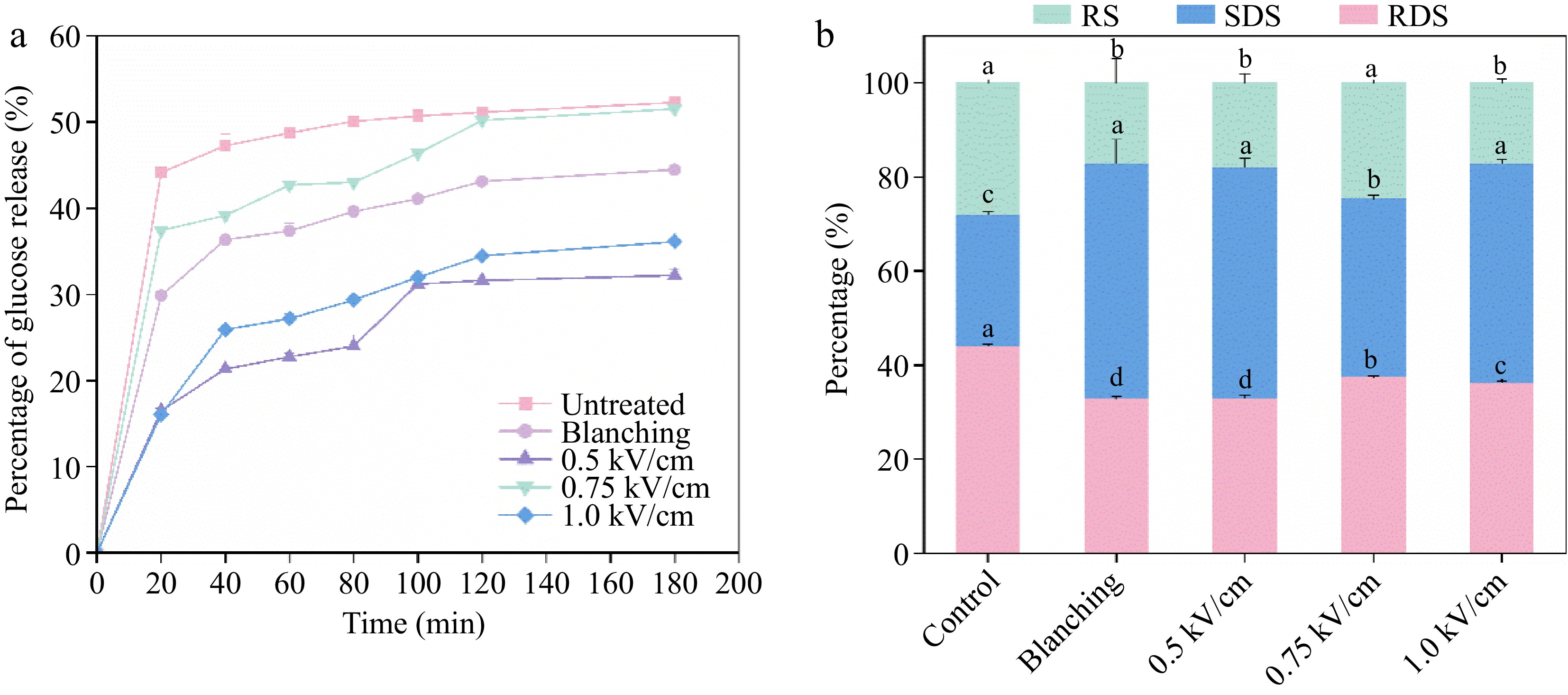
Figure 1.
Effects of PEF and blanching pretreatment on the digestibility of air-fried French fries. Values within the same column marked with distinct letters differ significantly (p < 0.05).
In the untreated air-fried French fries, the contents of RDS, SDS, and RS were 44.15%, 27.84%, and 28.02%, respectively. The proportion of RS was higher than that in the blanching group and the PEF-treated group. This high RS level is likely due to insufficient starch gelatinization within the dense, raw-like core, which physically impeded enzyme access, as supported by the compact microstructure seen in the SEM images (Fig. 2a)[19]. However, it is crucial to note that this high RS content is coupled with an extremely hard and unpalatable texture (Table 1), rendering the product sensorially unacceptable and commercially unviable.
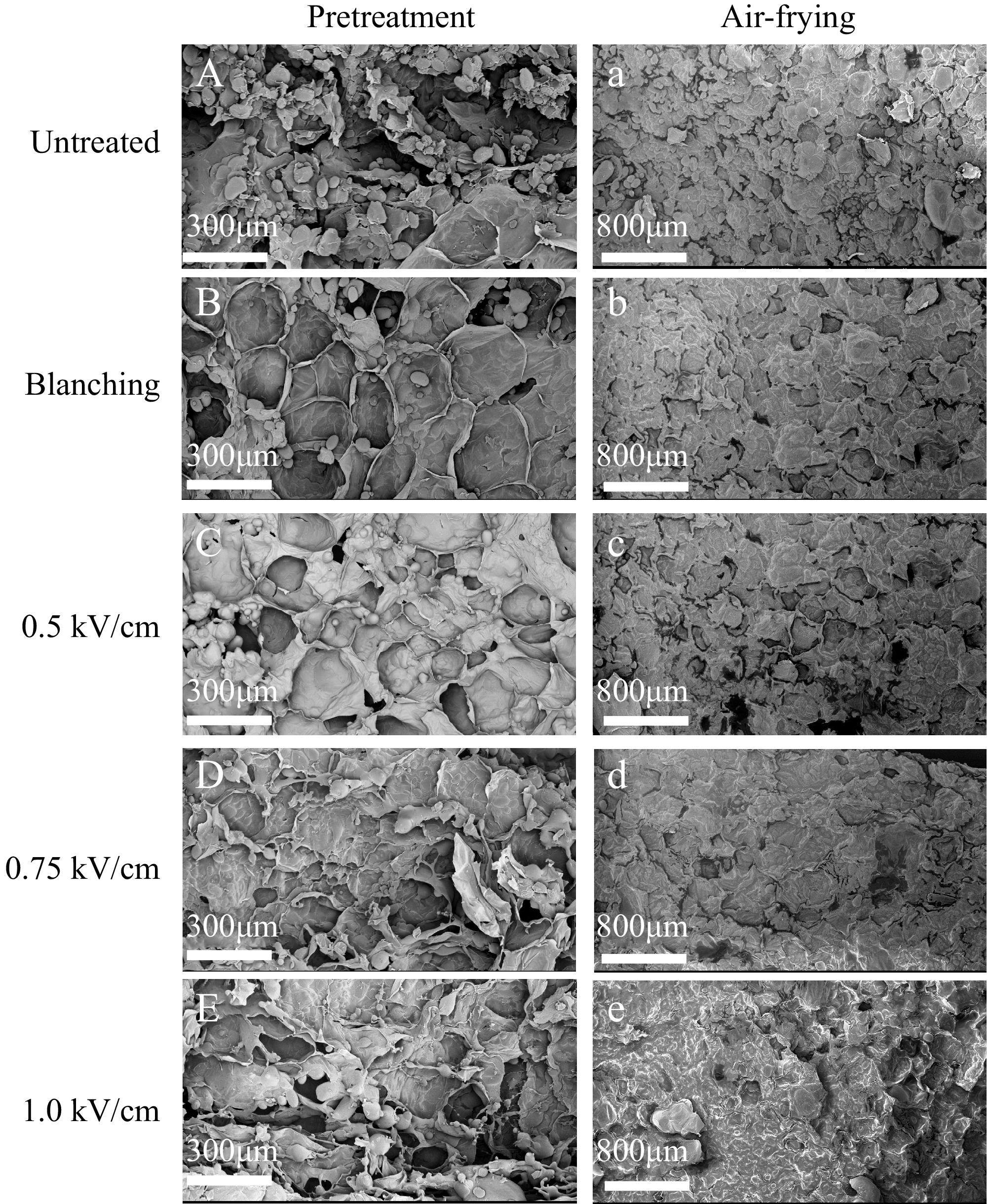
Figure 2.
Effects of PEF and blanching pretreatment on the microstructure of the fresh potato strips and air-fried French fries. (a–e) Fresh potato strips after pretreatment: (a) control, (b) blanching, (c) 0.5 kV/cm, (d) 0.75 kV/cm, (e) 1.0 kV/cm. (A–E) Air-fried French fries after the air-frying process: (A) control, (B) blanching, (C) 0.5 kV/cm, (D) 0.75 kV/cm, (E) 1.0 kV/cm. The images of a–e and A–E were taken at 500x and 270x magnification, respectively.
Table 1. Effects of PEF and blanching pretreatment on the texture, crystallinity, and short-range molecular order of air-fried French fries.
Methods Hardness (g) Springiness (mm) Chewiness (g) Cohesiveness Xc (%) R1,047/1,022 Control 4979.87 ± 812.03ab 0.48 ± 0.03c 659.20 ± 74.92c 0.285 ± 0.00c 22.03 0.84 Blanching 3804.61 ± 296.02bc 0.39 ± 0.04d 305.33 ± 77.57c 0.246 ± 0.00c 10.25 0.98 0.5 kV/cm 3232.34 ± 629.81bc 0.68 ± 0.07a 1053.81 ± 279.83b 0.140 ± 0.04b 17.04 1.05 0.75 kV/cm 4895.38 ± 728.83ab 0.67 ± 0.03a 655.64 ± 139.86c 0.142 ± 0.00c 14.58 1.07 1.0 kV/cm 5026.26 ± 386.43a 0.57 ± 0.03b 343.53 ± 41.93a 0.122 ± 0.42a 14.88 0.95 Xc: the relative crystallinity of the sample; R1047/1022 represents the short-range ordered structure. Different lowercase letters (a, b, c) within the same column indicate significant differences (p < 0.05) among treatments. After blanching pretreatment, the content of RDS in the French fries significantly decreased to 32.84%, while the content of SDS substantially increased to 49.93%. During the blanching process, the potato strips were immersed in an excess of hot water, and heat was rapidly transferred to the interior, resulting in a high degree of starch gelatinization[20]. During the air-frying process, a shell-like structure was rapidly formed on the surface layer of the starch. This structure likely hindered the contact and reaction between enzymes and starch, thus promoting the conversion of RDS to SDS.
Upon treatment of potato strips with PEF at intensities of 0.5, 0.75, and 1 kV, the RDS contents were observed to be 32.97%, 37.44%, and 36.10%, respectively. The RDS contents were consistently lower than those of the control group but slightly higher than those of the blanching group. The SDS contents of the various PEF-treated groups ranged from 37.97% to 49.93%. Notably, the RS content in the PEF-treated groups was generally higher than that in the blanching group, exhibiting a trend of initial increase followed by a gradual decrease with the increment of PEF intensity.
Under the treatment condition of 0.75 kV/cm, the RS content reached its peak at 24.59%, significantly higher than that of other PEF treatment groups and the blanching group. This may be attributed to the enhanced electroporation effect of the PEF as the field strength increases, which further reduced the moisture content of the fresh potato chips. Subsequently, in the low-moisture, high-temperature environment of the air fryer, the thermal motion of starch molecule chains experienced a substantial reduction in interference from surrounding water molecules, thereby increasing the opportunities for intermolecular collisions and close approaches, favorable for the formation of double-helix structures[21]. Singh et al.[22] also observed that a lower moisture content could enhance the RS content in French fries. Meanwhile, the lipids present during processing can form amylose–lipid complexes (Type RS5) with amylose[23,24]. These complexes, similarly resistant to enzymatic hydrolysis, are capable of further elevating the total RS content.
Furthermore, PEF pretreatment results in a loose tissue structure of potatoes, which accelerates the migration of steam to the surface and the evaporation of surface moisture when exposed to high cooking temperatures. The rapid dehydration effect of this process expedites the formation of a crust, thereby hindering the contact between digestive enzymes and starch[25]. Compared to lower field intensities, at a higher electric field intensity of 1.0 kV/cm, the disruption of potato tissue intensifies, increasing the accessible surface area for enzymes to interact with starch, resulting in a slight decrease in RS content. The results indicate that potato strips prepared through PEF-assisted air-frying exhibit a higher content of RS compared to those subjected to blanching pretreatment. However, it must be pointed out that, in this study, we used an in vitro small-intestine digestion model, which may not fully reproduce the complex physiological conditions of the entire human digestive tract. Future studies incorporating dynamic gastrointestinal simulations will provide a more comprehensive understanding of the digestion of samples.
Effects of pretreatment on the texture of air-fried French fries
-
Table 1 shows the differential impacts of PEF and blanching pretreatment on the crucial texture parameters (including hardness, springiness, and chewiness) of air-fried French fries. The control group exhibited a hardness of 4,979.87 g, a direct reflection of its dense and compact tissue structure with ungelatinized starch granules, as observed in the SEM images (Fig. 2a). However, blanching pretreatment significantly reduced this metric, indicating its pronounced softening effect on the texture of the air-fried French fries. Through the application of thermal energy, blanching pretreatment caused alterations in the structures of hemicellulose and pectin, specifically manifested as the breaking of galacturonic acid chains and the degradation of cell wall components, thereby weakening the mechanical strength and adhesion between cells[26,27].
At a low intensity of 0.5 kV/cm, the hardness was 3,232.34 g, which was lower than that after the blanching pretreatment. This softening is a direct result of the PEF-induced electroporation, which created a more porous and less rigid cellular network, as seen in Fig. 2c, facilitating easier deformation under compression. However, extending the PEF treatment from 0.75 to 1.0 kV/cm led to a hardness rebound, increasing from 4,895.38 to 5,026.26 g. This increase in hardness was primarily attributed to the damage caused to the fibrous structure, pectin, and starch components of the fries by the high-intensity PEF treatment, leading to a much faster rate of surface water evaporation during the initial stages of air-frying. This rapid dehydration resulted in the formation of a thicker, denser, and more rigid crust compared to the lower-intensity treatments. Additionally, it facilitated protein denaturation, starch gelatinization, and heat transfer between the material and the oil, ultimately contributing to the formation of a crispy crust on the food[27,28].
Compared with control and blanching pretreatment, PEF pretreatment resulted in air-fried French fries with better springiness. This enhancement can primarily be attributed to the non-thermal properties of PEF and its uniform treatment effect, which effectively mitigates the negative impact on springiness caused by undesirable changes such as starch gelatinization and pectin degradation that occur during the blanching process. Chewiness describes the effort required to chew solid food until it is ready for swallowing, reflecting the overall resistance of air-fried French fries to chewing. Compared to the control group (659.20 g), the blanching treatment resulted in a chewiness value of 305.22 g. When PEF pretreatment was applied at 0.5, 0.75, and 1.0 kV/cm, the resulting chewiness values were 1,053.81, 655.64, and 343.53 g. Under a low electric field intensity of 0.5 kV/cm, the chewiness value was significantly higher. This phenomenon can be attributed to the fact that a low electric field intensity causes minimal disruption to potato's cell walls, resulting in less pronounced starch gelatinization and pectin degradation. The non-excessively gelatinized starch and intact pectin networks preserve the structural compactness of potato strips, thereby enhancing the resistance perceived during mastication.
PEF pretreatment also resulted in better springiness compared with blanching. This seemingly counterintuitive result, despite the low hardness, is explained by the substantially higher springiness and cohesiveness of this sample (Table 1). Chewiness is a product of these parameters. Because of the enhanced elasticity and structural integrity, although the initial compression is soft, the food matrix is resilient and requires more energy to fully masticate, a characteristic often associated with a desirable food texture[29]. In contrast, a high electric field intensity of 1.0 kV/cm caused severe disruption to the internal structure of starch molecules. During mastication, the weakened structural integrity requires minimal force for rupture, resulting in a significant reduction in chewiness[30]. In this study, an optimal PEF intensity of 0.5 kV/cm could yield products with a similar texture to that of classic fries.
Effects of pretreatment on the color values of air-fried French fries
-
Color is a crucial attribute in the sensory evaluation of food, significantly influencing consumer acceptance and preference[31]. The color parameters and appearance of potato strips after blanching or PEF pretreatment are presented in Table 2. The L* value quantifies the perceived lightness of a color, while a higher L* value indicates greater brightness of the sample. Both blanching and PEF pretreatment reduced the L* value of the potato strips. The L value of the potato strips first increased and then decreased slightly with increasing PEF pretreatment intensity, whereas the potato strips pretreated with PEF for 0.75 kV/cm exhibited a higher brightness (L* value: 61.84) than other PEF pretreatments, indicating that moderate PEF pretreatment may help maintain the brightness of the fries.
Table 2. Effects of PEF and blanching pretreatment on the color parameters of air-fried French fries.
Methods L* a* b* ΔE Samples Control 67.64 ±
4.05a−0.70 ±
0.21b23.00 ±
2.96a/ 
Blanching 66.50 ±
1.08a−0.03 ±
0.24a18.71 ±
1.49b4.49 ±
3.34a
0.5 kV/cm 58.38 ±
0.80b−1.78 ±
0.22c12.02 ±
2.10c14.40 ±
3.81c
0.75 kV/cm 61.84 ±
0.65b−1.82 ±
0.12c7.17 ±
0.42d16.90 ±
3.13d
1.0 kV/cm 58.85 ±
0.76b−1.81 ±
0.11c13.47 ±
0.46c13.01 ±
3.55b
Different lowercase letters (a, b, c) within the same column indicate significant differences (p < 0.05) among treatments. In comparison to the control and blanching pretreatment, the French fries obtained through PEF pretreatment demonstrated lower a* and b* values. Previous research has indicated that an increase in the a* value is closely linked to a higher concentration of acrylamide[32]. Additionally, our research findings reveal that PEF treatment is effective in reducing the acrylamide content in French fries, as illustrated in Supplementary Fig. S1. Certain food ingredients, such as asparagine and reducing sugars, are implicated in the formation of acrylamide during heat treatment at temperatures above 120 °C as a byproduct of the Maillard reaction[33]. PEF pretreatment triggers electroporation-mediated enhancement of cellular membrane permeability. The resulting structural change increases cell membrane permeability, facilitating the leaching of asparagine and reducing sugars, which are the primary precursors for acrylamide synthesis. Consequently, the reduced concentration of these precursors in the frying environment leads to decreased acrylamide formation via Maillard reaction mechanisms.
The total color difference (ΔE) quantifies the overall perceptual color difference between a sample and the reference (control). A smaller ΔE value indicates a similar appearance to the control. As shown in Table 2, the blanching treatment yielded the lowest ΔE value (4.49), indicating that its color was most similar to that of the control group. Compared with the blanching group, all the PEF treatment groups exhibited higher ΔE values. This was primarily attributed to the significant reductions in both lightness (L*) and yellowness (b*) after PEF treatment, which could be ascribed to the fact that PEF treatment facilitated the leaching of Maillard reaction precursors, thereby inhibiting the formation of a golden-yellow hue[34]. Among the PEF groups, the ΔE value peaked at 16.90 when the PEF intensity was 0.75 kV/cm, indicating the strongest inhibitory effect on color formation at this intensity.
Effects of pretreatment on the microstructure of fresh potato strips and air-fried French fries
-
The SEM images of cross sections of fresh potato strips and air-fried French fries with different pretreatments are shown in Fig. 2. The fresh potato strips showed intact cells with distinct spherical starch granules (Fig. 2a). After blanching, the spherical starch granules disappeared, indicating that the starch granules had undergone gelatinization (Fig. 2b). Following the PEF pretreatment, a small number of spherical starch granules remained, but the potato tissue structure underwent significant disruption, marked by the appearance of pores and fragments within the previously dense tissue (Fig. 2c, d). This structural characteristic significantly promotes rapid evaporation of moisture during air-frying, enhances the steam flow velocity, and subsequently minimizes oil penetration. Additionally, it aids in swiftly balancing the temperatures between the interior and exterior of the potato strips, thereby effectively reducing their raw and hard texture. This phenomenon can be attributed to the mechanical effects of the PEF, which transfers energy directly to the sample, causing rapid compression and expansion of the tissue structure, thereby inducing cell collapse and an increase in porosity[15,35]. Furthermore, as the PEF treatment intensity increased, the extent of tissue disruption intensified (Fig. 2e). This resulted in cell collapse and increased porosity, which subsequently accelerated the starch gelatinization rate during the subsequent air-frying process.
After air-frying, the cross sections of the control sample exhibited large areas of blocky structures with compact tissue and the presence of a few ungelatinized raw starch granules (Fig. 2a). This structure might result in higher hardness and a relatively tough texture, consistent with the texture analysis data obtained. After blanching, the microstructure of the potato strips exhibited pores, albeit with uneven pore distribution (Fig. 2b). This may be attributed to the fact that during the process of air-frying, the cell structure inside the food undergoes contraction, and the contraction pattern exhibits an irregular state. As water continuously evaporates, pores gradually form within the potato strips[36]. After PEF pretreatment, the microstructure of potato strips transformed into a large aggregate form (Fig. 2c–e). This can be explained by the fact that the internal structure of French fries is replete with numerous starch granules that have lost their original intact structure. This indicates that the starch within the French fries has rapidly undergone gelatinization, deformation, and compression, coalescing into a uniform and consolidated mass that occupies the entire intracellular space[37]. This phenomenon suggests that starch gelatinization is accelerated by PEF pretreatment.
Effects of pretreatment on the crystallinity of the air-fried French fries
-
Starch crystallinity serves as a crucial indicator reflecting the degree of ordered structure within starch granules. As shown in Fig. 3a, the crystallinity of the air-fried French fries without pretreatment was 22.03%. After blanching, it decreased to 10.25%. This significant change indicates that blanching treatment led to extensive unwinding of the double-helix structures within the starch granules, with ordered crystalline regions transforming into amorphous regions. Under the influence of high temperature, the starch molecule chains fully extended and underwent gelatinization. The substantial decrease in crystallinity was closely related to the significant increase in the SDS content of blanching pretreatment samples. Although the high degree of starch gelatinization initially enhanced enzymatic susceptibility, the dense gel network structure formed during the subsequent air-frying process restricted the diffusion and penetration of digestive enzymes, thereby reducing the enzymatic hydrolysis rate of starch.
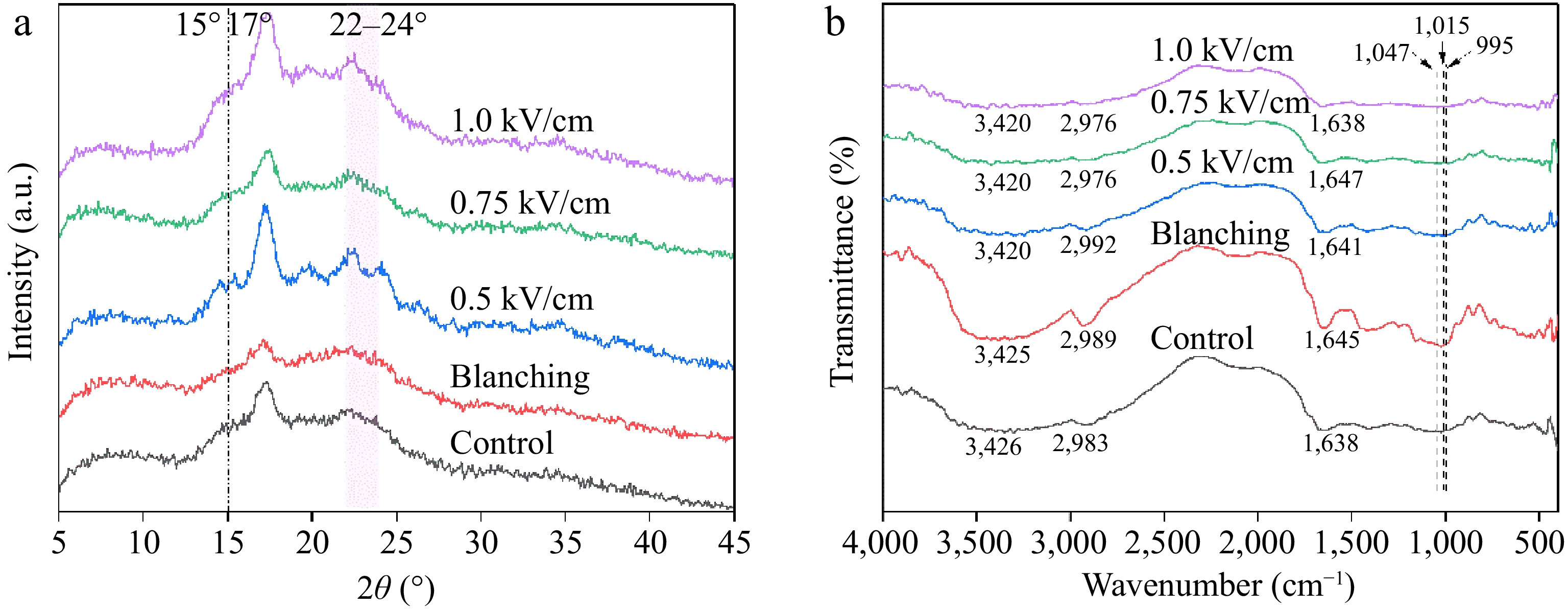
Figure 3.
Effects of PEF and blanching pretreatment on the X-ray diffraction (XRD) patterns of the air-fried French fries (a) and on the FTIR in the 4,000–400 cm-1 range of the air-fried French fries (b).
In contrast, the impact of PEF treatment on the starch crystalline structure was relatively mild. As the electric field strength increased from 0.5 to 1.0 kV/cm, the sample crystallinity gradually decreased from 17.04% to 14.58%. However, in all cases, the crystallinity values were higher than that of the blanching group. This moderate reduction in crystallinity was mainly attributed to the damage caused by the PEF electroporation effect on the cell wall structure, rather than PEF directly acting on the crystalline structure of the starch granules. Notably, during the pretreatment stage, PEF treatment significantly reduced the sample water content through the electroporation effect (MRI imaging results provided intuitive evidence for this). This created favorable microenvironmental conditions for the reorganization of starch molecule chains during the subsequent air-frying process. In a relatively low-moisture environment, the thermal motion constraints on starch molecule chains were reduced, and intermolecular interactions were enhanced, facilitating the formation of more stable double-helix structures and amylose–lipid complexes, which resulted in a higher crystallinity than that of the blanching group.
Effects of pretreatment on the FTIR of the air-fried French fries
-
The FTIR spectra of air-fried French fries with different pretreatments are presented in Fig. 3b. All samples exhibited broad absorption bands in the 3,000–3,700 cm–1 region, corresponding to O–H stretching vibrations and intermolecular hydrogen bonding interactions. Notably, blanched samples showed significantly increased peak width compared with untreated controls, which can be attributed to water molecule penetration into both amorphous regions and the crystalline structures of starch during thermal treatment. These water molecules formed hydrogen bonds with starch molecules, disrupting the original intermolecular hydrogen bonding network. In contrast, PEF-treated samples exhibited minimal changes in peak width relative to controls, indicating the limited impact of PEF on starch gelatinization.
FTIR spectroscopy enables the detection of short-range ordering in starch double-helix structures, wherein the absorbance at 1,047 cm−1 reflects crystalline region characteristics and that at 1,022 cm−1 corresponds to amorphous domains[38]. The intensity ratio (R1,047/1,022) provides a quantitative assessment of the short-range ordered structures formed by regular arrangement of adjacent starch chains. As shown in Table 1, control samples exhibited the lowest R1,047/1,022 value (0.84), indicating maximum structural disorder in surface starch, which was consistent with the highest RDS content observed in this group[39]. Following blanching treatment, R1,047/1,022 increased to 0.98, which can be explained by the partial starch gelatinization leading to molecular chain unfolding, followed by rapid dehydration during air-frying that reduced the intermolecular distances, promoting enhanced intermolecular interactions and the formation of more compact, ordered structures.
At moderate field strengths (0.5 and 0.75 kV/cm), R1,047/1,022 values exceeded those of both control and blanching groups, indicating enhanced short-range molecular ordering in air-fried potato strips. This enhancement likely resulted from the PEF-induced ordered rearrangement of starch molecular chains, forming regular ordered domains that showed increased resistance to enzymatic digestion and favored RS formation[40]. However, when the field strength increased to 1.0 kV/cm, R1,047/1,022 values showed a slight decline, possibly due to structural disruption of starch's ordered regions under excessive electric field intensity. The present findings demonstrate that structural modifications induced by different pretreatments directly influence the digestibility characteristics of air-fried potato products.
Effects of pretreatment on the water distribution distribution
-
MRI was used to determine the moisture distribution within samples. In MRI images, a redder color indicates a higher content of hydrogen protons in the sample, which also signifies a higher moisture content[41,42]. A shift towards yellow-green colors indicates a reduction in moisture[42].
As illustrated in Fig. 4, both the untreated and blanched fresh potato strips exhibited extensive red regions, suggesting that their internal cellular structures remained intact with high moisture content. In contrast, as the field strength of the PEF treatment gradually increased, the moisture signal intensity (red regions) in the fresh potato strips significantly decreased and the red regions were gradually replaced by yellow regions. This indicates that short-duration PEF treatment disrupted the cellular structure of the potato strips, promoting the outward migration and localized loss of internal moisture.
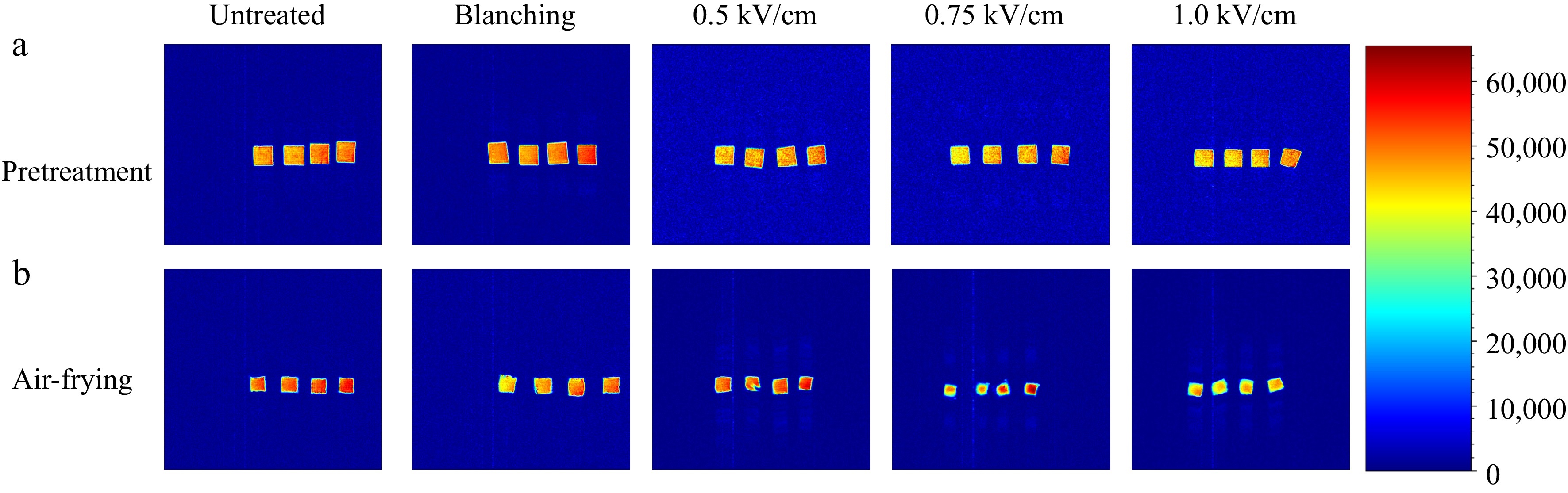
Figure 4.
Effects of PEF and blanching pretreatment on the water distribution of the potato strips and air-fried French fries. (a) Samples after pretreatment; (b) pretreated samples after air-frying.
After air-frying, the MRI hydrogen proton signals in the control group's potato strips showed little change compared with those before air-frying, indicating that their tissue structures were relatively dense and retained moisture well. This structure hindered the deep penetration of digestive enzymes, corresponding to a higher RS content. In contrast, the moisture signals in the blanched group significantly decreased after air-frying, suggesting severe damage to their cellular structures and substantial moisture evaporation.
At a PEF field strength of 0.5 kV/cm, the internal hydrogen proton signal intensity in the potato strips after air-frying was higher than that in the blanched group. It is speculated that under the surface electroporation induced by PEF, a crisp crust rapidly formed on the potato strip surface, effectively inhibiting excessive internal moisture loss. As the PEF intensity increased, the moisture signals gradually weakened. Particularly at a field strength of 1.0 kV/cm, the red regions significantly decreased and yellow-green regions increased, indicating that the strong electric field severely disrupted the tissue structure, leading to accelerated moisture loss and uneven distribution. With the significant loosening of the tissue, digestive enzymes could easily come into contact with more starch granules, resulting in a slight decrease in RS content.
Effects of pretreatment on the oil content of air-fried French fries
-
Figure 5 illustrates the influence of blanching pretreatment and PEF pretreatment on the oil content of air-fried French fries. During the air-frying process, oil is rapidly heated by the high-temperature hot air and subsequently transferred between the surface and interior of the fries through thermal convection[43].
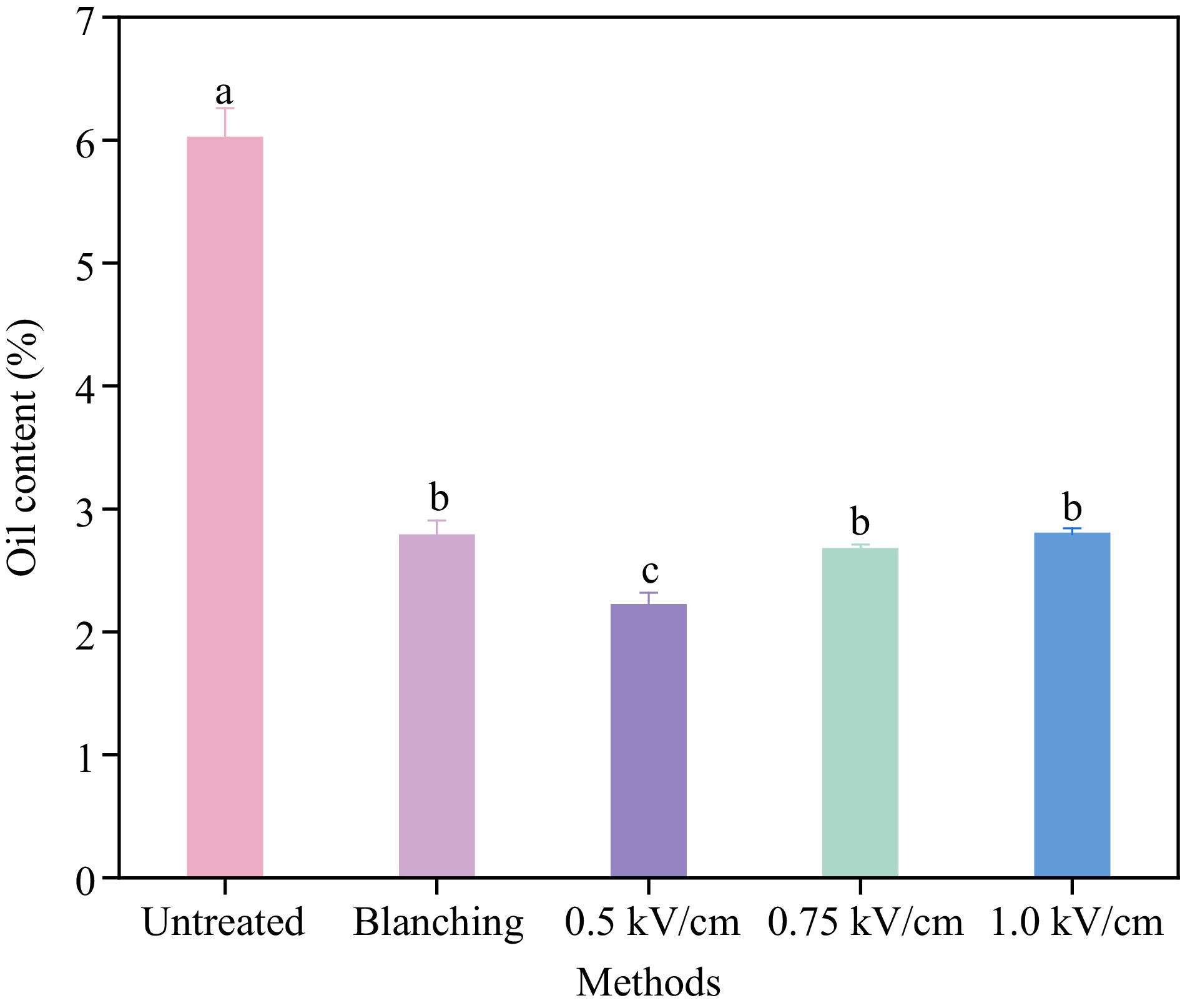
Figure 5.
Effects of PEF and blanching pretreatment on the oil content of the air-fried French fries. Values within the same column marked with distinct letters differ significantly (p < 0.05).
The experiments showed that the control group had the highest oil content, reaching up to 6.02%. This phenomenon was mainly attributed to the high surface moisture content and dense tissue structure of the raw French fries, which impeded the effective transfer of heat. As a result, some of the water could not be completely evaporated during the frying process[44]. The failure of water to evaporate in a timely manner subsequently affected the gelatinization of surface starch, making it difficult to form a dense "protective shell". This, in turn, provided channels for oil to penetrate into the interior of the French fries, leading to an increase in oil content.
Compared with raw French fries, blanching pretreatment could significantly reduce the oil content of air-fried French fries. The blanching heat damaged some of the cellular structures, promoting the release of outer-layer moisture and the pre-gelatinization of starch. This made it easier to form a dense shell during subsequent frying. This "shell" structure effectively blocked the penetration of oil into the interior, thereby reducing the oil content of the blanching-group French fries compared with that of the raw-fries group.
Although PEF pretreatment also effectively reduced the oil content of air-fried French fries, different effects were observed under different electric field intensities. When the PEF pretreatment intensity was 0.5 kV/cm, the oil content of the French fries dropped to the lowest level (2.22%), which was significantly lower than those of the control group and the blanching group. Relevant studies have shown that PEF treatment enhances the porosity of French fries and generates micro-cracks. This not only expands the interface for water evaporation but also shortens the evaporation path, enabling faster water volatilization[12,15]. Under conditions of relatively high steam intensity, it becomes more difficult for oil to penetrate into the interior. Meanwhile, rapid heat exchange accelerates the gelatinization and shell formation of surface starch, further enhancing the barrier effect against oil[12,15,28].
However, when the PEF treatment intensity was increased to 1.0 kV/cm, the oil content of the French fries increased slightly. The possible reason is that the excessively strong electric field further increased the number of pores and cracks in the microstructure of the French fries, resulting in an overly loose and fragile tissue. This, in turn, provided more pathways for oil penetration, leading to an increase in oil content. Nevertheless, on the whole, the oil content of the French fries in all PEF intensity treatment groups was lower than that of the untreated raw French fries, and the low-intensity PEF (0.5 kV/cm) treatment yielded the best results, outperforming the blanching pretreatment.
Effects of pretreatment on the TGA of potato strips
-
As can be observed from Fig. 6, the results of TGA reveal significant differences in the thermal degradation behaviors of French fries among the untreated group, blanching group, and PEF-treated group.
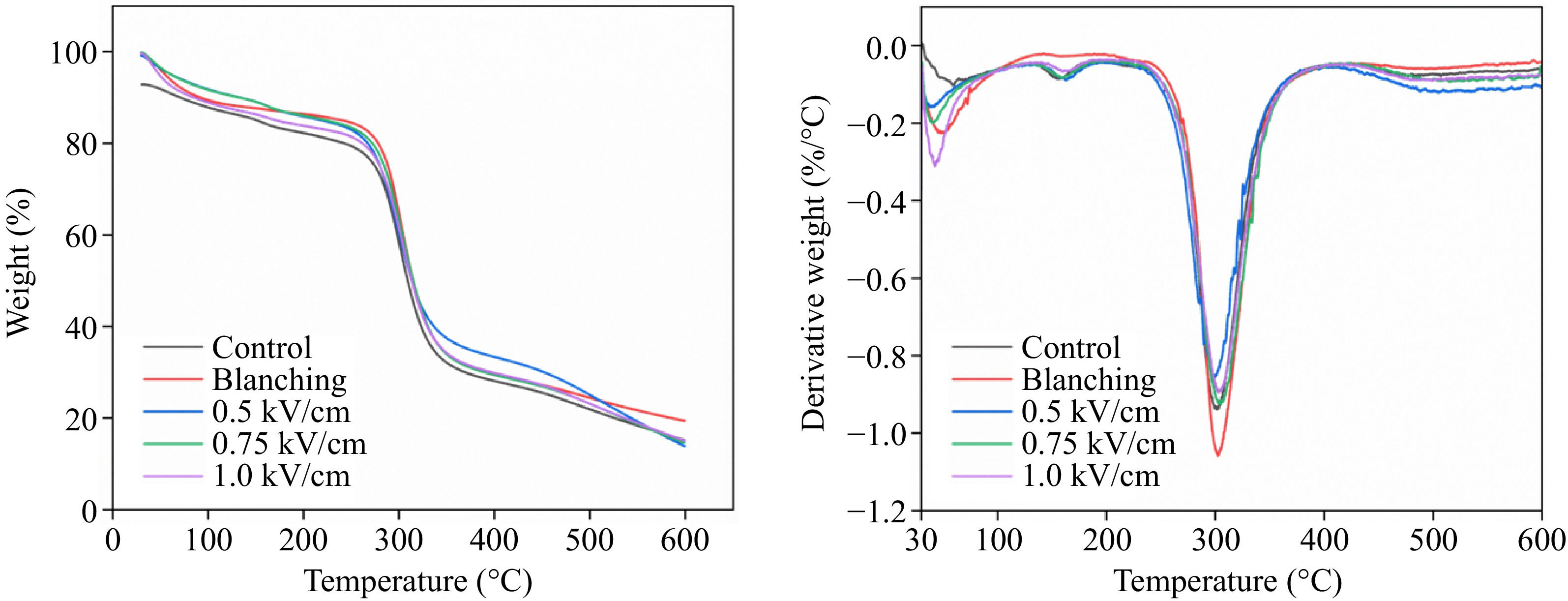
Figure 6.
Effects of PEF and blanching pretreatment on the TGA of the air-fried French fries.
During the first stage (from room temperature to 100 °C), the PEF-treated group demonstrates the highest water loss rate (ranging from 16.55% to 20.48%), which is notably higher than that of the untreated group (14.32%) and the blanching group (15.65%). This can be attributed to the electroporation effect induced by PEF, which disrupts the tissue structure of the French fries, creating a porous network that accelerates water migration and facilitates rapid exchange with hot air.
The second stage occurs between 250 and 350 °C. During this temperature rise, the molecular chains of starch undergo cleavage, representing the process of starch thermal decomposition.
The third stage emerges around 350 °C, primarily involving the carbonization of thermal decomposition residues. The untreated group has the lowest weight loss rate of 39.22%, likely due to its relatively low degree of starch gelatinization and dense texture, which endow it with high thermal stability. In contrast, the samples subjected to blanching treatment exhibit the highest weight loss rate of 50.65%, mainly because high-temperature blanching causes the cleavage of starch molecular chains and structural loosening, resulting in a significant reduction in thermal stability. Under PEF treatment conditions of 0.5, 0.75, and 1.0 kV/cm, the weight loss rates of the French fries are 46.16%, 50.49%, and 46.32%, respectively, which are higher than those of the untreated group but lower than those of the blanching group. This indicates that although PEF treatment causes less damage to the starch structure compared to blanching treatment, the porous structure formed through electroporation still promotes thermal degradation.
The TGA results show that both blanching and PEF treatments accelerate the thermal degradation process of French fries, which, to a certain extent, facilitates their cooking. This process not only shortens the cooking time but also accelerates the formation of the crust, making the French fries easier to cook. Additionally, it expedites crust formation during the air-frying process, thereby restricting the contact between digestive enzymes and starch and increasing the RS content.
-
This study demonstrates that PEF pretreatment is a viable and advantageous alternative to conventional blanching for producing higher-quality air-fried French fries. PEF pretreatment significantly improved texture, reducing hardness compared with untreated samples and yielding a desirable soft texture. PEF induced a porous microstructure that enhanced heat and mass transfer, facilitating the formation of a surface crust that served as a physical barrier to delay enzyme diffusion. Most notably, PEF pretreatment of 0.75 kV/cm led to a significant increase in RS content (up to 24.59%) compared with that of blanching (17.23%). Thus, this work provides a strong theoretical and technical foundation for applying PEF technology to develop healthier fried foods, as it can not only improve the texture but also reduce the starch digestibility simultaneously.
This work was supported by the Basic and Applied Basic Research Foundation of Guangdong Province (2024A1515110137), National Key Research and Development Program of China (2023YFD2101000), the Key Laboratory Project of Guangdong Province (Grant no. 2022B1212010015), and Basic Research Foundation of Guangdong Province (Grant no. 2023A1515011534).
-
The authors confirm their contributions to this study as follows: conceptualization, methodology, validation, investigation, data curation, visualization, writing – original draft, writing – review and editing: Chen B; methodology, formal analysis, writing – review and editing: Luo S; methodology: Wang L, Huang Y, Ma C; formal analysis: Xiao Y; writing – review and editing: Zheng Z, Ji T; funding acquisition, supervision, writing – review and editing: Zeng X; supervision, writing – review and editing: Li J. All authors reviewed the results and approved the final version of the manuscript.
-
All data generated or analyzed during this study are included in this published article.
-
The authors confirm that they have no conflicts of interest with respect to the study described in this manuscript.
-
accompanies this paper online at: https://doi.org/10.48130/fia-0026-0026.
-
Authors contributed equally: Boru Chen, Shiyin Luo
- Supplementary Fig. S1 Effects of PEF and blanching pretreatment on acrylamide content in French fries.
- Copyright: © 2026 by the author(s). Published by Maximum Academic Press on behalf of China Agricultural University, Zhejiang University and Shenyang Agricultural University. This article is an open access article distributed under Creative Commons Attribution License (CC BY 4.0), visit https://creativecommons.org/licenses/by/4.0/.
-
About this article
Cite this article
Chen B, Luo S, Wang L, Huang Y, , et al. 2026. Understanding how pulsed electric field pretreatment affects microstructural changes and starch digestibility in air-fried French fries. Food Innovation and Advances 5(3): 372−381 doi: 10.48130/fia-0026-0026 

Understanding how pulsed electric field pretreatment affects microstructural changes and starch digestibility in air-fried French fries
- Received: 03 September 2025
- Revised: 30 November 2025
- Accepted: 22 December 2025
- Published online: 30 July 2026
Abstract: Direct air-frying of raw potato strips usually leads to an undesirably hard texture and poor sensory qualities. Although blanching pretreatment improves the texture, it increases starch digestibility and requires excessive processing time and energy consumption. In this study, we evaluated the potential of pretreatment with a pulsed electric field (PEF) as an alternative for enhancing the quality of air-fried French fries. Scanning electron microscopy revealed that PEF created a porous matrix structure, enhancing water evaporation and heat transfer during air-frying. Compared with untreated samples, PEF pretreatment at 0.5 kV/cm significantly reduced the hardness from 4,979.87 to 3,232.34 g, yielding a softer texture. Notably, compared with thermal blanching, PEF pretreatment significantly increased the resistant starch (RS) content from 17.23% to 24.59%, indicating reduced starch digestibility. Fourier transform infrared spectroscopy and X-ray diffraction analyses confirmed that PEF caused less damage to short- and long-range structures than blanching, thereby enhancing their resistance to enzymatic hydrolysis. This study provides the theoretical foundation and technical guidance for applying PEF technology to develop fried foods with healthier profiles and optimal textural properties.
-
Key words:
- Pulsed electric field (PEF) /
- Air-fried /
- French fries /
- Digestibility