












-
Modern broiler production must deliver rapid growth and low production costs while meeting expectations for food safety, welfare, and reduced antimicrobial use. Restrictions on antibiotic growth promoters (AGPs) have increased the incidence and economic impact of dysbiosis-associated conditions, particularly when birds face high stocking density, heat stress, mycotoxins, or enteric pathogens. In response, broiler nutrition increasingly relies on additive 'toolboxes' (organic acids, enzymes, probiotics, prebiotics, minerals, and phytogenics) aimed at stabilizing the gut ecosystem and limiting inflammation-driven nutrient diversion[1−4].
Within the phytogenic landscape, Allium species occupy a distinctive position because their bioactive chemistry is both potent and relatively well characterized. Garlic (A. sativum) and onion (A. cepa) contain organosulfur compounds (OSCs) derived from cysteine sulfoxides, as well as polyphenols (e.g., quercetin derivatives), saponins, and fructans/fructo-oligosaccharides. These constituents are repeatedly linked to antimicrobial activity, redox modulation, and immune tuning in experimental systems. The related peer-reviewed research emphasizes that this 'multicompound' character can be advantageous for resilience but also creates variability because the relative abundance of these compounds is sensitive to the cultivar, agronomy, and processing. A decade-focused synthesis of phytogenic feed additives further supports the role of Allium-derived metabolites as natural antibiotic alternatives and identifies fermentation and encapsulation as key technologies for stabilizing and delivering these compounds[5].
Despite plausible mechanisms, in vivo outcomes are not always consistent. Reactive sulfur metabolites can be lost during drying or pelleting, and high inclusion rates may reduce palatability. Recent studies agree on probiotic fermentation as a practical strategy to enhance the functional reliability of Allium-based additives. Fermentation can reduce pungency, increase soluble phenolics through enzymatic deglycosylation, partially hydrolyze fructans into more fermentable oligosaccharides, and generate microbial metabolites (organic acids, peptides) that synergize with plant constituents[6−12].
This review integrates evidence from peer-reviewed literature on (i) Allium as antibiotic substitutes, (ii) probiotic fermentation mechanisms, and (iii) applications in broilers, together with updated peer-reviewed studies. We synthesize the major bioactive classes, the key fermentation-driven transformations, the mechanistic pathways relevant to broiler productivity and gut health, and practical considerations for product design and evaluation.
-
This article is a structured narrative review rather than a formal systematic review. PubMed, Web of Science, Scopus, and Google Scholar were searched for English-language literature published from 2000−2025 using combinations of Allium, garlic, onion, shallot, leek, fermented garlic, probiotic fermentation, lactic acid bacteria, Bacillus, yeast, broiler, poultry, feed conversion ratio, gut microbiota, intestinal morphology, oxidative stress, immune, necrotic enteritis, and coccidiosis. Primary in vivo broiler studies were prioritized when product identity, processing/fermentation, dose, and outcome data were sufficiently described; mechanistic in vitro studies and reviews were used for biological context. Because products, study designs, and endpoints were heterogeneous, no meta-analysis, PRISMA flow, or formal risk-of-bias score was undertaken. Evidence was synthesized at study level by product type, challenge context, dose, and outcome. Studies from the authors' group are identified as author-group evidence and are not treated as independent replication.
Inclusion and exclusion criteria. We prioritized peer-reviewed journal articles reporting in vivo outcomes in broilers (performance, gut health, immunity, oxidative status, carcass/meat quality) with a clear description of the Allium source, processing methods (raw, aged, extract, fermented, encapsulated), and dose. Mechanistic in vitro studies were used to support hypotheses but were not treated as evidence of efficacy. Studies in other poultry or livestock species were included when they clarified the fermentation chemistry or safety constraints.
Data extraction and synthesis. We extracted qualitative descriptors of the products' chemistry, fermentation parameters (starter cultures, time, temperature, moisture, pH), and the outcomes' directionality. Because study designs and reporting were heterogeneous, the results are synthesized by mechanism and outcome domain rather than pooled quantitatively. Where possible, we highlight contexts in which effects are most consistently reported (e.g., under pathogen challenge or heat stress).
-
The review on Allium highlights that Allium matrices combine several bioactive families whose abundance depends on the species, plant part, maturity, and processing. For poultry nutrition, four groups are most relevant: OSCs, polyphenols, saponins, and fructans/fructo-oligosaccharides (FOSs).
OSCs. OSCs originate from S-alk(en)yl-L-cysteine sulfoxides that are rapidly converted by alliinase when the plant tissue is disrupted, producing thiosulfinates (e.g., allicin) and downstream sulfides and thiosulfonates. In feed, OSCs' reactivity is a double-edged sword: it contributes to antimicrobial potency but also makes the profile unstable during processing and storage. Fermentation/aging and encapsulation are therefore often used to shift the profile toward more stable metabolites while preserving biological activity[7,13−22].
Polyphenols. Onion and shallot are notable sources of quercetin conjugates and other flavonoids. Polyphenols contribute to radical scavenging, the modulation of inflammatory pathways, and improved oxidative stability in meat. Many phenolics are glycosylated in raw plant matrices; microbial beta-glucosidases can release aglycones during fermentation, potentially increasing bioaccessibility and potency[23−28].
Saponins. Steroidal saponins reported in several Allium taxa may contribute to antimicrobial and immunomodulatory effects and may influence lipid metabolism through interactions with bile acids. Their net effect is dose- and matrix-dependent. Fermentation can modify saponin profiles through partial hydrolysis or deglycosylation, but the evidence base remains limited[29−32].
Fructans and FOSs. Many Allium species store carbohydrates as fructans and contain FOSs that can function as prebiotics. These carbohydrates may support beneficial microbiota and short-chain fatty acid production, improving barrier function and immune tone. Fermentation can partially hydrolyze high-molecular-weight fructans into shorter-chain oligosaccharides that are more readily fermented by commensals in the lower gut[10−12].
Because these bioactive classes coexist and interact, Allium products behave as complex matrices rather than single-entity additives. Marker-based characterization (targeting OSC metabolites, total phenolics, and fructan profiles) is therefore essential to improve reproducibility across studies and commercial batches[33,34]. The principal reported poultry effects associated with these bioactive classes are summarized in Table 1.
Table 1. Summary of the reported effects of Allium-based additives in poultry and their associated bioactive classes.
Animal/model Allium source and form Dominant bioactive Main reported effects Ref. Broiler Garlic powder/extract OSCs; phenolics ↓ Enteric pathogens; ↑ antioxidant enzymes; variable BW/FCR [1−4,7,23−26] Broiler Onion/shallot powder Quercetin; fructans ↑ Microbiota diversity; potential ↓ serum lipids; modest performance gains [1,35−42] Broiler Allium hookeri root OSCs; saponins ↑ Tight junction markers; ↓ inflammatory response under LPS/NE models [27−29,43−45] Layers/quail Allium mixtures Mixed Improved egg quality; antioxidative status; microbial modulation [1,5,46] Challenge models Encapsulated PTSO/PTSO2 Thiosulfonates Reduced lesions and pathogen load; improved gut integrity [30−32] Processing and probiotic fermentation: rationale and expected transformations
-
Figure 1 summarizes the retained processing-to-product workflow; it is a conceptual schematic rather than quantitative evidence. Processing strongly influences the efficacy of Allium additives. Drying and milling improve storage and dosing but can reduce reactive sulfur metabolites. Extraction can concentrate certain fractions but may remove fibers and alter the synergy among the compounds. Reviews devoted to fermentation argue that probiotic fermentation offers a scalable compromise: it preserves the matrix's complexity while improving palatability and increasing bioaccessible metabolites.
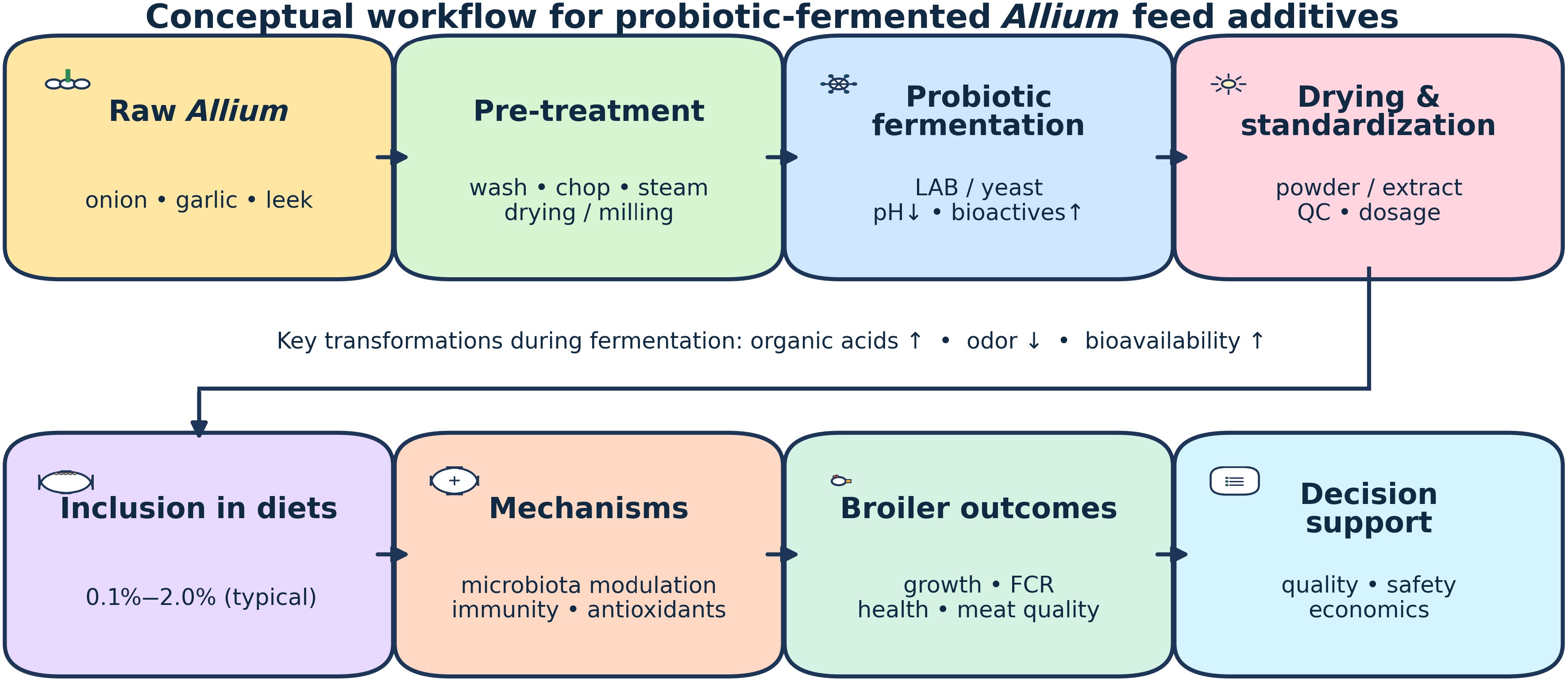
Figure 1.
Conceptual workflow for producing probiotic-fermented Allium feed additives. The diagram summarizes typical processing steps and key biochemical transformations reported for probiotic fermentation of Allium matrices.
Starter cultures and fermentation formats. Common starters include lactic acid bacteria (Lactiplantibacillus/Lacticaseibacillus spp., Pediococcus spp.), Bacillus spp., and yeasts. Solid-state fermentation (SSF) and submerged fermentation (SMF) differ in their moisture, oxygen transfer, and metabolite profiles; SSF is often feed-compatible and cost-effective, whereas SMF allows tighter control of the pH and temperature. The selection should be guided by the target outcomes (e.g., maximizing phenolic release vs maximizing organic acid production) and by the downstream processing constraints.
Enzymatic mechanisms. Microbial enzymes drive transformation: Beta-glucosidases deglycosylate flavonoids; esterases hydrolyze phenolic esters, proteases and lipases modify the matrix and release small peptides and lipids, and acidification changes the extraction kinetics. These processes can increase soluble phenolics and antioxidant capacity. In parallel, fermentation generates organic acids and bacteriocin-like substances that can complement Allium's inherent antimicrobial activity[7,47,35−38].
Biotransformation and stabilization. Fermentation can reduce pungency by transforming volatile sulfur metabolites and can increase stable sulfur compounds (e.g., S-allyl cysteine in aged/black garlic-type processing). For onion and shallot, fermentation-driven release of quercetin aglycone may increase biological activity. These processes are promising but remain undercharacterized in feed-grade manufacturing; standard analytical panels are needed to link fermentation parameters to chemical endpoints. Representative fermentation formats, operating conditions, and reported compositional changes are summarized in Table 2.
Table 2. Typical effects of probiotic fermentation on Allium matrices.
Allium substrate Starter culture Format Indicative conditions Reported compositional shifts Functional implication Garlic/black garlic LAB and/or yeast SSF/SMF 24–72 h; pH ↓ ↑ Water-soluble sulfur metabolites;
↑ antioxidant capacityImproved stability and redox effects Onion/shallot Lactiplantibacillus spp. SMF 30–37 °C; 24–48 h ↑ Free phenolics (deglycosylation);
↓ pungencyHigher bio-accessibility; better palatability Allium hookeri root LAB or Bacillus SSF Moist substrate; 2–5 d Altered OSC/saponin profile;
↑ organic acidsBarrier protection under challenge Mixed herbs including Allium Bacillus + LAB SSF 1–3 d; aeration ↓ Antinutritional factors;
↑ enzyme activitiesPotential synergy with digestibility Mechanisms of action in broilers
-
The interactions among antimicrobial, redox, barrier, microbiota, and immune pathways are synthesized concptually in Fig. 2. Mechanistic interpretations in the wider literature converge on a network of interacting pathways, Antimicrobial effects and pathogen control, redox and inflammatory modulation, gut barrier maintenance, microbiota-mediated metabolite shifts, and indirect effects on nutrient utilization. These mechanisms are not mutually exclusive and likely operate together as a systemic response.
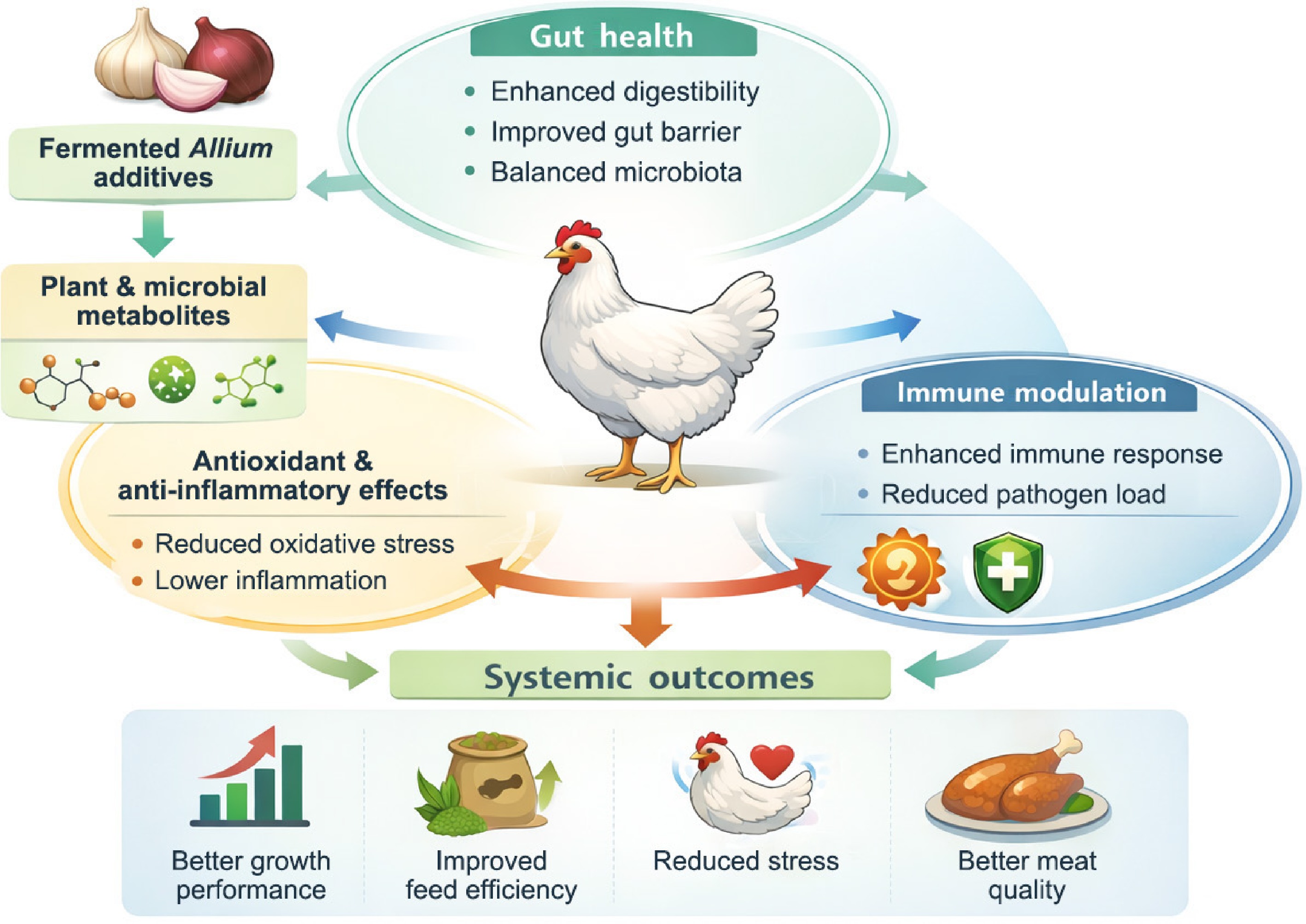
Figure 2.
Integrated mode of action model for fermented Allium additives in broilers. Multiple interacting pathways link plant and microbial metabolites to gut function and systemic outcomes.
Antimicrobial and anti-parasitic activity
-
OSCs such as thiosulfinates and thiosulfonates inhibit a broad range of bacteria in vitro. In vivo, their efficacy depends on their stability, the site of release, and the baseline microbial ecology. Encapsulated thiosulfonates (e.g., encapsulated propyl propane thiosulfonate (PTSO/PTSO2) have been explored to deliver active compounds deeper into the gut and reduce volatility losses during feed processing[7,20−22].
Evidence in broilers suggests that the most consistent benefits occur under enteric challenge (e.g., necrotic enteritis, lipopolysaccharide (LPS), where reducing the pathogen burden can prevent inflammation-driven performance loss. Some studies also suggest supportive effects against parasitic pressure when Allium products are combined with other phytogenics, consistent with a multistep strategy[1,39,40,48−50].
Antioxidant and anti-inflammatory effects
-
Rapid broiler growth increases oxidative metabolism, whereas stressors such as heat and endotoxin challenge amplify inflammatory signaling. Allium's phenolics and stable sulfur metabolites can support redox balance either by direct radical scavenging or by upregulating endogenous antioxidant defenses. Across trials, Allium supplementation is frequently linked to higher sodium dismutase (SOD)/catalase (CAT) activities and lower malondialdehyde levels, particularly under stress conditions[51].
Inflammation and redox are tightly coupled: Oxidative stress can activate NF-kB pathways, and inflammatory cytokines increase oxidative burden. Fermented Allium products may dampen excessive inflammation through reduced pathogen-associated molecular patterns, microbiota shifts, and the direct signaling effects of phenolic aglycones and sulfur metabolites. Reported outcomes include lower proinflammatory cytokines and improved immune redox biomarkers, although the results vary by model and sampling time[19,41,52,53].
Gut barrier integrity and microbiota modulation
-
Barrier disruption increases the translocation of microbial products, fueling systemic inflammation and diverting nutrients away from growth. The peer-reviewed literature has compiled evidence that Allium products (including fermented forms) can improve the architecture of the villi and are associated with higher expression of tight junction markers in challenge models. These effects are often accompanied by shifts toward higher Lactiplantibacillus abundance and reduced pathogenic taxa[54].
Fermentation may enhance effects on the microbiota by providing soluble oligosaccharides and phenolics that are readily utilized by commensals, and by generating organic acids and antimicrobial peptides that suppress opportunists. Increased short-chain fatty acids—especially butyrate—are a plausible downstream mediator because butyrate supports epithelial energy supply and anti-inflammatory signaling[8−12,52].
Nutrient utilization and metabolic modulation
-
Improved gut morphology and reduced subclinical inflammation can increase apparent nutrient digestibility and feed efficiency. Some studies also report changes in the lipid metabolism, consistent with the effects of saponins and polyphenols on bile acids and hepatic pathways. Because the diet's composition modifies the baseline microbiota and metabolism, Allium's efficacy should be evaluated within the context of the full diet (protein level, fiber/non-starch polysaccharides (NSP), fat quality, enzyme package) rather than as a standalone input.
These interactions may explain why Allium additives show stronger benefits in some trials (e.g., under higher NSP loads or pathogen pressure) than in low-stress settings. Mechanistic biomarker panels can help distinguish genuine additive effects from background diet effects.
Evidence from in vivo broiler studies
-
The review of applications in broilers compiles evidence across multiple Allium species and product forms, including fermented preparations. Most studies report neutral to positive effects on performance and gut health, with larger and more consistent improvements under challenge conditions (e.g., LPS, coccidia, necrotic enteritis) or environmental stress (e.g., heat). Nonetheless, heterogeneity is substantial, reflecting differences in the dose, product chemistry, fermentation parameters, baseline diet, bird genetics, and measured endpoints.
Table 3 provides a decision-oriented synthesis of representative broiler trials involving fermented Allium products or closely related synbiotic/encapsulated approaches. These examples should be interpreted as patterns of evidence rather than definitive efficacy estimates.
Table 3. Representative evidence in broilers for fermented Allium-based products and related formulations (selected examples; qualitative synthesis).
Study / independence Design / context Product / dose Study-level result Interpretation Hai et al.[4] /
Author-group evidencen = 250 male J-Dabaco broilers; E. coli challenge on day 8; 35 d L. plantarum-fermented chive; 1% or 3% diet FC3: full-period BWG 739.5 vs 659.4 g/bird in challenged control; PEI 83.91 vs 57.37; FCR 2.32 vs 2.30 Clear challenge-model benefit for BWG/PEI; FCR not superior to challenged control Malematja et al.[22] / Independent n = 200 Ross 308; 42 d; no pathogen challenge Onion extract 0, 5, 10, 15, or 25 g/kg diet Growth performance and meat sensory outcomes were not significantly affected
(p > 0.05)Neutral performance result; demonstrates context/product heterogeneity Elbaz et al.[27] / Independent n = 480 Ross 308; 35 d; environmental heat stress Garlic essential oil 200 mg/kg; lemon EO 200 mg/kg; or mixture EO treatments improved body
weight/FCR and reduced mortality; SOD/GPx increased and MDA decreased
(p < 0.05)Supports stress-context benefit; not a fermented product, so used as related Allium evidence Fathi & Rezaee [31] / Independent n = 500 Ross 308 males; heat stress; 42 d Black garlic powder 10, 20,
or 30 g/kg in heat-stressed groupsSupplementation improved growth performance and reduced mortality; antioxidant defense increased (GPx) and
MDA decreasedSupports processed/fermented-garlic benefit under heat stress; dose- and context-specific Note: This is a structured narrative review; no pooled effect size or confidence interval is presented because products, challenge models, doses, and endpoints are heterogeneous. The table therefore reports study-level sample size, exposure, and quantitative/clearly significant outcomes where available. Growth performance and feed efficiency
-
Growth performance is typically reported as body weight gain (BWG), feed intake, and feed conversion ratio (FCR). Across trials, Allium supplementation tends to yield modest improvements in FCR or no change; negative effects are usually associated with high inclusion rates or reduced palatability. Fermented products may minimize the decrease in intake by decreasing pungency and providing organic acids that support feed hygiene and digestive conditions[55].
Growth outcomes should be interpreted alongside health indicators. Even when BWG is unchanged, improvements in mortality, lesion scores, oxidative status, or flock uniformity may be economically meaningful in antibiotic-reduced programs.
Intestinal morphology and microbiota
-
Villus height, crypt depth, and villus/crypt ratio are common structural proxies for absorptive capacity. Many studies in the peer-reviewed literature report improved epithelial architecture with Allium additives, including fermented forms, especially under challenge. Microbiota analyses frequently show increased Lactiplantibacillus and reduced opportunistic/pathogenic taxa, consistent with barrier-supportive and anti-inflammatory effects. A non-Allium comparator is licorice[56].
Future trials should integrate sequencing with targeted metabolomics (short-chain fatty acids, bile acids, OSC metabolites) and functional barrier measures (tight junction proteins, permeability assays) to connect microbial shifts to the hosts' physiology.
Immune function and disease resilience
-
Immune outcomes include immunoglobulins, cytokine expression, vaccine response, and lesion-based indices under challenge. Allium products may enhance resilience by reducing the pathogen load and by modulating inflammatory signaling. In challenge models, some studies have reported improved lesion scores and a shift toward a less proinflammatory cytokine profile, together with better mucosal integrity.
Immune measures are sensitive to the sampling time and challenge intensity. Harmonized reporting and standardized immune panels would improve cross-study comparability and help distinguish true immunomodulation from reduced pathogen exposure.
Carcass traits and meat quality
-
Allium additives have also been evaluated for their effects on meat quality, primarily through antioxidant effects that reduce lipid oxidation and improve shelf life. Polyphenols and stable sulfur metabolites may contribute to better oxidative stability, color retention, and odor profiles. Sensory outcomes can be dose-dependent; therefore, practical doses should balance functional gains with organoleptic neutrality.
Safety, standardization, and implementation
-
Although Allium species are widely consumed as foods, concentrated extracts or high-dose powders may cause feed refusal and could impose physiological burdens in sensitive contexts. In broilers, the doses used in most trials are below levels associated with overt toxicity, but palatability and product variability remain practical constraints[57].
Standardization and quality control. Inconsistent efficacy often traces back to inconsistent chemistry. For fermented products, quality control should include the raw material's identity and moisture, marker compounds (target OSC metabolites and total phenolics), microbiological quality (starter's identity; viable counts if relevant; absence of pathogens), mycotoxin screening for plant substrates, and stability under storage and pelleting. Reporting these parameters would substantially improve studies' interpretability and commercial reliability[33,34].
Formulation and delivery. Encapsulation can protect volatile OSCs and control the release site, whereas postfermentation drying improves shelf stability but can reduce microbial viability. Depending on the intended mechanism, products may be positioned as primarily phytogenic (with at focus on plant metabolites) or as synbiotic-like (plant metabolites plus live/inactivated microbial components) (Table 4). Practical decisions should align the farm's goals with product design and manufacturing constraints.
Table 4. Practical considerations for designing and evaluating fermented Allium interventions in broilers.
Design element Recommendation Rationale Notes Raw material Specify species, plant part, cultivar/region, and processing history The chemical profile varies widely across sources Include marker analytics where feasible Fermentation Report starter strain(s), inoculum, time, temperature, moisture, and pH trajectory Biotransformation depends on the processing variables Differentiate SSF vs SMF Dose and duration Use dose-finding pilots; consider starter vs finisher phases Responses can be nonlinear; palatability matters Report feed intake/refusals Outcomes Measure performance plus gut/immune/redox biomarkers Mechanistic endpoints explain heterogeneity Include lesion scoring under challenge Economics Report cost per ton of feed and return on investment under farm conditions Adoption depends on net benefit Consider local ingredient costs Safety Monitor organoleptic effects and potential interactions High OSC loads may affect flavor or physiology Check compatibility with vaccines/coccidiostats -
The evidence summarized in the broader literature supports fermented Allium products as plausible contributors to antibiotic-reduced broiler programs, but not as universal replacements. Their strongest value proposition may be as resilience enhancers—reducing performance loss under enteric or environmental challenges by supporting barrier integrity, microbiota balance, and immune redox homeostasis. This framing aligns with a shift from growth promotion via microbial suppression toward growth support by optimizing gut function[1,4,5].
Sources of heterogeneity. Study-level comparisons indicate that context matters. In E. coli-challenged broilers, 3% Lactiplantibacillus plantarum-fermented chive increased full-period BWG from 659.4 to 739.5 g/bird and PEI from 57.37 to 83.91 relative to the challenged control, while FCR was not improved (2.32 vs 2.30)[4]. By contrast, 0−25 g/kg onion extract in unchallenged Ross 308 broilers did not significantly alter growth performance (p > 0.05)[22]. Under heat stress, 200 mg/kg garlic essential oil improved FCR and antioxidant indices[27], and black garlic powder (10−30 g/kg) improved growth and antioxidant responses[31]. These contrasts identify challenge status, processing/fermentation, dose, palatability, and raw-material chemistry as important effect modifiers[58].
Regulatory and consumer considerations. Allium ingredients are generally perceived as 'natural', but their regulatory classification varies (feed material vs. feed additive) and fermentation introduces additional strain-specific considerations. Transparent labeling, safety documentation, and well-controlled manufacturing processes are essential for market acceptance.
Research priorities. Three directions appear to be particularly impactful: (1) Marker-based standardization (chemical and microbiological) to improve reproducibility; (2) mechanistic trials integrating microbiomic and metabolomic data with functional gut assays; and (3) well-powered field trials with clear economic endpoints. Synergistic combinations (e.g., fermented Allium and organic acids, enzymes, or targeted probiotics) are promising but require factorial designs that quantify the interaction effects rather than assuming additivity.
-
Fermented Allium products are promising adjuncts in antibiotic-reduced poultry programs, but current evidence is heterogeneous and does not support a universal antibiotic-growth-promoter replacement claim. Benefits appear more consistent in defined enteric- or heat-stress models than in some unchallenged settings. Future trials should use standardized products, independent replication, prespecified safety and efficacy endpoints, and economically relevant field designs.
The authors acknowledge the contributions of their colleagues at the Faculty of Animal Husbandry and Veterinary Medicine, University of Agriculture and Forestry, Hue University, Hue City, Vietnam.
-
This review does not report animal experiments.
-
The authors confirm their contributions to the paper as follows: conceptualization and supervision: Phan VH; literature synthesis and methodology: Phan VH, Hoang TAP, Nguyen DTK; writing − original draft: Phan VH, Hoang TAP, Nguyen DTK; writing − review and editing: Phan VH, Tran TN. All authors reviewed the results and approved the final version of the manuscript.
-
Data sharing is not applicable to this article as no datasets were generated or analyzed during the current study.
-
The authors declare that they have no conflict of interest. Specifically, no commercial, financial, consulting, or equity relationship related to the products discussed in this review is reported.
- Copyright: © 2026 by the author(s). Published by Maximum Academic Press on behalf of Nanjing Agricultural University. This article is an open access article distributed under Creative Commons Attribution License (CC BY 4.0), visit https://creativecommons.org/licenses/by/4.0/.
-
About this article
Cite this article
Phan VH, Hoang TAP, Nguyen DTK, Tran TN. 2026. Probiotic-fermented Allium feed additives in poultry: bioactive transformation, gut mechanisms, and evidence as antibiotic alternatives - a structured narrative review. Animal Advances 3: e028 doi: 10.48130/animadv-0026-0015 

Probiotic-fermented Allium feed additives in poultry: bioactive transformation, gut mechanisms, and evidence as antibioticalternatives - a structured narrative review
- Received: 18 January 2026
- Revised: 16 April 2026
- Accepted: 25 May 2026
- Published online: 15 October 2026
Abstract: Antibiotic growth promoters (AGPs) have been progressively restricted in many poultry-producing regions, intensifying the search for feed additives that can sustain performance while reducing antimicrobial resistance pressure. Allium species (Allium/Amaryllidaceae), including garlic (Allium sativum), onion (A. cepa), leek (A. porrum), shallot (A. ascalonicum), and related taxa, provide a chemically diverse matrix of organosulfur compounds, polyphenols, saponins, and fructans that can modulate pathogens, oxidative stress, and host immunity. However, variability in the raw materials, the instability of reactive sulfur metabolites, and inconsistencies across in vivo trials have limited translation of the findings into predictable on-farm outcomes. Probiotic fermentation (e.g., lactic acid bacteria, Bacillus spp., yeasts) is increasingly used to improve palatability and stability, convert glycosylated phytochemicals into more bioavailable aglycones, release oligosaccharides with prebiotic activity, and generate microbial metabolites that interact with the gut ecosystem. Drawing on peer-reviewed literature on the use and probiotic fermentation of Allium and on recent peer-reviewed studies, this review synthesizes (i) major bioactive classes in Allium matrices, (ii) biochemical transformations during fermentation, (iii) mechanistic pathways relevant to broilers' productivity and resilience, and (iv) practical considerations for formulation, quality control, and evaluation. Overall, fermented Allium products show promise for improving feed conversion, gut barrier function, and immune–redox balance under commercial stressors, but the responses are heterogeneous and depend on the product's chemistry, fermentation parameters, dietary context, and challenge models. Future progress requires marker-based standardization, mechanistic biomarkers, and well-powered, economically grounded trials that link shifts in the microbiome and metabolome to host phenotypes.
-
Key words:
- Allium spp. /
- Antibiotic alternatives /
- Gut microbiota /
- Medicinal plants /
- Poultry /
- Probiotic fermentation