-
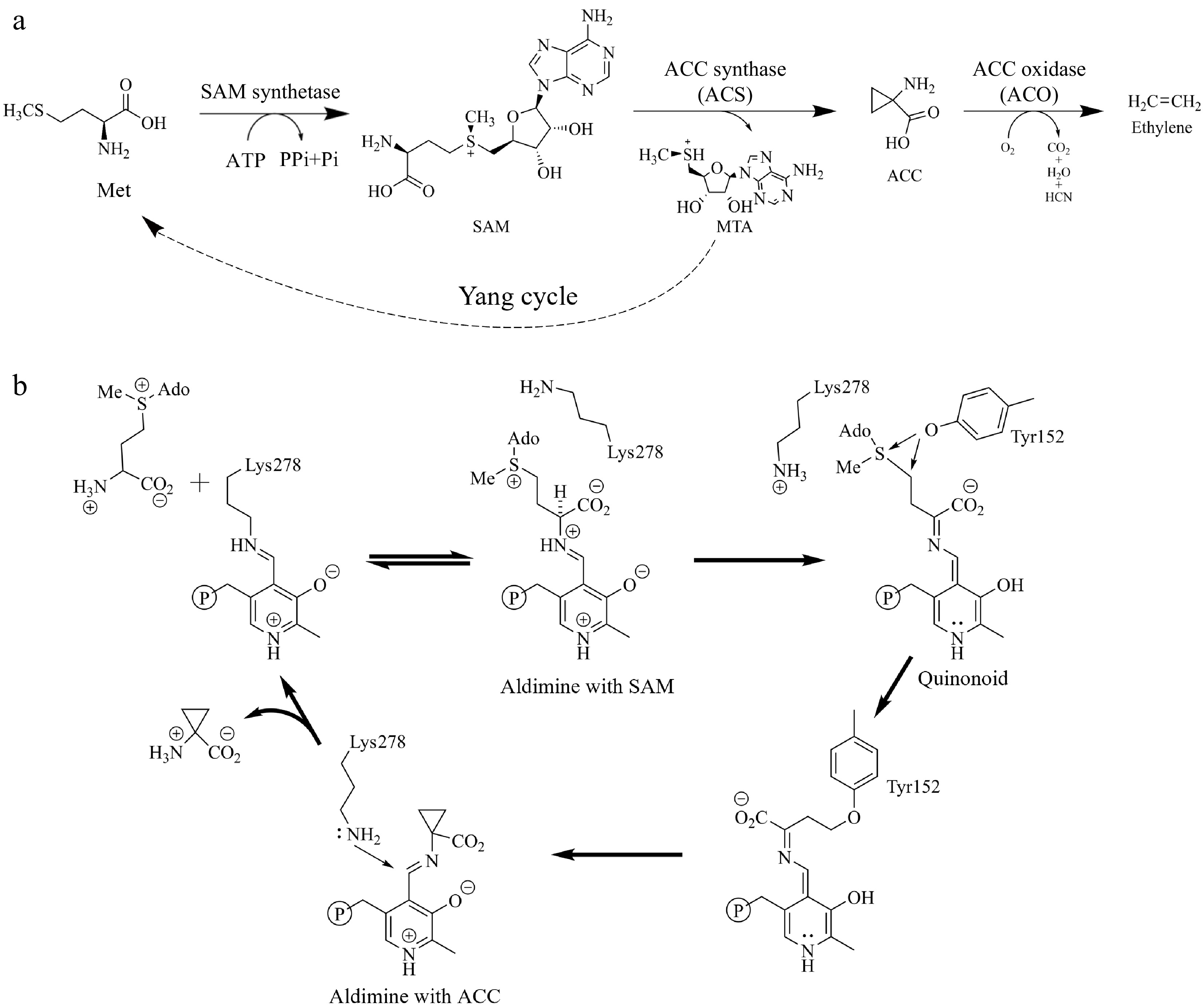
Figure 1.
Ethylene biosynthesis pathway. (a) Ethylene biosynthesis starts with methionine (Met) as the primary substrate, followed by the sequential actions of SAM synthetase, 1-aminocyclopropane-1-carboxylic acid (ACC) synthase (ACS), and ACC oxidase (ACO). (b) A putative mechanism for the conversion of SAM to ACC.
-
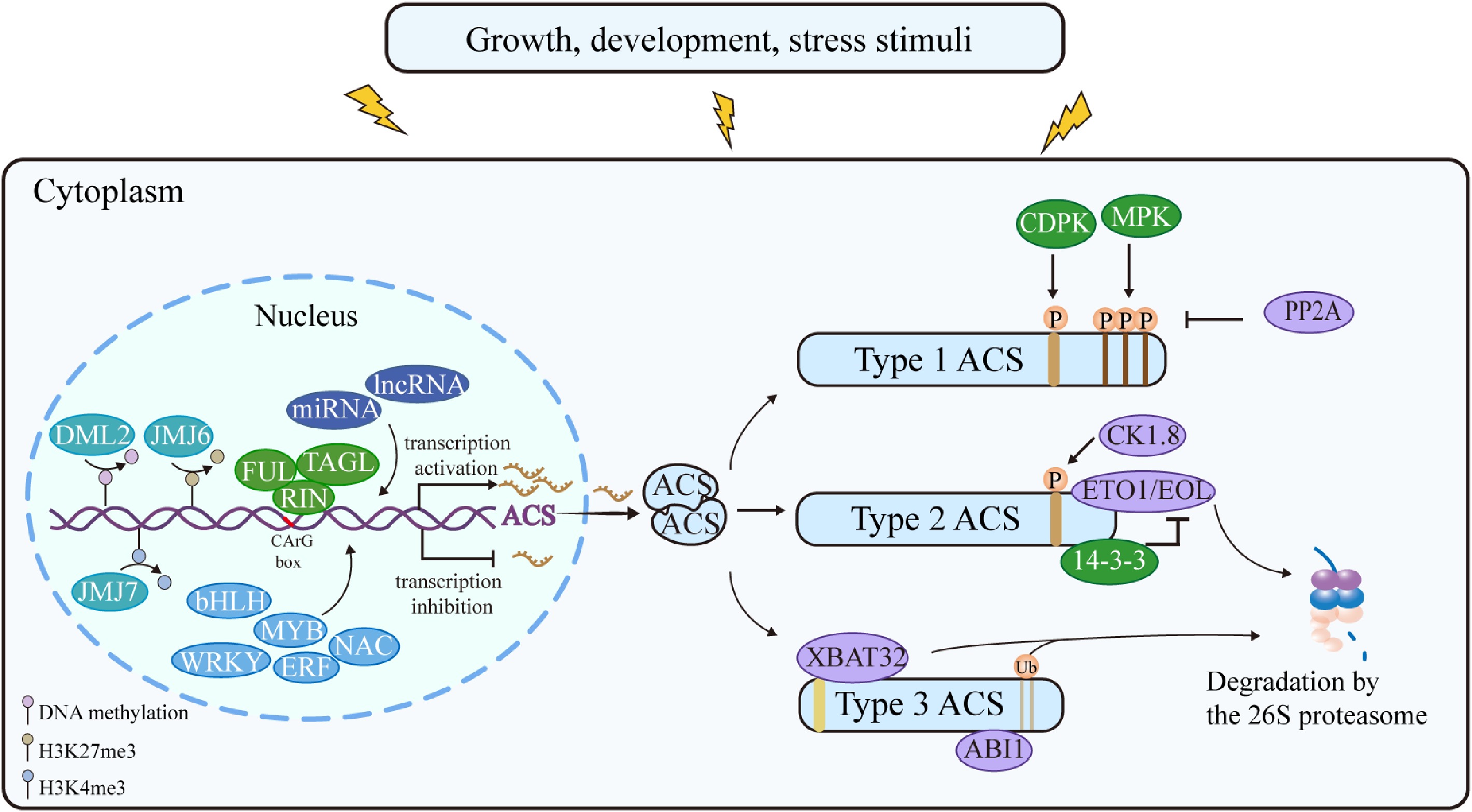
Figure 2.
Transcriptional and post-translational regulation of ACS. RIN interacts with FUL and TAGL1 separately to bind to the CArG box in the ACS promoter, activating the transcription of ACS. Other transcription factor families, including bHLH, ERF, MYB, NAC, and WRKY, can also regulate transcription by binding to the ACS promoter. The promoter of ACS is also subjected to epigenetic regulation through methylation and histone modification, thereby affecting transcriptional accessibility. ACS has different specific motifs and is subject to different post translation regulation. Type I ACS is phosphorylated by CDPK and MPK, leading to an increased protein stability, while PP2A-mediated dephosphorylation negatively regulates protein stability. CK1.8 enhances the binding of ETO1/EOL by phosphorylating Type II ACS, thereby promoting protein degradation. 14-3-3 proteins protect Type II ACS from degradation by interacting with ACS and promoting the turnover of ETO1/EOL. XBAT32 and ABI1 interact with type III ACS and promote their degradation, respectively.
-
Biological process Species Gene Function Ref. Vegetative growth Arabidopsis ACS2 Development of lateral root [76] ACS5 Elongation of the hypocotyl [77] ACS7 Development of plant height [78] ACS1 Leaf senescence [80] Citrus ACS4 Development of plant height [22] Maize ACS7 Development of plant height [79] Maize ACS2, ACS6 Leaf senescence [81] Sex determination and flowering Cucumber ACS7 Sex differentiation [83] ACS11 Female flower development [84] Melon ACS2 Sex differentiation [82] ACS11 Female flower development [82,84] Watermelon ACS4 Formation of hermaphroditic flowers [85] Pineapple ACS2 Flowering [86] Oncidium ACS12 Flowering [87] Fruit ripening Apple ACS1 Fruit ripening [89] Citrus ACS Fruit ripening [90] Melon ACS Fruit ripening [92] Tomato ACS2 Fruit ripening [93,94,95] ACS4 Fruit ripening [93,95] Stress response Arabidopsis ACS6, ACS7, ACS8, ACS10, ACS11, ACS12 High temperature stress [97] ACS2, ACS6 Drought [102] ACS11 Boron deficiency [104] ACS2, ACS6, ACS7 Pathogen resistance [107] Rice ACS2, ACS5 High temperature stress [97] ACS1, ACS2 Cr-stress [99] ACS1, ACS5 Flooding [103] ACS1, ACS2 Phosphate deficiency [105] ACS1, ACS2 Pathogen resistance [107,108] Cotton ACS12 High-salt stress [100] Table 1.
The roles of ACS in plant life.
Figures
(2)
Tables
(1)