-
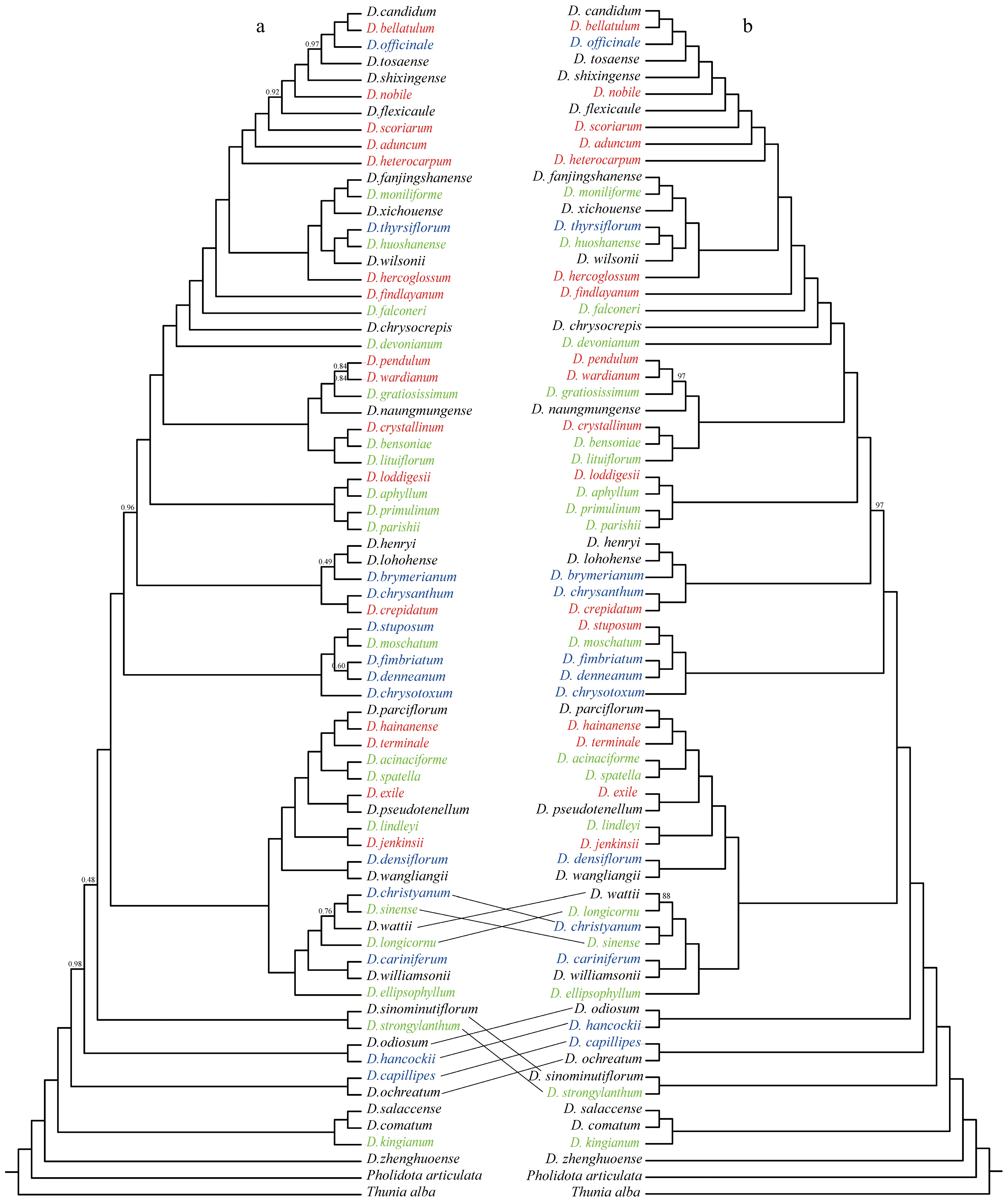
Figure 1.
Phylogenetic tree of 70 Dendrobium species based on chloroplast whole-genome reconstruction, with T. alba and P. articulata as outgroups. (a) Maximum likelihood tree, with bootstrap support values (BS) on each branch, and BS of 1.00 not shown. (b) Bayesian tree, with posterior probability (PP) on each branch, and PP of 100% not shown. Green species names indicate SI species; red species names represent SC species; blue species names indicate SI/SC species.
-
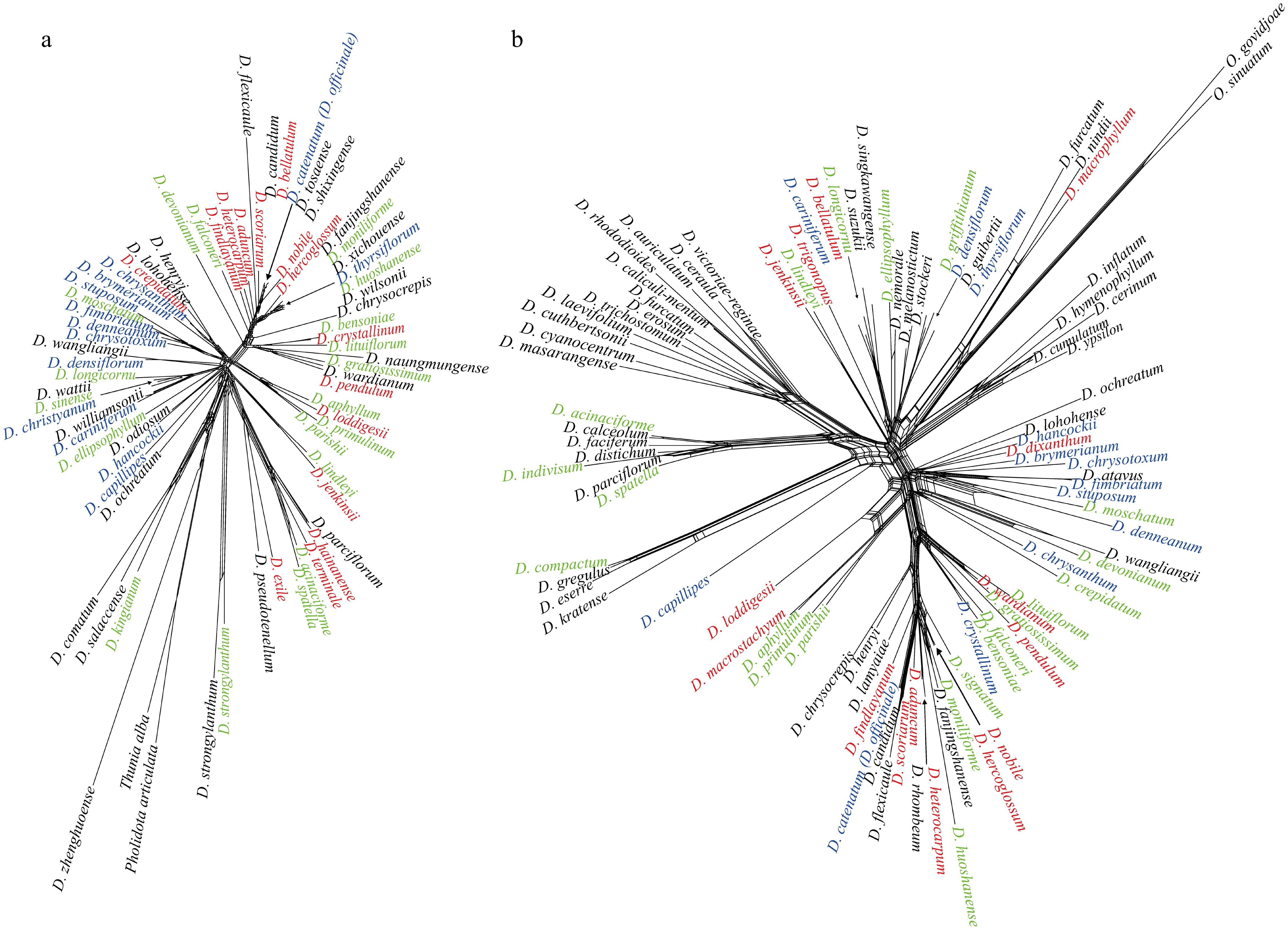
Figure 2.
Reconstructs of the reticulate evolutionary relationships of Dendrobium. (a) Chloroplast genome data, with T. alba and P. articulata as outgroups. (b) Nuclear ITS sequences, with O. govidjoae and O. sinuatum as outgroups. Green species names indicate SI species; red species names represent SC species; blue species names indicate SI/SC species.
-
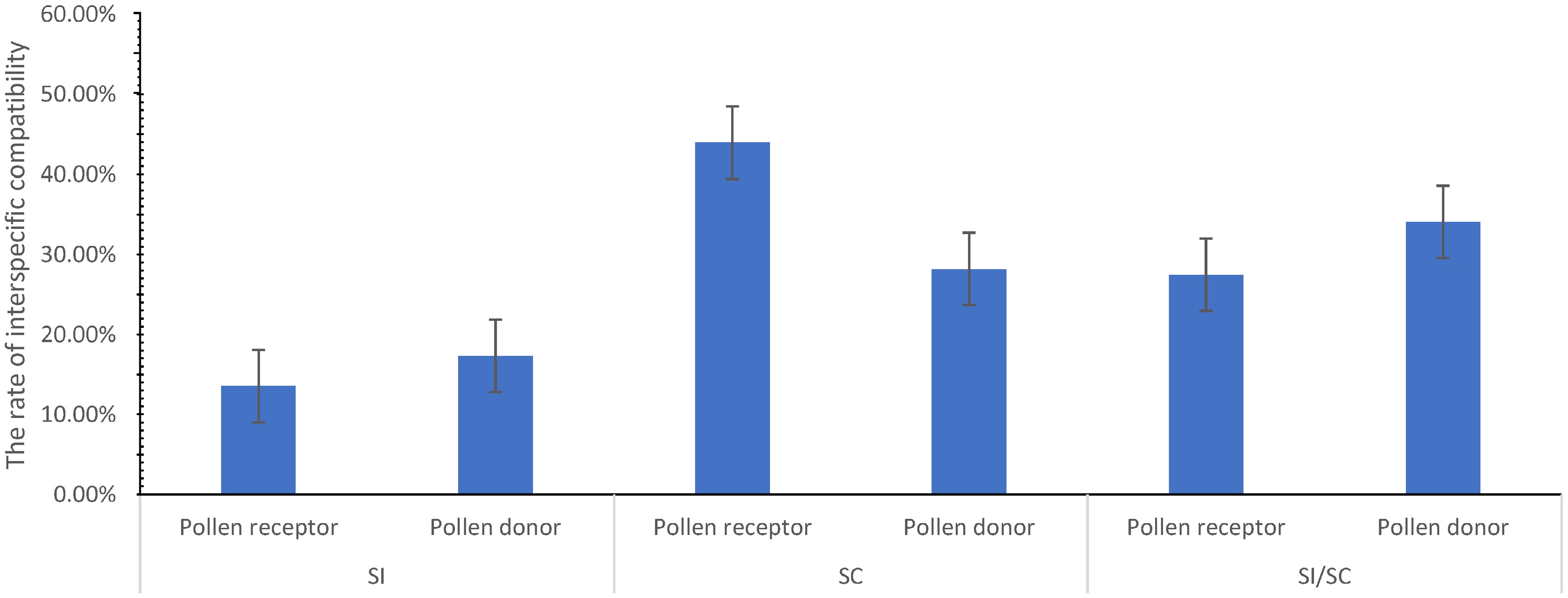
Figure 3.
The potential of different SI of 64 Dendrobium species as hybridization parents.
-

Figure 4.
Interspecific compatibility comparison of 11 Dendrobium species and 64 Dendrobium species. The blue column represents the rate of interspecific compatibility of 11 Dendrobium species, and the orange column represents the rate of interspecific compatibility of 64 Dendrobium species.
-

Figure 5.
Reconstructs of the reticulate evolutionary relationships of 11 Dendrobium species. (a) Chloroplast genome data, with T. alba and P. articulata as outgroups. (b) Nuclear ITS sequences, with O. govidjoae and O. sinuatum as outgroups.
-
Species Self-incompatibility Dataset of origin Species Self-incompatibility Dataset of origin D. aciculare SI P D. jiaolingense SC H D. acinaciforme SI P D. keithii SI P D. aduncum SC H D. kingianum SI P D. aggregatum SI P D. lamellatum SI P D. albosanguineum SI P D. leonis SI H, P D. aloifolium SI P D. leptocladum SI P D. alterum SI P D. linawianum SI P D. aphyllum SI M, P D. lindleyi SI M, H, P D. arachnites SI P D. linguella SI P D. bellatulum SC H D. lituiflorum SI P D. bensoniae SI M D. loddigesii SC H, P D. bicameratum SI P D. longicornu SI M, H D. bicaudatum SI M D. macrophyllum SC P D. bigibbum SC P D. macrostachyum SC P D. bilobulatum SC/SI P D. mannii SI P D. blumei SI P D. monile SI P D. brevimentum SI P D. moniliforme SI M, H D. brymerianum SC, SI, SC M, H, P D. moschatum SI P D. bullenianum SI P D. mucronatum SI P D. capillipes SC, SI H, P D. nathanielis SI P D. cariniferum SC, SI H, P D. nobile SC H, P D. christyanum SC, SI M, H D. officinale SI, SC, SI M, H, P D. chrysanthum SI, SC M, H D. pachyglossum SI P D. chrysotoxum SI, SC, SI M, H, P D. pachyphyllum SI P D. compactum SI P D. panduriferum SI P D. crepidatum SI, SC, SC M, H, P D. parcum SI P D. crumenatum SI M, H, P D. parishii SI M, P D. crystallinum SC, SC, SI/SC M, H, P D. pendulum SC H, P D. cucullatum SI H D. phalaenopsis SI, SI/SC M, P D. dalbertsii SC P D. planibulbe SI P D. delacourii SC P D. podagraria SI P D. denneanum SI, SC M, H D. polyanthum SC H D. densiflorum SI, SC H, P D. porphyrochilum SI M, H D. denudans SI P D. primulinum SI P D. devonianum SI M, P D. pulchellum SI P D. disticum SI P D. salaccense SC H, P D. dixanthum SC P D. scoriarum SC H D. draconis SI, SI, SI/SC M, H, P D. secundum SI M, H, P D. ellipsophyllum SI P D. senile SI P D. erostelle SI P D. setifolium SI P D. exile SC P D. signatum SI M, H D. falconeri SI H, P D. sinense SI P D. farmeri SI P D. spatella SI M D. fimbriatum SC, SI H, P D. speciosum SI P D. findlayanum SC H D. spectabile SC P D. formosum SI M, P D. stratiotes SC P D. gibsonii SI P D. strebloceras SC P D. gouldii SC P D. strongylanthum SI M, H D. gratiosissimum SI H, P D. stuposum SC, SI, SC M, H, P D. griffithianum SI P D. subulatum SI P D. hainanense SC H D. sulcatum SC P D. hancockii SI, SC H, P D. terminale SC H D. harveyanum SI H D. tetrodon SC P D. hendersonii SI P D. thyrsiflorum SI, SC, SI M, H, P D. hercoglossum SC M, H, P D. tortile SC P D. heterocarpum SC H, P D. transparens SC H D. hildebrandii SC P D. trantuanii SC H D. huoshanense SI M D. trigonopus SC H D. indivisum SI P D. undulatum SC P D. infundibulum SC/SI P D. unicum SI H D. jenkinsii SC M, H, P D. virgineum SI P D. jiajiangense SC H D. wardianum SC H, P SI: Self-incompatibility species; SC: Self-compatibility species; SI/SC: Both. P: Dataset from Pinheiro et al.[17]; H: Dataset from Huang[21]; M: Dataset in this study. Table 1.
Self-pollination results of 124 Dendrobium species.
-
Pollen receptor Pollen donor Number of interspecific hybridization combinations Number of fruit combinations produced The rate of interspecific compatibility SI SI 178 23 13.14% SC SC 80 38 47.50% SI/SC SI/SC 28 13 46.43% SI SC 69 6 8.70% SC SI 70 17 24.29% SI SI/SC 63 13 20.63% SI/SC SI 64 14 21.88% SC SI/SC 41 19 46.34% SI/SC SC 39 9 23.08% All All 632 152 24.05% SI: Self-incompatibility species; SC: Self-compatibility species; SI/SC: Both; all: SI, SC and SI/SC species. Table 2.
The rate of interspecific compatibility of 64 Dendrobium species based on self-incompatibility.
-
Pollen receptor Pollen donor Flower Capsule set The rate of capsule set (%) Dataset
of originD. aphyllum D. officinale 2 0 0 M D. bensoniae D. officinale 27 0 0 M D. bensoniae D. crystallinum 7 3 42.86 M D. bensoniae D. chrysotoxum 2 0 0 M D. chrysotoxum D. officinale 3 0 0 M D. chrysotoxum D. crystallinum 2 0 0 M D. chrysotoxum D. bensoniae 2 0 0 M D. chrysotoxum D. hercoglossum 4 1 25 M D. crystallinum D. officinale 15 0 0 M D. crystallinum D. bensoniae 8 2 25 M D. crystallinum D. chrysotoxum 2 0 0 M D. denneanum D. officinale 2 1 50 M D. hercoglossum D. officinale 13 2 15.38 M D. hercoglossum D. chrysotoxum 8 0 0 M D. hercoglossum D. bensoniae 3 0 0 M D. hercoglossum D. crystallinum 3 0 0 M D. moniliforme D. bensoniae 2 0 0 M D. moniliforme D. crystallinum 2 0 0 M D. moniliforme D. hercoglossum 3 3 100 M D. moniliforme D. officinale 20 20 100 M D. moniliforme D. chrysotoxum 14 6 42.86 M D. nobile D. officinale 3 3 100 M D. officinale D. denneanum 7 7 100 M D. officinale D. moniliforme 10 8 80 M D. officinale D. bensoniae 28 17 60.71 M D. officinale D. crystallinum 9 5 55.56 M D. officinale D. chrysotoxum 20 18 90 M D. officinale D. hercoglossum 12 9 75 M D. officinale D. nobile 8 3 37.5 M D. officinale D. stuposum 3 0 0 M D. stuposum D. officinale 4 0 0 M D. aphyllum D. huoshanense 14 0 0 M D. aphyllum D. chrysotoxum 8 1 12.5 M D. chrysotoxum D. aphyllum 12 12 0 M D. officinale D. huoshanense 6 4 66.67 M D. chrysotoxum D. moniliforme 1 0 0 WP D. moniliforme D. chrysotoxum 1 0 0 WP D. officinale D. aphyllum 10 3 30 R D. chrysotoxum D. moniliforme 8 4 50 Pan D. nobile D. moniliforme 10 4 40 Pan D. officinale D. nobile 15 5 33.33 L D. officinale D. chrysotoxum 15 13 86.7 L D. nobile D. officinale 15 0 0 L D. nobile D. chrysotoxum 15 0 0 L D. chrysotoxum D. officinale 15 0 0 L D. chrysotoxum D. nobile 15 0 0 L P: Dataset from Pinheiro et al.[17]; J: Dataset from Johansen[16]; W: Dataset from Wilfret[24]; Pan: Dataset from Pan et al.[25]; L: Dataset from Li et al.[26]; R: Dataset from Ren[27]; M: Dataset in this study. Table 3.
The rate of interspecific compatibility of 11 Dendrobium species.
Figures
(5)
Tables
(3)