-
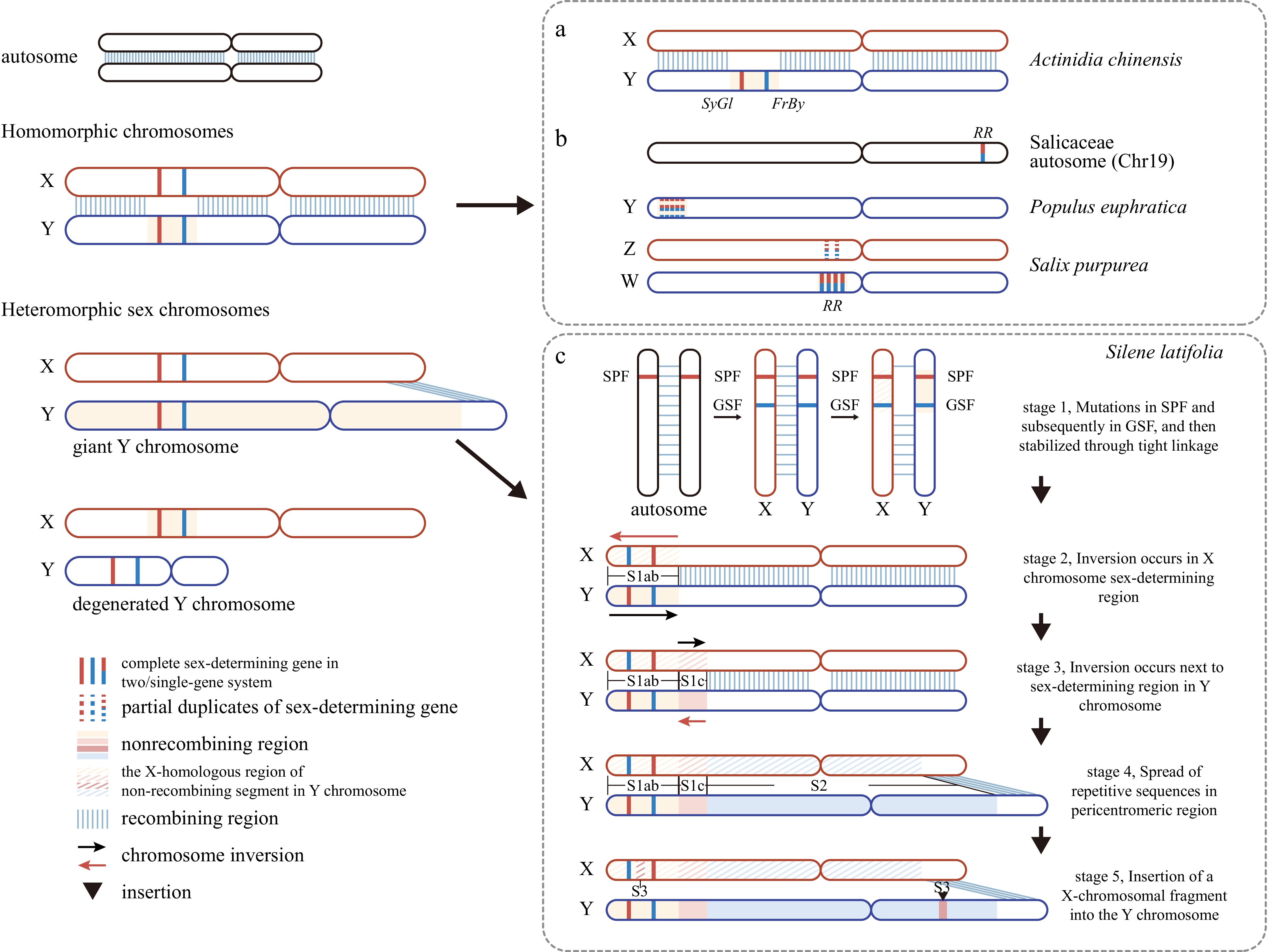
Figure 1.
Representative examples of homomorphic and heteromorphic sex chromosome systems in plants. (a) Kiwifruit shows a homomorphic XY system, where sex is determined by the Y-linked genes SyGl and FrBy. (b) Sex chromosome turnover in Salicaceae. In Populus euphratica (poplar), an XY system is encoded on chromosome 19, whereas in Salix purpurea (willow), a ZW system has evolved on the same homologous region, with the sex-determining gene RR relocated to the W chromosome. (c) Stepwise evolution of heteromorphic sex chromosomes in S. latifolia. Stage 1: Sequential mutations in SPF and subsequently in GSF establish a sex-determining locus stabilized by tight linkage. Stage 2: A paracentric inversion occurs in the sex-determining region on the X chromosome (Stratum 1ab). Stage 3: An additional inversion arises in the corresponding region on the Y chromosome (Stratum 1c), consolidating recombination suppression. Stage 4: Repetitive sequences and transposable elements accumulate and spread around the pericentromeric region, driving expansion of the nonrecombining region (Stratum 2). Stage 5: Further structural change involves the insertion of an X-derived fragment into the Y chromosome, contributing to the formation of Stratum 3. Stamen-promoting factor, SPF; gynoecium-suppressing factor, GSF.
Figures
(1)
Tables
(0)