-
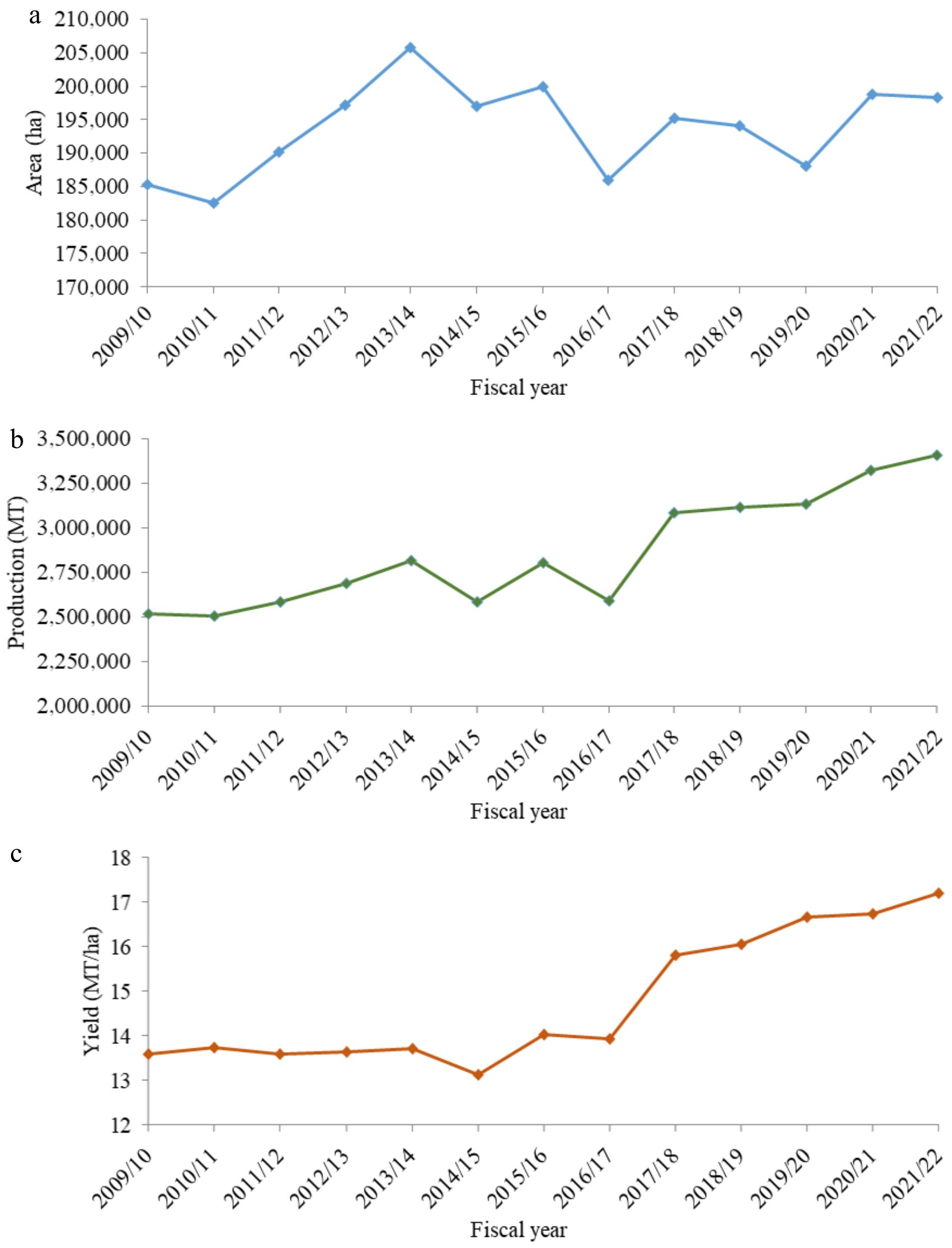
-
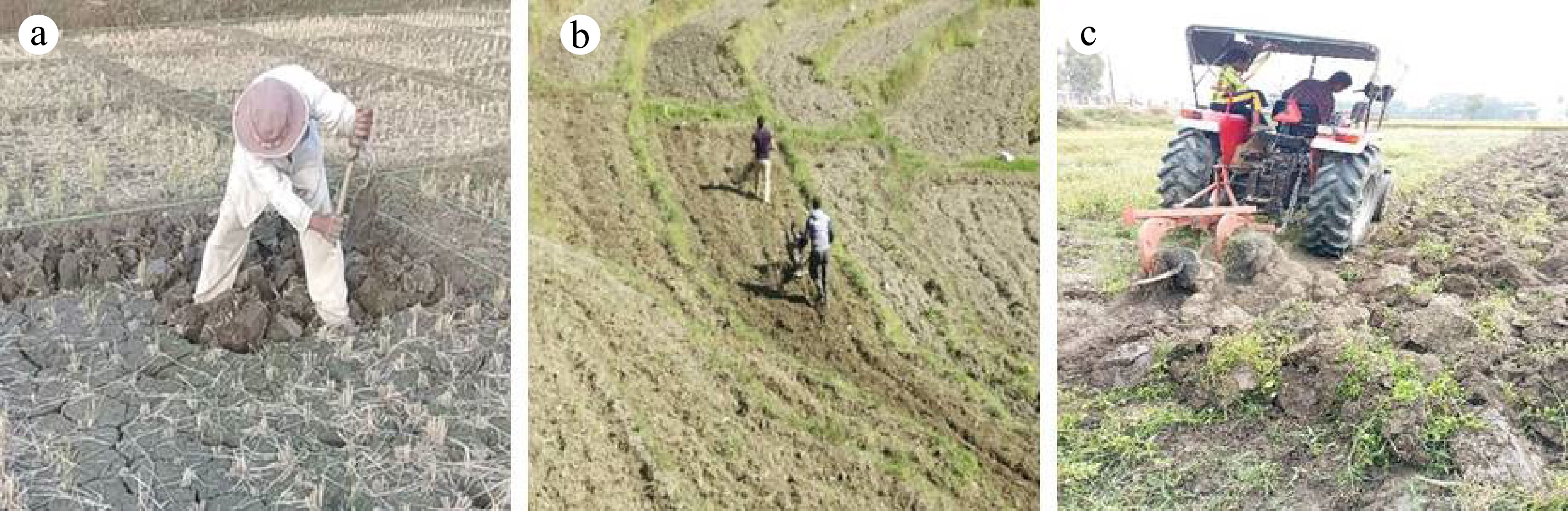
Figure 2.
Land preparation: (a) Manual tillage. (b) Mini tiller. (c) Four-wheel tractor.
-
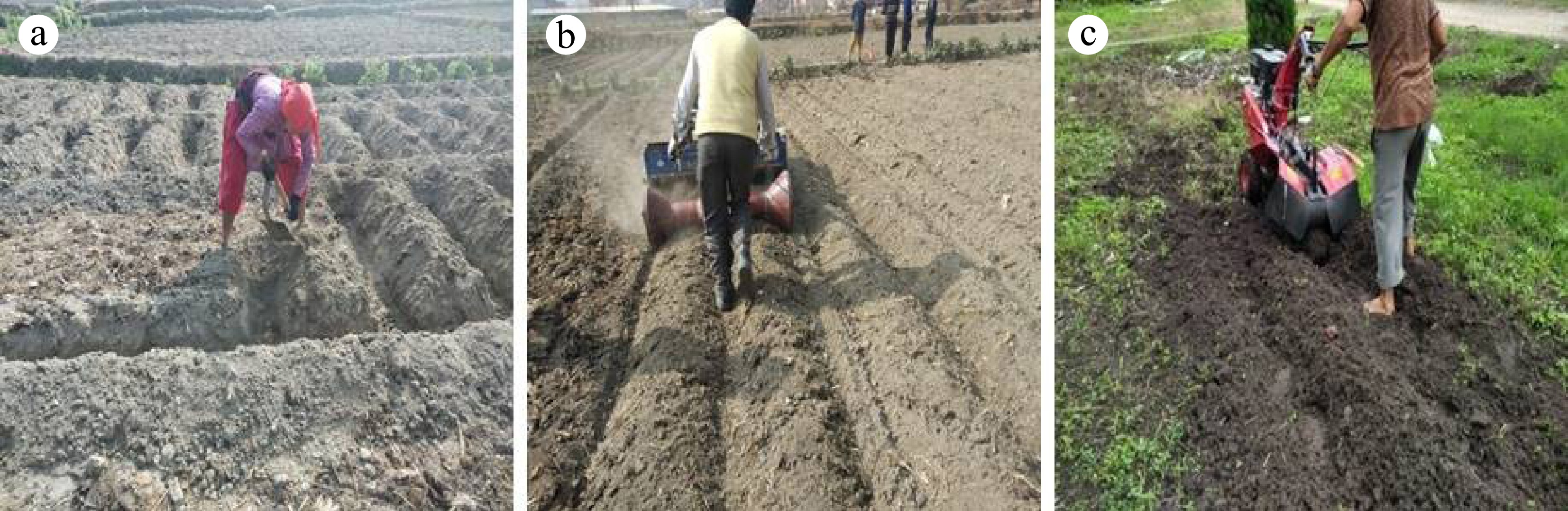
Figure 3.
(a) Comb type bed forming using spade. (b) Power tiller bed former. (c) Mini tiller ridger.
-
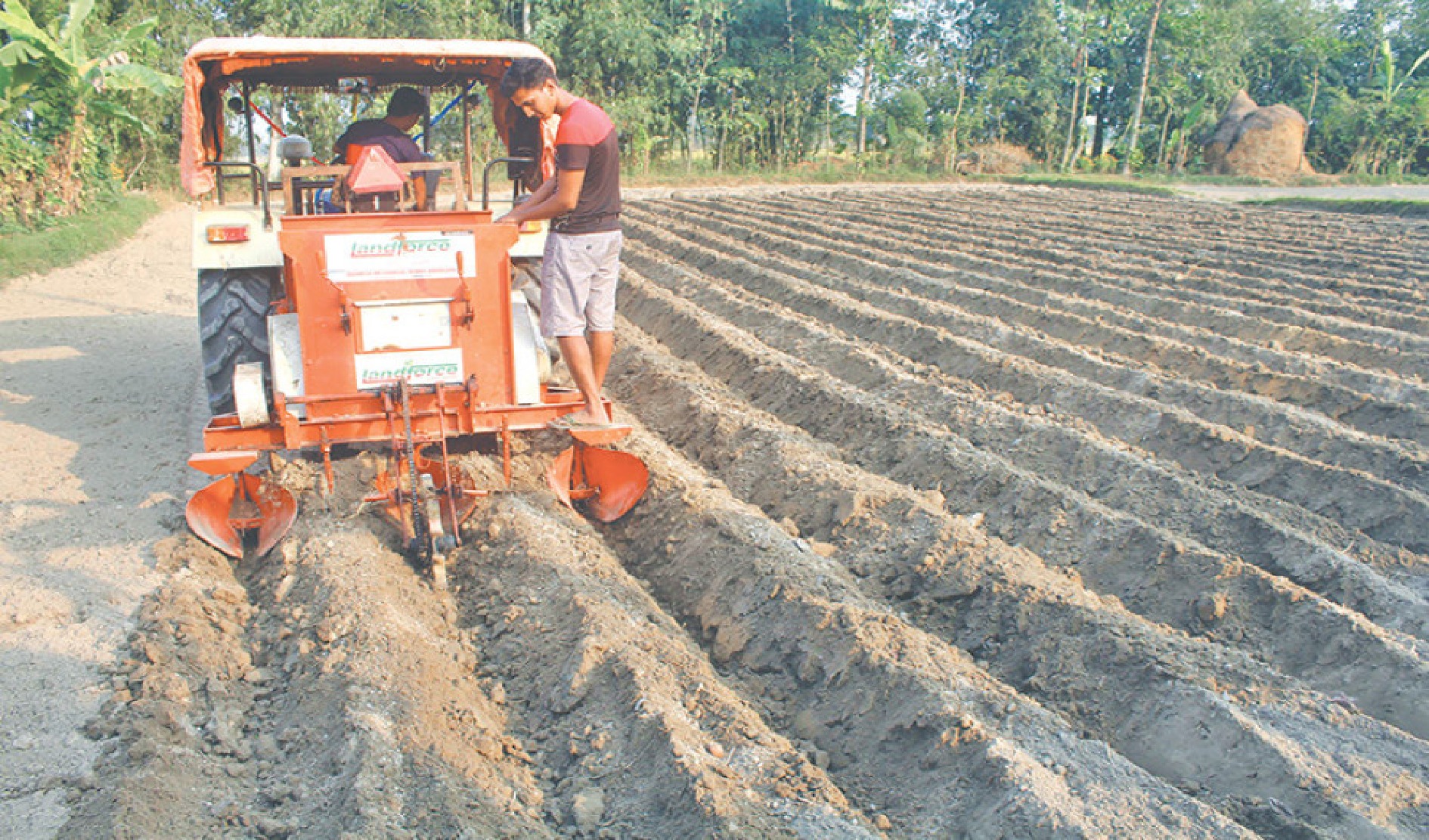
Figure 4.
Potato planter (adapted from Rajbansi[8]).
-
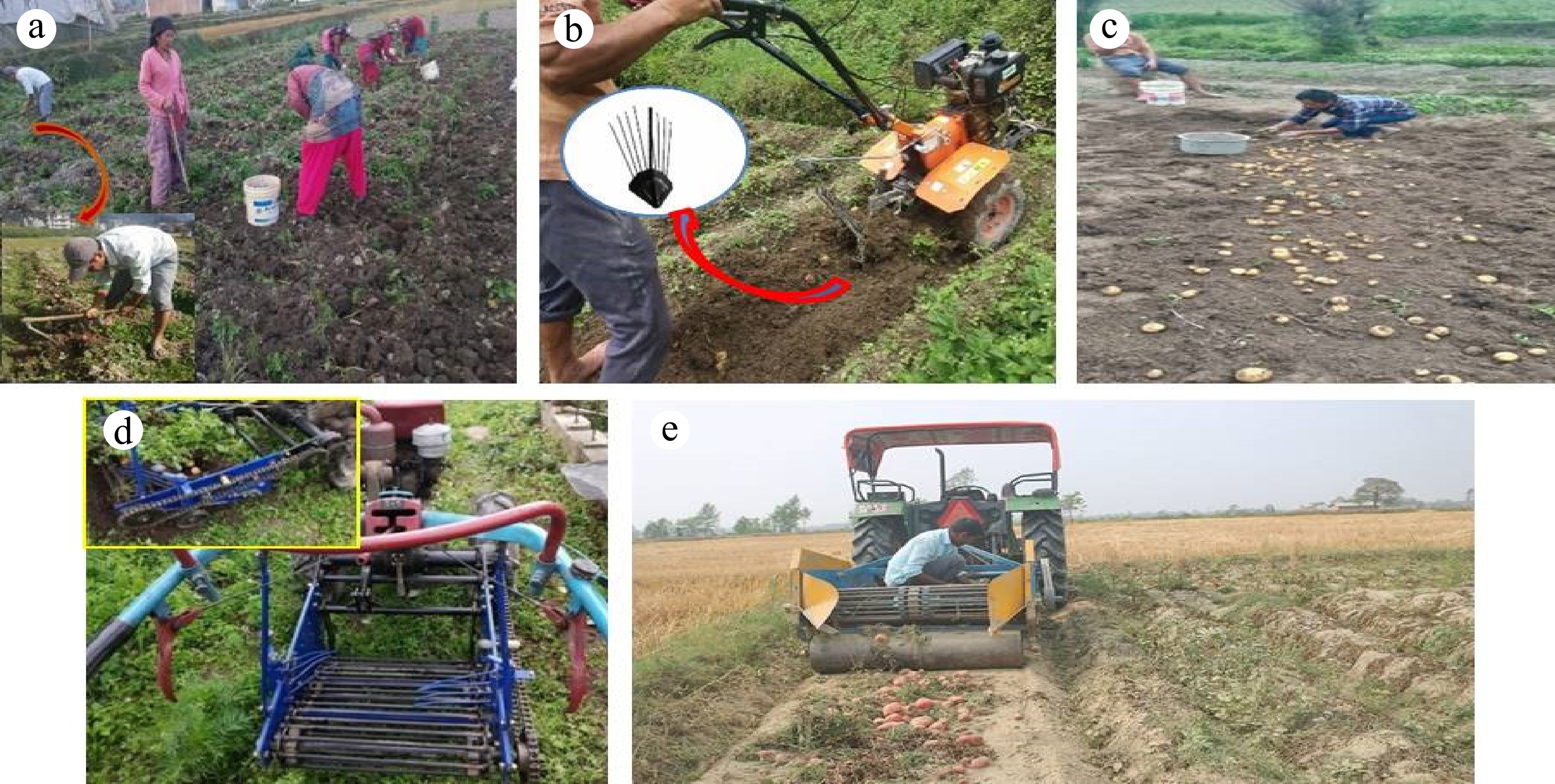
Figure 5.
(a) Manual digging. (b) Mini tiller digger. (c) Collection of digger harvested potatoes. (d) Power tiller digger. (e) Four-wheel tractor attached potato digger (Image 'e' adapted from Bidari[13]).
-
Stage Purpose/function Region specific technologies Adoption region/status Key bottlenecks and constraints R&D priorities/tech suggestions Land preparation Break soil, incorporate organic matter and level the field a) Terai: tractor, plough, harrow, rotavator, laser land leveler;
b) Hill: mini tiller, power tiller# Power tillers and tractors common in Terai; mini tillers fit hills; laser levelers rare # Steep slopes; high costs; limited credit; fragmented plots; poor infrastructure; lack of local machinery # Mechanized, better than other operations, expand mini tillers or small tillage tools for small terraces Seed bed preparation Make furrows/ridges for better root and tuber growth a) Terai: tractor mounted bed former, ridger;
b) Hill: power tiller bed former and mini tiller ridger, manual spade-based beds# Tractor-mounted units moderately used in Terai and mid-hills; mini tiller bed formers under NARC research # No hill-compatible machinery; limited R&D and promotion; poor training and fabrication support # R&D for hill-specific equipment, increase field demos across agro-ecologies Seed cutting and treatment Cut large tubers into seed pieces and treat with fungicides/
insecticidesTeri and hill: knife and sickle, manual/chemical seed treatment, Hand sprayers # Dominant in all regions; mechanical seed cutters not in use # Sanitation risks from manual cutting; no small-scale seed cutters; limited innovation and commercialization # Research on mechanical cutter design and testing Planting Precisely plant seed tubers at correct spacing and depth a) Terai: hand tools and automatic or semi-automatic potato planters;
b) Hill: hand tools# Traditional in hills; partially mechanized in Terai (NARC & PMAMP-supported). # No hill-suited planters; no mechanized bung system; limited credit and R&D support; seasonal use only # Increase demonstration of verified planters in Terai; and in-depth research on hill suitable small potato planter or tools Weeding and intercultural operations Control weed, aerate soil and maintain ridges Terai and hills: manual tools (hoe, spade), dry land weeder, animal-drawn tools, mini tillers (limited use), mulching (plastic/straw) # Manual everywhere; some mini-tiller use in Terai/mid-hills; mulching emerging in commercial zones # No potato-specific weeder; CHCs lack targeted tool; insufficient training; mulching barriers # Testing and promoting mechanized/semi-mechanized weeders, ridgers, and cultivators in Terai; lightweight power weeders for hills Plant protection Apply fertilizers and chemicals uniformly a) Terai: knapsack sprayer, power sprayer, boom sprayers;
b) Hill: small hand compression sprayer, knapsack sprayer# Basic tech like knapsack sprayers common; advanced methods (drones, electrostatic sprayers) # Limited research and promotion of modern tools; high cost and technical complexity; lack of custom equipment for TPS and smallholders # Integrate fertigation in potato farming; expand demonstrations of boom sprayers, precision sprayers, and drone trials Irrigation and fertigation Provide adequate and uniform irrigation water to crop Terai and hill: sprinklers/drip, solar pumps, pumps (centrifugal, turbine, submersible, axial flow, mixed flow pumps), mini tiller-operated pump, flood and canal systems; # Traditional in hills; drip/sprinkler in Terai/mid-hills; solar pumps rising; manual fertilizer broadcasting # Energy access and cost issues; no long-term economic studies; technical support lacking; limited subsidies in remote areas # Increase demos of mini-tiller pumps and economic feasibility study of drip/sprinkler/solar pumps; research fertilizer broadcasting equipment Harvesting Lift tubers from the soil with minimal damage a) Terai: tractor mounted potato diggers or power tiller digger;
b) Hill: power tiller or mini tiller digger, manual tools (hoe/spade)# Manual in hills; mechanized digging in Terai and mid-hills flatlands Poor terrain fit; high costs; manual collection required; no customization for small plots # Research and promote hill-suitable tech; adopt ridge-furrow cultivation in valleys; and demo potato harvesters in hills and Terai Post-harvest processes Clean, sort, package, and store harvested or seed potatoes Manual grading and sorting, manual roller drum grader (NAERC), traditional storage (pit, room-floor), cold storage # Manual dominates; low adoption of cold storage, mostly (70%) in central region # Non-specific grader designs; technical complexity; high energy and cost, limited storage; poor hill transport; and low processing equipment adoption # Need affordable manual/motorized graders and reliable cold storage for small farmers; design low-power gravity/vibration systems (battery/solar); promote low-cost evaporative/insulated storage; support group-owned cold chains Protected cultivation for seed production Produce disease-free seeds Screen houses, tissue culture, aeroponics and TIS (limited use), UV-treated irrigation # Low adoption; used by NARC, KU, NPRP, few private farms; mainly in research, pilot, or demo stages # High costs and skill gaps; lack of affordable systems, skilled labor, equipment; no clear farmer scale-up roadmap # Yet to scale, research on low-cost protected structure Table 1.
Summarized technological breakdown and associated bottlenecks of agricultural equipment for various stages of potato production process in Nepal.
-
Category Bottlenecks/constraints Impact Economic and financial barriers ● High initial investment
● Socio-economic constrictions (gender, land & income)
● Energy and fuel dependency
● Poor access to credit and insurance
● Custom hiring monopolies with limited, costly, and poorly monitored services
● High import tax on parts and raw materials (15%–30%)● Unaffordable
● Restricts investment
● Raises operational costs
● Restricts local manufacturingTechnical, operational and infrastructure deficiencies ● Lack of appropriate machinery for small farms
● Incompatibility with local soil conditions
● Technical skill gaps; limited spare parts, skilled mechanics, and maintenance services
● Low technical capacity of farmers/operators
● Crop damage from mechanized harvesting
● Weak infrastructure (roads, irrigation, electricity, and storage)
● Higher post-harvest losses (20%–30%)● Disrupt the value chains
● Reduce machine efficiency
● Delay cultivation
● Reliance on ineffective methods
● Duplication of effortsAgricultural and production constraints ● Supply chain bottlenecks (input, seeds, irrigation, labor)
● Pests and diseases (e.g., blight, aphids, wilt)
● Weak seed system
● Traditional cropping methods e.g., comb beds
● Environmental concerns (degradation, erosion, emissions, climate change)● Reduce yield, quality, and profits
● Raise costs, harm environment
● Limit machine useTopographical and farm structure limitations ● Steep, narrow terrain with rugged terraces
● Fragmented smallholdings (avg. parcel size: 0.24 ha, 3.27 parcels/farm)
● Predominantly rainfed, subsistence farming● Limits technological adoption Policy, governance, and institutional issues ● Absence of clear federal-aligned policies and standards
● Weak research–extension–education coordination
● Poorly resourced mechanization institutions● Duplication of efforts
● Limit the research and innovationPrivate sector and industry limitations ● Decline of traditional artisans (blacksmiths)
● Lack of government-supported manufacturing
● Financial/technical limits for Small Machinery Entrepreneurs (SMEs)
● Urban-focused importers and suppliers● Import dependence
● Costly local products
● Limited rural access to tech and servicesSocial and labor dynamics ● Traditional comb-type beds
● Shortage of skilled agri-labor
● Youth migration and cultural resistance
● Gender/income gaps; lack of inclusive tools
● Socioeconomic inequalities● Burdens women and elderly
● Restricts machine use
● Excludes marginalized groups
● Fosters resistance to changeTable 2.
Categorized bottlenecks and constraints in potato mechanization of Nepal.
-
Policy conflict impact Description Opportunities for alignment Import tariff level a) Agricultural machinery: 1%–5% (mostly1%) +VAT exemptions (except four wheel tractor and undefined machines).
b) Raw materials and spare parts: 5%–30%+ VAT + additional charges.Balanced policy mix:
a) Harmonize policies:
● Remove tariffs on raw materials and parts for agricultural machinery.
● Prioritize subsidies for local equipment.
● Offer performance-based manufacturer incentives (e.g. for durability, local jobs, sustainability).
b) Build local capacity:
● Invest in training and innovation hubs.
● Support joint ventures and tech transfer.
● Provide technical and financial aid to producers
● Establish quality standards and certifications
c) Targeted subsidies:
● Link subsidies to farm size, location, and income.
● Promote cooperatives using local machines.
● Subsidize raw materials for local fabricators.
● Apply outcome-based subsidiesSubsidies & incentives a) Subsidies for both imported and locally produced equipment (50%–75%).
b) Industrial incentives from mid-2022: 100% tax exemptions for 5 years from operations.Imported machines a) Positive impacts: enables affordable access to machinery, accelerating agricultural mechanization. Disruption across the value chain a) Raw material importer: import tariffs raise the cost of essential components and raw materials (e.g. steel, MS bar, engines, motor, bearings etc.), making local manufacturing less competitive. b) Local Manufacturers: despite tax breaks, high input costs and competition from subsidized imports hinder local production. c) Distributors/dealers: tariffs raise local machine prices, pushing dealers to prefer imports over domestic brands. d) Farmers: subsidies aid mechanization, but expensive local machines lead to import dominance and maintenance challenges.
e) Repair/service sector: inconsistent product mix (imported vs. local) complicates service and parts standardization, and raise maintenance expenses.Undermine strategic goals a) Import tariffs aim to protect local industry or generate revenue but raise costs for manufacturers reliant on imports, while untaxed assembled imports undercut them.
b) Agricultural subsidies boost mechanization but favoring imports over local products undermines domestic manufacturing growth.Stagnation of domestic industry a) Local manufacturers face high costs, limited finance, and unfair import competition.
b) Without strong domestic production, Nepal relies on imports, lacks local innovation, and suppresses job opportunities.Farmer-level impacts a) Affordability: subsidized imports can be costly for small farmers due to poor after-sales service and expensive parts.
b) Suitability: imported machines often mismatch Nepali terrain and small plots.
c) Maintenance: limited rural access to parts and repairs raises long-term costs.Macro-level effects a) Trade imbalance: import reliance drains foreign exchange.
b) Revenue vs development trade off: tariffs raise revenue but limit industry and farm growth.
c) Investor confidence: policy conflicts discourage agro-industry investment.Table 3.
Policy conflict (import tariff vs subsidies) impact across the agricultural machinery value chain of Nepal.
-
Region Suggested land scale for farm Suitable farming systems Farming nature Appropriate mechanization Future strategy Mountain (high hills and Himalayas) # < 1 ha clustered smallholders
# Small-scale/
cooperative farmingOrganic crops, medicinal herbs, goat/yaks # Common in hill and mountain regions
# Fragmented terrain and limited arable land# Precision tools, solar dryers, drones, and terrain-smart tech
# Mini tillers, hand planters, compact harvesters
# Promotion of two-wheel tillage tractors
# Cooperative equipment sharing# Encourage group farming machinery rings for cost-sharing.
# Consolidate land cooperatives via agreements.Hill # 0.5–2 ha medium farms with terracing and pooling
# Small to medium scaleSemi-mechanized farming: vegetables, fruits, agroforestry, livestock Found in peri-urban and mid-hill regions # Mini tillers, small harvesters, power weeders, and cooperative hiring centers
# 15-35 HP tractors, small sprayers and semi-automatic planters
# Ridge formers, diggers, and basic graders# Promote custom hiring for mid-sized machinery.
# Expand extension services to promote machinery use.
# Expand small machinery use.Terai # 1–5 ha or more large farms
# Medium to large scaleCommercial mechanized farming of cereals and cash crops # Typically Terai or commercial enterprises
# Flat terrain, fertile soil, good infrastructureFull-scale mechanization: planters, irrigation, sprayers, harvesters, and automated grading/packaging # Develop mechanized farm clusters or agri-business zones.
# Promote PPPs to invest in infrastructure and value chains.
# Consolidate small plots via cooperatives or land leasing.Table 4.
Recommended land scales matched to different farming systems along with feasible future mechanization strategies.
Figures
(5)
Tables
(4)